

Illitic clays are often essential ingredients in the production of building ceramics due to their plasticity and green strength. Illite has been used widely as a fluxing material. Its finer particle size and high potassium content together with a low melting point make it suitable for use as a melting agent (Wattanasiriwech et al., Reference Wattanasiriwech, Srijan and Wattanasiriwech2009). The other properties of the clay are related to its mineralogical and chemical composition, especially the presence of kaolinite and/or illite (the most important clay mineral components for the building ceramics industry). Very common natural additive minerals in clays are mica, montmorillonite, carbonates, iron oxides, sulfides and feldspar. In addition, clays often contain organic matter (Das Kshama et al., Reference Das Kshama, Mohan, Lalithambika and Nair1992). The desired mechanical and thermophysical properties of clay bodies are attained during thermal treatment up to 1000°C. Therefore, it is important to investigate these properties during as well as after firing. The variations observed in the final properties of ceramic products are explained by production technology, different mineralogy, crystal order and the amount and nature of the impurities present in the clays.
The topic most often investigated in ceramic research is the transformation of clay phases during the heating stage of firing. On the other hand, the elastic properties of clays have scarcely been studied. Elastic properties are determined mainly in fired ceramic samples, in which the original clay has been altered by adding various minerals and organic matter and by thermal treatment. The elastic properties develop during firing and reflect transformations of the phases and changes of the microstructure. Thus, the measurement of the Young's modulus (YM) of kaolinitic and illitic clays during firing indicates the influence of the physically bound water, dehydroxylation, sintering, vitrification and quartz transitions on the YM (Štubňa et al., Reference Štubňa, Šín, Trník and Veinthal2012b; Húlan et al., Reference Húlan, Trník, Štubňa, Bačík, Kaljuvee and Vozár2015; Jankula et al., Reference Jankula, Húlan, Štubňa, Ondruška, Podoba, Šín, Bačík and Trník2015). The YM further depends on microstructural characteristics, such as porosity, microcracks, newly formed phases after the dehydroxylation of clays, high-temperature reactions, and processes taking place during the cooling stage of firing (Číčel et al., Reference Číčel, Novák and Horváth1981; Hlaváč, Reference Hlaváč1981; Kruglitsky et al., Reference Kruglitsky, Datsenko and Moroz1984; Pytlík & Sokolář, Reference Pytlík and Sokolář2002; Vieira et al., Reference Vieira, da Silva, da Silva, Capitaneo and Monteiro2005; de Oliveira et al., Reference de Oliveira, Vilches, Soler and Villegas2012). After reaching the highest firing temperature and the dwelling period, the cooling stage of firing follows. Although usually only the β → α phase transition of quartz takes place, the final mechanical properties are formed during the cooling stage. The highest values of the mechanical strength and the YM are observed close to the glass-transition temperature (750–800°C). From this temperature down to room temperature the mechanical properties decrease, which can be measured indirectly via acoustic emission and measured directly via thermomechanical analysis (Chmelík et al., Reference Chmelík, Trník, Štubňa and Pešička2011; Knapek et al., Reference Knapek, Húlan, Minárik, Dobroň, Štubňa, Stráská and Chmelík2016).
The goals of this study were to study the internal processes occurring in the clay ceramic body during heating and cooling and to analyse their influences on the elastic properties. The clay used in this study is from a locality in Liepa, Latvia. The clay, which has been exploited successfully for brick manufacture in the past (Dabare & Svinka, Reference Dabare and Svinka2014; Loutou et al., Reference Loutou, Hakkou, Argane, Mansori, Grase, Svinka and Mezinskis2017), was studied extensively in the 1980s–1990s, and again in the past decade (Sedmale et al., Reference Sedmale, Sperberga, Sedmalis and Valancius2006, Reference Sedmale, Randers, Rundans and Seglins2017; Dabare & Svinka, Reference Dabare and Svinka2014; Riekstina et al., Reference Riekstina, Berzins, Krasta, Svinka and Skrypnik2015; Loutou et al., Reference Loutou, Hakkou, Argane, Mansori, Grase, Svinka and Mezinskis2017). Current research is focused on the development of new materials for which the Liepa clay might be used, such as lightweight ceramic composites with fly-ash from thermal power stations (Rugele et al., Reference Rugele, Lehmhus, Hussainova, Peculevica, Lisnanskis and Shishkin2017), ceramic hollow spheres (Shishkin et al., Reference Shishkin, Laksa, Shidlovska, Timermane, Aguedal, Mironovs and Ozolins2017) and reduced-weight metalloceramic composites (Shishkin et al., Reference Shishkin, Mironovs, Zemchenkov, Antonov and Hussainova2016).
Materials and methods
The green (unfired) samples prepared from ceramic clay from the Latvian deposit in Liepa consisted of illite, kaolinite, quartz and feldspar. The chemical composition of the clay is given in Table 1 (Muter et al., Reference Muter, Potapova, Nikolajeva, Petrina, Patmalnieks, Švinka and Švinka2012).
Chemical composition of the Liepa clay (wt.%).

LOI = loss on ignition.
Analyses of the mineralogical compositions of the green and fired Liepa clays were performed by X-ray diffraction (XRD) on a BRUKER D8 Advance diffractometer with a Cu anticathode, an accelerating voltage of 40 kV and a beam current of 40 mA. After heating the clay at 900°C with soaking times of 0, 30 and 60 min, quantitative XRD analysis using the Rietveld method was performed. The XRD analysis was also conducted for the clays heated at 1000°C and 1100°C without soaking. The standard deviation of the quantitative XRD analysis varied between 1% and 3%, but all recorded phases were positively identified in the diffraction patterns.
Dry clay lumps, 10–100 mm in size, were crushed using a rotor-stator disintegrator (3000 rpm, diameter 500 mm) model DS-A designed and constructed at Tallinn Technical University. The coarse powder obtained was milled mechanically in two steps using a DSL-175 percussive disintegrator. The fine comminution is the result of collisions between two rotors rotating in opposite directions and the clay particles (Tamm & Tymanok, Reference Tamm and Tymanok1996). The granulometry was determined using an Analysette 3 (Fritsch) vibratory sieve shaker and an Analysette 22 (Fritsch) laser diffraction particle sizer. Two approximately equal groups of clay particles were created by milling: one group with particle sizes of 1–20 µm and another group with particle sizes of 20–800 µm.
The milled clay was mixed with distilled water to obtain a suspension containing 58 wt.% clay. Then, prismatic samples were prepared by casting the suspension into gypsum forms. The samples were freely dried, and their cross-sections after drying and abrading were 11 mm × 11 mm. The lengths of the samples were adapted to the particular analyser.
The elastic properties of the samples during their heating up to 1100°C were studied with dynamic thermomechanical analysis (D-TMA), in which the resonance frequency of the flexurally vibrating prismatic sample was determined using an impulse excitation technique (Húlan et al., Reference Húlan, Trník and Štubňa2014; Štubňa et al., Reference Štubňa, Húlan, Trník and Vozár2018). Young's modulus, E, was calculated from the formula given by Schreiber et al. (Reference Schreiber, Anderson and Soga1974) and ASTM Standard 1259-01 (2001), in which changes of the mass and dimensions of the sample induced by the heat at the temperature t are taken into account (Trník et al., Reference Trník, Štubňa, Varga, Bačík and Podoba2011; Štubňa et al., Reference Štubňa, Trník, Podoba, Sokolář and Bačík2012a):
 $$E(t) = 0.94645\displaystyle{{m_0\left( {1 + \displaystyle{{\Delta m(t)} \over {m_0}}} \right)\,l_0^3 f^2(t)} \over {a_0^4 \left( {1 + \displaystyle{{\Delta l(t)} \over {l_0}}} \right)}}T(t),$$
where f is the resonant frequency of the fundamental mode of flexural vibration, l is the length, a is the side of the square cross-section and m is the sample mass. T is the correction factor, which is also a function of the actual dimensions and Poisson's ratio (considered to have the constant value 0.2, which is typical for ceramics) (Schreiber et al., Reference Schreiber, Anderson and Soga1974; ASTM Standard 1259-01, 2001). The standard relative uncertainty of determination of the YM in the temperature range of the experiments is 2% (Štubňa et al., Reference Štubňa, Húlan, Trník and Vozár2018).
Because the dimensions and the mass of the sample change during heating, their actual values have to be substituted into Eq. (1). These are: l(t) = l 0 + Δl(t), a(t) = a 0 + Δa(t) and m(t) = m 0 + Δm(t), where l 0, a 0 and m 0 are the initial length, the side of the cross-section and the mass measured on green samples at room temperature, respectively. Changes in the dimensions and the mass induced by the heat (i.e. Δl(t), Δa(t) and Δm(t)) were determined using thermodilatometry (TD) and thermogravimetry (TG). To study the densification process, the bulk density, ρ, at actual temperature was calculated. This was derived from its initial value, ρ0, as:
 $${\rm \rho} (t) ={\rm \rho} _0\displaystyle{{1 + \displaystyle{{\Delta m(t)} \over {m_0}}\,} \over {1 + 3\displaystyle{{\Delta l(t)} \over {l_0}}}}.$$
Differential thermal analysis (DTA) and TG were performed using the modernized Derivatograph 1000 analyser (Podoba et al., Reference Podoba, Trník and Podobník2012) on a green compact sample with dimensions of 11 mm × 11 mm × 16 mm and a mass of ~2.8 g in static air atmosphere.
The TD was performed on a horizontal push-rod alumina dilatometer (cf. Jankula et al., Reference Jankula, Šín, Podoba and Ondruška2013) on green samples with dimensions of 11 mm × 11 mm × 25 mm.
All thermal analyses (TG/DTA, TD and D-TMA) were carried out with a 5°C min–1 heating rate. The TD and D-TMA were also performed during cooling from the maximum firing temperature (900°C, 1000°C or 1100°C), with the cooling rate of 5°C min–1.
Matrix density, ρm, was determined using a Porotec Pycnomatic ATC-Multi He-pycnometer at room temperature on green and fired samples. This quantity and the bulk density determined at room temperature were used to calculate the true porosity (accessible to He atoms) as (1 – ρ0/ρm) × 100%. Water-accessible porosity was determined according to ASTM C 373-88 (1999).
Results and discussion
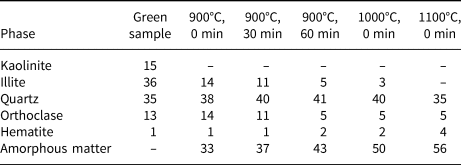
The results of the XRD analysis are given in Table 2. The clay is rich in quartz, which is in accordance with the chemical composition (Table 1). The amorphous phase was formed during firing at >900°C. The amount of the amorphous phase, which is a glassy phase, was dependent on the firing temperature as well as the soaking time. The amount of orthoclase decreased after firing at >1000°C, contributing to the glassy phase. The rather high iron content (Table 1) is responsible for the formation of hematite and the dark red colour of the fired samples.
Results of the XRD analysis of the Liepa clay after firing at various temperatures and soaking times (vol.%).

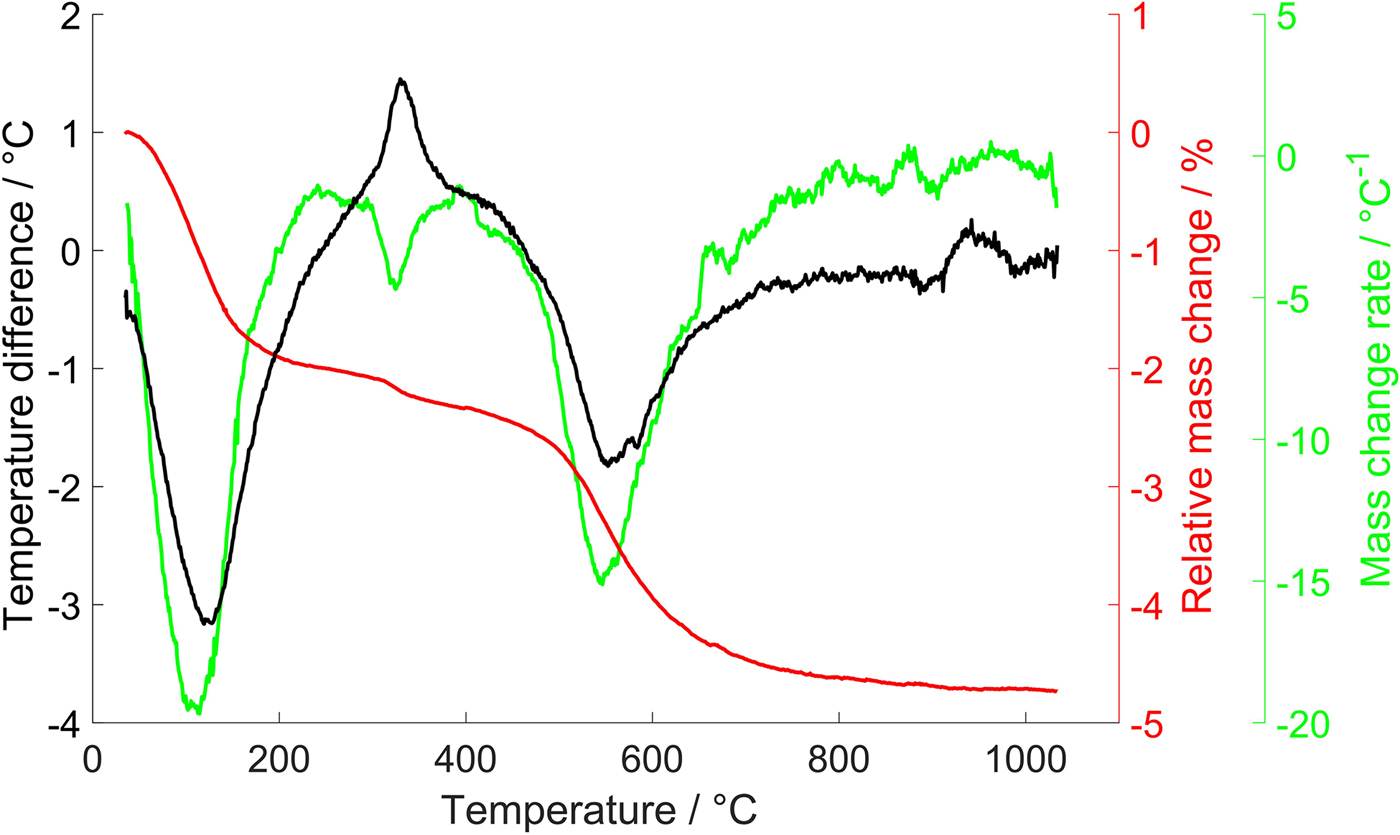
The TG and its derivation (DTG) showed three mass-loss events (Fig. 1): (1) release of the physically bound water (20–300°C); (2) burning of the organic matter (300–400°C); and (3) dehydroxylation of kaolinite and illite (420–700°C).
DTA (black curve), TG (red curve) and DTG (green curve) of the Liepa clay.

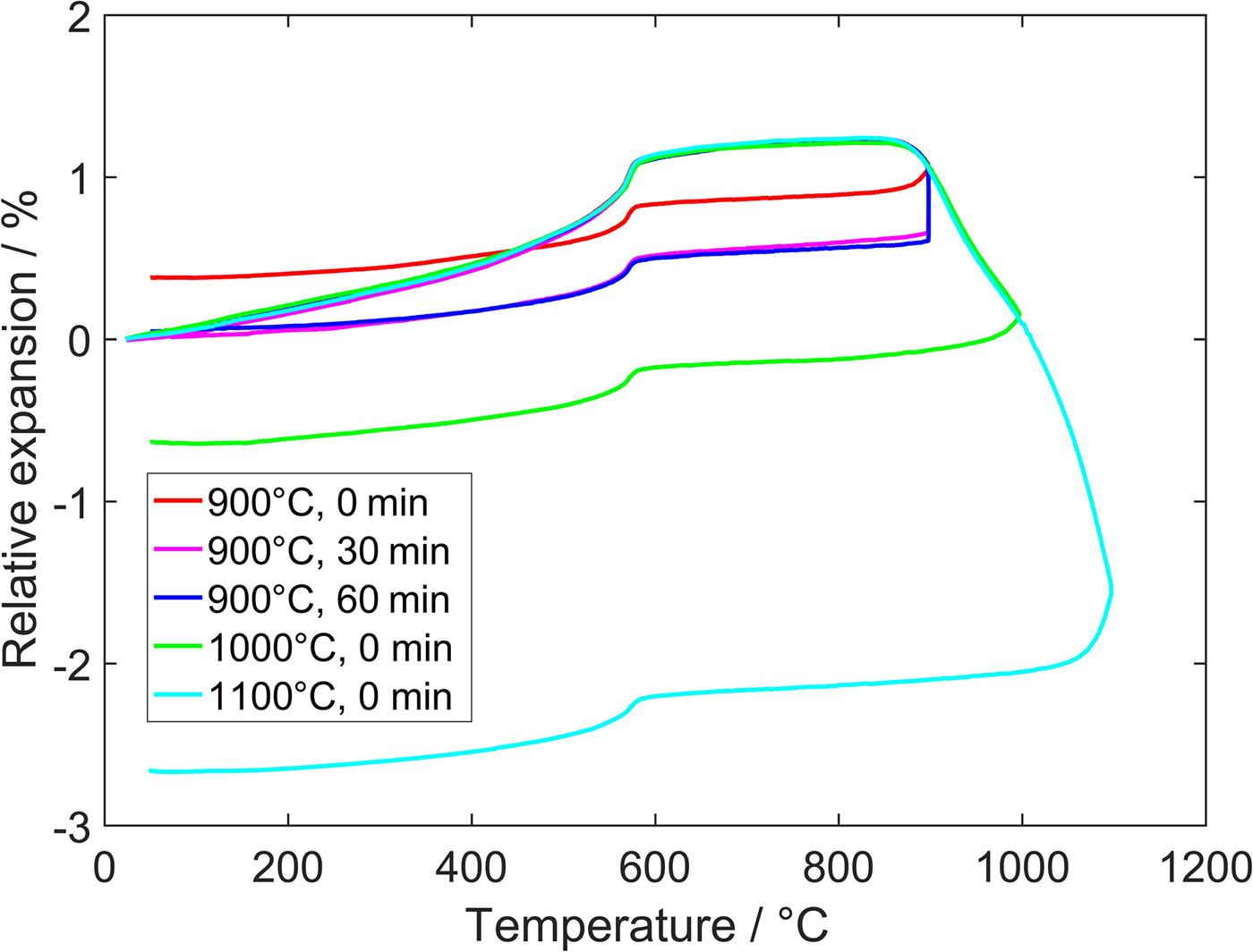
The TD curves were typical for a clay containing relatively large amounts of illite and quartz (Fig. 2). When the samples were heated, some contraction due to the release of the physically bound water was observed at low temperatures (20–200°C). Then, a clear expansion step appeared as a result of the superposition of three phase changes. One of them was the dehydroxylation of illite, which is accompanied by expansion. Over the same temperature interval, dehydroxylation of kaolinite took place. This process causes contraction, but due to a lower kaolinite content, the contraction was not observed in the TD curves. The third process was the α → β transition of quartz, which is characterized by a steep expansion over a narrow interval at ~573°C. After the completion of dehydroxylation, sintering started at ~800°C and the samples contracted. The contraction also continued when the samples were cooled from the highest firing temperatures. Here, only a clear step caused by the β → α transition of quartz, which is characterized by a steep contraction at ~573°C, was observed.
TD curves of the Liepa clay for firing up to 900°C, 1000°C and 1100°C.
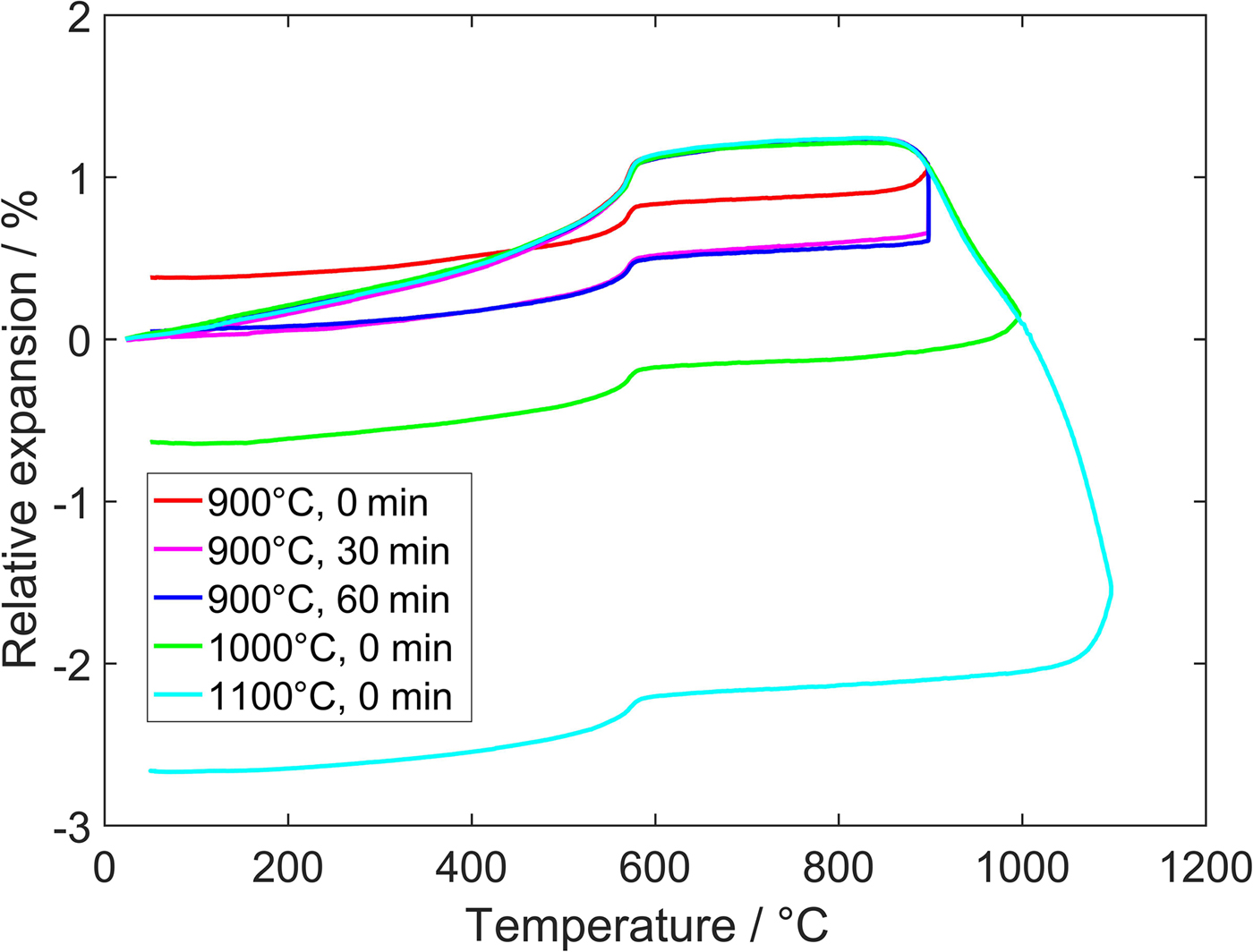
Three dwelling times (0, 30 and 60 min) were applied at the maximum selected firing temperature of 900°C. This temperature was chosen because it is often used in brick manufacturing. The higher temperatures of 1000°C and 1100°C were applied without a dwelling period to compare the properties obtained at these temperatures with the same properties obtained at 900°C and different dwelling times. Higher maximal firing temperatures caused more intensive sintering (which is believed to be of the viscous flow type because of a relatively high amorphous/glassy-phase content; see Table 2), and therefore a greater overall contraction was obtained. The increase in the dwelling time at 900°C from 0 to 30 min caused an additional shrinkage of ~0.42%. Increase of the dwelling time to 60 min at 900°C did not cause any further contraction.
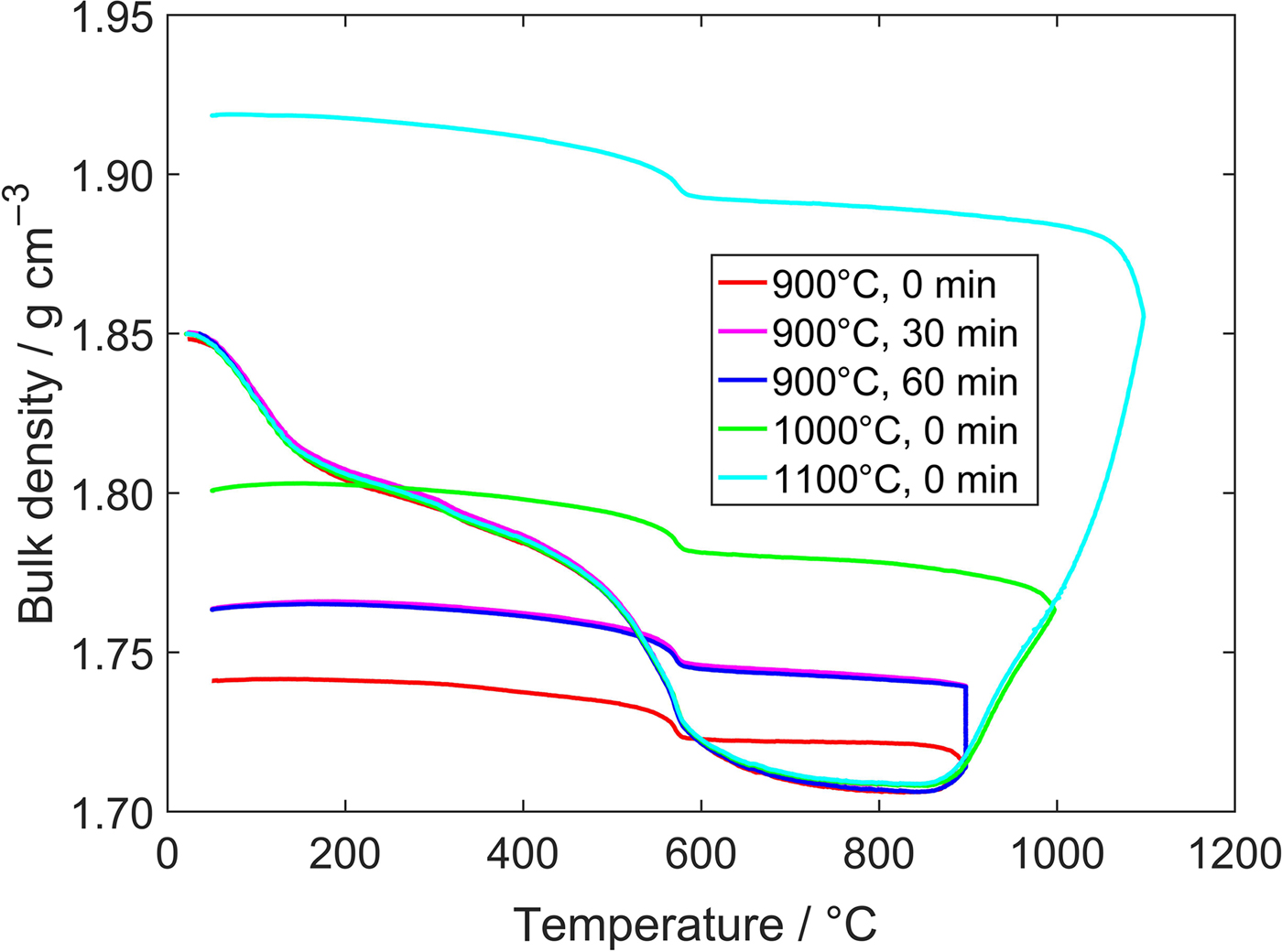
The YM is proportional to the bulk density; therefore, the dependence of the bulk density on the temperature and soaking time was derived using Eq. (2) and the initial value of the bulk density and the TD and TG results (Fig. 3). During heating to 800°C, the bulk density was governed mainly by the mass loss (0–4.6%) because the thermal expansion in this temperature region was only 0–1%. When the sample mass became constant after dehydroxylation, the bulk density was dependent on the sample's dimensions. The curves of the bulk density started from the initial value of 1.85 g cm−3 for the green samples and were, as expected, identical up to 900°C. The bulk density decreased due to the significant mass loss and the relatively small volume increase. Above 900°C, as is visible for the 1000°C and 1100°C firings, the bulk density increased due to sintering (Fig. 3). The step at ~573°C in the cooling stage of firing confirmed the presence of quartz.
Development of the bulk density of the Liepa clay for three firing temperatures (900°C, 1000°C and 1100°C) and for three soaking times at 900°C (0, 30 and 60 min).
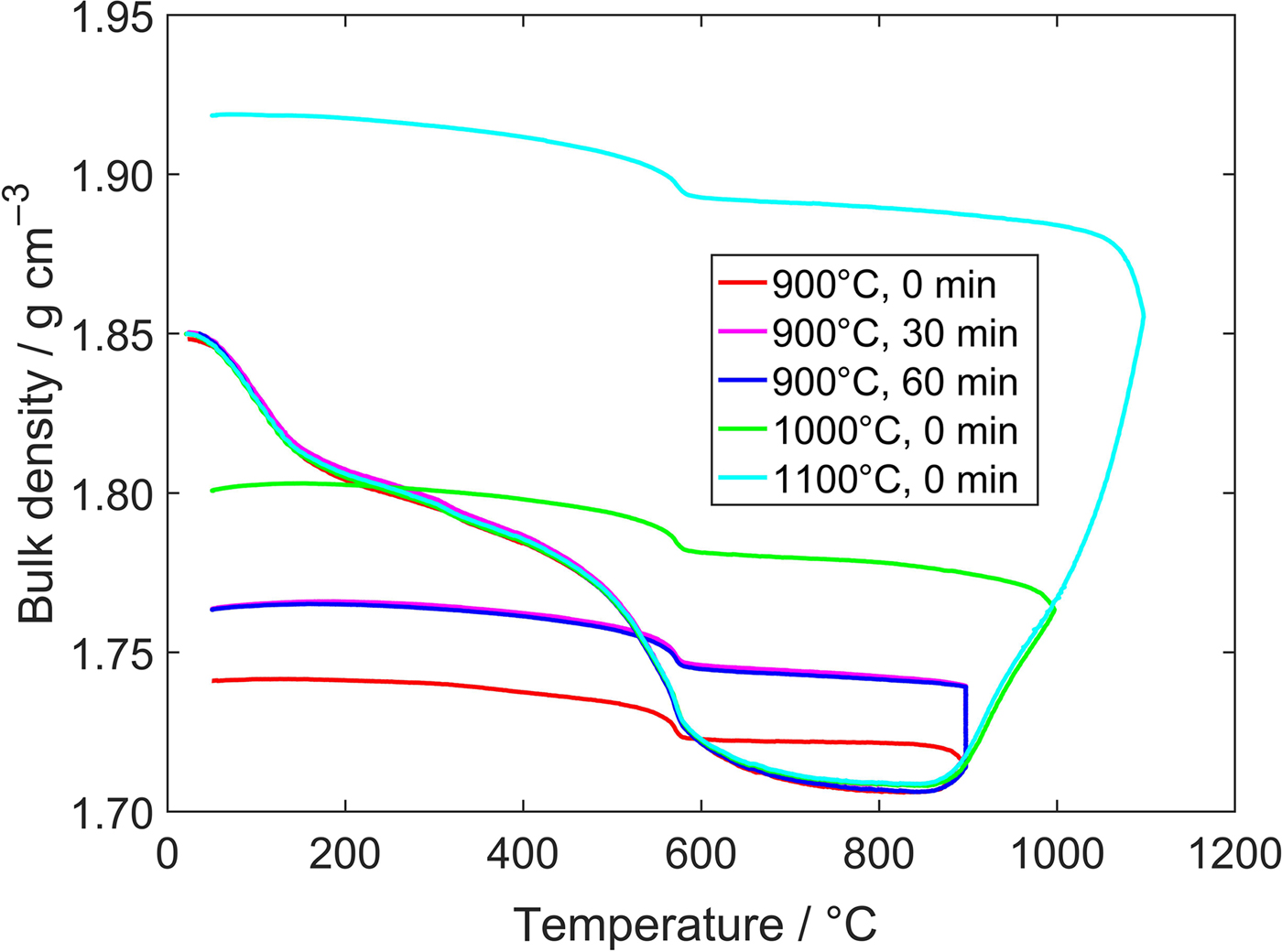
Three soaking times were applied at 900°C when the sample mass was constant, and the bulk density was controlled only through volume contraction. The bulk density increased between the soaking times of 0 and 30 min, but remained almost constant for the soaking times of 30 and 60 min. This behaviour might be explained through the first stage of sintering, when the sample volume changes only slightly. The bulk density increased steeply due to sintering when the firing temperature exceeded 900°C.
Firing at 1100°C resulted in a decrease in porosity from its original value of 35.2% to 30.0% due to sintering. Water-accessible pores represented ~84% of the total (true) porosity for all thermal treatments.
The development of the YM during firing is shown in Fig. 4. The curves were nearly identical for temperatures up to 900°C. An increase in the YM at low temperatures (20–250°C) is linked to the release of the physically bound water, which sets the crystals closer to each other. Dehydroxylation did not influence the YM, which decreased in accordance with similar studies using other clays (Štubňa et al., Reference Štubňa, Trník, Podoba, Sokolář and Bačík2012a; Húlan et al., Reference Húlan, Trník, Štubňa, Bačík, Kaljuvee and Vozár2015). The temperature dependence of the YM of quartz exhibits a significant V-shaped minimum around the α ↔ β transition (Pabst & Gregorová, Reference Pabst and Gregorová2013). This small V-shaped minimum also appeared in the Liepa clay as a result of its abundant quartz (35%) (Fig. 4). The YM began to increase slowly when the temperature reached 600°C, even though the sample expanded, possibly due to the beginning of sintering (mostly solid state). The YM began to rise significantly at >~850°C due to vitrification and subsequent intensive sintering through the viscous flow.
Development of the Young's modulus of the Liepa clay for three firing temperatures (900°C, 1000°C and 1100°C) and at three soaking times at 900°C (0, 30 and 60 min).

The YM increased when the soaking times increased during isothermal heating at 900°C: E = 8 GPa for 0 min, E = 11 GPa for 30 min and E = 12.7 GPa for 60 min. This can be explained by the sintering that progressed during the isothermal heating. In contrast with dimension changes, the YM increased during the isothermal period between 30 and 60 min at 900°C. The YM thus reflects microstructural changes during sintering more sensitively than TD measurements.
The development of the YM during the cooling stage of firing showed a typical shape that has also been observed in previous studies (Chmelík et al., Reference Chmelík, Trník, Štubňa and Pešička2011; Knapek et al., Reference Knapek, Húlan, Minárik, Dobroň, Štubňa, Stráská and Chmelík2016). The YM increased during the beginning of cooling, then its increase slowed down, and eventually the YM began to decrease slightly when the glass-transition temperature was reached. The glassy phase became solid, and the first cracks caused by the differences in the thermal expansion coefficients of the phases appeared. This microcracking led to the decrease of the YM.
Upon further cooling, the β → α transition of quartz took place at ~573°C. The volume of quartz crystals decreased by 0.68%. Their YM dramatically decreased and then increased, forming a V-shaped minimum in the temperature dependence of the YM (Pabst & Gregorová, Reference Pabst and Gregorová2013). Stress relaxation around quartz grains took place, and there was a partial recovery of the YM, probably due to the closing of previously formed radial cracks. The origin of the V-shaped minimum is the result of two causes:
(1) The YM is determined by the mixture rule, according to which the overall YM results from the YM values of the individual components of the material (Schreiber et al., Reference Schreiber, Anderson and Soga1974). The YM of quartz has a characteristic V-shaped minimum, while the YM values of the other components slowly decrease without any extrema.
(2) The V-shaped minimum (Fig. 4) is also the result of changes in the mechanical radial stresses around the quartz grains (Chmelík et al., Reference Chmelík, Trník, Štubňa and Pešička2011). Such behaviour indicates strongly the significance of the β → α transition of quartz.
When the transition of quartz was completed, the YM continued to decrease because microcracks were still being formed at the boundaries between the different phases. The decrease of the YM during cooling from the glass-transition temperature (~750°C) to room temperature is significant: ~50% for firing up to 900°C, 1000°C and 1100°C. A very similar development of the YM in ceramic clays has been described previously (Knapek et al., Reference Knapek, Húlan, Minárik, Dobroň, Štubňa, Stráská and Chmelík2016; Nigay et al., Reference Nigay, Cutard and Nzihou2017).
Summary and conclusions
Green (unfired) samples prepared from ceramic clay from Liepa (Latvia) composed of illite (38%), kaolinite (17%), quartz (35%) and feldspar (18%) were investigated. The samples were heated to 900°C, 1000°C and 1100°C and were cooled from these temperatures at the heating/cooling rate of 5°C min–1. Assessment using DTA, TG, TD and D-TMA was performed. It was found that:
• The results from TG and DTG showed three mass-loss events: (1) release of the physically bound water (20–300°C); (2) burning of organic matter (300–400°C); and (3) dehydroxylation of kaolinite and illite (420–700°C).
• The initial bulk density was 1.85 g cm–3. The bulk density decreased due to a significant mass loss and a relatively small volume increase. Above 900°C, the bulk density increased as a consequence of sintering. The presence of quartz confirms a step in the bulk density at ~573°C in the cooling stage of firing.
• The increase in the YM at low temperatures (20–250°C) is linked to the release of the physically bound water, which sets the crystals closer to each other. Dehydroxylation and the α → β transition of quartz did not influence the YM significantly.
• The onset of sintering was registered via the YM even if only small dimension changes took place (600–900°C). Sintering supported by the glassy phase (>900°C) was accompanied by a steep contraction and a steep increase in the YM.
• The YM increased when the soaking times increased during the isothermal heating at 900°C, which may be explained by the progress of sintering during the isothermal heating.
• The YM increased from the beginning of cooling until the glass-transition temperature of the glassy phase was reached. The glassy phase became solid and the first cracks caused by the differences in the thermal expansion coefficients of the phases appeared. This microcracking led to the decrease in the YM.
• During the β → α transition of quartz, the process of stress relaxation around the quartz grains took place. The sharp V-shaped minimum has two causes. First, the YM is determined by the elastic moduli of the sample components. The YM of quartz has a characteristic V-shaped minimum, while the YM of the other components slowly decreases without any extrema. Second, the V-shaped minimum is also the result of the change in the mechanical radial stresses around the quartz grains. Such behaviour strongly indicates a significant role of the β → α transition of quartz.
• When the transition of quartz was completed, the YM decreased again because microcracks were still being formed at the boundaries between the different phases. The decrease in the YM during cooling from the glass-transition temperature (~750°C) to room temperature is significant: ~50% for all firings.
Acknowledgements
This work was supported by the Czech Science Foundation (grant no. 17-16772S), by the National Research Program of Latvia 2014–2017 as part of the project ‘Investigation of the entrails of the Earth to obtain various natural raw materials and develop new technologies (GEO)’ subproject no. 4.2 and by the grant VEGA 1/0810/19 of the Ministry of Education of the Slovak Republic.