Introduction
Lung cancer is the leading cause of cancer related deaths worldwide with approximately 2,300 new cases diagnosed in Ireland annually. 1 , 2 Lung cancer typically presents at an advanced stage and continues to have a poor prognosis despite recent advances in therapeutic strategies. Five-year overall survival (OS) rate for advanced non-operable non-small cell lung cancer (NSCLC) is consistently around 10–15%.Reference Warner, Dahele and Hu 3 – Reference Berghmans, Paesmans and Sculier 5 Prognosis in NSCLC patients is an extensively studied topic and it is well recognised that prognostic factors such as tumour, node and metastasis (TNM) stage, age and weight loss do not apply equally across patients treated with surgery, radiotherapy, chemotherapy or a combination of all three.Reference Warner, Dahele and Hu 3 – Reference Brundage, Davies and Mackillop 6
Radiotherapy in combination with chemotherapy remains the mainstay of treatment for advanced NSCLC patients.Reference Rodrigues, Choy and Bradley 7 , Reference Eberhardt, De Ruysscher and Weder 8 It has been shown that increasing tumour volume negatively impacts outcomes in patients treated with radical radiotherapy.Reference Yu, Guan, Xing and Xiang 9 – Reference Martel, Strawderman, Hazuka, Turrisi, Fraass and Lichter 22 This is predicted by the radiobiological effect of increasing tumour volume on rates of cell inactivation and re-oxygenation.Reference Baumann, Krause, Thames, Trott and Zips 23 – Reference Bentzen and Thames 26 However, tumour volume’s precise role concerning OS, cause specific survival and locoregional recurrence (LR) rates and the prognostic role of lymph node volume are poorly defined. There is no clear consensus from published data regarding tumour volume’s role in patient outcomes, especially with regards to LR rates.Reference Koo, Moon and Lim 10 , Reference Soliman, Yaromina and Appold 11 , Reference Alexander, Othus, Caglar and Allen 13 , Reference Werner-Wasik, Swann and Bradley 14 , Reference Willner, Baier, Caragiani, Tschammler and Flentje 19 , Reference Martel, Strawderman, Hazuka, Turrisi, Fraass and Lichter 22
The implications of an exact role for tumour volume are unclear. Several small dose escalation and alternative regime studies have shown benefit of altering treatment in terms of dosing, fractionation and timing in accordance with volume but large-scale randomised trials have yet to be undertaken.Reference Soliman, Yaromina and Appold 11 , Reference Werner-Wasik, Swann and Bradley 14
The study aim is a retrospective cohort survival analysis of NSCLC patients treated with radical radiotherapy over a 10-year period intending to further define tumour volume’s association with survival outcomes to aid in the planning of future clinical trials.
Methods
A retrospective analysis of NSCLC patients treated with radical radiotherapy between January 2006 and December 2016 in University Hospital Galway radiation oncology department was performed with institutional board approval. A total of 460 patients with lung cancer were identified from the Mosaiq™ database (Elekta AB, Stockholm, Sweden). Only patients with pathologically confirmed NSCLC treated with primary curative intent with radiotherapy (defined as a radiation dose ≥60 Gy or a hypofractionation dose of 55 Gy in 20 fractions Reference Maguire, Khan and McMenemin 27 ) were included. Patients receiving radiotherapy in a neo-adjuvant or adjuvant role with regards to surgery were excluded. Patients were required to have a minimum follow-up time from completion of radiotherapy to date of data collection of 12 months. Out of the total of 460 patients with lung cancer who received radiotherapy, 94 received radiotherapy in an adjuvant or neo-adjuvant capacity, 96 had small-cell lung cancer, 91 received a palliative dose or incomplete radical dose <55 Gy, and 12 did not have adequate follow up time ≥12 months. The final number of patients included in this study was 167.
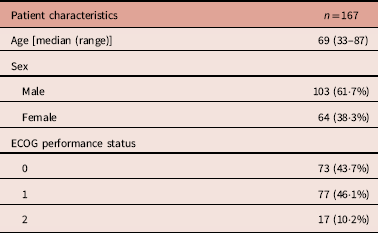
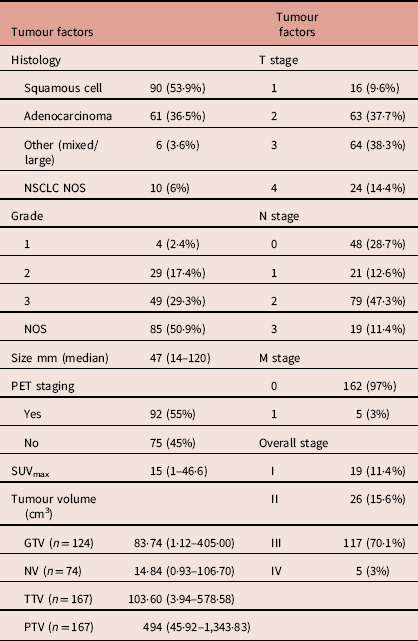
Patient factors (sex, age, performance status) and tumour factors (histology, grade, size, max standard uptake value) for the 167 patients were collected using the Mosaiq™ Oncology database, radiology database and histology database, Tables 1 and 2. All patients underwent an initial staging computed tomography (CT) thorax and subsequent bronchoscopy, endobronchial ultrasound, CT guided biopsy or mediastinoscopy with or without positron emission tomography in accordance with hospital guidelines, multidisciplinary team meeting consensus and availability of diagnostic test at time of investigation. All patients were staged according to either the American Joint Committee on Cancer (AJCC) 6th TNM staging system or the 7th edition if diagnosed after January 2010. 28 , Reference Greene, Balch, Haller and Morrow 29 For the purpose of the study all patients classified according to the 6th edition were re-staged based on the 7th edition. Overall there were 11 staging changes, ten minor downstages of stage IIB to stage IIA and one patient upstaged, changing staging brackets, from stage IIB to stage IIIA based on a maximum tumour diameter >70 mm.
Patient factors

Tumour factors

Notes: All staging according to American Joint Committee on Cancer (AJCC) tumour, node and metastasis 7th edition.
Median values given for size, SUVmax and volumes.
Abbreviations: NSCLC, non-small cell lung cancer; NOS, not otherwise specified; PET, positron emission tomography; SUV, standard uptake value; GTV, gross tumour volume; NV, nodal volume; TTV, total tumour volume; PTV, planning target volume.
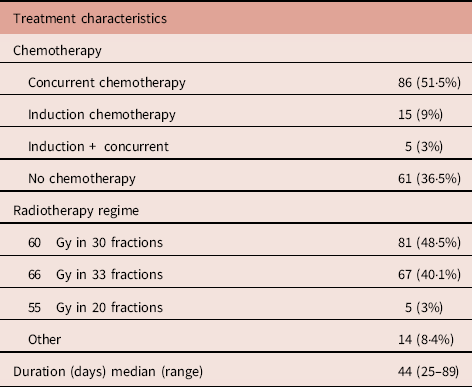
Radiation was delivered using three-dimensional conformal radiotherapy (3D-CRT). Most patients received external beam radiotherapy in 2 Gy fractions to a total of either 60 or 66 Gy. Five patients received a hypofractionated schedule of 55 Gy in 20 fractions.Reference Maguire, Khan and McMenemin 27 Chemotherapy regimens are summarised in Table 3. Concurrent chemotherapy was mostly prescribed as per the Southwest Oncology Group (SWOG)Reference Albain, Crowley and Turrisi 30 regimen with cisplatin and etoposide (n = 82) and induction chemotherapy consisted of carboplatin/pemetrexed, gemcitabine/cisplatin or carboplatin/paclitaxel.
Chemotherapy and radiotherapy

All patients underwent a treatment planning CT scan in the supine position. CT images were acquired in 3 mm slices and encompassed the entirety of both lungs and supraclavicular fossae. Tumour volumes were contoured by a consultant radiation oncologist using the OnCentra™ Masterplan Planning System (Nucletron B.V., Veenendaal, The Netherlands) and an expansion of 1·5–2 cm on the gross tumour volume (GTV) was used to generate the planning target volume (PTV) and was adjusted on a patient specific basis to account for tumour anatomy and organ at risk dosing constraints. Clinical tumour volumes were not drawn for all patients and therefore were not included in analysis. All volumes were subject to peer review approval before commencement of radiotherapy. The OnCentra™ database was reviewed to collect the GTVs, nodal volumes and PTVs for all patients. Total tumour volume (TTV) was defined as the sum of the primary tumour GTV and nodal GTV if confirmed lymph node involvement. In 43 cases, due to the primary tumour location, the nodes and primary tumour are drawn within the same volume and separate values for primary tumour volume and nodal volume could not be identified. Patients were divided into two groups for statistical analysis, smaller TTV and larger TTV based on the median TTV 103 cm3.
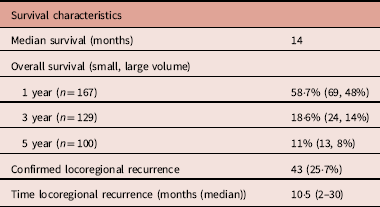
Patients were followed-up with a CT thorax after 3 and 6 months. Clinical reviews were at 1, 6 and 12 months following completion of treatment. Due to geographical distance from treating hospital a significant proportion (n = 45) of patients were followed-up in other institutions following their 1 month clinical review and follow up-imaging was unavailable for analysis. OS was calculated as the time from first fraction of radiotherapy to death or last follow-up date. All patients were confirmed as alive or deceased at the time of data collection. LR was defined as radiological confirmation of disease recurrence in the treatment field or regional lymph nodes and time to LR was calculated from beginning of radiotherapy. Table 5 contains a summary of survival outcomes.
Median OS was estimated by the Kaplan–Meier actuarial method. The log-rank test was used to evaluate statistically significant differences among survival curves in the univariate analyses. For multivariate analyses, the Cox proportional hazards model was used. In these multivariate analyses, the following as the explanatory variables were used: TTV, Eastern Cooperative Oncology Group (ECOG) performance status, Nodal Involvement and Chemotherapy. All statistics were carried out using the International Business Machines (IBM) Statistical Package for the Social Sciences (SPSS) version 24 (SPSS Inc., Chicago, IL, USA) for windows. For all analyses, a p value <0·05 was accepted as statistically significant.
Results
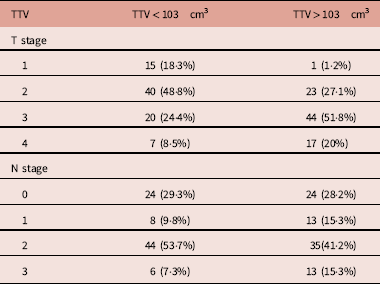
Tables 1 and 2 demonstrate the patient and tumour parameters for the entire study cohort. The median TTV was 103 cm3. Stage IIIA was the most common tumour stage overall (54·5%) and this remains true within the small and large tumour volume subgroups, 56·1 and 52·9%, respectively. The small volume subgroup showed a predominance of T2 tumours (48·8%) while the large volume subgroup consisted mostly of T3 tumours (51·8%). N2 was the most common nodal stage overall (47·3%) and within both subgroups (Table 4). Larger volumes were more likely to be prescribed a treatment regimen of 60 Gy in 30 fractions (58·8%) and small volumes were more likely to receive 66 Gy in 33 fractions (47·6%).
Small and large tumour volume staging trends

Abbreviation: TTV, total tumour volume.
OS rates at 1, 3 and 5 years for smaller volumes were 69, 24 and 13% and for larger volumes 48, 14 and 8%, respectively (Table 5). LR was confirmed in 43 patients with a median time to recurrence of 10 months.
Summary of survival outcomes

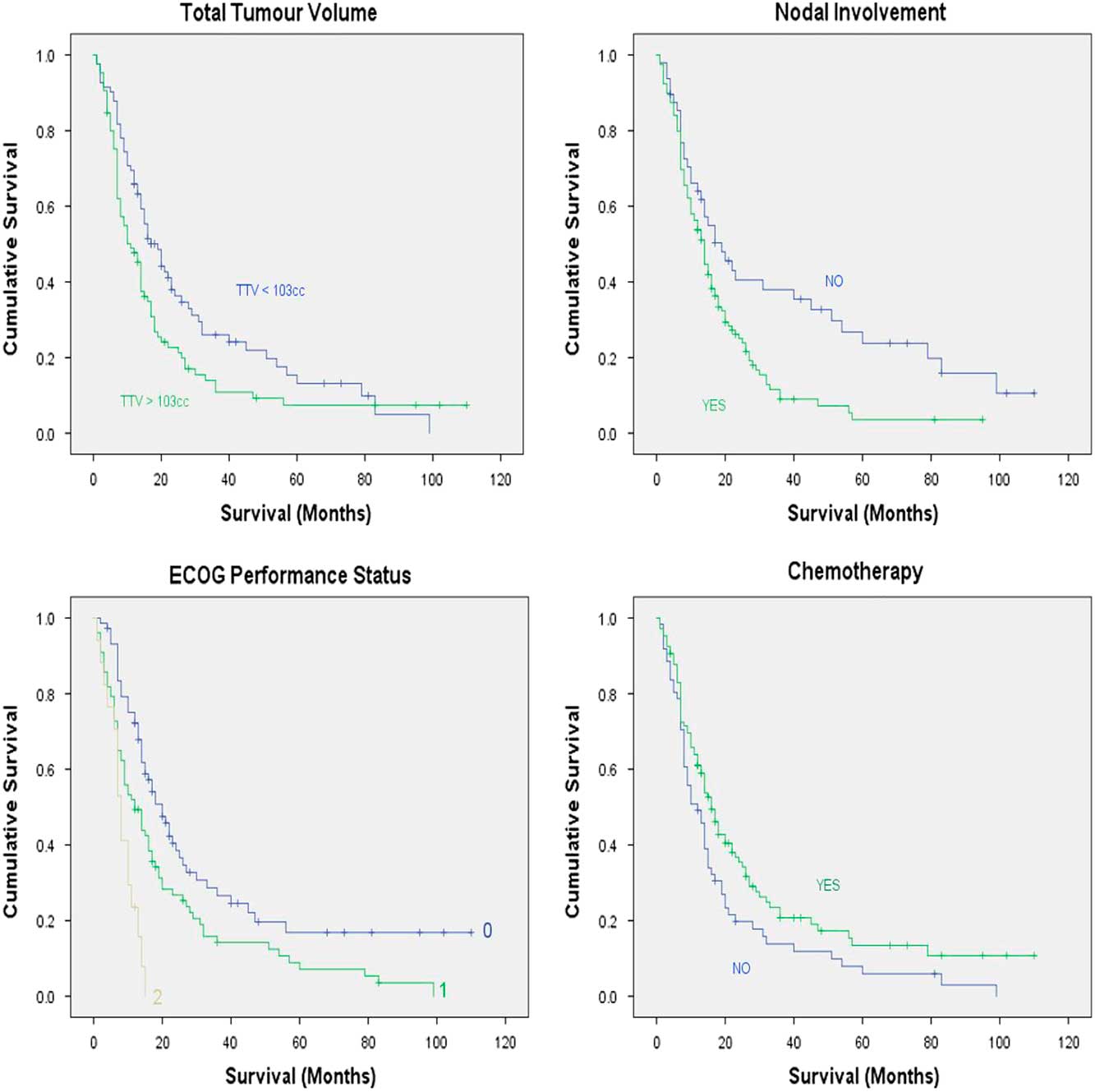
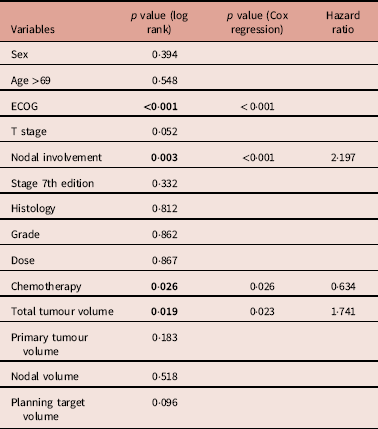
On univariate survival analyses, larger TTV was significantly associated with poorer OS (p = 0·019) particularly within the first 20 months. The use of chemotherapy either as induction chemotherapy or concurrently significantly improved survival (p = 0·026) and specifically the use of chemotherapy within the larger volume subgroup (p < 0·001). Nodal involvement (p = 0·003) and ECOG performance status (p < 0·001) were also significant independent prognostic factors as represented on Kaplan–Meier survival curves shown in Figure 1. Sex, age, T stage, overall stage, histology, grade, dose, primary tumour volume, nodal volume and PTV were all non-significant predictors of OS as summarised in Table 6.
Kaplan–Meier survival curves for significant univariate factors.

Univariate and multivariate analyses

Bold values denote statistically significant prognostic factors
No factor was found to be independently predictive of LR and therefore multivariate analysis was not carried out with respect to this primary endpoint. Multivariate analysis was performed for OS using a cox regression model. The factors evaluated and their p values are shown in Table 6. The four univariate predictors of survival remained predictive of OS on multivariate analysis. The p value, hazard ratio and confidence intervals for TTV on multivariate analysis are p = 0·03, hazard ratio 1·741 (95% confidence interval 1·212–2·501).
Discussion
In NSCLC, traditional prognostic factors such as TNM stage, age, performance status and weight loss have been extensively studied and are implemented in the selection of therapies such as surgery, radiotherapy and chemotherapy.Reference Berghmans, Paesmans and Sculier 5 , Reference Brundage, Davies and Mackillop 6 , Reference Eberhardt, De Ruysscher and Weder 8 , Reference Dehing-Oberije, Aerts and Yu 31 – Reference Vansteenkiste, De Ruysscher and Eberhardt 33
The observation that larger tumour volume negatively impacts outcome in radiotherapy may reflect the fact that the number of cancer stem cells increases approximately proportionally with increasing tumour volume and that the dose necessary to achieve local tumour control depends on the logarithm of cancer stem cells to be inactivated.Reference Baumann, Krause, Thames, Trott and Zips 23 , Reference Baumann, Krause and Hill 34 , Reference Baumann, Dubois and Suit 35
This study demonstrated the continued importance of tumour volume as a prognostic factor for patients with NSCLC particularly with regards to OS as a primary measurable endpoint. PTV was not a significant predictor of survival, which reflects the significantly different PTVs possible for the same TTV on the basis of geographic difference between primary and nodal disease. This finding supports the hypothesis that worsening survival with larger tumour volumes is related to tumour cell burden rather than total radiation dose or toxicity.
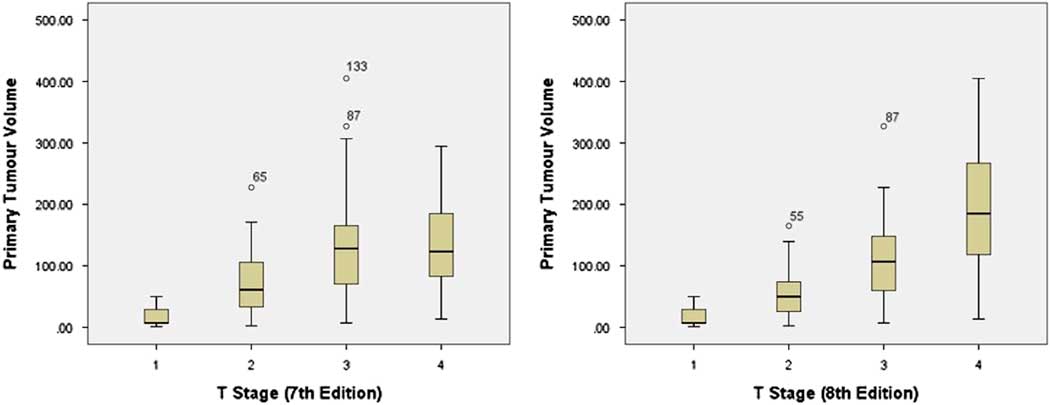
The findings in this study concur with most published studies on this topic.Reference Yu, Guan, Xing and Xiang 9 – Reference Soliman, Yaromina and Appold 11 , Reference Alexander, Othus, Caglar and Allen 13 – Reference Martel, Strawderman, Hazuka, Turrisi, Fraass and Lichter 22 In a large prospective study, Ball et al.Reference Ball, Fisher and Burmeister 12 found that total volume significantly influenced OS within the first 18 months only. This study demonstrated a similar stronger association between tumour volume and survival in the earlier periods following therapy while also retaining the influence long term. Importantly, this study demonstrated the limitations of the TNM staging system’s 7th edition in predicting survival in advanced lung cancer patients treated by radiotherapy. The introduction of the 8th edition in January 2017 has aimed to remedy this with new stringent size cut-offs. 36 Based on these new cut-offs alone all patients were provisionally restaged according to the 8th edition and on re-analysis of the data both the new T stage and overall stage were shown to be better predictors of OS than the 7th edition. This may be in part because T staging per the 8th edition is now more reflective of primary tumour volume as evidence by Figure 2.
Correlation of primary tumour volume with T stage (7th and 8th editions).

The published studies on this topic are heterogenous, focussing on a wide range of patient subgroups, treatment regimes, tumour volume cut-offs and primary endpoints. While the role of tumour volume regarding survival has been relatively consistent, its role in LR rates is poorly defined. Several studies have found a positive relationshipReference Koo, Moon and Lim 10 , Reference Soliman, Yaromina and Appold 11 , Reference Alexander, Othus, Caglar and Allen 13 , Reference Werner-Wasik, Swann and Bradley 14 , Reference Willner, Baier, Caragiani, Tschammler and Flentje 19 and some found no significant relationshipReference Martel, Strawderman, Hazuka, Turrisi, Fraass and Lichter 22 between tumour volume and local recurrence. However, in many of these studies the relationship was dose dependent and not consistent across all patient subgroups.Reference Soliman, Yaromina and Appold 11 , Reference Willner, Baier, Caragiani, Tschammler and Flentje 19 , Reference Bradley, Ieumwananonthachai and Purdy 21 , Reference Martel, Strawderman, Hazuka, Turrisi, Fraass and Lichter 22 This study found no association with any of the patient, tumour or treatment variables and LR rates. This is likely due to the large number of our patients being followed-up in partner institutions without full access to follow up imaging and documentation. Similarly, we chose not to evaluate cause specific survival as a primary endpoint due to lack of sufficient follow-up data.
This study found no significant difference between the three different dosing subgroups with regards to any of the primary endpoints when stratified by tumour volume. Several studies have suggested that dose escalation for larger tumours improves LR rates however, this has yet to be validated by large clinical trials.Reference Willner, Baier, Caragiani, Tschammler and Flentje 19 , Reference Bradley, Ieumwananonthachai and Purdy 21 Soliman et al.,Reference Soliman, Yaromina and Appold 11 performed a subgroup analysis of the prospective randomised CHARTWEL (Continuous Hyperfractionated Accelerated Radiotherapy-Weekend Less) trial with the aim of assessing the role of GTV on local failure, disease-free survival, distant metastases and OS across the different treatment groups within the trial. For all patient groups, GTV was significantly associated with increased distant metastases, decreased disease free survival and decreased OS. The association did not differ significantly between the treatment arms. For all treatment groups, they demonstrated increasing rates of local failure with increasing GTV and that this increase in local failure was significantly less pronounced for patients in the CHARTWEL arm. This is the first study of its kind to demonstrate that the magnitude of the time factor of fractionated radiotherapy increases with tumour volumes. A small number of patients in our study underwent a hypofractionation schedule and there is potential for a similar study to be carried out in the future as this regimen is being used more commonly in our practice.
In a subgroup analysis of Radiation Therapy Oncology Group 0617Reference Bradley, Paulus and Komaki 37 Dose escalation trial with cetuximab Chun et al. Reference Chun, Hu and Choy 38 compared patients receiving intensity-modulated radiation therapy (IMRT) with those receiving 3D-CRT in the trial. There was no significant difference in 2-year survival outcomes despite the IMRT having larger tumour volumes and worse prognostic factors overall. This highlights the potential benefit of IMRT as an alternative modality for larger tumours, but this has yet to be evaluated in large-scale clinical trials.
Conclusion
TTV is a significant prognostic factor in patients with advanced NSCLC treated by radical radiotherapy. The surgically based 7th edition TNM staging system offers incomplete information with regards to prognosis for patients treated with chemoradiotherapy. In this cohort of patients TTV is more reliable at predicting survival than T stage and overall stage (7th edition). The role of tumour volume for the selection of alternate treatment and dose regimes is still undefined. There is a significant potential for future clinical trials to further tailor radiation treatment to each patient’s specific needs.
Acknowledgements
This research was conducted as part of a thesis on behalf of the author R. Joyce to fulfill the requirements for a Masters of Multidisciplinary Radiology in the National University of Ireland Galway. Special thanks to all members of the radiation oncology and medical physics departments of Galway University Hospital.