1. Introduction
Common pool resource (CPR) management can be complex and difficult to understand. With multiple uses and users of CPRs, the quality of management depends on coordination of the activities of multiple individuals. Garrett Hardin (Reference Hardin1968) cautioned that open-access CPRs would be destroyed due to the lack of effective management strategies. He recommended that CPRs should either be nationalized or privatized in order to overcome the tragedy. But, more than 30 years after his often-cited article in Science, scholars have noted that many CPRs across the world did not collapse as he cautioned and continued to be managed without being privatized or centralized (Ostrom et al., Reference Ostrom, Burger, Field, Norgaard and Policansky1999).
Studies show that many users do come together for collective arrangements and devise various alternative management options. Some users adopt various coordinated strategies for appropriation of resource units (Ostrom et al., Reference Ostrom, Gardner and Walker1994). Coordinated strategies are influenced by the rules used for ordering their own relationships, various attributes of the biophysical world, and the nature of the community where the action arena occurs. To understand institutional issues it is important to examine how rules emerge within a physical and community setting to generate particular types of situations.
Management of most irrigation systems is guided by various rules at the system level. In community-managed irrigation systems, farmers develop a variety of rules to specify rights and responsibilities among themselves (Tang, Reference Tang1992). Most importantly they enforce these rules without the involvement of external agencies. Contexts and irrigation systems vary, and, thus, self-organized rule configurations vary depending on a variety of local attributes of irrigation systems (Lam, Reference Lam1998).
Thomas Dietz et al. (Reference Dietz, Ostrom and Stern2003) noted that maintaining a certain level of collective action among farmers is always a challenge. Universal solutions to water management problems do not exist. Thus, farmers’ decision-making authority related to devising rules is crucial (Bardhan, Reference Bardhan2000; Meinzen-Dick, Reference Meinzen-Dick2007; Regmi, Reference Regmi2008). Local institutions such as water users’ organizations enable farmers to realize possible benefits of collective action (Meinzen-Dick et al., Reference Meinzen-Dick, Raju and Gulati2002; Leathes et al., Reference Leathes, Knox, Kay, Trawick and Rodriguez-Diaz2008). The literature on collective choice discusses rules and their effect on collective action (Ostrom, Reference Ostrom1990; Ostrom et al., Reference Ostrom, Burger, Field, Norgaard and Policansky1999). Analytical approaches have been offered to study the evolution of rules and norms (Crawford and Ostrom, Reference Crawford and Ostrom1995; Ostrom, Reference Ostrom2005; Ostrom and Basurto, Reference Ostrom and Basurto2011). However, the empirical evidence examining the relevance of these theories is still limited. Thus, in this paper, we are interested in two empirical puzzles related to irrigation management in Nepal: (1) the relationship of governance structure with rule formation, enforcement and rule following; and (2) the effect of rule enforcement on irrigation system performance.
Nepal has a large irrigation sector in which rules and policies for irrigation have changed amid economic and political changes (Shah and Singh, Reference Shah and Singh2000; National Planning Commission, 2002; Shukla, Reference Shukla, Shivakoti and Ostrom2002). Irrigation systems are found in diverse biophysical and community settings in the country. Traditional farmer-managed irrigation systems are predominant mostly in the hill/foothill areas. Most of the medium- to large-scale irrigation systems are built in Terai and valley areas (Shah and Singh, Reference Shah and Singh2000). The diverse landscape across hills and plain areas results in varied biophysical attributes of the irrigation systems. The location of irrigation systems varies with respect to market development, investments and commercial opportunities. Such differences may also influence rule formation and its use in irrigation management.
This paper addresses the above-mentioned empirical puzzles considering three specific questions: (a) How does rule formation vary across irrigation systems that are subject to different governance modes? (b) Is rule formation influenced by diversity in biophysical characteristics of the irrigation system and community attributes? (c) How do rule enforcement mechanisms affect performance and collective action regarding irrigation performance?
2. Analytical approach
Using the institutional analysis and development framework
The main focus of this paper is on understanding the rule systems in irrigation management by examining the evolution of rules and norms, through which we can assess institutional change (Ostrom and Basurto, Reference Ostrom and Basurto2011). Social, economic or political changes may lead to a change in formal institutions and ultimately result in the establishment of new rules or additional enforcement mechanisms to achieve favorable outcomes. Some argue that institutional change follows a logical sequence (Florensa, Reference Florensa2004) though describing only a fraction of the whole process of institutional change. Sometimes the processes of institutional change develop in a spiral-like manner (Greif, Reference Greif2005). In the beginning, individuals face the choice of whether or not to support a change in existing rules. The expected costs and benefits associated with institutional change (change in rules) play an important role (Livingston, Reference Livingston2005). Information on expected benefits from alternative sets of rules and the costs of changing existing rules (including the monitoring and enforcing of new ones) affect the likelihood of institutional change (Ostrom, Reference Ostrom1990).
Depending on the situation, institutional change may take place only at the formal level such as by state agencies. There is a possibility that, despite a change in formal rules, people may continue to comply with the norms that had regulated their activities and continue with the existing situation. This depends on the level of autonomy of actors to change the rules. Thus it is possible that changes can remain only at the formal government level without affecting the rules at the grass-roots level.
New institutional economics draws an important distinction between institutional arrangements and institutional environments (Saleth and Dinar, Reference Saleth and Dinar2000). Institutional arrangements are the immediate structure that humans impose on their dealings with each other (North, Reference North1990). In this paper, the institutional environments we include are government water policies and irrigation-related laws. In referring to institutions or institutional arrangements, we refer to rules-in-use of water users’ associations (WUAs).
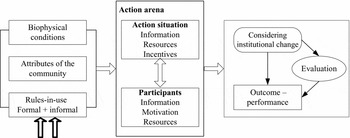
Considering the focus of the paper, we have used a revised version of the institutional analysis and development (IAD) framework as a guiding framework for analysis (Ostrom et al., Reference Ostrom, Gardner and Walker1994; Ostrom, Reference Ostrom and Sabatier1999) (Figure 1). We start our analysis by focusing on the rules-in-use component part of the IAD framework. We then consider the action arena as the main unit of institutional analysis, where the users interact with other components of the whole system, and at the end affect the outcome (Ostrom, Reference Ostrom2005, Reference Ostrom2007).
Using the institutional analysis and development framework to analyze rule formation and its effect on the performance of irrigation systems

In combination with the biophysical attributes of the irrigation systems and structure of the community, changes in rules-in-use have an effect on action arenas through direct influence on the participants and their required actions. In irrigation management, the entire irrigation system represents the action arena, which defines several action situations such as the meetings to form the rules, and the actual process of irrigation itself. In particular, the meetings act as a common platform for farmers to discuss and change the rules based on their need or considering the information acquired from other action situations such as the biophysical context and nature of the community. Such interaction, together with rules, will ultimately affect the outcome, that is, performance of the irrigation systems.
The ADICO syntax for analyzing the rule-formation process
Institutional statements provide a basis for institutional analysis. Institutional statements include rules, norms and shared strategies. Sue Crawford and Elinor Ostrom (Reference Crawford and Ostrom1995) developed the grammar of institutions and proposed that all institutional statements could be coded using a syntax, which illustrates similarities and differences between shared strategies, norms and rules. We have adopted the modified ADICO syntax proposed by Ostrom (Reference Ostrom2005) and her colleagues that enables us to code institutional statements using a common syntax:
- A ‘Attributes’
Defines values of participant-level variables distinguishing to whom the institutional statement applies.
- D ‘Deontic’
Refers to the three modal verbs: ‘may’ (permitted); ‘must’ (obliged); and ‘must not’ (forbidden).
- I ‘Aim’
Describes particular actions or outcomes in the action situation.
- C ‘Conditions’
Defines when and where an action or outcome is permissible, obligatory, or forbidden.
- O ‘Or else’
Sets out the consequence for not following a rule.
Rules include all five components (ADICO), whereas norms have four components (ADIC), and shared strategies have only three components (AIC). The ADICO syntax provides a basis for coding all institutional statements in a consistent manner, thus allowing us to analyze the change of institutional statements over time. In order to add essential details, we append information on how the rules are enforced to the basic ADICO syntax.
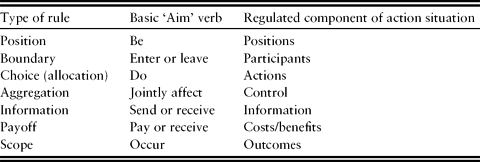
Rules operate in an action situation. An action situation is a focal unit of analysis; people are said to be in an action situation whenever they are faced with a set of potential actions that jointly produce outcomes. Ostrom (Reference Ostrom2005) suggested classifying the rules into seven broad types based on the ‘Aim’ element of rules as discussed in the ADICO syntax (Table 1).
The ‘Aim’ component of seven types of rule
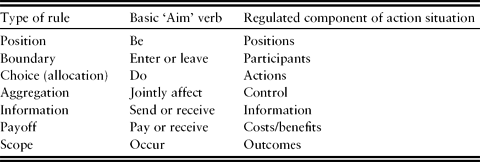
Source: Adapted from Ostrom (Reference Ostrom2005).
3. Data and methods
Selection of sample irrigation systems
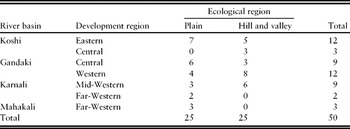
This paper is based on an extensive survey of 50 irrigation systems across Nepal. Irrigation systems were selected based on three criteria – ecological region, economic characteristics and management structure – following a series of steps.
In the first step, we selected major river basins across all regions of the country. In the second, we focused on physical terrain – plains or hills (including upper valleys). In each terrain type we selected a particular district as a cluster. In the final step, irrigation systems were selected from different strata within the identified clusters. The forms of management structure considered were farmer-initiated systems and agency-initiated systems (including jointly managed and/or management transferred to the users). Table 2 presents the number of sample irrigation systems selected from different parts of Nepal.
Number of sample irrigation systems selected from different parts of Nepal

The majority of the sampled irrigation systems (n 41) had been initiated by and are managed by farmers. The remaining systems are agency-initiated, out of which three are under joint management and the other six are also managed by users at various levels.
One of the focuses of this paper is to examine the relationship of governance structure with rule formation, enforcement and rule-following behavior. Thus, in further discussions, we group sampled irrigation systems into two categories based on governance structure: ‘farmer-managed irrigation systems’ (FMISs); and ‘agency-managed irrigation systems’ (AMISs). We find some sort of farmers’ involvement in the management of agency-initiated systems as well, especially after the adoption of participatory irrigation management policy by the government. However, a tendency of relatively less-active participation of farmers with lack of cooperation and coordination with related agencies is observed in such systems (Pradhan et al., Reference Pradhan, Sijapati, Riddell and Prasad1998; Shukla, Reference Shukla, Shivakoti and Ostrom2002). The situation could particularly differ in the case of rule formation as it may start from the very beginning of the system initiation. Thus we find the two categories, FMISs and AMISs, representing different governance modes and as comparable groups. Many studies also indicate differences in various aspects of governance mechanism in the case of FMISs and AMISs (Lam, Reference Lam1996, Reference Lam1998; Pradhan et al., Reference Pradhan, Sijapati, Riddell and Prasad1998; Shukla, Reference Shukla, Shivakoti and Ostrom2002; Bhatta et al., Reference Bhatta, Ishida, Taniguchi and Sharma2005).
Data sources, collection techniques and analysis
This paper is based on primary and secondary sources of information from both national policy level and irrigation system level. The information on national irrigation policy/act/regulation changes was collected from secondary sources such as policy documents and other published literature.
Information from the irrigation system level was collected from primary sources – the sampled 50 irrigation systems. Data were collected through interviews with officials from WUAs in the selected irrigation systems. For interviews we used structured checklists that included eight parts: general information; users; physical condition; water delivery situation; management structure; institutional arrangements and rules; influencing factors and external intervention; and water management issues and problems in the selected irrigation systems. The rule-formation process for each sampled irrigation system was collected considering the period starting from the initiation of the system. For analysis purposes, we mainly used information on existing rules, rule-formation process, rule-following behavior, enforcement mechanisms, and performance of the irrigation systems in addition to its biophysical features.
The analysis included both qualitative and quantitative techniques. Quantitative data are summarized using the mean, frequency, and percentage and are presented in tabular form. Considering the categorical nature of variables, the Pearson χ2 test was used to analyze the association between different interest variables (Tables 6, 7 and 8).
A monitoring and sanctioning index (MSI) was created combining six institutional variables (Lam, Reference Lam1998). The six variables were: (1) information made available to the farmers about water appropriation; (2) information on individual farmer's contribution on system maintenance; (3) penalty for rule violations; (4) water withdrawal rights; (5) monitoring rule conformance; and (6) variations in levels of sanctioning. We assigned a value of ‘1’ if any of these rules exist, and a ‘0’ if the rule does not exist. Then we added up the values of all six variables to create the MSI, the value of which ranges from 0 to 6. In the analysis, we classified irrigation systems into two groups: systems with MSI scores of less than 4; and systems with MSI scores of at least 4. In addition, the Mann–Whitney test was used to compare the median MSI scores. This non-parametric rank-based test was used considering the skewed distribution of the MSI scores.
Biophysical attributes of sampled irrigation systems
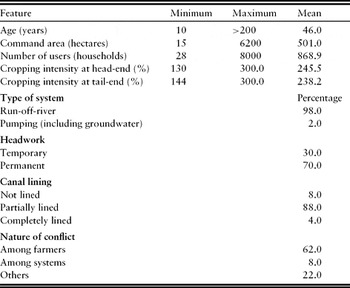
The IAD framework (Figure 1) includes biophysical attributes as one of the components. In this paper we have considered the biophysical attributes of a system as possible factors affecting rule formation. In this section we discuss the major biophysical attributes of the sampled irrigation systems (Table 3). The average age of the sampled systems was 46 years. The command area and number of users varied largely. The average cropping intensity at the head-end of the system was 245.5%, whereas it was slightly lower at the tail-end of the system.
Biophysical attributes of the sampled irrigation systems in Nepal

The majority of the sampled irrigation systems were of run-off-the-river type. A significant proportion of systems had temporary headwork. However, the canals in most of the systems were partially lined. Most of them (92%) reported some form of conflicts, conflict among farmers (62%) being the most significant. In a later section (see ‘Application of the ADICO syntax’) we will discuss how the biophysical attributes affect rule formation.
4. Policy and regulatory directive for irrigation management in Nepal
Our analytical approach (see ‘Using the institutional analysis and development framework’ section) considers the institutional environment as one of the possible factors affecting rule formation. Thus, in this section we review government water policies and irrigation-related laws and later examine how they affect rule formation at the irrigation system level.
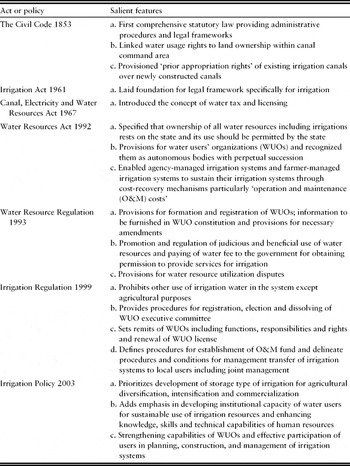
In Nepal, water resources policies entered into the legal domain with the enactment of the first comprehensive statutory law called the Civil Code (Muluki Ain) in 1854 (Khanal, Reference Khanal1982). The Civil Code linked water usage rights to land ownership and prior appropriation rights of existing irrigation systems over newly constructed systems. Clearly defined rules on water distribution to avoid disputes were apparent early in the history (Baral, Reference Baral2001). Following an introduction of planned development (five-year plans) in the mid 1950s, Nepal witnessed a flurry of policy interventions in water resource sectors including irrigation. The Irrigation Act 1961 laid the first legal framework specifically for irrigation. This was later replaced by the Canal, Electricity and Water Resource Act 1967 that introduced the concept of a water tax. However, it must be mentioned that water law in Nepal consists of customary rights and statutory laws. The past centralized system of governance primarily satisfied the interests of ruling elites rather than those of producers, traders and consumers.
With the restoration of democracy in 1990 there has been a shift towards community participation and private sector involvement in decision-making. The first national irrigation regulation was devised in 1989, which was revised and promulgated as the Irrigation Policy in 1992 that emphasized formal registration of FMISs to the government authority. Subsequently, irrigation policy went through further revisions, the latest being in 2003. Currently, there exist four policies, two acts and five regulations related to the water resources of Nepal (Table 4). Among them the acts, regulations and policies that are directly related to irrigation development and management are the Water Resources Act 1992, Water Resource Regulation 1993, Irrigation Regulation 2000 and Irrigation Policy 2003 (His Majesty's Government of Nepal, 1992, 1993, 2000, 2003).
Salient features of irrigation policies in Nepal

Sources: His Majesty's Government of Nepal, 2001; WaterAid Nepal, 2005.
In addition, the Tenth Five Year Development Plan of Nepal (2002–07) awarded legal rights to WUAs and irrigation division offices to collect service fees to address the paucity of funds for operation and maintenance (National Planning Commission, 2002). The Plan also included user-centered designs in detail designing of irrigation projects. It was the first time that the users’ designs have been recognized in the planning documents of the government.
Review of the national policies related to irrigation management shows that the focus of the government is on increased participation of users in the management of their systems. For this, the aim is to transfer the management authority of the government-built systems to the users. Those regulations provide directives for: registration; election and dissolution of an executive committee; function, responsibility and right; and renewal of the WUA. They also provide guidelines for the establishment of an operation and maintenance (O&M) fund, and the fixation and collection of an irrigation service fee. All these policies and regulatory directives (the institutional environment) influence the institutional arrangements through direct and indirect effect on the process of rule formation at the irrigation system level. While considering the IAD framework, these macro-policies could influence the action arena as exogenous factors.
5. Operational and collective choice level rules
The above section provides an overview of national level policies related to water resources, particularly on irrigation management issues. These policies provide a broader national framework for the management of irrigation systems present in the country. In the following subsection we discuss various operational and collective choice level rules existing at the irrigation system level.
Existence of various rules at system level
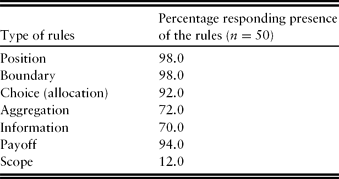
Irrigation systems are managed based on various sets of rules at operational and collective choice levels. A variety of rules exists in the operation and management of irrigation systems in Nepal. Table 5 illustrates the presence of seven types of rules as responded by the sampled irrigation systems. All but one of the sampled irrigation systems showed the presence of rules related to irrigation management. One AMIS did not have any kind of rules. Farmers simply used the water if it was available. Moreover, they were not at all serious about managing the canals.
Presence of different types of rules in the sampled irrigations systems of Nepal
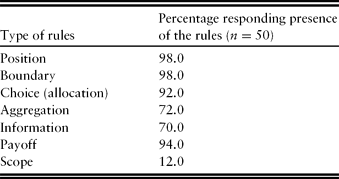
Based on our field survey, we next discuss commonly observed rules under seven categories as mentioned in Table 5.
Position rules
The position rules define the set of possible positions for participants. Those using irrigation water are assigned the position as a ‘general member’ of the system. The irrigation systems are typically managed by water users’ committees (WUCs). Various executive positions are assigned at the operational level with authority to manage specific functions related to the operation and management of the irrigation system. Typical positions include president, vice-president, secretary, treasurer and members. Each position has specific duties, responsibilities, and the authority associated with different positions is reflected in the level of influence on action situations and outcomes.
In some irrigation systems, branch committees are responsible for looking after particular branch canals. In other cases irrigation canals are divided into various blocks, and each block committee is assigned a different position. The aim of block and branch committees is to decentralize power and for the smooth functioning of blocks/branches.
Another common position rule observed was the provision for hiring guards for water rotation commonly known as ‘dhalepa’, as reported by 64% of the sampled systems. Generally, a water guard is hired from among the water users. However, outsiders are also hired as regular staff, especially in AMISs. On the other hand, in FMISs, users generally rotate the monitoring position among the users themselves, which helps to ensure better collective action.
Boundary rules
The boundary rules define eligibility to enter a position, the process determining which eligible participants may (or must) enter the position and the process of exit (may or must) from any position (Ostrom, Reference Ostrom2005). In irrigation systems these entry and exit conditions are determined through various criteria; for example, land holding, shares and membership.
The most common boundary requirement used as a rule was land holding. All but one system used land holding in the command area as a mandatory requirement for being a member of the irrigation system. The common rule of arrangement is that one is automatically eligible to be a member if his/her land falls within the command area. In most cases the users need to pay designated membership fees.
Choice (allocation) rules
Choice rules guide which action is required, permitted or forbidden. In the case of irrigation systems, choice or allocation rules guide the way of appropriating water by the farmers. The rule assigns the responsibility to the participants holding particular positions such as water guard, monitor, or executive committee to make sure that certain arrangements are required to distribute the available water in a proper way. Allocation rules are especially important if the water is scarce. If appropriate allocation rules are adopted and effectively enforced, they can reduce uncertainty and conflict among irrigators in relation to water withdrawal (Tang, Reference Tang1992).
For most of the sampled irrigation systems, the irrigation canal was divided into different areas, and a fixed time slot was assigned to the particular area, then to another, and so on. The time was fixed as a result of group discussion among the farmers. A subcommittee is made responsible for the distribution and monitoring of water allocation. In many cases, the rule for water allocation within the branch was that the succeeding field gets a turn only after the preceding field is completely wet (generally from the head-end to the tail-end). But in some cases, for example, Khurkhuriya Irrigation System in Kailali district, the turn starts from the tail-end to the head-end of the system.
Depending on the biophysical characteristics of the irrigation system and community attributes, the water allocation criteria differed across the irrigation systems. Learning through management, in some places rules were devised considering the problem faced by users at the tail-end of the irrigation system. In order to minimize the disadvantage of the farmers from the tail-end, some irrigation systems, for example Kamal Khola Irrigation System in Ilam district, included the provision of providing a distance incentive (bato kharcha) of one to four hours to tail-end farmers.
Aggregation rules
The aggregation rules are related to decision processes that determine whether a single participant or a group of participants can decide about any action (Ostrom, Reference Ostrom2005). They are often related to the process of making operational rules. The irrigation systems in Nepal mostly operate on collective decision-making, though it differs across irrigation systems, thus requiring the involvement of multiple participants for making decision regarding any action. A majority of the sampled irrigation systems reported the presence of this rule. The commonly existing one was the need for a community consensus to decide water allocation. The water guard (monitor) is responsible for regulating the water allocation based on earlier agreed norms. In the case of any dispute between farmers the water guard has the right to enforce the arrangements. Better consensus was observed in FMISs compared with AMISs.
Information rules
The information rules directly affect the level of information available to the participants involved in an action situation. A majority of the sampled irrigation systems reported the presence of information rules. The most common rule was the need to keep financial transactions in a standard manner and report to the general meeting annually, as well as being made available to the users. Similarly, if somebody breaks a rule repeatedly, the knowledge of this rule infraction will be made public and the farmer will be restricted from further use of the water. Other common information rules include water allocation mechanisms and schedules for operation and maintenance of the irrigation system.
Payoff rules
Payoff rules provide provisions for rewards, burdens or sanctions being involved in particular action situations. In a majority of the sampled irrigation systems, provisions are such that they require labor contribution by each user for cleaning of the canal. An example of a rule statement in an FMIS is: ‘It is mandatory for the farmer to be present in cleaning of the main canal, but in case of branch canal one can either go himself or send other people’. If any farmer is absent during canal cleaning, they need to pay a fine, small at first, then a bit more, and if they do not comply again and again, they are not allowed to use the water. For example, Betani Irrigation System in Jhapa district reported that if the rule is broken for the first time the farmer is fined the sum of 100 Nepalese rupees (NRR). If the same farmer repeats the mistake then the fine is NRR 200, for the third time the fine is NRR 500. After the fourth time, the farmer will not be allowed to use water. The amount, however, varied across irrigation systems.
Sometimes the fine for not attending the canal cleaning is based on corresponding land size. For example, Jhirhari Irrigation System in Siraha district reported that if a user with up to 0.33 ha of land is absent, he/she has to pay NRR 50/day. If a user with > 0.33 ha is absent he/she has to pay NRR 100/day. Similarly, there is the provision of fines against water stealing, with an increase in the amount in cases of repeated violations of the rules.
Scope rules
These rules are directly related to the outcome which must, must not or may be affected by the result of actions taken by participants within a specific situation. Scope rules define which outcomes are desirable from the actions of the participants. These rules were reported by only a few of the sampled irrigation systems. Some irrigation systems had rules restricting the use of water. Farmers should use the water for agricultural purpose only, and in some cases a rule restricts the crop as well. For example, in Betani Irrigation System of Jhapa district there was a restriction on the cultivation of spring rice.
Rule formation in irrigation management
In this section we discuss two aspects of rule formation in irrigation management. First, we examine the application of the ADICO syntax in rule formation. Then we describe how different factors affect this process.
Application of the ADICO syntax
Various rules provide economic incentives to users and designate their accountability and obligations. An important aspect in rule configuration is ‘how people start formulating rules and how it becomes institutionalized in their community?’ Rules are often confused with ‘shared strategy’ and ‘norms’. Based on the structure of institutional elements, as discussed in the section ‘The ADICO syntax for analyzing the rule-formation process’, we analyze the evolution of institutional statements up to its higher level, as formal rules. It is assumed that at the beginning the users start with some kind of no-rule situation or default condition (Ostrom, Reference Ostrom2005) and then add different components and ultimately develop a rule with all the necessary components.
Based on the rule-formation process recorded from most of the sampled irrigation systems, we observed that when people come together and start digging a canal in an area, most often the rule formation starts immediately. Farmers start with a shared strategy like ‘Farmers of this village will use water from this canal’ that includes only the ‘AIC’ part of the ADICO syntax.
In the process, the farmers determine the actions that participants ‘may’, ‘must’ and ‘must not’ do. For example: ‘Farmers should contribute labor or cash in the operation and maintenance as specified by the committee’. It becomes a norm and includes the ‘ADIC’ part of the syntax.
Finally, the farmers also assign consequences for not following agreed norms, for example: ‘Farmers should contribute labor or cash in the operation and maintenance as specified by the committee, if they fail to do so they should pay a fine’. The final form is the rule including all components of the ADICO syntax.
The above discussion shows the ADICO syntax in general is applicable to understand how the rule-formation process starts with simple statement with only a few components, and then the farmers add other components making it a formal rule. Below we look at further details of application of the ADICO syntax in rule formation.
The expected production incentives motivated the users to set the boundary and devise water allocation mechanisms. The entry requirements and related provisions are the sets of rules that users devise with higher priority. The boundary rules started including AIC components of the ADICO syntax. A common example of a boundary rule was: ‘Farmers having land in the command area can use the water from a particular system’. They also add the next component setting conditions such as ‘the new users must pay a membership fee’ and ‘the users must contribute in repair and maintenance of the system’. In addition, rules related to water allocation were often among the first to develop in an irrigation system. This is a key incentive for farmers to get involved in the system.
Another set of rules evolves due to the concerns related to operation and maintenance of the irrigation infrastructure. Owing to relatively poor infrastructures that require regular repair and maintenance, farmers devise the rules regarding labor contribution for the cleaning of the canal. In this case farmers were more concerned about the rule enforcement. Thus they included an additional component in the rule, such as imposing fines and penalties for rule breakers. Such rules included all components of the ADICO syntax, with inclusion of the ‘Or else’ component. Similarly, based on experience and the context, users defined various new rules as well. Some irrigation systems needed to restrict the cultivation of high-water-demanding crops in the dry season. Such provisions needed to include an additional component in the rule, forbidding certain action.
For the smooth functioning of a WUC, users devised rules specifying the frequency and time of WUC meetings, general farmers’ meetings and other meetings. In order to ensure the participation of users in meetings, additional components are included in the rule as an enforcement mechanism. For example, if members are not present for three consecutive times, their membership is discontinued. At the same time most of the formal rules, such as regarding collection of water fees, which were formulated based on the directive from the irrigation divisional office, included all components of the ADICO syntax, including the ‘Or else’ part as well.
Factors affecting rule formation
Rule formation is influenced by various endogenous and exogenous factors. Below we discuss how different factors affect rule formation. Major factors include: governance structure; institutional environment; and other components as indicated in the IAD framework earlier.
The level of autonomy of a WUA is the most important factor in rule formation. It is an important aspect of governance structure, which shows how the difference in governance affects rule formation. It also reflects the governance mechanisms that affect rule formation. Autonomy means the freedom of water users to design rules for water allocation and to design collective choice-making mechanisms. This was measured in three categories: no autonomy; low degree of autonomy; and high degree of autonomy. The WUAs in FMISs were found to have a higher degree of autonomy compared with AMISs even though some AMISs are jointly managed or formal management rights have been transferred. The Pearson χ2 test showed a significant difference (significant at less than 1%), with the majority of AMISs having a low degree of autonomy (Table 6). This implies that the mode of governance affects rule formation. More interference was reported in AMISs whereas FMISs are more autonomous. In an FMIS users can devise rules based on their interest and necessity, and manage rules themselves. The experienced committee members in FMISs formulate rules based on the interest and necessity of the users. Another study also reports that a high degree of autonomy results in better rule formation (Shivakoti and Bastakoti, Reference Shivakoti and Bastakoti2006).
Degree of autonomy of water users’ associations in farmer-managed irrigation systems (FMISs) and agency-managed irrigation systems (AMISs) of Nepal

** Pearson χ2 = 10.6; degrees of freedom = 2; significant at 1%.
Formal policy changes, changes in the institutional environment as an exogenous factor affecting the action arena in the IAD framework, also affected rule formation. FMISs had no formal written rules at the early stages of their formation and were mainly operated based on informal arrangements for many years. Ashutosh Shukla and Khem Raj Sharma (Reference Shukla and Sharma1997) point out that users in FMISs are involved from the very beginning and so they are bonded through collective efforts. Systems initially work based on social norms and values. Negotiation and promises played an important role. Mostly such norms were not recorded in written form (Shivakoti and Ostrom, Reference Shivakoti and Ostrom2002). Local institutional arrangements were formalized after registration of the users’ committee with the government authority. Formal registration of FMISs began after the changes in government policy during the 1990s. In Nepal, the first national irrigation regulation was devised in 1989, which was revised and promulgated as Irrigation Policy 1992 (refer to the ‘Policy and regulatory directive for irrigation management in Nepal’ section). In fact, it was the first formal irrigation policy of the country. The change in policy emphasized the formal registration of FMISs with the government authority. The WUAs of 47 systems (out of 50 sampled irrigation systems) were registered at the time of our fieldwork. Registration requires an executive committee with assigned roles and responsibilities, major position rules, and the ‘Constitution of the WUA’. The constitution should show boundary requirements, operation and maintenance arrangements, fees, fines and penalties, and other operational level rules. Informal norms and shared strategy, mostly not in the written form, of the users are formalized as written rules.
Similarly, the biophysical attributes of the irrigation systems also affect the rule formation, as depicted in the IAD framework (Figure 1). For example, especially in the case of FMISs, the concerns regarding operation and maintenance of the irrigation infrastructure influenced the rule-formation process. Most of the FMISs of Nepal have relatively poor infrastructure, such as temporary headworks and only partially lined canals (Table 3), compared with the AMISs and they also need regular repair and maintenance. Farmers devised the rules regarding labor contribution for the cleaning of the canal. Maintaining better infrastructure conditions was crucial for assured water supply. Thus farmers were more concerned about the enforcement of these rules. In addition to the need of repair and maintenance, the biophysical condition of the irrigation system also determines the water availability over different seasons. Thus some irrigation systems needed to formulate rules considering the water availability as well. In such cases, some irrigation systems restrict the cultivation of high-water-demanding crops in the dry season. For example, the WUA of Betani Irrigation System of Jhapa district imposed restriction in the cultivation of spring rice.
Another exogenous factor affecting rule formation was the support from external agencies, which influenced rule formation both positively and negatively. In the case of the irrigation systems of Sindhupalchok district, the support from external agencies has positively helped in improving the management of the irrigation systems. But external support has not always contributed positively for designing their local institutional arrangements. Farmers dislike some rules, such as the provision for water fees, because it involves cash outlay. However, they comply because it is a precondition for their irrigation systems to get agency financial support. Such preconditions were observed in the case of some agency-initiated and now jointly managed or management transferred systems. The WUC must formulate rules regarding collection of water fees based on the directive from the irrigation divisional office. If it fails to do this, the irrigation system will not be entitled to receive funds from the government.
In general the WUC is responsible for all operational activities at irrigation system level. The committee initiates all the necessary activities including proposed institutional changes in the form of new rules for a particular action situation. However, the extent of the committee's involvement in the process is determined by the endogenous factors related to irrigation systems, the physical context it operates on, and the users. It is also often influenced by an external agency, especially in the case of AMISs.
6. Rule enforcement, performance and collective action
Rules are important for regulating activities related to irrigation system operation and management. As discussed earlier, a majority of the irrigation systems have an array of rules devised for the management of their systems. However, with knowledge of the existence of the rules only, we cannot guarantee that they are followed by the users and are thus playing a significant role in affecting performance. It is equally important to analyze the monitoring and sanctioning arrangements present in the system. This provides the evidence for the effectiveness of the rules (North, Reference North1990; Lam, Reference Lam1998). Thus, we added variables in our field study to address how rules are enforced – a topic not covered by the ADICO syntax.
In this section we look at the monitoring and sanctioning arrangements used on the system, the level of rule following by the users, and the relationship between rule enforcement and performance of the irrigation system. An MSI was created combining six institutional variables (for details, please refer to the ‘Data sources, collection techniques and analysis’ section). The MSI showed that FMISs are far better than AMISs in monitoring and sanctioning arrangements (Table 7). The Pearson χ2 test showed that the difference between FMISs and AMISs was significant (significant at less than 5%), implying that the rule enforcement mechanisms are well institutionalized in the case of FMISs. The Mann–Whitney test also showed that median MSI was significantly higher in FMISs (significant at 3.5%).
Monitoring and sanctioning arrangements in farmer-managed irrigation systems (FMISs) and agency-managed irrigation systems (AMISs) of Nepal

* Pearson χ2 = 4.48; degrees of freedom = 1; significant at 5%.
In FMISs, users themselves formulate various rules regarding irrigation system operation and management from the beginning of the system. Those rules, in general, are crafted by users considering the local situation, especially in order to fit into the existing physical infrastructure of the system and community requirements. Local farmers formulate rules based on the ideas, norms and understandings commonly shared in the community. In AMISs, the officials formulate most of the rules and impose them upon the users, but the officials are not always fully aware of the local context. This has a direct effect on the compliance of the users to follow the existing rules.
In FMISs a majority of the users follow the rules (Table 8), whereas in AMISs substantial levels of violations were found in more than half of the irrigation systems. The higher the proportion of rule violators and the higher the level of violations, the greater is the chance of less collective action. Ultimately, this affects the smooth operation and management of irrigation systems, thereby affecting long-term sustainability.
Level of rule following among users in farmer-managed irrigation systems (FMISs) and agency-managed irrigation systems (AMISs) of Nepal

*** Pearson χ2 = 12.77; degrees of freedom = 1; significant at 0.1%.
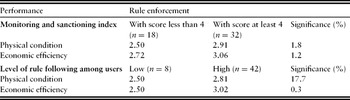
This rule enforcement situation affects the outcome through the effect on the action arena as indicated in the IAD framework (Figure 1). The rule enforcement situation in FMISs is favorable for better collective action among the users, and thus for better performance of the system. We compared monitoring and sanctioning arrangements, and rule-following behavior with two performance indicators: overall physical condition (measured on a four-point scale) and short-run technical economic efficiency (measured on a four-point scale). The results showed that irrigation system performance is significantly related to the better enforcement of the rules (Table 9).
Rule enforcement and performance of the irrigation systems

Notes: Physical condition and economic efficiency are measured on a four-point scale and the value ranges between 1 and 4. The numbers presented in the Table indicate the mean for each category.
The MSI score and rule-following behavior reveal that the level of rule compliance is directly related to the likelihood of collective action in irrigation management. Water users work together to maintain the physical condition of the infrastructure in irrigation systems with a higher MSI score and a high level of rule following. Higher scores are also related to better short-run technical economic efficiency.
Moreover, for situations of a problem of rule compliance, farmers have added supplementary enforcement mechanisms to their existing rules. In some irrigation systems, we also found that if fines for stealing water are not paid, they are referred to local government or even to the police station. Some scholars have also noted the need for this additional component in rule analysis to capture the enforcement mechanisms (Mittenzwei and Bullock, Reference Mittenzwei and Bullock2001; Smajgl, Reference Smajgl2007). This is very important in ensuring collective action.
7. Conclusion and policy implications
Our empirical study of rules used by irrigation systems in Nepal illustrates the usefulness of the ADICO syntax (Crawford and Ostrom, Reference Crawford and Ostrom1995; Ostrom, Reference Ostrom2005) for examining specific rule configurations and their effect on performance. The ADICO syntax, however, does not capture well the enforcement mechanisms that exist in many irrigation systems of Nepal. Thus, this assessment of the applicability of the ADICO syntax in understanding how rules affect performance suggests the need for adding one component related to ‘enforcing mechanisms’. This would improve the usefulness of the ADICO syntax for understanding how rules affect collective action and performance.
In regular operation and maintenance of an irrigation system users are bonded by various formal and informal rules. Rules crafted by water users match local context better than those prescribed by state agencies. FMISs generally devise their own rules based on local context and taking into account the ideas, norms and understandings shared in the community. In contrast, the rule formulation in AMISs is mostly done by the officials of the Irrigation Office.
The revised national irrigation policies required the formalization of rules in FMISs while registering their system with the government authority. However, FMISs still have a higher degree of autonomy in terms of formulating rules and devising their institutional arrangements than AMISs. The WUAs in FMISs can make rules on water allocation and designing collective action mechanisms. This was supported by strong rule enforcement mechanisms that existed in FMISs. But in the case of AMISs, only a few have effective rule enforcement mechanisms.
In FMISs, the self-devised rules considering their local context, ideas and understandings facilitate collective contribution in the operation and maintenance of the irrigation systems. Thus, rule violations are rare in FMISs compared with AMISs. The results suggest that forming new rules to manage irrigation systems should fully consider contextual factors. Rules, which are devised based on the particular biophysical condition of the resource with emphasis on the local community, can result in improved collective action. The learning from the case of FMISs in Nepal could be applicable in suggesting the formation of water management rules in other countries as well.
Acknowledgements
This paper is part of a larger study supported by a grant from the Research Grants Council of Hong Kong (grant no. HKU7233/03H) made to the University of Hong Kong on the project ‘Asian Irrigation Institutions and Systems (AIIS) Dynamics study and Database Management’. We are grateful to Professor Elinor Ostrom (Indiana University, USA) and Dr Louis Lebel (Chiang Mai University, Thailand) for detailed comments on the earlier version of the paper. We are thankful to the executive members of WUAs, irrigation officials and farmers in Nepal for the information and their support during our field survey.