INTRODUCTION
To date, interventions for Alzheimer’s disease (AD) and other dementia disorders have not been effective at ameliorating their devastating effects. As earlier behavioral interventions and/or clinical trials may prove more efficacious in altering the disease’s trajectory (Sperling et al., Reference Sperling, Aisen, Beckett, Bennett, Craft, Fagan and Park2011), the development of clinical measures that might allow earlier identification of individuals at risk for dementia is vital. Relevantly, a current challenge within clinical settings is distinguishing normal age-related changes in cognitive functioning from the potential preclinical disease stage of mild cognitive impairment (MCI). MCI is posited to be an intermediate stage between normal aging and dementia, in which subtle deficits in cognitive functioning are evident yet the individual remains functionally independent (Petersen, Reference Petersen2004). Notably, many but not all individuals with MCI convert to a dementia disorder. Thus, the development of novel clinical measures that might help distinguish between normal aging as compared to pathological changes in the assessment of MCI is needed.
Longitudinal research indicates that slowed gait is predictive of functional declines (Studenski et al., Reference Studenski, Perera, Wallace, Chandler, Duncan, Rooney and Guralnik2003) and has been shown to precede both evidence of MCI and conversion to a dementia disorder (Mielke et al., Reference Mielke, Roberts, Savica, Cha, Drubach, Christianson and Knopman2013; Verghese, Wang, Lipton, Holtzer, & Xue, Reference Verghese, Wang, Lipton, Holtzer and Xue2007; Verghese et al., Reference Verghese, Annweiler, Ayers, Barzilai, Beauchet, Bennett and Capistrant2014). However, while there is evidence that suggests gait decline is predictive of dementia, problematically it is also recognized that gait often slows with advanced age, which may clinically limit the use of simple gait speed in assessment. There is research that indicates gait characteristics while performing a cognitive-task distinguishes between MCI and normal aging, whereas simple gait performance does not (Muir et al., Reference Muir, Speechley, Wells, Borrie, Gopaul and Montero-Odasso2012). In this respect, cognitive-load dual task assessment might provide a sensitive measure of cognitive decline in older adults being evaluated for cognitive concerns.
Mechanistically, research investigating the cognitive control of motor actions suggests that the posterior parietal cortex is the interface between the sensory and motor cortices, and also plays an integral role in attention network functioning (for reviews, see Andersen, Snyder, Bradley, & Xing, Reference Andersen, Snyder, Bradley and Xing1997; Holtzer, Epstein, Mahoney, Izzetoglu, & Blumen, Reference Holtzer, Epstein, Mahoney, Izzetoglu and Blumen2014). Converging evidence of the posited neural substrates shared between gait and cognition is provided by the strong relationship between neuropsychological tests that require aspects of executive function, attention, and visuospatial integration with slower gait speed in older adults (e.g., Best, Davis, & Liu-Ambrose, Reference Best, Davis and Liu‐Ambrose2015; Coppin et al., Reference Coppin, Shumway-Cook, Saczynski, Patel, Ble, Ferrucci and Guralnik2006; Herman, Mirelman, Giladi, Schweiger, & Hausdorff, Reference Herman, Mirelman, Giladi, Schweiger and Hausdorff2010; Holtzer, Verghese, Xue, & Lipton, Reference Holtzer, Verghese, Xue and Lipton2006; Holtzer, Wang, & Verghese, Reference Holtzer, Wang and Verghese2012; MacAulay, Brouillette, Foil, Bruce-Keller, & Keller, Reference MacAulay, Brouillette, Foil, Bruce-Keller and Keller2014).
Dual-task gait assessment has bolstered this argument, by providing evidence that gait automaticity is disrupted in response to cognitive load tasks (e.g., counting or spelling a word backward) that divide attention resources while walking (for review, see Al-Yahya et al., 2011). Dual- as compared to single-task gait velocity has also been associated with greater functional connectivity in supplementary motor and prefrontal regions (Yuan, Blumen, Verghese, & Holtzer, Reference Yuan, Blumen, Verghese and Holtzer2015). Moreover, a growing body of evidence indicates that declines in executive function, visuospatial, and attention processes underlie the relationship between dual-task related gait changes and cognitive decline within both demented and relatively healthy older adult samples (e.g., Allali et al., Reference Allali, Kressig, Assal, Herrmann, Dubost and Beauchet2007; Holtzer et al., Reference Holtzer, Epstein, Mahoney, Izzetoglu and Blumen2014, Reference Holtzer, Wang and Verghese2012; MacAulay et al., Reference MacAulay, Brouillette, Foil, Bruce-Keller and Keller2014, Reference MacAulay, Allaire, Brouillette, Foil, Bruce-Keller, Han and Keller2015; Rosano et al., Reference Rosano, Studenski, Aizenstein, Boudreau, Longstreth and Newman2012; Yogev-Seligmann, Hausdorff, & Giladi, Reference Yogev‐Seligmann, Hausdorff and Giladi2008). Taken together, dual-task gait assessment appears to be a sensitive measure of cognitive function that may be useful as a routine screening measure within clinical settings.
Given the large aging population and anticipated increase in incidence/prevalence rates for dementia disorders, there is a great need for sensitive measures to screen for MCI that can be routinely applied in primary health care settings. The Mini-Mental State Examination (MMSE), the most widely used screening measure for cognitive impairments in older adults lacks adequate sensitivity to detect MCI (for meta-analysis, see Mitchell, Reference Mitchell2009). There is research that indicates that cognitive load dual-task gait assessment, a cost-effective easily administered task, might provide a sensitive measure to detect early stages of cognitive decline within routine clinical care. However, more research is needed as all studies to our knowledge investigating MCI compared to normal aging group differences in cognitive load dual-task gait assessment have used community volunteers for the normally aging control groups.
Problematically, older adult volunteer groups tend to be at lower risk than the general population (e.g., healthier and more educated; Welsh-Bohmer et al., Reference Welsh-Bohmer, Østbye, Sanders, Pieper, Hayden and Tschanz2009), which may emphasize group differences in gait decrements. Furthermore, medical comorbidities are common with advanced age and in those with cognitive complaints (Welsh-Bohmer et al., Reference Welsh-Bohmer, Østbye, Sanders, Pieper, Hayden and Tschanz2009). Thus, whether cognitive load dual-task gait assessment can distinguish between MCI and normal aging in a clinically representative treatment seeking population remains uncertain.
While there is evidence that links dual-task related gait decrements to dementia/cognitive decline, the extent to which these findings can be generalized to real-world clinical settings has yet to be studied. The present study aimed to increase the ecological validity of cognitive load dual-task gait assessment for MCI by extending these findings to a representative clinical population. Toward this aim, gait speed of patients being clinically evaluated for cognitive concerns was evaluated during single and cognitive load dual-task conditions in a memory clinic setting. It was hypothesized that those classified as MCI based on comprehensive neuropsychological testing, clinical interview, and history would demonstrate greater dual-task decrements in their gait speed than those diagnostically considered to be Normal Aging.
Exploratory area under the receiver operating characteristic (AUROC) curve analysis investigated the MMSE as compared to the single-and dual-task gait speed measures diagnostic accuracy in the classification of MCI patients. Second, we sought to partially replicate prior studies that have investigated the effects of visuospatial integration and executive attention performance on dual-task gait speed in healthy volunteers (Holtzer et al., Reference Holtzer, Verghese, Xue and Lipton2006, Reference Holtzer, Wang and Verghese2012; MacAulay et al., Reference MacAulay, Brouillette, Foil, Bruce-Keller and Keller2014) within a treatment-seeking population of older adults. Toward this second aim, the relative contribution of performance on a composite measure of visuospatial integration and executive attention processes to gait speed was investigated via regression analyses across groups; known relevant demographic and health risk factors known to influence gait speed were assessed to control for potential confounds.
METHODS
Participants
Patients selected for current study were middle-to-older age adults who underwent a neuropsychological evaluation for cognitive concerns at a memory clinic in the Department of Neurology at the Medical University of South Carolina between November 2015 to April 2016. As we were interested in a representative clinical population, inclusion criteria and age distribution were purposefully wide to allow for assessment of relevant risk factors in relation to gait performance. Exclusion criteria for the present analysis were individuals younger than 45, a dementia disorder, Parkinson’s disease, epilepsy, recent major strokes (defined as within the past year), intellectual disorders, in need of assistance walking, severe obesity [defined as body mass index (BMI)≥40], severe cognitive impairments (defined as MMSE scores ≤18; Folstein, Folstein, McHugh, Reference Folstein, Folstein and McHugh1975), probable normal pressure hydrocephalus, history of psychotic disorder, or moderate-to-severe traumatic brain injuries.
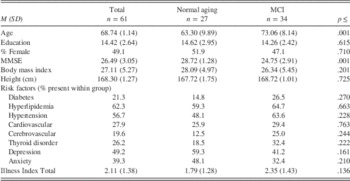
Sixteen individuals were excluded based on these criteria. The final sample included 61 patients (31 males and 30 females) with a mean age of 68 years. Patients were primarily Caucasian (93.7% and 6.3% African American) and education level ranged from 9 to 20 years. Table 1 presents demographic and clinical characteristics of patients by cognitive status. This study was approved by the Medical University of South Carolina Institutional Review Board, and all human data collected were obtained in compliance with board regulations.
Group differences in demographic and clinical characteristics by cognitive status

Note. MMSE=Mini-Mental State Examination.
Diagnostic Assessment/Selection Procedures
All procedures were standard of care with a licensed clinical neuropsychologist (M.T.W.) and/or advanced neuropsychology trainees (post-doctoral and pre-doctoral level intern students) in a memory clinic. All individuals presented to the clinic with subjective cognitive/memory complaints. Anthropometric measurements (BMI, height, and weight) were collected for every patient by certified nursing staff before the neuropsychological assessment. Clinical interview and medical record review collected information on the presence or absence of cardiovascular disease, cerebrovascular disease, neurological disorders (e.g., seizures and/or traumatic brain injury), biological indicators of health risk (hypertension, hypercholesterolemia, diabetes, thyroid disease), and psychological history (depression and anxiety). Current depressive symptoms were also assessed using the Geriatric Depression Scale (GDS 30-item; Yesavage et al., Reference Yesavage, Brink, Rose, Lum, Huang, Adey and Leirer1983) or the Beck Depression Inventory-II (BDI; Beck, Steer, & Brown, Reference Beck, Steer and Brown1996).
Petersen (Reference Petersen2004) criteria for MCI diagnosis was applied. Patients were first classified by cognitive status (normal, MCI, or dementia) based on comprehensive neuropsychological testing. Five cognitive domains were assessed for each patient: memory for verbal and visual information, attention/psychomotor speed, language (confrontational naming and verbal fluency), visuospatial, and executive function. However, not all patients received exactly the same test battery, as the study data were collected during the course of routine clinical care that adhered to a fixed-flexible battery approach.
Age, education, estimated intelligence, functional status (and if not working, prior occupation and reasons for retiring), and presence of psychiatric symptoms were assessed in relation to cognitive status. MCI was defined as evidence of impaired neurocognitive test performance (standard scores 1 SD or greater below the normative mean) on two measures within a cognitive domain, presence of cognitive complaints, and intact basic and instrumental activities of daily living as determined by medical records and/or clinical interview of patient and an informant when present. Following meeting initial inclusion criteria for MCI, information obtained from the clinical interview and medical records were evaluated to assess whether the diagnosis was consistent with these factors. Final diagnostic decisions were confirmed by M.T.W.
Neuropsychological tests used for diagnostic purposes were well-validated measures that are used as part of routine procedures in the memory clinic. These tests have demonstrated reliability and validity within older adults and have been shown to be sensitive to cognitive change in older adults. All patients were administered a measure of global cognition (MMSE). Specific tests included the: Consortium to Establish a Registry for Alzheimer’s Disease (CERAD; Spangenberg, Henderson, & Wagner, Reference Spangenberg, Henderson and Wagner1997; Welsh, Butters, Hughes, Mohs, & Heyman, Reference Welsh, Butters, Hughes, Mohs and Heyman1992), Repeatable Battery for the Assessment of Neuropsychological Status (Randolph, Tierney, Mohr, & Chase, Reference Randolph, Tierney, Mohr and Chase1998), Boston Naming Test; Kaplan (Kaplan, Goodglass, & Weintraub, Reference Kaplan, Goodglass and Weintraub1976), Controlled Oral Word Association Test (FAS and Category subtests; see Strauss, Sherman, & Spreen, Reference Strauss, Sherman and Spreen2006), Hopkins Verbal Learning Test-Revised and Brief Visuospatial Memory Test-Revised (Benedict, Schretlen, Groninger, Fobraski, & Shpritz, Reference Benedict, Schretlen, Groninger, Dobraski and Shpritz1996; Benedict, Schretlen, Groninger, & Brandt, Reference Benedict, Schretlen, Groninger and Brandt1998), and Trail Making Test (TMT; Reitan & Wolfson, Reference Reitan and Wolfson1993). Wechsler Adult Intelligence Scale-IV subtests (Wechsler, Reference Wechsler2008; Block Design, Digit Span, Vocabulary, Coding and Information) were also administered and considered in diagnostic decisions in combination with individuals’ educational background (defined as years of education).
Cognitive Correlates of Gait
This study was specifically interested in examining the contribution of executive attention and visuospatial functioning to gait performance. Based on prior work (Holtzer et al., Reference Holtzer, Verghese, Xue and Lipton2006, Reference Holtzer, Wang and Verghese2012; MacAulay et al., Reference MacAulay, Brouillette, Foil, Bruce-Keller and Keller2014), an Executive Attention composite score was formed from Block Design, TMT (Trails A and B time in seconds), and Digit Symbol Coding. These tests require executive attention, processing speed, and visuomotor coordination and have proven to be sensitive predictors of dementia (Lezak, Howieson, & Loring, Reference Lezak, Howieson and Loring2004). Before forming the composite, subtest scores were converted to Z-scores. Internal consistency reliability was good (Chronbach’s α=.80, n=4). Health and demographic factors (age and sex) that are known contributors to gait were investigated as categorical variables. Education attainment served as an estimator of cognitive reserve (Stern, Reference Stern2002, Reference Stern2006).
Gait Assessment
Gait speed was collected following neuropsychological testing in an adjacent hallway. The walkway was a hospital hallway, 23 feet long. Patients were given 4-feet acceleration and deceleration phases at every trial. Markers on the floor demarcated start and stop points. Examiners walked behind patients out of their field of vision so that patients would not alter their pace to the examiner. Gait speed was collected via a stopwatch. Walking time was recorded in seconds to the hundredth place. For all gait trials, patients were instructed to walk across the walkway “using their normal everyday walking speed.” Two simple-task trials collected normal walking speed before administering the cognitive load dual-task trials. Consistent with previous dual-task gait research in older adults (e.g., Hollman, Kovash, Kubik, & Linbo, Reference Hollman, Kovash, Kubik and Linbo2007; MacAulay et al., Reference MacAulay, Brouillette, Foil, Bruce-Keller and Keller2014, Reference MacAulay, Allaire, Brouillette, Foil, Bruce-Keller, Han and Keller2015), patients were instructed to spell a five-letter word backward (World and Arrow) aloud as they walked during the two dual-task conditions. Average scores were formed from the two gait trials for each task condition. Qualitative data regarding cognitive performance while walking (numbers of letters spelled correctly score: 0–10 points possible) were collected.
Statistical Analyses
Preliminary analyses examined group differences in demographic and clinical characteristics via analysis of variance, chi-square, or Fisher’s exact tests. All data were inspected for skewness and kurtosis. Log transformations corrected for positive skew in TMT and gait measures. Repeated measure analyses of covariance assessed group differences in gait speed while adjusting for sex and age. Gait speed served as a dependent measure (dual vs. simple walking task) and cognitive status (MCI vs. Normal Aging) was a between subject factor. Age differences in both gait characteristics and diagnostic status were expected; thus, age was standardized by group and entered as a covariate within the model to assess for its influence without removing the shared variance between MCI and age with gait speed.
Bonferroni corrections adjusted for multiple comparisons. Partial eta-squared (ηp 2) and Cohen’s d served as measures of effect size. MMSE recommended cut-scores of 25 were applied to assess for specificity and sensitivity of the MMSE in detecting MCI. True positives were defined as those with MMSE scores ≤25. AUROC analysis using standardized Z-scores compared the MMSE to the single-and dual-task gait speed measures in the classification of MCI patients. Reverse-scores were used to allow for similar scaling on the different measures when appropriate.
Multiple imputation procedures based on Rubin’s (Reference Rubin1996) recommendations were used to replace missing values for the regression analyses. Replaced values were based on predictions from the observed data. All variables used in the final analyses were included in the imputation model. Patterns between observed data and pooled data were compared to investigate for potential bias in estimates. Visual comparison of the results between observed data and pooled data were consistent with another. Hierarchal regression models investigated the independent contributions of the relevant demographic and health variables, executive attention, and cognitive status to gait speed during the simple and dual-task conditions. Adjusted R-squared (adj. R 2), changes in adj. R 2 and F (ΔF), and the standardized coefficients for the final model(s) are reported to allow for the examination of respective contributions and effect sizes for each of these variables. All tests of significance were two-tailed. Statistical analyses were performed using SPSS-Version 24 (IBM Corp., Armonk, NY) and MedCalc for Windows, version 15.0 (MedCalc Software, Ostend, Belgium).
RESULTS
Analyses first examined group differences in demographic and clinical characteristics. Table 1 presents the descriptive statistics for the demographic and clinical characteristics of patients by cognitive status. Of the included patients, 34 met criteria for MCI and 27 were classified as Normal Aging. Individuals diagnosed with MCI as compared to those considered to be Normal Aging were significantly older and had lower MMSE scores; groups did not significantly differ in terms of sex or education. Groups did not differ in current depressive symptoms (BDI: M=13.96, SD =10.16; or GDS: M=7.16, SD=4.61), ranging from moderately depressed to normal. Additionally, groups did not differ significantly on specific health risk factors or overall disease burden.
Given the small number of amnestic MCI subtypes (aMCI: n=7), MCI subtypes were not investigated within the primary analyses. However, preliminary analyses found no significant differences in gait speed between MCI and aMCI groups. There were trend level differences in diabetes and cerebrovascular risk factors (ps<.10) and significantly higher MMSE scores (p=.043) in the MCI as compared to aMCI group. These findings need to be taken with caution given the small sample size and that findings were no longer statistically significant once appropriate adjustments for the multiple comparisons were made.
Group Differences in Dual-Task Performance
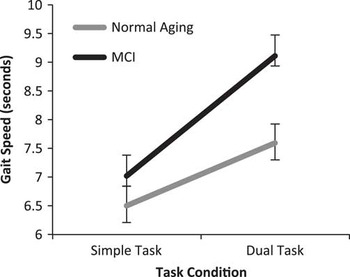
Gait speed was significantly slower during the dual-task as compared to the simple-task walking condition across all participants, F(1,56)=62.07, p ≤.001, ηp 2=.526. A significant between-group main effect found that the MCI as compared to Normal Aging patients overall had slower gait speed, F(1,56)=8.22, p=.006, ηp 2=.128; however, follow-up analysis using the Bonferroni correction revealed that the MCI group significantly differed in their dual- but not simple-gait speed (F=8.95; p=.006, Cohen’s d=.797). There was also a significant interaction between gait condition with group on gait speed that suggested the dual-task decrement effect was greater in those with MCI than Normal Aging patients, F(1,56)=4.03, p=.049, ηp 2=.067.
Older Age [F(1,56)=7.76; p=.007; ηp 2=.122] but not Sex was associated with slower gait speed (p=.547). As expected, results also indicated an interaction between age and task condition on gait speed, F(1,56)=4.69, p=.034, ηp 2=.076. Cognitive performance between groups during the dual-task also significantly differed, such that the MCI patients provided less correctly spelled backward letters (Mdn=6; SD=3.20) while walking than Normal Aging patients (Mdn=10; SD=2.26), Welch’s F=10.03, p=.002. Figure 1 illustrates average gait speed scores within each condition and the moderating effect of cognitive status on dual-task related gait decrements.
MCI versus Normal Aging group means and standard errors for gait speed (seconds) by task condition. Results represent the main effect of task condition and the interaction between groups with task condition, all ps<.05.

Using an MMSE cut-score of 25, the MMSE had excellent specificity at 96% (95% confidence interval [CI] [79.7, 99.9%]) but poor sensitivity at 53.1% (95% CI [34.74%, 70.91%]). The three curves in the AUROC analysis found that each test was significantly higher than chance (AUROC=.50), all ps=.05. Overall, the diagnostic accuracy of the MMSE (AUROC=.897; SE=.040) was good-to-very-good, dual-task gait speed (AUROC=.738; SE=.067) was fair-to-good, and simple gait speed (AUROC=.674; SE=.077) was poor-to-fair as a test.
Correlates of Gait Analyses
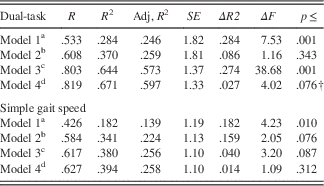
For each gait speed condition, relevant predictor variables were entered into a hierarchal regression model to determine their independent contributions to gait speed performance. Demographic (age, sex, education) and anthropometric (BMI and height) variables were investigated first. This was followed by health risk factors (diabetes, hyperlipidemia, hypertension, cardiovascular, cerebrovascular, and thyroid disorder) that are known contributors to gait speed. Next, the cognitive variables were examined. The last step within each model investigated the contribution of cognitive status (MCI vs. Normal Aging diagnosis). Relevant variables of sex and health risk known to impact gait speed were retained regardless of their statistical significance to control for confounds in the analyses. Table 2 presents the summary results for each step within the models.
Model summary for dual-task and simple gait speed

a Age, sex, and education.
b Age, sex, education, health risk variables.
c Age, sex, education, health risk variables, and executive attention.
d Age, sex, education, health risk variables, executive attention, and cognitive status.
adj. R 2=adjusted R-squared; SE=standard error; Δ=delta.
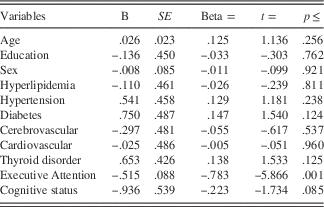
Results of the hierarchal regression analysis on dual-task gait speed performance found that age, sex, and education accounted for 28.4% of the variance within the first step; BMI and height were not significant and were removed from further analyses. Next, the influence of health risk factors on gait speed was investigated. Addition of these variables into the equation did not reach statistical significance but were retained in the model to control for confounds. Subsequently, the addition of the Executive Attention composite score accounted for 27.4% of additional variance in dual-task gait speed. The addition of cognitive status (MCI vs. Normal Aging) into the model only reached trend level of significance, contributing to 2.7% of the variance. The final model presented in Table 3 accounted for almost 60% of the variance in dual-task gait speed with only executive attention being a significant contributor to dual-task gait speed. These results indicate that group differences (MCI vs. Normal Aging) in dual-task gait speed are largely attributable to executive attention.
Final model for predictor variables effect on dual-task gait speed

The same regression procedures described above were then repeated using simple gait speed as the dependent variable. These results found that only the first step in the model was statistically significant, in which age, sex and education appeared to account for 13.9% of the variance in gait speed (See Table 2). While inclusion of the health risk variables reached only a trend level of significance, entry of these variables attenuated the significant relationship between age and education with simple gait speed, supporting their role as confounding factor that should be controlled for when investigating gait speed. Executive attention displayed a weak relationship with simple gait speed. Cognitive status was not related to simple gait speed within the final model. Once all of the other relevant variables were adjusted for, hypertension and Executive attention displayed significant relationships with simple gait speed; however, the final model was not statistically significant, p=.312.
DISCUSSION
To our knowledge, this study provides the first investigation of gait speed in response to a cognitive-load dual task in patients seeking a neuropsychological evaluation for cognitive concerns related to aging. The present study increases the external validity of dual-task gait assessment of cognitive decline and indicates that it is a useful tool for distinguishing MCI from normal aging within routine care. While both MCI and Normal Aging patient groups demonstrated dual-task decrements in their gait speed, a large effect size was found for the MCI group being significantly slower in their dual-task but not simple gait speed. Additionally, the MCI group made more cognitive errors in response to the cognitive load task than those considered to be normally aging. These findings are consistent with evidence that dual-task related decrements are sensitive in identifying older adults with cognitive impairments relative to normally aging older adults (Holtzer, Burright, & Donovick, Reference Holtzer, Burright and Donovick2004).
These results have clinical implications as they demonstrate expected patterns of gait-brain behavior relationships in response to a cognitive-load dual task within a clinically representative population. Overall, the notion that gait automaticity is significantly affected by cognitive demands upon executive attention processes and the dual-task provokes clinically meaningful gait changes in patients with MCI as compared to those considered to be normally aging was supported. MCI individuals did not differ in terms of sex, education, or their degree of medical risk factors but as expected were older than those considered to be Normal Aging.
As hypothesized, neuropsychological measures of executive attention and visuospatial integration contributed to variance in dual-task gait speed well beyond that of advanced age alone. Dual-task gait speed was also superior to simple gait speed in its ability to discriminate between MCI and Normal Aging as indicated by the AUROC analysis. Of further interest, MCI was not related to simple gait speed once other relevant factors were adjusted for in the model. Similar to past research, these results collectively suggest that cognitive load dual-task assessment reveals impairments that may not be obvious under simple walking conditions. These findings are also consistent with evidence that impairments in higher-level cognitive control, particularly degradation of visuospatial integration and executive attention capacity (Sheridan & Hausdorff, Reference Sheridan and Hausdorff2007), underlie the relationship between cognitive load dual-task decrements in gait and MCI/dementia.
Particularly notable within this study is the high incidence rate of MCI. In light of research that indicates the incidence of cognitive decline is 18 to 40% higher in the southeastern United States (where the study took place) than other regions (Wadley et al., Reference Wadley, Unverzagt, McGuire, Moy, Go, Kissela and Howard2011), we view this as an important finding. The Southeast has been characterized by its higher degree of health, socioeconomic, and cultural risk factors that are linked to cognitive decline. Furthermore, while stroke is linked to MCI, Wadley et al. (2010) suggest that cognitive decline could identify those at high risk for stroke rather than vice versa.
Outside of the Southeast, there are also indications that the reported estimates for dementia are substantially lower than the actual rates. Notably, in the United Kingdom, there was a significant increase in the proportion of those with formal diagnoses of dementia over a 3-year period (42% in 2012 to 62% in 2015) following government efforts aimed at early identification of patients experiencing symptoms of dementia through their primary care and referral for assessment to dedicated memory clinics (Hayhoe, Majeed, & Perneczky, Reference Hayhoe, Majeed and Perneczky2016). Additionally, as Ritchie (Reference Ritchie2004) noted, depending on procedural differences there are large differences in the rates of MCI prevalence, ranging from 1% to 29%. It is outside the scope of this study to further comment on these differences, but these results in the context of other findings are of great public health concern and are worthy of further investigation.
Limitations to this study include its cross-sectional design. Another limitation worth mention is potential ceiling effects on certain cognitive tests (e.g., the CERAD) that might have led to misclassification of individuals as normal aging; however, such misclassification would likely underestimate rather than overestimate the found effects (i.e., create a bias toward the null). Additionally, although evidence has linked physiological indices of disease burden to gait decline (Rosso et al., Reference Rosso, Sanders, Arnold, Boudreau, Hirsch, Carlson and Newman2015), presence of medical risk factors as measured by clinical history was not predictive of gait speed in either task condition. Adjusting for these factors did appear to attenuate the relationship between age and gait speed. Thus, it is possible that non-physiological measurement of illness fails to capture important relationships between gait and health risk factors. In addition, although the observational method used to collect gait speed is comparatively less reliable than electronic based gait analysis systems, its advantage lies in that gait assessments can be readily implemented in routine clinical settings without the need for expensive equipment or extensive set-up.
Future studies with larger samples that can differentiate between different subtypes of MCI are recommended. While aMCI is most commonly associated with AD, non-amnestic MCI is often associated with subcortical vascular disease or other neurodegenerative conditions. Leukoaraiosis, usually caused by subcortical vascular disease, has been associated with working memory and visuoconstruction deficits, as well as with gait impairment (Baezner et al., Reference Baezner, Blahak, Poggesi, Pantoni, Inzitari and Chabriat2008). Thus, it would be expected that patients with this disorder would be impaired on dual tasks.
Of interest, different gait parameters have been found to associate with distinct patterns of cognitive decline (Allali, Ayers, & Verghese, Reference Allali, Ayers and Verghese2016). There is research that links genetic risk for AD to shorter stride length but not walking speed (MacAulay et al., Reference MacAulay, Allaire, Brouillette, Foil, Bruce-Keller and Keller2016). However, notably, preliminary evidence has linked cerebral Aβ deposits (a risk factor for AD) to slower dual-task gait speed in healthy older adults (Nadkarni et al., Reference Nadkarni, Lopez, Perera, Studenski, Snitz, Erickson and Klunk2016), and a specific difficulty with dual-task performance has been noted in patients with AD (Della Sala & Logie, Reference Della Sala and Logie2001). All considered, and consistent with theories of equifinality, it is likely that dual-task decrements in gait involves numerous etiological factor and thusly may impact different aspects of gait. We were unable to perform analysis of the subjects’ brain imaging for the present study, but we plan to incorporate imaging and MCI subtype analysis in our future research to help further refine conceptualizations of dual-task related motor-cognitive decline.
Importantly, while the MMSE demonstrates good specificity for dementia, it lacks sensitivity to detect earlier stages of cognitive decline. These results provide further evidence that the MMSE alone is not an adequate screening measure for MCI. Notably, these differences did not appear to be explained by differences in education or other clinical characteristics. The MMSE demonstrated excellent specificity, but unacceptable sensitivity with 53.12% of patients diagnosed with MCI having MMSE scores above the recommended cut-score of 25.
Although the MMSE lacked sensitivity, its ability to discriminate disease state was superior to both of the gait speed measures that ranged from poor to good. Given heterogeneity in gait characteristics, further research is needed to establish clinical cut-scores for cognitive load dual-task gait speed changes that are based on regressed values of factors known to influence gait to increase its diagnostic accuracy. Additionally, it would be worthwhile to perform a similar comparison with the Montreal Cognitive Assessment given its rise in popularity as a more sensitive cognitive screener but that also been criticized for poor specificity (Larner, Reference Larner2012; McLennan, Mathias, Brennan, & Stewart, 2011).
Despite limitations, this work has important clinical implications as it demonstrates the utility of the dual-task gait assessment for capturing MCI in the clinic setting. Overall, there is substantial converging evidence that dual-task gait assessment serves as an easily administered measure of executive attention functioning within older adults. The present study extended these findings on the relationship between dual-task gait speed and cognition into a clinical population seeking a neuropsychological evaluation for subjective memory concerns. Dual-task provoked gait changes in walking speed were an important behavioral marker of neurocognitive functioning as evidenced by the large effect of group differences in gait speed during the dual-task (MCI slower) and the significant contribution of executive attention to gait speed within the regression analyses. Relevantly, assessment of dual-task decrement in gait speed can be easily implemented as a screener measure for MCI across an array of settings, to include rural primary care. In sum, our results indicate that cognitive load dual-task gait assessment could provide a cost-efficient and sensitive measure by which older adults at risk for a dementia disorder are detected across an array of clinical settings.
ACKNOWLEDGMENTS
The authors have no funding sources/study sponsors or conflict of interests to declare.