Introduction
Srebarna Biosphere Reserve is situated in north-east Bulgaria (44°7′N, 27°5′E). It includes Srebarna Lake (a Danubian oxbow lake) and adjacent wet grasslands and inundated forests. Srebarna Lake is eutrophic, connected via an artificial canal with the Danube (Michev et al., Reference Michev, Georgiev, Petrova and Stoyneva1998; Uzunov et al., Reference Uzunov, Tzavkova, Todorov and Varadinova2001; Pehlivanov et al., 2006). The conservational value of this reserve has been internationally recognized by being listed as a site of the World Cultural and Natural Heritage and a biosphere reserve under the Programme on Man and the Biosphere (UNESCO), and being included in the List of Wetlands of International Importance (Ramsar Convention) and among Important Bird Areas (BirdLife International). This reserve is characterized by a significant diversity of highly protected species, including fish-eating birds; it is one of the major European nesting sites of the Dalmatian pelican (Pelecanus crispus Bruch) (Michev et al., Reference Michev, Georgiev, Petrova and Stoyneva1998). This determines the importance of the fish populations as a major food resource for the lake ecosystem and as a source of helminth infections for avian hosts.
Helminth parasites of fish from Srebarna Lake have never been studied in detail (Michev et al., Reference Michev, Georgiev, Petrova and Stoyneva1998). The only ichthyoparasitological data for this lake are those by Margaritov (Reference Margaritov1959) reporting three helminth species, two of them in the rudd Scardinius erythrophthalmus (L.). The latter species is one of the most abundant fish species in the lake (Pehlivanov, Reference Pehlivanov2000; Pehlivanov et al., Reference Pehlivanov, Vassilev and Vassilev2005), thus being an important element in food webs. The present study on helminth parasites of the rudd from Srebarna Lake is part of a wider programme carried out in 2004–2006 by the authors; it aims to characterize parasitic worms in fish from this lake, both as an integral part of the inventory of its biodiversity and as possible regulators of host populations. Furthermore, since data on helminth communities in fish from the Lower Danube area are scarce, we have analysed and interpreted the results from the point of view of characterization of the structure of helminth communities.
The aim of the present study was to reveal the species composition of parasitic worms and to describe the structure of helminth communities in S. erythrophthalmus from Srebarna Lake.
Materials and methods
In total, 180 rudd specimens (total length 82–240 mm) were examined for helminth parasites (Monogenea, Trematoda, Cestoda, Acanthocephala and Nematoda) during spring, summer and autumn of 2005–2006. Thirty host individuals per season were studied. Fish were captured by local fishermen or technical staff members using various methods (netting, angling or electro-fishing). They were transported alive to the laboratory within 1 h after being captured. Half of each sample was studied immediately, and the other half was either fixed in 4% formalin or frozen for subsequent studies. Helminthological dissections under the stereomicroscope were carried out following recommendations and procedures described by Bauer et al. (Reference Bauer, Musselius and Strelkov1981), Gusev (Reference Gusev1983), Bykhovskaya-Pavlovskaya (1962, Reference Bykhovskaya-Pavlovskaya1985) and Moravec (1994, Reference Moravec2001). All parasites were identified and counted. They were fixed and preserved in 70% ethanol (Bauer et al., Reference Bauer, Musselius and Strelkov1981; Moravec, Reference Moravec1994). Cestodes, trematodes and monogeneans of the genus Diplozoon were stained in iron acetocarmine, dehydrated in ethanol series with increasing concentrations, cleared in eugenol and mounted in Canada balsam (Bykhovskaya-Pavlovskaya, Reference Bykhovskaya-Pavlovskaya1985; Georgiev et al., Reference Georgiev, Biserkov and Genov1986). Metacercariae of Diplostomum spp. were stained in iron acetocarmine, dehydrated in ethanol series, cleared in dimethylphthalate and mounted in Canada balsam (Bykhovskaya-Pavlovskaya, Reference Bykhovskaya-Pavlovskaya1985; Shigin, Reference Shigin1986). Nematodes and monogeneans were studied in temporary glycerol mounts (Bykhovskaya-Pavlovskaya, Reference Bykhovskaya-Pavlovskaya1985; Moravec, Reference Moravec1994) and ammonium picrate mounts (Malmberg, Reference Malmberg1970; Gusev, Reference Gusev1983), respectively.
The terminology used followed Bush et al. (Reference Bush, Lafferty, Lotz and Shostak1997). Brillouin's Diversity Index, Berger–Parker Dominance Index and Jaccard Similarity Index (Ij) were calculated as described by Maguran (Reference Maguran1988). The dominant structure of the component helminth communities was determined according to the criteria proposed by Kennedy (Reference Kennedy1993) on the basis of the prevalence (P%): satellite (P% < 10), secondary (10 < P% < 20) and core (P%>20) species. Mean abundance (MA ± SD) and mean intensity (MI ± SD) were calculated using Microsoft Excel and (STATISTICA 7.0). Seasonal differences were evaluated statistically by applying the chi-square test or Fisher's exact test for comparing prevalence, Bootstrap 2-sample t-test for comparing mean abundances and mean intensity (Quantitative Parasitology, version 3.0 available at website http://www.behav.org/qp/qp.htm; Rozsa et al., Reference Rozsa, Reiczigel and Majoros2000).
Results
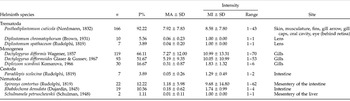
Helminth parasites were recorded in 166 rudd specimens (92.2%). Ten helminth species (trematodes, cestodes, monogeneans and nematodes) were identified (table 1). No acanthocephalans were found.
Species diversity of helminth parasites in the rudd Scardinius erythrophthalmus from Srebarna Lake (180 host specimens studied).

n, number of fish infected; P%, prevalence; MA, mean abundance; MI, mean intensity.
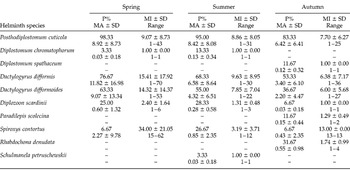
Seasonal differences of the mean abundance (table 2) were significant between three seasons for Dactylogyrus difformis, D. difformoides and Diplozoon scardinii (Bootstrap t-test P < 0.05 for all). Seasonal differences of the mean intensity (table 2) were significant between spring and autumn for D. difformoides and D. scardinii, and between spring and autumn and summer and autumn for D. difformoides (Bootstrap t-test P < 0.05 for all).
Seasonal changes of helminth infection in the rudd Scardinius erythrophthalmus from Srebarna Lake (60 host specimens studied each season).

P%, prevalence; MA, mean abundance; MI, mean intensity; Range, range of intensity.
Seasonal differences of the prevalence (table 2) were significant between three seasons for D. difformis, D. difformoides, D. scardinii and Posthodiplostomum cuticola (Fisher's exact test P < 0.05 for all).
The similarity of the species composition of helminth component community between the seasons was considerable: spring–summer Ij = 0.750, spring–autumn Ij = 0.778 and summer–autumn Ij = 0.600.
The core species in the component helminth community in rudd in Srebarna Lake were P. cuticola, D. difformis and D. difformoides (table 1). Posthodiplostomum cuticola had also the highest mean abundance, followed by D. difformis and D. difformoides. The highest intensity of infection was exhibited by D. difformis, followed by D. difformoides, Spiroxys contortus and P. cuticola. The secondary species were D. scardinii, S. contortus and Rabdochona denudata while Diplostomum chromatophorum, D. spathaceum, Paradilepis scolecina and Schulmanela petruschewskii were satellite species (table 1).
Twelve rudd specimens (6.7%) were not infected. The infracommunities consisted of 1–6 helminth species: 25 hosts (13.9%) with one, 31 (30.6%) with two, 68 (37.8%) with three, 33 (18.3%) with four, 8 (4.4%) with five and only three (1.67%) with six helminth species. The maximum number of helminth individuals recorded in one infracommunity was 170.
The indices of diversity and dominance of helminth communities had similar values in all the seasons (table 3).
Seasonal variations of the indices of diversity and dominance of helminth communities in the rudd Scardinius erythrophthalmus from Srebarna Lake.

Discussion
The only previous study on helminth parasites from fish in Srebarna Lake (Margaritov, Reference Margaritov1959) revealed the trematodes Asymphylodora tincae (Modeer, 1790) and Posthodiplostomum cuticola (Nordmann, 1832) in rudd. Asymphylodora tincae is not a specific parasite for rudd and that record has been recognized as accidental (Kakacheva-Avramova, Reference Kakacheva-Avramova1983). Our results corroborate with the latter conclusion, since we did not record A. tincae.
We found ten helminth species; apart from P. cuticola, all were recorded for the first time for Srebarna Lake. However, their finding in this host species is not unusual. Until now, helminth parasites of rudd have been studied from various rivers and reservoirs in Bulgaria. From this host species, Margaritov (Reference Margaritov1964a, Reference Margaritovb) reported Dactylogyrus vistulae (Prost, 1957), Gyrodactylus sp. and Diplozoon paradoxum (Nordmann, 1932) from Batak Reservoir. Kakacheva-Avramova (Reference Kakacheva-Avramova1962, Reference Kakacheva-Avramova1965, Reference Kakacheva-Avramova1972, Reference Kakacheva-Avramova1973, Reference Kakacheva-Avramova1977) recorded Ligula intestinalis (L., 1758) from Kirilovski Reservoir, Pomphorhynchus laevis (Müller, 1776) and Rhabdohona denudata from Strumeshnitsa River, D. difformis and Diplozoon sp. from Sushitsa River, Gyrodactylus decorus (Malmberg, 1957), Diplozoon sp. and L. intestinalis from Tundzha River, Gyrodactylus cyprini (Osmanov, 1964), G. decorus and G. scardinii (Malmberg, 1964) from rivers in the Balkan Range, Bucephalus polymorphus (Baer, 1827) (metacercariae), Cotylurus pileatus (Rudolphi, 1802) (metacercariae), Apophallus muehlingi (Jägerskiöld, 1899) (metacercariae), Dactylogyrus crucifer (Wagener, 1857), D. difformoides, D. izjumovae (Gusev, 1966), Caryophyllaeides fennica (Schneider, 1902), L. intestinalis (larvae) and P. laevis from the Danube (near the town of Silistra). Khadzhiiski (1979) found L. intestinalis in rudd in Kamchiya Reservoir. Kakacheva-Avramova et al. (Reference Kakacheva-Avramova, Margaritov, Gruptscheva, Russev and Naidenow1978) reported D. crucifer, Dactylogyrus izjumovae, C. fennica, L. intestinalis, Rhipidocotyle illense (Ziegler, 1883), C. pileatus (metacercariae), A. muehlingi and P. laevis from the Danube. Nedeva et al. (Reference Nedeva, Atanasov, Karaivanova, Cakic and Lenhardt2003) also confirmed the occurrence of P. laevis in rudd from the Danube. In the present study, we report for the first time Spiroxys contortus, Schulmanela petruschewskii, Diplostomum spathaceum, D. chromatophorum, Paradilepis scolecina and Diplozoon scardinii as parasites of rudd in Bulgaria. Diplozoon scardinii is also a new record for the Bulgarian fauna.
Srebarna Lake is an oxbow lake, connected to the Danube via an artificial canal during the past 15 years. Since fish populations in the lake and the river are believed to be closely associated (frequently exchanging individuals), the comparison of the species composition of the component helminth communities is expected to reveal substantial similarities. In contrast, only one species is recorded as a parasite of rudd in both the Danube and in Srebarna Lake. This is the monogenean D. difformis, which is a specific parasite of rudd and has a direct life cycle (Gusev, Reference Gusev1985). A possible reason for the difference in the species composition of helminth parasites in rudd between the river and the lake are the different environmental conditions. The parasite species with indirect life cycles recorded in the river have mostly benthic molluscs and crustaceans as intermediate hosts. Srebarna Lake is currently characterized by a thick layer of detritus, which is associated with low oxygen concentrations and poor benthic communities. This results in the composition of the benthic communities comprising mostly dipteran larvae, mainly chironomids (Uzunov et al., Reference Uzunov, Tzavkova, Todorov and Varadinova2001). The diversity of molluscs is rather low, and the only abundant species is Planorbarius corneus (L.) (intermediate host of P. cuticola), occurring mostly in shallow places. As a whole, molluscs are almost entirely lacking in benthic samples from the central part of the lake (Uzunov et al., Reference Uzunov, Tzavkova, Todorov and Varadinova2001), which is probably due to the thick layer of detritus and the absence of aquatic vegetation (Angelov, Reference Angelov2000; Uzunov et al., Reference Uzunov, Tzavkova, Todorov and Varadinova2001). The great number of metacercariae of Diplostomum recorded in the course of the present study can be explained by the substantial diversity of fish-eating birds (Michev et al., Reference Michev, Georgiev, Petrova and Stoyneva1998) and the abundance of snails at the lake periphery (Angelov, Reference Angelov2000; Uzunov et al., Reference Uzunov, Tzavkova, Todorov and Varadinova2001).
The lake zooplankton is dominated by rotiferans, cladocerans and copepods (Pehlivanov et al., 2006). The latter are intermediate hosts of P. scolecina (parasitic in cormorants as adults) and S. contortus (parasitic in water turtles as adults).
In relation to the host specificity, D. difformis and D. scardinii are species-specific parasites of the rudd (Gusev, Reference Gusev1985; Jarkovský et al., 2004). The remaining species have wider host ranges, mostly associated with cyprinid species.
Dzika (Reference Dzika2005) carried out a detailed study of helminth parasites of rudd from Warniak Lake, Poland. Eleven helminth species were recorded during 1998–1999: D. difformis, D. difformoides, Dactylogyrus fallax (Wagener, 1857), Diplostomum sp. (metacercariae), Ornithodiplostomum scardinii (Shulman in Dubinin, 1952) (metacercariae), P. cuticola (metacercariae), Tylodelphys clavata (Nordmann, 1832) (metacercariae), Ichthyocotylurus sp. (metacercariae), Phyllodistomum sp., Raphidascaris acus (larvae) and Neoechinorhynchus rutili. The data of Dzika (Reference Dzika2005) demonstrate the presence of five core species in the component helminth community of the rudd population in Warniak Lake. These are Diplostomum sp. (P% = 56.1, MA = 5.70), O. scardinii (P% = 55.2, MA = 5.85), D. difformis (P% = 22.9, MA = 0.90), D. difformoides (P% = 20.7%, MA = 0.87) and N. rutili (P% = 25.3%, MA = 0.82). The remaining species are satellite. Species recorded both in Srebarna and Warniak are D. difformis, D. difformoides and P. cuticola, which are core species in the component helminth communities in rudd at both sites.
Our study revealed the highest infection parameters of core and secondary species during the spring and the lowest infection rate during the autumn (table 2). Kakacheva-Avramova et al. (Reference Kakacheva-Avramova, Margaritov, Gruptscheva, Russev and Naidenow1978) and Kakacheva-Avramova & Menkova (Reference Kakacheva-Avramova and Menkova1978) also reported high prevalence during spring and summer and the lowest prevalence in autumn.
Acknowledgements
We are grateful to Dr B.B. Georgiev (Central Laboratory of General Ecology, Bulgarian Academy of Sciences, Sofia) for his useful suggestions during the present study.