Introduction
Cognitive impairment, a core feature of schizophrenia, predicts important clinical outcomes, including relapse frequency and everyday functioning (Keefe and Fenton, Reference Keefe and Fenton2007; Schaefer et al., Reference Schaefer, Giangrande, Weinberger and Dickinson2013; Green, Reference Green2016). Unfortunately, therapeutic options for cognitive deficits in schizophrenia are limited, with no available pharmacological treatments. The development of mechanistically-novel therapeutics can be informed by understanding the neural substrates of cognitive dysfunction in schizophrenia. Achieving this goal requires investigation of the diseased brain using complementary approaches. In particular, studies of postmortem human brain tissue provide the essential molecular, cellular, and circuitry levels of resolution that are not currently possible in studies of living subjects (Deep-Soboslay et al., Reference Deep-Soboslay, Akil, Martin, Bigelow, Herman, Hyde and Kleinman2005; Deep-Soboslay et al., Reference Deep-Soboslay, Benes, Haroutunian, Ellis, Kleinman and Hyde2011; Bianchi et al., Reference Bianchi, Gordon and Koroshetz2017).
Interpreting how postmortem human studies inform our understanding of the neural substrates of cognitive impairments faces three challenges. The first challenge is the absence of measurements of cognitive aptitude in the studied individuals, with the notable exception of studies performed in elderly, chronically hospitalized individuals whose cognition is tested antemortem (e.g. see Humphries et al., Reference Humphries, Mortimer, Hirsch and De Belleroche1996, Purohit et al., Reference Purohit, Perl, Haroutunian, Powchik, Davidson and Davis1998, Martin-Ruiz et al., Reference Martin-Ruiz, Haroutunian, Long, Young, Davis, Perry and Court2003, Rapp et al., Reference Rapp, Schnaider-Beeri, Purohit, Reichenberg, Mcgurk, Haroutunian and Harvey2010). Neurocognitive testing is not a part of populace data collection in the USA and is not routinely performed in individuals with schizophrenia. Because many donations to postmortem human brain banks come from subjects that are not studied before death, comparing neurocognitive measures obtained premortem with biological measures obtained postmortem in individuals with schizophrenia is not currently feasible. Second, given this limitation, the interpretation of findings from postmortem studies to date has relied on inferences drawn from group-level cognitive findings in living subjects. This strategy rests on the untested assumption that schizophrenia subjects included in postmortem brain studies have cognitive impairments comparable to those identified in studies of living subjects. Third, the absence of cognitive measures at the level of individual subjects in postmortem brain studies precludes the assessment of whether the severity of neural alterations and of cognitive deficits is related across individuals. Each of these challenges might be addressed by using established proxy measures of cognitive aptitude to evaluate the presence and severity of premortem cognitive deficits in postmortem human subjects.
Educational and occupational attainment measures are well-suited candidate proxy measures of cognitive aptitude to begin addressing these challenges. Educational (Deary et al., Reference Deary, Strand, Smith and Fernandes2007) and occupational (Strenze, Reference Strenze2007) attainment each have strong positive correlations with various measures of cognitive aptitude in the general population and have been previously used as proxy measures of cognition in living subjects (Rietveld et al., Reference Rietveld, Medland, Derringer, Yang, Esko, Martin, Westra, Shakhbazov, Abdellaoui, Agrawal, Albrecht, Alizadeh, Amin, Barnard, Baumeister, Benke, Bielak, Boatman, Boyle, Davies, De Leeuw, Eklund, Evans, Ferhmann, Fischer, Gieger, Gjessing, Hagg, Harris, Hayward, Holzapfel, Ibrahim-Verbaas, Ingelsson, Jacobsson, Joshi, Jugessur, Kaakinen, Kanoni, Karjalainen, Kolcic, Kristiansson, Kutalik, Lahti, Lee, Lin, Lind, Liu, Lohman, Loitfelder, Mcmahon, Vidal, Meirelles, Milani, Myhre, Nuotio, Oldmeadow, Petrovic, Peyrot, Polasek, Quaye, Reinmaa, Rice, Rizzi, Schmidt, Schmidt, Smith, Smith, Tanaka, Terracciano, Van Der Loos, Vitart, Volzke, Wellmann, Yu, Zhao, Allik, Attia, Bandinelli, Bastardot, Beauchamp, Bennett, Berger, Bierut, Boomsma, Bultmann, Campbell, Chabris, Cherkas, Chung, Cucca, De Andrade, De Jager, De Neve, Deary, Dedoussis, Deloukas, Dimitriou, Eiriksdottir, Elderson, Eriksson, Evans, Faul, Ferrucci, Garcia, Gronberg, Guethnason, Hall, Harris, Harris, Hastie, Heath, Hernandez, Hoffmann, Hofman, Holle, Holliday, Hottenga, Iacono, Illig, Jarvelin, Kahonen, Kaprio, Kirkpatrick, Kowgier, Latvala, Launer, Lawlor, Lehtimaki, Li, Lichtenstein, Lichtner, Liewald, Madden, Magnusson, Makinen, Masala, Mcgue, Metspalu, Mielck, Miller, Montgomery, Mukherjee, Nyholt, Oostra, Palmer, Palotie, Penninx, Perola, Peyser, Preisig, Raikkonen, Raitakari, Realo, Ring, Ripatti, Rivadeneira, Rudan, Rustichini, Salomaa, Sarin, Schlessinger, Scott, Snieder, St Pourcain, Starr, Sul, Surakka, Svento, Teumer, Tiemeier, Van Rooij, Van Wagoner, Vartiainen, Viikari, Vollenweider, Vonk, Waeber, Weir, Wichmann, Widen, Willemsen, Wilson, Wright, Conley, Davey-Smith, Franke, Groenen, Hofman, Johannesson, Kardia, Krueger, Laibson, Martin, Meyer, Posthuma, Thurik, Timpson, Uitterlinden, Van Duijn, Visscher, Benjamin, Cesarini and Koellinger2013; Le Hellard et al., Reference Le Hellard, Wang, Witoelar, Zuber, Bettella, Hugdahl, Espeseth, Steen, Melle, Desikan, Schork, Thompson, Dale, Djurovic and Andreassen2017). Both measures are also predicted by the severity of cognitive impairment in individuals with schizophrenia (Keefe and Fenton, Reference Keefe and Fenton2007; Rajji et al., Reference Rajji, Miranda and Mulsant2014; Green, Reference Green2016). Finally, information regarding educational and occupational attainment are relatively accessible and can be obtained and verified from multiple sources during postmortem clinical characterization procedures used by many postmortem human brain banks (Deep-Soboslay et al., Reference Deep-Soboslay, Benes, Haroutunian, Ellis, Kleinman and Hyde2011).
In clinical studies of schizophrenia, assessment of cognitive aptitude, and the presence and severity of cognitive impairments, has been evaluated in relation to three different comparison groups: healthy subjects, subjects with other mental illnesses, and the schizophrenia proband's first-degree relatives. The cognitive performance of most individuals with schizophrenia is >1.0 s.d below the mean of healthy subjects (Keefe and Fenton, Reference Keefe and Fenton2007; Schaefer et al., Reference Schaefer, Giangrande, Weinberger and Dickinson2013). Moreover, subjects with schizophrenia are typically more severely cognitively impaired than are subjects with major depressive or bipolar disorder (Keefe and Fenton, Reference Keefe and Fenton2007). Accordingly, educational and occupational attainment in individuals with schizophrenia is lower than healthy (Keefe and Fenton, Reference Keefe and Fenton2007; Rajji et al., Reference Rajji, Miranda and Mulsant2014; Green, Reference Green2016) and psychiatrically-ill (Vreeker et al., Reference Vreeker, Boks, Abramovic, Verkooijen, Van Bergen, Hillegers, Spijker, Hoencamp, Regeer, Riemersma-Van Der Lek, Stevens, Schulte, Vonk, Hoekstra, Van Beveren, Kupka, Brouwer, Bearden, Maccabe and Ophoff2016; Karpov et al., Reference Karpov, Joffe, Aaltonen, Suvisaari, Baryshnikov, Naatanen, Koivisto, Melartin, Oksanen, Suominen, Heikkinen and Isometsa2017) subjects. Although comparisons to healthy subjects from the general population identifies approximately 80% of individuals with schizophrenia as cognitively impaired (Keefe and Fenton, Reference Keefe and Fenton2007), both the presence and severity of cognitive impairments in any given individual with schizophrenia appears to be more accurately identified by the deviation from the cognitive aptitude of their parents (Keefe et al., Reference Keefe, Eesley and Poe2005; Keefe and Fenton, Reference Keefe and Fenton2007). Indeed, 98% of individuals with schizophrenia underperform cognitively based on that predicted by the level of education of either parent (Keefe et al., Reference Keefe, Eesley and Poe2005; Keefe and Fenton, Reference Keefe and Fenton2007; Keefe and Harvey, Reference Keefe and Harvey2012). These findings are further reflected in differences in educational and occupational attainment across generations. In the general population, educational and occupational (Wyatt and Hecker, Reference Wyatt and Hecker2006) attainment typically improve from one generation to the next. However, subjects with schizophrenia show the opposite pattern (Keefe et al., Reference Keefe, Eesley and Poe2005; Keefe and Fenton, Reference Keefe and Fenton2007; Kendler et al., Reference Kendler, Ohlsson, Mezuk, Sundquist and Sundquist2016).
In the present study, we begin to address the challenges associated with interpreting how postmortem human studies inform our understanding of the neural substrates of cognitive impairments. First, using a large cohort of postmortem subjects (N = 507), we demonstrate that the expected group differences in educational and occupational attainment are present in postmortem subjects with schizophrenia relative to unaffected comparison, major depressive disorder, and bipolar disorder subjects. Second, we demonstrate that in contrast to the other subject groups, postmortem subjects with schizophrenia fail to show improvements in educational and occupational attainment relative to their parents. As in living subjects, the magnitude of this deviation between proband and parental attainment may better identify the presence and severity of cognitive dysfunction in postmortem individuals with schizophrenia rather than comparisons to unaffected subjects.
Methods
Postmortem human subjects
Brain specimens were obtained during autopsies conducted at the Allegheny County Medical Examiner's Office (Pittsburgh, PA, USA) after consent for donation was obtained from the next-of-kin. The results of an expanded psychological autopsy (Kelly and Mann, Reference Kelly and Mann1996; Lewis, Reference Lewis2002; Beneyto et al., Reference Beneyto, Sibille, Lewis, Charney and Nestler2009; Deep-Soboslay et al., Reference Deep-Soboslay, Benes, Haroutunian, Ellis, Kleinman and Hyde2011) including structured interviews conducted with family members and review of medical, toxicology, neuropathology, and medical examiner's reports were used by an independent committee of experienced clinicians to make consensus DSM-IV (American Psychiatric Association, 1994) diagnoses, or the absence thereof, for each subject. This comprehensive method of establishing psychiatric diagnoses postmortem directly addresses the challenges associated with the sole use of medical record review or family interviews, which may be problematic for establishing mood disorder (Deep-Soboslay et al., Reference Deep-Soboslay, Akil, Martin, Bigelow, Herman, Hyde and Kleinman2005) or schizoaffective disorder (Sundqvist et al., Reference Sundqvist, Garrick, Bishop and Harper2008) diagnoses.
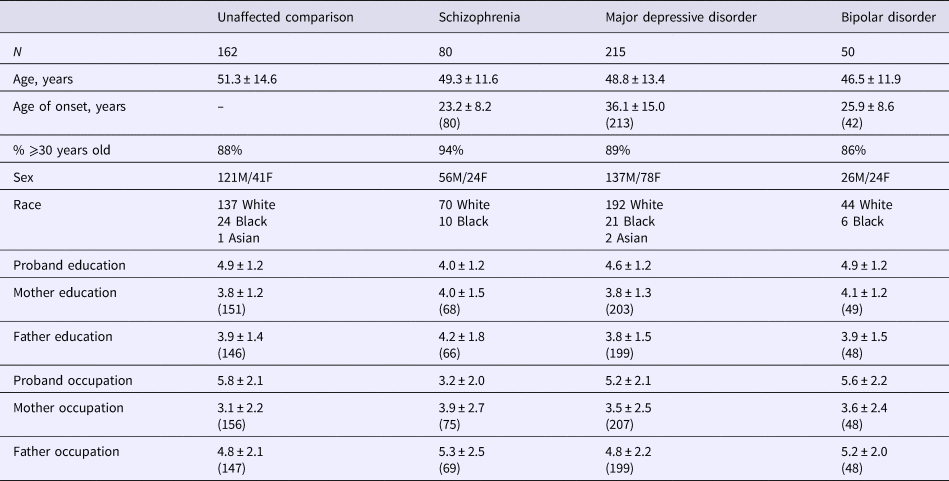
Subjects (N = 507) were included for study if they had documented educational and occupational attainment; were ⩾18 years of age so that, at minimum, partial high school educational attainment was possible; and met criteria for schizophrenia or schizoaffective disorder (N = 80), major depressive disorder (N = 215), bipolar disorder (N = 50), or unaffected comparison (N = 162) (Table 1). Subject groups did not differ in mean age (F 3,503 = 2.0, p = 0.1) or racial composition (χ2 = 3.4, p = 0.8), but the proportions of males and females differed significantly across diagnostic groups (χ2 = 10.8, p = 0.01) (Table 1). Pair-wise comparisons showed that the proportion of males and females in the unaffected comparison subject group differed significantly from major depressive disorder subjects (χ2 = 5.1, p = 0.02) and bipolar disorder subjects (χ2 = 9.2, p = 0.002), but not from schizophrenia subjects (χ2 = 0.6, p = 0.4). The difference in sex across groups is due to the over-representation of males, which reflects the fact that men are more likely to die under circumstances which require a forensic evaluation. Within the ill subjects, diagnostic group showed a main effect on age of onset (Table 1; F 2,334 = 34.0, p < 0.0001). Tukey's post hoc analysis revealed that subjects with major depressive disorder had significantly (p < 0.0001) older age of onset than subjects with schizophrenia or bipolar disorder, but that age of onset did not differ significantly (p = 0.5) between schizophrenia and bipolar disorder subjects. All procedures were approved by the University of Pittsburgh's Committee for the Oversight of Research and Clinical Training Involving Decedents and Institutional Review Board for Biomedical Research.
Summary demographic characteristics of probands and summary educational and occupational attainment scores of probands and their parentsa

a Parentheses contain the numbers of parents with available data. Values are mean ± SD.
Educational and occupational attainment in postmortem human subjects and their parents
Documentation of education and occupation for the proband and their parents was obtained through the structured interview, medical records, medical examiner's report, and public records (e.g. obituary and social media). The structured interview is performed by a licensed clinical psychologist and includes the Postmortem Subject Demographic History Form, a 14-page instrument developed by researchers at the University of Pittsburgh that includes documentation of educational and occupational attainment of the decedent and their parents. Scoring of the Postmortem Subject Demographic History Form uses Hollingshead categorical rankings for both educational and occupational attainment (Hollingshead, Reference Hollingshead1975) (online Supplementary Table S1). Categorical rankings of education were used instead of years of completed education because informants can provide a general level of education (e.g. partial high school; partial college) with greater certainty than specific years of education.
Information regarding highest achieved education and occupation for probands and their parents was obtained through the structured interview with confirmation from medical records, medical examiner's report, and/or publicly available records for 96.2% of subjects. The remaining 3.8% of subjects had only review of medical records, medical examiner's report, and/or publicly available records for documentation of educational and occupational attainment. Educational and/or occupational attainment was known for at least one parent for 92.1%, and for both parents for 86.6%, of probands (Table 1). If discrepancies in highest parental attained education or occupation were found, values that were most frequently reported were used, or coded as ‘unknown’ if there was irreconcilable ambiguity.
Statistics
Educational and occupational attainment values for probands and parents are rank-order categorical variables (Hollingshead, Reference Hollingshead1975). Thus, to compare educational and occupational attainment across diagnostic groups, a cumulative logit model with proportional odds property was employed (online Supplementary Methods). The model included diagnostic group as the main dependent variable, and age, sex, and race as covariates. F-tests were used to assess the overall diagnosis effect, followed by pairwise comparisons between groups. The resulting odds ratio (OR) indicates that the odds of having higher educational or occupational attainment in one subject group is equivalent (OR = 1), greater (OR > 1), or lower (OR < 1) than the attainment in another subject group.
To assess the deviation in attainment of each proband relative to their parents, a cumulative logit mixed-effects model treating proband, mother, and father as clustered measures within a family was employed, where the fixed effects include generation (i.e. proband v. mother or father), proband diagnosis, and generation by proband diagnosis interaction. The generational effects within each diagnostic group were tested and compared across diagnostic groups. Within each diagnostic group, an OR > 1 indicates that the proband has higher odds of having greater attainment than the parent.
Analyses were implemented in SAS PROC GLIMMIX. The default (‘containment’) degrees of freedom method was used to compute the denominator degrees of freedom for the mixed-effects models accounting for within-family correlation and for the characterization of the within- and between-family variability.
Results
Educational and occupational attainment in postmortem subjects
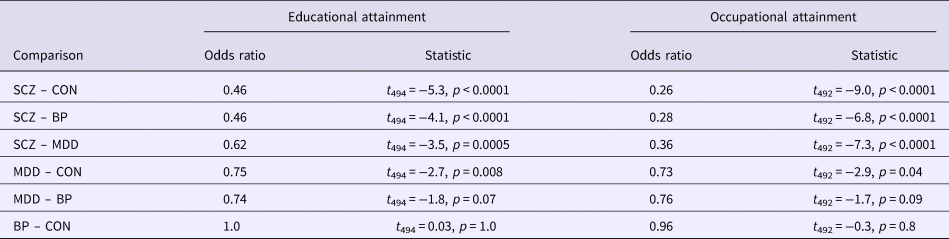
Consistent with studies of living individuals (Keefe and Fenton, Reference Keefe and Fenton2007; Schaefer et al., Reference Schaefer, Giangrande, Weinberger and Dickinson2013; Rajji et al., Reference Rajji, Miranda and Mulsant2014; Vreeker et al., Reference Vreeker, Boks, Abramovic, Verkooijen, Van Bergen, Hillegers, Spijker, Hoencamp, Regeer, Riemersma-Van Der Lek, Stevens, Schulte, Vonk, Hoekstra, Van Beveren, Kupka, Brouwer, Bearden, Maccabe and Ophoff2016; Karpov et al., Reference Karpov, Joffe, Aaltonen, Suvisaari, Baryshnikov, Naatanen, Koivisto, Melartin, Oksanen, Suominen, Heikkinen and Isometsa2017), educational attainment was lowest in schizophrenia subjects, intermediate in major depressive disorder subjects, and highest in unaffected comparison and bipolar disorder subjects (Table 1). Statistical analysis confirmed a significant main effect of diagnosis on educational attainment (F 3,494 = 10.6, p < 0.0001). Subjects with schizophrenia had significantly lower educational attainment relative to unaffected comparison, bipolar disorder, and major depressive disorder subjects (Table 2). Educational attainment was lower (OR = 0.73) in subjects with ‘pure’ schizophrenia (N = 49) relative to subjects with schizoaffective disorder (N = 31), but this difference was not statistically significant (t 71 = −1.2, p = 0.2). Subjects with major depressive disorder had significantly lower educational attainment relative to unaffected comparison but not bipolar disorder subjects (Table 2). Educational attainment did not differ in subjects with bipolar disorder relative to unaffected comparison subjects (Table 2).
Comparison of educational and occupational attainment in probands

Unaffected comparison (CON); schizophrenia (SCZ); major depressive disorder (MDD); bipolar disorder (BP). Odds ratio <1 indicates subjects in the first diagnostic group have lower odds of achieving greater attainment than subjects in the second diagnostic group.
Similarly, occupational attainment was lowest in schizophrenia subjects, intermediate in major depressive disorder subjects, and highest in unaffected comparison and bipolar disorder subjects (Table 1). Statistical analysis showed a significant main effect of diagnosis on occupational attainment (F 3,492 = 29.1, p < 0.0001). Subjects with schizophrenia had significantly lower occupational attainment relative to unaffected comparison, bipolar disorder, and major depressive disorder subjects (Table 2). Subjects with ‘pure’ schizophrenia had lower occupational attainment (OR = 0.64) than subjects with schizoaffective disorder, but this difference was not statistically significant (t 68 = −1.8, p = 0.08). Subjects with major depressive disorder had lower occupational attainment relative to unaffected comparison but not bipolar disorder subjects (Table 2). Occupational attainment did not differ in subjects with bipolar disorder relative to unaffected comparison subjects (Table 2).
Within the ill subjects, age of illness onset did not significantly affect educational (F 1,322 = 0.06, p = 0.8) or occupational (F 1,320 = 0.4, p = 0.5) attainment, and there was no significant interaction between age of illness onset and diagnostic category on either educational (F 2,322 = 0.2, p = 0.8) or occupational (F 2,320 = 2.3, p = 0.1) attainment.
Educational and occupational attainment in postmortem subjects relative to parents
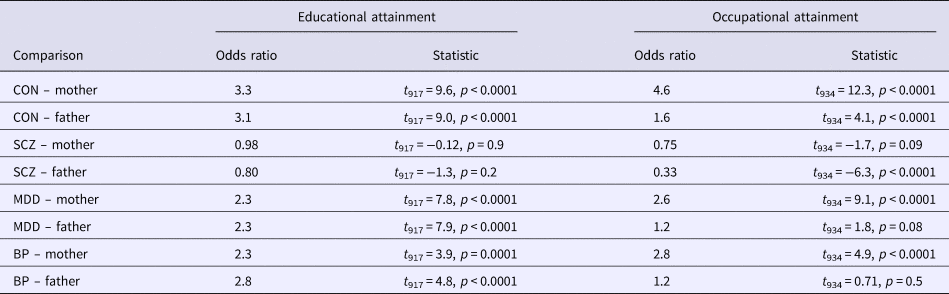
In the general population, both educational (Ryan and Bauman, Reference Ryan and Bauman2016) and occupational (Wyatt and Hecker, Reference Wyatt and Hecker2006) attainment typically improve from one generation to the next. For example, between 1965 and 1980, when 89% of the included postmortem subjects were at least 25 years of age, the percentage of US males and females aged 25 years and older who completed high school increased by ~20% (Reference BureauBureau). Accordingly, across all probands, educational (F 2,917 = 48.9, p < 0.0001) and occupational (F 2,934 = 70.1, p < 0.0001) attainment were significantly greater than their parents. However, there was a significant interaction between generational differences and diagnostic group for both educational (F 6,917 = 8.3, p < 0.0001) and occupational (F 6,934 = 15.0, p < 0.0001) attainment. Educational attainment of proband unaffected comparison, major depressive disorder, and bipolar disorder subjects was significantly higher than either parent (Table 3). Similarly, occupational attainment of proband unaffected comparison subjects was significantly higher than either parent, and major depressive and bipolar disorder subject occupational attainment was higher relative to their mothers, but not their fathers (Table 3). In contrast, generational improvement in educational and occupational attainment was not found in subjects with schizophrenia relative to either parent, and occupational attainment was significantly worse than their fathers (Table 3).
Comparison of educational and occupational attainment in probands relative to parents

Unaffected comparison (CON); schizophrenia (SCZ); major depressive disorder (MDD); bipolar disorder (BP). Odds ratio >1 indicates the proband has higher odds of greater attainment than the parent.
These findings do not appear to be due to differences in parental attainment across proband diagnostic groups, as highest achieved education of mothers (F 3,462 = 1.1, p = 0.4) or fathers (F 3,450 = 1.0, p = 0.4), and highest achieved occupation of fathers (F 3,452 = 1.2, p = 0.3) or mothers (F 3,462 = 2.7, p = 0.05) did not significantly differ across proband diagnostic groups.
Discussion
Our findings address some of the key current challenges associated with interpreting postmortem findings of the neural substrates of cognitive impairments in schizophrenia. We found that the highest levels of lifetime educational and occupational attainment obtained via psychological autopsy were significantly lower in schizophrenia subjects relative to unaffected comparison, bipolar disorder, and major depressive disorder subjects, consistent with findings in living subjects (Keefe and Fenton, Reference Keefe and Fenton2007; Schaefer et al., Reference Schaefer, Giangrande, Weinberger and Dickinson2013; Rajji et al., Reference Rajji, Miranda and Mulsant2014; Vreeker et al., Reference Vreeker, Boks, Abramovic, Verkooijen, Van Bergen, Hillegers, Spijker, Hoencamp, Regeer, Riemersma-Van Der Lek, Stevens, Schulte, Vonk, Hoekstra, Van Beveren, Kupka, Brouwer, Bearden, Maccabe and Ophoff2016; Karpov et al., Reference Karpov, Joffe, Aaltonen, Suvisaari, Baryshnikov, Naatanen, Koivisto, Melartin, Oksanen, Suominen, Heikkinen and Isometsa2017). Also consistent with findings in living subjects (Keefe et al., Reference Keefe, Eesley and Poe2005; Keefe and Fenton, Reference Keefe and Fenton2007; Kendler et al., Reference Kendler, Ohlsson, Mezuk, Sundquist and Sundquist2016), we found that schizophrenia probands failed to show generational improvement in educational and occupational attainment relative to their parents. In contrast, unaffected comparison, major depressive disorder, and bipolar disorder subjects all showed the expected generational improvements in attainment. Together, these findings support (1) the robustness of using an expanded psychological autopsy to acquire information on postmortem subjects acquired via Medical Examiner collaboration, (2) that educational and occupational attainment can be used in postmortem studies to estimate the presence and severity of premortem cognitive deficits, and (3) that comparison to parental attainment may be the most sensitive measure of the presence and severity of cognitive deficits for studies of schizophrenia.
We also found that educational and occupational attainment in subjects with major depressive disorder was significantly lower than in unaffected comparison subjects, but significantly higher than in subjects with schizophrenia, consistent with findings in living subjects (Keefe and Fenton, Reference Keefe and Fenton2007; Harvey, Reference Harvey2011). Lifetime educational and occupational attainment did not differ between bipolar disorder and unaffected comparison subjects. These results are also in agreement with some studies in living subjects which show that individuals with bipolar disorder have unimpaired or even higher maximal educational (Depp et al., Reference Depp, Davis, Mittal, Patterson and Jeste2006; Martinez-Aran et al., Reference Martinez-Aran, Vieta, Torrent, Sanchez-Moreno, Goikolea, Salamero, Malhi, Gonzalez-Pinto, Daban, Alvarez-Grandi, Fountoulakis, Kaprinis, Tabares-Seisdedos and Ayuso-Mateos2007; MacCabe et al., Reference Maccabe, Lambe, Cnattingius, Sham, David, Reichenberg, Murray and Hultman2010; Vreeker et al., Reference Vreeker, Boks, Abramovic, Verkooijen, Van Bergen, Hillegers, Spijker, Hoencamp, Regeer, Riemersma-Van Der Lek, Stevens, Schulte, Vonk, Hoekstra, Van Beveren, Kupka, Brouwer, Bearden, Maccabe and Ophoff2016) and occupational (Depp et al., Reference Depp, Davis, Mittal, Patterson and Jeste2006) attainment relative to healthy comparison subjects. Finally, subjects with major depressive or bipolar disorder all showed the expected generational improvement in educational and occupational attainment relative to their parents.
Across all subjects with a psychiatric diagnosis, we found that age at illness onset had no significant effect on educational or occupational attainment. Younger age at onset, especially of schizophrenia, typically predicts a poorer prognosis (Semple and Smyth, Reference Semple and Smyth2013). However, the predictive ability of age of onset varies depending upon the population studied and the outcome measures used (reviewed in Leboyer et al., Reference Leboyer, Henry, Paillere-Martinot and Bellivier2005; Menezes et al., Reference Menezes, Arenovich and Zipursky2006; Peters et al., Reference Peters, Sylvia, Magalhaes, Miklowitz, Frank, Otto, Hansen, Dougherty, Berk, Nierenberg and Deckersbach2014; Joslyn et al., Reference Joslyn, Hawes, Hunt and Mitchell2016; Stentebjerg-Olesen et al., Reference Stentebjerg-Olesen, Pagsberg, Fink-Jensen, Correll and Jeppesen2016; Immonen et al., Reference Immonen, Jaaskelainen, Korpela and Miettunen2017). For example, meta-analyses have shown no significant effect of age on onset on various employment and education outcomes in schizophrenia (Menezes et al., Reference Menezes, Arenovich and Zipursky2006; Immonen et al., Reference Immonen, Jaaskelainen, Korpela and Miettunen2017), though a younger age of illness onset was associated with a worse aggregate measure of ‘social/occupational functioning’ (Immonen et al., Reference Immonen, Jaaskelainen, Korpela and Miettunen2017). Individual studies of major depressive or bipolar disorder show inconsistent effects, and suggest that the recurrent nature of the illnesses may be more influential on general prognosis than age of onset (Tondo et al., Reference Tondo, Lepri, Cruz and Baldessarini2010; Baldessarini et al., Reference Baldessarini, Tondo, Vazquez, Undurraga, Bolzani, Yildiz, Khalsa, Lai, Lepri, Lolich, Maffei, Salvatore, Faedda, Vieta and Tohen2012; Aminoff et al., Reference Aminoff, Hellvin, Lagerberg, Berg, Andreassen and Melle2013; Wilson et al., Reference Wilson, Hicks, Foster, Mcgue and Iacono2015; Joslyn et al., Reference Joslyn, Hawes, Hunt and Mitchell2016).
Although cognitive ability and educational and occupational attainment are strongly related in both the general population (Deary et al., Reference Deary, Strand, Smith and Fernandes2007; Strenze, Reference Strenze2007; Krapohl et al., Reference Krapohl, Rimfeld, Shakeshaft, Trzaskowski, Mcmillan, Pingault, Asbury, Harlaar, Kovas, Dale and Plomin2014) and in schizophrenia (Green et al., Reference Green, Kern and Heaton2004; Keefe and Fenton, Reference Keefe and Fenton2007; Nuechterlein et al., Reference Nuechterlein, Ventura, Subotnik, Hayata, Medalia and Bell2014), additional factors can influence these measures. For example, environmental factors, such as socioeconomic status (Hackman et al., Reference Hackman, Farah and Meaney2010; American Psychological Association, 2019), and genetically-influenced traits, such as personality (Poropat, Reference Poropat2009; Komarraju and Karau, Reference Komarraju and Karau2005; Jackson, Reference Jackson2006; Krapohl et al., Reference Krapohl, Rimfeld, Shakeshaft, Trzaskowski, Mcmillan, Pingault, Asbury, Harlaar, Kovas, Dale and Plomin2014) and motivation (Duckworth et al., Reference Duckworth, Quinn, Lynam, Loeber and Stouthamer-Loeber2011; Krapohl et al., Reference Krapohl, Rimfeld, Shakeshaft, Trzaskowski, Mcmillan, Pingault, Asbury, Harlaar, Kovas, Dale and Plomin2014), influence cognitive aptitude and attainment. Moreover, in individuals with schizophrenia, other symptom domains may, either individually or by an interaction with impaired cognition (Harvey et al., Reference Harvey, Koren, Reichenberg and Bowie2006; Couture et al., Reference Couture, Granholm and Fish2011; Cella et al., Reference Cella, Stahl, Morris, Keefe, Bell and Wykes2017), affect attainment. For example, severity of negative symptoms also predicts important functional outcomes, including educational and occupational attainment (McGurk and Meltzer, Reference Mcgurk and Meltzer2000; Milev et al., Reference Milev, Ho, Arndt and Andreasen2005; Tsang et al., Reference Tsang, Leung, Chung, Bell and Cheung2010; Fervaha et al., Reference Fervaha, Foussias, Agid and Remington2014; Ventura et al., Reference Ventura, Subotnik, Gitlin, Gretchen-Doorly, Ered, Villa, Hellemann and Nuechterlein2015). Thus, attainment measures of education and occupation are closely tied to, but do not solely reflect, cognitive aptitude.
Several observations suggest that the current results do not reflect the effects of selection bias or potential confounding factors. All subjects with confirmed diagnoses and educational and occupational attainment were included for study. Subject groups did not differ in mean age or racial composition but did differ in the proportion of males and females. However, sex is unlikely to be a confound in the current studies since (1) sex (in addition to age and race) were controlled for in all statistical testing, (2) proband educational and occupational attainment were similar in males and females within a diagnostic group (data not shown), (3) the male:female ratio was similar in schizophrenia and major depressive disorder subjects, but these groups differed in the main findings, (4) sex did not differ between unaffected comparison and schizophrenia subjects, and (5) sex cannot explain the superior achievements of bipolar disorder subjects since both males and females were equally present.
Interpreting many postmortem human studies of cognitive impairments in schizophrenia has faced three challenges: (1) the absence of premortem neurocognitive data, (2) the subsequent reliance on the assumption that cognitive aptitude in subjects included in postmortem human studies is comparable to studies of living subjects, and (3) the absence of individual cognitive measures precluding an assessment of any relationship between severity of neural alterations and severity of cognitive deficits. The current results directly address these challenges by demonstrating that multiple proxy measures of cognitive aptitude obtained during postmortem psychological autopsies show findings very similar to those in living subjects with schizophrenia, major depressive disorder, or bipolar disorder. Given that educational and occupational attainment can be readily obtained by postmortem human brain banks, and formal measures of cognitive ability have only been available in unique studies of elderly, chronically hospitalized subjects with schizophrenia and/or dementia (Humphries et al., Reference Humphries, Mortimer, Hirsch and De Belleroche1996; Purohit et al., Reference Purohit, Perl, Haroutunian, Powchik, Davidson and Davis1998; Martin-Ruiz et al., Reference Martin-Ruiz, Haroutunian, Long, Young, Davis, Perry and Court2003; Rapp et al., Reference Rapp, Schnaider-Beeri, Purohit, Reichenberg, Mcgurk, Haroutunian and Harvey2010), use of these proxy measures of cognition can be widely implemented in postmortem studies. As such, the current results demonstrate that these proxy measures of cognitive aptitude can be used in future studies to interrogate the molecular, cellular, and circuitry substrates of cognitive dysfunction within the same postmortem subjects in future studies.
Supplementary material
The supplementary material for this article can be found at https://doi.org/10.1017/S0033291719000382.
Author ORCIDs
David A. Lewis, 0000-0002-3225-6778
Acknowledgements
The authors gratefully acknowledge the digital graphics expertise of Mary Brady. Demographic data for some subjects was obtained from the NIH NeuroBioBank at the University of Pittsburgh Brain Tissue Donation Program.
Financial support
This work was supported by the National Institutes of Health (J.R.G., grant number MH107735; D.A.L., grant number MH043784); and the Brain and Behavior Research Foundation (J.R.G., grant number 23866).
Conflict of interest
Drs Glausier, Kelly, Salem, and Chen report no conflicts of interests. David A. Lewis currently receives investigator-initiated research support from Pfizer. In 2016–2018, he served as a consultant in the areas of target identification and validation and new compound development to Merck.