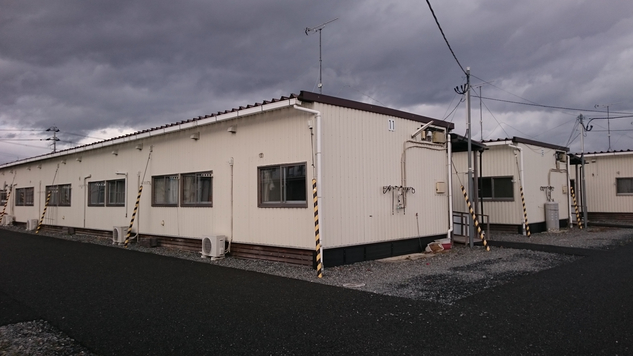
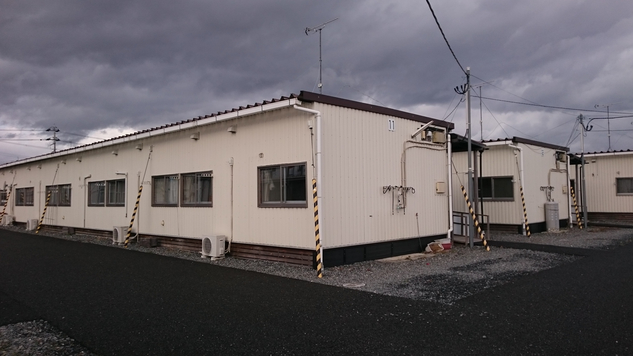
The Great East Japan Earthquake (GEJE) and subsequent tsunami brought massive damage to the Pacific coastal areas of northeast Japan on March 11, 2011. The damage was severe, especially in the Iwate, Miyagi, and Fukushima Prefectures in the Tohoku region. More than 400 000 buildings were destroyed (120 000 houses were completely destroyed, and 280 000 houses were partially destroyed),1 and approximately 350 000 survivors were forced to relocate.2 In Japan, temporary housing (Figure 1) is provided to those whose homes are completely destroyed and who cannot pay for a new home by themselves under the Disaster Relief Act. Prefabricated temporary housing has been used in previous large natural disasters such as the Great Hanshin Earthquake. Following the GEJE, prefabricated temporary housing (46%), public-funded rental housing (50%), and public housing, including national public officers’ housing and employment promotion housing (4%), were used as temporary housing all over Japan.3 More than 52 000 prefabricated temporary housing units were built in Japan; 22 000 were built in the Miyagi Prefecture alone.3 Many survivors were forced to live in prefabricated temporary housing.
Exterior of a Typical Prefabricated Temporary Housing.
One study found that children who experienced the GEJE had a higher risk of atopic dermatitis (AD) and asthma.Reference Ishikuro, Matsubara and Kikuya4 Though the mechanisms were incompletely understood, it was likely that psychological stress, resulting from the natural disaster, was involved in the exacerbation of eczema symptoms.Reference Kodama, Horikawa and Suzuki5
On the other hand, according to the survey conducted after the GEJE, prefabricated temporary housing was found to be associated with deterioration of indoor air environments.Reference Hasegawa, Yoshino and Yanagi6–Reference Shinohara, Tokumura and Kazama11 Several epidemiological studiesReference Cai, Liu and Hu12, Reference Bornehag, Sundell and Hagerhed-Engman13 suggested that dampness or chemical indoor pollutants were linked with the prevalence of allergic symptoms in children, although the biological mechanisms were not elucidated. Therefore, we hypothesized that children living in prefabricated temporary housing could have increased their risk of eczema and respiratory symptoms due to not only psychological stress, but also other factors such as indoor air environments.
Few reports were available on the effects of living in prefabricated temporary housing after a natural disaster on childhood allergy symptoms. The present study aimed to investigate the association between eczema or respiratory symptoms and types of housing 3–4 years following the GEJE, with consideration of the potential confounding effects of mental health symptoms.
METHODS
Study Design and Participants
The present study was based on the Tohoku University Tohoku Medical Megabank Organization (ToMMo) Child Health Study, conducted in 2014 and 2015, a cross-sectional survey of public school children in Miyagi Prefecture, Japan. The ToMMo Child Health Study sought to elucidate the health conditions regarding increased risk of illness or worsening of symptoms following the GEJE. The study design of the surveys was previously reported in detail.Reference Kikuya, Miyashita and Yamanaka14, Reference Miyashita, Kikuya and Yamanaka15 Ethical approval was obtained from the Institute Review Board of Tohoku University Graduate School of Medicine (No. 2012–1–278). The parents or guardians of the children provided informed consent to their participation in the study by completing and returning the questionnaire.
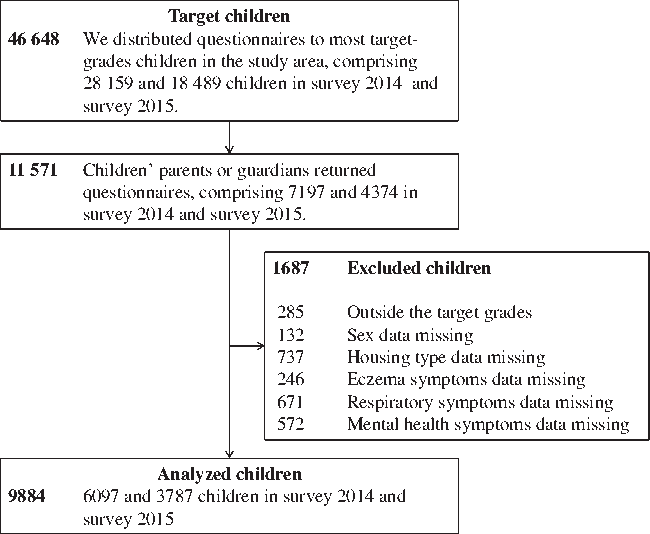
Among a total of 481 public schools, including elementary, junior high, and special needs schools (289 from Survey 2014 and 192 from Survey 2015) in a total of 39 municipalities (25 from Survey 2014 and 14 from Survey 2015), we surveyed children in the 2nd grade (ages 7 and 8 years), 4th grade (ages 9 and 10 years), and 6th grade (ages 11 and 12 years) of elementary school and children in the 8th grade of junior high school (ages 13 and 14 years). The questionnaire was distributed to a total of 46 648 children (28 159 from Survey 2014 and 18 489 from Survey 2015). It was completed by the parents or guardians at home. In total, 11 571 (24.8%) questionnaires (7197 from Survey 2014 and 4374 from Survey 2015) were received via mail to our laboratory. We excluded questionnaires from 1687 children because they were outside of the target grades (164 from Survey 2014 and 121 from Survey 2015) or because of missing responses for sex (81 from Survey 2014 and 51 from Survey 2015), types of housing (514 from Survey 2014 and 223 from Survey 2015), eczema symptoms (210 from Survey 2014 and 36 from Survey 2015), respiratory symptoms (455 from Survey 2014 and 216 from Survey 2015), or mental health symptoms (362 from Survey 2014 and 210 from Survey 2015). Finally, 9884 questionnaires (valid response rate, 21.2%), consisting of 6097 from Survey 2014 and 3787 from Survey 2015, were included in the present analysis (Figure 2).
Flowchart for the Selection of Participating Children.

Types of Housing
We asked about children’s housing as follows: In which type of dwelling do you and your children currently live? Answer choices were (1) prefabricated temporary housing; (2) private rental housing under a designated leasing system for people affected by the disaster; (3) rental housing not under a designated leasing system for people affected by the disaster; (4) home of family, friends, or relatives; (5) housing rebuilt at the same location as before the disaster; (6) housing rebuilt at a new location; (7) same housing as that before the disaster; and (8) other.
Assessment of Eczema, Respiratory Symptoms, and Mental Health Symptoms
To assess the presence of eczema and respiratory symptoms, the International Study of Asthma and Allergies in Childhood (ISAAC) Questionnaire was adopted.Reference Asher, Keil and Anderson16, Reference Nishima and Odajima17 The questionnaire was completed by the parents or guardians at home. Though grade 8 children were adolescents, their parents or guardians answered the questionnaire in the present study unlike an original ISAAC design. This questionnaire about the eczema symptom included the following questions: (1) Has your child ever had an itchy rash that was coming and going for at least 6 months? (2) Has your child had this itchy rash at any time during the past 12 months? and (3) Has this itchy rash at any time affected any of the following places: the folds of the elbows, behind the knees, in front of the ankles, under the buttocks, or around the neck, ears, or eyes? Based on the study by Odhiambo et al. Reference Odhiambo, Williams and Clayton18 and our previous studies,Reference Kikuya, Miyashita and Yamanaka14, Reference Miyashita, Kikuya and Yamanaka15 we determined the presence of eczema symptoms. If Questions 2 and 3 were answered with “yes,” eczema symptoms were classified as “present.” The presence of respiratory symptoms was determined as a positive response to the following ISAAC questionReference Asher, Keil and Anderson16, Reference Nishima and Odajima17: Has your child had wheezing or whistling in the chest in the last 12 months?
Mental health symptoms were assessed using the Japanese language version of the Strengths and Difficulties Questionnaire (SDQ).Reference Goodman19, Reference Matsuishi, Nagano and Araki20 The SDQ comprises 25 items with 3 response options (“not true,” “somewhat true,” and “certainly true”) categorized into 5 domains. SDQ total difficulties comprise 4 subcategories: emotional symptoms, conduct problems, hyperactivity/inattention, and peer problems. The clinical range for SDQ total difficulties was determined as scores of ≥ 16 out of 40 points.Reference Goodman19, Reference Matsuishi, Nagano and Araki20
Statistical Analysis
The prevalence rates of eczema or respiratory symptoms were calculated according to each type of housing. We used chi-squared tests to compare the proportions of categorical variables between groups. To calculate the odds ratios (ORs) and 95% CIs for the associations of types of housing with eczema or respiratory symptoms, we fitted generalized linear mixed models because the impact of the GEJE and subsequent tsunami varied among municipalities of residence. We computed the model with a logit link function that included a random effect for municipality of residence and types of housing as a fixed effect, adjusted for sex (boy or girl), school grade (grades 2, 4, 6, or 8), survey year (2014 or 2015), and mental health symptoms (clinical or not clinical), using a category of “same housing as that before the disaster” as a reference. The municipality of residence was defined as the municipality where the school was located. In Miyagi Prefecture, there were prefectural and municipal schools as public schools. Sixty-one children attending a prefectural school were excluded from the multivariable analyses because prefectural school students come to school from the whole areas of Miyagi Prefecture, and the municipalities of residence were likely different from those wherein the children’s schools were located. For subgroup analyses, the association of types of housing with eczema symptoms was analyzed stratifying by mental health symptoms (clinical or not clinical), adjusting for sex, school grade, and survey year in a similar manner.
All statistical analyses were performed using SAS software version 9.4 (SAS Institute Inc., Carey, NC, USA), and the significance level was defined at < 0.05 in 2-tailed tests.
RESULTS
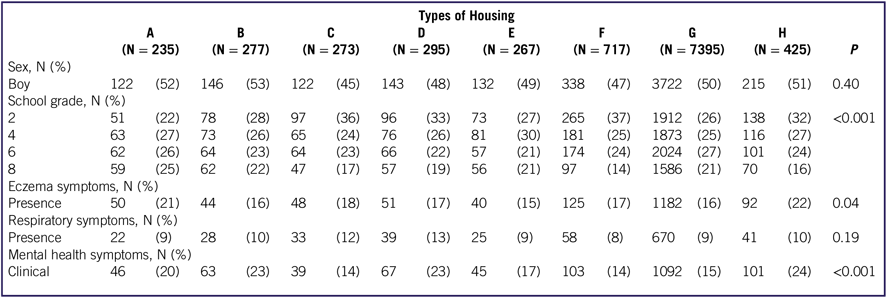
The participants’ characteristics are presented according to the types of housing in Table 1. The number of children by types of housing was 235 (2.4%) in prefabricated temporary housing; 277 (2.8%) in private rental housing under a designated leasing system for people affected by the disaster; 273 (2.8%) in rental housing not under a designated leasing system for people affected by the disaster; 295 (3.0%) in homes of family, friends, or relatives; 267 (2.7%) in housing rebuilt at the same location as before the disaster; 717 (7.3%) in same housing as that before the disaster; 7395 (75%) in housing rebuilt at a new location; and 425 (4.3%) in other. The rates of prefabricated temporary housing or public-funded rental housing were 2% to 3% regardless of the school grade, respectively. The number of children with eczema symptoms was 551 (20%) of 2710 in 2nd grade, 437 (17%) of 2528 in 4th grade, 392 (15%) of 2612 in 6th grade, and 252 (12%) of 2034 in 8th grade. The number of children with respiratory symptoms was 329 (12%) of 2710 in 2nd grade, 268 (11%) of 2528 in 4th grade, 229 (9%) of 2612 in 6th grade, and 90 (4%) of 2034 in 8th grade. Children living in prefabricated temporary housing tended to have a higher prevalence of eczema symptoms.
Characteristics of Participants by Types of Housing

The types of housing were subdivided into 8 categories: (A) prefabricated temporary housing; (B) private rental housing under a designated leasing system for people affected by the disaster; (C) rental housing not under a designated leasing system for people affected by the disaster; (D) home of family, friends, or relatives; (E) housing rebuilt at the same location as before the disaster; (F) housing rebuilt at a new location; (G) same housing as that before the disaster; and (H) other.
Children in school grades 2, 4, 6, and 8 were ages 7–8, 9–10, 11–12, and 13–14 years, respectively.
The presence of eczema and respiratory symptoms was assessed by the International Study of Asthma and Allergies in Childhood Questionnaire.Reference Kikuya, Miyashita and Yamanaka14, Reference Miyashita, Kikuya and Yamanaka15
The clinical category for mental health symptoms was determined using the Strengths and Difficulties Questionnaire total difficulties.Reference Odhiambo, Williams and Clayton18, Reference Goodman19
P-values were computed by chi-squared tests.
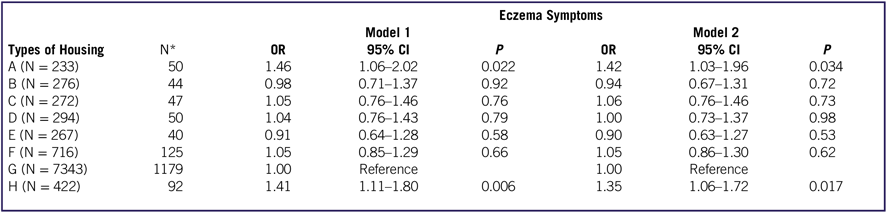
The prevalence rate of eczema symptoms for children living in prefabricated temporary housing tended to be higher than that for children living in other types of housing. Children living in prefabricated temporary housing had a significant association with eczema symptoms in Model 1 (OR, 1.46; 95% CI, 1.06–2.02; P = 0.022). After adjusting for the presence of mental health symptoms, similar results were observed in Model 2 (OR, 1.42; 95% CI, 1.03–1.96; P = 0.034) (Table 2). There were no significant interactions between eczema and sex (boy or girl; P for interaction = 0.80), school grade (grade 2, 4, 6, or 8; P for interaction = 0.96), survey year (survey 2014 or survey 2015; P for interaction = 0.19), or mental health symptoms (clinical or not clinical; P for interaction = 0.42).
Association Between Types of Housing and Eczema Symptoms
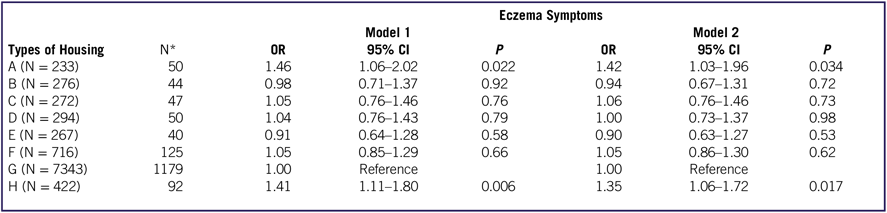
Types of housing were subdivided into 8 categories: (A) prefabricated temporary housing; (B) private rental housing under a designated leasing system for people affected by the disaster; (C) rental housing not under a designated leasing system for people affected by the disaster; (D) home of family, friends, or relatives; (E) housing rebuilt at the same location as before the disaster; (F) housing rebuilt at a new location; (G) same housing as that before the disaster; and (H) other.
The presence of eczema symptoms was assessed by the International Study of Asthma and Allergies in Childhood Questionnaire.Reference Kikuya, Miyashita and Yamanaka14, Reference Miyashita, Kikuya and Yamanaka15
Odds ratios (ORs) and 95% CIs were calculated in generalized linear mixed models and included a random effect for municipality of residence.
Model 1: Adjusted for sex, school grade, and survey year.
Model 2: Adjusted for sex, school grade, survey year, and presence of mental health symptoms.
Municipality of residence was defined as the municipality where the school was located. Sixty-one children attending the prefectural school were excluded from the analysis because the municipalities where the schools were located were likely to be different from the municipalities of residence.
* The number of children with eczema symptoms.
For subgroup analyses, children living in prefabricated temporary housing tended to have a higher prevalence of eczema symptoms, regardless of the presence of mental health symptoms (OR, 1.72; 95% CI, 0.91–3.23; P = 0.092) or absence of mental health symptoms (OR, 1.32; 95% CI, 0.90–1.94; P = 0.15). OR for the association of prefabricated temporary housing in children with mental health symptoms tended to be higher than that in children without mental health symptoms.
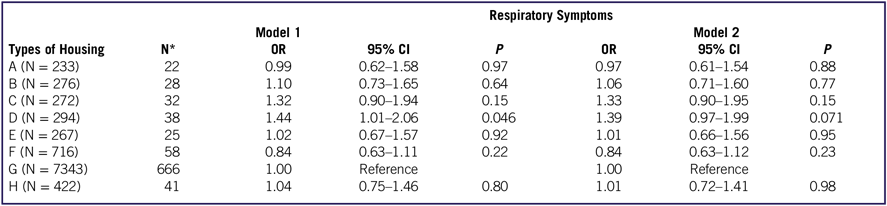
The prevalence rate of respiratory symptoms in prefabricated temporary housing was not higher than that observed in children living in other types of housing. Living in prefabricated temporary housing was not significantly associated with developing respiratory symptoms (OR, 0.97; 95% CI, 0.61–1.54; P = 0.88) (Table 3). There were no significant interactions between wheeze and sex (boy or girl; P for interaction = 0.83), school grade (grade 2, 4, 6, or 8; P for interaction = 0.81), survey year (survey 2014 or survey 2015; P for interaction = 0.35), or mental health symptoms (clinical or not clinical; P for interaction = 0.29).
Association Between Types of Housing and Respiratory Symptoms

The types of housing were subdivided into 8 categories: (A) prefabricated temporary housing; (B) private rental housing under a designated leasing system for people affected by the disaster; (C) rental housing not under a designated leasing system for people affected by the disaster; (D) home of family, friends, or relatives; (E) housing rebuilt at the same location as before the disaster; (F) housing rebuilt at a new location; (G) same housing as that before the disaster; and (H) other.
The presence of eczema symptoms was assessed by the International Study of Asthma and Allergies in Childhood Questionnaire.Reference Kikuya, Miyashita and Yamanaka14, Reference Miyashita, Kikuya and Yamanaka15
Odds ratios (ORs) and 95% CIs were calculated in generalized linear mixed models and included a random effect for municipality of residence.
Model 1: Adjusted for sex, school grade, and survey year.
Model 2: Adjusted for sex, school grade, survey year, and presence of mental health symptoms.
The municipality of residence was defined as the municipality where the school was located. Sixty-one children attending the prefectural school were excluded from the analysis because the municipalities where the schools were located were likely to be different from the municipalities of residence.
* The number of children with respiratory symptoms.
DISCUSSION
In the present study conducted in the disaster area at 3–4 years after the GEJE, children living in prefabricated temporary housing had a significant association with eczema symptoms. On the contrary, there was no significant association between prefabricated temporary housing and respiratory symptoms.
According to a previous study, preschool children who experienced the GEJE could have a higher risk of AD.Reference Ishikuro, Matsubara and Kikuya4 Our results showed that children living in prefabricated temporary housing had a significant association with exhibition of eczema symptoms. Psychological stress can affect neuroendocrine and immune functions and lead to exacerbations of stress reactive and inflammatory dermatoses.Reference Gupta, Jarosz and Gupta21 Inflammatory biomarkers are increased in patients with psychological stress.Reference Passos, Vasconcelos-Moreno and Costa22 Another study found that acute psychosocial stress disrupts the skin barrier function homeostasis.Reference Altemus, Rao and Dhabhar23 It was also reported that psychological stress caused by the Great Hanshin Earthquake could be responsible for the exacerbation of AD symptoms.Reference Kodama, Horikawa and Suzuki5 Based on the existing knowledge, we first hypothesized that psychological stress caused by changes in the residential environments may exacerbate skin conditions. We accordingly conducted an additional analysis adjusting for the presence of mental health symptoms. However, the subsequent results showed a similar tendency. Therefore, both mental health symptoms caused by changes in the residential environments and other factors such as indoor air environments could affect the exacerbation of eczema symptoms. Meanwhile, children classified as “other” also have a higher prevalence of eczema symptoms. Because each child in “other” had different living environments, it was impossible to evaluate the influence on eczema symptoms by living environment. The prevalence of mental health symptoms in the children classified as “other” tended to be high. For the children classified as “other,” psychological stress accordingly may be responsible for the exacerbation of eczema symptoms.
Several cross-sectional studies from Shanghai, Reference Cai, Liu and Hu12 Sweden,Reference Bornehag, Sundell and Hagerhed-Engman13 Ireland,Reference Duggan, Sturley and Fitzgerald24 and the United StatesReference Sun and Sundell25 reported that dampness-related exposures were linked with eczema in children. Prefabricated temporary housing is likely to cause damp indoor environments. One report suggested that dew condensation was liable to occur in prefabricated temporary housing after the GEJE.Reference Hasegawa, Yoshino and Yanagi26 In prefabricated temporary housing, condensation was previously found within windows, walls, floors, and ceilings in 50% of the structures sampled in the summer and 80% of those sampled in the winter. These rates are higher than those of normal residential houses in Japan. Further, higher carbon dioxideReference Yanagi, Yoshino and Hasegawa7 and higher fungal concentrationsReference Yanagi, Yoshino and Hasegawa8 were observed in prefabricated temporary housing units. In addition, 1 study found that the total volatile organic compounds (TVOCs) concentration was high in prefabricated temporary housing after the GEJE.Reference Oikawa, Takao and Murata9 A cohort study from Korea reported that exposure to high concentrations of TVOCs during infancy increased the risk of AD at 3 years of age. Therefore, children living in prefabricated temporary housing may develop eczema symptoms secondary to indoor air environments that are damp and/or feature chemical indoor pollutants, although definitive evidence is scarce.
In contrast, the prevalence of respiratory symptoms among children living in prefabricated temporary housing was not higher than that among children living in other types of housing. The WHO guidelines27 and 2 systematic reviewsReference Fisk, Lei-Gomez and Mendell28, Reference Bornehag, Blomquist and Gyntelberg29 previously described evidence of the association between damp indoor environments and respiratory symptoms. It remains unclear as to why there was no association of respiratory symptoms with prefabricated temporary housing, although it has a positive association with eczema symptoms. These results should be interpreted with caution. Further researches are needed to explore the exact mechanisms that lead to allergic symptoms.
To the best of our knowledge, this is the first report to demonstrate the associations between prefabricated temporary housing and childhood eczema and respiratory symptoms after a natural disaster. However, this study has several limitations. First, because the valid response rate was low (valid response rate, 21.2%), response bias may have occurred. Because the parents of children who responded to our survey may differ in specific ways from those who did not, careful interpretation is warranted. Nevertheless, our study had the advantage of covering almost all schoolchildren in our study area.Reference Kikuya, Miyashita and Yamanaka14, Reference Miyashita, Kikuya and Yamanaka15 Second, we did not consider additional confounding factors, including socioeconomic status. A previous survey from Japan reported that children with low household incomes had higher risks of eczema symptoms.Reference Sasaki, Yoshida and Adachi30 Possibly, children living in prefabricated temporary housing had a higher prevalence of eczema as a consequence of their low household incomes. Though children living not only in prefabricated temporary housing, but also in private rental housing under a designated leasing system for people affected by the disaster, and homes of family, friends, or relatives could have low household incomes on the grounds of the inability to rebuild or rent homes by themselves, our results showed that children living in prefabricated temporary housing were at a higher risk than those living in private rental housing under a designated leasing system for people affected by the disaster and homes of family, friends, or relatives. Therefore, we remain convinced that socioeconomic factors are not a main cause for development of eczema symptoms among children living in prefabricated temporary housing.
CONCLUSIONS
Children living in prefabricated temporary housing had a higher prevalence of eczema symptoms. Even after adjusting for the presence of mental health symptoms, our analysis produced similar results. In contrast, these children did not demonstrate a higher prevalence of respiratory symptoms in comparison with children residing in other residential environments. Further researches are needed to support our findings, with a detailed assessment of indoor air pollutants and careful control for confounding factors.
Acknowledgments
This work was supported by the MEXT Tohoku Medical Megabank Project and Japan Agency for Medical Research and Development (AMED) under Grant Number JP15km0105001. We would like to thank the Miyagi Prefectural Board of Education and the municipal boards of education in Shiroishi, Natori, Kakuda, Zao, Shichikashuku, Ogawara, Murata, Shibata, Kawasaki, Marumori, Kesennuma, Tome, Kurihara, Higashimatsushima, Osaki, Shichigahama, Taiwa, Osato, Ohira, Shikama, Kami, Wakuya, Misato, Onagawa, and Minamisanriku for participating in the study.
Conflict of Interest Statement
The authors have no conflicts of interest to declare.
Authors’ Contributions
YK and S Kuriyama designed the study and drafted the manuscript. MK, MM, CY, MI, TO, HM, NN, FN, HT, AH, IT, S Kure, NY, and S Kuriyama contributed to the data collection. YK and S Kuriyama performed the statistical analysis and interpretation of the results. All authors have read and approved the final manuscript.