In the last several decades, the world has seen increasing outbreaks of novel, emerging, or re-emerging infectious diseases. Many carry high case-fatality rates, lack effective treatment or prophylaxis, and spread person to person, requiring infection control and public health countermeasures for outbreak control. Nosocomial transmission of these high-consequence infectious diseases (HCIDs) 1 , such as Ebola virus disease (EVD), Reference Chevalier, Chung and Smith2,Reference Lopaz, Amela and Ordobas3 Crimean–Congo hemorrhagic fever (CCHF), Reference Tsergouli, Karampatakis, Haidich, Metallidis and Papa4 severe acute respiratory syndrome (SARS), Reference Cheng, Chan, To and Yuen5 and Middle East respiratory syndrome (MERS) Reference Hui, Azhar, Kim, Memish, Oh and Zumla6 highlight the need for comprehensive infection prevention and control (IPC) to mitigate risk to healthcare personnel (HCP) and patients.
High-level isolation units (HLIUs) have been established globally to optimize clinical care while mitigating the risk of nosocomial transmission of HCIDs. This has been accomplished by building clinical expertise in HCID care and implementing the hierarchy of controls, with an emphasis on engineering controls, administrative controls, and correct and consistent use of personal protective equipment (PPE) appropriate for the pathogen and task. Reference Bannister, Puro and Fusco7,Reference Smith, Anderson and Christopher8 Few such units existed globally prior to the early 2000s; however, in response to increasing regional and global threats of HCIDs following the 2003 SARS pandemic and the 2001 US anthrax attacks, additional HLIUs were constructed in the United States, Europe, and Asia. Reference Cieslak and Kortepeter9,Reference Brouqui, Puro and Fusco10 The number of HLIUs has expanded since the 2013–2016 West Africa EVD epidemic. In the United States, 55 hospitals were designated in 2015 as treatment centers for EVD, including the designation of 10 US regional Ebola and other special pathogen treatment centers (RESPTCs). Reference Kratochvil, Evans and Ribner11 However, many non-RESPTC facilities have since relinquished those capabilities due to funding and sustainability challenges. Reference Herstein, Biddinger and Gibbs12
In the mid-2000s, 2 separate consensus efforts were undertaken to establish guidelines and key design elements of HLIUs: a 2005 US consensus meeting of existing US HLIUs and stakeholders and a European consensus effort coordinated by the European Commission. The resulting consensus reports Reference Bannister, Puro and Fusco7,Reference Smith, Anderson and Christopher8,Reference Brouqui, Puro and Fusco10 represent hallmark publications related to HLIU design and operations. These focused regional initiatives aimed at identifying key components and consensus best practices of HLIUs, albeit with limited experience to draw from at the time.
In 2018, the US National Ebola Training and Education Center (NETEC), Reference Kratochvil, Evans and Ribner11 now named the National Emerging Special Pathogens Training and Education Center, hosted an international workshop with HLIUs from the United States, Europe, and Asia in Washington, DC, to discuss challenges, successes, and key elements of HLIU design and operations. We present the findings of the pre-workshop survey of global HLIUs. This survey represents the first global collection of approaches from HLIUs in Europe, Asia, and the United States with robust, successful experiences.
Methods
In February 2018, an electronic survey was distributed to 22 HLIUs located in the United States, Europe, and Asia that planned to participate in the International Workshop on High-Level Isolation held at the US National Institutes of Health in April 2018. Participation was voluntary, and individual responses were confidential. The survey assessed the HLIU general organization, operating costs, staffing models, and various aspects of comprehensive IPC programs. Data were coded and analyzed using descriptive statistics in an electronic spreadsheet. The survey (Supplementary Material online) was conducted in Qualtrics software (SAP, Provo, UT).
Results
Overall, 19 (86%) of the 22 facilities completed the survey; 8 (42%) of these 19 were US RESPTCs and 11 (58%) were HLIUs located outside of the United States in China, France, Germany, Italy, Japan, Norway, Singapore, Spain, South Korea, and the United Kingdom. All non-US HLIU surveys were completed by the lead physician or HLIU medical director. Respondents for US RESPTCs varied (eg, medical director, research director, program manager), although the larger HLIU team likely contributed to survey completion.
HLIU location, physical infrastructure, and funding
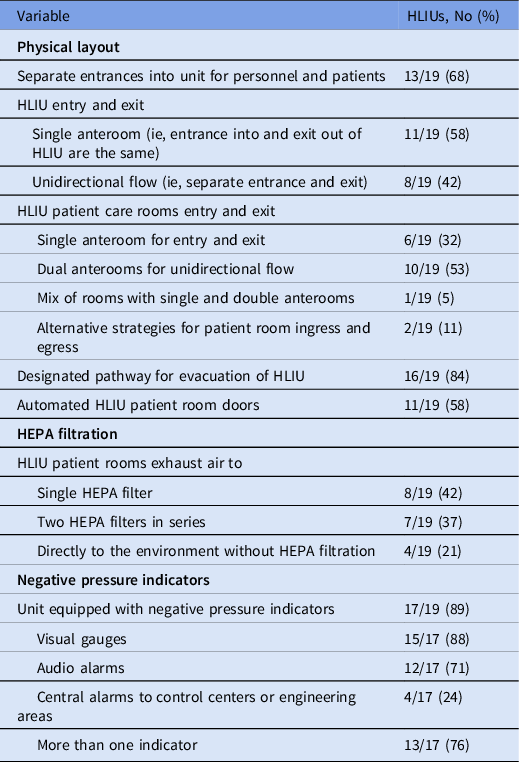
Overall, 11 HLIUs reported their location was in the main hospital building; 5 were in an independent or standalone facility and 3 were in another facility. All units had separate air handling from the rest of the building or encompassing unit. Moreover, 11 HLIUs (58%) were dedicated units (ie, used exclusively for treatment of HCIDs), and the other 8 (42%) were used routinely (ie, daily) for standard, non-HCID patient care. Physical infrastructure capabilities of responding units are detailed in Table 1.
Physical Infrastructure Features Reported by Responding High-Level Isolation Units (HLIUs)

Note. HEPA, high-efficiency particulate air.
The mean annual reported operating budget (N = 13, in US dollars) for units was $484,615 (median, $500,000; range, $80,000–800,000). The primary source of funding for HLIUs was national or federal government in 17 (89%) of 19 HLIUs; 2 facilities (11%) reported that the hospital was the primary funding source.
HLIU communication strategies
HLIUs employed communication systems to enable patient-to-HCP communication without entering the isolation room, and 16 responding units (84%) used >1 strategy: 15 (79%) used telephones, 11 (58%) used video, 10 (53%) used an intercom system, 7 (37%) used white boards, 2 (11%) used head sets, and 4 (21%) used other strategies. Similar strategies were employed for HCP-to-HCP communication: 15 (79%) respondents used telephones, 11 (58%) used video, 12 (63%) used an intercom system, 8 (42%) used white boards, and 4 (21%) used head sets.
Patient populations, surge planning, and clinical modalities
Overall, 13 (68%) of 19 responding units could accept a noncritically ill patient with a suspected or confirmed HCID within 4 hours of notification; all others reported up to 8 hours. For critically ill patients, 2 units reported >8 hours of notification required.
All 19 units reported that they cared for adults; 15 units (79%) cared for pregnant women, 14 (74%) cared for children, and 9 (47%) cared for neonates. The mean number of HLIU beds was 6.37 (median, 4; range, 2–20) for adults and 4.23 (median, 2; range, 1–10) for children; however, capacity was dependent on pathogen (Table 2). Moreover, 15 facilities (79%) reported a surge plan for increased high-level isolation demand. Of these, all plans addressed beds, PPE, and medical instruments (eg, ventilators); 10 (67%) of these 15 units addressed waste management and 12 (80%) included strategies for increased demand for HLIU staff (eg, recruitment of additional staff, modification of time shifts). Respondents reported a mean of 35.3 isolation beds (single bed with negative pressure) available for HCID surge capacity (median, 10; range, 2–127).
Maximum Capacity of High-Level Isolation Units (HLIUs) When Configured for Viral Hemorrhagic Fevers (VHFs) and High-Consequence Respiratory Diseases such as Middle East Respiratory Syndrome (MERS) and Novel Influenza

All responding units reported policies and procedures to perform mechanical ventilation, continuous renal replacement, central venous catheter placement and management, ultrasound, and radiograph. Other modalities teams would perform within the HLIU: 11 units had a team for nonemergent deliveries, 9 had a team for prone positioning, 9 had a team for emergency surgeries, 5 had a team for ECMO, and 2 had a team for autopsies, 2 had a team for MRI, and 2 had a team for computed tomography.
Pathogens requiring admission to HLIU
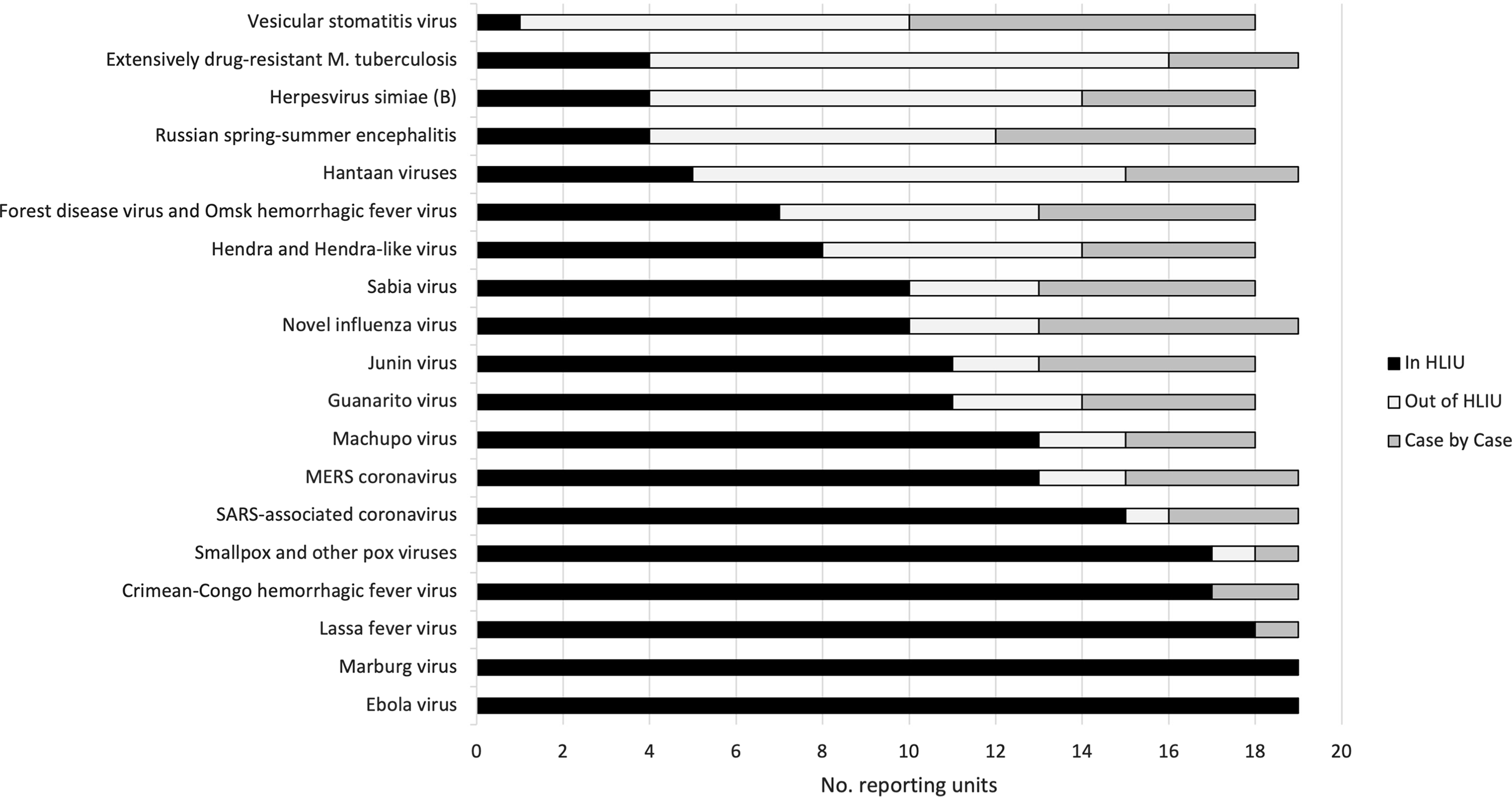
Respondents reported on the preferred location of care specific to the confirmed pathogen (Fig. 1). Of 19 respondents, 17 (89%) had treated a suspected or confirmed case of at least 1 of the pathogens displayed in Figure 1. Moreover, 9 units (47%) had treated confirmed patients with EVD, and another 6 units had treated suspected cases of EVD. HLIUs reported experience with the following pathogens: 9 (47%) reported experience with extensively drug-resistant TB, 4 (21%) reported experience with Lassa fever, 4 (21%) reported experience with Hantavirus disease, 3 (15.8%) reported experience with SARS, 3 (15.8%) reported experience with novel influenza, 2 (10.5%) reported experience with CCHF, 2 (10.5%) reported experience with MERS, and 2 (10.5%) reported experience with herpesvirus simiae (B) infection.
Reported preferred location of care, by pathogen. Note. HLIU, high-level isolation unit.

HLIU organization, staffing, and training
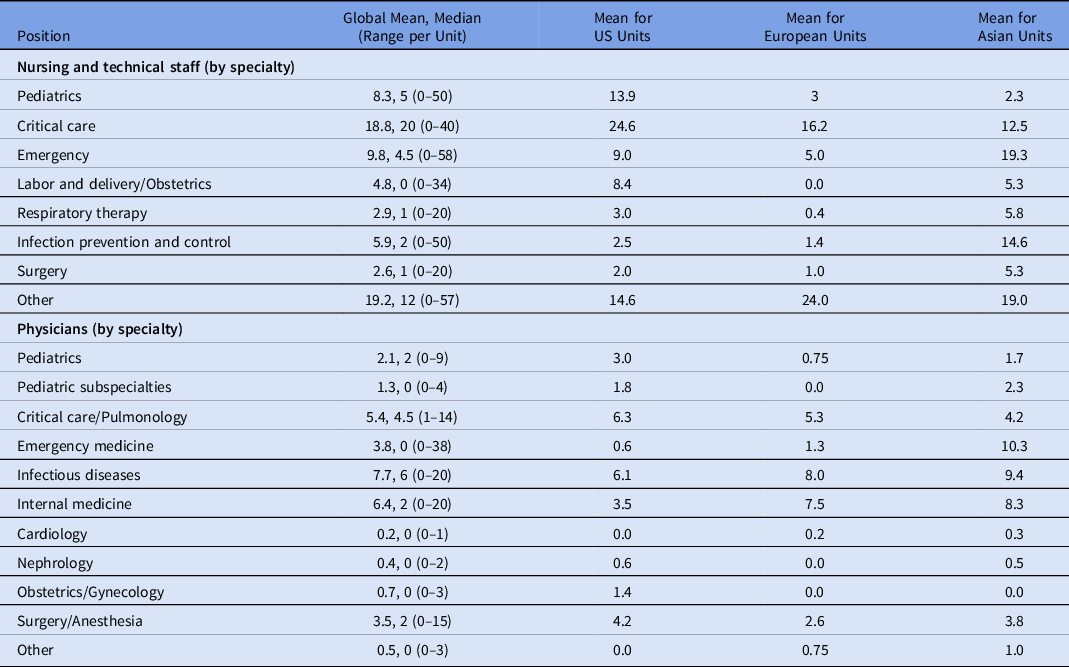
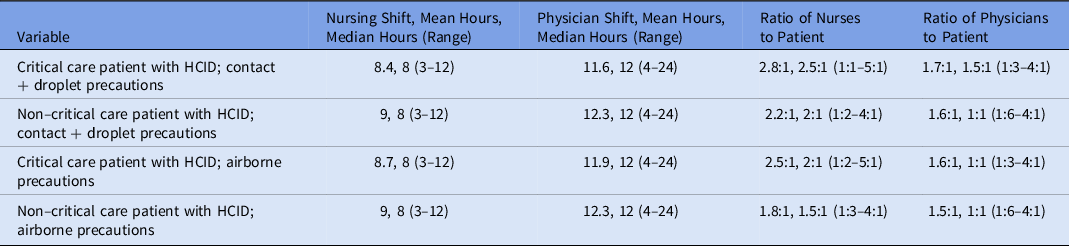
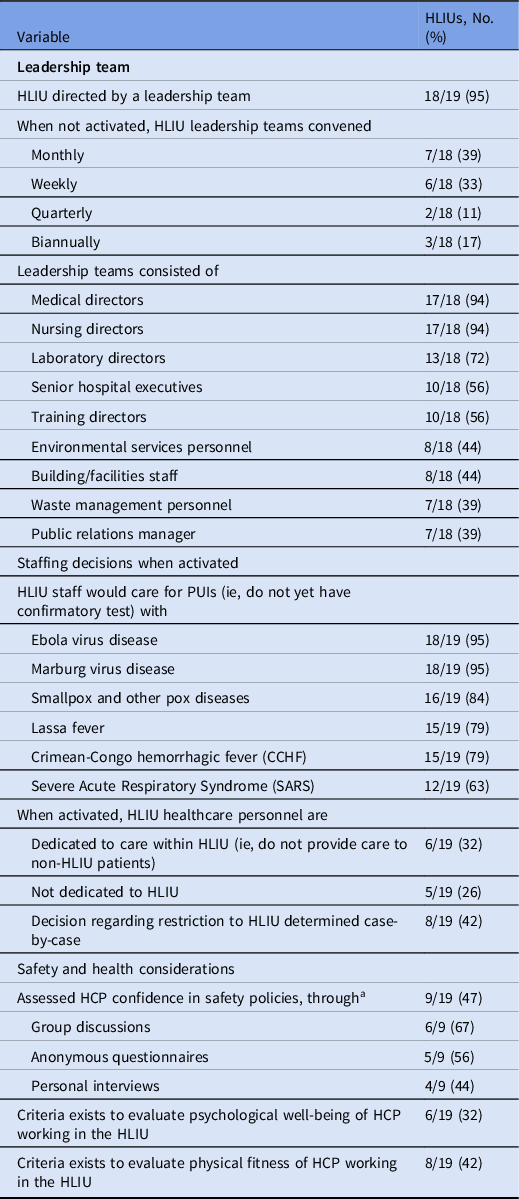
Among the 19 HLIUs, 9 (47%) reported that their staff were entirely voluntary, 5 (26%) reported that their staff were entirely nonvoluntary, and 5 (26%) had both volunteer and assigned staff. Reported composition of trained teams, detailed in Table 3, included a broad range of clinical and nonclinical roles. Also, 15 units (79%) reported different staffing models based on patient acuity or isolation precautions (Table 4). Table 5 describes HLIU leadership team composition and staffing considerations.
Number of Staff Trained in Personal Protective Equipment (PPE) to Work in the High-Level Isolation Unit (HLIU) by Position

High-Level Isolation Unit (HLIU) Staffing Models for Nurses and Physicians Based on Patient Acuity and Isolation Precautions

Note. HCID, high-consequence infectious disease.
High-Level Isolation Unit (HLIU) Leadership Composition and Staffing Considerations

Note. PUI, patient under investigation; HCP, healthcare personnel.
a Some units were assessed in >1 way.
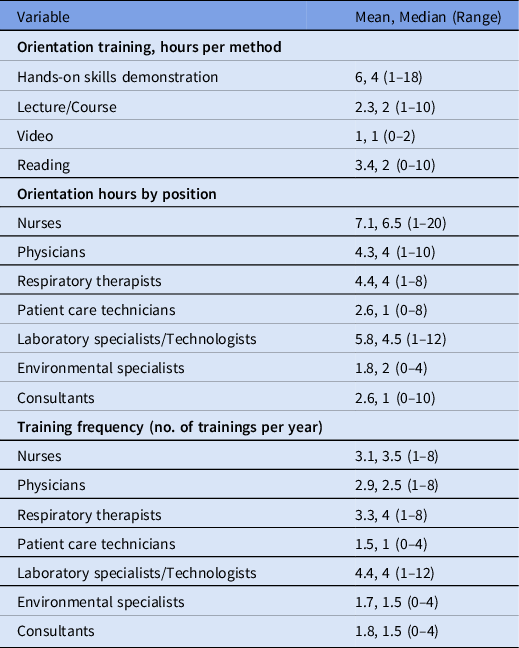
Of the 19 responding HLIUs, 18 (95%) required orientation training for new HCP prior to working in the unit, 16 (89%) of which consisted of an HLIU-specific training module, 6 (33%) of which included a hospital infection control module, and 1 (6%) included an internationally recognized training curriculum (eg, European training for infectious disease emergencies [ETIDE] Reference Baka, Fusco and Puro13 ). Also, 15 units reported trainees had to successfully demonstrate competence (eg, perform manual skills or medical procedures) prior to working in the HLIU, and 13 of these 15 reported that HCP wore PPE during competency assessment. Also, 17 HLIUs (89%) required their HCP to undergo retraining. Methods of training and hours required for orientation by position are detailed in Table 6.
Methods of Orientation Training and Hours Required for Orientation by Staff Working in High-Level Isolation Units (HLIUs)

Cleaning and disinfection protocols and waste management
All respondents reported protocols for terminal disinfection of HLIU rooms: 8 (42%) included routine surface cleaning and disinfection; 10 (53%) used of both routine surface cleaning and disinfectant fogging or fumigation; 1 (5%) used fumigation only; and 2 (11%) also reported using ultraviolet germicidal irradiation (UVGI).
Among the 19 respondents, 18 (95%) described written protocols for disposal of liquid waste; among them, 8 (44%) of 18 chlorinated and then disposed liquid waste directly to the drains, 7 (39%) of 18 solidified and then disposed as solid waste, and 2 (11%) of 18 decontaminated by chlorination or peracetic acid with disposal into a dedicated drain system. Also, 10 units (53%) had built-in capacity for decontaminating liquid waste on site. Of these, 5 had steam or heat treatment systems and 5 had chemical treatment systems (beyond simply pouring a disinfectant such as bleach into the toilet or drain). Furthermore, 13 units (68%) had autoclaves for sterilization of HCID waste: 11 were located within the HLIU and 2 were located outside of the unit.
Laboratory
Of the 19 HLIU respondents, 13 (68%) prepared patient specimens for receipt by the laboratory using surface decontamination. Also, 5 used an air lock, 4 used a light box, and 2 used a dunk tank as adjunctive measures. Testing to establish the HCID diagnosis varied: 6 (32%) conducted testing on the same campus as the HLIU, 5 (25%) conducted testing in the same city, 3 (16%) conducted testing within the region. Furthermore, 3 facilities had the capability to do confirmatory testing within the unit, as approved by local public health. Routine clinical laboratory diagnostic testing (eg, chemistries, hematology) was performed within the patient care room in 4 HLIUs (21%), within the HLIU in 12 units (63%), and elsewhere on campus for 3 units (16%).
Discussion
Responding HLIUs represent some of the most experienced HLIUs in the world, with nearly all reporting that they had previously treated confirmed or suspected HCID cases. The variation in physical infrastructure, staff composition, and training requirements reported by units demonstrates the variety of approaches; indeed, standardization of HLIU physical infrastructure and processes is inherently challenging, given varying local and national regulations, physical space, and risk assessments. However, HLIUs do share common foundational elements, as previously recommended by European and US consensus efforts, including well-developed and practiced IPC processes and procedures, advanced engineering controls, and well-trained multidisciplinary healthcare teams.
HLIU capacity differed based on the disease, with capacity higher for respiratory pathogens. Limitations to bed capacity include both physical beds as well as dedicated staffing capacity. Reference Herstein, Biddinger and Kraft14 VHF care is intensive and may require higher HCP-to-patient ratios, as demonstrated by the survey responses presented here and by HLIUs with prior experience in VHF care. Reference Hewlett, Varkey, Smith and Ribner15 Most respondents distinguished adult bed capacity from pediatric beds, and several reported they could not offer care for special populations (eg, pregnant women and neonates) that require specific IPC protocols. Reference Kogutt, Sheffield and Whyne16
HLIUs expended, on average, US$484,615 per year to maintain capabilities (eg, staff training, ongoing validation of equipment, replacement of expired or consumed supplies). The dependence on national or federal funding by nearly every unit highlights the importance of sustained funding streams. Nondedicated units (ie, units used for normal hospital patient care) can offset costs by routine daily use; however, existing patients occupying the HLIU space must be relocated during trainings and exercises or activation, resulting in lost revenue and additional logistical and operational considerations. Reference Bannister, Puro and Fusco7,Reference Herstein, Biddinger and Gibbs12 These factors could influence decision-making criteria for HLIU admission (eg, related to suspected versus confirmed patients, diseases units would admit, and patient acuity). Reference Bannister, Puro and Fusco7
The decision to admit a patient into the HLIU could be based on varying factors, including the pathogen, patient acuity, relevant regulatory requirements, and financial considerations. There was consensus among survey respondents that EVD, CCHF, Marburg, Lassa fever, and smallpox would be managed in a HLIU; for the other diseases, use of HLIUs varied. Previous efforts have published lists of pathogens that warrant admission to an HLIU, 1,Reference Bannister, Puro and Fusco7,Reference Smith, Anderson and Christopher8,Reference Cieslak17 but no global consensus list currently exists. It is certainly possible that many of these emerging pathogens can and have been managed in conventional hospital settings; however, for pathogens that cause acute illness with high associated morbidity and mortality, that have few or no effective treatments, and that demonstrate the potential for human-to-human transmission, focused care in an HLIU is preferred to limit risk of nosocomial transmission and to preserve routine operational workflows in other hospital locations.
HCID management requires a multidisciplinary staff in part due to unique IPC considerations, the intensive nature of HCID care, and PPE requirements that limit duration of direct patient care shifts. HLIUs reported teams represent a broad scope of roles and expertise, including various clinical specialties, laboratory, training, and industrial hygiene. The breadth and size of HLIU teams, coupled with intensive orientation and ongoing training requirements, translate to a significant investment in ensuring fully trained teams for any potential activation. Not surprisingly, then, staff training was the most cited barrier in sustaining US high-level isolation capabilities in a 2019 survey. Reference Herstein, Le and McNulty18 Rigorous and sustained training is fundamental for HLIU operations because procedures are often different from routine practice and the consequences of inconsistent or incorrect implementation can be profound. In addition to well-developed protocols and procedures, units must ensure staff are trained and competent to think critically and assess risk, whatever the situation presents in these higher-risk environments. Despite the well-acknowledged need for highly trained staff, research is lacking on the effective number of orientation hours, optimal frequency and duration of serial training, and most effective delivery methods.
Most regional differences in HLIU capabilities related to rostered and trained staff. US HLIUs reported leadership teams met more frequently (either weekly or monthly) compared to units in Europe and Asia, where half of units met quarterly or twice per year. In the United States, staff were either entirely volunteer based (6 of 8) or had some volunteer and some assigned staff (2 of 8 units). Units in Asia were more likely to be completely nonvoluntary (3 of 5 units) or had some assigned staff (2 of 5 units), whereas units in Europe reported a mix: 3 of 6 units were entirely volunteer-based, 2 were entirely nonvoluntary, and 1 had some volunteer and some assigned staff. The US HLIUs reported teams trained more frequently (4.6 times per year) than units in Europe (2.6 times per year) or Asia (1.3 times per year). Similarly, HLIU physicians trained 4.3 times per year at US HLIUs, 2.2 times per year at European HLIUs, and 1.3 times per year at Asian units, respectively. We also noted differences reported in the number of trained staff members by speciality across regions (Table 3). Lastly, all US RESPTCs were located in the main hospital building, whereas 7 of 11 units in Europe and Asia were reported to be independent or standalone facilities or in a smaller building separate from the main building.
Although we aimed to provide a diverse, global perspective on HLIU operations, this study has several limitations. Data were self-reported. The differing physical layouts of HLIUs coupled with the survey methodology may not have allowed for nuanced responses. Indeed, 1 respondent reported that 2 separate units exist, used for different diseases, which contributed to challenges in answering survey questions. In addition, the survey was disseminated to known global HLIUs; however, we recognize that other such units may have existed. Lastly, this survey was conducted 2 years before the coronavirus disease 2019 (COVID-19) pandemic; although COVID-19 does not warrant HLIU admission, it is possible that HLIUs and the institutions they represent have altered their design, operations, and decision-making criteria as a result of the pandemic, and these changes are not reflected here. A follow-up analysis should be done to assess how COVID-19 has impacted HLIU approaches, including decision-making criteria for admitting patients with emerging respiratory pathogens, such as MERS coronavirus, and scaling up of HLIU capabilities when cases of an emerging infectious disease outpace capacity. Moreover, future studies of global HLIUs should explore the role of these specialized units (eg, highly trained personnel, exercised standard operating procedures, infrastructure) during the early stage of the COVID-19 pandemic, when a lack of information about the novel pathogen gave rise to unprecedented uncertainty in how healthcare systems and HCP should optimally and most safely respond.
In conclusion, these survey results represent a critical step in disseminating physical and organizational structures and challenges reported by select HLIUs worldwide. These data are important considerations for hospitals considering the design and development of HLIUs, and there is a need for continued global HLIU collaboration to define best practices. Indeed, a number of technical questions unique to HLIUs remain unanswered related to physical design, PPE protocols, cleaning and disinfection, and staffing and training. Even as focus remains on the COVID-19 pandemic, the emergence of EVD outbreaks and ongoing cases of MERS in the Middle East demonstrate the continued need to enhance infrastructure and capabilities of these units in preparation for the next HCID event.
Supplementary material
To view supplementary material for this article, please visit https://doi.org/10.1017/ice.2021.477
Acknowledgments
Financial support
NETEC is funded by US Department of Health and Human Services Office of the Assistant Secretary for Preparedness and Response and the Centers for Disease Control and Prevention (CFDA no. 93.825).
Conflicts of interest
E. Toner and M. Shearer report their institution was contracted by NETEC to facilitate the international workshop on high-level isolation units for which the survey was conducted. E. Toner, M. Shearer, and E. Nicastri report travel expenses were provided by NETEC to them to attend the high-level isolation unit workshop. J. Herstein, S. Vanairsdale, A. Vasa, A. Echeverri, E. Shenoy, and J. Lowe report that their institutions received funding from the NETEC grant to support their involvement in the survey distribution, design, and/or analysis. T. Wolf reports consultancy with Gilead, Merck Sharp Dome, and Janssen. All other authors report no conflicts of interest.