Introduction
Oriental fruit fly, Bactrocera dorsalis Hendel, is a highly polyphagous pest of fruits and vegetables in the South-east Asian region and the Pacific. It is known to infest over 250 species of host plants ranging from peaches, citrus and mango to coffee and chilli pepper (Clarke et al., Reference Clarke, Armstrong, Carmichael, Milne, Raghu, Roderick and Yeates2005). Female B. dorsalis oviposit in fruits where the larvae develop and this development is associated with the rapid rotting of fruits. Because it often lives in environments with rich microbial populations, B. dorsalis is thought to be rich in induction of antimicrobial peptides. To our knowledge, novel antimicrobial peptides such as Bactrocerin-1 have been uncovered and bioassayed from this pest (Dang et al., Reference Dang, Tian, Yi, Wang, Zheng, Li, Cao and Wen2006, Reference Dang, Tian, Yang, Wang, Ishibashi, Asaoka, Yi, Li, Cao, Yamakawa and Wen2009). With the wide application of next generation sequencing technology, large quantities of immune related genes are found in B. dorsalis as well (Yang et al., Reference Yang, Yuan, Cong, Xie and Wang2014). However, the functions of these immune related genes remain elusive.
Insects have been shown to have strong and effective defense systems without acquired immunity against invading microorganisms (Hoffmann, Reference Hoffmann2003; Lemaitre & Hoffmann, Reference Lemaitre and Hoffmann2007). For insects, robust induction of antimicrobial peptides in the fat body and hemocytes is one of its unique properties (Imler & Bulet, Reference Imler and Bulet2005). Several lines of evidence indicate that the nuclear factor κB (NF-κB) pathways play a major role in the host defense of Drosophila melanogaster (Hetru & Hoffmann, Reference Hetru and Hoffmann2009; Gilmore & Wolenski, Reference Gilmore and Wolenski2012). In D. melanogaster, three NF-κB family members, Dorsal, Dorsal-related immunity factor (Dif) and Relish, have been found to control the expression of genes encoding immune-responsive peptides and proteins (Hetru & Hoffmann, Reference Hetru and Hoffmann2009). Dorsal and Dif are activated by the Toll signaling pathway in response to infection by gram-positive bacteria and fungi. In contrast, Relish is triggered by the immunodeficiency (Imd) pathway in response to infection by gram-negative bacteria. The common and paramount characteristics of Rel/NF-κB family members is the existence of Rel homology domain (RHD), which mediated the binding of Rel/NF-κB protein to DNA, and the dimerization of Rel protein (Dushay et al., Reference Dushay, Åsling and Hultmark1996; Ghosh et al., Reference Ghosh, May and Kopp1998, Reference Ghosh, Wang, Huang and Fusco2012; Myllymäki et al., Reference Myllymäki, Valanne and Rämet2014). Although several decades of invertebrate Relish gene sequence, including beetles, termites, bees, ants, wasps, mosquitoes and flies, has been registered into GenBank, the information on their function is still unavailable with exception of D. melanogaster (Stöven et al., Reference Stöven, Ando, Kadalayil, Engström and Hultmark2000), Aedes aegypti (Antonova et al., Reference Antonova, Alvarez, Kim, Kokoza and Raikhel2009) and Anopheles gambiae (Meister et al., Reference Meister, Kanzok, Zheng, Luna, Li, Hoa, Clayton, White, Kafatos, Christophides and Zheng2005). Therefore, studies need to be extended beyond these model species to gain a full understanding of Relish function in insect immunity.
The huge economic loss caused by B. dorsalis has prompted several kinds of pest management strategies to reducing its population: pheromone traps, pesticide spray, biological control and the sterile insect technique. The use of pesticides is a primary method to control B. dorsalis, but it has been compromised by pesticide resistance, where numerous cases of resistance adoption have been observed in Taiwan (Hsu & Feng, Reference Hsu and Feng2006; Hsu et al., Reference Hsu, Chien, Hu, Chen, Wu, Feng, Haymer and Chen2012) and the mainland of China (Jin et al., Reference Jin, Zeng, Lin, Lu and Liang2011). From this perspective, it is urgent to develop the novel control strategies to continuously manage the population of B. dorsalis. Although several species of braconid parasitoids have been found, their control efficiency on B. dorsalis is very limited (Vargas et al., Reference Vargas, Ramadan, Hussain, Mochizuki, Bautista and Stark2002). It is generally accepted that insects employ innate immune responses to fight against pathogens. Nevertheless, rare data are still available on the mechanisms underlying the innate immune responses of B. dorsalis. Therefore, investigations on the immune responses of B. dorsalis are advisable and helpful to uncover a new target to disrupt its immune defenses. In the present study, a NF-κB factor homolog, designated as BdRelish, was cloned and functionally analyzed by RNAi strategy to enrich current knowledge of B. dorsalis immunity.
Methods
Insects
All flies used in this study were collected from the established laboratory colony that has been cultured for at least 20 generations in laboratory. The colony was maintained in cubical screen cages (0.3 × 0.3 × 0.3 m3) and supplied with abundant food (sugar: yeast extract powder in a 3:1 ratio by weight) and water ad libitum. Fifteen days later, adults become sexually mature, fresh bananas pricked with small holes were placed into the cage as an ovipositional substrate and eggs hatched there. Three days later, the bananas were transferred to a plastic container filled with wet sand, and the larvae jumped into the wet sand and pupated after 1–2 days. They were maintained at 28°C and 70–80% RH and received both natural and artificial light in a 12 h day/night cycle. Fifteen days after emergence, the adults were collected for further experiments.
Cloning and sequencing the full length of Relish cDNA
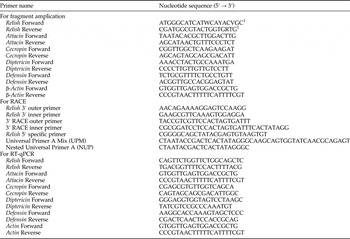
Total RNA was extracted from the different tissues including midgut, head and fat body using TRIzol Reagent (Invitrogen, Carlsbad CA, USA) as described in the manufacturer's protocol. The extraction of total RNA from the above tissues was independently replicated for three times and 15 adult flies were dissected in each replication. RNA quality and concentration was assessed and determined by electrophoresis on 1% agarose gel and a Thermo scientific Nanodrop 2000, respectively. A 1 µg total RNA was used to synthesize the 1st strand cDNA by PrimeScript™ Double Strand cDNA Synthesis Kit (Takara Biotechnology CO., Dalian, China) with an oligo(dT)18 primer following the manufacturer's instructions. Two degenerate primers (BdRelF and BdRelR, table 1) were designed based on the conserved region of published Relish sequences of six insect species, D. melanogaster (GenBank accession no. AAF20133), Aedes aegypti (GenBank accession no. AAM97895), Anopheles gambiae (GenBank accession no. 38993), Bombyx mori (GenBank accession no. BAF74126), Glossina morsitans morsitans (GenBank accession no. AAZ91474) and Nasutitermes magnus (GenBank accession no. AAZ08474). Touch-down polymerase chain reaction (PCR) reactions were run in 25 µl reaction system with 1 cycle of denaturation at 94°C for 3 min, 15 cycles at 94°C for 35 s, 54–0.5°C per cycle for 40 s, 72°C for 50 s, and 28 cycles 94°C for 35 s, 46°C for 40 s and 72°C for 50 s, followed by a 3 min extension at 72°C. The PCR products were cloned into pMD18-T EASY vector (Takara Biotechnology CO., Dalian, China) and sequenced. Based on the obtained partial cDNA sequence, rapid amplification of cDNA end (RACE) was performed. Specific primers 3′ BdRel1F and 3′ BdRel2F (table 1) were employed for 3′ RACE. Specific primers 3′ BdRel1R and 3′ BdRel2R (table 1) were used for 5′ RACE. 3′ RACE Outer Primer, 3′ RACE Inner Primer and Universal Primer A Mix (UPM) was used for 3′ RACE and 5′ RACE, respectively. Usually, 3′ RACE and 5′ RACE were completed by nested and touchdown PCR following the instruction of 3′-Full RACE Core Set Ver.2.0 (Takara Biotechnology CO., Dalian, China) and SMARTer™ RACE cDNA Amplification Kit (Clontech, Palo Alto CA, USA), respectively.
List of the primers used in this study.

1 Y = C or T; M = A or C; R = A or G; S = C or G; W = A or T; V = A, G or C; N = A, T, C or G.
Sequence analysis
The open read frame within the full length cDNA of Relish was determined based on alignments with registered full length Relish sequences derived from NCBI's GenBank database through Blast X analysis. The amino acid sequence of BdRelish protein was deduced with ExPASy software (http:www.expasy.org). The molecular weight of the protein was calculated based upon its amino acid constituency using the Compute pI/Mw tool (http://www.expasy.org/tools/pi_tool.html). Simple modular architecture research tool (SMART, http://smart.embl-heidelberg.de/) was used to analyze the deduced amino acid sequence of BdRelish. PSORT II software was run to detect if nuclear localization sequence was present in the protein encoded by BdRelish (http://psort.hgc.jp/form2.html). PEST domain and target sites for phosphorylation by casein kinase II were predicted by epestFIND (http://emboss.bioinformatics.nl/cgi-bin/emboss/epestfind) and Group-based Prediction System 2.1.2 (Xue et al., Reference Xue, Liu, Cao, Ma, Gao, Wang, Jin, Zhou, Wen and Ren2011), respectively. The full amino acid sequence of BdRelish was aligned with 28 published amino acid sequences of Rel/NF-kB family members from other species. Maximum likelihood trees were generated from multiple sequence alignments using the software of molecular evolution genetic analyses MEGA (version 5.0). Bootstrap analysis of 1000 replicates was run to determine the confidence of tree branch positions.
Expression analysis by reverse transcription (RT)-qPCR
A 1 µg total RNA from different tissues such as midgut, head and fat body were used to synthesize cDNAs by Thermo Scientific Verso cDNA Kit (Thermo Scientific, USA). The qRT-PCR was conducted using Power SYBR® Green qPCR Master Mix (Life technologies, USA) with a 20 µl reaction volume containing 250 nm primer and 100 ng cDNA in an ABI 7500 System. As an internal loading control, BdActin cDNA fragment was amplified with primers ActinF and ActinR (table 1). Standard curves of each gene were prepared via serial dilutions (10×) of cDNA samples to be sure that the amplification efficiencies of the primer pairs are between 90 and 110%. The PCRs were run under the following conditions: denaturation at 95°C for 10 min, 40 cycles of 95°C for 15 s, 60°C for 1 min and with a dissociation step. The expression level of BdRelish and four antimicrobial peptide genes were normalized to that of BdActin by the method of ΔΔCt. All calculations were completed by the accompanying software of ABI 7500 System.
Preparation of double-stranded RNA (dsRNA)
dsRNA corresponding to nucleotides 2660–3264 of Relish cDNA (GenBank accession no. KJ959618) was generated by the MEGAscript RNAi kit (Ambion, Austin, TX, USA). T7 promoter sites were added to the specific PCR primers of Relish. The sequences of the specific primers used were BdRelishF (5′-taatacgactcactatagggATAGCCAGTGATAATCCG-3′) and BdRelishR (5′-taatacgactcactatagggTTGTAGCCTAACGATGTG). PCR reactions were performed to obtain complementary templates with a single T7 promoter site. T7 RNA polymerase was used to transcribe single-stranded RNA (ssRNA) from each DNA template for 4 h at 37°C. Relish dsRNA was generated by incubating the mixing solutions containing equal amounts of complementary ssRNA at 75°C for 5 min and allowing the solution to cool to room temperature. DNA and ssRNA were removed from the solution by digestion with DNase I and RNase at 37°C for 1 h. The dsRNA was purified using the purification cartridges provided in the kit, and dsRNA was eluted with two successive 50 µl pre-heated (95°C) RNase-free water. Finally, the concentration of dsRNA was determined by a Thermo scientific Nanodrop 2000. dsRNA of eGFP was also generated as above to be used in the control treatments.
RNAi experiments
Gene silencing experiments were performed by injecting 138 nl of a 1 µg µl−1 solution of dsRNA into the thorax of cold-immobilized 15 day-old adults. The delivery of dsRNA was completed through using the Nanoliter 2010 injector (World Precision Instruments, Sarasota, USA). dsRNA of eGFP (enhanced green fluorescent protein) was used as the negative control in the present study. At 24 h after the injection of dsRNA, the treated adults were used to determine the transcription profiles of four antimicrobial peptide genes (Attacin, Diptericin, Defensin and Cecropin) and survival percentage of RNAi adults after bacterial challenge in the following treatments to reveal the potential role of Relish in the antibacterial defense. The experiments on the survival analysis of adults were repeated for two times and 50 flies were treated in each replication.
Bacteria challenge to adults before and after dsRelish silencing
Gram negative bacteria E. coli DH5α and gram positive bacteria Staphylococcus aureus were used as the pathogen to challenge the individuals in this study. These bacteria species was cultured at 30°C overnight with OD600 = 1 in Luria-Bertani's (LB) medium (1000 ml distilled water, 10 g tryptone, 5 g yeast extract, 10 g NaCl and pH 7.2). The 1 ml cultured bacteria solution were centrifuged with the velocity of 12,000 g under room temperature and discarded the supernatant and then washed the cell pellet by using sterilized phosphate buffer saline (being abbreviated as PBS thereafter, NaCl 137 mm, KCl 2.7 mm, Na2HPO4 10 mm, K2HPO4 2 mm, pH 7.2) for three times. Finally, the cell pellet was resuspended with 1 ml sterilized PBS and stored at 4°C for later use.
To reveal the transcriptional response of Relish after bacterial challenge, adults 15 days after emergence were infected by injection 138 nl bacteria solution prepared as above with the Nanoliter 2010 injector (World Precision Instruments, Sarasota, USA). The same volume of sterilized PBS was injected as the negative control. Ten adults were injected as one replication and three replications were performed in each treatment. Fat body of injected adults in each replication was isolated individually and pooled into RNAlater (QIAGEN Tech, Alameda, CA) for later total RNA isolation. The flies were sampled 4, 8, 12 and 16 hpi (hours post infection). Furthermore, after being starved for 12 h, B. dorsalis adults were orally infected by S. aureus solution prepared as above to determine if Relish participates in the immune response of midgut. Adults in the control groups were fed with 5% sterilized sugar solution. However 24 h later, the midguts were dissected and used to isolate total RNA. Each treatment contains three independent biological replications and 15 flies were treated into each replication.
Statistical analysis
Two-sample comparisons were conducted by the t-test. Analysis of variance (ANOVA) was applied to detect if there were significant differences in the expression level of BdRelish and antimicrobial genes across various tissues of B. dorsalis or different treatments. A P-value < 0.05 was considered to be significant.
Results
cDNA cloning and sequence analysis
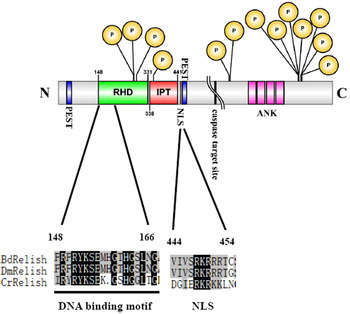
By degenerate PCR and RACE, a B. dorsalis cDNA with homology to DmRelish was obtained (GenBank accession No. KJ959618). The cDNA is 3954 bp containing an open reading frame of 3042 bp. The predicted protein comprises 1013 amino acids and includes an amino-terminal RHD (residues 148–331), an IPT (Ig-like, plexins, transcription factors) domain (DNA-binding domain, residues 338–441), two PEST domains (polypeptide sequences enriched in praline, glutamate, serine and theronine, residues 31–49 and 458–474) and an IκB-like domain with four ankyrin repeats (ANKs) (fig. 1). Interestingly, a potential caspase target site, L-V-E-D-G, in the residues 578–582 that is similar to the consensus target sit for group III caspases L-E-x-D (Thornberry et al., Reference Thornberry, Rano, Peterson, Rasper, Timkey, Garcia-Calva, Houtzager, Nordstrom, Roy, Vaillancourt, Chapman and Nicholson1997) was identified, and the aspartate (D) in the fourth position is absolutely necessary for Relish endoproteolysis in D. melanogaster (Stöven et al., Reference Stöven, Silverman, Junell, Hendengren-Olcott, Erturk, Engström, Maniatis and Hultmark2003). The nuclear localization signal (NLS) RKRRR was also located at the residue 448–452 (fig. 1). The above structural characteristics evidently indicated that the encoded protein is a Rel/NF-κB homologue and we refer to it as BdRelish. Furthermore, DNA binding motif is also detected in the RHD domain (residues 148–166). Finally, 13 potential sites for the casein kinase II's phosphorylation are predicted, including three in the RHD, three in the interval between RHD and ANKs, seven in the region near the IκB-like domain.
Schematic presentation of conservative domains and cleavage sites, which have been predicted in the amino acid sequence of BdRelish and sequence alignment with the characteristic motifs of other NF-κB proteins. CrRelish, Carcinoscorpius rotundicauda Relish (DQ345784).

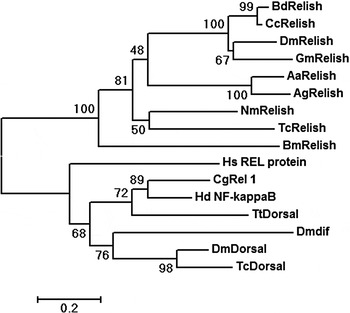
A phylogenetic tree was constructed to reveal the relationship between BdRelish and other registered NF-κB proteins from mammals and some arthropod species based on their deduced amino acid sequences. As shown in fig. 2, BdRelish was clustered into one branch with the Relish proteins of flies such as D. melanogaster and Ceratitis capitata, which suggested that they originated from the same ancestral gene, and BdRelish was confidently considered as the orthologue of D. melanogaster Relish. Collectively, these data suggested that BdRelish had a closer phylogenetic relationship with Relish proteins from Dipteran insects than other non-Dipteran insects.
The phylogenetic tree of Rel/NF-kB family members. The following amino acid sequences used in the phylogenetic analysis are obtained from the GenBank: DmRelish, Drosophila melanogaster Relish (AAF54333.2); CcRelish, Ceratitis capitata NF-κBP110 subunit (JAC02247.1); GmRelish, Glossina morsitans morsitans Relish (AAZ91474.1); AgRelish, Anopheles gambiae Relish (XP_308993.3); AaRelish, Aedes aegypti Relish (AAM97895.1); NmRelish, Nasutitermes magnus Relish (AAZ08474.1); TcRelish, Tribolium castaneum Relish (EEZ97717.1); BmRelish, Bombyx mori Relish (BAF74125.1); DmDorsal, D. melanogaster Dorsal (AAA28479.1); DmDif, D. melanogaster Dif (AAA28465.1); Hs P100a, Homo sapiens REL protein (AAI17192.1); CgRel 1, Crassostrea gigas Rel 1 (AAK72690.1); Hd NF-κB, Haliotis diversicolor supertexta NF-κB (AAW33559.1); Tt Dorsal, Tubifex tubifex Dorsal (BAD60879.1); TcDorsal, Tribolium castaneum Dorsal (NP_001034507.1). Numbers indicate the percentage of bootstrap replications that support each branch.

Transcriptional profiles across different tissues and after bacteria challenge
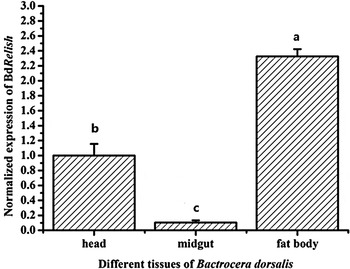
RT-qPCR results showed that BdRelish mRNA was expressed in all the assayed tissues including head, midgut and fat body, and significant differences were detected in the abundance of BdRelish mRNA across these assayed tissues (ANOVA: F 2,6 = 113.037, P < 0.05). The transcription level of BdRelish in the fat body was markedly higher than that in other assayed tissues (fig. 3).
Transcription level of BdRelish across different tissues of Bactrocera dorsalis including head, midgut and fat body. The transcription levels were determined by qPCR and normalized by that in the head of B. dorsalis. The β-actin gene was used as the internal control for qRT-PCR. Vertical bars represent the mean ± SEM (n = 3). Significant differences across different samples were indicated with various letters at P < 0.05.

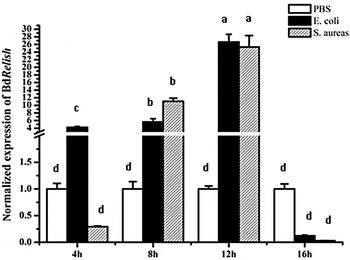
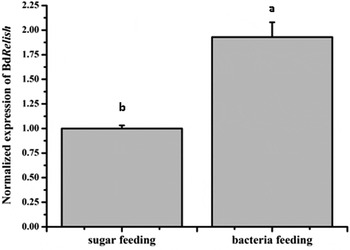
Since the highest expression level of BdRelish was found in fat body, the transcript profile of BdRelish was analyzed in fat body of adults after bacteria challenge. In fig. 4, different transcript profiles of BdRelish were detected in the E. coli and S. aureus-challenged groups, respectively. In the S. aureus-challenged group, the transcription level of BdRelish was not evidently increased at 4 hpi, but a significant increase was detected at 8 hpi and an expression peak presented at 12 hpi. In the E. coli-challenged adults, an evident upregulation of BdRelish was detected at 4 hpi, 8 hpi and 12 hpi. However, 16 h after bacteria challenge, the expression level of BdRelish dropped to the original value (fig. 4). The transcription level of BdRelish was also significantly induced by oral infection of S. aureus (fig. 5), which provided a demonstration that BdRelish mediated the gut immune responses to the invasion by gut nonresidential bacteria as well.
Transcription profiles of BdRelish in fat body of Bactrocera dorsalis at different time points after immune challenge. Individuals injected with sterilized PBS were used as negative controls. The value relative to the internal control β-actin gene is presented as mean ± SEM (n = 3). Significant differences were indicated with different letters at P < 0.05.

Transcription level of BdRelish in the gut of Bactrocera dorsalis 24 h after the oral infection of Staphyloccocus aureus. The adults in control groups were fed by 5% sterilized sugar solution. The relative expression level to the internal control β-actin gene is presented as mean ± SEM (n = 3, 15 flies were treated in each replication). Significant differences were indicated with various letters at P < 0.05.

Silencing efficiency of BdRelish dsRNA and its effect on the immune defense of B. dorsalis
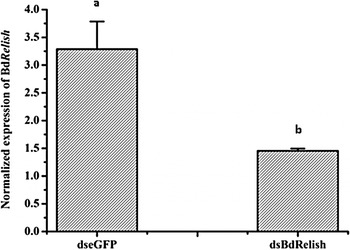
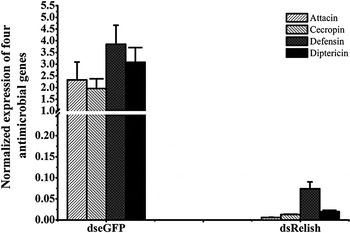
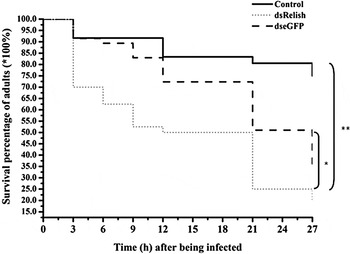
The effect of BdRelish dsRNA on the transcript level of BdRelish is presented in fig. 6. Compared with that of dseGFP-injected groups, the transcript level of BdRelish was dramatically reduced in the dsRelish-treated groups, and significant differences were determined between these two groups (T-test: t = 3.665, P < 0.05). It suggested the expression of BdRelish was significantly suppressed at 48 h after dsRNA of BdRelish was delivered. To know whether the silencing of BdRelish can impair the immune response of B. dorsalis adults, the transcription levels of Attacin, Diptericin, Defensin and Cecropin and the survival of adults after bacteria challenge were investigated. At 12 hpi, the transcription levels of Attacin, Diptericin, Defensin and Cecropin in dsRelish-injected groups were obviously lower than that of the respective dseGFP groups (t-test for Attacin: t = 2.981, P < 0.05; t-test for Diptericin: t = 4.916, P < 0.05; t-test for Defensin: t = 4.647, P < 0.05; t-test for Cecropin: t = 4.652, P < 0.05, fig. 7). From the fig. 8, it was observed that 30% of dsRelish-injected B. dorsalis adults were dead 3 h after the infection by E. coli and the adults in this group died at a significantly faster rate compared with two other groups. These data indicated that the immune response of B. dorsalis adults was obviously impaired by the injection of dsRelish. However 12 h later, the individuals in the dseGFP-injected group died more quickly than those in the untreated group and it might be caused by the injection injury. Therefore, this evidence implied that BdRelish played an important role in mediating the immune defense in B. dorsalis adults to fight against E. coli.
BdRelish expression in fat body of Bactrocera dorsalis at 48 h after the delivery of double strand RNA of Relish or eGFP (negative control) were determined by RT-qPCR. The relative expression level to the internal control β-actin gene is presented as mean ± SEM (n = 3). Significant differences were indicated with various letters at P < 0.05.

Effect of BdRelish gene silencing on the transcription level of four antimicrobial peptide genes, Attacin, Dipericin, Defensin and Cecropin in fat body of Bactrocera dorsalis at 12 h after bacterial infection. The relative expression level to the internal control β-actin gene is presented as mean ± SEM (n = 3). Significant differences were indicated with various letters at P < 0.05.

Effect of BdRelish gene silencing on the survival capability of Bactrocera dorsalis adults after bacterial challenge. Individuals without any treatment were used as the blank control; dsRelish: individuals were infected with E. coli solution being injected 24 h after the delivery of dsRNA of Relish; dseGFP: individuals were infected with the injection of 24 h after the delivery of eGFP dsRNA, this group served as the positive control. Fifty adults of Bactrocera dorsalis were treated in each treatment. The survival percentage of treated adults was investigated every 3 h after bacterial challenge.

Discussion
The full length cDNA nominated as BdRelish was cloned from the oriental fruit fly B. dorsalis. SMART analysis found that a typical RHD domain, IPT domain and IκB-like domain were detected in the deduced amino acid sequence of BdRelish. The nuclear localization signal sequence RKRRR was determined as well. Current evidence show that all NF-κB-related proteins have the conserved RHD domain that is required for DNA binding and dimerization (Hoffmann et al., Reference Hoffmann, Natoli and Ghosh2006; Minakhina & Steward, Reference Minakhina and Steward2006; Fan et al., Reference Fan, Wang, Lu, Ho and Ding2008). Therefore, domain characterization of BdRelish clearly indicated that it encodes a Relish homolog protein. It is well known that proteasomal degradation of IκBs is most likely a critical step in the activation of NF-κB (Baud & Derudder, Reference Baud and Derudder2011). Interestingly, the PEST domain that often serves as proteolytic signals (Rogers et al., Reference Rogers, Wells and Rechsteiner1986; Shumway et al., Reference Shumway, Maki and Miyamoto1999) is found in this Relish protein. Furthermore, the potential caspase target site, L-V-E-D-G, was also identified in the interval between RHD domain and the IκB-like domain of BdRelish. It suggests that BdRelish might also be activated by endoproteolytic cleavage to generate a DNA-binding RHD domain and a stable IκB-like fragment as demonstrated in D. melanogaster (Stöven et al., Reference Stöven, Silverman, Junell, Hendengren-Olcott, Erturk, Engström, Maniatis and Hultmark2003; Wiklund et al., Reference Wiklund, Steinert, Junell, Hultmark and Stöven2009). In addition, 11 potential target sites for casein kinase II, which mediate the phosphorylation of IκB protein before their proteolytic degradation (Barroga et al., Reference Barroga, Stevenson, Schwarz and Verma1995), were predicted and seven of them locate near the IκB-like domain of BdRelish. Altogether, the above domain analysis provides important and informative implications to facilitate further investigation on the mechanism underlying the tight regulation of Relish's activity in B. dorsalis. Phylogenetic analysis showed that Relish of B. dorsalis was clustered with registered Relish proteins from other insect species. So we can safely reach the conclusion that the cloned sequence of BdRelish is one member of the Rel/NF-κB family.
Analysis of the transcriptional profiles of BdRelish across different tissues of B. dorsalis uncovered that this gene is expressed in all tested tissue including head, midgut and fat body. However, the highest transcriptional level of Relish is detected in the fat body. It is well known that insect fat body, the equivalent to the liver of vertebrates, is a major and powerful immune-responsive organ, which can produce many immune active molecules such as antimicrobial peptides and other immune modulating peptides (Lemaitre & Hoffmann, Reference Lemaitre and Hoffmann2007). Thus the high transcriptional level of BdRelish in fat body might suggest that BdRelish is closely involved in the activation and regulation of immune defense in B. dorsalis.
Previous studies have demonstrated that three distinct signaling pathways are involved in regulating the synthesis of antimicrobial peptides in insects in response to infection, i.e. the Toll pathway, Imd pathway and the JAK/STAT pathway (Lemaitre & Hoffmann, Reference Lemaitre and Hoffmann2007). In Drosophila, NF-κB family members play a major role in their immune defense. For instance, Dorsal and Dif mediate the Toll pathway, while Relish mediates the Imd pathway (Hetru & Hoffmann, Reference Hetru and Hoffmann2009). Because BdRelish possesses the typical structural domains of Relish proteins, it might be involved in the immune response of B. dorsalis to infection. Here, RT-qPCR experimental data showed the transcriptional level of BdRelish was significantly elevated after bacteria injection, and fell to the original level at 16 hpi. This indicates that the transcription level of BdRelish is induced as a response to bacterial challenges, suggesting that BdRelish might be involved in the bacterial defense responses of B. dorsalis. Interestingly, E. coli induced the rapid upregulation of BdRelish at 4 hpi, while S. aureus caused the significant upregulation of BdRelish at 8 hpi, suggesting that Relish-mediated immune defenses are not specific to the infection of gram-negative bacteria. This different responsive pattern might imply that BdRelish is much more important for the Imd signaling pathway, which mediates the immune responses to gram-negative bacteria as documented in Drosophila (Myllymäki et al., Reference Myllymäki, Valanne and Rämet2014).
To further elucidate the role of BdRelish in the immune response to bacterial infection, the effect of dsRNA-mediated gene silencing on the transcription of the genes for antimicrobial peptides (Attacin, Diptericin, Defensin and Cecropin) and the survival capability of B. dorsalis adults after challenge was tested. Our data indicated that the levels of all four genes in the E. coli-injected adults were significantly inhibited after BdRelish was knocked down. This is consistent with that known immune effector genes of D. melanogaster (Cecropin, Diptericin, Attacin, Metchnikowin and Defensin) are under the regulation of Relish (Hedengren et al., Reference Hedengren, Asling, Dushay, Ando, Ekengren, Wihlborg and Hultmark1999; Leulier et al., Reference Leulier, Rodriguez, Khush, Abrams and Lemaitre2000). Furthermore, in contrast with the control groups, E. coli-injected individuals died at a significantly faster rate. Therefore, the impaired immune defense of adults to bacterial infection documented here shows that BdRelish is vital for the activation and regulation of immune defense in B. dorsalis. Relish has been cloned and characterized in the silkworm Bombyx mori (Tanaka et al., Reference Tanaka, Matsuki, Furukawa, Sagisaka, Kotani, Mori and Yamakawa2007) and some aquatic invertebrate animals such as Chinese shrimp Fenneropenaeus chinensis (Li et al., Reference Li, Yan, Wang, Priya, Li, Wang, Zhang and Xiang2009) and pearl oyster Pinctada fucata (Huang et al., Reference Huang, Liu, Guan, Shi, Wang, Zhao, Wu and He2012). However, little is known on the molecular mechanisms underlying how Relish specifically activates the immune-related effector genes to infection and where Relish goes after the invasive bacteria had been removed. Although the activation of Relish in D. melanogaster has been demonstrated to require proteolytic cleavage, as in the case for mammalian p100 and p105 (Hultmark, Reference Hultmark2003), and its activity is also modulated by other nuclear protein factors such as DMAP1 (Goto et al., Reference Goto, Fukuyama, Imler and Hoffmann2014) and Akirin (Bonnay et al., Reference Bonnay, Nguyen, Cohen-Berros, Troxler, Batsche, Camonis, Takeuchi, Reichhart and Matt2014), it is still controversial whether this reaction is conserved in other nonmodel insects. Consequently, advisable investigations should be conducted to reveal the molecular mechanism of Relish in other nonmodel insects to boost our understanding on their innate immunity.
To our knowledge, this is the first report that evidently demonstrated that BdRelish plays essential roles in regulating the expression of antimicrobial peptides genes as other reported NF-κB family members. However, nothing is known about the mechanisms that mediate the expression of downstream immune-related genes after receiving the converged signals on infection from the upstream regulators. Recent evidence has found that Relish could regulate the expression of antimicrobial peptide genes by forming homodimers and heterodimers with Dif or Dorsal (Tanji et al., Reference Tanji, Yun and Tony Ip2010; Zhong et al., Reference Zhong, Rao, Yi, Lin, Huang and Yu2016). The gut of B. dorsalis harbored a complex gut microbiota (Wang et al., Reference Wang, Jin and Zhang2011). Here, our data revealed that oral infection of S. aureus markedly induced the expression of BdRelish, which suggested that BdRelish also mediates the immune response of removing the nonresidential bacteria to maintain the gut homeostasis. It is well known that insect pests rely on the innate immunity to fight against the pathogen infection. Therefore, from the perspective of pest control, the present study provides some important insights to disrupt the immune defense of this pest by introducing the genetically modified gut bacteria to producing dsRNA targeting immune related genes such as BdRelish.
In conclusion, one Rel/NF-κB family member, BdRelish, was cloned and identified in B. dorsalis. Knock-down of BdRelish significantly impaired the magnitude of immune defense in B. dorsalis to fight against bacterial infection. This evidence suggested that BdRelish played a central role in mounting the immune response in this pest.
Acknowledgements
The authors are very indebted to Dr Jiannong Xu and Miss Ying Wang (Biology Department, New Mexico State University, USA) for improving their manuscript. They also thank Mr Zhichao Yao (Huazhong Agricultural University, China) for his completion of the part of PCR work. This study is granted by Chinese Natural Science Foundation (31201522), China Postdoctoral Science Foundation Supported Project (2012M511628) and The FAFU's Science Fund for Distinguished Young Scholars (xjq201205).