I. Something Old, Something New
We are familiar with one divide between “old” and “new” liberalism—that between classical liberalism and social justice liberalism.1
“Social justice liberalism” is more appropriate than either “welfare state liberalism” or “egalitarian liberalism.” “Welfare state liberalism” is a misnomer since obvious members of this group—such as John Rawls—believe that the welfare state is inadequate. “Egalitarian liberalism” is inappropriate since “new liberals” such as L. T. Hobhouse were not egalitarians. All “new liberals,” however, have been concerned with the idea of social justice. Hobhouse's Elements of Social Justice (London: Allen and Unwin, 1922) was one of the first books on the subject. On the division between the old and the new liberalism, see Michael Freeden, The New Liberalism: An Ideology of Social Reform (Oxford: Clarendon Press, 1978), and Freeden, Liberalism Divided: A Study in British Political Thought, 1914–1939 (Oxford: Oxford University Press, 1986).
See my essay “Liberalism at the End of the Century,” Journal of Political Ideologies 5 (2000): 179–99.
See John Rawls, Political Liberalism, paperback ed. (New York: Columbia University Press, 1996), 413. This is often put in terms of the contrast between the “liberty of the ancients and of the moderns”: I consider this contrast further in Section VII.D. Originally, Rawls insisted that civil rights were more important than political participation rights, but he came to revise his views. On Rawls's changing views, see note 105 below. Rawls declares himself to be a “deliberative democrat” in Rawls, “The Idea of Public Reason Revisited,” University of Chicago Law Review 64 (Summer 1997): 764–807, at 772; reprinted in John Rawls, The Law of Peoples (Cambridge, MA: Harvard University Press, 1999), and in Samuel Freeman, ed., John Rawls: Collected Papers (Cambridge, MA: Harvard University Press, 1999), chap. 26.
I have considered the differences between the old and the new liberalism in a more nuanced way in my essay “Public and Private Interests in Liberal Political Economy, Old and New,” in S. I. Benn and G. F. Gaus, eds., Public and Private in Social Life (New York: St. Martin's Press, 1983), 183–222.
Michael Freeden, a contemporary political theorist, has drawn our attention to another interesting contrast between old and new conceptions of liberalism.5
See Michael Freeden, Ideologies and Political Theory: A Conceptual Approach (Oxford: Clarendon Press, 1996), chap. 6.
See, for example, Ronald Dworkin, Sovereign Virtue (Cambridge, MA: Harvard University Press, 2000); and Philippe Van Parijs, Real Freedom for All (Oxford: Oxford University Press, 1995).
I have in mind, of course, Robert Nozick, Anarchy, State, and Utopia (New York: Basic Books, 1974).
See Herbert Spencer, “From Freedom to Bondage,” in Spencer, The Man Versus the State, with Six Essays on Government, Society, and Freedom (Indianapolis: Liberty Fund, 1982), 487–518; L. T. Hobhouse, Liberalism (London: Oxford University Press, 1911); J. S. Mill, On Liberty (1859), in John Gray, ed., On Liberty and Other Essays (New York: Oxford University Press, 1991); and John Dewey, Liberalism and Social Action (1935; New York: G. P. Putnam's Sons, 1980).
I believe that there is something right and enlightening about Freeden's version of the “old” and “new” divide, although of course it must be highly qualified. Liberalism has traditionally been a radical doctrine; criticizing the current order and presenting idealized proposals is part and parcel of the liberal tradition. Liberals are often radicals. And, of course, liberal theories were sometimes abstract and technical long before Rawls and the rise of academic liberalism in the United States. The nineteenth-century British philosopher T. H. Green, whose liberalism inspired Hobhouse and others, based his political theory on a version of absolute idealism drawn from G. W. F. Hegel, as abstruse a philosophical doctrine as one is apt to encounter.9
I should note that, in the hands of British philosophers such as Green, this theory was certainly more intelligible than in its original German version.
Isaiah Berlin, “Two Concepts of Liberty” (1958), in Berlin, Four Essays on Liberty (Oxford: Oxford University Press, 1969).
The movement from the older, more practical and accessible approach, to the newer, more academic and philosophical approach to liberal theorizing has been a mixed good. In my view, a clear deficit is the plethora of opposed moral blueprints for social institutions, each insisting that departures from its ideal scheme render existing institutions unjust and illegitimate. We now have before us libertarian theories based on self-ownership and rights to initial acquisition (telling us that nearly any redistribution of market outcomes is illegitimate);11
See, for example, Nozick, Anarchy, State, and Utopia; and Eric Mack, “Self-Ownership and the Right of Property,” The Monist 73 (October 1990): 519–43. For an overview, see Eric Mack and Gerald F. Gaus, “Classical Liberalism and Libertarianism,” in Gerald F. Gaus and Chandran Kukathas, eds., Handbook of Political Theory (London: Sage, 2004): 115–30.
See Hillel Steiner and Peter Vallentyne, eds., Left-Libertarianism and Its Critics (Basingstoke: Palgrave, 2000).
For the former, see my Social Philosophy (Armonk, NY: M. E. Sharpe, 1999), chap. 9; for the latter, see Julian Lamont, “Incentive Income, Deserved Income, and Economic Rents,” Journal of Political Philosophy 5 (1997): 26–46.
For the former, see Alan Gewirth, Reason and Morality (Chicago: University of Chicago Press, 1981); for the latter, see Marcus Verhaegh, “Kant and Property Rights,” Journal of Libertarian Studies 18 (Summer 2004): 11–32.
See esp. Dworkin, Sovereign Virtue, but there are a host of others who take this view.
For the former, see David Gauthier, Morals by Agreement (Oxford: Clarendon, 1986); for the latter, see Gregory Kavka, Hobbesian Moral and Political Theory (Princeton, NJ: Princeton University Press, 1986).
As I said, it is tempting to lay both the praise and the blame—if blame is appropriate—for the development of this more philosophical brand of liberal theorizing at Rawls's feet. Rawls's thinking, though, is always more complex than it first appears, and almost always more subtle than those whom he inspired. Rawls, we must remember, developed his philosophical liberalism into a political one where the overriding concern was meshing philosophical analysis with social facts. According to Rawls:
[E]ven if by some convincing philosophical argument—at least convincing to us and a few like-minded others—we could trace the right to private or social property back to first principles or to basic rights, there is a good reason for working out a conception of justice which does not do this. For … the aim of justice as fairness as a political conception is to resolve the impasse in the democratic tradition as to the way in which social institutions are to be arranged if they are to conform to the freedom and equality of citizens as moral persons. Philosophical argument alone is most unlikely to convince either side that the other is correct on a question like that of private or social property in the means of production. It is more fruitful to look for bases of agreement implicit in the public culture of a democratic society and therefore in its underlying conceptions of the person and of social cooperation.17
Rawls, Political Liberalism, 338–39.
Rawls presents us with a paradox. His work was a major impetus to developing abstract theories of distributive justice, and he himself insists that his own rather abstract philosophical theory demonstrates that both laissez-faire and welfare-state capitalism are unjustifiable.18
John Rawls, Justice as Fairness: A Restatement, ed. Erin Kelly (Cambridge, MA: Belknap Press of Harvard University Press, 2001), 136ff.
In this essay, I sketch a philosophical conception of liberal morality that stays true to Rawls's complex insight: although abstract philosophical argument alone cannot resolve our moral differences, careful philosophical reasoning is necessary to see our way to a resolution. Thus, I shall argue, we can develop a “new” (qua philosophical) liberalism that takes existing social facts and mores seriously while, at the same time, retaining the critical edge characteristic of the liberal tradition. However, pace Rawls, I shall argue that once we develop such an account, we are led toward a vindication of “old” (qua classical) liberal morality. Hence the old (vintage) wine in the new, more Rawlsian bottles.
Section II begins by sketching the basis for the claim that liberal principles must be “publicly justified”—justified to everyone. Section III argues that our deep disagreements about the proper standards of evaluation pose a challenge to all attempts at public justification. Sections IV through VI analyze methods for publicly justifying a morality under these conditions of disagreement on evaluative standards. Section VII then argues that the morality that is justified under these conditions is not the social justice/deliberative democratic liberalism of Rawls, but closer to what Benjamin Constant called the “liberty of the moderns.”19
See Benjamin Constant, “The Liberty of the Ancients Compared with That of the Moderns,” in Constant, Political Writings, ed. Biancamaria Fontana (Cambridge: Cambridge University Press, 1988), 308–28.
II. Public Justification Among Free and Equal Moral Persons
A. Free and equal moral persons
I take as my starting point the supposition that we conceive of ourselves and others as (1) moral persons who are (2) free and equal. Although these features are assumed in this essay, we should not suppose that these assumptions cannot themselves be defended. Rawls rightly argues that this general conception of moral persons is implicit in our public culture.20
See John Rawls, “Kantian Constructivism in Moral Theory,” in Freeman, ed., John Rawls: Collected Papers, 303–58, esp. 305ff. This is not to say that Rawls and I advance precisely the same conception of free and equal moral persons, as will become clear in what follows.
See my Value and Justification (Cambridge: Cambridge University Press, 1990), 278ff.
(i) A moral person is one who makes, and can act upon, moral demands. Moral persons thus conceive of themselves as advancing moral claims on others and being subject to such claims. Alternatively, we can say that moral persons understand themselves as owed, and owing, certain restraints and acts.22
See J. R. Lucas, On Justice (Oxford: Clarendon Press, 1980), 7. For a development of this conception of morality, see Thomas Scanlon, What We Owe Each Other (Cambridge, MA: Belknap Press of Harvard University Press, 1998), esp. 177ff. On this view, interpersonal claims are the crux of morality, though, of course, such claims need not be explicitly advanced: a moral person “makes claims on herself” in the sense that she accepts as reasons for actions the rights of others, and she acts on these reasons without prompting.
I argue this in Value and Justification, 281ff.
See Rawls, Political Liberalism, 51.
I argue for this claim in “The Place of Autonomy in Liberalism,” in John Christman and Joel Rogers, eds., Autonomy and the Challenges to Liberalism (Cambridge: Cambridge University Press, 2005), 272–306.
(ii) In the Second Treatise, Locke held that “[t]he natural liberty of man is to be free from any superior power on earth, and not to be under the will or legislative authority of man, but to have only the law of Nature for his rule.”26
John Locke, Second Treatise of Government, in Locke, Two Treatises of Government, ed. Peter Laslett (Cambridge: Cambridge University Press, 1960), sec. 21.
It also provides the basis for understanding morality as self-legislated. I develop this idea further in “The Place of Autonomy in Liberalism.”
(iii) To say that moral persons are equal is to claim, first, that qua moral persons they possess the minimum requisite moral personality so that they are equal participants in the moral enterprise and, second, that each is equally morally free insofar as no one is subjected to the moral authority of others. The equality of moral persons is their equality qua free moral persons: it is not a substantive principle of moral equality but a presupposition of the practice of moral justification insofar as it defines the status of the participants in moral justification. While this is a modest conception of moral equality, it rules out some conceptions of moral justification. Rawls not only conceives of moral persons as advancing claims against each other, but stresses that they view themselves as “self-authenticating sources of valid claims.”28
Rawls, Justice as Fairness, 23. The importance of the idea of self-authentication is easily overlooked in Rawls's thinking. It first appeared in his 1951 paper “Outline of a Decision Procedure for Ethics,” which conceived of ethics as adjudicating the claims of individuals, which he clearly saw as self-authenticating. See section 5 of that paper, in Freeman, ed., John Rawls: Collected Papers, chap. 1.
Hence, because of this, parties to Rawls's original position are not required to advance justifications for their claims. Rawls argues this in “Kantian Constructivism,” 334.
Many have advanced stronger conceptions of moral equality. Some have claimed, for example, that the very practice of morality presupposes an “equal right of each to be treated only with justification.”30
Hadley Arkes, First Things: An Inquiry into the First Principles of Morals and Justice (Princeton, NJ: Princeton University Press, 1986), 70; italics omitted. Compare Ted Honderich: “To have a liberty in the relevant sense, whatever else it comes to be, is to act in a way that has recommendation or justification. You have to have a right.” On this view, one may only act if one has a justified claim on others to allow one to act. Ted Honderich, After the Terror (Edinburgh: Edinburgh University Press, 2002), 45.
S. I. Benn and R. S. Peters, Social Principles and the Democratic State (London: George Allen and Unwin, 1959), 110.
I argue that it cannot in Justificatory Liberalism (New York: Oxford University Press, 1996), 162ff.
Validation from the rational and reflective perspective of another, however, is not the same as her actual consent. To treat another as a free and equal moral person is to accept that moral claims must be validated from her perspective when she rationally reflects upon them. Now, although, as Mill noted, there is a strong presumption that each knows her own perspective best, this is not necessarily so.33
Mill, On Liberty, 84–85 (chap. IV, para. 4). Mill also was aware that this assumption does not always hold true. See his Principles of Political Economy, in J. M. Robson, ed., The Collected Works of John Stuart Mill (Toronto: University of Toronto Press, 1963), vols. II and III, 947 (bk. V, chap. xi, sec. 9).
I deal with this complex question more formally in Justificatory Liberalism, parts I and II.
See ibid. and Value and Justification, 399–404.
Jeffrey Reiman, Justice and Modern Moral Philosophy (New Haven, CT: Yale University Press, 1990), 1–2.
B. The principle of public justification
Given the requirements for treating others as free and equal moral persons, the task of publicly justifying a moral principle P requires that P be validated from the perspective of each (sufficiently) reasonable free and equal moral person. To publicly justify a moral principle is to justify it to all reasonable free and equal moral persons within some public, who confront each other as strangers.37
On the concept of the public, see S. I. Benn and G. F. Gaus, “The Liberal Conception of the Public and Private,” in Benn and Gaus, eds., Public and Private in Social Life, 31–66.
I have employed the unfamiliar idea of “validating” a principle. Validating is, I think, especially appropriate in this context. To validate a moral principle P is to exercise one's authority to inspect P and confirm that it meets the relevant requirements (as when a visa is validated). Validation is not voluntaristic in the way that consent is, or “acceptance” or “rejection” might be taken to be. Validation first involves substantive requirements: to be valid, P must meet the test of respecting others' rational natures—there must be a conclusive reason justifying P. (What else could respecting others' rational natures require, other than providing them with reasons?) But validation is not simply a matter of in fact meeting the requirements—of there being a reason for P. It requires that this fact be confirmed by one who has the authority to do so. Surely, to respect the free moral and rational natures of others is to provide them with conclusive considerations for P that can be seen as such by them insofar as they are reasonable; given that we are free and equal, each of us alone has the moral authority to confirm principles binding him- or herself. If Alf appeals to P, and Betty, a free and equal rational moral person, cannot see how she has adequate reason to accept P, then Alf is not respecting her as a free and equal rational moral person if he nonetheless insists that she does have good reason to accept P and thus is morally required to abide by P. Alf's understanding of the demands of reason cannot trump Betty's reasonable understanding if he is to respect her as a free and equal rational moral person. To be more precise, let us work with the following understanding of public justification:
P is a bona fide moral principle only if each reasonable free and equal moral person would, upon presentation of P, validate it.
According to this understanding of public justification, to possess a bona fide moral claim does not require that everyone has already validated it, and this is the case for two reasons. (i) A bona fide moral claim only requires the validation of reasonable, not actual, moral persons. (ii) Public justification conceives of moral claims as carrying the guarantee that they can be justified to reasonable others, even if these justifications have not yet actually been presented. This, I think, points the way to a plausible version of what Rawls calls “the proviso.”38
John Rawls, “The Idea of Public Reason Revisited,” University of Chicago Law Review 64 (Summer 1997): 764–807, pp. 783–84.
III. The Problem of Evaluative Diversity
An obvious point of departure in publicly justifying moral principles would be to identify some “conception of the good”—involving a systematic relation of the various goods—that is shared by each free and equal moral person in the relevant public.39
Henceforth, the clause “in the relevant public” will be assumed.
I focus on this problem in Contemporary Theories of Liberalism: Public Reason as a Post-Enlightenment Project (London: Sage, 2003). See also my Social Philosophy, chap. 3.
On convergence as a mode of justification, see Fred D'Agostino, Free Public Reason: Making It Up As We Go (New York: Oxford University Press, 1996), 30–31.
Suppose we disaggregate conceptions of the good, or systems of value, into their component goods, values, and other normative principles. Even though we do not share full-blown systems of values, we do share many specific values, such as the good of bodily integrity, the good of personal resources, and the good of health; we also share moral “intuitions,” such as the wrongness of inflicting gratuitous pain on others. Abstracting from the notions of goods, values, moral “intuitions,” and so on, let us provisionally say that Σ is an evaluative standard for moral person Alf if and only if holding Σ is relevant to the validation of a candidate moral principle given Alf's rational point of view.42
I leave aside here whether Σ is itself a belief about the world, as ethical naturalists would have it. It is important to stress that nothing in my account precludes moral realism as a metaethical or metaphysical thesis; the epistemic constraint on moral reasons is the crucial principle on which the analysis rests.
See Fred D'Agostino, Incommensurability and Commensuration: The Common Denominator (Aldershot, Hampshire: Ashgate, 2003). I draw upon D'Agostino's insightful analysis throughout Sections III–V and in Section VII. I consider these issues in a different way in “Liberal Neutrality: A Radical and Compelling Principle,” in Steven Wall and George Klosko, eds., Perfectionism and Neutrality: Essays in Liberal Theory (Lanham, MD: Rowman and Littlefield, 2003), 136–165, 156ff.
This is to say that the normative standard passes on a degree of justification commensurate with its ranking within a perspective.
Many believe that a morality requires priority rules.45
See Kurt Baier, “The Point of View of Morality,” Australasian Journal of Philosophy 32 (1954): 104–35.
W. D. Ross, The Right and the Good (Oxford: Clarendon Press, 1930), 27ff.
Because so many issues of public morality require not only the justification of a set of moral claims, but some priority rules, we require some way to publicly commensurate individual evaluative standards to arrive at a public ordering of moral claims. The problem, then, is this: A public ranking of moral principle P1 over P2 is obviously justified only if the evaluative standards (and sound beliefs) of each rational and reflective moral person give her good reason to rank P1 over P2.47
This is too simple. A consistent system of trade-off rates between P1 and P2 need not, and most plausibly will not, be a simple priority according to which the satisfaction of P1, in any circumstance, is ranked above the satisfaction of P2. I focus on this idea in “Why All Welfare States (Including Laissez-Faire Ones) Are Unreasonable,” Social Philosophy and Policy 15, no. 2 (1998): 1–33. However, the more complicated analysis would only reinforce the point of the text: different sets of rational evaluative criteria will endorse different trade-off rates.
See Milton Rokeach, The Nature of Human Values (New York: The Free Press, 1973), 110; Milton Rokeach, “From Individual to Institutional Values,” in Rokeach, Understanding Values (London: Collier Macmillan, 1979), 208.
The problem of disagreement about public morality arising out of an agreement in evaluative standards is even more daunting than I have depicted it. I assumed above that each claim is to be validated by a single evaluative standard (along with relevant beliefs). More realistically, we must allow that, in each individual's perspective, a number of evaluative standards contribute to the validation of a moral principle. Thus, even if we all agree on the same set of evaluative standards and relevant beliefs, and all agree what standards are relevant to the validation of a specific moral claim, we may not all validate any specific moral claim. To see this, suppose that both Σ1 and Σ2 are relevant to the justification of P-type principles. If Alf's ranking is Σ1 [sc ] Σ2, while Betty's is Σ2 [sc ] Σ1, then Alf may validate P′ while Betty validates P′′. Thus, the initial problem in justifying priority rules becomes a problem of justifying any principle or claim when it is validated by multiple evaluative standards.
IV. Two Flawed Responses to Evaluative Diversity
Given the assumption of evaluative diversity, how might we endeavor to publicly justify some ranking of principles? Following Rawls, we might suppose a deliberative setting of rational and reflective moral persons evaluating proposed moral principles according their evaluative criteria; what such people would all accept shows what is publicly justified.49
“Understood in this way the question of justification is settled by working out a problem of deliberation: we have to ascertain which principles it would be rational to adopt given the contractual situation.” John Rawls, A Theory of Justice, revised ed. (Cambridge, MA: Belknap Press of Harvard University Press, 1999), 16.
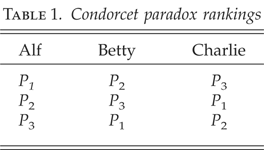
Condorcet paradox rankings

A. Aggregation
Let us first consider the familiar process of collective (aggregative) commensuration: Suppose that in our deliberative setting we seek to develop some aggregation procedure that takes, as inputs, each reasonable free and equal moral person's ranking of proposed moral principles (based on his or her own evaluative standards) and generates, as outputs, a publicly justified ordering of moral principles. Now, ex hypothesi, the procedure we develop must also pass the test of public justification; moreover, the problem of evaluative diversity resulting in different rankings of principles must not reproduce itself as a rational diversity in rankings of aggregation procedures. Given that all see themselves as equal moral persons, we might think that some aggregation procedure reflecting “one person, one vote” might be employed in our deliberative setting to decide on the publicly justified ordering of principles. The hitch, of course, is that the aggregation procedure itself must be justified, and our disputes about the rankings of principles will reproduce themselves as disputes about the rankings of procedures.50
As Robert Nozick reminds us: “When sincere and good persons differ, we are prone to think they must accept some procedure to decide their differences, some procedure they both agree to be reliable and fair. Here we see the possibility that this disagreement may extend all the way up the ladder of procedures.” Anarchy, State, and Utopia, 98.
The conditions are these: (1) Universal domain: There is a social ordering for every possible set of individual preference profiles. (2) Monotonicity: An individual's changing her evaluation from {y is better than x} to {x is better than y} cannot itself make x socially less preferred than y. (3) Nonimposition: The social ordering is always a function of individual orderings. (4) Pareto optimality: If everyone prefers x over y, the social ordering ranks x over y. (5) Independence of irrelevant alternatives: The social preference between x and y must depend only on individuals' preferences between x and y, and cannot be affected by the presence or absence of some third alternative, z. (6) Nondictatorship: There is no person whose individual ordering over every pair of options is decisive for the social ordering. See William Riker, Liberalism Against Populism (Prospect Heights, IL: Waveland Press, 1988). I evaluate Riker's criticisms of democracy in my essay “Does Democracy Reveal the Will of the People? Four Takes on Rousseau,” Australasian Journal of Philosophy 75 (June 1997): 141–62. For an analysis more nuanced than Riker's, see Dennis Mueller, Public Choice III (Cambridge: Cambridge University Press, 2003). For Arrow's own version, see Kenneth Arrow, Social Choice and Individual Values, 2d ed. (New Haven, CT: Yale University Press, 1963).
John Dryzek, for example, rejects most of Riker's analysis; see Dryzek, “Democratic Theory,” in Gaus and Kukathas, eds., The Handbook of Political Theory, 143–54.
This point is emphasized by Riker, Liberalism Against Populism, chap. 2. On the importance of this for democratic choice, see Gaus, “Does Democracy Reveal the Will of the People?”
Donald G. Saari, Chaotic Elections! A Mathematician Looks at Voting (Providence, RI: American Mathematical Society, 2000), 152; emphasis in original.
This is not to say that we are never warranted in relying on democratic procedures to resolve disputes. Given the background justification of moral and political principles, it may well be that at some point we have disagreements that we all have reason to believe must be resolved, and no procedure for resolving them is better than democracy. However, no aggregation procedure is intrinsically fair, stable, and reliable; whatever the merits of aggregation procedures, they are highly objectionable as ways to produce a justified, rational social choice of basic moral principles out of diverse individual orderings.
B. Elimination (or idealization)
Arrow's theorem relies on the assumption that the aggregation procedure must successfully operate for all possible individual rankings: the procedure must work for every permutation of the options. One way to respond to Arrow's theorem is, to use D'Agostino's term, “elimination”: we disallow some rankings so that the paradoxical social choice implied by table 1 does not occur.55
D'Agostino, Incommensurability and Commensuration, 91–95.
For an explicit argument of this sort, see Jonathan Riley, Liberal Utilitarianism: Social Choice and J. S. Mill's Philosophy (Cambridge: Cambridge University Press, 1983).
V. Justifying Public Morality: Arguments from Abstraction
A. Abstract and full justification
Is there some way to achieve public justification in the face of evaluative diversity? D'Agostino tells us that one of the great attractions of Rawls's original position is that it provides a device of “social commensuration”:
Rawls's problem is, indeed, one of ranking options in a social setting. The members of some society have to decide, in a way that will be collectively binding, how they are to organize their relations with one another, at least in certain fundamental ways. In particular they have to decide how to rank proposals about the so-called “basic structure of society.” If each individual appeared in his own identity as a participant in discourse or negotiations about how to organize the “basic structure of society” in a collectively acceptable way, it is unlikely, in the extreme, that any agreement on substantive matters would be possible and, hence, the various options (each a specification of “the basic structure”) would remain incommensurable with respect to one another. From a collective point of view we would not know how to order them in a satisfactory way.57
D'Agostino, Incommensurability and Commensuration, 100.
The device of the original position aims to provide a public justification of a ranking of some moral claims (such as liberty versus equality) by abstracting from our actual, full evaluative positions, and so providing a shared core perspective that yields a determinate deliberative-justificatory outcome.58
Ibid., 100–101.
Rawls, A Theory of Justice, 17.
Ibid., 120.
Ibid., 120–21.
(1) Most obviously, it must be the case that there is a shared perspective that identifies a common basis of evaluation. The aim is to show that once we abstract to a certain shared perspective (and thus, for example, we exclude our desires to dominate or rule others), we do share some evaluative standards. Arguments for abstraction need not deploy a device such as the original position: Alan Gewirth, S. I. Benn, and others have maintained that the perspective of an abstract agent devoted to acting on his or her own evaluative criteria validates basic liberty claims, though they have not utilized a hypothetical choice situation.62
Alan Gewirth, Reason and Morality (Chicago: University of Chicago Press, 1980), chap. 2; S. I. Benn, A Theory of Freedom (Cambridge: Cambridge University Press, 1988), chaps. 6–7. See also my Value and Justification, sec. 24.2.
(2) This shared perspective must identify especially important shared evaluative standards; it will be of little avail to identify a shared perspective that does not capture really important evaluative standards. We must, as Rawls says, “give very great and normally overriding weight” to the norms prescribed by the shared standpoint.63
Rawls, Political Liberalism, 241.
(3) Related to this point, it must be the case that the deliberative conclusions are not overturned as the process of abstraction is undone and individuals are again understood to be guided by their full set of evaluative standards. It is, I think, seldom appreciated just how important this point is to Rawls's later work. Rawls argues that the political conception can be justified as freestanding: it is based on an abstract conception of persons as reasonable and rational, free and equal—a conception that is said to be implicit in our democratic society, and thus, shared by all.64
Ibid., 10.
Ibid., 9.
Ibid., 386.
Ibid.
Most commentators on Rawls mistakenly identify these two ideas. Rawls employs the idea of a “module” when explaining “overlapping consensus” (ibid., 12–13; 144–45), whereas “freestandingness” applies to the appeal to shared conceptions of the person, and lack of metaphysical and other commitments, of the abstract argument for the two principles (ibid., 10, 40, 133, 144). The crucial passage that confuses many readers is on pp. 144–45 of Political Liberalism, where Rawls argues that because the political conception is freestanding it can serve as a module; many readers suppose that Rawls is simply equating the two ideas.
It is, I believe, a serious mistake to think that Rawls's basic notion of justification changed from A Theory of Justice to Political Liberalism, replacing the focus on shared reasoning in the original position with justification qua “overlapping consensus”—that all reasonable evaluative systems overlap on the basic liberal principles. Rather, the core idea throughout his work is the argument from abstraction in the original position, but Rawls increasingly worried that as the abstraction is undone and people come to know their comprehensive conceptions of value, their devotion to the principles might be “overridden.” Full knowledge of evaluative standards may change what is validated from their perspectives. Hence Rawls's claim that under “full” justification the normative importance of the pro tanto argument from abstraction is preserved (i.e., condition 3 is met). Let us, then, call this third requirement the stability of abstract justification under full justification. This last requirement is immensely important: unless the conclusion of the argument from abstraction can be affirmed in light of a rational and reflective, free and equal moral person's full set of evaluative criteria, the abstract justification will be defeated by these other elements of her evaluative set. When Rawls tells us his main concern in developing political liberalism was to provide an account of the stability of a society based on his principles,69
Ibid., xix.
B. Rawls's two principles of justice
As is well known, Rawls maintains that two strictly ordered principles are justified via the argument from abstraction:
First: each person is to have an equal right to the most extensive scheme of equal basic liberties compatible with a similar scheme of liberties for others.
Second: social and economic inequalities are to be arranged so that they are both (a) reasonably expected to be to everyone's advantage and (b) attached to positions and offices open to all.70
Ibid., 53. Compare the original edition of Rawls, A Theory of Justice (Cambridge, MA: Belknap Press of Harvard University Press, 1971), 60.
Rawls provides a compelling case that his argument from abstraction for the first principle and its priority over other social values satisfies our three conditions. (1) We do share the perspective of rational agents devoted to our ends. (2) What we are committed to when occupying this perspective is of great importance, since it is always relevant to action based on our evaluative standards. (3) The pro tanto case for an extensive and strong scheme of liberty seems stable under full justification. The compelling arguments in Rawls's Political Liberalism for overlapping consensus concern basic liberties. Much less compelling is the argument for the second principle. It was notoriously controversial whether the argument from the original position actually endorses the second principle. (Let us focus simply on principle 2(a), the so-called “difference principle.”) Rawls's attempts to show that abstract agents would select basic institutions that must distribute universally required goods so as to maximize the share to the least-advantaged group has confronted an array of objections that this would simply not be a rational strategy for such agents. Objectors insist that the abstracted parties would do better to maximize the average payoffs, or, alternatively, to avoid distributions that are disastrous to some, but once those distributions are omitted choose the distribution that maximizes average payoff, and so on.71
For evidence that ordinary reasoners tend toward this last option, and thus have non-Rawlsian strategies in original position–like situations, see Norman Frohlich and Joe A. Oppenheimer, Choosing Justice: An Experimental Approach to Ethical Theory (Berkeley: University of California Press, 1992).
For a review of the literature on people's beliefs about justice that brings out the importance of desert, see David Miller, “Distributive Justice: What People Think,” Ethics 102 (April 1992): 555–93. See also my Social Philosophy, chap. 6.
Gewirth, Reason and Morality, chap. 2.
Prudence is reasonably averse to risk, and spends a good deal of time planning for trouble and how to avoid it. Central to her evaluative criteria is that one is responsible for avoiding the pitfalls of life. Now she has good reason to value a cautious life in which she looks out for her own welfare rather than a life in which we look out for each other. For others may lead riskier lives, and thus put themselves in positions in which they are more likely to be imperiled. Prudence will see welfare-grounded claims to assistance as violating her “comprehensive conception of the good”: those whom she considers irresponsible and who reject the value of prudence, or reject taking responsibility for their own lives, will have claims on her that are antithetical to her values. People get into very hot water because they seek excitement, or are careless, or are too cheap or lazy to take precautions, or simply would rather spend their time and money having a good time. Prudence's objection is sound. Although, say, health-care provision often has been enacted on the ground that everyone's basic welfare interests should be protected, experience has shown that the careless or reckless make inordinate demands on health-care systems. Because welfare provision is funded by all, Prudence and others like her end up paying a good deal for the recklessness of smokers and motorcyclists who ride without helmets; thus, Prudence and her like-minded fellows are forced to encourage what they see as vices.
The second objection comes from Sylvan, a nature lover. Sylvan's values are not centered on his own life or well-being, but on the wonders of nature. Although he does what he can to help and protect nature, Sylvan is under no delusion that his survival is necessary for the survival of nature. Because he so loves nature, however, he seeks to devote his life to worshipping it and understanding it; he has a religious awe when in the presence of nature. Now Sylvan may well resist incurring significant costs or transferring resources via taxation to help others; he does not cherish humans—he thinks they are not all that important in the scheme of things. Now, to respect and to cherish are not the same: Sylvan can respect others as moral persons without cherishing their flourishing. To Sylvan, devoting his resources to being near nature is tremendously more important than saving humans. Of course, Sylvan realizes that some day he may need help, and he is reasonable enough to admit that if he needs help, it would be nice to get it. But his environment-oriented philosophy indicates that it will be no great loss to the universe whether he dies in five, ten, twenty, or forty years. So Sylvan would resist the idea that significant costs should be put on him to assist others.
C. The moral right to private property
Political philosophers such as Rawls and Gewirth thus contend that, if we consider simply the abstract perspective of ourselves as agents, we appreciate not only the importance we place on agency freedom, but the importance we place on the maintenance of agency, and thus we all endorse strong claims against others to help us maintain our agency. Even if the latter “agency welfare rights” are justified from the abstract perspective, I have argued, they are not stable under full justification: once Prudence and Sylvan are aware of their complete set of evaluate standards, they will reject these claims on them.74
See Loren Lomasky's argument concerning the “strains of commitment” that are induced by making us responsible for each other, and why this casts doubt on Rawls's claim that the difference principle would be selected in the original position. Lomasky, “Libertarianism at Twin Harvard,” Social Philosophy and Policy 22, no. 1 (2005): 178–99.
This, of course, supposes that property rights are not freedom rights. I argue for this view in my essay “Property, Rights, and Freedom,” Social Philosophy and Policy 11, no. 2 (1994): 209–40.
Immanuel Kant, The Metaphysical Elements of Justice, trans. John Ladd (Indianapolis, IN: Bobbs-Merrill, 1965), 53 (Private Law, sec. 2). Res nullius is a thing belonging to no one.
Ibid., 55 (Private Law, sec. 5).
Thus the famous case of Pierson v. Post (Supreme Court of New York, 1805; 3 Cai. R. 175, 2 Am. Dec. 264). Post, the plaintiff, was pursuing a fox with his hounds while Pierson came in during the chase, shot the fox, and carried it off. Post sued (invoking something like the labor theory of value) on the grounds that he was pursuing the fox, and so had a claim to it. The court found in favor of Pierson, as he possessed the fox. See Jesse Dukeminier and James E. Krier, eds., Property, 5th ed. (New York: Aspen, 2002), 19–24. For a discussion, see Carol Rose, “Possession as the Origin of Property,” University of Chicago Law Review 52 (Winter 1985): 72–96.
Given that a free moral person has an interest in acting in accord with his own evaluative standards (see Section II above), it does not seem that he can reject moral rights to property, even under full justification. This, of course, by no means justifies anything like capitalistic property rights. It merely demonstrates the importance of private property as a moral category for agency. The contours of those rights must be filled in, but however they are filled in, the property rights must be robust enough to secure the interest in agency and in doing “as I please.” Moreover, it must be remembered that whatever principle of property is justified by considerations of abstract agency must be stable under full justification. To accept that there is an intrinsic tie between free agency and property rights, and thus that a system of property rights is morally necessary, also implies certain other conditions: just as only systems of basic liberties that widely distribute liberty can be justified among abstract agents, so too with property. Systems distinguishing “mine and thine” by making everything mine and nothing thine are manifestly unable to be endorsed under full justification. Adequate defenses of private property have always sought to show that, at a minimum, the benefits of property rights are universal: everyone is much better off under a system of private property than without one.79
The universal benefit of private property has been a fundamental liberal theme. Consider the following canonical liberal passages. First, Adam Smith: “[T]he accommodation of an European prince does not always so much exceed that of an industrious and frugal peasant, as the accommodation of the latter exceeds that of many an African King, the absolute master of the lives and liberties of the thousand naked savages.” Adam Smith, An Inquiry into the Nature and Causes of the Wealth of Nations, ed. R. H. Campbell and A. S. Skinner (Indianapolis, IN: Liberty Press, 1981), vol. I, pp. 23–24. Now Locke: “There cannot be a clearer demonstration of any thing, than several Nations of the Americans are of this, who are rich in Land, and poor in all the Comforts of Life; whom Nature having furnished as liberally as any other people, with the materials of Plenty, i.e. a fruitful Soil, apt to produce in abundance, what might serve for food, rayment, and delight; yet for want of improving it by labour, have not one hundredth part of the Conveniences we enjoy: And a King of a large fruitful Territory there feeds, lodges, and is clad worse than a day Labourer in England.” Locke, Second Treatise of Government, 314–15 (sec. 41). In both cases, the claim is that private property is a Pareto improvement over a non-property regime.
For a sensitive discussion, see Jeremy Waldron, The Right to Private Property (Oxford: Clarendon Press, 1988), esp. chap. 11. Arguments for a Lockean “proviso” are also relevant here: i.e., the idea that a condition of a justified property right is that it does not interfere with others' opportunities to acquire property.
VI. Justifying Public Morality: The Testing Conception
A. Optimal eligible interpretations
The argument from abstraction identifies, at a minimum, the importance of agency freedom and property rules; let us focus for now on agency freedom, the fundamental liberal concern. As I said, the abstract argument gives us abstract requirements; a wide range of interpretations present themselves about just what freedoms are morally required by agents such as ourselves. To see our way to more specific justifications, let us introduce the concept of a set {p1 … pn} of optimal eligible interpretations of an abstract justified principle P. Our justificatory problem comes to this: We need to first identify what such a set might be, and then justify identifying one member of it as our public morality. Let us say that each interpretation p is put forward as a fully specified scheme of agency freedoms, including any priority rules. An interpretation p is eligible if and only if under full justification the interpretation of P qua p would be ranked by every reasonable moral person as better than no P interpretation at all. And let us restrict ourselves to only optimal eligible interpretations: if p1 and p2 are both eligible interpretations of P, and if under full justification everyone's evaluative standards rank p1 [sc ] p2, then p2 is excluded from the set of optimal interpretations.
I shall suppose, for the moment, that the set of optimal eligible interpretations contains more than one member (but see below). If the set is null, then the abstract argument was not stable under full justification insofar as, for every possible interpretation, at least one reasonable moral person ranks it as worse than a morality without the principle. If the set has one member, then the justificatory task is completed. But the assumption that the set can be reduced to one—in other words, that abstract philosophical argument actually justifies a unique and determinate answer to what our morality requires—strikes me as implausible, and is indicative of disregard for current practices that Freeden (to say nothing of Hume, Hayek, and so many others) warns against. I assume, then, that we have a nested disagreement: a rational disagreement about the best choice nested within a rationally agreed upon set.81
I have given a slightly different account of nested disagreement in Justificatory Liberalism, 156ff. For an enlightening discussion, see Micah Schwartzman, “The Completeness of Public Reason,” Politics, Philosophy, and Economics 3 (June 2004): 191–220.
B. The testing conception
We seem to have landed back where we started: we have divergent rankings with no best option, though now we do rationally concur that some member of the set must be selected. Of course, we can continue on with abstract philosophical argument: we might, for instance, develop some sort of bargaining theory that would show that some member of the set is the rationally-to-be-selected option.82
I sought to do this in Value and Justification, chap. 9.
An alternative conception of moral validation has been employed by philosophers such as Kurt Baier. Basic to Baier's analysis is that moralities are social facts. Anthropologists can identify a group's morality, and distinguish it from laws, taboos, and etiquette.83
See Baier, “The Point of View of Morality.”
See Kurt Baier, The Rational and the Moral Order (Chicago: Open Court, 1995), 212.
Our abstract construction has provided us with the requisite critical perspective; the task of moral reflection is to apply this perspective to our actual morality. Restricting ourselves now to agency freedom, our actual morality must be within the set of optimal eligible interpretations if all are to have good reason to accept our social morality. If our current interpretation of agency freedom is within the optimal eligible set, then we are confronted with actual moral freedom rights that satisfy the requirements of abstract moral reflection, and would not be rejected by any reasonable moral person under full awareness of her evaluative standards. This does not mean, however, that each person sees this as the best specification, or even one of the best, or even better-than-average. The existing practice may not be close to most people's ideal, but if it is part of the optimal eligible set, it qualifies as publicly justified. Moral obligation is not a tight function of moral perfection. Of course, people can provide arguments to move the current morality in their ideal directions. As Baier observes, “improvements in the society's morality can occur only by changes in the members' morality and these are best brought about by the members' own efforts at convincing one another by their discussions with others (and, of course, by their own critical reflections).”85
Ibid., 217.
In contrast, the current interpretation may fail to be justified in two ways: (1) It could be that our current interpretation of liberty rights is part of the set of eligible interpretations, but not in the set of optimal eligible moralities. In that case, there is some alternative moral practice that everyone's evaluative criteria ranks as better than the current way of interpreting our agency rights. In that case, our current moral rights to agency freedom, though they represent an eligible option, are irrational because they are suboptimal: we all have reason to adopt the optimal alternative scheme. This raises complex issues. How far, for example, is the current interpretation of P from the relevant optimal interpretation? Certainly there is a case for moral reform here, but whether one has reason to follow the current understanding of our moral liberty rights depends on the details of the case. A reasonable proposal is that in personal interactions one should appeal to the optimal code, as one has the opportunity for showing that it is justified among free and equal moral persons. In relations with strangers, however, it may be morally presumptuous for one to ignore the accepted code.
(2) Secondly, it might be the case that our current moral practice is not within the set of eligible interpretations: it is not justified under some free and equal moral persons' full evaluative standards. In that case, the current interpretation is illegitimate: it does not specify moral rights to freedom. Of course, we might still have pragmatic reasons to pay attention to these positive rights, but they would not be justified elements of our public morality. However, we should not jump to the conclusion that the entire current moral practice involving agency freedom would be undermined. Even if the entire practice cannot be fully justified, some parts of it may survive the scrutiny of full justification and thus morally ground parts of our current agency freedoms. Insofar as we can partition our moral practices,86
This partitioning raises formal problems about the possible interconnectedness of justifications that I do not pursue here.
See Jeremy Waldron, Law and Disagreement (Oxford: Oxford University Press, 1999), 104ff.
See my Justificatory Liberalism, 237ff. See also my essay “The Legal Coordination Game,” American Philosophical Association's Newsletter on Philosophy and Law 1 (Spring 2002): 122–28.
C. Morality as recognized claims
Some object to the testing conception of moral validation because it supposes a “bias” toward current moral practice. Why select the current morality from the set of eligible codes? What could justify this bias toward the actual?
A bias toward the actual is endorsed by a certain publicity condition on morality. This requires that a morality be a social fact. To be rationally justified is not sufficient to establish a bona fide moral rule: it must be accepted, taught, and relied upon. Baier sought to capture this publicity condition by requiring as a condition for being a moral rule that a rule “be taught to all children,” so that all would know what the rule is.89
Baier, “The Point of View of Morality.”
Rawls, A Theory of Justice, 115. Rawls relates this condition to Kant's justification of publicity in a note, 115n.
T. H. Green, Lectures on the Principles of Political Obligation, in Paul Harris and John Morrow, eds., Lectures on the Principles of Political Obligation and Other Writings (Cambridge: Cambridge University Press, 1986), sec. 116.
VII. The Rights of the Moderns
A. Rights as devices of devolution
Our fundamental moral concern, then, must be whether our current morality is at least within the set of eligible interpretations. Do we have any reason to think it is?
D'Agostino's analysis is again helpful, providing grounds for concluding that our liberal morality does reasonably well at the crucial task of coping with evaluative diversity. Because liberal morality is a morality of rights, its main solution to the problem of divergent evaluative standards, and divergent interpretations of shared principles, is to devolve to individuals the moral authority to decide what evaluative standards to apply in specific situations. A system of rights is an efficient response to the problem of public justification given evaluative diversity. “Civil society, with its individual rights and rights of association, [and] the market, with its foundation of property rights and rights of contract,” are, D'Agostino argues, devices of “commensuration” that devolve moral authority: they define spheres of authority that specify whose evaluative standards will be regulative in a social interaction.92
D'Agostino, Incommensurability and Commensuration, 105.
Ibid.
Of course, because there are indefinitely many systems of rights, the devolution solution presupposes that successful arguments from abstraction have identified the eligible systems, and the testing conception confirms that our system is in the set. Granted that, however, we can see how devolution via a system of rights greatly lessens what we might call the burdens of justification. Deep evaluative diversity, we have seen, poses serious obstacles to the public justification of a common morality. The rights solution is to mitigate our evaluative disagreements by granting to each a limited sphere in which an individual's evaluative standards have public standing. This function of rights is almost always overlooked.94
For a notable exception, see Eric Mack, “In Defense of the Jurisdiction Theory of Rights,” Journal of Ethics 4 (January–March 2000): 71–98.
B. The impossibility of a Paretian liberal?
At this point, the argument of Amartya Sen's essay “The Impossibility of a Paretian Liberal” is relevant, and seems to pose an objection to the devolution proposal.95
Amartya Sen, “The Impossibility of a Paretian Liberal,” The Journal of Political Economy 78 (January–February 1970): 152–57. For an extended, and accessible, discussion, see Amartya Sen, “Liberty, Unanimity, and Rights,” Economica, New Series 43 (August 1976): 217–45.
Nozick, for one, criticized this conception in Anarchy, State, and Utopia, 165–66. Cf. Sen, “Liberty, Unanimity, and Rights,” 229–31.
There is a book (e.g. Lady Chatterley's Lover) which may be read by Mr. A (“the prude”) or Mr. B (“the lascivious”) or by neither. Given other things, these three alternatives define social states, a, b and o respectively. Consider now the following possibility. The prude A most prefers o (no one reading it), then a (“I'll take the hurt on myself”), and lastly b (“Imagine that lascivious lapping it up”). The lascivious [Mr. B] prefers most a (“it will give that lilywhite baby a nice shock), then b (“it will be fun”), and last o (“what a waste of a good book”). On grounds of individual freedom, since B wants to read the book rather than no one reading it, b is socially preferred to o; note that in either case A does not read the book here. Similarly, since A does not want to read it, o is socially better than a. But a is Pareto superior to b, yielding a preference cycle.97
Sen, “Liberty, Unanimity, and Rights,” 218.
Thus, we get b [sc ] o (by Mr. B's right); o [sc ] a (by Mr. A's right), and a [sc ] b (by the Pareto principle, since in both Mr. A's and Mr. B's ordering, a [sc ] b); therefore, we get b [sc ] o [sc ] a [sc ] b —a cycle.
Some see this as a case against individual rights: such rights can conflict with the Pareto principle, which many see as so intuitively obvious as to be beyond dispute. After all, if everyone in society prefers a to b, then certainly that ought to be the social ordering; but if we combine this principle with individual rights to decide the social preference over some options, we can get a social preference—or a public morality—that is intransitive, and thus irrational. However, Sen saw this not as a case against liberal rights, but as showing “the unacceptability of the Pareto principle as a universal rule.”98
Ibid., 235.
If the Pareto principle is unacceptable as a general constraint, then we must question Arrow's theorem (see Section IV.A), which also relies on it (see note 51 above). Does this mean that justification via aggregation is a live option again? I think not, both for the reason I explore in the text, and because the formal problems identified by Arrow's theorem are just the tip of the iceberg with aggregation procedures, which display a plethora of worrisome features such as path dependence.
C. Rights and social recognition
Appreciation of the importance of rights as devices of devolution leads to another consideration (in addition to the publicity condition; see Section VI.C above) supporting the testing conception's “bias” toward actual morality. If a system of rights is to perform the function of devolving moral authority to individuals in society, it is crucial that these rights be socially recognized. In his Lectures on the Principles of Political Obligation, Green considers the distinction between de facto and de jure sovereignty.100
Green, Lectures on the Principles of Political Obligation, sec. 105. For defenses of “the rights recognition thesis,” see Rex Martin, A System of Rights (Oxford: Clarendon Press, 1993); Derrick Darby, “Two Conceptions of Rights Possession,” Social Theory and Practice 7 (July 2001): 387–417; and Gerald F. Gaus, “Green's Rights Recognition Thesis and Moral Internalism,” British Journal of Politics and International Relations 7 (2005): 5–17.
Green, Lectures on the Principles of Political Obligation, sec. 105.
Ibid.
The application of Green's analysis of sovereignty—understood in terms of the point of authority argument—to rights qua dispersed moral authority is manifest. To the extent that the function of moral rights is to localize moral authority, they cannot fulfill this function at all if they are not generally recognized. If there are no recognized moral rights, we are in a state akin to civil war, with each side seeking to construct its own preferred authority. As Green observes, however, in situations like this, there really is no sovereignty at all.103
Ibid.
D. The rights of the moderns
Benjamin Constant's famous lecture “The Liberty of the Ancients Compared with That of the Moderns” is interesting to us insofar as he set out to compare two interpretations of the freedom principle: the one that we “moderns” have developed and a more ancient one, which still has a pull on us. The liberty of the moderns, Constant tells us, consists in people's freedom from arbitrary arrest and punishment, their freedom of association and religion, their right to exercise influence on government, their right of expression, and their right “to choose a profession and practice it, to dispose of property, and even to abuse it; to come and go without permission, and without having to account for their motives or undertakings.” Constant contrasts this to the liberty of the ancients, which consisted of “exercising collectively, but directly, several parts of the complete sovereignty.”104
See Constant, “The Liberty of the Ancients Compared with That of the Moderns,” 310–11.
Rawls appears to change his position from a priority of the liberty of the moderns over the ancients (in his senses) to one of equal status. Compare Rawls, Justice as Fairness, 143, and Political Liberalism, 106ff. Although Justice as Fairness was published after Political Liberalism, it expresses Rawls's views from the 1980s. Constant himself held that “[i]ndividual liberty … is the true modern liberty. Political liberty is its guarantee, consequently political liberty is indispensable.” Constant concludes his essay, however, by insisting that the two sorts of liberty must be combined in free institutions. As Stephen Holmes points out, Constant wrote parts of his famous essay in the first years of the nineteenth century, with left-wing critics in his sights; much of this part of the essay is critical of the liberty of the ancients. By 1819, when he delivered his lecture, these left-wing critics had passed from the scene, and Constant, worried about overprivatization, added comments sympathetic to the liberty of the ancients. See Stephen Holmes, Benjamin Constant and the Making of Modern Liberalism (New Haven, CT: Yale University Press, 1984), chap. 2.
First, as Rawls sees it, the liberties of the moderns are, centrally, “freedom of thought and liberty of conscience, and the civil liberties generally.”106
Rawls, Political Liberalism, 299.
Ibid., 5.
See Rawls, A Theory of Justice, 176–77, 195; Rawls, Justice as Fairness, 143; and Rawls, Political Liberalism, 396ff.
Constant, “The Liberty of the Ancients Compared with That of the Moderns,” 311.
collective exercise of sovereignty; in deliberating, in the public square, over war and peace; in forming alliances with foreign governments; in voting laws, in pronouncing judgments, in examining the accounts, the acts, the stewardship of the magistrates; in calling them to appear in front of the assembled people, in accusing, condemning or absolving them.110
Ibid.
Constant did not have in mind, then, simply the distinction between, on the one hand, freedom of conscience and expression, freedom of association, and basic rights of the person, and, on the other hand, political rights. Once we see that political representation is part of the liberty of the moderns, it is uncertain whether the liberty of the ancients holds any attraction whatsoever. The “collective exercise of sovereignty” resulting in a “social jurisdiction” over the commensuration of evaluative standards cannot loom large in modern life, for the familiar reasons I have canvassed. Given (as Arrow and others have shown) the impossibility of devising a way of aggregating preferences into an overall social preference ordering (or, indeed, into a simple social choice) that does not violate reasonable conditions, collective commensuration wilts under the burdens of justification (see Section IV.A above).
Second, Rawls's gloss on the distinction just barely admits the right to private property as one of the “liberties” of the moderns. As I have said, in some places Rawls includes among the liberties of the moderns “basic” rights of property, while at other times no mention at all is made of property.111
Property is included in Rawls, Political Liberalism, 5, and Justice as Fairness, 2; it is omitted in Rawls, A Theory of Justice, 195; Justice as Fairness, 144; and Political Liberalism, 299.
See Rawls, Justice as Fairness, 177.
Private property is perhaps the chief means by which the authority to employ controversial evaluative standards is devolved to individuals and associations. We thus arrive at a second fundamental argument for private property rights (in addition to the argument from agency; see Section V.C). In the absence of robust private property rights, the rights of freedom of expression and of conscience, freedom of association, and freedom of occupation ineffectively respond to the burdens of justification, as so many of our evaluative standards relate to the disposition of resources. Owners employ controversial standards with which others disagree, yet others recognize a bundle of moral duties and liabilities that give public moral standing to an owner's standard-based activity. Rights in several property, by devolving moral jurisdiction, thus allow for moral claims in the face of evaluative disagreement and in the absence of collective commensuration.113
On these points, see Mack, “In Defense of the Jurisdiction Theory of Rights”; and Randy Barnett, The Structure of Liberty: Justice and the Rule of Law (New York: Oxford University Press, 1998), 138ff.
Waldron, The Right to Private Property, 47; emphasis added.
The idea of ownership as a status against the whole world in relation to a thing remains important in property law. See, e.g., Armory v. Delamirie (Kings Bench, 1722, 1 Strange 505), in Dukeminier and Krier, eds., Property, 108–9. On the importance of property qua jurisdiction over resources, see Barnett, The Structure of Liberty, 64ff.
The importance of several property for civil society is that it acts as an enabling device whereby rival and possibly incommensurable conceptions of the good may be implemented and realized without any recourse to any collective decision-procedure…. One may even say of civil society that it is a device for securing peace by reducing to a minimum the decisions on which recourse to collective choice—the political or public choice that is binding on all—is unavoidable.116
John Gray, Post-Enlightenment Liberalism (London: Routledge, 1993), 314.
A regime of individual moral rights, including a regime of private or “several” property, is thus a form of public justification or, perhaps better understood, a way to settle the problem of public justification in such a way that in the future it is no longer a collective problem. This point is seldom appreciated. It is, of course, widely accepted that, as the prominent libertarian philosopher Eric Mack puts it, the “organizing idea” of the “private property system … [is] the idea of sanctioning expansion of personal spheres of authority so as to secure individuals' inviolability in their respective life projects.”117
Mack, “Self-Ownership and the Right of Property,” 536.
Charles Reich, “The New Property,” Yale Law Journal 73 (1964): 771.
See Barnett, The Structure of Liberty, 138ff.
E. The fatal attraction of the liberty of the ancients
What Constant called the liberty of the moderns is, I believe, one of the great modern discoveries: it provides a framework for a common morality that reconciles deep differences in our evaluative standards by devolving moral authority to individuals, giving each a sphere in which her evaluative standards have authority. Yet, puzzlingly, contemporary political theory is enamored with the liberty of the ancients—collective commensuration to reach joint judgments about evaluative standards. The current fascination in contemporary political theory is “deliberative democracy”—a diverse family of views favoring enlarging the scope of democratic decision-making based on widespread public deliberation aiming at consensus.120
The core work here has been done by Jürgen Habermas. See his “Popular Sovereignty as Procedure,” trans. William Rehg, in James Bohman and William Rehg, eds., Deliberative Democracy: Essays on Reason and Politics (Cambridge, MA: MIT Press, 1997), 44. See generally the essays in that volume. See also Dryzek, “Democratic Theory.”
Gerald J. Postema, “Public Practical Reason: Political Practice,” in Ian Shapiro and Judith Wagner DeCew, eds., Nomos XXXVII: Theory and Practice (New York: New York University Press, 1995): 345–85, at 356.
See note 105 above.
This attempt to emulate in practice a romantic image of the past can only lead to oppression. Deliberative democracy supposes that our differences in evaluative standards are, as it were, only on the surface. Once we reason together and talk things through, deliberative democrats hold that our value orderings will be transformed:123
See Jon Elster, “The Market and the Forum,” in Bohman and Rehg, eds., Deliberative Democracy, 10–11.
VIII. Conclusion: Our Morality of Rights
I have argued that our commitment to treating others as free and equal moral persons implies a commitment to the public justification of our moral claims. Given reasonable evaluative diversity, the public justification of a morality must, somehow, take these reasonably diverse standards and arrive at a common, justified morality. The burdens of justification are weighty. A regime of rights solves the commensuration problem by devolving moral authority. Thus, I have upheld the liberty of the moderns—understood as a system of individual rights—over the liberty of the ancients, which stressed collective decision-making as the primary mode of public commensuration.
But how can we justify a regime of rights? Before we can devolve authority, we must justify a specific rights regime. Philosophical reflection and justification, I have argued, can give us abstract answers regarding which moralities are acceptable to free and equal moral persons, but they cannot create a morality, moral rights, or moral obligations. A morality is a social fact (though not only a social fact) that cannot be conjured up by even the most potent philosophical brews: it involves real norms, which structure actual social interaction. Once we abandon the thoroughly constructivist project, we see that the main aim of normative ethics is to reflect on the moral rights that are recognized in our society, and to determine which of them free and equal moral persons ought to embrace.