

In fact, all communities larger than primordial villages and face-to-face contact (and perhaps even these) are imagined. Communities are to be distinguished, not by their falsity/genuineness, but by the style in which they are imagined. (Benedict Anderson, Reference Anderson2006: 6)
1. Introduction
The present paper examines the notion of “pluri-areality,” a term used in German dialectology, in comparison to the dominant approach for the modelling of standard varieties, the pluricentric model. It is a concise presentation of the fuller argument in Dollinger (Reference Dollinger2019c). In English linguistics, pluricentricity is profoundly implicit and most obviously the cornerstone of the discipline of World Englishes (Kachru, Reference Kachru, Quirk and Widdowson1985), with antecedents dating back to the early post-war period (e.g., Partridge & Clark, Reference Partridge and Clark1951; Avis, Reference Avis1954, Reference Avis1955, Reference Avis1956). Pluricentricity as a concept explains and to a degree predicts the development of national varieties from both a postcolonial perspective (see Schneider, Reference Schneider2007; Hickey, Reference Hickey2012) and an old-world viewpoint (see Kloss, Reference Kloss1967, Reference Kloss1978; Hickey, Reference Hickey2012). Major theoretical contributions in the framework are available by Michael Clyne (Reference Clyne1984, Reference Clyne1992, Reference Clyne1995), Heinz Kloss (Reference Kloss1967, Reference Kloss1993) and Ulrich Ammon (Reference Ammon1995, Reference Ammon2016). The newcomer concept of “pluri-areality” is, by contrast, limited to German, where it has recently gained momentum (e.g., Elspaß, Dürscheid & Ziegler, Reference Elspaß, Dürscheid and Ziegler2017; Niehaus, Reference Niehaus2015; Dürscheid & Elspaß, Reference Dürscheid, Elspaß, Kehrein, Lameli and Rabanus2015). Some go so far as to reject the pluricentric concept outright (e.g., Herrgen, Reference Herrgen2015; Elspaß & Niehaus, Reference Elspaß and Niehaus2014; Glauninger, Reference Glauninger, Fiala-Fürst, Joachimsthaler and Schmitz2013), so much so that pluricentric accounts of German may today be in the minority (but see Schmidlin, Reference Schmidlin2011; Kellermeier-Rehbein, Reference Kellermeier-Rehbein2014; de Cillia & Ransmayr, Reference de Cillia and Ransmayr2019). It is claimed that “pluri-areality” is more “adequate,” “neutral” and “postnational,” as the following quote illustrates:
To avoid national implications Scheuringer suggests the adoption of the term “pluri-areality” (in agreement with Glauninger, Reference Glauninger, Fiala-Fürst, Joachimsthaler and Schmitz2013). The discussion within the Austrian Germanic Studies circles is being led with a certain political rather than linguistic bitterness, which is relatively easily avoided in the light of relatively transparent linguistic facts.Footnote 1 (Herrgen, Reference Herrgen2015: 142)
While the discussion has at times indeed been heated and bitter—after all, it’s about linguistic identities—the present paper probes the allegedly “relatively transparent linguistic facts” in Austria in relation to both the pluricentric and “pluri-areal” approaches. It seems time to take stock and ask what each of the two concepts stands for, how they model concrete sociolinguistic scenarios, and, finally, which concept captures speaker realities more adequately.
This paper is to a considerable degree meta-theoretical. It is structured as follows: section 2 visualizes the two concepts, followed by an argument-for-argument discussion of the case against pluricentricity in section 3, which is matched in section 4 with arguments against the “pluri-areal” perspective. In section 5, attitudinal data from Austria is tabled to reveal aspects of what the “pluri-areal” approach does not model, concluding that the pluricentric perspective is still the model of choice. From a knowledge-theoretical view point, three recommendations are made for sociolinguistic modelling, comprised of (a) a theory-driven approach that is rooted in the uniformitarian principle in linguistics, (b) a Popperian stance towards falsification with a more critical application of “bottom-up” data-driven models, and (c) an acknowledgement that definitions of language and variety cannot be carried out on purely linguistic grounds, without considering the full range of speaker perceptions and linguistic attitudes.
2. Dialect continua & national borders
Most if not all philologies have maintained for the better part of a century that national varieties are useful constructs in linguistic analysis (see, e.g., for Germanic, Deumert & Vandenbussche, Reference Deumert and Vandenbussche2003, and more generally, Muhr & Marley, Reference Muhr and Marley2015). The national level is obviously not the only relevant dimension, as language is co-defined by age, gender, location, social variables and so forth, yet the identity-forming dimension of national constructions is today well established (e.g., Wodak et al., Reference Wodak2009). In his study of nations as “imagined communities,” Anderson (Reference Anderson2006: 6) explains a paradox: “members of even the smallest nation will never know most of their fellow-members, meet them, or even hear of them, yet in the minds of each lives the image of their communion.” Such “communion” will have all sorts of effects, including cognitive and linguistic ones.
Examples of languages that are generally viewed as pluricentric are manifold. Muhr & Marley (Reference Muhr and Marley2015) and Kloss (Reference Kloss1978) offer tallies on such languages, of which some 50 have been linguistically studied, whether as varieties of one language, for instance English, Portuguese, and Spanish, or as varieties that have come to be considered languages in their own right, such as Norwegian (Haugen, Reference Haugen1966), Swedish (Oakes, Reference Oakes2001), Luxembourgish (Horner, Reference Horner2005), or Flemish and Dutch (Vandenbussche, Reference Vandenbussche, Gilles, Scharloth and Ziegler2011). Following Chambers & Trudgill (Reference Chambers and Trudgill1998: 4), I consider the distinction between a language and national variety of a language as not essential, as both “national variety of X” and “language X which is closely related to language Y” may fulfill the same identity-confirming functions.
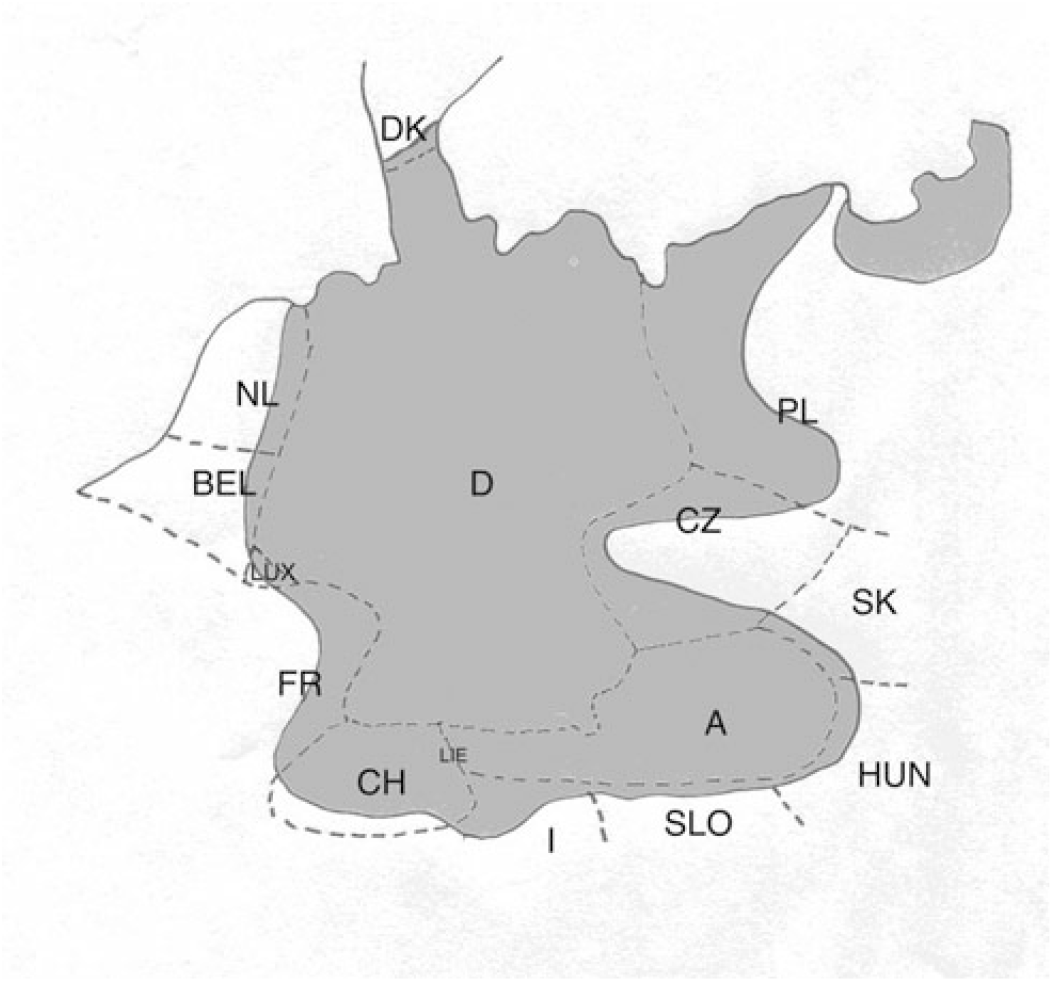
Map 1 depicts the linguistic area in which German has traditionally been the majority language (grey); it is shown that the political borders of the German-speaking countries do not coincide with the German linguistic area. Apart from Austria, Switzerland and Germany, we see sizeable German-speaking populations in Belgium, Luxembourg and Italy, while the areas in the east lost their German speakers in the 20th century.
Traditionally German-speaking areas (grey) and state borders (source: Maas, Reference Maas2014: 40).

The situation in English is quite different, at least as far as the Inner Circle varieties are concerned, which are those that derived from settler varieties. In English, sea borders are the norm, whose non-contiguous nature make it more likely that newer standard varieties are more readily recognized, e.g., Irish English, American English or New Zealand English. There are only a couple of contiguous land borders in the Inner Circle, strictly speaking only the Canada–US and the Northern Ireland–Republic of Ireland border. The English–Scottish border, though not (yet or any longer) an international border, is the most linguistically diverse border in the Inner Circle (e.g., Glauser, Reference Glauser1974) and a contiguous one. As the English and Scottish skirmishes and renegotiations over the centuries around that border have shown, contiguous borders are perhaps more likely to be questioned than sea borders (see, e.g., Watt, Llamas & Johnson, Reference Watt, Llamas and Johnson2010; Llamas, Watt & Johnson, Reference Llamas, Watt and Johnson2009). Generally speaking, the prominence of sea borders in English has allowed a focus on the more practical issues of language and national identity.
2.1 The English model
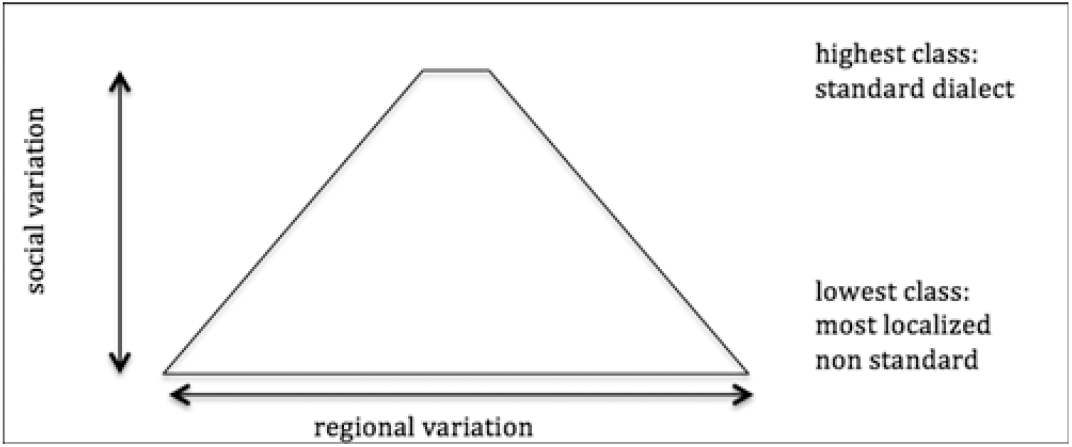
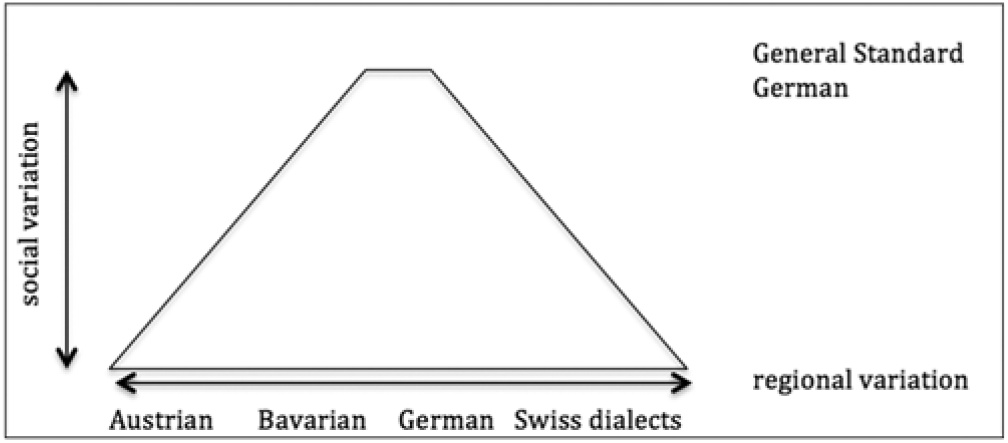
Peter Trudgill’s (Reference Trudgill2000) classic model of regional and social variation in Britain (first published in 1974) may serve as common ground for the discussion. The model is a schematization that is based on well-informed impressions, not on a particular data set per se. Figure 1 shows the original model, intended solely for the UK: social variation is vertically depicted, geographical variation is horizontally aligned. The pinnacle, the highest class dialect, is represented by very few speakers (short line: only 9–12% speak standard British English, Trudgill & Hannah, Reference Trudgill and Hannah2017: 9), with the many regional and social varieties more towards the bottom (many speakers, long line). Speakers and communicative situations can in this way be pegged anywhere in the pyramid.
Trudgill’s model of standard and non-standard dialect (Reference Trudgill2000: 30).

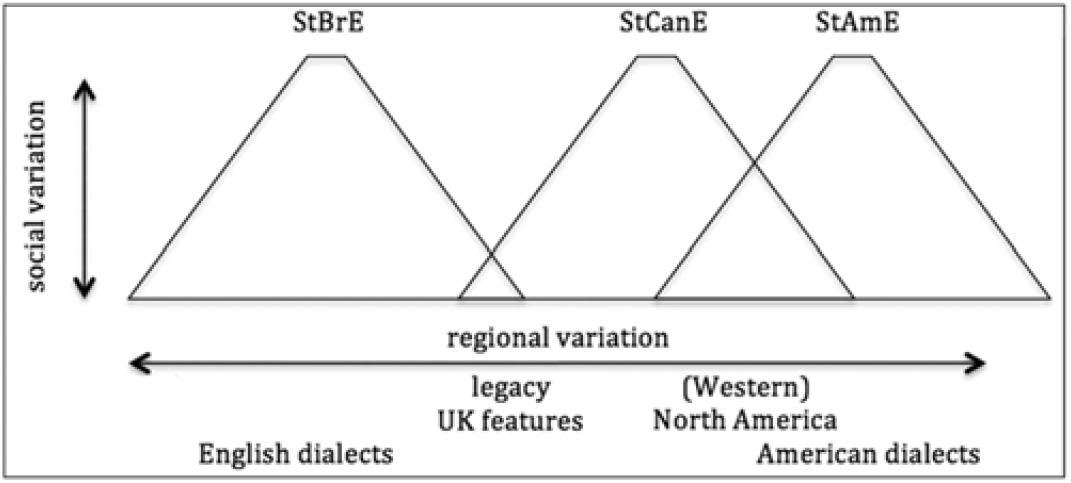
Figure 2 is an adaptation of the model to the international context, showing the standard varieties of English as autonomous from each other, as Standard Canadian English (StCanE), Standard American English (StAmE) and Standard British English (StBrE); they are defined endonormatively, that is by their own specific codification tools and independent of each other, yet they share, of course, almost all of their features. Just half a century ago, Canadian English, however, would have been merely on its way towards an autonomous national variety (Avis Reference Avis and Sebeok1973, Dollinger Reference Dollinger2019a). The more we move down from the standard varieties to the regional level, the more variation we get on the one hand, which, occasionally, may result by coincidence in more similarities between the neighbouring regional varieties, such as in Washington State and British Columbia, or, as we will see later, Upper Austria and Bavaria.
Pluricentric English, with three national standard varieties and feature overlap.

The existence of autonomous reference points of StCanE, StAmE, and StBrE is important, as they allow for a meaningful allocation of the lower levels. Some regional dialects may overlap considerably or even nearly completely, for instance the Western North American varieties (as depicted), yet linguistic similarities do not threaten the autonomy of either the Canadian or American standards; they are, by way of pluricentric theory, conceptualized as different standards that share some features with other standards. The case presented in Figure 2 is analogous to Chambers & Trudgill’s (Reference Chambers and Trudgill1998: 10-11) classic example of linguistic autonomy and heteronomy in 17th-century Sweden and Denmark.Footnote 2 Clyne (Reference Clyne1995) summarizes the pluricentric approach as follows:
The relationship between national varieties is usually a dynamic and interactive one because they are affecting one another and being affected by common influences. The actual differences between national varieties in terms of phonology, vocabulary and grammar may not be very great. Wardhaugh (1986:31) projects the difference as one of ‘flavor’ rather than ‘substance’. It is this difference that becomes a marker of national identity. (Clyne, Reference Clyne1995: 21)
In the Canadian case, the objective difference between western Canadian and western US speech is small, because “Canadian English is an essentially North American variety, very similar to that spoken in the Midland and Western regions of the United States” (Labov, Ash & Boberg, Reference Labov, Ash and Boberg2005: 215). Canadian English as a national variety of English does not exist so much because of its linguistic difference with American English, but by virtue of its speakers having decided collectively that Canadians deserve their own variety. This process of description, codification and celebration of Canadian idiosyncrasies has recently been described in detail, spanning some 80 years (Dollinger, Reference Dollinger2019a).
Adapting Trudgill’s model as shown in Figure 2 has a number of advantages. For instance, World Englishes can be nicely modelled in both their standard varieties (the peaks) and their regional and social variations, as well as their cross-border features. Border research supports such modelling: it is known that the “structural distance between the dialects and the standard variety often is not the same across the dialectal territory” (Auer, Reference Auer, Kortmann and van der Auwera2011: 492). We also know that regional linguistic differences on the non-standard level are just one factor, and not the most important one, towards establishing the linguistic autonomy of a national variety. Examples of this fact are many: the North Germanic dialect continuum dissecting the Swedish–Norwegian border, the dialects along the western Canada–US border, or the Slovak–Czech cross-border continuum. In all these cases, the regional varieties are considered varieties of Swedish, Norwegian, Canadian English, American English or Czech and Slovak on the sole fact that their speakers in a majority agree to do so.
A number of projects have looked at border varieties since Ludger Kremer’s pioneering study (Reference Kremer1979) on dialect diversification across the Dutch–German border. In the European context, there are Kremer & Niebaum (Reference Kremer, Niebaum, Kremer and Niebaum1990), Auer & Hinskens (Reference Auer and Hinskens1996), Auer, Hinskens & Kerswill (Reference Auer, Hinskens and Kerswill2005) and Auer (Reference Auer and Da Silva2013); in the North American context, we have, for example, Chambers (Reference Chambers1998), Boberg (Reference Boberg2005), Labov, Ash & Boberg (Reference Boberg2005) or Dollinger & Fee (Reference Dollinger and Fee2017), and in the Scottish context, Llamas et al. (Reference Llamas, Watt and Johnson2009) and Watt et al. (Reference Watt, Llamas and Johnson2010).
These findings are both individually and collectively very encouraging and supportive of the notion of pluricentricity. One of the key findings that this research has shown is the dynamic quality of the border and its attitudinal and cognitive effects among speakers on both sides of the border. An arbitrary political border becomes a more profound linguistic border over time. Auer et al. (Reference Auer, Delbecque, van der Auwera and Geeraerts2005: 29) summarily state:
Borders often have an effect on change, leading mainly to dd [dialect diversification] between dialects on either side of the border, and simultaneously dc [dialect convergence] between dialects on the same side. Borders are natural (e.g., rivers, swamp areas, mountain chains) or made by humans (tribal, political, and ecclesiastical boundaries).
Perceptual dialectology (Preston & Long, Reference Preston and Long1999–Reference Preston and Long2002) has shown that folk perceptions and linguistic attitudes play an important part in identity formation processes (for Canada, see McKinnie & Dailey-O’Cain, Reference McKinnie and Dailey-O’Cain2002). Britain (Reference Britain, Auer and Schmidt2010) considers perceptual elements, together with linguistic and social aspects, the vantage points of interpretations of space in dialectology. All three effects, are, of course, also operative along borders. Most important is perhaps that the cognitive and attitudinal dimension of speakers on either side of the border is altered, thus making Canadians and Americans or Austrians and Germans think of themselves as “different” from one another, which again has cognitive effects and may lead to further linguistic differentiation (e.g., Auer, Reference Auer and Da Silva2013; Dollinger, Reference Dollinger2012; Swan and Babel, Reference Swan and Babel2018). All of these effects feed back into the codification of a standard over time, and vice versa.
2.2 The traditional German model
In continental European dialectology, the relevance of political borders cutting across traditional dialect zones has traditionally been downplayed. While this view has been changing slowly since Kremer’s work, political borders within a language, e.g., Germany and Austria, are often modelled very differently than those between languages, e.g. the Dutch–German case. There are exceptions for some of the smaller European countries. Luxembourg, for instance, has codified its Moselle-Franconian dialects of German into Luxembourgish since WWII, the national language in Luxembourg (Horner, Reference Horner2005). As a result of that reframing, it has been shown that “the [Luxembourg] dialects in the eastern border regions are becoming less like those of neighbouring parts of Belgium[’s German speaking areas] and Germany” (Gilles, 1999, qtd. in Woolhiser, Reference Woolhiser, Kortmann and van der Auwera2011: 508). This dialect diversification is a well-attested sociolinguistic phenomenon.
More recently, the Dutch language has seen codification into a Standard Belgian Dutch and Standard Netherlands Dutch. Grondelaers & Van Hout (Reference Grondelaers and van Hout2011) describe the developing Standard Belgian Dutch in a pluricentric model. It is the effect of what Auer (Reference Auer, Kortmann and van der Auwera2011: 497) summarizes succinctly: “former common standards dissolve by repertoire splits (Belgium/Netherlands, Austria/Germany, Croatia/Serbia etc.)” into new endoglossic standards. We can see that standard languages are malleable and responsive to social changes, above all attitudinal changes, which fit well with social definitions of language vs. dialect, since “a ‘language’ is not a particularly linguistic notion at all” (Chambers & Trudgill, Reference Chambers and Trudgill1998: 4).
The pluricentric perspective is found in standard reference works of German. For instance, von Polenz (Reference Von Polenz1999: 414) considers German a pluricentric language “whose norms are not monocentrically defined.” Going on, he stresses the important position of Austrian German in the pluricentric German model, stating that “among all national varieties of German, the case of Austrian German is objectively the least problematic”Footnote 3 given its considerable codification in comparison to Swiss German.
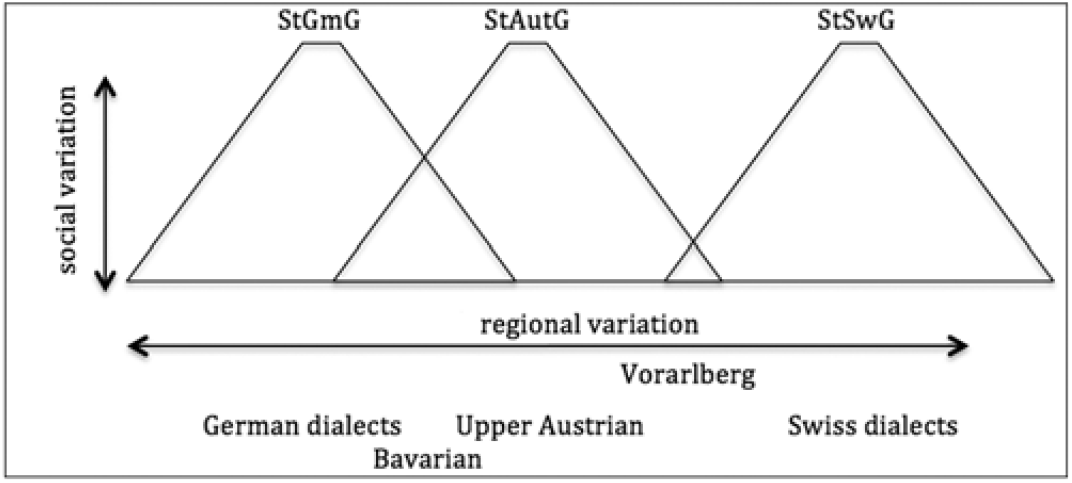
Following the visualization attempt of pluricentricity, Figure 3 shows three standard varieties of German: Standard German German (StGmG), Standard Austrian German (StAutG), and Standard Swiss German (StSwG).Footnote 4
Pluricentric German, with three national standard varieties and feature overlap.

The model depicts, analogous to the English case in Figure 2, the shared, cross-border features on the non-standard level between Swiss dialects and the Austrian province of Vorarlberg (the one sizeable traditional dialect region in Austria that is historically not a Bavarian dialect), as well as the Upper Austrian and Bavarian (Germany) dialects of German. As both Upper Austrian and Bavarian dialects historically derive from the same dialect region, i.e., the “mid Bavarian-Austrian” dialects, the area is ground zero in the pluricentricity debate (Dollinger, Reference Dollinger2019c).
The pluricentric model has the added advantage that its conceptualization fits in the larger, global language framework of abstand variety, difference by slow development, and ausbau variety, difference by social consensus (Kloss, Reference Kloss1978, originally in embryonic version in 1952). Kloss lists German in the Federal Republic, the (then) German Democratic Republic, Switzerland, and Austria next to European and Brazilian Portuguese, Dutch, and Flemish as “Nur-Ausbausprachen” or “exclusive-ausbau standard varieties,” i.e., standard languages exclusively “because they are used in bigger, independent states as the language of bureaucracy and administration” (Kloss, Reference Kloss1978: 67).Footnote 5
2.3 The “pluri-areal” model
In recent years, research on Austrian German has been undertaken by a group of professors hailing from Germany, which is quite novel for Austrian German. Gaining ground since 2010 out of the “bottom-up” historical linguistics movement, this approach aims to:
employ a new, current as well as sustainable, perhaps “supranationally” respectively “postnationally” oriented theory for the study, description and explanation of the continuing unique and complex heterogeneity of the German language. (Glauninger Reference Glauninger, Fiala-Fürst, Joachimsthaler and Schmitz2013: section 5)Footnote 6
Traditional histories of standard languages have been criticized as “standardization from above,” while historical sociolinguistic work has shown “a strong plea for ‘language histories from below’ in the study of standardization” (Elspaß & Niehaus, Reference Elspaß and Niehaus2014: 49). Rather than telling a teleological story of the development of the standard, the new school attempts to use less traditional, more diverse data to arrive at better interpretations.
By this reasoning, data-driven, bottom-up theory building is confronted with a science-theoretical, epistemological problem when pushed to the extreme. Advocating for a “new” way of modelling standard varieties, the proponents of “pluri-areality” claim that the use of the standard in German has changed and non-standard varieties have been pushed back. This new normal is rooted in the observation that today “the majority of Germans do not speak dialect”Footnote 7 (Elspaß, Engel & Niehaus, Reference Elspaß, Engel and Niehaus2013: 44), which is a statement that is certainly not true for Austria or Switzerland, where a complex array of varieties is in operation. For Austria, de Cillia & Ransmayr (Reference de Cillia and Ransmayr2019) show copious data along those lines: teachers in Austrian schools, for instance, report that their students speak Austrian “dialects” (51%) and “Umgangssprache” or colloquial standard (85%), while only 3% use Standard German German (Abb. 80). Among Austrian secondary students, a majority of 50% to 60% report speaking “dialect” with their friends and in all family categories (Abb. 84), which is an increase in dialect use when compared to their teachers’ answers.
The pluri-areal data-driven perspective is not sensitive enough to capture such speaker realities. The practice to operate with smaller regions, such as Germany Northeast, Germany Northwest, and Germany Midwest, assigns Austria and Switzerland a handful of regions and by definition removes any national perspective. This is called “bottom-up” modelling:
In order to emphasize the often merely regional dimensions of standard variants and to avoid the popular impression that ‘pluricentric’ is identical with ‘plurinational’, it is suggested that the situation in the German-speaking countries is to be called ‘pluri-areal’ and not pluricentric. We, too, concur with this by now disseminating opinion.Footnote 8 (Elspaß, Dürscheid & Ziegler, Reference Elspaß, Dürscheid and Ziegler2017: 2.2)
The rationale for the rejection of the pluricentric notion of standard lies in its alleged “idealized notion of standard”Footnote 9 (Elspaß, Dürscheid & Ziegler, Reference Elspaß, Dürscheid and Ziegler2017: 2.1), while “pluri-arealists” claim to construct their standards through their data.Footnote 10 What seems to underlie this reasoning is a confounding of what in English linguistics are called norms, which are the features that are predominant in a given setting including their social evaluation, with the standard. In Labov’s words, “speech communities show a uniform set of evaluative norms” (Labov, Reference Labov2001: 213). Standard, however, is by definition a socially constructed category. In Uriel Weinreich’s words, standardization “denote[s] a process of more or less conscious, and centralized regulation of language” (Weinreich, Reference Weinreich1954: 396). While “pluri-arealists” study norms and may well contribute to that discussion, their claim of studying the standard variety is more dubious. The creation of a standard has been analyzed in Haugen (Reference Haugen1966) in four stages, from the selection of a variety, to its elaboration, codification and acceptance, of which all four are profoundly social processes. The “pluri-arealists” seem at odds with this process, calling it “top down,” disregarding that any standard variety has been created in such a way.
By denying the national level any relevance in the setting of standards, “pluri-arealists” reiterate and render immutable the traditional model which is based on the standard that has been dominating throughout Germany; while the features of such a single standard may be questioned, its existence is put beyond dispute and the One Standard Axiom is born. Proponents of “pluri-areality” therefore implicitly support a monocentric approach to Standard German, as visualized in Figure 4. While their explicit quest is to describe the standard of German in terms of “regional standards,” they employ an unexpressed top-down approach, putting the non-dominant countries at an unsurmountable disadvantage.
Implicit model of standard as a result of “pluri-areality”.

A program of the study of “standard” that does not consider national boundaries as legitimate can, and perhaps should be considered as implicitly colonial: the biggest, most powerful nation gets to keep its standard, relegating all non-dominant standards to “regional local standards.” Not just from an English linguist’s perspective, such reasoning, presented as a neutral, bottom-up description of real language use, is blind to its own biases.
3. The case against pluricentricity
3.1 The charge of ideology
The mid-1990s saw a heated debate between proponents of the two camps. Muhr (Reference Muhr1996: 15) argues that there “is no reason to consider one’s own German as ‘worse’ than any other variety that comes from abroad,” while Scheuringer (Reference Scheuringer1996) rejects Muhr’s reasoning categorically by foregrounding an “anti-national stance,” because:
state nations or nations defined through language and nationalisms have in my opinion caused so many catastrophes in Europe until the present day that these notions are unsuited as concepts in the long term. (151)
While no one wishes to return to a pre-WWII interpretation of nationalism, Scheuringer’s unease does not per se render nation invalid as a variable. Einar Haugen offers perspective in his classic study of the codification of Norwegian—wresting Norway away from the Danish written standard and from Swedish influence. As if replying to Scheuringer’s statement, Haugen wrote:
Such negative judgements [of nationalism] are understandable in the light of world events. But they need to be tempered by an insight into the positive sides of nationalism. […] Nationalism is not only or even primarily directed against outsiders; it is also a sentiment of cohesion among the members of the nation, a loyalty which transcends the parochial or regional attachments of the primitive community. (Haugen, Reference Haugen1966: 278)
The identity-building force of national belonging is utterly negated by “pluri-arealists,” which is odd for historical sociolinguists. Some readers might object to a 50-year-old quote being used to speak to the national fabric of 21st century EU member states. To dispel such qualms, Israeli historian Tom Segev summarizes the current European situation in terms of national sentiments the following way:
We don’t have that [a unified Europe] because the national feelings are still very strong. It’s not something that is over. There was a phase, perhaps 20 years ago, when people thought it was over. (Segev, Reference Segev2018)
The national sentiments in today’s Europe are, sadly, not difficult to discern in the many populist movements. Even 20 years ago, however, the dream of a unified Europe entailed a long and difficult road on which Europe had just started to embark; for good reason, Wodak et al. (Reference Wodak2009: 4) speak of Europeans as homo nationalis, referring to identities that are considerably co-determined by national dimensions. Likewise, Crystal (Reference Crystal2017: 331) talks about “country-focused” social conventions and a lack of a cultural EU identity. The latter is, from today’s perspective, unfortunately uncertain to arise. Seidlhofer and Widdowson (Reference Seidlhofer and Widdowson2017: 361), for instance, consider the “likelihood of a common European identity developing at all” as “questionable” in the light of “the continuing historical adherence to the idea of separate nation-states.”
In the German linguistic arena, however, those arguing for a pluricentric perspective, such as Muhr or de Cillia, have been accused of an “ideological” or isolationist stance, which is an unfair charge in the light of “pluri-areal” perspectives being just as ideological (or not) as pluricentric ones (e.g., Seifter & Seifter, Reference Seifter and Seifter2016 for the most extreme form). The distinct possibility of an ideological bias among “pluri-areal” approaches behind terms such as objective data, bottom-up and mathematical models has not been addressed. The following shows that the “pluri-areal” perspective is not as neutral as claimed:
Of course it remains to be asked, whether in an era in which Europe’s growing-together is politically encouraged, which includes the German-speaking part of Europe, regional differences and as such cultural common ground, which in some cases are rooted in historical dialect areas, should not be emphasized instead of national differences. (Niehaus, Reference Niehaus2015: 164-5)Footnote 11
It is easy to see a non-linguistic interest in these lines and one wonders why only the pluricentric approach should be subject to ideological motivation. As Scheuringer (Reference Scheuringer1996) and Elspaß & Niehaus’ (Reference Elspaß and Niehaus2014) argument shows, there is potentially substantial ideology behind “pluri-areality.” Historians have not been unaware of such blind spots. Summarizing dominant intellectual trends, historian Joachim Whaley (Reference Whaley2002: 35) identifies “decades of West German ‘post-national’ thinking” in the aftermath of WWII as resulting in a “diminished sensitivity to the continuing significance of national issues for many neighbouring countries.” It is entirely possible that “pluri-areality” is the brainchild of such “diminished sensitivity” towards identity-forming realities in smaller European countries.
3.2 Pluricentricity as an “old-fashioned” pre-EU notion
Some linguists suggest that an integrationist European Union rendered Clyne’s concept of national varieties as “anachronistic”Footnote 12 (Glauninger, Reference Glauninger, Canisius, Gernr and Glauninger2001: 172). The original concept of pluricentricity, in which centres are often aligned with national centres, though there are half-centres and quarter-centres, depending on the degree of codification (Ammon et al., Reference Ammon2016: ixl-lxiii), is consequently turned via metaphorical extension into “pluri-national,” and then further into “pluri-uncentric” (Scheuringer, Reference Scheuringer1996: 152) on the logic that nations as centres are not utterly homogenous (axiom of categoricity, see 3.3), which “pluri-arealists” consider a condition of using the term centre.
Glauninger’s assessment is questionable from the perspective of decades-long efforts of economic, military and cultural integration in North America, culminating in NAFTA. It showed that more economic, cultural, and military integration does not lead to fewer linguistic acts of identity, but to more. Here is how Boberg summarizes this perhaps surprising outcome for Canadian English:
current indications are that Canadian English is not on the verge of disappearance in a continental blend dominated by American speech patterns. Despite the massive influence of American English over the last half-century, exercised through increasingly powerful channels like television and the internet, regional linguistic variation remains one of the few ways in which Canadians can still be reliably distinguished from Americans, at least in most parts of the continent. (Boberg, Reference Boberg2010: 250)
The same would apply to the EU and its integration on various levels, though the integrationist dynamic has all but stalled since the 2015 migration crisis. It does make sense, however, to show one’s roots simply and easily linguistically: say Jänner in Germany not Januar ‘January’ and you’ll likely be recognized as Austrian while still being understood: it’s a win-win. Such acts of identity are particularly important in the global context. As Wolfgang Dressler put it in a review of Ammon (Reference Ammon1995):
At least as far as Austria is concerned (where I am most competent), Ammon’s [Reference Ammon1995] evaluations and judgments are fair and well-balanced. He shows no traces of a “German German language imperialism” vis-a-vis the other national varieties of German, which is very much resented in Austria and Switzerland (Dressler, Reference Dressler1997: 609-10).
It seems that some “German German language imperialism” may shine through today in some papers on Austrian German. Glauninger’s death knell for pluricentricity as an outdated concept of the 20th century seems premature if not misconceived.
3.3 The axiom of categoricity
The axiom of categoricity is Chambers’ (Reference Chambers2009: 26-8) name for categorical assessments of language use that do not consider the gradual phenomena and probabilistic distributions that are so characteristic for linguistic variation. The axiom is not new as it was introduced into linguistics by Saussure in the early 1900s, and taken up by the early Generative linguists. Variationists, of course, never believed in it. One of the most incisive formulations of the axiom is by Martin Joos, who declared at the height of the structuralist paradigm: “We must make our ‘linguistics’ a kind of mathematics, within which inconsistency is by definition impossible” (Reference Joos1950: 702). And further on phenomena in the “real world” that linguists fail to describe:
Our reaction, as linguists, to this situation, is very simple: all phenomena, whether popularly regarded as linguistic (such as the tone of anger in an utterance) or not, which we find we cannot describe precisely with a finite number of absolute categories, we classify as non-linguistic elements of the real world and expel them from linguistic science. (Joos, Reference Joos1950: 703)
Such statements of course fly in the face of probabilistic linguistics, where it is about getting as close as possible to predicting all cases, knowing that a certain fuzziness will remain as a result of the social character of language (e.g., Kretzschmar, Reference Kretzschmar2015; Ritt & Kazmierski, Reference Ritt and Kazmierski2016). In a strange way, however, the “pluri-arealist” approach must be seen as a mathematical attempt to sweep aside any anomalies that are created within what is considered a language, in a Plato-like, essentialist kind of view. While German and Dutch are taken a priori as given, the differences between the varieties of German German and Austrian German are treated as categorically different from those between German and Dutch.
“Pluri-arealists” seem to have tacitly adopted the axiom of categoricity into sociolinguistics. Elspaß & Niehaus (Reference Elspaß and Niehaus2014: 56), for instance, present grammatical variation in verbs, i.e., the order in subordinate clauses of the finite verb, the auxiliary verb and the lexical verb. They summarize their results in what may be the only “pluri-areal” publication in English:
The 3–1–2 (gesehen werden kann) order is very noticeable in the south-eastern regions of the German-speaking language area. In Austria, it is even the dominant (but not absolute) variant. As leading grammar books such as the Duden grammar consider themselves grammars of usage, it is surprising that the 3–1–2 variant has not been marked as a standard variant yet […]. (Elspaß & Niehaus, Reference Elspaß and Niehaus2014: 56, emphasis added)
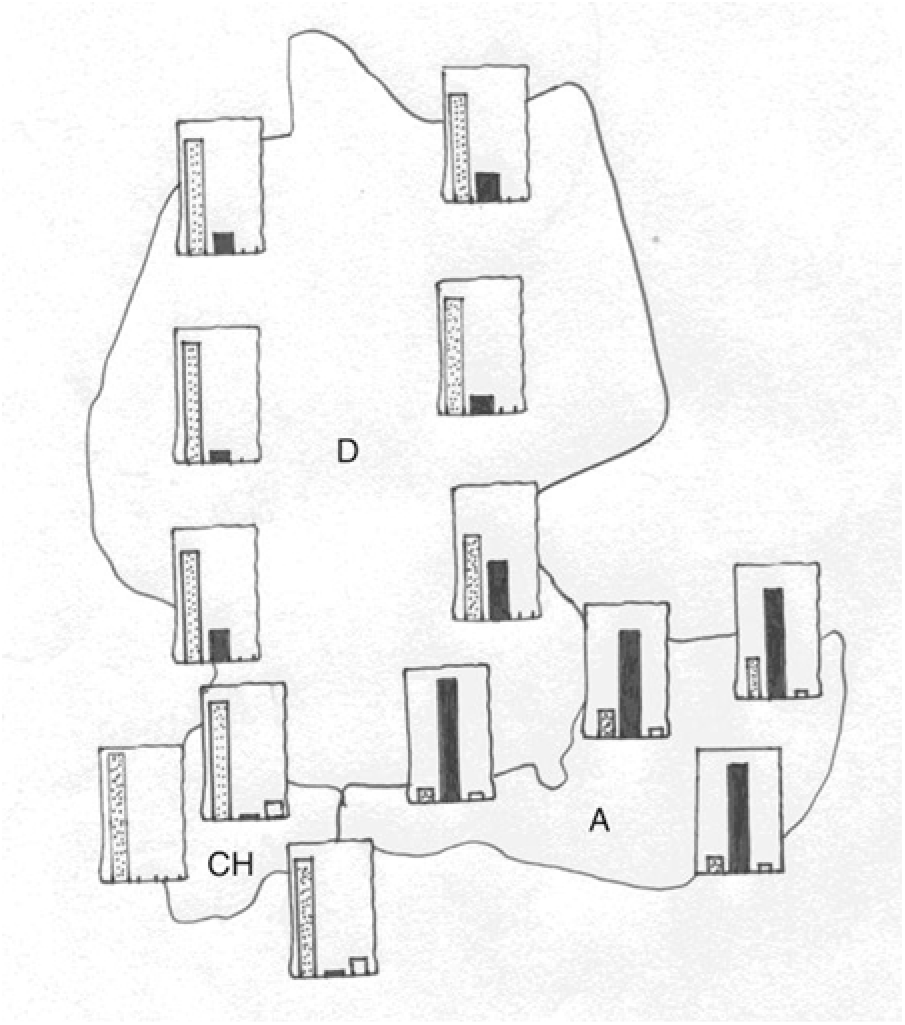
Note the requirement of the “absolute” as a benchmark criterion for “Austrianness,” which is a good example of the axiom at work in favour of the “pluri-areal” argument. The actual data, if one looks at it with a critical eye, however, supports pluricentricity. Figure 5 shows sequences of verbs in perfect passive constructions. The dark bar in the middle of the insets is pattern 3-1-2 (gesehen werden kann—SEEN + WILL + CAN ‘will be able to be seen’), reaching 90% or more in all Austrian locations and just up to 10% in most of Germany and less than that in Switzerland. In one part of Bavaria the pattern occurs as a minority form with about 30%, while the major pattern is 2-3-1 (kann gesehen werden—CAN—SEEN—WILL).
Verb sequence in subordinate clauses (Elspaß & Niehaus Reference Elspaß and Niehaus2014: 55).

The Bavarian behaviour is utterly predictable as a transition zone in a developing isogloss scenario, as Chambers & Trudgill (Reference Chambers and Trudgill1998) have shown, between the Austrian and the German regions, whose usage has not yet settled. The Austrian side is gravitating towards the Austrian standard 3-1-2 (gesehen werden kann), while the traditional Bavarian 3-1-2 has been “realigned” to the German standard, 2-3-1 (kann gesehen werden). The existence of a 30% or so minority use does not falsify the pluricentric approach, because sociolinguistics does not operate on the assumption of categoricity. Rather than using the one Bavarian region in categorical fashion as an argument against an Austrian norm, one should approach the situation as a dialect zone in transition.
On the contrary, we can predict that with more time, the Bavarian border region will blend in more fully with the German norm and that, say half a century ago, the Bavarian was more like the Austrian side. In “pluri-areal” parlance, however, the requirement for national varieties to show categorical varieties is worded in the following, very different way:
The missing differentiation between absolute and relative variation (resp. the little weighting of relative variation) is a frequently-voiced point of criticism against the pluricentric model.Footnote 13 (Niehaus, Reference Niehaus2015: 137)
From the above we may assume that something must be wrong with the pluricentric model, while the axiom of categoricity is selectively applied against the pluricentrists. Hypothesis testing—is a variable Austrian/Canadian—seems to be the safer way to proceed, a way that does not a priori negate national varieties. In the recent Dictionary of Canadianisms on Historical Principles (Dollinger & Fee, Reference Dollinger and Fee2017), it was attempted to falsify 1248 uses of Canadian words as non-Canadian, which was successful in 135 cases, while in 1113 cases a Canadian status was confirmed as one of six types (see Dollinger, Reference Dollinger, Pedro and Olivera2017). The types include higher discourse frequency or culturally salient terms or changing semantics in CanE compared to AmE: all aspects that a “pluri-areal” approach is blind to because it does not accept the national border as something real.Footnote 14
German dialectology has been putting pressure on the pluricentric approach for a while now. Dürscheid & Elspaß (Reference Dürscheid, Elspaß, Kehrein, Lameli and Rabanus2015) make that very clear:
Yet we do not accept the term “national varieties”; we also do not follow a pluricentric concept, which is based on ‘national centers’ (cf. the critique in, inter alia, Reiffenstein 2001; Auer Reference Auer and Da Silva2013). Because, firstly, the features do not stop at the international border, and, secondly, it does not apply that a given standard variety is customarily used in the country. (564)
The passage above, I would argue, can be construed as an attack in the name of the One Standard German Axiom. It is odd to see Auer (Reference Auer and Da Silva2013), who applies Agha’s (Reference Agha2007) concept of enregisterment to national varieties of German, used against the idea of pluricentricity. Enregisterment is described as “processes and practices whereby performable signs become recognized (and regrouped) as belonging to distinct, differentially valorized semiotic registers by a population” (Agha Reference Agha2007: 81); this is what has happened to words such as Jänner ‘January’, Topfen ‘cream cheese’, or Pickerl ‘sticker’ in Austrian German. Enregisterment is the cognitive association of linguistic features with entities, in this case nations, often against more complex behavioural data. By way of enregisterment, for instance, eh has become a prime Canadian marker (see http://www.dchp.ca/dchp2/Entries/view/eh for a summary), while it is used in many countries (Avis, Reference Avis1972).
Rather than taking enregisterment as counter-evidence against national varieties, pluri-arealists need to consider enregisterment a “real” process that is no less important than behavioural data. The fact that speakers enregister terms as Austrian or Swiss or German is prime evidence for each variety’s reality. Auer (Reference Auer and Da Silva2013: 40) writes, accordingly, that “there can be no doubt that the German language today is not only regionally, but also nationally pluricentric: there are normative differences between Austrian, Swiss and German Standard German.”
3.4 The late standardization of German
Some surmise that German deserves a “special status” in comparison to English, which would warrant special terms such as “pluri-areality.” Glauninger (Reference Glauninger, Canisius, Gernr and Glauninger2001: 172) claims vital differences in the standardization processes of English and German. For English, it is suggested that a standard variety was formed prior to colonial exploration, while in German, standardization set in much later.
The histories of English and German standardization are not as different as Glauninger makes us believe. While a London-based standard was in place in colonial English times, it only played a marginal role in the formation of new national varieties, because the speakers that emigrated overwhelmingly did not speak that standard. For Ontario, Canada, Dollinger (Reference Dollinger2008: 83) reports that a mere 7% of migrants came from southeast England, while the vast majority of English were lower class immigrants who did not command Standard English English, as were the vast majority of Scottish and Welsh who likewise used regional and social dialects. The suggested special status of German in terms of standardization seems to derive from a conflation of late political unification in Germany with late linguistic standardization, which is not borne out by a comparative perspective.
The difference between English and German standardization processes is unlikely to be significant. This is also because written Standard British English had been formed more or less by 1550, to a greater degree by 1700, and fully by about 1800. In German, similar changes can be detected before 1800. The two standards of the 16th century, a Southern (including Austrian) Imperial Standard and a Northeastern Central German Standard (influenced by Luther) gave way in favour of the latter as of 1750 in Austria (Havinga, Reference Havinga2018). As a result, standard German increasingly became associated with northern forms after 1800 (Mattheier, Reference Mattheier2003).
4. The case against “pluri-areality”
4.1 Popper’s knowledge theory and the conceptual emptiness of “pluri-areality”
While linguistic theory should make testable predictions, “pluri-arealists” are far from that requirement. Pluricentricity, which offers testable hypotheses, was single-handedly discarded by Scheuringer without offering more than a vague label in its place, a label synonymous with “geographical variation”:
Especially in relation to the standard language in Austria it is areal patterns, e.g., the old Bavarian-Austrian area, or the area that defines a general southern German, that are much more frequent than the nation-bound areas or smaller areas that operate below the level of the nation state. Yet more frequent, outright overwhelmingly so, is “One-Areality” [i.e., where no regional variation exists at all]. One-Areality is, it needs to be said, the base of a functioning and practicable Hochsprache [standard language]. Because One-Areality is, just as the nation-oriented pluricentric pattern, not the only pattern, the German language is “pluri-areal.”Footnote 15 (Scheuringer, Reference Scheuringer1996: 152)
This passage, which is the most detailed description of “pluri-areality” available, illustrates the frequent ad-hoc coinage of new terms: “One-Areality,” my own calque from Scheuringer’s neologism “Einräumlichkeit,” is one such term that is used to justify the One Standard German Axiom. Such coinages help demonstrate that “pluri-areality” has been applied to a range of scenarios without having been meaningfully defined. De Cillia & Ransmayr (Reference de Cillia and Ransmayr2019) call it “noticeable” (“auffällig”) that the pluri-areal approach “is in comparison with pluricentric ones theoretically little elaborated” and specify that what is missing are the key elements of any theory:
[…] the basic axiomatic assumptions and hypotheses concerning the connection of linguistic and extralinguistic variables, the development of a clearly defined terminological apparatus […] (de Cillia & Ransmayr Reference de Cillia and Ransmayr2019: 40)Footnote 16
Pluricentricity’s theoretical assumptions are, by stark contrast, laid out in Clyne’s (Reference Clyne1995) and Ammon’s (Reference Ammon1995) monographs as well as in Ammon et al. (Reference Ammon2016). Despite their vocal preference for data (see below), “pluri-arealists” do not seem to abide by epistemological principles. Karl Popper argues in Logik der Forschung (Reference Popper1966 [1934]) that what is possible is either description with a clearly expressed theory or description based on unexpressed theories. Since there is no statement to the theoretical base of “pluri-areality,” such studies rely on unexpressed theories; they may even operate, in Popper’s reasoning, beyond the realm of science:
There is fundamentally no end to the game of science: those who decide one day to no longer test one’s scientific findings, but to consider them as verified, are leaving the game. (Popper, Reference Popper1966 [1934]: 26).
Operating without a theory would automatically put them beyond “the game of science.” “Pluri-arealists,” as we will see below, are forced to perform conceptual twists and turns to make programmatic statements:
Isn’t it the case that a linguist is supposed to simply describe the interesting cases of areality in our case […] on all its levels such as traditional dialect, Umgangssprache, written language etc.?Footnote 17 (Scheuringer, Reference Scheuringer1996: 147)
In the above passage the descriptive fallacy “to simply describe” without theory is put on a pedestal. By necessity, any data is approached with pre-determined interpretations, because only theory-driven hypotheses and falsification may prevent such bias. As Labov, Ash & Boberg (Reference Boberg2005) point out in their Atlas of North American English: it “is now generally recognized that theory cannot be avoided so easily” (2006: 4). Unexpressed “theory” and assumptions sneak in through the backdoor in the form of the One Standard German Axiom that underpins the “pluri-areal” stance.
By contrast, pluricentrism makes clear theoretical, falsifiable predictions. For instance, it predicts that across a border region, such as in Braunau/AUT and Simbach/GER, or in Vancouver/CDN and Bellingham/USA, speech patterns diverge over time. It also stipulates that the dialect of neighbouring towns on either side of the border would converge with one another (see Auer et al., Reference Auer, Delbecque, van der Auwera and Geeraerts2005). Claiming that German is a “pluri-areal” language merely means that there is geographical variation of some unspecified sort. Maintaining the established term “geographical variation” and clearly stating that one is against pluricentricity would be the more upfront way and would be preferred over using synonymous terminology that purports to replace tested theoretical concepts.
4.2 Positivist Black Boxes
More recently, “pluri-arealists” have applied mathematical models to dialect geography. In the absence of theory, the algorithm that identifies isoglosses becomes the theory. One such method operates with geographical distances to estimate dialectometric distances (pioneered by Goebl, Reference Goebl1984 and others). The method systematically distorts generally accepted dialect boundaries and occasionally wipes them out completely. In the words of the pluri-arealist practitioners, it “frequently happens that differences in individual variables that coincide with structural dialect borders are straightened, shifted, or otherwise blurred” (Pickl et al., Reference Pickl, Spettl, Pröll, Elspaß, König and Schmidt2014: 29)Footnote 18.
An adapted method harnesses linguistic differences of variants rather than mere geographical distance. While it fares somewhat better, the problem of appropriate parameter settings remains unchanged, as “it is clear that in a different region and with other data, the results could be in favour of other parameter settings or even of geographical distances” (Pickl et al., Reference Pickl, Spettl, Pröll, Elspaß, König and Schmidt2014: 38). The method is, therefore, hardly neutral. Such cautionary reasoning is found in the technical papers, such as Pickl’s work (Reference Pickl2013), but does not enter the key papers (e.g., Elspaß, Dürscheid & Ziegler, Reference Elspaß, Dürscheid and Ziegler2017; Dürscheid & Elspaß, Reference Dürscheid, Elspaß, Kehrein, Lameli and Rabanus2015; Elspaß & Niehaus, Reference Elspaß and Niehaus2014). Since “pluri-areality” makes no statement on the role of international borders, it can hardly serve as a theoretical concept for their modelling.
The problem is that the dialectometric algorithm leaves key decisions in the hands of the analysts, i.e., the parameter settings, which opens the door for any preconceptions, rendering as doubtful any claims to the objectivity of results as “derived from the data itself” (Elspaß, Dürscheid & Ziegler, Reference Elspaß, Dürscheid and Ziegler2017: 71). Embleton, Uritescu & Wheeler (Reference Embleton, Uritescu and Wheeler2013) recognize the problem with apparently objective algorithms in dialect geography and consequently changed their mathematical mode. They no longer use behavioural or reported raw data as input, as the pluri-arealists do, but interpretive data, which “worked better than raw data” (Reference Embleton, Uritescu and Wheeler2013: 20). For the interpretative data, and this is key, “a human researcher has reviewed the data, made an assessment of whether or not two locations are the same, and recorded this with symbols” (Reference Elspaß, Engel and Niehaus2013: 17). Embleton and associates reject, in other words, the pure mechanical approach and introduce a perceptual angle.
So far we have discussed the split of one standard variety into two or more. The merger of two separate standards into a single one is rarer, yet was the result of the unification of the Federal Republic of Germany (FRG) and the (communist) German Democratic Republic (GDR) in 1990, with the latter being re-integrated into the Federal Republic after four decades of political and ideological separation that was not without linguistic consequences, as is predicted by pluricentric theory. While in West Berlin, the urban vernacular, Berlinish, was stigmatized, in East Berlin, the capital of the GDR, it had developed into an “urban colloquial variety,” a variety that had begun to spread beyond the city limits (Woolhiser, Reference Woolhiser, Kortmann and van der Auwera2011: 509). This case shows that even a very short separation of four decades (although an admittedly brutal kind) produces different norms that, eventually, are codified into a separate standard. German Unification, of course, put an end to this development.
Elspaß and Niehaus (Reference Elspaß and Niehaus2014) take an asocial stance on the construction of varieties. Disregarding cognitive, attitudinal, and also behavioural data, “pluri-arealists,” however, state of pluricentricity that:
[f]irstly, it is an entirely political concept, based on the notion of Überdachung of the language area by a political state. As for the recent history of German, this would have had the somewhat odd consequence that on 3 October 1990, the German language has lost [sic] an entire national variety, namely GDR German, literally overnight. Secondly, from a linguistic perspective, one may ask whether ‘national varieties of German’ are really varieties? (Elspaß & Niehaus, Reference Elspaß and Niehaus2014: 50)
What seems odd from a “pluri-areal” stance is precisely what the pluricentric model would predict: such changes would of course not happen overnight, but like other sociopolitical events (e.g., the Norman Conquest and a switch from English to French in the social upper echelons) with reasonable speed.
4.3 The One Standard German Axiom
It is fair to say that a strong bias against the pluricentricity of German has taken hold of the field, which is reflected in recent textbooks. In Schmidt & Herrgen (Reference Schmidt and Herrgen2011), an undergraduate textbook by the Marburg School of the Deutscher Sprachatlas, one will unsuccessfully look for terms such as national variety or pluricentricity. Austrian German or Swiss German are de facto treated as non-standard varieties (see Figure 4). Since even the monocentrists cannot fully ignore the national dimension of German, more opaque and idiosyncratic terms, this time “Oralisierungsnorm,” or “oral pronunciation norm,” are introduced to justify the One Standard German Axiom. Austrians and Swiss use the One Standard, which they mangle via their “oral pronunciation norms” into their pronunciations.
Where did this all start? While Wolf (Reference Wolf1994) coined the term in ad-hoc fashion in one of the last lines of a review article, the early pluricentrist Herman Scheuringer (1985) turned his back on studying Austrian German in a pluricentric context, arguing since 1990 against Standard Austrian German. His book on the Upper Austrian-Bavarian border is qualitative and more subjective than first meets the eye. Reviewing the book (Scheuringer, Reference Scheuringer1990a), Ludwig Zehetner arrives at the same conclusion as the present author, identifying a striking interpretive bias in the book.
Most of the differences between the regions of Braunau (Upper Austria) and Simbach (Bavaria) are to be deemed as results of the border realignment of 1779.Footnote 19 (Zehetner, Reference Zehetner1995: 355)
Scheuringer’s own conclusion, by contrast, focuses solely on the Old High German dialect zones that cut across the international border, stating in a follow-up publication that
All in all one issue seems to be clear: It would be presumptuous, given the historical-cultural connections between Bavaria and Austria, to postulate a linguistic boundary.Footnote 20 (Scheuringer, Reference Scheuringer1990b: 372)
I argue that it is here, in this study of the Upper Austrian-Bavarian border, that the problem started. Missing the key aspect of recent linguistic differentiation, Scheuringer’s interpretation has had a profound influence on the interpretation of Austrian German more generally.
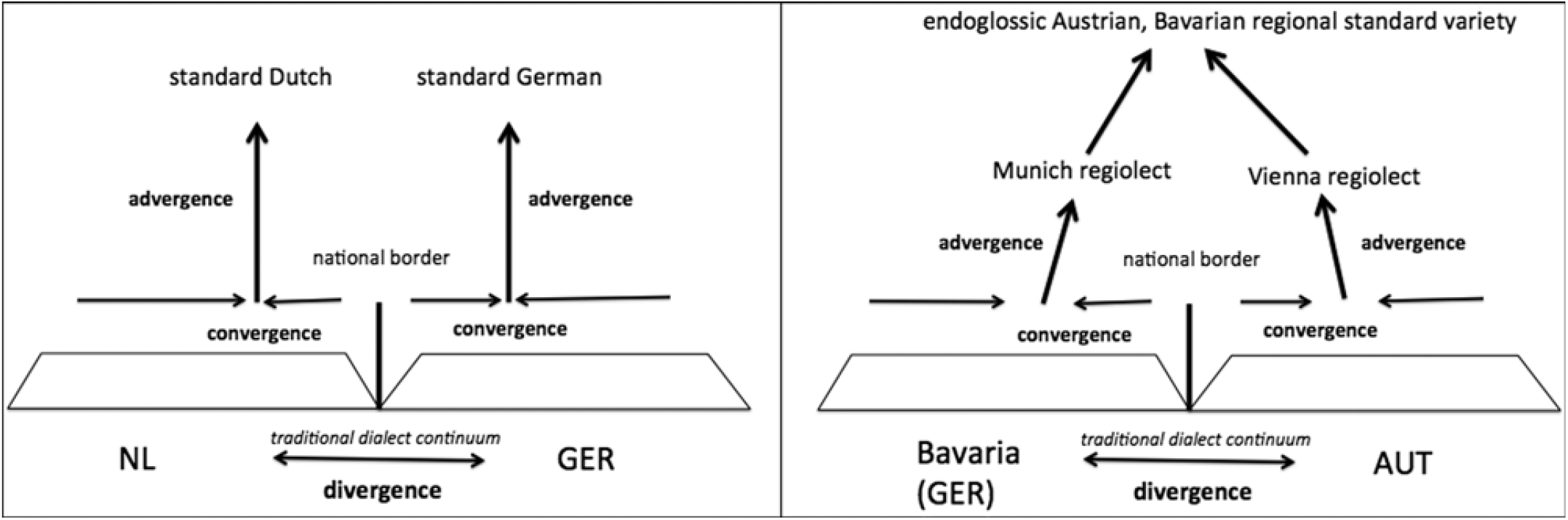
Auer (Reference Auer, Delbecque, van der Auwera and Geeraerts2005), for instance, which offers great clarity and is exemplary in many ways, relies on Scheuringer’s (Reference Scheuringer1990a, Reference Scheuringer1990b) interpretation for the Austrian case. Using the concepts of convergence, divergence, and advergence, Auer (Reference Auer, Delbecque, van der Auwera and Geeraerts2005) schematizes the situation along the Germanic dialect continuum between the Rhineland (German) and The Netherlands (Dutch), which was disrupted by the international border. Figure 6 (left) depicts the Dutch-German border as creating divergence across the dialects, while the dialects on either side converge towards each another. The advergence is the “roof,” the linguistic reference point, in the form of Standard Dutch on the one hand and of Standard German on the other hand.
Auer’s (Reference Auer, Delbecque, van der Auwera and Geeraerts2005) models of GER-NL and AUT-GER.

Auer’s depiction of the Austrian-German border, shown in Figure 6 on the right, is modelled rather differently. Instead of referring to a Standard German German and a Standard Austrian German as the roofs, the city lects of Munich and Vienna are declared as reference points. It is significant that no evidence is offered for using the city lects and not the codified standards as reference points. A joint “Austrian, Bavarian regional standard” is suggested, however, in line with the One Standard German Axiom. To summarize: we have two Germanic dialect continua, the one (Dutch) codified in the 18th and 19th centuries, the other (Austrian German) since 1945; we have two linguistically arbitrary borders, yet we are offered very different models.
Sociolinguistically, the move seems unmotivated. Socially, Munich and Vienna are not comparable in terms of international status, and the concept of an “Austrian regional standard” that is pulled out of the hat in Figure 6 is a questionable construct that replaces a national standard of Austrian German. It is strange that the fairly well codified and accepted variety of Standard Austrian German is “dialectalized” and demoted to a regional variety. While such demotions are historically documented, such as the 17th/18th century demotion of Scots as an independent literary language to a regional dialect of English (Millar, Reference Millar2007: 15), such demotions are usually the result of political, not linguistic, intervention.
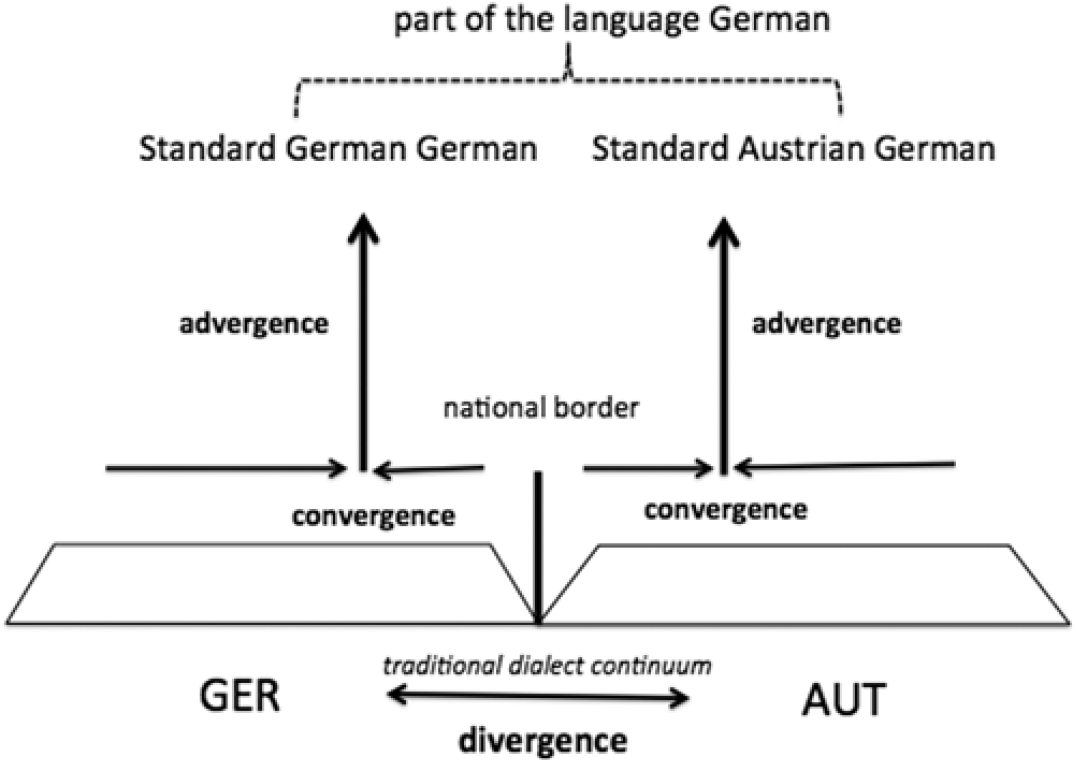
There is no convincing reason why the NL/GER situation should be modelled differently from the AUT/GER situation. Figure 7 is a pluricentric rendering of the scenario, which is a model-inherently consistent approach and socially realistic depiction of the Austrian–Bavarian border. Like in the NL/GER case, two standard varieties form the reference points.
The Austrian-German border in Auer’s schemata in the pluricentric framework.

Common in many “pluri-areal” papers is an underlying terminological fuzziness, a metaphorical penchant. We have seen a few examples above, Scheuringer’s “One-Areality” (my translation) or the declaration of “Austrian regional standard” and “Bavarian regional standard” in Figure 6. There are, overall, a great number of terms and labels in German dialectology when compared to English. Such plethora has not gone unnoticed. Nerbonne (Reference Nerbonne2015: 126), for instance, points out in a positive review of Pickl (Reference Pickl2013) that the paper’s inherent interpretation would “undermine the consistency of the term variety and thus dialect area” itself (Nerbonne, Reference Nerbonne2015: 126). Terminological wild “growth” is a consequence of an atheoretical stance in bottom-up approaches.
5. The lynchpin of speaker attitudes and perceptions
I argue that the One Standard German Axiom disregards speaker realities in Austria and Switzerland. It has been known for a long time that traditional Austrian dialects are used as identity markers (see Wodak et al., Reference Wodak2009). There are many indicators, however, that Austrian German is also an entity on the standard level. De Cillia, for instance, reasons that:
The German language plays—despite the official understanding [of Austria] as a nation founded by consensual agreement—ultimately an important role for Austrians’ national identity constructions, it has been and is instrumentalized for identity politics … and for demarcation with the other German-speaking countries, when the Austrian variety of the German language is set in focus.Footnote 21 (de Cillia, Reference de Cillia2015: 162)
Pfrehm’s study of variant acceptance found significant differences in what is perceived as standard in Austria and Germany (Pfrehm, Reference Pfrehm2007: 53). Likewise, Schmidlin’s (Reference Schmidlin2011) study on the perception, reported use and familiarity with national varieties of German comes to the same conclusion. When “pluri-arealists” therefore suggest that there are too few features in Standard Austrian German that are distinct from Standard German German, they conflate the issue of type frequency with token frequency. It is not the number of types that matters, but the way types are used and perceived as tokens in actual discourse. The following assessment reveals a reductionist, essentialist, and reifying approach to Standard German German in use that is ultimately metaphorical, as it seems to be based in—random—naming practices of linguistic varieties:
One can argue that less than two per cent of variation in standard German lexis and pronunciation and even less variation in grammar does hardly make a ‘variety’.” (Elspaß & Niehaus, Reference Elspaß and Niehaus2014: 50)
This assessment is subjective at best, but in the light of counter examples, it is also incorrect. Consider an analogue from genetics: while humans and chimps share 98% of their genes, no one would claim that humans and apes “hardly make” different species. The concept of type–token ratio considers that some variables are socially much more important (e.g., Jänner vs. Januar) than others (e.g., Viertel vor drei vs. Dreiviertel drei). Schmidlin is therefore quite right in pointing out that:
In the case of pluricentric varieties of standard German, the typical features can be equated with Austriacisms, Helvetisms, Teutonisms and regional variants, showing varying degrees of salience. … In that context, the number of features is less important than the interplay of pragmatically, lexically and, in case of the spoken standard, phonologically marked features. (Schmidlin, Reference Schmidlin2011: 291-2)
In other words, the number of features is not important, yet the weight that speakers assign to them is. This principle is possibly a sociolinguistic universal. The number cannot be too big in any case, or communication would come to a halt; after all, we’re dealing with varieties of the same language.
5.1 Linguistic insecurity in dominant vs. non-dominant varieties
Herrgen takes the implicit One Standard German Axiom to the next level in a perceptual study that deems audio samples as the linguistic standard only “if they are free of salient regionalisms” (Herrgen, Reference Herrgen2015: 140). The method that identifies regional speech is set as an absolute benchmark of one non-standard word or more for every five words (ibid) and therefore enforces a German German behaviour as “normal” and unmarked. The methodology is stacked against non-German standards of German: the perceptual cut-offs of what counts as standard and what does not are set as “very low” (sehr gering) (ibid), mirroring German German precedents, which implies that there is very little if any tolerance as to what counts as standard in German. Such study design is not sensitive to the multi-variational setting in Austria.
A serious methodological problem is that the term “pures Hochdeutsch” [pure Hochdeutsch] is used in the questionnaires. The term, which in Germany is synonymous with “standard German,” is in Austria intricately linked with exo-normative German German. As a result, Herrgen’s data is infelicitous, yet he boldly concludes:
The respondents from Austria (in contrast to those from Germany and Switzerland) accept [a Standard Austrian] sample as much as the federal German sample as “pures Hochdeutsch.” In other words: two standards obviously exist in Austria, which are equally accepted: an Austrian and a Federal German standard. These stand in contrast to the Swiss sample: this sample is assessed by all respondents [in all three countries] at a level that is the equivalent of a “regiolect.” (Herrgen, Reference Herrgen2015: 155)
The “obvious” interpretation of two equally accepted standards in Austria is an artefact of the method and its interpretation. From a speaker-based point of view, the conclusion seems outright incorrect: if people use StGerG in Austria, they are at first inevitably marked as outsiders, as people from Germany (speakers socialized in Germany are generally identifiable within a few syllables). There is for instance the negligible, low single-digit percentage of Standard German German that is found in Austrian schools (de Cillia & Ransmayr, Reference de Cillia and Ransmayr2019; Abb. 80). In obvious contrast to Herrgen, Peter is aware of the sociolinguistic situation, stating that “the Federal German standard variety generally carries the greatest prestige” in Austria (Reference Herrgen2015: 144), which:
does, however, not allow the conclusion that the speakers outside of Germany would also generally follow in their standard language production the norm of the Federal Republic of Germany. (Peter, Reference Peter2015: 144)
Herrgen, by contrast, instead declares an entirely new phase in the standardization of German, a new era of a general “de-nationalization” [“Entnationalisierung”] of the German language, while the liberalization of the Austrian media landscape in the 1990s is identified as the cause for “the de-nationalization of the phonetic realizations of national standard varieties” (Herrgen, Reference Herrgen2015: 157).
It is irritating that the factor of linguistic inferiority or insecurity is nowhere mentioned by Herrgen, which would go a long way towards explaining the supposed acceptance or ‘social superiority’ of Standard German German in official contexts, the air of ‘authority’ and the ‘social distance’ that may come with it. There is an analogue in Canadian English: a socially balanced sample of Canadians (14–80+, gender and ethnicity diversified) rates British English as the “best” and “most correct” English, but despite that Canadians do not accept British English as a standard in their country. They see it as foreign (Dollinger, Reference Dollinger, Nelson, Proshina and Davis2019b: section 8).
Muhr (Reference Muhr2003) documents an increase of German TV shows in Austria throughout the 1990s, with prominent German TV channels, such as Pro7 and RTL, becoming available via cable. However, the argument of media influence seems too simplistic and counterevidence is easy to find. One argument has to do with the varieties used in commercials. The German stations in Austria are usually not broadcasting German TV spots, but use “commercial windows” with spots that are dubbed in Austrian Standard German or were produced specifically for the Austrian market. If there were no social need for it, these companies would not spend money on that matter. Herrgen’s interpretation further begs the question why the “denationalization” did not happen from the 1960s to the 1980s, when many Austrians had access to three German TV stations—in addition to two Austrian stations—via terrestrial antenna. Austrians have been hearing German German for many decades now, but like Canadians hearing American English, they do not simply adopt the exonormative standard.
5.2 Attitude data from Austria
Fortunately, there is reliable speaker attitude data available. Their importance has been realized for Canadian English at least since Warkentyne (Reference Warkentyne1983) and Owens and Baker (Reference Owens and Baker1984). In German, such studies are rarer, with Schmidlin (Reference Schmidlin2011) being one of the first. The data shows that Austrians perceive many terms as standard that German speakers would consider either non-standard or at the cut-off point (Schmidlin, Reference Schmidlin2011: 259). On aggregate, Schmidlin considers “the relevance of the international borders as pragmatic and cognitive borders as a remarkable result” of her study (297). Consequently, “regional heterogeneity within Germany does not seem to play a role with many of the polled variables,” which means that Southern Germans (including Bavarians), while in one historical dialect zone with most Austrians, “answer like the middle and northern German respondents,” not like the Austrian ones (ibid).Footnote 22 This is an important result and confirms the transition area interpretation in Figure 5, as well as more generally the perceptual reality of social evaluations, the key concept with which Labov defines a speech community.
De Cillia and Ransmayr (Reference de Cillia and Ransmayr2019: 220) offer highly interesting data regarding the recognition of Austrian German as an entity. University-educated teachers (5-year programs) associate in 61% of cases the term “Austrian German” with the variety of TV and radio newsreaders, i.e., with Standard Austrian German; by contrast, those who hold just a three-year educational college degree do so only in 33% of cases. A higher education is therefore beneficial to the recognition of “Austrian German,” and suggests that Austrian teacher education is exonormatively influenced. In Canada, a considerably higher awareness of Canadian English is likewise found in the highly educated compared to those with only a diploma or high school degree (Dollinger, Reference Dollinger2015: 253–4). In Austria, 54% of teachers of teachers in three-year colleges associate traditional Austrian dialects with the term “Austrian German,” but only 35% of 5-year university-educated teachers. The positive correlation of education and recognition of Austrian German is an interesting parallel with the Canadian data and is possibly a universal in ausbau varieties.
These data make a very powerful case for Austrian German as an entity. De Cillia and Ransmayr’s findings are based on socially sensitive questions and are asked indirectly, avoiding linguistic terminology. Most importantly for the present paper, their results speak a clear language in favour of Standard Austrian German, with 90% of high school teachers and 79% of high school students believing that German is a language with more than one standard. In Canada, likewise, 84% of Canadians with a post-secondary education and 73% without a university degree believe in a “Canadian way of speaking” (Dollinger, Reference Dollinger2015: 253).
5.3 Language pedagogy
The above data suggest that education is key in the acceptance of Standard Austrian German, though it is very late in the educational stream—in 5-year university programs—that the issue of pluricentricity is discussed. The subject of German in Austrian schools is of course confronted with the problem of norms. The German Duden dictionaries have long claimed to cover the German-speaking countries in their entirety, while they have been heavily biased towards the northern German varieties. The Österreichisches Wörterbuch (ÖWB, Austrian Dictionary), which has been given free to all Austrian students since the mid-1970s, is the most pragmatic choice for Austrian students, yet it has been harshly critiqued for not applying corpus driven methods. While not perfect, the methods of the ÖWB were not different from the Duden dictionaries. ÖWB is used by 28% of Austrian students, while 38% use the internet and 48% the Duden dictionaries (de Cillia & Ransmayr, Reference de Cillia and Ransmayr2019: Abb. 25; multiple answers were allowed).
There is an important pedagogical case to be made for the use of a pluricentric model that probably trumps other reasons. As Austrian children mostly grow up bi-dialectally, they are often left to their own devices to navigate the complex variation patterns in Austrian German. De Cillia and Ransmayr (Reference de Cillia and Ransmayr2019: 228–229) conclude from their study that Austrian teachers are not adequately trained about Austrian German and are not supported when experiencing linguistic insecurity, which they inevitably pass on to their students. The express adoption of a pluricentric approach in teaching, including its integration into national syllabi, as de Cillia and Ransmayr (Reference de Cillia and Ransmayr2019: 231) recommend, would with one stroke eliminate a good deal of that linguistic insecurity. At present, little is done to support students in their linguistic identity formation; what is worse, the “pluri-areal” bandwagon of the past ten years has nothing to offer to them. On the contrary, that approach would revert to exo-normative days.
That “pluri-arealists” are not all about description, but may have other plans can occasionally be seen. Current projects tend to “focus on the description, documentation and in the last instance on the codification of regional variation” (Elspaß, Dürscheid & Ziegler, Reference Elspaß, Dürscheid and Ziegler2017: 2.1).Footnote 23 This goal does not consider StAutG and StSwG, but an undefined “standard German” that would then, via Herrgen’s “oral strategies” try to model why Austrians and Swiss do not fit the German German norm. As Sutter summarizes her take on “pluri-areality”:
The pluri-areal model considers the fact that the linguistic development of the past centuries is more important in shaping varieties than the relatively young nations states.Footnote 24 (Sutter, Reference Sutter2017: 31)
Sociolinguists would beg to differ. While language history is important for language historians, it cannot be constantly foregrounded and shoved into the faces of speakers of non-dominant varieties.
6. Safeguards for the modelling of standard varieties
There should be no confusion about the continuing usefulness of pluricentricity. If we treat some borders one way (Canada, Flanders, Luxembourg, Sweden), we cannot treat one border (Austria) differently unless we have compelling reasons to do so. In the Canadian context I sometimes speak of the “birthright” or right of residence of Canadians to learn about Canadian English in schools, not American, not English English (Dollinger, Reference Dollinger2011: 8). International borders, which are usually drawn arbitrarily, have real linguistic and cultural effects. For the Canada–US border, Chambers concludes that
[…] differences may also be trivial, taken one by one, but they amount to culture. […] They [the cultural differences] persist, as we have seen, whether the ‘fence’ is a gorge or a meandering river or just a line on the road. (Chambers, Reference Chambers, Jansen and Siebers2019: 258).
“Pluri-areal” is an atheoretical term that is synonymous with the established term “geographical variation.” In order to avoid such confusing duplication, I propose three methodological safeguards that would prevent such development in the future.
6.1 The “horizontal” Uniformitarian Principle
Transferred from geology into linguistics in the 1860s, the uniformitarian principle has been a cornerstone in historical linguistics, so much so that sociolinguists felt the need to revive it. Labov considers it “so central to [his] work” (Reference Labov1994: 21) that he discusses its application at length. If we consider comparing different diachronic language states with one another as a vertical application of the principle, then the comparison of different varieties in the present can be considered a horizontal application of the uniformitarian principle. In the horizontal application, we need to be wary of social situations that might distort that parallel. As I argued above, such special status for German is unwarranted. Judging by sociolinguistic practice, which has foregrounded and indeed thrived on a comparative element (e.g., language studies in Chambers, Reference Chambers2009; Gold & Tremblay, Reference Gold and Tremblay2006), researchers have had few hesitations applying the uniformitarian principle horizontally to different western societies in the present day. They have been doing so for a long time (e.g., Cedergren, Reference Cedergren1973); I am merely integrating this practice as a second reading of the uniformitarian hypothesis.
6.2 Theory-driven falsification, not just “bottom-up”
A basic requirement in academic inquiry is the subjugation of theory-derived hypotheses to independent testing, in Popper’s terminology the exposure to falsification. The strategy to declare, from a German position with the backing of 80 million speakers, that both Standard Austrian German (c. 8 million) and Standard German German are equally “accepted” in Austria (Herrgen, Reference Herrgen2015), disregards the social situation on the ground. To make such claims, interpretations should be rooted in Occam’s razor, giving preference to the explanation that uses the least and simpler presuppositions. This would lead to linguistic insecurity as an explanatory factor and not to Herrgen’s “de-nationalization” claim. In any case, theory-derived predictions would be required that are either falsified by the data or not. As no theory is made explicit by “pluri-arealists,” interpretations are necessarily subject to the analyst’s implicit assumptions, as Popper pointed out. In the end, the speakers of Austrian German need to decide for themselves, for which de Cillia & Ransmayr (Reference de Cillia and Ransmayr2019), as well as Schmidlin (Reference Schmidlin2011), Pfrehm (Reference Pfrehm2007) and others, offer very convincing data in favour of a pluricentric view of German.
That political borders throw a wrench into geographical variation has by now been widely acknowledged. Boberg (Reference Boberg2000) made an important stride in that direction and no less than William Labov commented that features do “not follow the predictions of the cascade model across the U.S.–Canada border” (Labov, Reference Labov, Britain and Cheshire2003: 10). Variation within and across state boundaries is no problem for the pluricentric approach. As Haugen (Reference Haugen1966) demonstrates for Norwegian, any standard language, including Standard German German, is an artefact and a result of language and variety planning:
No single criterion could be found that would at once be universal for Norway and distinctive from her neighbours. The features that were actually widespread in the dialects did not necessarily fit well together into a single linguistic structure. (Haugen, Reference Haugen1966: 300).
There would be no Standard German, no Standard Dutch, or no Norwegian, if categoricity were a requirement for the codification of a standard variety. “Pluri-arealists” seem to be enforcing unrealistic benchmarks that are rooted in the axiom of categoricity on those standard varieties of German that may be seen as expendable. The myth of “bottom-up” becomes a self-fulfilling prophecy: national varieties are discounted because they are not categorical in their variables, which is demonstrated with a methodology that categorically rules out the social interplay of language variety and identity on the national level.
6.3 Variation and variety planning
Not all linguistic colleagues may want to lend their expertise to language planning. Einar Haugen reminds us of the fallibility of the linguist:
It must be granted that linguists are not necessarily equipped to pursue language planning. Their sensitivity to linguistic nuances may be dulled by excessive preoccupation with the mechanics of language. (Haugen, Reference Haugen1966: 297)
It is legitimate, of course, to be solely concerned with geographical variation in language, but then one’s claims must stay clear of the social dimension. In any case, the linguist is well advised not to use the term “pluri-areality” for the simple reason that dialectologists have long-standing terms for the phenomena of ‘geographical variation’ and ‘regional variation’, neither of which carries colonial undertones and, more importantly, which do not cause confusion. The term “pluri-areality” casts a dark cloud of language history over the speakers of non-dominant standard varieties, a cloud that they can never escape from. If adopted, the linguist must be aware of its emptiness as a concept, its asocial dimensions, and, inevitably, its colonial reverberations. Because what applies, among other varieties, to English, Norwegian, Mexican Spanish, and Spanish Spanish must also apply to German. It is time we abandon “pluri-areality” irrevocably in favour of the fully theoretically-grounded, internationally established, and, above all, falsifiable concept of pluricentricity.
Acknowledgements
I wish to thank Dennis Preston for his intellectual curiosity, as well as an anonymous reviewer—with “no stake in the sides being argued”—for insightful comments on the submitted version of this paper.