INTRODUCTION
Despite the eastern Atlantic affinities of the Azorean molluscan fauna (Ávila, Reference Ávila2000) about 13% are known to occur in the Caribbean province (Ávila et al., Reference Ávila, Silva, Schiebel, Cecca, Backeljau and Martins2009). Nevertheless, the systematics and amphi-Atlantic status of some of these species remains controversial and requires re-appraisal (Malaquias et al., Reference Malaquias, Calado, Padula, Villani and Cervera2009).
Amphi-Atlantic distributions are common in opisthobranchs. A recent study recognized 134 species of opisthobranchs occurring on both margins of the Atlantic realm (García & Bertsch, Reference García and Bertsch2009). Yet, the use of molecular phylogenetic approaches has demonstrated that species of molluscs traditionally regarded as amphi-Atlantic can belong to distinct taxa (e.g. Reid et al., Reference Reid, Lal, Mackenzie-Dodds, Kaligis, Littlewood and Williams2006; Malaquias & Reid, Reference Malaquias and Reid2008; Claremont et al., Reference Claremont, Williams, Barraclough and Reid2011; Carmona et al., Reference Carmona, Malaquias, Gosliner, Pola and Cervera2011).
Three species of Thuridilla are described in the Atlantic Ocean, namely T. hopei (Vérany, Reference Vérany1853) (=T. splendida (Grube, Reference Grube1861)), T. picta (Verrill, Reference Verrill1901) (=T. duis (Marcus & Marcus, Reference Marcus and Marcus1967)) and T. mazda Ortea & Espinosa, Reference Ortea and Espinosa2000. The first two have been subject to major systematics confusion due to their morphological and chromatic resemblance (Thompson, Reference Thompson1977; Bouchet, Reference Bouchet1984; Ortea et al., Reference Ortea, Luque and Templado1988; Thompson & Jaklin, Reference Thompson and Jaklin1988; Jensen, Reference Jensen1992), but recently Carmona et al. (Reference Carmona, Malaquias, Gosliner, Pola and Cervera2011) showed that these two species are distinct and allopatric; T. hopei inhabits the eastern Atlantic including the Azores (where it has a stable and large population in a coastal lagoon at Fajã de St. Cristo in São Jorge Island) and T. picta occurs in the Caribbean Sea and Bermuda. The species T. mazda was until now only known from the Caribbean Sea.
In this work we report for the first time the presence of the Caribbean species Thuridilla mazda in eastern Atlantic waters, namely on the archipelago of the Azores.
MATERIALS AND METHODS
During the ‘IV International Workshop of Malacology and Marine Biology (São Miguel, Azores)’ (4–13 July 2011) organized by the Department of Biology of the University of the Azores, intertidal and shallow communities of invertebrates were surveyed down to 35 m deep off the village of Mosteiros (north-west São Miguel Island, Azores). Opisthobranch specimens were obtained intertidally and through SCUBA diving by manual collecting and brushing suitable habitats (e.g. sponges, algae, hydrozoans and bryozoans). In the laboratory samples were sorted and specimens photographed, relaxed, and fixed for anatomical dissection in formalin and DNA extraction in 96% ethanol. The single specimen of Thuridilla mazda (Zoological Museum, SAB.2011.DI6B4) was fixed in formalin.
RESULTS
Twenty-six species of opisthobranchs were collected; among them the Caribbean species Thuridilla mazda Ortea & Espinosa, Reference Ortea and Espinosa2000 that is here reported for the first time on eastern Atlantic shores.
MATERIAL EXAMINED
1 specimen, Piscinas Naturais dos Mosteiros (37°53′43″N–25°49′22″W); 1 m deep, on algae; maximum length = 17 mm.
COLORATION
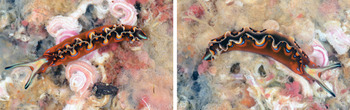
General body colour dark reddish-brown. Undulating parapodial margins lined with several colourful spots and bands, which further accentuate the undulations (7 in each parapodial lobe of present specimen). Parapodial edges with thin white or pale yellow line. Below this is a band, which in the outwards folded parts is thick and gradually changes from pale yellow to bright orange. In the inwards folded parts this band is narrow and orange interrupted by black spots. Below this is a dark brown to black band, which in the outwards folded parts surrounds an iridescent blue crescent-shaped spot. Below the dark brown band is a series of orange crescent-shaped spots, corresponding to the undulations of the parapodial margins. There are no coloured spots on the lower parts of the parapodia. The inner side of the parapodia could only be observed by prying the parapodia apart. The colour is dark green, almost black with a paler greyish band along the margins. At the posterior end an elongate iridescent blue spot is visible. The orange band of the parapodia continues around the posterior body margin. A conspicuous white Y-shaped spot covers the dorsal surface of the head, neck and dorso-medial surface of the rhinophores. It may be light yellow towards the central part, and ends posteriorly in an iridescent blue spot in front of the orange pericardial ridge. Between the anterior margins of the rhinophores is an orange spot. The front of the head is dark brown. There is a small iridescent blue spot in front of and below each eye. The eyes are relatively small and indistinct, located at the edge of the dorsal white spot. The rhinophores have small blue spots along the white stripe and a thin blue line on the external surface. The ventral surface and the tips of the rhinophores are dark brown. There is an orange band along the anterior and antero-lateral part of the foot (Figure 1).
Thuridilla mazda Ortea & Espinosa, Reference Ortea and Espinosa2000. Specimen collected in Mosteiros, São Miguel Island, Azores (total length = 17 mm).

DISTRIBUTION
Costa Rica, Cuba, Bahamas and Yucatan, Mexico (Ortea & Espinosa, Reference Ortea and Espinosa2000; Redfern, Reference Redfern2002; Valdés et al., Reference Valdés, Hamann, Behrens and DuPont2006; Rosenberg et al., Reference Rosenberg, Moretzsohn, García, Felder and Camp2009; Carmona et al., Reference Carmona, Malaquias, Gosliner, Pola and Cervera2011, WORMS, 2011).
DISCUSSION
As pointed out in the introduction, the amphi-Atlantic status of many species of opisthobranchs remains to be tested within a molecular systematics framework and where this has been accomplished it was often demonstrated that ‘single’ species are a complex of multi-taxonomic partitions with the width of the Atlantic realm acting as an effective barrier for dispersal (Malaquias & Reid, Reference Malaquias and Reid2008; Carmona et al., Reference Carmona, Malaquias, Gosliner, Pola and Cervera2011). However, the geographical position of the Azores half way between both sides of the Atlantic basin makes this archipelago more prone to be successfully colonized by western species. The oceanographical influence of the southern branch of the Gulf Stream—the Azores Current—in the archipelago is well documented (Gould, Reference Gould1985) and therefore it is not surprising to find western tropical organisms in the Azores, particularly those with planktonic larva. The larval development of the sea slug Thuridilla mazda is unknown, but this species is likely another example documenting the importance of the Gulf Stream as a putative means of dispersal and colonization of tropical organisms in these northern Atlantic islands. Nevertheless, an anthropogenic introduction of this species by shipping (e.g. yachts) cannot be completely ruled out.
The species Thuridilla mazda is broadly sympatric with T. picta in the Caribbean province and both show chromatic similarities but simultaneously consistent morpho-anatomical differences (see Ortea & Espinosa, Reference Ortea and Espinosa2000). The rinophores are cylindrical and more elongate in T. picta and conical and shorter in T. mazda, and the radula has higher number of teeth in T. picta; though the latter feature could be due to the comparatively larger dimension of the specimens of T. picta studied by Ortea & Espinosa (Reference Ortea and Espinosa2000). The lack of coloured spots on the lower parts of the parapodia and the absence of coloured rings on the rhinophores distinguish T. mazda from T. picta.
The molecular phylogeny of Carmona et al. (Reference Carmona, Malaquias, Gosliner, Pola and Cervera2011) showed strong support for the sister relationship between the eastern Atlantic species T. hopei and the western Atlantic T. picta but the phylogenetic position of T. mazda, included only on the 16S rRNA and Histone-3 gene phylogenies, was not resolved. Its chromatic and morpho-anatomical resemblance hints at a possible closer relationship with the other two Atlantic species but this remains to be confirmed within a phylogenetic framework.
New records of opisthobranch molluscs are continuously reported from the Azores (e.g. Chan & Gosliner, Reference Chan and Gosliner2007; Malaquias et al., Reference Malaquias, Calado, Padula, Villani and Cervera2009; Pedro et al., Reference Pedro, Malaquias, Costa and Ávila2011) showing that the knowledge about this fauna in the region is far from complete. The total number of species known in the archipelago is now 144, an increase of nearly nine per cent since the publication of the Cervera et al. (Reference Cervera, Calado, Gavaia, Malaquias, Templado, Ballesteros, García-Gómez and Megina2006) catalogue. As suggested by Malaquias et al. (Reference Malaquias, Calado, Padula, Villani and Cervera2009) and Pedro et al. (Reference Pedro, Malaquias, Costa and Ávila2011) knowledge about this group in the Azores would likely gain substantially from the development of fieldwork programmes on the poorly known islands of the western group (Flores Island and Corvo Island), which are likely more prone to be influenced by the southern branch of the Gulf Stream.
ACKNOWLEDGEMENTS
We thank A.F. Martins, J. Xavier, and A.C. Costa for putting together the ‘IV International Workshop of Malacology and Marine Biology (São Miguel, Azores)’ and for inviting us to participate. We are grateful to all participants of the workshop for their help with collecting and for the great atmosphere that made this workshop a very enjoyable event. A special thanks to J. Brum, P. Raposeiro, P. Melo and F. Pires for their assistance with SCUBA diving and to S. Ávila, J.L. Cervea and T. Gosliner for valuable discussions on the biogeography of the Azores and taxonomic identifications. The ‘IV International Workshop of Malacology and Marine Biology’ was funded by Direcção Regional da Ciência, Tecnologia e Comunicações dos Açores (ref. M3.2.2/I/026/2011), Fundação para a Ciência e Tecnologia (FCT–Portugal) and Fundação Luso-Americana para o Desenvolvimento (FLAD). The first two authors were partially supported by the research grants CGL2006-05182/BOS and CTM2008-05228-E/MAR, Spanish Ministry of Science and Innovation.