Introduction
Superovulation of female mice is still a common technique for production of large numbers of oocytes. The increased production of genetically modified mice over recent years with the introduction of the CRISPR/Cas9 technique has also been reflected by a high demand for mouse 1-cell embryos. Superovulation allows synchronization of females and the release of large numbers of oocytes, therefore reducing the numbers of animals needed for this purpose. Most protocols use two hormones to mimic the effects of endogenous follicle stimulating hormone (FSH) and luteinizing hormone (LH) through the injection of pregnant mare serum gonadotropin (PMSG) followed by human chorionic gonadotropin (hCG), with an interval of 42–48 h between the two hormones. Several factors affect the efficiency of superovulation and, therefore, the number of females needed for a given purpose. Female age (Gates, Reference Gates1956; Gates and Bozarth, Reference Gates and Bozarth1978; Hoogenkamp and Lewing, Reference Hoogenkamp and Lewing1982; Sugiyama et al., Reference Sugiyama, Kajiwara, Hayashi, Sugiyama and Yagami1992; Redina et al., Reference Redina, Amstislavsky and Maksimovsky1994; Luo et al., Reference Luo, Zuñiga, Edison, Palla, Dong and Parker-Thornburg2011; Kolbe et al., Reference Kolbe, Landsberger, Manz, Na, Urban and Michel2015) and strain (Gates and Bozarth, Reference Gates and Bozarth1978; Luo et al., Reference Luo, Zuñiga, Edison, Palla, Dong and Parker-Thornburg2011), hormone dose (Gates and Bozarth, Reference Gates and Bozarth1978; Legge and Sellens, Reference Legge and Sellens1994; Luo et al., Reference Luo, Zuñiga, Edison, Palla, Dong and Parker-Thornburg2011; Wu et al., Reference Wu, Xue, Chen, Dai, Guo and Li2013), interval between hormones administration (Luo et al., Reference Luo, Zuñiga, Edison, Palla, Dong and Parker-Thornburg2011), the light cycle (Braden, Reference Braden1957; Behringer et al., Reference Behringer, Gertsenstein, Nagy and Nagy2016) and the mouse estrous cycle phase at the time of PMSG injection (Lim et al., Reference Lim, Moon, Lee and Chang1985; Tarín et al., Reference Tarín, Pérez-Albalá, Gómez-Piquer, Hermenegildo and Cano2002) seem to be the most important factors.
Several reports have stated that, in C57BL/6J females, the optimal age for superovulation occurs before 48 days of age, at 21–32 days (Hoogenkamp and Lewing, Reference Hoogenkamp and Lewing1982; Kolbe et al., Reference Kolbe, Landsberger, Manz, Na, Urban and Michel2015). This finding was further supported by an alternative study that referred to a body weight of 14.2 g or less, corresponding to approximately 28 days of age, to be optimal to achieve the highest superovulation efficiency in C57BL/6NHsd mice (Luo et al., Reference Luo, Zuñiga, Edison, Palla, Dong and Parker-Thornburg2011). In other strains, similar results have been described, with a tendency for better results with younger females, except in Crl:CD1(ICR) mice (Luo et al., Reference Luo, Zuñiga, Edison, Palla, Dong and Parker-Thornburg2011; Kolbe et al., Reference Kolbe, Landsberger, Manz, Na, Urban and Michel2015; Behringer et al., Reference Behringer, Gertsenstein, Nagy and Nagy2016). Age and weight are important factors related to female onset of puberty and first ovulation. Juvenile females’ sensitivity to negative feedback from endogenous estrogen decreases as puberty initiates and, consequently, FSH and LH levels rise, and the first ovulatory cycle begins. The onset of puberty has been related to vaginal opening, an apoptosis-mediated process dependent on the gene Bcl2 (Mayer et al., Reference Mayer, Acosta-Martinez, Dubois, Wolfe, Radovick, Boehm and Levine2010). More precisely, the onset of puberty seems to occur 7 days after vaginal opening, when using the Pub-Score (Gaytan et al., Reference Gaytan, Morales, Leon, Heras, Barroso, Avendaño, Vazquez, Castellano, Roa and Tena-Sempere2017). For better results, superovulation should be performed before puberty, at 3–4 weeks of age or before vaginal opening (Kolbe et al., Reference Kolbe, Landsberger, Manz, Na, Urban and Michel2015), occurring between 24 to 30 days of age (Fox et al., Reference Fox, Barthold, Davisson, Newcomer, Quimby and Smith2006, Caligioni, Reference Caligioni2009).
Attempts to optimize hormone doses and interval between hormones have been described previously (Legge and Sellens, Reference Legge and Sellens1994; Luo et al., Reference Luo, Zuñiga, Edison, Palla, Dong and Parker-Thornburg2011), with a 5 IU dosage at an interval of 47–49 h to be optimal for most mouse strains. The estrous cycle at which the hormones are injected also affects the efficiency of the protocol. One study (Hogan et al., Reference Hogan, Costantini and Lacy1986) stated that gonadotropins should be synchronized with the female estrous cycle to achieve optimal numbers and quality of pre-implantation embryos, plus higher percentages of oocytes that reach blastocyst stage when PMSG is given in estrus, diestrus-2 or proestrus.
The light cycle is also an important factor as it affects the time of LH release. hCG should be given 2–3 h before the endogenous peak of LH. In mice, the LH surge occurs 15–20 h after the midpoint of the second dark cycle (Hogan et al., Reference Hogan, Costantini and Lacy1986). Legge and colleagues (Legge and Sellens, Reference Legge and Sellens1994) for mature mice (6–8 weeks old) described the impact of gonadotropin injection time in relation to the beginning of the light cycle. However, information is scarce regarding timing of administration in younger mice, which are commonly used for oocyte collection.
The aim of this work was to determine the impact of PMSG and hCG time of injection at different schedules in relation to the dark phase (3, 5 and 7 pm, and lights on between 7 am to 7 pm), using C57BL/6J mice of different ages (pre-puberal) and taking into account weight and estrous cycle phase at time of PMSH and hCG injections. Optimization of superovulation protocols remains an important tool in the effort to reduce numbers of animals used in several types of experiments and to allow maximum yield of oocyte numbers. Hormone doses were used based on results previously described (Luo et al., Reference Luo, Zuñiga, Edison, Palla, Dong and Parker-Thornburg2011).
Materials and methods
Animals and husbandry
All experiments were approved by the i3S Animal Ethics Committee and Portuguese Competent Authority (DGAV) (Ref 2017_03), and performed at the i3S Animal Facility. Animal care was provided according to the European Directive 63/2010 and Portuguese Legislation. This facility is AAALAC accredited and follows the recommendations of the Guide for the Care and Use of Laboratory Animals, as well as FELASA recommendations. C57BL/6J female mice (n = 89) were used at 3–5 weeks old, weighing between 11 and 19 g, as this was the optimum age for superovulation (Luo et al., Reference Luo, Zuñiga, Edison, Palla, Dong and Parker-Thornburg2011; Kolbe et al., Reference Kolbe, Landsberger, Manz, Na, Urban and Michel2015). Animals were produced at the i3S/IBMC animal facility and breeders were replaced every other year using animals from the original colony to maintain a stable genetic background. Females were kept in standard conditions: temperature inside the rooms was 20–210C and humidity was 45–65%. Animals were fed with Envigo Teklad 2014S and provided with distilled water ad libitum. Females were housed in groups of five or six animals in type III Eurostandard cages (820 cm2 floor area) with corn cob (Scobis Duo, Mucedola, Italy) as bedding material. Environmental enrichment was provided for all cages (card tube rolls and nesting paper) and animals were placed under a microbiological control programme, free of pathogens according to FELASA specific pathogen-free (SPF) recommendations. The light cycle corresponded to a 12 h : 12 h, dark : light period, with lights turned on at 7 am. All experiments were performed between September and December. Although some facilities use a 10 h : 14 h light cycle, most of articles describing superovulation describe a light cycle of 12 h : 12 h. Moreover, a 12 h : 12 h light cycle is the cycle adopted by the i3S Animal Facility and we aimed to obtain results that could be easily implemented within our current practices. Animal welfare was monitored during the whole experiment. Female estrous cycle was not synchronized before PMSG and hCG injection.
Experimental groups
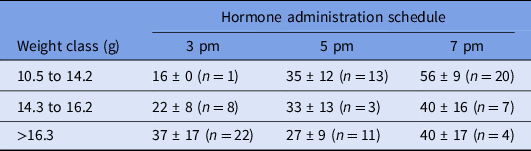
In total, 89 females were used for this experiment and only females with an oocyte number higher than 1 were considered for statistical analysis. The 3 pm group contained 31 females, the 5 pm group had 27 females and the 7 pm group had 31 females. Each schedule group had females at 3, 4 and 5 weeks of age. Details regarding the number of females used for each of the administration schedules and age are stated in Table 1. Female weight was also registered and analysis was performed considering the weight and weight class. For the weight class, data were grouped as: less than 10.4 g; between 10.5 and 14.2 g; between 14.3 and 16.2 g and more than 16.3 g, as described previously by another group (Luo et al., Reference Luo, Zuñiga, Edison, Palla, Dong and Parker-Thornburg2011). The number of females in each of the administration schedules according to weight class is represented in Table 2.
Mean number of oocytes and degenerated oocytes using the three different schedules of hormone administration based on female age

Values are mean ± standard deviation.
Mean number of oocytes in the three different schedules, based on female weight class

Values are mean ± standard deviation.
Superovulation
PMSG (ProSpec, HOR 272) and hCG (ProSpec, HOR 250) were diluted at a dose of 50 IU in sterile water and frozen at −20°C until further use. Before injection, aliquots were thawed and diluted in sterile water to prepare a 100-µl dose of 5 IU. Both hormones were injected by intraperitoneal injection. Vaginal swabs were stained with Diff Quick (907-1073, Henry Schein, Spain) and classification of the estrous cycle was carried out based on the method described by Caligioni (Reference Caligioni2009). On the day of the beginning of the experiment, a vaginal swab was collected 30–60 min before PMSG injection. PMSG was administered at 3, 5 and 7 pm and 48 h afterwards, a second vaginal swab was collected, 30–60 min before hCG administration, followed by this last hormone administration.
Oocyte analysis
At 12–14 h after hCG injection, females were euthanized by cervical dislocation. The number of oocytes was counted individually. For that, each oviduct was collected and placed in M2 medium. Hyaluronidase (Sigma Aldrich, H4272) was used at a concentration of 0.5 mg/ml in M2 and each oviduct was teared in a 100-μl droplet and kept for less than 1 min to allow cumulus cell removal. The number of oocytes within the cumulus cells and damaged/degenerated oocytes were counted using a Leica stereomicroscope (MDG41) at ×60 magnification. Due to the low numbers of degenerated oocytes, this variable was not considered in the final statistical model.
Statistical analysis
Statistical analysis was performed using SAS/STAT software. A general linear model (GLM) was used to compare the number of normal oocytes (dependent variable) collected assuming the following variables: schedule, age, the estrous cycle phase at the time of PMSG and hCG injection and weight either as a covariable or class (independent variables). Once the significant variables were determined, the GLM was repeated using only the significant terms. The final model was then:
 $${\rm{y}} = {\rm{schedule}} + {\rm{age + PMSG}} + {\rm{hCG}} + {\rm{schedule}} \times {\rm{age}} + {\rm{e}};$$
where ‘y’ represents the oocyte number; ‘schedule’ the hormone administration time; ‘PMSG’ the phase of the estrous cycle at the time of PMSG administration; ‘hCG’ the phase of the estrous cycle at the time of hCG administration; ‘schedule × age’ the interaction between these two factors and ‘e’ the model residuals. A P-value less than 0.05 was considered as statistically significant.
Results
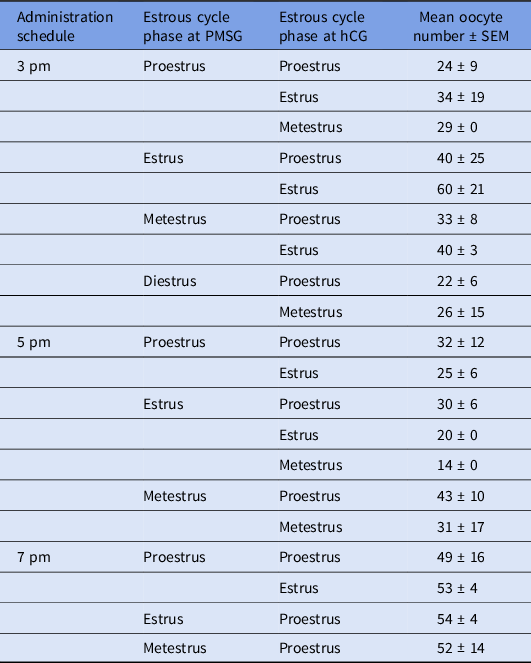
Statistical analysis showed that weight (either as a continuous variable or when considered as weight classes) was not a significant factor for the number of oocytes collected (P = 0.476 for weight and 0.290 for weight classes). The estrous cycle phase at the time of PMSG and hCG injection was also not a significant factor for the number of oocytes (P = 0.248 and 0.9717, respectively, for estrous cycle at time of PMSG and hCG injections). Results for these two variables are represented in Table 2 (weight class) and Table 3 (estrous cycle), although these terms in the model were not significant. Schedule (P < 0.001) and age (P < 0.001) were considered as statistically significant factors, as well as the interaction between age and schedule (P = 0.026).
Mean number of oocytes based on estrous cycle phase at the time of PMSG and hCG injection

The mean number of oocytes and standard deviation (SD) are described in Table 1 based on female age and time of administration. The number of degenerated oocytes is also stated in Table 1.
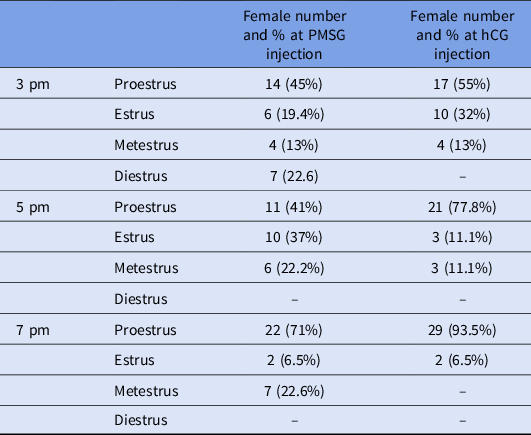
The mean numbers of oocytes from the 3 pm group was 37 ± 2; at 5 pm the mean number of oocytes was 29 ± 3 and at 7 pm it was 50 ± 3. A significant difference was found between all groups, but the highest difference was obtained between embryos collected at 3 pm and 7 pm (P = 0.009) and between embryos collected at 5 and 7 pm (P < 0.001); significant differences were also found between 3 and 5 pm (P = 0.026). For age, the mean number of oocytes for females at 3 weeks of age was 52 ± 3; at 4 weeks was 36 ± 3 and at 5 weeks of age was 30 ± 3. A statistically significant difference was found between 3 weeks of age and 4 and 5 weeks (P < 0.001); no statistical differences were found between the number of oocytes collected from females at 4 and 5 weeks of age (P = 0.085). Interaction between age and schedule was considered to be statistically significative (P = 0.026). At 3 pm, the mean number of oocytes collected from females at 3 weeks of age was statistically different from the number of oocytes collected using the same schedule for females at 4 and 5 weeks of age (P < 0.001); the mean number of oocytes between females at 4 and 5 weeks of age at 3 pm was not significantly different (P = 0.836). At 5 pm, the mean number of oocytes was not significantly different between the three ages used (P-values between 0.123 and 0.392). The 7 pm group revealed a significant difference between the mean number of oocytes collected from females at 3 and 4 weeks of age (P = 0.034), between 3 and 5 weeks (P = 0.0002) and between 4 and 5 weeks (P = 0.029). Females at 3 weeks produced significantly more oocytes when superovulation was performed at 3 pm and 7 pm when compared to 5 pm (P = 0.0004 and <0.0001) but no difference was found for females at 3 weeks of age at 3 and 7 pm (P = 0.791). At 4 weeks of age, the number of oocytes was statistically different between females superovulated at 3 pm and 7 pm (P < 0.0001) and at 5 and 7 pm (P = 0.0001) but not between 3 and 5 pm (P = 0.591). At 5 weeks of age, significant differences in the number of oocytes were found between females whose hormones were given at 3 and 7 pm (P = 0.02) and between 5 and 7 pm (P = 0.039) but not between oocytes collected at 3 and 5 pm (P = 0.762). The percentages of females in each phase of the estrous cycle are listed Table 4.
Female’s synchronization according to the administration schedules

Discussion
Superovulation is a valuable tool to produce large numbers of oocytes using a reduced number of animals. Optimization of superovulation protocols is essential to maximize the use of such animals, which is an ethical obligation of all scientists using animals. Our results showed that females at 3 weeks of age, superovulated at 3 pm or 7 pm (4 h before the dark cycle or at the beginning of the dark cycle, respectively) produced significantly higher numbers of oocytes, which would allow a reduction in the number of animals used. Previous reports have shown that female age is an important factor when considering the efficiency of superovulation, but only one study was available that explored the effect of an ideal schedule for superovulation, using mature females and not younger females. The described range of ages being optimal for superovulation in B6 females included females that were less than 48 days old, at 21–32 days (Luo et al., Reference Luo, Zuñiga, Edison, Palla, Dong and Parker-Thornburg2011; Kolbe et al., Reference Kolbe, Landsberger, Manz, Na, Urban and Michel2015) or before vaginal opening at 24–30 days of age (Fox et al., Reference Fox, Barthold, Davisson, Newcomer, Quimby and Smith2006; Caligioni, Reference Caligioni2009). Despite weight also being described as an important factor, in our experiment no differences were found between the number of oocytes based on female weight or even when the weight variable was assumed as a weight class. The onset of puberty might be related to the efficiency of superovulation and some studies have stated that superovulation should be performed before onset of puberty, defined as vaginal opening at 24–30 days or 7 days later as described by other authors (Gaytan et al., Reference Gaytan, Morales, Leon, Heras, Barroso, Avendaño, Vazquez, Castellano, Roa and Tena-Sempere2017). The relationship between the onset of puberty and weight in laboratory mice is not completely clear, as these two factors have been described as dependent or partially dependent (females with a higher body weight achieve puberty earlier) (Falconer, Reference Falconer1984, Yuan et al., Reference Yuan, Meng, Nautiyal, Flurkey, Tsaih, Krier, Parker, Harrison and Paigen2012). Conversely, recently investigations concluded that increase in body fat and leptin do not trigger the onset of puberty (Bronson, Reference Bronson2001). This study used females at ages that were already described as optimal for this kind of protocol. The fact that puberty may not be related to body weight can, in part, explain these results.
Despite age being described as an important factor, the time of administration has also an effect on the number of oocytes. This effect seems to be dependent on age, as 3-week-old females at 3 pm and 7 pm produced significantly better results compared with the other groups. When considering only the effect of schedule, regardless of female age, the 7 pm group had significantly higher numbers of oocytes compared with the 3 pm and the 5 pm (2 h before the dark cycle) groups. At 3 pm, the 3-week-old females produced significantly more oocytes compared with females at 4 and 5 weeks of age. The group with the better results was the 7 pm group, using females at 3 weeks of age and, while females at 3 weeks of age produced similar numbers of oocytes when superovulated at 3 or at 7 pm, older females gave better results when superovulated at 7 pm. For B6 females at 4 and 5 weeks of age, the onset of puberty was closer and synchronizing hormone administration with onset of the dark cycle appeared to produce better results. The fact that the strain tested responded better to superovulation protocols when hormones were given closer to the beginning of the dark cycle can be related to the fact that natural ovulation occurs 3–5 h after its start (Behringer et al., Reference Behringer, Gertsenstein, Nagy and Nagy2016). As LH surge occurred about 6 h before ovulation (Hogan et al., Reference Hogan, Costantini and Lacy1986) or 15–20 h after the midpoint of the dark cycle, this meant that, in a 7 am : 7 pm light cycle, LH surge occurred between 4 and 8 pm. hCG administration is recommended to be injected a few hours before the natural LH peak (Hogan et al., Reference Hogan, Costantini and Lacy1986). However, for this particular strain and when using pre-pubertal females, synchronizing hCG injection with the natural LH surge seemed to produce better results for the three ages tested and, more significantly, for females at 4 and 5 weeks old compared with other schedules.
The estrous cycle phase at the time of hormone administration has been described by Tarín et al. (Reference Tarín, Pérez-Albalá, Gómez-Piquer, Hermenegildo and Cano2002) as a factor with effects on the ovary response to superovulation. Here, synchronization levels in proestrus, estrus and metestrus were high at the time of hCG administration in all groups, but no significant differences were found between the mean number of oocytes from synchronized females. This finding reinforces the idea that the estrous cycle phase is not a determinant factor for superovulation outcome.
Our analysis excluded females with zero oocytes, as we considered that these females did not respond to superovulation; one female was in diestrus, and another three females were either in metestrus (one) or proestrus (two). This showed that synchronization in proestrus or metestrus is not enough to produce higher numbers of oocytes, and also that diestrus is the phase in which females produced the worst results.
Despite the larger numbers of oocytes collected in some of the discussed conditions, it has been described often that superovulation has a negative effect on embryo development (Van der Ertzeid and Storeng, Reference Ertzeid and Storeng1992; Auwera and D’Hooghe, Reference Van Der Auwera and D’Hooghe2001; Fortier et al., Reference Fortier, Lopes, Darricarrère, Martel and Trasler2008; Market-Velker et al., Reference Market-Velker, Zhang, Magri, Bonvissuto and Mann2009). Other factors, such as age of females, has also been described as having a potential effect on the efficiency of IVF (Kolbe et al., Reference Kolbe, Landsberger, Manz, Na, Urban and Michel2015). These last authors described lower IVF efficiency when oocytes were collected from females at 33–36 days of age compared with younger females. For this experiment, oocyte quality was not evaluated and further work would be required to validate a similar quality between groups.
In conclusion, for C57BL6/J mice, higher numbers of oocytes were produced when PMSG and hCG were given closer to the beginning of the dark cycle for females at 4 and 5 weeks of age. Females at 3 weeks of age produced better results at 7 pm and 3 pm, although the higher number of oocytes corresponded with females at 3 weeks at 7 pm. The percentage of females in proestrus in the 7 pm group was higher but, as already described, no significant differences were found between females in different estrous cycle phases. Females at 4 and 5 weeks of age responded better to superovulation when hormones are given closer to the beginning of the dark cycle (7 pm). Additionally, the use of females at 3 weeks of age at 3 and 7 pm could significantly reduce the number of females needed, especially compared with females at 5 weeks of age. Facilities can easily implement these findings by using light cycles that allow hormone administration over a schedule compatible with their working plan and by choosing females of optimal age for superovulation. This valuable and practical data can also help to reduce the number of euthanized female mice for collection of oocytes.
Acknowledgements
The authors would like to thank the i3S facility staff for all the help provided with the animals.
Author contributions
SL conceived the study; executed the practical work; wrote the article. JC performed the statistical analysis and wrote the article. FG conceived the study and wrote the article. IA conceived the study and wrote the article.
Statement of interests
There is no conflict of interest that could be perceived as prejudicing the impartiality of the research reported.
Financial support
This research did not receive any specific grant from any funding agency in the public, commercial or not-for-profit sector.
Ethical standards
The authors assert that all procedures contributing to this work complied with the ethical standards of the relevant national and institutional guides on the care and use of laboratory animals