


Introduction
Autistic people are more likely to experience common mental health conditions such as anxiety and depression. In a study using linked primary and secondary care data, Underwood et al. (Reference Underwood, DelPozo-Banos, Frizzati, Rai, John and Hall2023) report primary care coded anxiety in 27.56 % of autistic people and in 13.60% of a matched group of people who were not autistic, and primary care coded depression in 31.39% of autistic people and in 17.90% in a matched group people who were not autistic. Autistic people are thus more likely to need access to mental health services than people who are not autistic; however, they often have poor experience of such services (Mandy, Reference Mandy2022)
Psychological therapies are a primary intervention for common mental health problems such as anxiety and depression (National Institute for Health and Care Excellence, 2020; National Institute for Health and Care Excellence, 2022) and the same evidence base should be used for autistic people to determine appropriate treatments when specific alternatives are not evidenced (National Institute for Health and Care Excellence, 2021). In England, psychological therapies for anxiety and depression are primarily provided by NHS Talking Therapies for Anxiety and Depression services (NHS TTad; previously known as Improving Access to Psychological Therapies or IAPT). NHS TTad provides evidence-based psychological therapies, with stepped intensity and duration by therapists who are accredited and who receive outcome-focused supervision. Data on therapy and service processes and clinical outcomes are collected for every contact, which ensures that real-time information is available to the client, therapist, and supervisor on therapy progress. The data also contribute to local and national service level outcomes (National Collaborating Centre for Mental Health, 2024). NHS TTad therapy is delivered by high intensity therapists (HITs) who are trained to accreditation standards in NICE supported (National Institute for Health and Care Excellence, 2020; National Institute for Health and Care Excellence, 2022) therapies (e.g. cognitive behaviour therapy (CBT), eye movement desensitisation and reprocessing (EMDR), interpersonal psychotherapy (IPT), person-centred experiential counselling for depression (PCE-CfDP)) and psychological wellbeing practitioners (PWPs) who are trained in CBT-based approaches such as guided self-help and psycho-education for people with mild-to-moderate depression and anxiety disorders (Clark, Reference Clark2011).
El Baou et al. (Reference El Baou, Bell, Saunders, Buckman, Mandy, Dagnan and Stott2023) analysed national level data for people who received therapy in NHS TTad in England in 2012–2019. Autistic people were identified from linked datasets and were matched with a comparison group of not autistic people on several sociodemographic and clinical factors. The study reported outcomes for both groups using the core metrics available for NHS TTad. Data were available for 2,515,402 adults who received at least two intervention sessions; 8761 had an autism diagnosis of which 8593 were matched with an adult who was not autistic. More than half of the autistic group (4820 (56.1%)) showed reliable improvement (when a person’s scores have improved by a statistically reliable amount, irrespective of whether they meet recovery criteria); however, this was a lower percentage than in the matched group who were not autistic (5304 (61.7%)). For people who were not autistic reliable improvement was associated with being employed and being in higher socioeconomic groups; this association was not found for autistic people. This suggests that pathways to recovery in therapy may be somewhat different for autistic people and more personalised and adapted approaches may be required.
Brice et al. (Reference Brice, Rodgers, Ingham, Mason, Wilson, Freeston and Parr2021) surveyed 537 autistic adults regarding possible reasonable adjustments in mental health services. They identified positive adjustments in the areas of sensory environment, clinical and service context, clinician knowledge and communication and clinician willingness to adapt their approach to suit the person’s preferences. However, participants identified such adjustments were often not available in such services. Adjustments to psychological therapies have, largely, been highlighted through clinical consensus (e.g. National Institute for Health and Care Excellence, 2021; National Autistic Society, 2021; Mason et al., Reference Mason, Ingham, Birtles, Michael, Scarlett, James and Parr2021), although a small number of adaptations have been reported in specific therapy intervention studies (e.g. Loizou et al., Reference Loizou, Pemovska, Stefanidou, Foye, Cooper, Kular and Johnson2024). Such adaptations include longer duration of therapy (Blainey et al., Reference Blainey, Rumball, Mercer, Evans and Beck2017) and therapist consistency (Adams and Young, Reference Adams and Young2021). In addition, specifically adapted versions of existing therapies for anxiety (e.g. Rodgers et al., Reference Rodgers, Brice, Welsh, Ingham, Wilson, Evans and Parr2023) and depression (e.g. McKeon et al., Reference McKeon, Cotton, Aldridge, Cape, Clout, Cooper and Russell2024) have begun to be tested for autistic adults.
One of the most frequently identified positive adaptations is training for clinicians on how to adjust their work for autistic people (Brice et al., Reference Brice, Rodgers, Ingham, Mason, Wilson, Freeston and Parr2021). However, specific therapy training has not often been reported. Training for therapists working with autistic children has been reported (e.g. Brookman-Frazee et al., Reference Brookman-Frazee, Chlebowski, Villodas, Roesch and Martinez2021); however, training for therapists working with autistic adults has only been described as components of randomised control trials (e.g. Loizou et al., Reference Loizou, Pemovska, Stefanidou, Foye, Cooper, Kular and Johnson2024), although the wider need for such training has been frequently identified (e.g. Cooper et al., Reference Cooper, Loades and Russell2018). In England general training in working with autistic people is mandatory in Health and Social Services (NHS England, Reference NHS2024), but such training is not specific to particular care pathways such as the therapy approaches required in NHS TTad.
Miller et al. (Reference Miller, Bowden, Dewison, Ingham, Thwaites and Dagnan2025) interviewed 12 NHS TTad therapists regarding their experience of working with autistic adults. The themes identified several aspects of service structure and process that would significantly benefit from adaptation but also identified the need for further training designed to meet the needs of therapists in NHS TTad.
The aim of the current study was to evaluate an initial introductory therapist training and system adaptation for autistic people in NHS TTad.
Method
Context
The training described in this paper was in an NHS TTad service in the North of England that was considering processes and structures to make the service more accessible for autistic people. One of the key challenges in making such adaptations is the identification of autistic people in NHS TTad services as, currently, the national systems do not code autism and do not ask a question regarding whether a person is autistic. The NHS TTad service involved in this paper had recently introduced a question asking whether people considered themselves to be autistic or possibly autistic (which was developed in collaboration with autistic people) and placed a ‘flag’ in the local data systems. To support this, training was developed for the service so that clinicians were confident to respond when people did identify themselves as autistic.
Ethics
The study was classed as service development/evaluation and was not required to gain NHS ethics approval within the UK ethical frameworks in place at the time of the project. Although not classed as research, all processes followed an ethical structure consistent with requirements of the British Psychological Society, British Association of Behavioural and Cognitive Therapists and with NHS national guidelines. Participants received an information sheet describing all data collection and data management processes and consent was obtained prior to questionnaire and interview completion; all data were anonymised before analysis.
Development of training curriculum
The training curriculum was based on a review of publications identifying adaptations that can be made to therapy to support autistic people (e.g. Cooper et al., Reference Cooper, Loades and Russell2018; National Autistic Society, 2021; Petty et al., Reference Petty, Bergenheim, Mahoney and Chamberlain2021). The local training was developed by a group consisting of autistic people, practitioners who were expert in the provision of NHS TTad services and practitioners who were expert in therapy with autistic people. The training had three sections and was delivered in a half-day online format:
-
(1) The first was a brief overview of local processes for the self-identification question and flag introduced in the local NHS TTad system.
-
(2) The second was a brief overview/reminder of the nature of autism based on materials used in the Newcastle Health Checks project (e.g. Taylor et al., Reference Taylor, Ingham, Mason, Finch, Wilson, Scarlett and Parr2023)
-
(3) The third was an introduction to the adaptations that can be made to therapy. The adaptations section was divided into sections on therapy preparation, general therapy issues, assessment in NHS TTad, communication strategies and remote therapy; this section was based on materials cited above and the slides are available from the corresponding author.
There are no previous studies reporting training on working with autistic people in NHS TTad. Dagnan et al. (Reference Dagnan, Masson, Thwaites, James and Hatton2018) report training with NHS TTad therapists working with people with intellectual disabilities and the approach in the current paper uses the structure described in that paper.
Participants
Sixty-seven NHS TTad staff attended the training, of which 60 (89.5%) were women, with a mean age of 42.8 years (SD 11.2); 45 (67.2%) worked in high intensity pathways and they had worked in NHS TTad for a mean of 6.6 years (SD 4.5) years. Fifty (74.6%) participants stated they had previously worked therapeutically with an autistic person and stated they had a mean of 1.0 (SD 1.1) autistic people on their current caseload (range 0–4). The numbers in the response group reduced at each time point (see Tables 1 and 2); at each time point the demographic characteristics of the responding and non-responding group were compared. At no time point were the responding group significantly different from the non-responding group.
Comparison of pre- and immediate post-training confidence and therapeutic efficacy scores

Comparison of pre-, immediate post-training and three-month follow-up confidence and therapeutic efficacy scores

The six participants who contributed qualitative interviews were all women, with a mean age of 45.2 years (SD 14.5) and a mean of 7.2 years (SD 4.8) of experience of working in NHS TTad. Four (66.7%) participants worked in high intensity pathways, one (16.7%) worked in low intensity pathways and one (16.7%) worked in counselling.
Measures
The following measures were completed at pre-training only:
-
(1) Demographic data identified participant gender, age, years working in NHS TTAD, and experience of providing therapy for autistic people.
The following measures were all completed by participants pre-training, immediately post-training and at three-month follow-up.
-
(2) The Therapy Confidence Scale-Autism (TCS; Cooper et al., Reference Cooper, Loades and Russell2018; Dagnan et al., Reference Dagnan, Masson, Cavagin, Thwaites and Hatton2015). This is a 14-item scale that describes the confidence of therapists in working with autistic people. The items are described in Dagnan et al. (Reference Dagnan, Masson, Cavagin, Thwaites and Hatton2015) and describe stages in engaging people in therapy, from forming a therapeutic alliance, carrying out assessments, formulating, adapting interventions, and enabling a positive end to therapy.
When applied to therapists working with people with intellectual disabilities the TCS had a single-factor structure accounting for 62% of the scale variance, Cronbach’s alpha for the scale was 0.93, test–retest reliability was 0.83, and the scale was shown to be sensitive to change following training (Dagnan et al., Reference Dagnan, Masson, Cavagin, Thwaites and Hatton2015). Based on the 67 people who completed the scale at pre-training in this study, Cronbach’s alpha for the scale was 0.93.
-
(3) A General Therapy Self-Efficacy Scale (Dagnan et al., Reference Dagnan, Masson, Cavagin, Thwaites and Hatton2015) using five items from the General Self-Efficacy Scale (GSE; Schwarzer and Jerusalem, Reference Schwarzer, Jerusalem, Weinman, Wright and Johnston1995) was adapted to measure self-reported efficacy in response to clinical problem. Dagnan et al. (Reference Dagnan, Masson, Cavagin, Thwaites and Hatton2015) reported properties of the scale used in training with 107 mainstream therapists with respect to people with intellectual disabilities; the adapted scale had a Cronbach’s alpha of 0.69 and an adjusted item-total correlation range of 0.31–0.51. Based on the 67 people who completed the scale pre-training in the present study, Cronbach’s alpha for the scale was 0.77.
-
(4) Two single items were also included. At immediate follow-up the question ‘The training was engaging and relevant to my job’ was asked with a 5-point response scale (‘strongly agree’ to ‘strongly disagree’) and at 3-month follow-up ‘I have applied what I have learned during training’ was asked with the same response scale.
The following was completed at three-month follow-up only.
-
(5) A semi-structured interview was developed to explore qualitative reports of changes in practice following the introduction of the autism flag and associated training. The framework was based on Kirkpatrick’s model of training (Kirkpatrick and Kirkpatrick, Reference Kirkpatrick and Kirkpatrick2005), which has previously been used in evaluation training within IAPT services (Dagnan et al., Reference Dagnan, Masson, Thwaites, James and Hatton2018). Participants were asked what they found useful from the training, to give examples of changes to their practice following training and asked specifically about the flag and its practical application.
Procedure
The participants in the training days were sent an email asking them to complete the baseline questionnaires prior to the training sessions, the email contained a link to a Microsoft Forms-based questionnaire. The questionnaire began with an explanation of the purpose and potential use of the data collected and a statement guaranteeing anonymity in reporting results; this was repeated for therapists who contributed to interviews. Immediately after completing training participants were sent a further email asking them to complete the post-training questionnaire and after three months an email was sent out to training participants asking them to complete a further follow-up questionnaire. For each data collection period two follow-up reminders were sent out to all staff. Individual data were linked across the time points using a linking function in Microsoft Forms; this information was included in the information sheet and data were fully anonymised prior to analysis.
At the three-month follow-up the questionnaire asked respondents to indicate if they were willing to be interviewed as part of the evaluation process. Therapists were interviewed in the order they volunteered. Interviews were completed on video link, lasted around 20 minutes, and were recorded with the therapist’s permission. Interviews were transcribed, the transcriptions checked and anonymised and the recordings deleted.
Analysis
Demographics are presented with simple descriptive statistics, and the data from pre–post assessments and pre–post to three-month were analysed using repeated measures analysis of variance (ANOVA) with a post-hoc Tukey test to identify specific effects. Partial eta-squared (ηp2) is presented as a measure of effect size for all analyses; an ηp2 of greater than 0.14 is considered a large effect size (Richardson, Reference Richardson2011).
The qualitative data were analysed using thematic analysis using the processes described in Braun and Clarke’s (Reference Braun and Clarke2022) revision of their approach. Firstly, the data were read and re-read several times by the second author to allow familiarisation and were then coded inductively. The data were analysed for shared meaning among different codes, which might form themes or subthemes, with a thematic map constructed to support this. Emerging themes were discussed in supervision with the first author and their robustness was tested. Themes that did not have enough data to support them were discarded and those selected were considered in relation to the whole data. Themes were then defined, named, and subthemes identified. Examples of the transcript which illustrated each were selected. The full analysis was shared with the last author, who is a specialist in qualitative analysis, with any adjustments discussed and a consensus reached.
Results
The comparisons of the two scales from pre- to post-training are shown in Table 1. The data were analysed using a repeated measures ANOVA to allow the same effect size measure to be reported for the two presented analyses. Forty-five therapists responded to the post-training questionnaire; the group mean scores for the confidence questionnaire and self-efficacy questionnaire both increased pre- to post-training at a statistically significant level. In response to the item ‘The training was engaging and relevant to my job’, nine (20.0%) respondents replied ‘neither agree nor disagree’, 27 (60.0%) replied ‘agree’ and 11 (24.4) replied ‘strongly agree’.
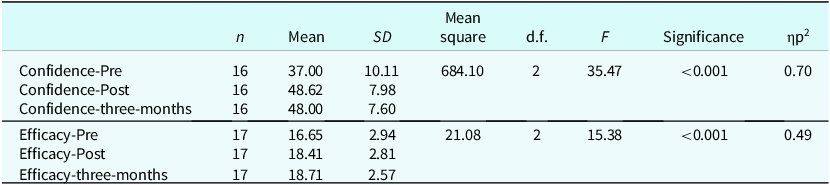
Table 2 shows the responses for those people who completed questionnaires for all three time points. The data are analysed using repeated measures ANOVA. At pre-, post- and three-month follow-up, 17 therapists completed the efficacy scale and 16 completed the confidence scale. The data show that the significant changes at immediate post-training were maintained at three-month follow-up; the post-hoc Tukey tests showed that the significant change was between pre- and post-measures and pre-measures and the three-month post-training follow-up. At three-month post-training, participants were asked the question ‘I have applied what I have learned during training’; one person (5.9%) replied, ‘disagree’ five (29.4%) replied ‘neither agree nor disagree’, 11 (64.7%) replied ‘agree’ and three (17.6%) replied ‘strongly agree’.
Qualitative interviews
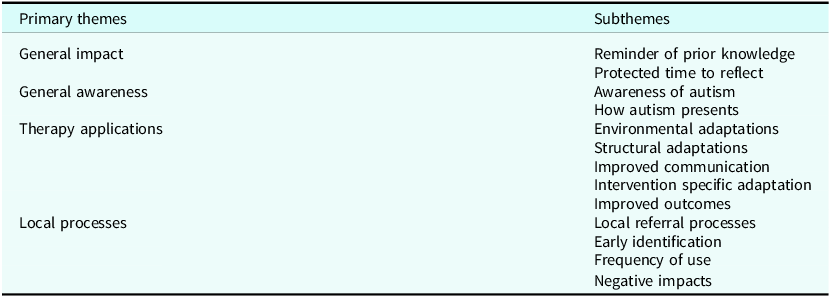
A thematic analysis was carried out following the approach described by Braun and Clarke (Reference Braun and Clarke2022). Four key themes were evident within the dataset: ‘General impact’, ‘General awareness’, ‘Therapy adaptation’ and ‘Local processes’. Each of these themes has several subthemes and the thematic map is presented in table 3.
Thematic map of qualitative analysis

Data are presented with an indicator of the therapist who offered the statement; we have not linked these to any demographics as these may have allowed therapists to be identified within their service.
General impact
This theme captured general impacts of the training; two subthemes were identified: ‘reminder of prior knowledge’ and ‘protected time to reflect’.
Several participants valued the ‘ reminder of prior knowledge ’, indicating that they had a level of autism awareness prior to the training but that the training emphasised the relevance of these skills:
R5: ‘First and foremost, it’s like awareness, so it’s like bringing it back to the forefront that this is something we need to consider.’
R6: ‘I would always make any adaptations anyway; I would always have a conversation right at the start with any autistic client, but I guess it to some extent just reiterated the relevance of that for me.’
Similarly, participants noted that the training provided ‘ protected time to reflect’ :
R3: ‘I think the most useful thing was just the space to think about autism, just the protected space in our busy working lives.’
General awarenesses
This theme is defined by an increased general awareness of autism and its presentation in NHS TTad. There were two subthemes: ‘general awareness of autism’ and ‘how autism presents’.
All participants reported an increased ‘ awareness of autism ’:
R1: ‘In terms of like highlighting and awareness, that was really helpful.’
R4: ‘I think a big part of it was just to kind of, be more aware of it.’
Several participants associate this with the increasing level of public awareness and recognition of autism. For example, participants noted:
R4: ‘I think I’ve shifted my thinking in terms of, well anybody could have it, and there’s probably more people coming for mental health problems in the general population that probably have got an element of this.’
R3: ‘… there’s so much sort of discussion in the media about neurodiversity at the moment isn’t there, and so many people are adults and going forward for assessment.’
However, many clients remain without an appropriate diagnosis, or even an awareness that they may be autistic. Consequently, clinicians identified ‘ how autism presents ’ as a key theme which supported them to open discussion with a person about possible autistic needs. Participants reported:
R1: ‘Everyone kind of like experiences their autism really very differently as well, so I guess there’s never going to be a one size fits all approach.’
R5: ‘We’ve just scratched the surface and it’s just so complex … it comes down to asking an individual about any adaptations or anything they want us to be aware of.’
The training was seen as useful in discussing gender differences, repetitive behaviours, and understanding how differential diagnoses may impact upon someone’s presentation:
R3: ‘Realising that autism in women, you know, can be more likely to be sort of masked.’
R6: ‘OCD, and autism and social anxiety in autism, and just looking at some kind of aspects where things are similar but a little bit different.’
R4: ‘Thinking about kind of repetitive behaviours and stuff as being soothing things rather than distressing thing.’
Therapy adaptation
This theme refers to specific adaptations that participants made following training to meet the needs of autistic clients. Five subthemes were identified: ‘environmental adaptations’, ‘structural adaptations’, ‘improved communication’, ‘intervention-specific adaptations’ and ‘improved outcomes’.
Participants identified ‘ environmental adaptations ’ within sessions. They reported that the training was helpful in drawing attention to factors that may distract or limit an autistic client’s ability to participate. For example, promoting awareness of potential sensitivity to background noises and visual distractions:
R1: ‘I can have that possible conversation … do we need to get rid of the clock out of the room because it’s ticking too much?’
R4: ‘… how the room is set out, putting my stuff away, making it kind of like less cluttered and you know making sure the environment is right.’
Similarly, participants found it useful to consider ‘ structural adaptations ’ to the sessions. These included the need for face-to-face sessions (when remote therapy is the predominant model), more breaks, and longer session times to account for these:
R1: ‘So we were able to offer her, we knew she needed a face-to-face assessment.’
R2: ‘It also gave me a bit of a heads up because the assessment ended up taking like an hour whereas sometimes, they’re half an hour.’
There was a consensus that these adjustments are also beneficial to the clinician, allowing them to appropriately manage their schedule around any additional needs.
An additional theme emerged which considered interpersonal adaptations which clinicians might make directly to promote ‘ improved communication ’. This included taking the time to ask the client more about how they experience autism:
R1: ‘Probably a few more questions and a bit more that I need to find out to try and make them more comfortable in the treatment.’
R2: ‘I was able to have a discussion with him about when he was diagnosed and the way it presents for him.’
More specifically, participants noted that it was useful to have an early discussion to address areas of communication which autistic clients typically find more difficult or uncomfortable. This helps the rapport between client and clinician:
R1: ‘I can instantly think right when this person comes in there are probably a few more questions and a bit more that I need to find out to try and make them more comfortable in the treatment.’
R2: ‘Can have that possible conversation around eye contact and how she prefers the term autism being referred.’
Almost all participants referred to ‘ intervention-specific adaptations ’ where they tailored formulation, concepts and treatment to autistic adults presenting within the service. One participant noted:
R5: ‘Often in CBT, which is one of the therapies I work in, using like metaphors or quite like flowery language to give examples is often quite helpful for people, but it’s understanding that actually that might be quite unhelpful for somebody who is autistic and that might be more confusing.’
Similarly, other participants described the difficulty of explaining CBT models to clients with autism:
R1: ‘We get people to see things from someone else’s point of view to see that maybe their thoughts aren’t necessarily facts and how that would kind of like play in when someone actually does struggle seeing things from someone else’s perspective.’
R5: ‘I think a lot of the models themselves maybe don’t lend to people who think differently than the typical person.’
A separate subtheme identified the link between staff training and ‘ improved outcomes ’:
R1: ‘There’s that higher chance of keeping people in treatment and helping them recover.’
R5: ‘The more that we’re aware of it, the more we are getting training on it, the better we will become as practitioners.’
Local process
Finally, participants referenced the acquired familiarity with local autism diagnostic processes, the NHS TTad local process of self-identification, and the use of the system label. Four subthemes were evident within this: ‘local referral processes’, ‘early identification’, ‘frequency of use’ and ‘negative implications’.
The importance of knowledge of ‘ local referral processes ’ was highlighted to increase with increased clinician confidence in referring or signposting people towards appropriate support. Several participants identified the importance of this:
R1: ‘And she was like when I see what they do and what I do, so I’ve helped her get in touch with her GP for an assessment.’
R2: ‘I completed a referral for the autism diagnostic service with a patient.’
Overall, participants reported that they found the ‘ early identification ’ and flagging process useful. Discussion of this within training ensured that staff are familiar and confident with its use:
R1: ‘Having that flag on the top and knowing to be mindful before going in … I can see it’s there and I can instantly think, there are probably a few more questions and a bit more that I need to try and find out.’
R2: ‘I had a telephone triage assessment with a guy and it said autism on there and then that prompted me to have a discussion with him.’
R6: ‘Maybe some people aren’t quite primed to spot stuff so, a label that can kind of like encourage people to look for stuff is handy.’
Several participants were surprised by the ‘ frequency of use ’ of the label, paradoxically decreasing its visibility:
R5: ‘I think because it’s so common, you’re missing it more, it’s just like another thing that you see on the dashboard.’
R3: ‘A lot of my patients have currently got the label. So, I don’t know whether it’s less meaningful.’
Therapists were aware that as more people question whether they are autistic the waiting list times for formal diagnostic assessments are also increasing. Therapists understood the ‘ negative implications ’ of this and the need to better support individuals during this time.
R3: ‘So many people are going forward for assessment, and I am concerned, the impact going forward for autism when that person then might have to wait two years for an assessment and what that does to them? I suppose I think it’s important then for us to have a go to list of organisations who can help.’
In addition, there was a recognition that support for those with autism, even following a diagnosis, is lacking and that this may result in more need for NHS TTAD services:
R4: ‘How difficult it is for people you know, to, more widely get their needs met because I think, if we’re just thinking about it in a mental health service, then you know, there’s going to be lots of, it’s going to be much more difficult in the wider world isn’t – is there an argument for not just looking at adaptations for the session but expanding this awareness of autism across contexts – provide whole approach to client. Understand and advise manage mood across these?’
Discussion
This paper has described the evaluation of brief introductory training on working with autistic people for staff in an NHS TTad service. The training was developed in association with the introduction of a system which enables clients to self-identify as autistic and for the service data system to flag this so that therapists are aware and can adjust their practice accordingly. The training included a brief introduction to autism and an overview of therapy process adaptations suitable for autistic people. The training was evaluated using measures of confidence in working with autistic people and general changes in therapy self-efficacy taken at pre-training, immediately post-training, and three months post-training. Six therapists contributed to qualitative interviews offering a more detailed account of the impact of the training at three months post-training.
The confidence and self-efficacy scales showed significant change towards greater confidence and greater therapeutic self-efficacy at immediate post-training which was maintained at three months post-training. The primary quantitative outcome in this paper is confidence in providing therapy to autistic people. There is an emphasis in this training approach that NHS TTad therapists have core meta-competencies in adaptation, as emphasised in the core CBT competency framework (Roth and Pilling, Reference Roth and Pilling2007). The training described in the current paper offers the opportunity for therapists to reflect on their existing adaptation skills and their application to adaptation for autism which may have a positive impact on therapists’ general sense of their therapeutic self-efficacy. A similar approach and result was found by Dagnan et al. (Reference Dagnan, Masson, Thwaites, James and Hatton2018) where an increase in both confidence and therapeutic self-efficacy was also maintained over a three-month follow-up period for staff offered training in working with people with intellectual disabilities.
The qualitative analysis identified four main themes: ‘General impact’, ‘General awareness’, ‘Therapy adaptation’ and ‘Local processes’, each with several subthemes. Therapists identified new knowledge and general reflective opportunities offered by training, identified changes to their individual practice in adapting therapies, and identified the flagging system as a valuable tool in preparing for therapy with autistic people. These themes are particularly interesting given the relatively brief nature of the training. The adaptations presented in the training were relatively easy to apply and therapists report that they have prompted conversations with the autistic client regarding their preferences. The service makes the ‘Pre-clinic autism information form’ (Cooper and Russell, Reference Cooper and Russell2024) available to therapists, which can support a detailed conversation about communication needs within therapy. This provides the client with confidence that there is an understanding of their autism potentially promoting a better therapeutic relationship.
Whilst this paper has described a brief therapy training it is likely that more in-depth training within NHS TTad services needs to be developed. In England there is a national initiative to ensure that all statutorily funded services receive core training in autism. The evaluation of this approach shows that the training was well received and staff generally were able to report an impact on their practice (National Development Team for Inclusion, 2022); however, the training does not offer specific details on adapting therapy for autistic people. Additionally, the specific therapy models used within NHS TTad may require specific adaptations to assessment and treatment. Some presentations are particularly challenging to assess in autistic people, in particular some features of obsessive-compulsive disorder (OCD) and social anxiety may overlap with core areas of autistic presentation. There are studies that consider the autism specific presentation and treatment of social anxiety (e.g. Wilson et al., Reference Wilson and Gullon-Scott2024; Spain et al., Reference Spain, Sin, Linder, McMahon and Happé2018) and OCD (e.g. Elliott et al., Reference Elliott, Marshall, Morley, Uphoff, Kumar and Meader2021; Kose et al., Reference Kose, Fox and Storch2018) and other core anxiety presentations (Rodgers et al., Reference Rodgers, Brice, Welsh, Ingham, Wilson, Evans and Parr2023). Further consideration of the adaptation of evidence-based, non-CBT approaches used in NHS TTad will also be important. The evidence for low-intensity interventions for autistic people is in a very early stage (e.g. Russell et al., Reference Russell, Jassi and Johnston2019) and the evidence for interventions such as person-centred experiential counselling for depression (PCE-CfD) and interpersonal psychotherapy (IPT) with autistic people is not yet reported. However, the data presented by El Baou et al. (Reference El Baou, Bell, Saunders, Buckman, Mandy, Dagnan and Stott2023) suggests that autistic people are being treated successfully within NHS TTad services, albeit with slightly less positive outcomes. This suggests that there will be considerable experience and expertise in NHS TTad services where clinicians have been adapting therapies for a range of presentations with varying degrees of success; studies to capture and share this experience will be important.
This paper is an initial exploration of brief training for NHS TTad therapists in working with autistic adults. There are obvious challenges in interpretation of these results as this is a study of a single service with a low response rate at the three-month follow-up data collection and we should be cautious in generalising results due to the number of therapists in the service who did not respond. The number of participants contributing to the thematic analysis is also small, and although the themes are robustly developed it is not possible to know that the themes are fully stable. These limitations suggest that the findings reported here should be generalised very cautiously as they may be specific to a service that has invested in training and service development regarding neurodiversity. However, the apparent impact of a brief training approach is encouraging and further development and evaluation of this approach is warranted. El Baou et al. (Reference El Baou, Bell, Saunders, Buckman, Mandy, Dagnan and Stott2023) report outcomes for autistic people in NHS TTad based on a data set that links national NHS TTad outcomes with three NHS datasets that clearly identify autistic people; however, the processes to develop these data were complex and time consuming and cannot provide ‘real-time’ feedback on changes in service delivery. To fully evaluate the impact of training on therapy outcomes requires routine identification of autistic people in NHS TTad data systems so that ongoing changes in outcome, contingent on training can be tested.
Key practice points
-
(1) The evidence base for the adaptation of therapies for autistic people is poorly developed. The specific evidence for NHS TTad services is very limited.
-
(2) Simple adaptations to service processes and brief training for NHS TTad therapists can be applied to NHS TTad services.
-
(3) The simple adaptations and training described initially appear to have an impact upon therapist confidence and therapeutic self-efficacy. Following the training therapists can describe several ways in which they have changed their practice to better support autistic people.
-
(4) It is likely that further detailed training is needed for the specific models used in NHS TTad to increase their applicability to autistic people. A comprehensive identification and data recording system is needed to enable systematic evaluation of the impact of such training on therapy outcomes for autistic people.
Data availability statement
The data that support the findings of this study are available on request from the corresponding author, DD. The data are not publicly available due to data elements that could compromise the anonymity of research participants.
Acknowledgements
None.
Author contributions
Dave Dagnan: Conceptualization (equal), Data curation (equal), Formal analysis (equal), Investigation (equal), Methodology (equal), Project administration (equal), Supervision (equal), Writing - original draft (lead), Writing - review & editing (equal); Barry Ingham: Conceptualization (equal), Investigation (equal), Methodology (equal), Project administration (equal), Writing - review & editing (equal); Richard Thwaites: Conceptualization (equal), Investigation (equal), Methodology (equal), Supervision (equal), Writing - review & editing (equal); Dani Lewis: Data curation (equal), Formal analysis (equal), Methodology (equal), Writing - review & editing (equal); Jade Sunley: Data curation (supporting), Investigation (supporting), Writing - review & editing (equal); Paul Miller: Formal analysis (equal), Methodology (equal), Supervision (equal), Writing - review & editing (equal).
Financial support
No financial support was received for this study.
Competing interests
Richard Thwaites is the Editor-in-Chief of the Cognitive Behaviour Therapist. He was not involved in the review or editorial process for this paper, on which he is listed as an author. The remaining authors have no conflicts of interest related to this publication.
Ethical standards
The study was classed as service development/evaluation and was not required to gain NHS ethics approval within the UK ethical frameworks in place at the time of the project. Although not classed as research, all processes followed an ethical structure consistent with requirements of the British Psychological Society, British Association of Behavioural and Cognitive Therapists and with NHS national guidelines. Participants received an information sheet describing all data collection and data management processes and consent was obtained prior to questionnaire and interview completion; all data were anonymised before analysis.




Comments
No Comments have been published for this article.