1 Introduction
Research findings over the past 30 years provide some evidence as to the positive effects of the use of digital technology on ESL/EFL learning (cf. Blake, Reference Blake2009; Cummins & Davesne, Reference Cummins and Davesne2009; Hafner & Miller, Reference Hafner and Miller2011; Kárpáti, Reference Kárpáti2009; Laborda, Reference Laborda2009; Mompean, Reference Mompean2010; Murray & Hourigan, Reference Murray and Hourigan2008; O’Bryan & Hegelheimer, Reference O’Bryan and Hegelheimer2007; Ros I Sole, Calic, & Neijmann; Reference Ros I Sole, Calic and Neijmann2010; Wu, Witten, & Franken, Reference Wu, Witten and Franken2010). Also, the use of technology in language classes has grown worldwide in past decades (White, Reference White2003). In 2012, the Statistical Center of Iran also reported that the number of Iranians who use the Internet has reached 11,002,248 approximately 1,500,000 of which use the Internet for educational purposes. This is an indication that the Internet has found its way into the study habits of Iranian students, which would seem to suggest a readiness for implementing digital technological tools in Iranian foreign language classes. However, there seems to be a relatively slow uptake in the Iranian language teaching context. This paper attempts to investigate the status quo of technology use in EFL classes in Iran and examines the factors involved in the take up of digital technology in EFL classes at language institutes and universities.
Existing studies on the impediments to implementing technology in classrooms have focused on both general education and language education. On the basis of an extensive literature review within the context of the United Kingdom, Mumtaz (Reference Mumtaz2000) reported on the studies which examined factors discouraging teachers from using digital technology in mainstream education. Early studies in the 1990s illustrated the impediments to the use of digital technology in classes, such as lack of experience in teaching with the help of digital technology, lack of onsite support for teachers using digital technology, lack of help in student supervision while working with technology, lack of IT teachers to instruct students how to work with technology, lack of facilities, lack of time for integrating technology into the syllabus, and lack of financial support.
Robertson et al. (Reference Robertson, Calder, Fung, Jones, O’Shea and Lambrechts1996), on the other hand, identified several broad themes as reasons for teachers’ resistance to the use of digital technology in their classes. These consisted of resistance toward changes imposed from outside, time management issues, lack of support from administrations, teachers’ attitudes, and some personal and psychological factors.
In the 2000s, further studies were done to investigate the reasons for not incorporating technology-enhanced instructions in second/foreign language classes. Burke (Reference Burke2000) identified a general lack of digital literacy among pre-service and in-service teachers, which led to inhibition in using digital technology in ESL/EFL instruction. Lam (Reference Lam2000) interviewed ten ESL teachers to discover the factors playing a role in decisions regarding the use of technology in their classes. She reported that teachers’ beliefs played the most significant role in their decision making process.
Egbert, Paulus & Nakamichi (Reference Egbert, Paulus and Nakamichi2002) also tried to locate barriers in the specific context of CALL teacher training. They investigated CALL integration by teachers who had just completed a CALL professional development course. Although these teachers were capable of and confident in using newly acquired technologies, they were reluctant to use them due to various factors such as time, curricular and administrative restrictions, as well as insufficient resources.
Kessler (Reference Kessler2006), on the other hand, considered lack of preparation through language teacher training courses as a reason for not integrating technology into language teaching. This is what Butler-Pascoe (Reference Butler-Pascoe1995) and Egbert and Thomas (Reference Egbert and Thomas2001) also referred to as an inhibitor in technology integration in instruction. Compton (Reference Compton2009), in turn, considered the lack of CALL teacher educators and trainers as a reason for not having effective CALL courses to train CALL practitioners.
A number of other barriers have also presented themselves in the context of language teaching. DelliCarpini (Reference DelliCarpini2012) reported teacher knowledge, teacher skills, and teacher beliefs about the effectiveness of instructional technology and effective use of resources as the teachers’ reasons for not implementing digital technology in their language instructions.
To date, however, relatively few studies in Iran have examined the obstacles in incorporating technology in EFL classes in the Iranian context. Marandi (Reference Marandi2010) outlined some of these barriers, including cultural concerns which often lead to the “unpredictable blocking of Internet sites” (op. cit.: 180). She also referred to inadequate facilities, such as computers and Internet connections; lack of IT support; students’ unequal access to technology and their anxiety in working with computers; rigid syllabi at schools and institutes, which do not allow technology integration; and the lack of communities of practice for language teachers. In Reference Bordbar2010, Bordbar also looked into high school teachers’ attitudes toward computer-assisted language learning. Using surveys and interviews, he collected data from 83 high school EFL teachers who had experience in using computers for teaching and learning language. He found that lack of time, support and facilities prevents teachers from using CALL in their classes. Fatemi Jahromi and Salimi (Reference Fatemi Jahromi and Salimi2011) also investigated the attitudes of high school teachers and students toward technology integration in language classes. Their findings indicated positive attitudes of teachers and students toward the use of computers in language learning. As for computer competence, students’ competence was limited whereas that of teachers was moderate. Daneshdoust and Keshmiri hagh (Reference Daneshdoust and Keshmiri hagh2012) examined the advantages and disadvantages of Internet-based language learning in Iran by administering a questionnaire to 120 EFL teachers at a university. The results indicated that learners and teachers were not ready for Internet-based language courses. They suggested that the needs of learners should be taken into account when designing such language courses, and proposed that teachers should be well-equipped with the knowledge and skills to direct learners’ learning. Few recent CALL studies have investigated the attitudes and practices of Iranian EFL teachers working in language institutes and universities, the population addressed in the current study via the following questions:
1. Do Iranian EFL teachers integrate computer technology into their classrooms?
2. What are some of the obstacles toward implementing CALL in Iran, as perceived by Iranian EFL teachers?
2 Methodology
The study presented here is part of a larger research project investigating the application of technology in language teacher preparation in CALL. This phase of the study took place during the spring term in 2012; it surveyed Iranian EFL teachers’ use of technology in their classes, and investigated the major obstacles toward their integrating technological tools in their language classes.
2.1 Participants
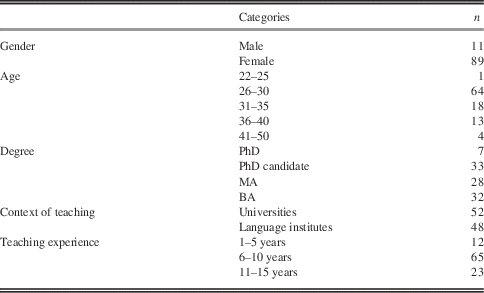
The study made use of two categories of participants. To answer the first question of the study, 100 EFL teachers completed the Teacher Technology Integration Survey (TTIS) (Vannatta & Banister, Reference Vannatta and Banister2009). From among this sample, 48 were teaching at language institutes and the rest were teaching at universities. The demographics of these teachers are shown in Table 1.
Demographics of the participants of the first phase of the study

The second category of participants, who were selected to collect data for the second research question, consisted of twelve Iranian EFL teachers (nine females and three males) at universities and language institutes. Purposive sampling (Cohen, Manion & Morrison, Reference Cohen, Manion and Morrison2007), a subcategory of nonprobability sampling was used for the selection of these respondents whose identity is protected here with the use of pseudonyms. The underlying motive for such a selection was to have the perspective of hand-picked EFL teachers in terms of their experience, educational degrees and the grades they were teaching. All the participants of the second category held at least master’s degrees in teaching English as a foreign language (TEFL) and were experienced teachers with at least five years of instruction. Within this category four groups of participants were chosen. The first group included four participants who had experienced using technology in their language classes and/or running fully-online EFL classes. The second group consisted of two EFL teacher educators with extensive experience in teaching EFL classes, but with no familiarity with CALL. The third group members were two EFL teachers teaching at language institutes who did not use technology in/for their classes. The final group interviewed were four of the participants of an online CALL teacher education course who taught at institutes and universities. It should be noted that almost all the teachers interviewed at this stage of the study were based in Tehran, the capital of Iran. This is an important point, since it can affect the generalizability of the results.
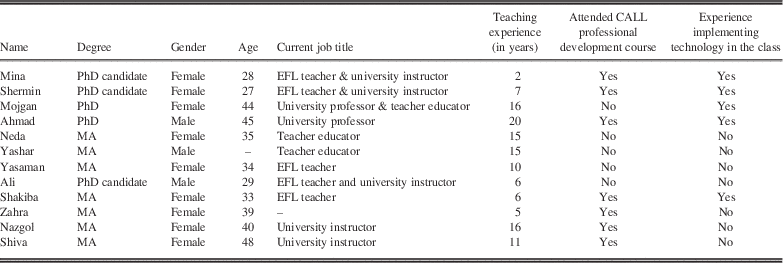
In what follows we detail the characteristics of each respondent from the second category of participants (see Table 2 for a summary).
Demographics of the participants of the second phase of the study

Mina was a 28-year-old PhD candidate in TEFL who usually taught general English courses. She worked as a part-time teacher in private language institutes and for the past two years she had been teaching at both public and private universities in Tehran. She had experienced computer-assisted language teaching for three terms at the time of the interview. She had taken a CALL course during her PhD program. She was selected for this study because she had practical experience in the application of technology in her EFL classes. To be more specific, she usually made use of weblogs for her students to express themselves and asked her students to work with various technological tools.
Shermin was a 27-year-old PhD candidate in TEFL who had taught general English courses at private language institutes for seven years, with three years of experience at university level in the public sector in Tehran. For the past two-and-a-half years she had utilized CALL in her classes and served as a teaching assistant in online general English courses at a public technical university. She too had taken a CALL preparation course for her PhD program.
Mojgan was 44 years old, had a PhD, and had taught English for sixteen years. She was currently teaching TEFL at MA and PhD levels and online general English courses in the public sector in Tehran. She had not taken any training courses in CALL but had been teaching online English courses at a technical public university for two years. She had also served as an EFL teacher educator in the private sector.
Ahmad, who was 45 years old, had been teaching English for twenty years in the public sector. He mostly taught general English courses. He had ten years of practical experience in utilizing CALL for instructing his learners, in addition to having actually majored in CALL while formerly living in the UK.
The next respondent was Neda, a teacher educator at a public language institute. She was 35 years old and held an MA in TEFL, with fifteen years of experience in teaching advanced English courses. She worked in the public sector in Tehran and had not taken any training courses in CALL, nor had she experienced using CALL in her EFL classes.
Yashar was another EFL teacher educator at a private language institute in Tehran, who held an MA in TEFL. He had not taken any CALL courses and had not experienced using technology in his classes. He had taught advanced courses for fifteen years, and for the past eight years had served as an EFL teacher educator.
Yasaman, 34, had an MA in TEFL, and had been teaching advanced English courses for the past ten years in private language institutes in Tehran. She had not attended any courses in CALL and did not utilize technology for/in her classes.
Ali, 29, was a PhD candidate in TEFL who had taught general English courses and some BA courses in English-related majors at private universities for six years. He also worked in private language institutes in Tehran and had not experienced any CALL courses.
The other four informants consisted of four high achievers of a fully online CALL professional development course designed and delivered by the researchers for another part of the study. Shakiba held an MA in TEFL and usually taught advanced courses at a private language institute. She was 33 years old and had six years of teaching experience in the private sector. She had recently taken the above-mentioned CALL professional development course and had six months of experience in teaching with the help of technology after attending the recent CALL course.
Zahra, who was 39 years old, had an MA in TEFL. Though she had been engaged in teaching at private language institutes for five years, she was not teaching at the time of the study. She had attended the online professional development course in CALL but she did not have any experience in using CALL in an actual classroom.
As a university instructor, Nazgol held an MA in TEFL and had been teaching for sixteen years as a faculty member at a private university. She was 40 and usually taught various courses at BA level in the private sector. She had also taken the professional development course in CALL but had not yet had the opportunity to experience CALL in practice.
Finally, Shiva was a 48-year-old faculty member who held an MA in TEFL. She had been teaching various BA courses at a private university for the past eleven years. She had recently completed the professional development course in CALL, but did not implement technology in her classes. Table 2 summarizes the demographics of the participants who were interviewed for the second phase of the study.
2.2 Data Collection
The TTIS questionnaire and interviews were the techniques used to collect data in two phases of this study.
The questionnaire used in the study was the multi-dimensional Teacher Technology Integration Survey (TTIS) developed by Vannatta and Banister in 2009. The questionnaire’s main aim as the authors put it was “to assess teachers’ technology integration practice” (op. cit.: 329). It does so by tapping into six constructs of teachers’ risk-taking behaviors and comfort with technology; their perceived benefits of using classroom technology; their beliefs and behavior about classroom technology use; their technology support and access; their technology use for instruction, instructional support, and communication; and facilitation of student technology use.
The questionnaire is made up of two parts: demographic details and items related to the constructs. The first part aimed at collecting information regarding the age, gender, degree, teaching experience and the grades the participants were teaching. The second part consisted of 59 items divided into four sections. The first section dealt with risk-taking behaviors, the perceived benefits, and teachers’ beliefs and behavior about the use of technology in classrooms. These items were measured on a 4-point scale from strongly agree to strongly disagree. Three reverse items were included in this section (items 2, 3, and 5).With respect to the first question of the survey, which examined whether technology was used in EFL classrooms, some modifications were made to the original instrument to make it appropriate for the current situation in our setting. The second section contained eight items related to teacher support and access to technology and was also on a 4-point scale ranging from not available in my building, to available but not accessible (can’t use or sign up for), to available but have limited access, to available and have easy access. The third section included thirteen items dealing with the level of frequency teachers made use of technology to support their instruction. The responses to these items were measured on a 5-point scale ranging from never to 1-2 times a semester to several times a semester to several times a month to several times a week. And finally, the last section tapped into the frequency of students’ use of technological tools in their classrooms. This set of eighteen items followed the 5-point scale measurement of the previous section.
The reliability and validity of the TTIS questionnaire were originally established by Vannatta and Banister (Reference Vannatta and Banister2009) through administering it online to 279 K-12 teachers who were serving as cooperating teachers through a large Midwest state university in the United States. These have also been documented in another study by Hastings (Reference Hastings2009). The reliability of the TTIS questionnaire in this study was .89.
As the second technique of data collection, the study used a 10-question semi-structured interview with the participants on the application of technology in language teaching and language teacher education. This type of interview provides the opportunity to deviate slightly from the interview guidelines and consider issues that might be illuminating throughout the interview.
The first researcher developed the interview questions with the help of the second researcher who is a CALL teacher with years of experience experimenting with CALL and CALL education, as well as another TEFL professor with expertise in the field of TEFL teacher education. The questions were divided into two parts, one dealing with the use of technology in language teaching and the other addressing the use of technology for CALL teacher education. The main purposes of the interview questions were to explore the EFL teachers’ understanding of CALL, to locate the obstacles in incorporating CALL in Iranian EFL classrooms, to gain insight into what teachers consider essential to be included in CALL education courses, and to find out the challenges and rewards an online CALL professional development course might have for both the organizer and the participants of such a course.
The interviews, which lasted between 30 and 55 minutes, were recorded on an MP3 player and were later transcribed verbatim for further analysis. The sessions began with a couple of warm-up questions which were intended to make respondents feel at ease. At the same time, detailed information on the participants’ demographic characteristics was collected through these questions. Then the interview proceeded with the main questions addressing the major aims of the study.
2.3 Data Analysis
Data from the questionnaire were entered into the Statistical Package for Social Sciences (SPSS, version 18) software. Subscale scores were then calculated consisting of the means of respective subscale items: risk-taking behaviors and comfort with technology; perceived benefits of using technology in the classroom; beliefs and behaviors about classroom technology use; teacher support for technology use; teachers’ technology use for instruction; and facilitation of students’ technology use.
One of the researchers carried out content analysis on the interview transcripts, following a qualitative structural scheme. Mayring (Reference Mayring2000) defines content analysis as the process of summarizing and reporting data in a way that “the essential contents are preserved but a short, manageable text is produced” (op. cit.: 268). The transcripts were studied and segmented into units of impediments EFL teachers encountered in integrating technology into their classes. These units were then organized on the basis of their content into different categories—an umbrella term for the units with a similar thematic core. It should be mentioned that the same researcher analyzed the transcripts for the second time after an interval of two months to ensure consistency of analysis. The results of the second content analysis yielded 90% consistency between the first and second content analyses. Moreover, another rater was asked to run content analysis on 20% of the transcripts. This analysis also yielded 80% consistency with the analyses conducted by the researcher.
The researchers tried not to limit themselves to the themes already in the literature; therefore, a bottom-up approach was adopted to guide the categorization of themes.
3 Results and discussion
3.1 The status quo of technology integration in Iranian EFL classrooms
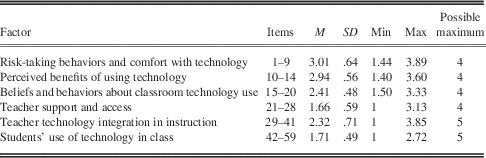
Descriptive statistics for all technology-related factors and technology use factors are presented in Table 3. The first three technology-related factors in Table 3 are: risk-taking behaviors and comfort with technology; perceived benefits of using technology; beliefs and behaviors about classroom technology use. These were comprised of twenty items (items 1–20) and were based upon a 4-point Likert scale with participant responses ranging from strongly disagree to strongly agree. Items 2, 3 and 5, which were negatively stated, were recoded in reverse in order to accommodate transposed agreement on the Likert scale. The last technology-related factor had to do with teacher support and access, consisting of eight items (items 21–28) ranging from not available in my building to available and have easy access on a 4-point scale. The factor that had the greatest mean was risk taking (M=3.01 out of 4). In contrast, the one with the lowest mean was teacher support and access (M=1.66 out of 4).
Descriptive Statistics for Teacher Technology-Integrated Factors
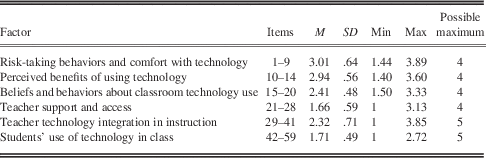
The next two factors in Table 3 have to do with the technology use. They show teachers’ technology integration and students’ use of technology in the classroom. These items were rated on a 5-point scale ranging from never to several times a week. The first one shows teachers’ technology integration in instruction with a mean of 2.32 out of 5, and the second one indicates that the mean score of using technology by students is 1.71 out of 5. The results are indicative that teachers’ use of technology is greater than that of the students.
Table 3 shows that the EFL teachers interviewed claimed to be risk-takers. This can be partly due to the fact that these teachers were familiar with computer technology for their personal use.
Regarding the second factor in the table, i.e., perceived benefits of using technology, the sampled EFL teachers claimed that technology had a positive effect on their teaching and students (M=2.94 out of 4). However, such beliefs did not manifest themselves in these teachers’ actual use of technology for instruction. Therefore, it is likely that some of the teachers chose answers which seemed to be more prestigious. In other words, considering the common trend in favor of technology, they chose answers which reflected this trend to show that they are up-to-date.
The third factor in the table dealt with the teachers’ beliefs and behaviors about the use of technology in classrooms. The index of 2.41 out of 4 is indicative of a fairly low use of technology in the classroom as most items in this section deal with the actual integration of technology in the classroom. Although the teachers considered technology as a useful tool, for various reasons their actions did not follow their belief (M=1.66 out of 4). Linking this factor to the next factor in Table 3, i.e., support and access, it becomes obvious that the availability of computers was limited and they did not have access to IT support for their classes. There are also many other reasons which inhibit teachers from using technology in their classrooms which will be discussed in the next section of this paper.
The next factor shows the low rate of technology integration in teaching on the part of the teachers (M=2.32 out of 5). This may also be due to various reasons, some of which have already been referred to above.
Finally, students’ use of technology in the classroom (M=1.71 out of 5) is less than that of teachers which, in addition to the factors affecting teachers’ use of technology, can be the result of not having proper facilities in the classroom and of teachers’ resistance to incorporating technology in their classrooms, thus setting an undesirable model for their learners.
All in all, it is evident from the above table that the actual use of technology for and in the classroom by teachers, as well as students’ use of technology in the classroom, is not very common. This may be due to the lack of support and access teachers face, despite the fact that they mostly claim to be risk-takers and to believe in the benefits of technology for classroom use.
3.2 Obstacles to CALL implementation
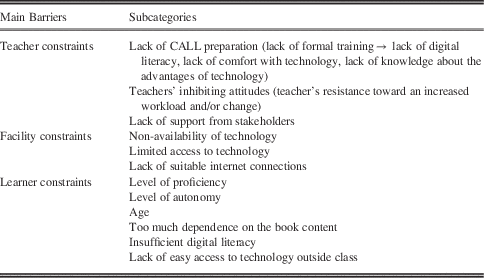
The findings presented here are derived from the comments made by the respondents in their interviews and deal with the obstacles teachers see in implementing CALL. The impediments mentioned by the Iranian EFL teachers can be classified into three categories: (1) teacher constraints, (2) facility constraints, and (3) learner constraints (Table 4).
Main barriers in implementing CALL, as perceived by Iranian teachers
3.2.1 Teacher constraints
The obstacles in implementing CALL that were referred to the most were those related to teachers. These can be subcategorized into lack of CALL preparation, inhibiting attitudes, and lack of support from stakeholders. Lack of CALL preparation refers to the fact that the Iranian EFL teachers are not ready and well-equipped to integrate technology into their classes. This can be due to the lack of formal training in this area which in turn leads to teachers’ lack of digital literacy, lack of familiarity and comfort with technology, and lack of knowledge about the benefits of utilizing technology in the class. The second subcategory dealt with teachers’ inhibiting attitudes. These attitudes and perceptions made teachers distance themselves from technology and its application in the classroom. These inhibiting attitudes were comprised of teacher’s resistance toward an increased workload and/or change. Lack of support from stakeholders, e.g., supervisors and students, was also mentioned as a reason for not implementing technology, and falls in the third subcategory of teacher constraints. In what follows we will elaborate on each constraint and support it with the participants’ comments. It is noteworthy that the order of presentation of these barriers is indicative of their frequency.
The first reason for not utilizing technology within the category of teacher constraint was the lack of teachers’ preparation in the form of professional development courses or pre-service teacher education programs. In such formal training, teachers are usually introduced to various available technologies and learn how to integrate them into their classes. They also become familiar with the advantages of class technology use. Although it is necessary for teachers to become acquainted with these technologies, the existence of training courses on CALL in the form of standalone professional development courses or a component in teacher training courses is very rare in the Iranian context. It was only in 2007 that a CALL course was first introduced to Alzahra University’s TEFL PhD program. Since then only a few other universities have also offered this course in their PhD programs. In the year 2010, also, Alzahra University once more took the initiative and offered a CALL course at MA level for its students of TEFL. A similar course has been offered in at least one other state university since then.
Unfortunately, however, although some efforts have been made at degree programs, in the teaching training courses offered in language institutes (where much of the actual teaching of language takes place), CALL is not yet being incorporated. Therefore, lack of training is still a major problem in the Iranian context, one that has received frequent mention by the participants of this study. Neda, for example, said, “Even the e-learning part… I think needs a bit of training so if you don’t have that kind of training you might be reluctant to try it.” Mina claimed, “Many of our teachers are not prepared. They don’t know that much about it [CALL], how to use it for instructional purposes. Even many of the courses that are held for enhancing teachers’ understanding of technology solely depend on the introduction of technology, not how to use technology for instructional purposes. So they do not have that much knowledge to critically integrate technology.” Yasaman similarly commented, “Maybe they are not really into technology because they don’t know how to use it.”
Teacher training in CALL leads to enhancing teachers’ digital literacy. Digital literacy refers to the ability to effectively and critically use a range of digital technologies. The lack of such a skill will lead to teachers’ resistance to integrating technology in their classes. Neda claimed that teachers may not “know how to use technological tools. Maybe in our case there are a lot of good teachers but since we are in this situation, we don’t know how much, at least a lot of people still don’t know much how to use these mp3s, mp4s, IWB, ….” Mojgan, on the other hand, confessed that, “I wouldn’t say that I’m well-equipped with technology. It’s the bare rudimentary things that I would have to know and I have to talk about and deal with in the class.”
The lack of comfort with technology is another result of not having proper training in CALL. Those who experience technophobia and are not familiar with technology are obviously uncomfortable with it and avoid technology in their instruction. Ahmad proposed, “Maybe some people have phobia.” And Nazgol repeatedly mentioned the use of technology in class as being “too risky” and claimed that “they [the teachers] are afraid of it.” She continued, “One big reason is because teachers are not familiar with technology. They are afraid of it. They are not comfortable with it one bit.” She also suggested that the technophobia of instructors may be caused by their age, “Since their instructors are usually older, not old but older [than the students], so that could be the reason they don’t like change. They don’t like using stuff, they are afraid of to use it.” Shermin also confirmed this idea by proposing that “the reason is that teachers are not familiar with technology themselves. They have phobia and do not like technology. They are not familiar with technology as well as their students; therefore, they avoid utilizing it.”
The next result of not having proper training is teachers being unaware of the benefits of technology use in class. Teachers should believe in the advantages of using technology in the class; otherwise, they are not tempted to integrate it in their class and consider it a waste of time. Mina stated, “Maybe …they don’t see a profit out of it, [so] they don’t use it…. Because he or she believes that in a similar situation, she can get more out of the book in comparison, for example, to the Internet.” This reason was emphasized by Nazgol when she stated “Perhaps they’re [teachers are] not aware of how useful, you know, it could be and maybe like me until a few months ago [referring to her CALL course], they don’t know, like, about the researches that have been done.”
The second reason for not integrating technology in the category of teacher constraint was teachers’ inhibiting attitudes toward technology; i.e., their resistance toward an increased workload and/or change. Zahra, for example, referred to the difficulty of making changes, claiming, “Some teachers are lazy. I know some people, you know they say, oh come on, why should we use CALL, because we’ve been doing this, God knows, for 30 years now? We are satisfied with this sort of blackboard and chalk system; why should we use computers?” Nazgol also believed that by not using technology, “You feel the need less to keep yourself up-to-date and use new materials, because the book is always there. It’s not changing. The book is always going to be the same.”
The interviewed teachers also believed that computer-assisted language learning/teaching increases their work and takes a lot of time and energy. Shiva asserted, “Sometimes it is difficult to manage such classes; sometimes you have to work at home, sometimes you have to control many things, to check everything. I think working with technology needs more energy and time than the real class.” Yasaman also referred to lack of time, and Nazgol also stated, “It took so much of our time that I wasn’t tempted to do it….you have to spend a lot of time and energy.”
The final subcategory shows that teachers need support from the stakeholders involved in the teaching endeavor, such as supervisors and learners. Ali referred to the lack of support from supervisors, saying that “supervisors might not let the teachers use technology” and Nazgol claimed, “We’re not even encouraged by our students to change it that much…so maybe if I were…I mean if a teacher were challenged more by their students. Even if they were asking more for that type of stuff, then I would feel it’s necessary.”
Most of the above-mentioned teacher constraints appear to be common worldwide (cf. Burke, Reference Burke2000; Butler-Pascoe, Reference Butler-Pascoe1995; Egbert & Thomas, Reference Egbert and Thomas2001; Kessler, 2000; Mumtaz, Reference Mumtaz2000; Robertson et al., Reference Robertson, Calder, Fung, Jones, O’Shea and Lambrechts1996; DelliCarpini, Reference DelliCarpini2012). However, an interesting point mentioned by the participants was that even students can play a role in encouraging teachers to utilize technological tools in their classes. This is a factor which will inevitably prove itself further in a few years, when more students become digitally literate and require their teachers to change.
3.2.2 Facility constraints
The next most frequent reason for not using technology in language teaching was lack of facilities. This ranged from total non-availability of technology to limited access. While the total non-availability of technology refers to the absence of computers and technological tools in educational settings, limited access to digital technology refers to contexts in which the quantity/quality of technological tools is inadequate. The suitability of Internet connections was also a factor, ranging from no Internet connection at certain educational settings, to slow connections in general. Interestingly, although website filtering is admittedly an occasional obstacle in Iran, it did not receive mention by any of the participants. This might be in part due to the fact that many of the participants had limited or no experience with actually implementing CALL in their language classes, which raises the interesting question of whether the constraints would be perceived somewhat differently by professional Iranian CALL practitioners.
From among facility constraints, total non-availability of computers and technological tools was the most frequent reason for not using technology in the classroom. Shermin argued, “The first problem a teacher faces in using technology is the fact that it requires facilities.” Ali claimed, “I do not use technology directly in my classrooms due to the lack of facilities. Most of the classes lack technological instruments like computers and the Internet.” Ahmad also suggested, “Maybe a teacher does not have access to the technology.” Shiva put it more strongly, asserting, “It can be very helpful here but only if we have the facilities. We don’t even have a voice recorder here [a private university], [not even] a tape recorder. We don’t have a computer; we don’t have an equipped lab here.”
It is worth making a distinction between private and public universities in Iran. Contrary to some countries, at the moment the computer facilities of public universities in Iran are in general much more satisfactory than those of the private sector (the reverse is currently true about private versus public schools, however). This might be why only EFL teachers from the private sector referred to the lack of facilities.
On the other hand, there are situations in which technology is available but it is not that accessible for class use or there is not enough to go around. Nazgol referred to situations in which technology existed but the quality and/or quantity was not good enough. She maintained, “Actually it’s [the university computer lab] not that available for classes… first of all it was very hard to arrange it [using the computer lab] because they said…it’s supposed to be free for all students to use and if we let you use it for your class, that would be depriving other students of it for an hour and a half. Not reasonable at all. And another thing is that, you know, maybe, like, a few of them [computers] were not working. I was sitting, I don’t know, like 3 or 4 students at each computer and trying to explain.”
The final constraint in this subcategory was the quality of the Internet connection, as one participant referred to the general quality of Internet connections in Iran. Yashar declared, “In Iran, … the Internet connections are usually poor, the dialup connection is not really useful.”
It is worth mentioning at this point that scarcity of technological resources in various educational settings has also been referred to by other researchers (cf. Egbert et al., Reference Egbert, Paulus and Nakamichi2002; Marandi, Reference Marandi2010; Marandi, Reference Marandi2013; Mumtaz, Reference Mumtaz2000; Yeok-Hwa Ngeow, Reference Yeok-Hwa Ngeow2010).
3.2.3 Learner constraints
Finally, learner constraints also played a role in whether teachers implement CALL in their classes. Learner constraints included learners’ autonomy and language proficiency level as well as their age, their dependence on the book, their level of digital literacy, and their access to facilities out of school.
Mojgan and Shermin, who had experienced online EFL teaching at a state university, considered learner factors such as level of proficiency, age and autonomy as determining factors. To Mojgan, the younger the students, the more likely they would be happy with the integration of technology. This is somewhat reminiscent of the distinction made between digital natives and digital immigrants (Prensky, Reference Prensky2001), at least in the sense of early versus late habit formation leading to a corresponding ease or difficulty of skill acquisition. In this sense, the younger students are digital “natives” and they feel more relaxed in using digital technology, and in some instances, they even prefer the use of technology since they have grown up with it. Nazgol also considered this age factor, saying, “Maybe the younger ones [students] were more interested in using technology.” Mojgan, on the other hand, suggested, “Maybe the level of proficiency of the students allows such technology to be used more successfully. The students are more autonomous.”
Students’ attitudes as a factor in this category refer to how learners feel about technology and its role in the learning process. What becomes evident from the teachers’ point of view is that learners do not consider technology sufficient as a standalone component in language learning. Shakiba argued, “Some students think they will learn something when they have a book in their hands…. And it takes so much time to persuade them that there’s a method when using computers.” This is an indication that some students might not take a class with technology integration as seriously as they should.
On the other hand, unfamiliarity with technology on the part of students is another factor which inhibits teachers from introducing digital technologies into their classrooms. Ali, for example, believed that one reason for teachers not using technology might be that their “students might not be familiar with technology.”
Zahra was the only one to mention the difficulties students may sometimes face in accessing technology outside the classroom. She stated, “Teachers have to know students’ limitations, both at the individual level and social level. Some of them might not have easy access to technological devices outside the class. Even if they have, there might be social limitations as to for example how they can have access to these social networks.” If this is the case, teachers cannot always ask their students to complete a task which requires technology use outside of the classroom, and this is a constraining factor for them.
4 Conclusion
The current study highlights the limiting factors of implementing CALL in Iranian language classes as mentioned by a number of Iranian EFL teachers. According to this study teacher constraints seemed to play a major role in the limited application of technology in language teaching in Iranian EFL classes. These constraints were mainly caused by lack of training in CALL. This is in line with Robertson et al.’s (Reference Robertson, Calder, Fung, Jones, O’Shea and Lambrechts1996) conclusion that the quality and quantity of professional development courses for teacher preparation in using digital technology in the classroom must be high to ensure they become acquainted with a range of uses and the benefits of such tools. Lam (Reference Lam2000) identified teacher attitudes toward the usefulness of technology and its ease of use as factors determining whether they would use it or not. Another study by Reed et al. (Reference Reed, Anderson, Ervin and Oughton1995) supported the idea that a computer course can positively influence teachers’ attitudes toward computers, as it makes them more confident and shows them the benefits of technology.
Another teacher constraint identified in this study was teacher resistance (Lam, Reference Lam2000; Robertson et al. Reference Robertson, Calder, Fung, Jones, O’Shea and Lambrechts1996), due to their fear of increased workloads and/or change. Lack of support from the stakeholders was also seen to be a determining factor in this study, a problem which has received mention in other studies as well (Marandi, Reference Marandi2010).
Concerning facility constraints, the results of this study suggest that limited availability or lack of digital technologies at language institutes and universities, as well as poor Internet connections, still pose problems for the integration of technology in Iranian classrooms.
Finally, the learner constraints referred to in this study reveal that Iranian teachers consider issues such as learners’ level of proficiency, autonomy, and age when deciding on the use of technology in classes. The learners’ occasionally insufficient digital literacy, dependence on book-based instruction, and technology access problems outside of class were also considered to be limiting factors by the Iranian EFL teachers participating in this study. This appears to be a distinctive feature of this study, as most similar studies in the literature did not appear to perceive such student limitations as a problem.
In conclusion, it needs to be pointed out that the current study was based on the perceptions of a relatively small number of participants, many of whom had not yet actually experienced the difficulties of CALL first-hand; therefore, it is quite possible that certain constraints have been overlooked by them or have received insufficient attention. For example, Marandi (Reference Marandi2010) also mentions parents’ concerns as another limiting factor in the Iranian context. However, this issue was not mentioned by the participants of the present study, nor did issues such as blocking of Internet websites, lack of tech help, rigidity of school and institute syllabi, or lack of shared learning communities (Marandi, Reference Marandi2010) receive mention. It is possible that some of these would be of concern to teachers with more varied CALL experience than one generally finds within the current Iranian context. These conjectures notwithstanding, it seems safe to infer from the current results a general lack of infrastructure for the application of CALL in Iran, with insufficient teacher preparation claiming the lion’s share of the problem.