
Introduction
Several species of whales occur in the Mediterranean Sea; some are resident and others are visitors. Little is known, however, about whales in this region in the distant past, as archaeological, and specifically archaeozoological, research on whales and whaling has been limited. Where cetacean bones have been recovered from archaeological sites, few attempts have been made to identify the specific skeletal element (such as the type of vertebra) or species represented. Despite the lack of in-depth research to negate claims for whaling, it has generally been assumed that prehistoric people lacked the ability to hunt these animals at sea, and that all bone remains found in pre-medieval contexts are the result of the exploitation of beached individuals. To resolve this, a research project was initiated to explore whether whales may have been intentionally exploited, based on the archaeological and zooarchaeological evidence from the Strait of Gibraltar (Bernal-Casasola Reference Bernal-Casasola, Carreras and Morais2010a; Bernal & Monclova Reference Bernal, Monclova and Bernal2011, Reference Bernal, Monclova, Costa and Hernández2012). In 2014, a larger project commenced at the Maison des Sciences de l'Homme in Montpellier, entitled ‘Y a-t-il eu une exploitation ancienne des baleines en Méditerranée?’; the aim was to carry out a broad investigation of ancient whale exploitation throughout the Mediterranean Basin. This paper presents research undertaken under the auspices of this second project. It synthesises the current state of knowledge on ancient whale exploitation in the study region by reviewing and updating the corpus of available archaeozoological evidence within a broad chronological, cultural and geographic framework extending from the Upper Palaeolithic to Late Antiquity.
Archaeozoological evidence for whales in the Mediterranean
Strait of Gibraltar: Iberian Peninsula and North Africa
The earliest archaeological evidence for the exploitation of whales that may be associated with the Mediterranean Sea comes from Upper Palaeolithic sites (c. 17500–15000 cal BP) in the Spanish Pyrenees. The whale bones from 11 such sites had been modified into ornaments and artefacts—mostly harpoon heads (e.g. Poplin Reference Poplin and Poplin1983; Corchón et al. Reference Corchón, Mateos, Álvarez-Fernández, Peñalver, Delclòs and van der Made2008), although a whale barnacle was recovered in the cave of Las Caldas. Pétillon (Reference Pétillon2013) notes that the Atlantic coast is the most probable source for the cetacean raw material used in artefact manufacture, but does not totally exclude the possibility that at least some of the cetacean material derives from the Mediterranean Sea. This is corroborated by the discovery of two species of whale barnacles in the prehistoric Nerja Cave (1; site numbers refer to Figure 1 & Table 1) in southern Spain (Álvarez-Fernández et al. Reference Álvarez-Fernández, Carriol, Jordá, Aura, Avezuela, Badal, Carrión, García-Guinea Maestro, Morales, Perez, Perez-Ripoll, Rodrigo, Scarff, Villalba and Wood2014). There is a long chronological hiatus between these and later Punic and Roman sites with whale remains around the coast of the Iberian Peninsula.
Map of the Mediterranean with the archaeological sites marked (see also Table 1).

Whale bones mentioned in the text (numbers 5, 6, 15, 16, 18, 20, 21, 22, 25, including some previously unpublished examples for 15, 19 & 20; for further references for those on the Iberian Peninsula, see Bernal & Monclova Reference Bernal, Monclova, Costa and Hernández2012: 179).

As shown in Table 1, the largest concentration of whale remains comes from 13 Roman sites on the Iberian Peninsula, 10 of which lie on the Mediterranean coast, close to the Strait of Gibraltar; 3 others face the Atlantic Ocean. The sites date from the Republican period through to Late Antiquity. The Mediterranean Sea sites include four fish-salting plants or cetariae: Baelo Claudia (20; Figure 2), Iulia Traducta (24), Manilva (18) and Septem (23). In North Africa, the Hellenistic city and Roman military camp of Tamuda (19; Figure 2) has produced whale bones in contexts from the second century BC to Late Antiquity.
Left) plan of the ancient Roman city of Baelo Claudia; right) the Mauretanian site of Tamuda, with locations of whale bones marked.

Southern France: the Gulf of Lion
On the coast of the Gulf of Lion in southern France, whale bones have been found at two sites: Lattara (15) near Montpellier (Hérault), and Gruissan (25) near Narbonne (Aude) (Figure 1).
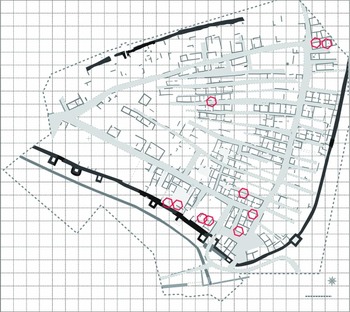
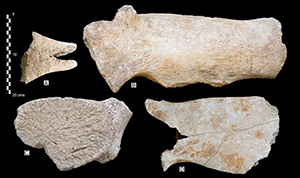
At Lattara, the first whale bones recovered came from the area known as ‘La Cougourlude’ (16), located outside the city walls and used as a necropolis during the Roman period; unfortunately, the exact findspot is unknown, and their chronology is equally uncertain. The three bones were worked and have been identified as belonging to the fin whale (Macé Reference Macé2003). The updated inventory of whale remains includes several other pieces from different excavation areas at Lattara (Figure 3). They derive from all chronostratigraphic levels: from the earliest foundation contexts (early fifth century BC) to the Roman period (around the first century AD). Most samples are fragments of vertebrae (cervical, thoracic caudal) or crania. New finds (not published) were excavated in 2012 and 2013 (Figure 4A–E). The majority of the fragments were used as raw material: for example, a handstone (rubber) from a quern incorporated into a wall; others were carved. No tool marks have been identified in the bone assemblage, so it is difficult to assess their function.
Plan of the ancient protohistoric site of Lattara, with locations of whale bones marked.

Selection of whale bones: A) Lattara: 55143, vertebra, 500–400 BC; B) Lattara Cougourlude: 991292; C) Lattara: 104008, vertebra, 50–25 BC; D) Lattara Cougourlude: 991293, vertebra, Roman; E) Lattara: 123049, rib, 400–375 BC; F) Tamuda: rib carved into a carpenter's tool, second–first centuries BC; G) Baelo Claudia: vertebra, second–first centuries BC; H) Traducta: UE 1416, vertebra, fifth century AD; I) Bocca do Río: inter-vertebral disc, Roman; J) Tamuda: UE 712, vertebrae fragments, second century BC; K) Septem: UE 4018, rib, fifth century AD; L) Gruissan: 1267, vertebra, sixth century AD.

Similar observations have been made regarding finds from Gruissan at Saint Martin, located on the border of a lagoon and dated to the sixth century AD. Remains from a lumbar vertebra have been identified. Here, the apophysis was clearly isolated intentionally, maybe in order to use the vertebral centrum, as suggested by Strabo (Geographica 15.2.13; Meana & Piñero Reference Meana and Piñero1992).
The whalebones from both Lattara and Gruissan have been interpreted as the remnants of stranded animals (Gardeisen Reference Gardeisen, Pernet and Py2010). This assumes an opportunistic action, the bones being collected, perhaps, for use as raw material (they are smoother than wood) or fuel (as suggested by their secondary deposition in the archaeological contexts).
Italian mainland and islands
The oldest remains of large cetaceans found in Italian archaeological contexts originate from the Grotta dell'Uzzo (2) in western Sicily (Tagliacozzo Reference Tagliacozzo1993; Cassoli & Tagliacozzo Reference Cassoli and Tagliacozzo1995). The Mesolithic II levels yielded remains of a long-finned pilot whale (Globicephala melas), but most remains were found in the levels corresponding to the transition between the Neolithic and the Mesolithic periods.
Other finds from Sicily include four sperm whale vertebrae dated to the sixth–fifth centuries BC, found at Motya (11; Reese Reference Reese2005). The proximity of purple-dye manufacturing facilities led Reese to conclude that the vertebrae were used as anvils to break shells. One of the Motya vertebrae had a bronze arrowhead embedded in it, interpreted as the coup de grâce administered to a dying beached animal (Reese Reference Reese2005), rather than as evidence of intentional hunting. A vertebra of a false killer whale (Pseudorca crassidens), found in a third-century BC deposit, was identified at the site of Isola Grande. All of these finds are located in western Sicily, which is positioned such that currents facilitate the migration of whales and probably also the transportation of their carcasses.
In Sardinia, the oldest fragment of whalebone is a vertebra from the Bronze Age site of the nuraghe of Lu Brandali (6), overlooking the Strait of Bonifacio. It belonged to an adult specimen and exhibits numerous cut marks, which suggests that it was probably used as a cutting board.
Dating to a few centuries later, a bone fragment of a large whale was found in level C (fourth century BC) at the Etruscan site of San Rocchino (12), Viareggio, Tuscany (Wilkens Reference Wilkens2003). It is probably a vertebral apophysis of a rorqual, with marks of butchering.
A long bone, probably a humerus, was recovered during the excavation of a well in the harbour area of the Roman colony of Turris Libisonis (22; modern Porto Torres). This unpublished bone exhibits numerous cut marks and scratches, which were perhaps partially inflicted during the animal's slaughter, but which are mostly due to the use of the bone as a cutting board.
The most recent (in date) whale bone fragment included in our study, identified as a scapula, was found in an early medieval (sixth–eighth centuries AD) site built on the ruins of the Roman villa of Sant'Imbenia (26), in the bay of Porto Conte near Alghero. This piece has a sharp cut on the neck, immediately below the joint, which was probably inflicted with a saw. This cut may have been administered in order to separate the fin, or to prepare this large bone for further carving. The scapula is not particularly large: it could correspond to a medium-sized species or a young specimen of a large-sized species.
The Aegean: mainland and islands
To date, zooarchaeological research in the ancient Aegean has yielded only a few cetacean remains that can be associated with whales. The earliest evidence comes from Late Neolithic Saliagos (3), on the island of Antiparos (Renfrew & Evans Reference Renfrew and Evans1968). Two vertebrae, possibly from a single individual, have been identified. According to the excavators, they could belong to a fairly small whale.
A Neolithic context below the Minoan levels in Phaistos (4), Crete (under the pavement of Magazine 28), has yielded a large whale vertebra (Pernier Reference Pernier1935). The publication of the discovery provides very little information, and no species identification was attempted. Given its size and the context of the discovery, it could be interpreted either as a curio or as a ritual deposit.
At the site of Kastanas (7; Thessalonika Province, northern Greece), an unidentified fragment of whale bone was discovered in an Iron Age context (1000–800 BC; Becker Reference Becker1986).
Two unidentified fragments of whale bone that were modified by chopping/sawing, were recently recovered from Iron Age contexts (c. 1100 BC) at the site of Tiryns (5), near the town of Nauplion, in the Peleponnese (P. Morgenstern pers. comm.). Another possible Iron Age example of cetacean remains is a whale or dolphin bone found in a tomb at Torone (8), northern Greece (Bökönyi Reference Bökönyi, Ruscillo and Papadopoulos2005).
The best-known example from Greece comes from an Early Geometric well in the area of the ancient Agora of Athens (9; Papadopoulos & Ruscillo Reference Papadopoulos and Ruscillo2002). It has been identified as a fragmentary glenoid from a right scapula belonging to a fin whale. Specialists suggest that it was found in a secondary context, and that it was ideally suited as a work surface. This is supported by the presence of several cut marks made by metal tools.
Discussion
Chronology, spatial distribution and quantity of remains
The distribution of archaeological sites in the study region that have yielded whale remains is clearly biased towards the Western Mediterranean. Alhough this may be linked to the recent research focusing on the Strait of Gibraltar (Bernal & Monclova Reference Bernal, Monclova and Bernal2011, Reference Bernal, Monclova, Costa and Hernández2012), it seems unlikely given the presence of remains listed here from sites in southern France and Italy. Moreover, the extensive corpus of archaeozoological publications from Turkey, the Levant and Egypt does not document a single occurrence of whale bone. Thus, to date, in the Eastern Mediterranean, only the Greek mainland and islands have yielded finds. The paucity of data may relate to the fact that, compared to the Western Mediterranean, the Eastern Mediterranean is an oligotrophic environment with higher salinity and temperatures and relatively low productivity (Coll et al. Reference Coll, Piroddi, Steenbeek, Kaschner, Ben Rais Lassram, Aguzzi, Ballesteros, Bianchi, Corbera, Dailianis, Danovaro, Estrada, Froglia, Galil, Gasol, Gertwagen, Gil, Guilhaumon, Kitsos, Koukouras, Lampadariou, Laxamana, López-Fé de la Cuadra, Lotze, Martin, Mouillot, Raicevich, Rius-Barile, Saiz-Salinas, San Vicente, Somot, Templado, Turon, Vafidis, Villanueva and Voultsiadou2010), rendering it less attractive for large cetaceans. Furthermore, whales enter the Mediterranean through the Strait of Gibraltar, making this a ‘cetacean hotspot’.
As will already be clear from this study, there is a general scarcity of whale remains in sites throughout the Mediterranean Basin; they are thinly scattered across time and space, in contrast to the abundance of other types of marine faunal remains recovered from archaeological contexts. How may we account for this?
(i) Methodological problems: Cetacean bones are particularly prone to decay due to the abundance of spongy tissue, and this applies especially to weathered bones. They are frequently represented only by fragments of spongy tissue, and often escape identification; their intense degree of fragmentation severely impedes species diagnosis and often anatomical identification.
(ii) Processing location: Most beached whales were probably processed at the site of discovery or some nearby coastal location, so we cannot expect numerous remains in settlements.
(iii) Loss of sites: Isostatic variations resulting from rising sea levels and subsidence have resulted in the inundation of many sites that were on or near the coast.
(iv) Shore topography: The ‘fetch’ and topography of many of the Mediterranean coasts are not conducive to the beaching of whales.
(v) Bone diagenesis: The actions of marine annelids that specialise in the consumption of whale bone (Muniz et al. Reference Muniz, De Gibert and Esperante2010) may reduce the quantity of whale bones washed onshore.
(vi) Olive oil: The presence of an extensive olive-oil industry in the Mediterranean Basin may have limited the need for whale blubber for cooking and lighting in this region.
(vii) Meat decomposition: Most whales sink on death, then surface and float for days or weeks, buoyed up by gases from decomposition. Cawthorn (Reference Cawthorn1997) notes that 12 hours is considered the maximum post-mortem time before decomposition begins to affect meat and oil quality. This process would be exacerbated by the warm climate of the Mediterranean, so that most beached whale carcasses would be unattractive food sources.
(viii) Food taboos: For more recent periods, the Islamic and Judaic prohibition on eating the flesh of already dead mammals (but not fish), and for Jews the ban on eating fish without scales, may have limited the exploitation of beached cetaceans, which were perceived as fish and not as animals by ancient peoples.
Finally, the chronological range of the remains is considerable, with one group of sites dating to the Upper Palaeolithic, and another set of occurrences spanning the period from the ninth century BC to the sixth century AD. The clearest concentration of finds falls within the Roman period and provides potential evidence for the intentional exploitation of whale remains at Mediterranean sites during this time.
Whaling vs scavenging
Archaeologists and archaeozoologists are inclined to consider the remains of large cetaceans as belonging to stranded animals. The exploitation of a beached animal the size of a large whale can be carried out without specialised equipment and techniques, and most archaeological finds, e.g. from Lattara or Motya, have been interpreted as the remains of such activity.
Fishing tackle, several metal harpoons and arrowheads, and net weights have been identified dating to protohistoric and Roman times (Figure 5). These could plausibly be connected with whale-hunting, but may have been designed for hunting other large sea animals (Bernal-Casasola Reference Bernal-Casasola2010b).
Selection of whale representations (A & E) and archaeological fishing tackle (B, C & D): A) heroic fishing scene in a clay stamp for bread/cakes from Tamuda, second century BC (positive impression); B) bronze harpoon from Emporiae; C) trident from the wreck at Ulu Burun, Turkey; D) chained hook from Pompeii (Bernal-Casasola Reference Bernal-Casasola2010b); E) Lod Mosaic, from a villa near Tel Aviv (third–fourth centuries AD).

In recent archaeological research, there are few references to ancient whaling in the Mediterranean. The combination of the osteological remains (Table 1), together with the presence of iconographic evidence that shows a heroic fishing scene (Figure 5A), has, however, led present author Bernal-Casasola and colleagues (Bernal-Casasola Reference Bernal-Casasola, Carreras and Morais2010a; Bernal & Monclova Reference Bernal, Monclova and Bernal2011, Reference Bernal, Monclova, Costa and Hernández2012) to raise the possibility of at least occasional whale exploitation in the Roman period around the Strait of Gibraltar, perhaps even through dedicated whaling.
Iconography
Depictions of large sea mammals in the archaeological record of the Mediterranean region are rare. There are a few prehistoric images interpreted as whales, such as the example carved on a sperm whale's tooth from Mas d'Azil (Poplin Reference Poplin and Poplin1983), but such pieces may be associated with activities on the Atlantic rather than the Mediterranean coast. A recent review by Papadopoulos and Ruscillo (Reference Papadopoulos and Ruscillo2002: 215–22) compiled the scarce evidence, beginning with representations from the Geometric period, through to depictions of ‘Jonah and the whale’ on Late Roman sarcophagi. Generally, images of large sea mammals are confined to mythological scenes, but there are some exceptions (Figure 5E).
Traditionally, the scarcity of iconographic depictions of cetaceans has been interpreted as evidence that these animals were not hunted during antiquity (Papadopoulos & Ruscillo Reference Papadopoulos and Ruscillo2002: 216). This line of thought can be challenged: if the same position were adopted for other marine species, the conclusion would have to be that these were also not fished. The reason for the meagre presence of these species in the artistic record may be that their exploitation was carried out by the lower social orders, an activity of little interest to the Graeco-Roman elite, and even criticised by Roman moralists (Bernal & Monclova Reference Bernal, Monclova, Costa and Hernández2012: 177).
Uses of whale products
Understanding the function of archaeological finds of whale bone is often problematic, as they are almost always found in isolation. They no longer have any connection with the living animal or its nutritional potential, and cut marks are often ambiguous and may reflect butchery or modification damage; they are difficult to associate with a specific cut for acquiring meat or other purposes. From the archaeozoological evidence for the Mediterranean, several possible uses for whalebone can be identified:
Salted meat: Bernal-Casasola (Reference Bernal-Casasola, Carreras and Morais2010a) recently proposed that some facilities in Roman fish-salting production centres could have been used for the salting of whale meat and grease. For example, the unusual, large, truncated, cone-shaped salting hoppers (capacity >15m3) could have been used to salt several tonnes of whale meat. The best examples can be found in ‘Industrial Complex VI’ at Baelo Claudia, and at several sites in Sicily (Vendicari-Portopalo). It appears that whale-meat salting was known in antiquity, as suggested by some ancient sources such as Galen (On the properties of foodstuffs 6.728; Powell Reference Powell2007). The answer could come from chemical analysis of residues from interiors of salting basins. Such residues found at Baelo Claudia have been subject to chromatographic analysis, but the results to date remain inconclusive (the residues are currently under study by N. Garnier).
Artefacts: Finished objects made of whalebone are scarce, and whalebone artefact manufacturing sites are unknown from Mediterranean sites in protohistoric and Roman times. Cut whalebone waste from manufacturing processes has, however, been found in several sites (Figure 4H & L). This denotes the presence of such an industry in periods post-dating the Upper Palaeolithic artefact industry using cetacean bone documented for the Iberian Peninsula (Pétillon Reference Pétillon2013: 538).
Bone has several advantages over wood and ivory, and it is not surprising that several chopping or cutting boards crafted from vertebrae or scapulae, and used by fishermen or craftsmen, have been documented. This is the most common type of whale-related artefact in the archaeological record, and is documented throughout the periods studied here and from the Aegean to the Strait of Gibraltar. It is proposed that the whalebone from the Athenian Agora was used by a hide tanner, as shown by the delicacy of the cuts on the bone surface (Papadopoulos & Ruscillo Reference Papadopoulos and Ruscillo2002); the vertebrae from Motya are suggested to have served as anvils for grinding Murex shells (Reese Reference Reese2005); the bones from Baelo and Traducta, are proposed to be cutting boards for carving up fish (Bernal & Monclova Reference Bernal, Monclova, Costa and Hernández2012). These interpretations call to mind several Attic ceramic depictions of the Classical period, in which fishermen are shown cutting up large fish (Papadopoulos & Ruscillo Reference Papadopoulos and Ruscillo2002; Bernal & Monclova Reference Bernal, Monclova and Bernal2011: 113).
Biofuel: Pre-cut pieces (cf. vertebral epiphysis) could be used as fuel for a fire, as attested by burnt elements. A cranium fragment, exhibiting traces of thermal alteration, has been found in Lattes (Macé Reference Macé2003); also, the fragment of a burnt rib (Figure 4K) dated to the Late Roman period was found in the fish-salting plant of Septem (Bernal-Casasola Reference Bernal-Casasola, Carreras and Morais2010a). Additional evidence found at modern sites, for example, Lavezzi, as well as ethnographic evidence, seems to support this idea (Vigne Reference Vigne1994: 203–204).
Oil and blubber production: Some of the recovered remains correspond to the spongy and light inner parts of the bone. It has been suggested that in Tamuda, in the second century BC (Figure 4F), and in Septem, in the Late Roman period, these bones were also boiled in order to extract fats and oils (Bernal & Monclova Reference Bernal, Monclova and Bernal2011). To date, this proposal lacks archaeometric confirmation due to the difficulties involved in the identification of oils and fats in archaeological contexts (Garnier Reference Garnier, Botte and Leitch2014).
With regard to whale-oil processing, it has been proposed that the heated rooms found in some Roman salting factories in North Africa, such as at Tingitana (Cotta and Tahadart), and some of the atypical channels—not usual in traditional fish-salting plants found in the Late Roman factory in Gijón, on the Cantabrian coast—could have been used for this purpose (Bernal-Casasola Reference Bernal-Casasola, Carreras and Morais2010a), although this is currently only a hypothesis to be tested by future research.
Conclusion
Despite the limited archaeological evidence presented here, it is possible to conclude that cetaceans and different human communities (e.g. Phoenicians, Greeks, Mauris, Gauls and Romans) interacted in the Mediterranean Basin across space and time. It is possible that the exploitation of cetaceans was carried out differently in each region and by each community. As such, what was practised in the Strait of Gibraltar in the Roman period (occasional whale hunting) seems unique in the Mediterranean.
From the data presented here, we cannot distinguish between the exploitation of beached animals, opportunistic exploitation of whales (including forcing whales to beach) and even occasional active whaling (recall the bronze arrowhead in one of the Punic vertebrae from Motya). Due to the lack of concrete evidence from representations, texts and skeletal remains belonging to a diverse spectrum of whale species, we are at present excluding the option of organised hunting of whales in the Mediterranean during antiquity.
There are strong similarities in the various uses of whale from the contexts under consideration. Aside from the obvious exploitation of meat and oil (for which we have no corroborating data), these ranged from providing raw material for artefacts, as biofuel, curios and as elements incorporated into ritual and symbolic contexts. Future research should focus on the identification of the species of whales represented at archaeological sites (Rodrigues et al. Reference Rodrigues, Horwitz, Monsarrat and Charpentier2016), using both morphological criteria and DNA analysis. A useful avenue of research may be palaeodietary studies using isotopes to identify the consumption of whale meat. Recent research has indirectly confirmed the exploitation of whale meat at one site in Spain thanks to the identification of barnacles (Álvarez-Fernández et al. Reference Álvarez-Fernández, Carriol, Jordá, Aura, Avezuela, Badal, Carrión, García-Guinea Maestro, Morales, Perez, Perez-Ripoll, Rodrigo, Scarff, Villalba and Wood2014). It would also be expedient to expand the role played by archaeometric techniques in order to identify remains of meat, fat and other whale-related by-products in association with the salting industry (salting hoppers and cetariae pavements). Finally, bone industries from the Mediterranean Basin should be re-examined for evidence of cetacean bone.
Acknowledgements
This study is an output of the project ‘Y a-t-il eu une exploitation ancienne des baleines en Méditerranée?’, funded by the Maison des Sciences de l'Homme de Montpellier, the ANR (Project MORSE, CEP&S 2011-ANR-11-CEPL-006), the AniMed network (CNRS, UMR5140 Archéologie des sociétés méditerranéennes, University Paul-Valéry, Montpellier), the Labex Archimede (programme IA-ANR-11-LABX-0032-01) and the Project HAR2013-43599-P of the Ministry of Economy & Competitiveness of the Spanish Government. We thank the following colleagues for supplying us with information and unpublished material: J.P. Bernardes (Bocca do Rio), A. Cosso (Lu Brandali), I. García Jiménez (Baelo Claudia) and C. Sanchez (Gruissan).