

Introduction
Amylase, the enzyme that hydrolyses starch, is found widely in animals, plants and microbes (Li and Cai, Reference Li and Cai2004). Nowadays, amylase is the most important, industrially produced and, so far, the most frequently used enzyme in starch processing (Kong and Wang, Reference Kong and Wang1989; MacGregor and Janecek, Reference MacGregor and Janecek2001). Starch liquefaction is usually conducted under high temperatures (Du and Hao, Reference Du and Hao2006), therefore high-temperature resistance and thermal stability are the main features of interest regarding the use of amylase (Guo and Li, Reference Guo and Li2006). The α-amylase from B. cereus presents these characteristics as well as a high activity (Kang and Lee, Reference Kang and Lee2004).
Bacillus cereus B905 and B904 are beneficial endophytic bacteria isolated from plants. The results from greenhouse and field experiments have shown that both strains promote plant growth and have a prophylactic effect on plants. Before colonizing the plant host, these two strains use available nutrients to intensify their metabolism and increase their population (Kang and Lee, Reference Kang and Lee2004). Extracellular amylase activities have been found on both strains.
In this experiment, the characteristics of extracellular amylase of B. cereus B905 and B904 strains were analysed and the amylase genes were cloned. Results from this study could help in revealing the molecular mechanism of plant colonization by Bacillus cereus, and provide new genetic resources for the industrial production of highly thermoresistant amylase.
Materials and methods
Bacterial strains and plasmids
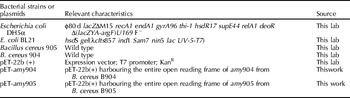
The bacterial strains and plasmids used in this experiment are shown in Table 1. Strains were cultured on plates of liquid or agarose Luria–Bertani (LB) media. The selective medium for α-amylase was LBS (LB medium with 1% soluble starch), supplemented, when necessary, with 50 μg/ml ampicillin (Amp) to ensure plasmid stability in the bacteria.
Bacterial strains and plasmids used

Enzymes and biochemical reagents
Tris-saturated phenol and Amp were produced by Beijing Xinjingke Biotechnology (Beijing, China). Restriction endonucleases XbaI, HindIII and BamHI were from Promega (Wisconsin, USA). Agarose was from Spain, packed by TanWei Biotechnology (Beijing, China). dNTP came from TaKaRa (Dalian, China) and polymerase Taq DNA and ligase T4 DNA were purchased from TanWei Biotechnology. Other analytically pure reagents were all of domestic origin.
Enzymological studies of α-amylase
Plaque detection and determination of enzyme activity of amylase
B. cereus 905 and 904 were inoculated in solid medium LBS (Zhou and Ma, Reference Zhou and Ma2006). After cultivation at 32°C for 72 h, 3 mmol/l iodine and 10 mmol/l KI were added for staining (Zhang and Zhang, Reference Zhang and Zhang2004). Enzyme activity was determined following QB/T1803 (Niu and Xu, Reference Niu and Xu2006). (Enzyme activity: when 1 g enzyme powder or 1 ml enzyme liquid dissolves 1 mg soluble starch at 60°C in 1 min, it is one enzyme activity unit expressed in U/g or U/ml.)
Electrophoretic analysis of amylases
After 48 h the culture was centrifuged and the supernatant was taken as a crude extract of amylase. An aliquot of 5 μl SDS-PAGE upper sample buffer was added to 20 μl crude extract. After electrophoresis by native-PAGE, the gel, containing 0.5% soluble starch, was treated overnight with Tris–HCl (pH 6.8) for protein renaturation, and also for iodine staining activity.
Detection of heat resistance of amylase
Enzyme solutions were treated at different temperatures (40–100°C) for 10, 30, 60, 120 and 130 min, respectively. Then, they were rapidly cooled on ice to room temperature. The relative activity of the residual enzymes was measured by comparison with the enzyme activity of the unheated enzyme solution (100%).
Detection of the acid and alkali resistance of amylase
Enzyme solutions were diluted in buffer solutions at different pH (Cl–HCl pH 2.0–2.2, Gly–HCl pH 3.0, HAc-NaAc pH 4.0–5.0, Tris–HCl pH 6.0–8.0, Gly–NaOH pH 9.0–10.0, Na2HPO4–NaOH pH 11.0, KCl–NaOH pH 12.0–13.0) (Deutch, Reference Deutch2002). After incubating at 40°C for 1 h, the residual enzyme activity was measured (the highest enzyme activity was considered as 100%).
Detection of the impact of metal ions and protease inhibitor on enzyme activity
Different metal ions and the protease inhibitor sodium dodecyl sulphate (SDS) and ethylenediaminetetraacetic acid (EDTA) were added into the reaction systems at a final concentration of 1.0 mmol/l. The enzyme solution without metal ions was used as a control.
Cloning and expression of genes encoding α-amylase
Total DNA extraction from B. cereus
One Bacillus cereus strain was selected and put in 5 ml LB liquid at 37°C, before shaking at 200 rpm until OD600=0.8. The bacteria were collected from 1 ml culture by centrifugation and were extracted in 600 μl Tris–EDTA (TE) buffer pH 8.0, containing 2 mg/ml lysozyme, 10% SDS and 20 mg/ml protease K. After 1 h in a water bath at 37°C, solutions of 5 mol/l NaCl and cationic surfactant hexadecyltrimethylammonium bromide (CTAB)/NaCl (10%/0.7 mol/l) were added and well mixed. After incubation in a water bath at 65°C for 10 min, the same volume of phenol/chloroform (1:1,v/v) was added and the supernatant was precipitated with 0.6 volumes of isopropanol. The precipitate was washed in 70% ethanol, air-dried and dissolved in 20 μl TE buffer (pH 8.0) and preserved according to Xia (Reference Xia2002).
Cloning of amylase genes
Based on B. cereus α-amylase DNA sequences in GenBank, the following primers were designed:
AmyS-5: (5′-ACAGGATCCATGCGTGTGGGGAAAATAC-3′);
AmyS-3: (5′-ACACTCGAGTTTCCGTCTCTTTTTAACC-3′).
AmyL-5: (5′-ACAGGATCCGATGCTTAAAGAAGC-3′);
AmyL-3: (5′-ACACTCGAGCCATTTTAATATGGAG-3′).
The underlined regions indicate restriction sites, for BamHI in AmyS-5 and AmyL-5 and for XhoI in AmyS-3 and AmyL-3.
PCR amplifications with genome DNA encoding B. cereus 905 and B. cereus 904 were carried out, using the following parameters: denaturation at 94°C for 5 min; 35 cycles of denaturation at 94°C for 30 s, annealing at 50°C for 30 s, and elongation at 72°C for 40 s; extension at 72°C for 10 min. The amplified fragment was recovered by electrophoresis after double digestion. The recovery product was inserted into pET-22b(+) after a double digestion with BamHI and XhoI. Escherichia coli BL21 (DE3) was transformed with the resulting plasmid for protein expression and sequence analysis (Wang and Peng, Reference Wang and Peng2007).
Expression of amylase genes in E. coli
Recombinant E. coli was cultured overnight at 37°C in 5 ml LB containing 100 μg/ml AMP. It was then inoculated in 50 ml LB [1% (v/v)] and cultured at 37°C until OD600=0.6–0.8. The inducer isopropyl β-d-thiogalactopyranoside (IPTG) was added at a final concentration of 1 mmol/l. The culture was incubated at 37°C for 5 h to induce the expression of target genes.
Induced bacteria (1 ml) were centrifuged at 12 000 rpm for 30 s. The pellet was washed with 50 mmol/l phosphate buffer solution (pH 6.0) and received the same volume of SDS upper sample buffer (40 mmol/l Tris–HCl, 10% glycerol, 2% SDS, 5% mercaptoethanol and 0.1% bromophenol blue). The tube was bathed in boiling water for 5 min, rapidly cooled on ice for 2 min and centrifuged at 5000 rpm for 10 min. A 12% SDS-PAGE of 5 μl supernatant was carried out (uninduced bacteria were used as a control).
Results
Amylase test of the two strains
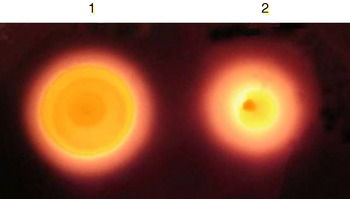
After B905 and B904 were cultured in LBS medium for 48 h, they were stained with iodine. The results showed a bright circle of starch degradation around the growing colonies (Fig. 1).
Activity of Bacillus cereus on the 1% starch of LBS substrate. 1, B. cereus 905; 2, B. cereus 904. (See online for a colour version of this figure.)

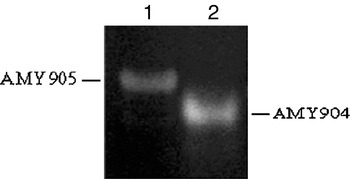
The native PAGE, protein renaturation staining and iodine activity showed differences in the form of the active protein between these two bacteria (Fig. 2), suggesting that they (AMY905 and AMY904) are different amylases.
Identification of B. cereus amylases by native PAGE. 1, B. cereus 905; 2, B. cereus 904.

Effect of pH on enzyme activity and stability
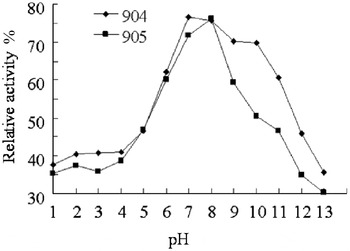
The crude amylase enzymes from the two B. cereus strains were extracted and tested for acid and alkali resistance at 40°C. The results showed that their levels of sensitivity to acidity and alkalinity were similar. The optimum pH ranged between 6.0 and 10.0. In this range, both amylases retained more than 50% enzyme activity in 48 h (Fig. 3), which meant that the two enzymes could have relatively high activity over a wide pH range.
Effect of pH value on activity of enzymes produced by B. cereus.

Impact of temperature on enzyme activity and stability
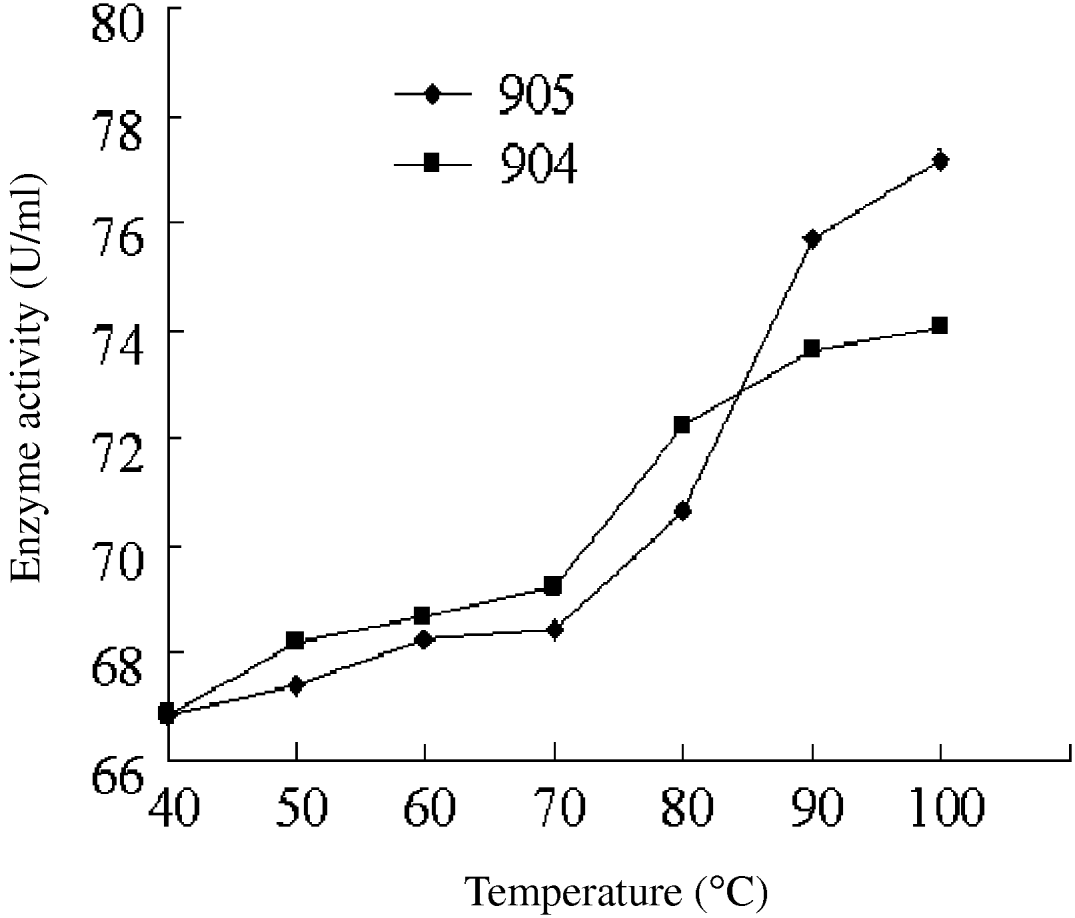
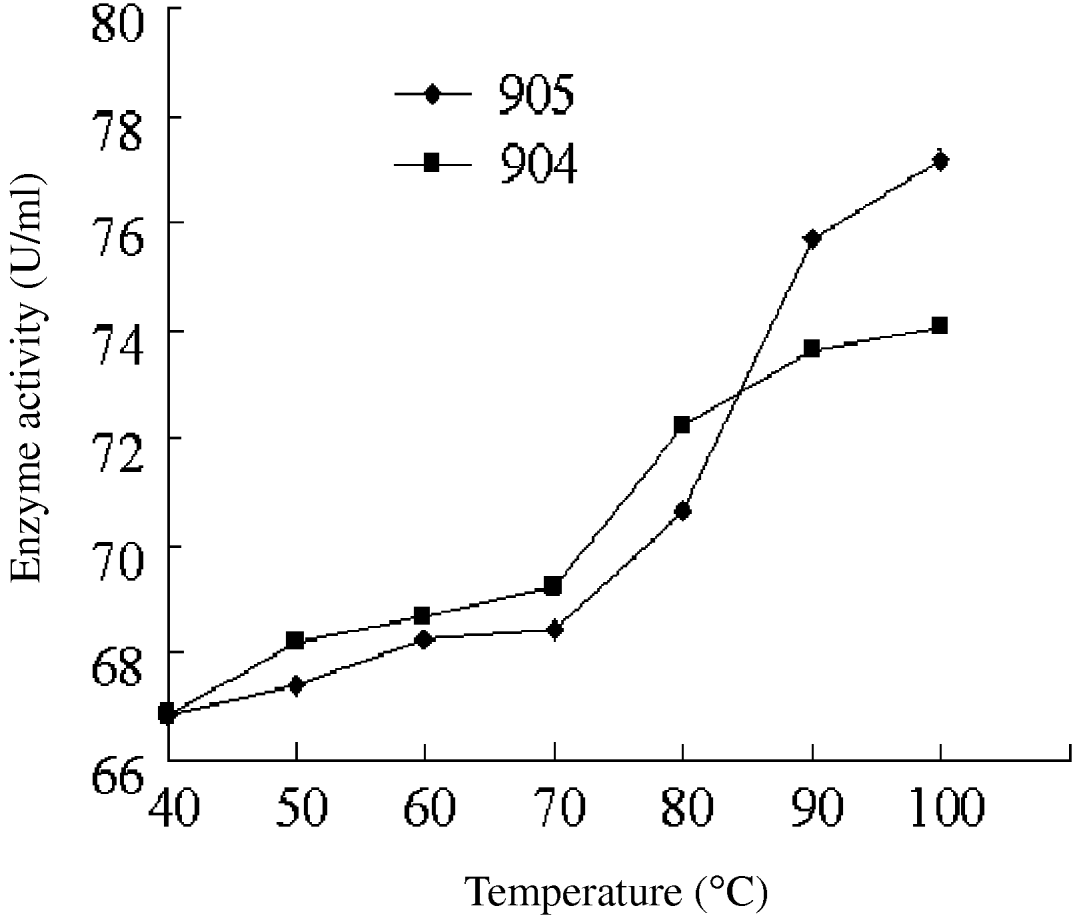
The heat resistance test revealed that the α-amylase generated from both strains maintained high activity in the temperature range of 40–100°C (Fig. 4). Their activities were more than 70 U/ml for both strains, showing that they were both high-temperature resistant α-amylases. Below 100°C, the enzyme activity of strain B904 was lower than that of strain B905. Their α-amylases exhibited high heat stability without Ca2+ dependence (see below). After treatment at 100°C for 2 h, the enzyme activity of the amylases were 80% and 60% for B904 and B905, respectively.
Effect of temperature on enzyme activity produced by B. cereus.
Impact of metal ions and protease inhibitor on enzyme activity
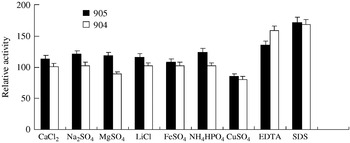
At room temperature and pH 6.0, the crude enzyme was treated with 1.0 mmol/l different metal ions and protease inhibitor for 30 min. The enzyme activity was measured and compared. The results showed that Ca2+, Na+, Li+, NH4+, Fe2+ and Mg2+ had a slight promoting effect on the amylase secreted from B905. Whereas Ca2+, Na+, Li+, NH4+ and Fe2+ had almost no effect on the amylase from B904, some inhibitory effect was noticed with Mg2+. Cu2+ strongly inhibited amylase activity for the two strains (Fig. 5). The protease inhibitors SDS and EDTA both had a promoting effect on the amylase from the two strains.
Effects of various salts, SDS and EDTA on enzyme activity produced by B. cereus.

Cloning of genes encoding α-amylase
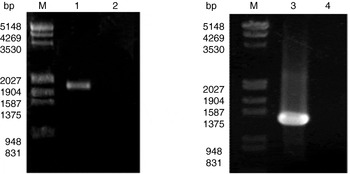
The gene sequences of α-amylase from B. cereus strains in GenBank were compared. There were two completely different α-amylase genes of B. cereus. According to gene sequences, two primers AmyL-5/AmyL-3 and AmyS-5/AmyS-3 were designed. The results of PCR amplification showed that only a 1700 bp band was amplified by AmyL-5/AmyL-3 from B905 and a 1000 band by AmyS-5/AmyS-3 from B904 (Fig. 6). The sequence analysis revealed that B905 and B904 contained 1761 and 1362 bp DNA fragments, respectively. From BLAST sequence analysis we know that both fragments belonged to α-amylase genes, namely amy905 and amy904, respectively.
PCR analysis of the α-amylase from B. cereus. Lanes: M, marker; 1 and 4, B. cereus 905 PCR product; 2 and 3, B. cereus 904 PCR product.

Induced expression of α-amylase genes in Escherichia coli
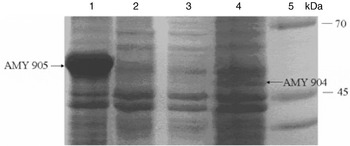
We inserted amy905 and amy904 into plasmids, producing pET-amy905 and pET-amy904. E. coli BL21 was transformed with these. After inducing expression with ITPG, fragmented cells contained α-amylase activity. The SDS-PAGE results showed protein bands of 55 kDa (amy904) and 68 kDa (amy905) (Fig. 7).
SDS-PAGE of the purified Amy905/Amy904 from E. coli BL21. Lanes: 1, total protein of E. coli BL21 (DE3) with pET-amy905 induced by IPTG; 2 and 3, total protein of E. coli BL21 (DE3) with pET-amy905/904 before induction with IPTG; 4, total protein of E. coli BL21 (DE3) with pET-amy904 induced by IPTG; 5, standard protein marker.

Discussion
The enzymological analysis showed that α-amylases from B. cereus 905 and 904 (B905 and B904) conserved their activity in a relatively wide pH range. The stability temperature of the enzyme activity reached 90–100°C, and the thermal stability as well as the enzymatic activity did not depend on Ca2+. Therefore, these new proteins, which are high-temperature resistant and extracellular Ca2+ independent, could solve ongoing problems related to amylase production. This finding will help to improve the heat resistance of the enzyme and reduce the dependence of its thermal stability on Ca2+. Application of these gene resources in industrial processes involving amylase could, to some extent, improve the efficiency and quality of the production of high-temperature resistant amylase and reduce production costs.
The amylase genes have been cloned in many bacteria. Two completely different amylases exist in B. cereus. This experiment has validated this phenomenon at the DNA level. The differences of gene length and sequence showed that their proteins have evolved in two entirely different ways.
Bacterial strains B905 and B904 were both separated from plant hosts. The amylase produced extracellularly could very well help bacteria degrade sugar and ease its absorption, so that bacterial nutrition could be ensured when the bacteria colonize plant hosts. The two different amylase genes provide potential for bacterial genetic modification and improvement of colonization ability in plant hosts.
Acknowledgements
This work was supported by National High Technology Research and Development Plan ‘863 plan’ (No. 2006AA10A211) and Special Agricultural Commonwealth Research Programs: Physaclospora piricola resistance resources information database establishment (No. nyhyzx07055).