INTRODUCTION
Prevention of suicide is a public health priority, and there has been a recent increase in attention and concern regarding suicidality in Operation Enduring Freedom/Operation Iraqi Freedom/Operation New Dawn (OEF/OIF/OND) service members and veterans in particular; there is some evidence showing they are at increased risk relative to the general population (e.g., Kang et al., Reference Kang, Bullman, Smolenski, Skopp, Gahm and Reger2015). In an effort to improve veteran suicide prevention, the Department of Veterans Affairs (VA) conducted the largest analysis of veteran suicide rates in United States history, which revealed that an average of 20 veterans per day died from suicide in 2014 (Office of Suicide Prevention, 2016). Thus, it is essential to identify risk factors associated with suicidality to improve prevention and intervention approaches for vulnerable veteran populations.
It is well established that psychiatric conditions, particularly depression and post-traumatic stress disorder (PTSD), are prevalent in veterans and are associated with increased risk of suicidal behaviors and suicide completion (Jakupcak et al., Reference Jakupcak, Cook, Imel, Fontana, Rosenheck and McFall2009; Pietrzak et al., Reference Pietrzak, Goldstein, Malley, Rivers, Johnson and Southwick2010; Pompili et al., Reference Pompili, Sher, Serafini, Forte, Innamorati, Dominici and Girardi2013; Tanielian & Jaycox, Reference Tanielian and Jaycox2008). In fact, research has shown that veterans with psychiatric disorders who used Veterans Healthcare Administration (VHA) demonstrated elevated rates of suicide relative to veterans without psychiatric disorders and the general population (e.g., Connor et al., Reference Conner, Bohnert, McCarthy, Valenstein, Bossarte, Ignacio and Ilgen2013; Ilgen et al., Reference Ilgen, Bohnert, Ignacio, McCarthy, Valenstein, Kim and Blow2010; Kang & Bullman, Reference Kang and Bullman2008). However, veterans also commonly experience other concerning conditions that contribute to elevated risk of suicidality, including traumatic brain injury (TBI). Numerous studies across community and military samples have demonstrated that history of TBI confers increased risk of suicidality, including suicidal ideation (SI; Mackelprang et al., Reference Mackelprang, Bombardier, Fann, Temkin, Barber and Dikmen2014; Simpson & Tate, Reference Simpson and Tate2002), attempt (Silver, Kramer, Greenwald, & Weissman, Reference Silver, Kramer, Greenwald and Weissman2001; Simpson & Tate, Reference Simpson and Tate2002), and completion (Bahraini, Simpson, Brenner, Hoffberg, & Schneider, Reference Bahraini, Simpson, Brenner, Hoffberg and Schneider2013; Brenner, Ignacio, & Blow, Reference Brenner, Ignacio and Blow2011; Fazel, Wolf, Pillas, Lichtenstein, & Långström, Reference Fazel, Wolf, Pillas, Lichtenstein and Långström2014; Teasdale & Engberg Reference Teasdale and Engberg2001).
Approximately 20% OIF/OEF/OND veterans have experienced a TBI (Tanielian & Jaycox, Reference Tanielian and Jaycox2008), with the overwhelming majority (more than 80%) of TBIs experienced falling in the mild range of severity (Defense and Veterans Brain Injury Center, 2017). Psychiatric conditions such as PTSD and depression commonly co-occur in veterans with a history of mild TBI (mTBI), and this comorbidity has been associated with more severe psychiatric and postconcussive symptoms and poorer functioning than mTBI alone (Belanger, Kretzmer, Vanderploeg, & French, Reference Belanger, Kretzmer, Vanderploeg and French2010; Hoge et al., Reference Hoge, McGurk, Thomas, Cox, Engel and Castro2008; Lippa et al., Reference Lippa, Fonda, Fortier, Amick, Kenna, Milberg and Mcglinchey2015).
There has been some debate about whether history of TBI confers additional risk of suicidality above and beyond presence of comorbid psychiatric conditions and symptom severity. This debate appears to be driven by mixed findings across studies, as several studies have reported that history of TBI, including mTBI, was independently associated with or increased suicide risk when accounting for comorbid mental health conditions (e.g., Brenner et al., Reference Brenner, Ignacio and Blow2011; Silver et al., Reference Silver, Kramer, Greenwald and Weissman2001; Simpson & Tate, Reference Simpson and Tate2005), whereas others found that TBI did not have an independent influence or increase risk relative to psychiatric conditions alone (e.g., Barnes, Walter, & Chard, Reference Barnes, Walter and Chard2012; Brenner, Betthauser, et al., Reference Brenner, Betthauser, Homaifar, Villarreal, Harwood, Staves and Huggins2011; Finley et al., Reference Finley, Bollinger, Noël, Amuan, Copeland, Pugh and Pugh2015).
Some of the discrepant findings across studies may be due to heterogeneity in TBI severity included in the study samples, with many including the full range of TBI severities, whereas others focused specifically on mTBI. Even within the mTBI literature, studies have frequently collapsed across individuals who experienced fewer versus greater lifetime mTBIs. Accumulating evidence indicates that individuals with a history of multiple mTBIs experience poorer outcomes relative to those with one to two mTBIs, including worse psychiatric, cognitive, and functional outcomes (Dams-O’Connor et al., Reference Dams-O’Connor, Spielman, Singh, Gordon, Lingsma, Maas and Vassar2013; Dretsch, Silverberg, & Iverson, Reference Dretsch, Silverberg and Iverson2015; Iverson, Gaetz, Lovell, & Collins, Reference Iverson, Gaetz, Lovell and Collins2004; Spira, Lathan, Bleiberg, & Tsao, Reference Spira, Lathan, Bleiberg and Tsao2014). Thus, a consideration of lifetime mTBI burden may be important when examining suicidality in military and veteran populations and could clarify inconsistent results across studies. In fact, Wisco et al. (Reference Wisco, Marx, Holowka, Vasterling, Han, Chen and Keane2014) showed that a history of multiple TBIs was more strongly associated with SI than history of a single TBI. Similarly, Bryan & Clemans (Reference Bryan and Clemans2013) found that number of TBIs experienced was associated with increased suicide risk and this relationship remained even when accounting for severity of depression, PTSD, and postconcussive symptoms.
Individuals with a history of multiple mTBIs may be at greater risk for suicidality because of the cognitive dysfunction that has been observed across several domains, including attention, processing speed, memory, and executive functioning (e.g., Belanger, Spiegel, & Vanderploeg, Reference Belanger, Spiegel and Vanderploeg2010; Cancelliere et al., Reference Cancelliere, Hincapié, Keightley, Godbolt, Côté, Kristman and Cassidy2014; Iverson, Echemendia, LaMarre, Brooks, & Gaetz, Reference Iverson, Echemendia, LaMarre, Brooks and Gaetz2012; Iverson et al., Reference Iverson, Gaetz, Lovell and Collins2004; Spira et al., Reference Spira, Lathan, Bleiberg and Tsao2014). Furthermore, greater severity of comorbid psychiatric and postconcussive symptoms has been shown to exacerbate neuropsychological dysfunction in these individuals (e.g., Cancelliere et al., Reference Cancelliere, Hincapié, Keightley, Godbolt, Côté, Kristman and Cassidy2014). Across numerous non-TBI focused studies, poorer cognitive functioning has been associated with suicidality, particularly in psychiatric populations (e.g., Keilp et al., Reference Keilp, Sackeim, Brodsky, Oquendo, Malone and Mann2001, Reference Keilp, Gorlyn, Russell, Oquendo, Burke, Harkavy-Friedman and Mann2013, Reference Keilp, Beers, Burke, Melhem, Oquendo, Brent and Mann2014; Pu, Setoyama, & Noda, Reference Pu, Setoyama and Noda2017; Richard-Devantoy, Berlim, & Jollant, Reference Richard-Devantoy, Berlim and Jollant2014, Reference Richard-Devantoy, Berlim and Jollant2015).
In terms of TBI samples specifically, there appear to be only two studies conducted thus far examining relationships between neuropsychological functioning and suicidality and included veterans with primarily moderate to severe TBIs. Brenner and colleagues (2015) found that those with a history of both TBI and suicide attempt (SA) were impaired on a test of decision making relative to individuals with TBI history only, SA history only, and those without a TBI or SA. Similarly, Homaifar, Brenner, Forster, and Nagamoto (Reference Homaifar, Brenner, Forster and Nagamoto2012) showed that individuals with both TBI and SA were more perseverative on a test of executive function compared to those with a history of TBI but no previous SA.
Although these two studies suggest associations between cognitive difficulties and suicidality in veterans with a history of TBI, more research is warranted to better characterize the cognitive mechanisms that may confer increased suicide risk, particularly in individuals with mTBI. Studies examining cognitive risk factors for suicidality (both ideation and attempt) in other populations have typically focused on executive functioning, predominantly measures of decision making and impulsivity (e.g., Bredemeier & Miller, Reference Bredemeier and Miller2015; Burton, Vella, Weller, & Twamley, Reference Burton, Vella, Weller and Twamley2011; Jollant et al., Reference Jollant, Bellivier, Leboyer, Astruc, Torres, Verdier and Courtet2005; Richard-Devantoy et al., Reference Richard-Devantoy, Gorwood, Annweiler, Olié, Le Gall and Beauchet2012). The focus on executive dysfunction is consistent with empirical and theoretical work suggesting that impairments in executive functioning make it difficult to regulate emotions, generate and implement problem solving/coping strategies, inhibit suicidal thoughts and impulsive behaviors, etc. (e.g., Bredemeier & Miller, Reference Bredemeier and Miller2015).
However, poorer functioning in other cognitive domains may also play a role in risk of suicide. Other studies of suicidality have suggested that lower-level processes such as impaired processing speed may contribute to executive function difficulties (e.g., Keilp et al., Reference Keilp, Beers, Burke, Melhem, Oquendo, Brent and Mann2014). In addition, there is some evidence that memory problems may increase risk for suicidal behaviors, such that individuals have difficulty accessing and using past experiences to solve current problems and imagine future outcomes, leading to increased hopelessness (Richard-Devantoy et al., Reference Richard-Devantoy, Berlim and Jollant2015).
Therefore, the present study aimed to examine relationships between several domains of cognitive functioning and SI in OEF/OIF/OND veterans with a history of mTBI. SI was of particular interest given that it is common in this population (e.g., Pietrzak et al., Reference Pietrzak, Goldstein, Malley, Rivers, Johnson and Southwick2010; Wisco et al., Reference Wisco, Marx, Holowka, Vasterling, Han, Chen and Keane2014) and is a well-established risk factor for SAs and suicide completion (e.g., Brown, Beck, Steer, & Grisham, Reference Brown, Beck, Steer and Grisham2000; Mann et al., Reference Mann, Ellis, Waternaux, Liu, Oquendo, Malone and Currier2008). We expected that worse performance on cognitive measures, particularly executive function tasks, would be associated with greater risk of suicidal ideation.
Furthermore, based on the literature showing that a history of multiple mTBIs is associated with poorer neuropsychological functioning and increased risk for suicidality, we also explored the hypothesis that lifetime mTBI burden would moderate relationships between cognitive functioning and SI. Finally, given that psychiatric symptoms are typically the strongest predictors of suicide risk, we examined whether observed relationships would remain when accounting for psychiatric distress.
METHODS
Procedure
Veterans with a history of TBI who were seeking clinical services for cognitive complaints at the VA San Diego Healthcare System (VASDHS) completed a comprehensive clinical neuropsychological assessment. Before neuropsychological testing, clinical neuropsychologists or advanced doctoral trainees conducted a semi-structured interview to gather details regarding TBI injury characteristics (event history, presence and length of loss of consciousness [LOC] or posttraumatic amnesia [PTA], postconcussive symptoms, etc.), mental health symptoms/diagnoses, and demographic information. Following the clinical interview, neuropsychological measures were administered to assess various cognitive domains including attention, processing speed, executive functioning, and learning and memory.
Retrospective chart reviews were subsequently conducted by experienced research assistants who gathered data from the comprehensive clinical neuropsychological assessments, TBI interviews, and from VA medical records. The VA/Department of Defense (2016) guidelines were used to determine TBI severity classification based on the longest duration of LOC or PTA reported during the clinical interview. Veterans who had a history of only mild TBI, defined as LOC≤30 min and PTA≤24 hr, were included in present analyses; those who sustained a moderate or severe TBI were excluded. When discrepancies were apparent between reported LOC and PTA, the greatest reported LOC or PTA was used to determine severity of injury. All procedures were approved by the VASDHS Institutional Review Board.
Participants
OEF/OIF/OND veterans with a history of mTBI were included in the present study if they were between the ages of 18 and 55, had a standard score of 70 or above on the Wide Range Achievement Test-4 (WRAT-4) Reading subtest, performed within expectations on performance validity measures (see Measures section for details), and completed self-report measures of depression and PTSD symptoms. Based on these inclusion criteria, a total of 282 participants were available for analyses. On average, veterans were 33 years old (SD = 8.41) and completed 13 years of formal education (SD = 1.72). The sample was predominantly male (93%), Caucasian (63%), and non-Hispanic (69%). Based on self-reported details gathered during the clinical interview along with those available in their medical charts, 59% of the sample experienced LOC and 38% experienced PTA for the worst TBI reported.
Data regarding lifetime TBI burden were missing for six participants. The median number of lifetime TBIs was 2.00 (M = 2.42; SD = 1.84; range = 1–13). This variable was highly skewed with several notable outliers; thus, it was dichotomized (history of one to two vs. three or more mTBIs) based on previous research that used this variable to group individuals and demonstrated that those with three or more mTBIs have poorer recovery and worse outcomes (e.g., Belanger, Spiegel, et al., Reference Belanger, Spiegel and Vanderploeg2010; Dretsch et al., Reference Dretsch, Silverberg and Iverson2015; Guskiewicz et al., Reference Guskiewicz, McCrea, Marshall, Cantu, Randolph, Barr and Kelly2003, Reference Guskiewicz, Marshall, Bailes, McCrea, Harding, Matthews and Cantu2007; Iverson et al., Reference Iverson, Gaetz, Lovell and Collins2004, Reference Iverson, Echemendia, LaMarre, Brooks and Gaetz2012; Kerr, Thomas, Simon, McCrea, & Guskiewicz, Reference Kerr, Thomas, Simon, McCrea and Guskiewicz2018; Spira et al., Reference Spira, Lathan, Bleiberg and Tsao2014). A total of 65% of the sample (n = 180) reported experiencing one to two mTBIs (M = 1.42; median = 1.0), whereas 35% (n = 96) reported experiencing three or more lifetime mTBIs (M = 4.30; median = 3.0). In terms of mechanism of mTBIs, 64% reported a history of a blast-related TBI. According to medical records, 76% of the sample had a diagnosis of PTSD and 54% had a diagnosis of a depressive disorder.
Measures
Depression and suicidal ideation
The Beck Depression Inventory-II (BDI-II; Beck, Steer, & Brown, Reference Beck, Steer and Brown1996) is a 21-item self-report measure that was used to assess depression symptoms in the past 2 weeks. Item 9 assesses for suicidal thoughts or wishes and was used to create a dichotomous variable indicating whether or not participants endorsed SI. Participants who endorsed “I don’t have any thoughts of killing myself” were placed in the SI- group (n = 232). Those who chose “I have thoughts of killing myself, but I would not carry them out” (n = 49) or “I would like to kill myself” (n = 1) were placed in the SI+ group (n = 50). No participants selected “I would like to kill myself if I had the chance.” This method is consistent with previous studies that used a similar item on a depression measure to create a dichotomous variable indicating the presence or absence of SI in OEF/OIF/OND veteran populations (e.g., Haller, Angkaw, Hendricks, & Norman, Reference Haller, Angkaw, Hendricks and Norman2016; Hellmuth, Stappenbeck, Hoerster, & Jakupcak, Reference Hellmuth, Stappenbeck, Hoerster and Jakupcak2012; Pietrzak et al., Reference Pietrzak, Goldstein, Malley, Rivers, Johnson and Southwick2010). When calculating BDI-II total scores for analyses, item 9 was omitted.
PTSD and postconcussive symptoms
The PTSD Checklist-Civilian Version (PCL-C; Weathers, Litz, Herman, Huska, & Keane, Reference Weathers, Litz, Herman, Huska and Keane1993) is a 17-item self-report measure used to assess PTSD symptoms in the past month. The Neurobehavioral Symptom Inventory (NSI; Cicerone & Kalmar, Reference Cicerone and Kalmar1995) is a 22-item self-report measure in which participants rated how much they were disturbed by postconcussive symptoms in the past month. A subset of participants (n = 57) did not complete this measure, leaving n = 225 available for follow-up analyses using the NSI.
Neuropsychological measures
The majority of participants received a core set of standard neuropsychological tests that were used in analyses, although the available data for each cognitive domain measured varied slightly due to the clinical nature of the visit (e.g., reason for referral, patient fatigue, time constraints). The WRAT-4 Reading subtest (Wilkinson & Robertson, Reference Wilkinson and Robertson2006) standard score was used as a measure of premorbid intellectual functioning. Scaled scores on Delis-Kaplan Executive Function System (D-KEFS; Delis, Kaplan & Kramer, Reference Delis, Kaplan and Kramer2001) Trail Making visual scanning, letter sequencing, and number sequencing subtests were used to assess attention/processing speed. Learning was measured using the California Verbal Learning Memory Test, Second Edition (CVLT-II; Delis, Kramer, Kaplan, & Ober, Reference Delis, Kramer, Kaplan and Ober2000) trials 1–5 learning T-score and the Rey-Osterrieth Complex Figure (ROCF; Meyers & Meyers, Reference Meyers and Meyers1995) copy trial T-score. Memory was assessed using the CVLT-II long delay free recall Z-score and ROCF retention trial T-score. Executive functioning performance was measured using the Wisconsin Card Sorting Test-64 Card Version (WCST-64; Kongs, Thompson, Iverson & Heaton, Reference Kongs, Thompson, Iverson and Heaton2000) perseverative responses T-score, D-KEFS Verbal Fluency switching subtest scaled score, and D-KEFS Trail Making number-letter switching subtest scaled score.
Neuropsychological measures were Z-scored and averaged by domain to create composite scores. To facilitate ease of interpretation of the significant interactions, cognitive composite scores were inverted such that higher scores indicated greater cognitive impairment. Participants were excluded based on suboptimal performance on the Test of Memory Malingering (TOMM; Tombaugh, Reference Tombaugh1996) or the CVLT-II forced choice condition. Standard cutoffs were used to define suboptimal performance: raw scores below 45 on trial 2 or the retention trial of the TOMM or below 15 on the CVLT-II forced choice condition.
Statistical Analyses
All statistical analyses were conducted in IBM SPSS Statistics, Version 23 (IBM Corp., Armonk, NY). Participants were first divided into two groups based on responses to item 9 (suicidal thoughts or wishes) on the BDI-II as described above: SI endorsers (SI+; n = 50) and nonendorsers (SI-; n = 232). Chi-square tests and independent t tests were used to compare groups on demographic variables (age, years of education, gender, race, ethnicity), injury variables (presence of LOC and PTA for worst injury reported, history of blast-related mTBI, lifetime mTBI burden), and symptom measures (PTSD, depression, postconcussive symptoms). Independent samples t tests were also used to examine group differences on neuropsychological measures of premorbid intellectual functioning, attention/processing speed, learning, memory, and executive functioning.
For the neuropsychological measures that were significant in t test analyses, follow-up logistic regressions examined whether performance on those measures uniquely predicted SI above and beyond PTSD, depression, and postconcussive symptoms. Each symptom measure was entered into separate regression models to avoid multicollinearity given their significant intercorrelations. Including symptom measures in the same model would lead to suppression and obscure interpretation of the coefficients for each measure (see Cohen, Cohen, West, & Aiken, Reference Cohen, Cohen, West and Aiken2003).
Next, logistic regressions were used to examine whether there were interactive effects between neuropsychological composite scores and mTBI burden (one to two vs. three or more mTBIs) on risk for SI. Composites for each cognitive domain were explored in separate regressions in which the cognitive composite score, TBI burden dichotomous variable, and their interaction were entered. For any significant interactions, additional logistic regression analyses were conducted to determine whether interactions predicted SI above and beyond PTSD, depression, and postconcussive symptoms. Analyses tested whether interactions between cognitive composites and symptom measures should also be included as covariates in these follow-up models. None of the cognitive composite by symptom measure interactions were significant predictors of SI (all ps>.12), and including these interactions in the models of interest did not improve model fit or alter results. Thus, they were not included as covariates in final models reported for parsimony. Logistic regressions used bootstrapping with 1000 samples to provide estimates robust to violations of assumptions given slight skew in the symptom scores.
RESULTS
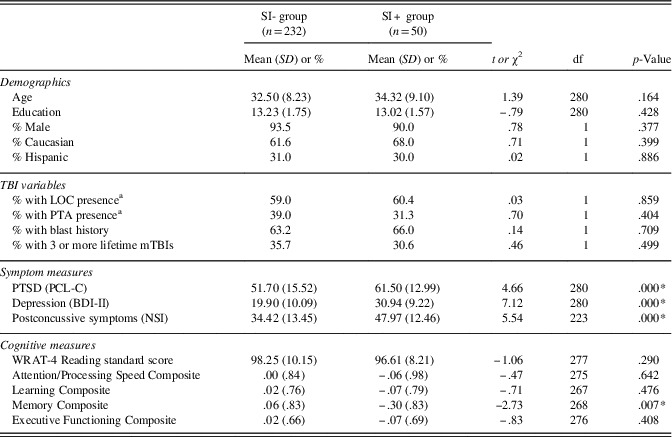
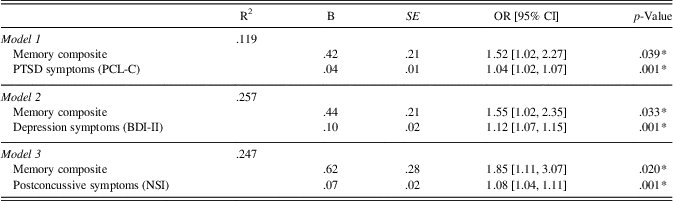
There were no differences on demographic or injury variables between individuals who endorsed SI versus those who did not (all ps>.16, see Table 1). In terms of symptom measures, the SI+ group endorsed more severe PTSD (t(280) = 4.66; p<.001; d = 0.68), depression (t(280) = 7.12; p<.001; d = 1.14), and postconcussive symptoms (t(223) = 5.54; p<.001; d = 1.05). In terms of cognitive measures, the SI+ group exhibited significantly worse memory performance relative to the SI- group (t(268) = −2.73; p = .007; d = 0.43). There were no group differences in premorbid intellectual functioning (p = .290) or in other cognitive domains (ps>.40). Worse memory performance remained a significant predictor of SI when controlling for PTSD symptoms (B = .42; OR = 1.52; 95% CI [1.02, 2.27]; p = .039), depression symptoms (B = .44; OR = 1.55; 95% CI [1.02, 2.35]; p = .033), and postconcussive symptoms (B = .62; OR = 1.85; 95% CI [1.11, 3.07]; p = .020; see Table 2).Footnote 1
Descriptive and group differences on Demographic, Injury, Symptom, and Cognitive Measures for the Suicidal Ideation Endorsers (SI+) and Non-Endorsers (SI-)

Note.
* p<.05. Lower scores indicate worse performance for the cognitive measures.
a LOC and PTA presence for worst TBI reported.
SS = scaled scores; LOC = loss of consciousness; PTA = post-traumatic amnesia; TBI = traumatic brain injury; PTSD = post-traumatic stress disorder; BDI-II = Beck Depression Inventory-Second Edition; PCL-C = Posttraumatic Stress Disorder Checklist-Civilian version; NSI = Neurobehavioral Symptom Inventory; WRAT-4 = Wide Range Achievement Test – Fourth Edition.
Results of logistic regressions examining memory and symptom measures predicting suicidal ideation

Note.
* p<.05. Memory composite was coded such that higher scores reflected greater impairment. R2 is Nagelkerke’s method.
OR = odds ratio; CI = confidence interval; PTSD = post-traumatic stress disorder; PCL-C = PTSD Checklist Civilian Version; BDI-II = Beck Depression Inventory-Second Edition; NSI = Neurobehavioral Symptom Inventory.
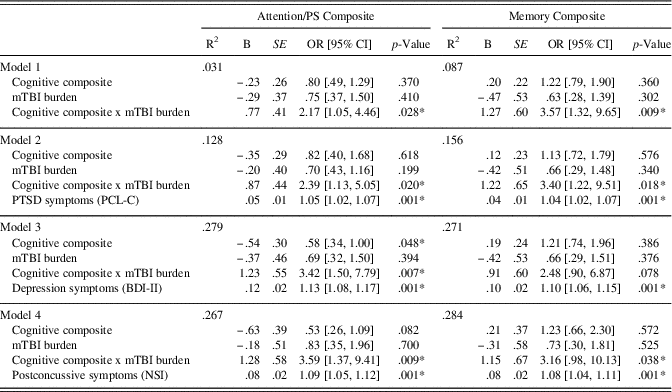
In the logistic regression examining interactions between cognitive composites and mTBI burden on SI, the interaction between attention/processing speed and mTBI burden predicted SI (OR = 2.17; 95% CI [1.05, 4.46]; p = .028; see Table 3). Probing the interaction using the SPSS PROCESS macro (Hayes, Reference Tombaugh2013) indicated that there was no relationship between attention/processing performance and risk for SI in those with a history of one to two mTBIs (B = −.23; SE = .24; OR = .80; p = .352); however, poorer attention/processing speed was significantly associated with greater risk of SI in individuals who experienced three or more mTBIs (B = .55; SE = .28; OR = 1.72; p = .048). The interaction between the attention/processing speed composite and mTBI burden remained significant when controlling for PTSD symptoms (OR = 2.39; 95% CI [1.13, 5.05]; p = .020), depression symptoms (OR = 3.42; 95% CI 1.50; 7.79], p = .007), and postconcussive symptoms (OR = 3.59; 95% CI [1.37, 9.41]; p = .009) in separate regressions (see Table 3). The pattern of the interaction remained consistent across the three models that included symptom scores as covariates.
Results of logistic regressions examining interactions between cognitive composite scores and mTBI burden predicting suicidal ideation

Note.
* p<.05. mTBI burden is dichotomous: one to two vs. three or more mild traumatic brain injuries. Neuropsychological measures were coded such that higher scores reflected greater impairment. R2 is Nagelkerke’s method.
OR = odds ratio; CI = confidence interval; PTSD = post-traumatic stress disorder; PCL-C = PTSD Checklist Civilian Version; BDI-II = Beck Depression Inventory-Second Edition; NSI = Neurobehavioral Symptom Inventory; PS = processing speed.
The interaction between memory performance and mTBI burden was also significantly associated with SI (OR = 3.57; 95% CI [1.32, 9.65]; p = .009; see Table 3). Probing the interaction showed a similar pattern as the attention/processing speed composite. There was no relationship between memory performance and risk for SI in those with a history of one to two mTBIs (B = .20; SE = .23; OR = 1.22; p = .377); however, poorer memory performance was significantly associated with greater risk of SI in individuals who experienced three or more mTBIs (B = 1.47; SE = .45; OR = 4.36; p = .001). The interaction between the memory performance and mTBI burden remained significant when controlling for PTSD symptoms (OR = 3.40; 95% CI [1.22, 9.51]; p = .018) and postconcussive symptoms (OR = 3.16; 95% CI [.98, 10.13]; p = .038) but dropped below significance when accounting for depression symptoms (OR = 2.48; 95% CI [.90, 6.87]; p = .078; see Table 3). For all three models including symptom measures as covariates, the pattern of the interaction remained consistent. Interactions with mTBI burden and other cognitive domains were not significant: learning (B = .63; OR = 1.87; 95% CI [.70, 4.98]; p = .168) and executive function (B = .61; OR = 1.84; 95% CI [.82, 4.13]; p = .102).
DISCUSSION
The primary goal of the present study was to examine relationships between neuropsychological functioning and suicidality in OEF/OIF/OND veterans with a history of mTBI to better characterize the cognitive mechanisms that may confer increased risk of suicide in vulnerable individuals. In particular, we were interested in whether the number of lifetime mTBIs would moderate relationships between cognitive functioning and SI, even when considering psychiatric symptom severity, an already well-established risk factor for suicide. Results indicated that memory dysfunction was associated with SI; however, this finding was qualified by an interaction between memory performance and mTBI burden. Specifically, in veterans with greater mTBI burden (three or more reported lifetime mTBIs), memory dysfunction was associated with greater risk of SI. Processing speed also interacted with lifetime mTBIs and demonstrated a similar pattern, such that veterans with a history of multiple mTBIs and poorer processing speed exhibited greater likelihood of suicidality. Observed relationships between cognitive functioning, mTBI burden, and SI remained significant when accounting for psychiatric distress and postconcussive symptoms.
To our knowledge, this is the first study to date that has examined cognitive functioning and SI within a sample of OEF/OIF/OND veterans with a history of mTBI. This is a particularly crucial area of research, given the frequency with which OEF/OIF/OND veterans experience mild TBI, cognitive symptoms, psychiatric distress, and SI (e.g., Tanielian & Jaycox, Reference Tanielian and Jaycox2008; Wisco et al., Reference Wisco, Marx, Holowka, Vasterling, Han, Chen and Keane2014). These factors in combination appear to elevate risk of SAs and completions, although very little is known about how these factors relate to each other and the mechanisms through which they confer risk. Such research has the potential to inform intervention and prevention efforts to reduce rates of suicide in this population and potentially more broadly.
Although there has been very little research investigating relationships between neuropsychological functioning and suicide risk in individuals with a history of TBI of any severity, previous research in non-TBI samples has also implicated memory dysfunction in suicidality. For example, several studies showed that depressed individuals with a previous SA exhibited poorer performance on tests of verbal and visuospatial memory relative to depressed individuals without a previous attempt and healthy controls (Keilp et al., Reference Keilp, Sackeim, Brodsky, Oquendo, Malone and Mann2001, Reference Keilp, Gorlyn, Russell, Oquendo, Burke, Harkavy-Friedman and Mann2013, Reference Keilp, Beers, Burke, Melhem, Oquendo, Brent and Mann2014). It has been proposed that memory dysfunction may confer risk for suicidality by making it challenging to retrieve relevant information from previous experiences to use when attempting to solve current problems (Richard-Devantoy et al., Reference Richard-Devantoy, Berlim and Jollant2015).
Additionally, such memory-related issues may make it difficult to envision the future and obtain long-term perspective on current stressors, leading to hopelessness (Richard-Devantoy et al., Reference Richard-Devantoy, Berlim and Jollant2015), a factor strongly associated with suicidality (e.g., Brown et al., Reference Brown, Beck, Steer and Grisham2000; Simpson & Tate, Reference Simpson and Tate2007). Further evidence supporting this proposal comes from an imaging study that demonstrated overlapping brain regions, including the hippocampus, were involved in the construction and elaboration of both past and future events; thus, common processes appear to be engaged during memory retrieval and future-oriented thinking (Addis, Wong, & Schacter, Reference Addis, Wong and Schacter2007).
Numerous studies examining neuropsychological risk factors for suicidality in various populations have focused on impairments in higher-level cognitive functions such as executive functioning and memory; however, there has been limited research exploring whether deficits in more fundamental, lower-level processes, particularly information processing speed, may play a role. Prior research has demonstrated that processing speed is often slowed in individuals with a history of TBI, particularly those with comorbid mental health conditions, and contributes to the cognitive deficits that are often observed in these individuals, most notably executive dysfunction (e.g., Jurick et al., Reference Jurick, Crocker, Sanderson-Cimino, Keller, Trenova, Boyd and Jak2018; Madigan, DeLuca, Diamond, Tramontano, & Averill, Reference Madigan, DeLuca, Diamond, Tramontano and Averill2000; Nelson, Yoash-Gantz, Pickett, & Campbell, Reference Nelson, Yoash-Gantz, Pickett and Campbell2009).
In the present study, results indicated that, in addition to memory dysfunction, reduced processing speed was associated with greater risk of SI in individuals with a history of multiple mTBIs; however, these domains of cognitive functioning and suicidality were unrelated in those with a history of one or two mTBIs. Thus, these results indicate that future studies in this crucial area of research should consider the role of lifetime mTBI burden in this population and would benefit from examining both basic and higher-level cognitive functions.
Although no studies thus far have considered relationships between lifetime TBI burden and neuropsychological functioning in suicidality, numerous studies have shown that greater number of TBIs is associated with increased risk of SI (Bryan & Clemans, Reference Bryan and Clemans2013; Wisco et al., Reference Wisco, Marx, Holowka, Vasterling, Han, Chen and Keane2014), more severe psychiatric and postconcussive symptoms (Dretsch et al., Reference Dretsch, Silverberg and Iverson2015; Iverson et al., Reference Iverson, Gaetz, Lovell and Collins2004; Spira et al., Reference Spira, Lathan, Bleiberg and Tsao2014), and poorer overall functioning (Dams-O’Connor et al., Reference Dams-O’Connor, Spielman, Singh, Gordon, Lingsma, Maas and Vassar2013). In terms of cognitive outcomes, individuals with a history of one to two mTBIs appear to recover and return back to baseline functioning within 3 months, with no evidence of enduring neuropsychological dysfunction (e.g., Iverson, Brooks, Lovell, & Collins, Reference Iverson, Brooks, Lovell and Collins2006). However, those with a history of multiple mTBIs frequently exhibit persisting cognitive impairments, including deficits in processing speed and memory, well past the acute stages of recovery (Belanger, Spiegel, et al., Reference Belanger, Spiegel and Vanderploeg2010; Dams-O’Connor et al., Reference Dams-O’Connor, Spielman, Singh, Gordon, Lingsma, Maas and Vassar2013; Iverson et al., Reference Iverson, Gaetz, Lovell and Collins2004, Reference Iverson, Echemendia, LaMarre, Brooks and Gaetz2012).
In terms of the pathophysiological outcomes resulting from multiple mTBIs, research using various experimental models has demonstrated diffuse axonal injury and demyelination (Bailes, Dashnaw, Petraglia, & Turner, Reference Bailes, Dashnaw, Petraglia and Turner2014; Fehily & Fitzgerald, Reference Fehily and Fitzgerald2017), as well as cumulative damage to hippocampal cells (Slemmer, Matser, De Zeeuw, & Weber, Reference Slemmer, Matser, De Zeeuw and Weber2002). Given that myelin plays a key role in information processing speed and that hippocampal functioning is essential for memory performance, it is not surprising that observed pathophysiological changes in white matter and the hippocampus have been linked to motor and memory dysfunction following multiple mTBIs in both animal and human studies (Mouzon et al., Reference Mouzon, Chaytow, Crynen, Bachmeier, Stewart, Mullan and Crawford2012; Multani et al., Reference Multani, Goswami, Khodadadi, Ebraheem, Davis, Tator and Tartaglia2016; Niogi et al., Reference Niogi, Mukherjee, Ghajar, Johnson, Kolster, Sarkar and McCandliss2008). This line of research in conjunction with present findings informs our understanding of the potential neuropsychological mechanisms through which history of multiple TBIs confers increased risk of suicidality.
Although speculative, it seems reasonable to hypothesize that multiple mTBIs cause various brain changes including diffuse axonal damage, which in turn contribute to processing speed and memory dysfunction, as well as increases in distress; such problems may result in suicidal thoughts and behaviors that are difficult to regulate because of the cognitive impairment that is present. Future research would benefit from testing this causal hypothesis. In addition, future research should examine whether present results generalize to suicidal behaviors, specifically attempts, in individuals with a history of multiple mTBIs.
Much of the previous research examining relationships between neuropsychological functioning and SAs has implicated poorer executive functioning, particularly on tests of impulsivity and decision making, across various populations (Bredemeier & Miller, Reference Bredemeier and Miller2015; Burton et al., Reference Burton, Vella, Weller and Twamley2011; Jollant et al., Reference Jollant, Bellivier, Leboyer, Astruc, Torres, Verdier and Courtet2005), including individuals with a history of moderate to severe TBI (Brenner et al., Reference Brenner, Bahraini, Homaifar, Monteith, Nagamoto, Dorsey-Holliman and Forster2015; Homaifar et al., Reference Homaifar, Brenner, Forster and Nagamoto2012). However, it has been proposed that distinct neuropsychological mechanisms may be involved in different aspects of suicidality (e.g., SI vs. suicidal behaviors, high-lethality attempts vs. low-lethality; Bredemeier & Miller, Reference Bredemeier and Miller2015; Burton et al., Reference Burton, Vella, Weller and Twamley2011; Keilp et al., Reference Keilp, Gorlyn, Russell, Oquendo, Burke, Harkavy-Friedman and Mann2013). This theory may explain why the present study did not find any relationships between tests of executive functioning and SI.
The present study has several limitations to consider. It was cross-sectional in nature, preventing the testing of causal hypotheses. In addition, the sample was predominantly male veterans; thus, it is unclear whether results will generalize to civilians and to women, as there is evidence of gender differences in suicide risk (e.g., Stack, Reference Stack2000), including in those with a history of TBI (Oquendo et al., Reference Oquendo, Friedman, Grunebaum, Burke, Silver and Mann2004; Wisco et al., Reference Wisco, Marx, Holowka, Vasterling, Han, Chen and Keane2014). Measures of inhibition or impulsivity were not included in the neuropsychological assessment; thus, it remains unclear whether difficulties in these particular types of executive functions would be associated with suicidal ideation in individuals with a history of mTBI.
Finally, the present study was not able to explore other potential moderators of the relationship between cognitive impairment and SI (e.g., medications, sleep disturbance, pain); future research would benefit from examining whether other factors play a role in suicidality in this population. It is also possible that modifiable factors such as medication usage and sleep dysfunction and/or certain personality traits like impulsivity and sensation seeking may put individuals at greater risk for sustaining multiple TBIs and poorer cognitive and emotional outcomes, thus making them more vulnerable to SI.
Despite the noted limitations, the present study has several strengths to highlight, including being one of the first studies to examine relationships among lifetime TBI burden, neuropsychological functioning in several domains, and suicidality in a sample of individuals with a history of mTBI. In addition, the present study used data from treatment-seeking veterans who participated in a neuropsychological assessment in the context of VA clinical services. Thus, the sample is likely representative of vulnerable veterans who may be at an increased risk of suicide, given that the research demonstrating elevated risk in OEF/OIF/OND veterans was conducted specifically in those who were receiving VA care (Connor et al., Reference Conner, Bohnert, McCarthy, Valenstein, Bossarte, Ignacio and Ilgen2013; Ilgen et al., Reference Ilgen, Bohnert, Ignacio, McCarthy, Valenstein, Kim and Blow2010; Kang & Bullman, Reference Kang and Bullman2008).
Finally, present results show that the interactions between TBI burden and memory/processing speed remained significant predictors of SI even when accounting for psychiatric and postconcussive symptom severity. Previous research has consistently demonstrated that psychiatric distress is one of the strongest predictors of suicidality (Brown et al., Reference Brown, Beck, Steer and Grisham2000; Jakupcak et al., Reference Jakupcak, Cook, Imel, Fontana, Rosenheck and McFall2009; Pietrzak et al., Reference Pietrzak, Goldstein, Malley, Rivers, Johnson and Southwick2010; Zimmerman et al., Reference Zimmerman, Villatte, Kerbrat, Atkins, Flaster and Comtois2015), including in active duty and veteran samples with a history of TBI (Brenner et al., Reference Brenner, Ignacio and Blow2011; Bryan & Clemans, Reference Bryan and Clemans2013); however, our findings demonstrate that other nonemotional variables, specifically TBI-related and cognitive factors, together uniquely contribute to increased suicide risk, above and beyond psychiatric factors. As such, the present results may hold important treatment implications; cognitive training or interventions that simultaneously target both cognitive dysfunction and psychiatric distress may be most appropriate for this vulnerable group.
ACKNOWLEDGMENTS
Laura Crocker received salary support during this work from the VA Interprofessional Polytrauma and TBI Fellowship and Career Development Award Number IK2 RX002459 from the VA Rehabilitation R&D Service. The authors declare no conflicts of interest. Jessica Bomyea received salary support during this work from Career Development Award Number CX001647 From the VA Clinical Science R&D Service.