


7.1 Introduction: Data/Infrastructure
“Infrastructures as regulation” and “governance by data” are suggestive designators of forms of ordering that are not directly legal but relate – as law does – to the generation and allocation of resources and status, the opening or constraining of future possibilities, and the shaping of behavior and all manner of relations.Footnote 1 “Infrastructures” and “data” have in common that they are relational, material, dynamic, complex, and scalar. A high proportion of infrastructures involve data, and almost all electronic digital data is collected, stored, moved, and used within infrastructures. Various melds of data and infrastructures are of tremendous significance in diverse areas of current and future regulatory governance, as well as to the formation and functioning of scientific knowledge. Knowledge and understanding of earth systems, and efforts in planetary and space governance, depend heavily on “data infrastructures.” For these reasons, the theory and practice of science-related data infrastructures and their governance demand attention.
Scientific data infrastructures are frequently discussed and analyzed as information and knowledge infrastructures.Footnote 2 Data infrastructures are, of course, largely about producing “knowledge” in the form of scientific insights and understanding of specific natural phenomena: the underlying driver for many participants (not all) is data as a means for producing information and then for generating knowledge. At the same time, data can shape imaginaries, define problems, create and “translate” processes and phenomena that are represented in data, draw boundaries (i.e., what is valid and what is “noise”), and embody normativities through choices around datafication (i.e., what becomes data), naming (i.e., what is being measured), standards (i.e., what becomes valid data), and modes of presentation (i.e., formats, visualizations, etc.).Footnote 3 Data can also enable action without ever becoming information or knowledge that is legible to humans, such as when data is transmitted between machines or is fed into a computational model. Data generation, processing, movement, and ultimate use is enabled by physical, digital, and knowledge infrastructures, each of which individually, collectively, interdependently, and/or in opposition to each other exert regulatory powers. It is through infrastructures that data is configured and reconfigured, channeled, blocked, stored, and made durable over a long time and across extended space – or fleeting and constrained.
In this chapter, we focus on the production of data about the ocean. With the urgencies of climate change and recognition of ocean’s importance in regulating climate, global-scale initiatives such as the Ocean Decade,Footnote 4 have focused on enhancing production of “ocean data” and improving observational capacities of countries to engage in such data production. Creating “a digital representation of the ocean” is one of the challenges articulated and embraced by the Ocean Decade initiative.
What role do governance arrangements, background legal rules, and the core infrastructures play in enabling data collection, determining what “ocean data” is produced, and when and how it is made available? We explore this question by focusing on data about oceanic features produced by the Argo network – an international program, operationalized by state agencies and research institutions, that comprises arrays of autonomous floats for ocean observation.Footnote 5 The floats, which drift with ocean currents and move vertically between the surface and mid-water levels, generate multidimensional spatial, temporal, sensory observation data about certain physical and biogeochemical properties of the oceans. The data is constituted and configured through physical and digital infrastructures that enable generation, transmission, and storage of data, knowledge infrastructures through which sensor data is transformed into data that is legible by scientific communities and usable for delineated purposes. This “sensing” data not only forms part of the ontology of what it is describing but also help make what the data is called to represent (in this case: “the ocean”).Footnote 6 Data, however, is necessarily reductive, partial, and incomplete – it is never the thing itself that it is meant to represent.Footnote 7 What it creates is a function of choices made at various temporal and spatial infrastructural sites: What data can be produced given existing technologies, capacities, needs, legacy infrastructures? What data has inferential potential? What data can be generated in a sustained fashion? How can relationality of (what) data be best leveraged? How can contextual variabilities be accounted for to arrive at commensurability (which itself raises questions of capacity, expertise, etc.)?
Argo’s socio-technical practices, aggregated with other ‘data infrastructures’ across different areas of scientific observational and modeling practice and across different scales, can have an onto-epistemologicalFootnote 8 effect, constructing and crystallizing a particular conception of “the ocean” (as one comprising sets of datafied physical and biogeochemical parameters) or of the self-reproducing vision of earth system, “consisting of interlinked physical, chemical, and biological processes that cycle materials and energy in non-linear, complex and dynamic ways within the system.”Footnote 9 Argo’s emphasis on openness and accessibility of data and generally participatory governance,Footnote 10 may enable users to leverage the relationality and recombinant potential of data to open up opportunities to rupture “fixed and bounded systems and the traditional notions of causality and agency, which lie at the heart of an autopoietic framing of the Earth system’s functioning” and instead reveal new ways of relating in more-than-human worlds.Footnote 11 By inverting Argo, we hope to generate insights about its regulatory ambivalence.Footnote 12 Thinking across scales – from localized sites of Argo decision-making processes to global aspirations for the development of “trusted, inclusive, and interconnected ocean data and information ecosystem that is actively used for decision making to support sustainable ocean management”Footnote 13 – we ask how thinking from infrastructure and data to “data infrastructure” may contribute to governance arrangements relating to observational science and planetary modeling.
In this spirit and drawing on our earlier work, we endeavor to “think infrastructurally” about Argo (Section 7.2). Through examination of annual meeting notes, interviews, and remote attendance of the Argo Steering Committee’s 2023 annual meeting, we analyze the techniques and practices involved in planning, testing, calibrating, validating, and error-correcting that ultimately lead to the production, transmission, and dissemination of Argo data. We analyze (in Section 7.3) the sites, processes, and interfaces that determine what data is being produced by whom, where, when, how, and why, as well as what data is not being produced, which interests remain neglected, and where and when no data is being generated. We then position Argo within the institutional governance related to oceans, weather, climate and, most recently, earth systems to illustrate both the evolution of Argo’s role and its evolving and uneasy position within different governance approaches (Section 7.4). In the conclusion, we challenge the utility of “ocean data” as an analytical category and highlight the risks of over-coordination and institutionalization of data infrastructures. We suggest that allowing data infrastructures like Argo to develop organically might lead to productive (if unexpected) connections, fusions, or splits, which might in turn reorient the focus of observation toward unexplored interactions between and within earth systems. Complementing legal reconstruction projects such as “earth systems law”Footnote 14 and “more-than-human constitutionalism,”Footnote 15 we ultimately hope that our analysis helps bring to the fore some core data-infrastructuralFootnote 16 features of planetary governance as it now exists and will (have to) rapidly further evolve.
7.2 Thinking Infrastructurally About Argo
“Thinking infrastructurally” entails understanding infrastructure not simply as a thing, but as a set of relations, processes, and imaginations.Footnote 17 The field of infrastructure studies has provided one set of observational perspectives: if it is an infrastructure it has technical, social, and organizational elements which all go together, and numerous gateways, interfaces, workarounds, alliances, upstream and downstream dependencies, re-purposing, perpetual maintenance and funding needs, and prospects or experience of incompletion, decay, and ruins.Footnote 18 The “actants” – in Actor-Network Theory parlance – include human, nonhuman, and indeed non-animate participants.Footnote 19
Like other infrastructures, Argo involves physical components, human labor, and layer upon layer of integrated, partly interconnected, or otherwise interfacing interdependent systems and networks. Like other data infrastructures, Argo is embedded in and constituted by legacy and coterminous knowledge infrastructures, including practices of scientific knowledge production and the larger (geo)political economy. Understanding Argo as an infrastructure entails studying its entangled technical, social, and organizational dimensions, with particular attention to continuities and legacies that shaped its development over time and space. Argo’s technical artifacts consist of various configurations of computational hardware and software, float design and sensor selection, satellite constellations, as well as data formats and websites. Its social conventions are characteristic of scientific knowledge production and related scientific practices of data collection and verification, and its organizational matrix involves research institutions, international organizations, funding structures, and various legal arrangements, ranging from float manufacturing contracts to the UN Convention on the Law of the Sea (UNCLOS).
Like many observational science or information-focused infrastructures, the Argo floats network is a composite, is embedded in other infrastructures, and has links to many more. We will suggest that this network is sustained and extended by the data, that the drive for data is the main precipitator of key components of the infrastructure which interact in the manner of a system, and that the infrastructure boundaries are regularly negotiated and may shift with new data demands and constituencies. A unified purposive agency is supplied by deliberations and decisions in the Argo governance institutions; but the diverse human processes which construct and operate the data infrastructures are fragmented and have multiple referents and interconnections.
For purposes of our analysis, we distinguish between Argo’s data generating infrastructures (the sensors and their floats, and their launch), Argo’s data transmission, location, and control infrastructures (enabled by satellites), and Argo’s data processing, storage, and dissemination infrastructures (provided by so called “data assembly centers”).
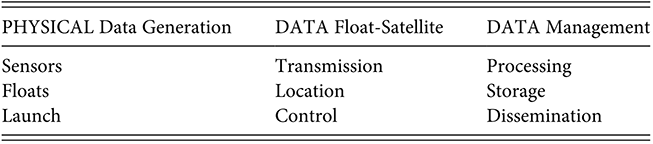
Table 7.1 Long description
A three-column table describing the main elements of the Argo Floats infrastructure or ‘stack’. Column One (Physical Data Generation) includes three elements – sensors, floats, and launch. Column Two (Data Float-Satellite) includes three elements – transmission, location and control. Column Three (Data management) includes three elements – processing, storage and dissemination.
One can think of these data infrastructures together as the “Argo stack” (see Table 7.1):Footnote 20 without sensors and floats there would be nothing to transmit, locate, or control; without the data transmission infrastructure, the data would be stuck on the floats; without the location infrastructure, “data about the ocean” could be data about anywhere in the ocean; without control infrastructures (e.g., limited directionality of the floats enabled by Iridium satellite two-way connectivity), floats would drift entirely aimlessly; without data storage infrastructure (including backups), data would be transient and could get lost; without data processing infrastructure, no scientifically relevant information could be gained from the data; and without data dissemination infrastructures, no one would be able to access and use the data for scientific research. Each of these infrastructures is itself constituted by a coming-together of the technical, the social, and the organizational. Together, they comprise Argo.
In the following three sub-sections, we navigate the Argo stack by following the “lifecycle” of Argo data,Footnote 21 beginning with data generation on the floats, followed by data transmission and float geolocation via satellites, to data processing and dissemination at data assembly centers. As becomes evident, control of data generating and transmission infrastructures is distributed among different public and private actors. Links, connections and inter-operations of different infrastructural components (e.g., satellites, sensors, floats, launching ships) are loosely coordinated by Argo members, often in ad hoc fashion. At the same time, durability and resilience of infrastructural inter-dependencies are critical to Argo being able to maintain stable and reliable generation of time-series data. Changes in data generating and transmission infrastructures (such as changes in satellite systems or recalibration of sensors) necessitate reconfiguration and adjustments during data processing (and sometimes changes to data standards) to ensure forward- and backward consistency. In light of scarce resources, Argo teams is often faced with choices and tradeoffs, discussed below, which in turn shape, configure, and circumscribe the type of data that is ultimately generated, its potential uses, and its relevant publics.
7.2.1 Data Generating Infrastructures: Floats and Sensors
Data does not exist in the state of nature – in contrast to natural resources to which data is sometimes analogized.Footnote 22 It is generated – in this case, by Argo sensors and the floats they ride on. Zooming in on how and what data is produced by Argo floats reveals the immense importance of materialities of data generation. Argo’s network of autonomous floats drift with the ocean currents and cycle between the surface and depths of 2,000 meters (“Core Argo,” the continuation of the original version initiated in the 1990s) or up to 6,000 meters (“Deep Argo”).Footnote 23 The technology behind the floats was inherited by Argo from the World Ocean Circulation Experiment (WOCE) – the first global hydrographic survey that deployed autonomous floats. Only a small group of manufacturers has the technological sophistication to cater for the relatively low demand for floats – some of them design and equip the floats in dialogue with scientific groups who plan to operate them.Footnote 24 Performance assessments, design ideas, and new needs or requirements circulate through industry channels and through the Argo governance structures. Argo’s data generating infrastructure is dependent on float manufacturers and their supply chain infrastructures, and also on laboratories for development and testing of floats and instruments, shipping and logistics infrastructures for transporting floats to vessels of launch, and the launching vessels themselves.
Access to vessels that travel at the requisite time needs to match the availability of funding, floats, and the scientific team to specific geographic areas. Where several floats are launched at intervals, the ship needs to be at sea for a sufficient period of time to enable spatial and temporal distribution of the floats.Footnote 25 Institutions that have access to funds, or that can partner with other research programs, can commission research vessels.Footnote 26 In other instances, commercial and tourist cruises,Footnote 27 and even military vessels are used for deployment. Lack of reliable launch vessels creates not only geographic but also geopolitical dependencies. Russia’s invasion of Ukraine unexpectedly complicated deployment efforts when militaries around the world were for a time put on heightened alert, with some navies no longer willing to have their ships used for Argo float deployment to avoid inadvertent disclosure of their fleets’ locations by backtracking public Argo data. Earlier, the COVID-19 pandemic had temporarily set back deployment efforts with fewer ships going out to sea and quarantine rules preventing researchers from boarding vessels.
With lifespans ranging from five to seven years (and even less for Deep Argo floats) and no opportunity for post-deployment service, every component of the float, its sensors, and communication capabilities through the satellite system needs to be tested pre-launch, and the release of the float needs to be monitored as well. This requires trained human labor and time.Footnote 28 The ultimate pre-deployment assessment can take between one and one-and-a-half hours, the last direct human-machine interaction in the series of numerous tests, calibrations, and validations that floats and sensors have undergone at the facilities of their respective manufacturers as well as at the research centers responsible for their deployment.Footnote 29
Once released, the float descends to drifting depth (usually 1,000 meters), where it drifts for roughly ten days before descending to profiling depth of 2,000 meters (or up to 6,000 meters for Deep Argo) before resurfacing. During their ascent, the floats take a series of measurements via sensors, and, once on the surface, transmit the data via satellites, while receiving instructions for their next mission. For the majority of the Argo fleet, this surface interval is between fifteen minutes and one hour, after which the float sinks to a drift depth for about nine days. It then descends anew, repeating the ten-day cycle. See Figure 7.1.
Argo float deployment, data generation, and transmission. (C) Argo Program. Reprinted with permission from the Argo Program.
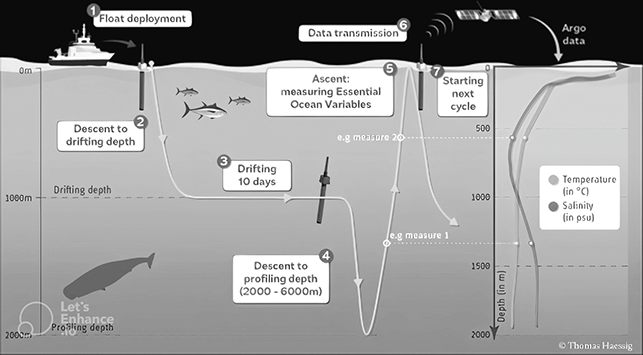
Figure 7.1 Long description
The illustration shows a boat and floating sensors on the ocean’s surface. Sensors are shown under the ocean up to a depth of 6000 metres, measuring salinity and temperature and drifting for a 10-day period. The illustration also shows a satellite above the ocean’s surface transmitting the data collected from the sensors. Three fish and a whale are also included in the depiction of the ocean.
The floats – made by different manufacturers and carrying different sensors – produce what is sometimes termed “raw data” about certain physical characteristics of the ocean, such as temperature and pressure.Footnote 30 Given the relatively circumscribed market for floats and sensors, researchers and manufacturers often collaborate in the development, testing, calibration, and customization of relevant instruments. Frictions can arise when instruments fail or produce flawed data, especially about whether the cash-strapped lab or the manufacturer will carry the loss or cost of replacement. A sensor malfunction on an already deployed float can be very costly, as floats are usually not recoverable for repairs or upgrades.Footnote 31
Although all floats are equipped with conductivity-temperature-depth (CTD) sensors, only some floats generate profiles of biogeochemical properties (BGC-Argo). In addition to CTD sensors, BGC-Argo floats can integrate sensors to measure chlorophyll fluorescence, particle backscatter, dissolved oxygen, nitrate, pH, and irradiance. The variability is partly a function of different scientific interests and needs and partly a function of launching parties’ capacity and availability of resources. Historically, except for oxygen, a single sensor was used for the other BGC variables. However, increasingly, for most of these variables there are different types of sensors available, some differing on measurement principles. Introduction of new sensors requires ensuring interoperability with float models and cross-sensor calibration to ensure standardized data output, which depends on the willingness of sensor manufacturers to share the necessary metadata among themselves as well as with float manufacturers and Argo scientists. Evaluation of new sensors may also require review of baseline standards: should the first integrated sensor be used as a reference point against which any new entrant is evaluated? Introducing new sensors also requires additional testing, but trials of sensors on floats is a slow and expensive process. Any minor malfunction (e.g., a failure in a trivial connector cable) can lead to loss of data, and since floats are difficult to recover, on-float testing is not an efficient proposition. In-lab testing requires specialized lab settings that enable sensor testing under controlled circumstances, but these are not very widely available.
7.2.2 Data Transmission, Location, and Control Infrastructures: Satellite Systems
To transmit and receive data, Argo relies on satellite infrastructures. The less time a float spends on the sea surface for transmission, the less vulnerable it is to external elements. The Iridium satellite system, which consists of sixty-six satellites at a height of approximately 781 km, can transmit more data within a shorter period of time than other satellite systems dating from the period prior to Starlink-like mega-constellations, because Iridium allows “data calls” to be relayed from one satellite to another until they reach the satellite that registers the float. Iridium also allows for two-way communication, making it possible to send instructions to the float for troubleshooting or for changing the float’s mission (e.g., a float can be redirected to observe a developing hurricane). In this way, Iridium is both a data transmission and control infrastructure.Footnote 32
Iridium, however, lacks the ability to geo-locate the floats. Hence, each float with an Iridium modem also includes a Global Positioning System (GPS) receiver to record the location of the float. A controller board on the float interfaces with the GPS receiver, the Iridium modem, the CTD sensors, and any other additionally installed sensors. The GPS receiver and the Iridium modem share an antenna that is connected to the radiofrequency circuit board, which serves as a platform for the GPS receiver, the Iridium modem, and any other communications devices.Footnote 33 Every additional instrument mounted on the float comes with a cost that is not purely financial: increased weight of the float, higher energy consumption, and shorter battery lifespan are tradeoffs and compromises that are often made through discussion among members of Argo. These shape not only what data is being generated but also who can generate it given capacity constraints.Footnote 34
Once on the surface, floats using the Iridium network perform a series of tasks in sequential order, with the floats creating their own temporality.Footnote 35 First, if a float is equipped with an oxygen sensor, it will collect in-air samples of dissolved oxygen. Second, it will acquire a position fix using GPS. This typically takes several minutes as the float establishes the connection with the GPS satellites and subsequently determines the position. Third, the float connects with an Iridium satellite and the Iridium gateway, logs on to the launching group’s data server, and queries the server for any changes that might be necessary in the mission configuration for the next profile. Lastly, the float transmits the profile (i.e., data collected from the water column during the float cycle), surface O2 samples, GPS, and engineering data (i.e., float diagnostic data), packaged into a series of highly compressed packets which are formatted according to Argo Data Management Team standards, via Iridium (for ways in which standards impact data production, see discussion infra, Section 7.3.1).Footnote 36 Due to interruptions in the transmission process, it is often necessary for the data to be transmitted several times before all data have been successfully uploaded.Footnote 37 On average, floats using Iridium spend twenty to thirty minutes on the sea surface for each cycle.Footnote 38
In the early days of Argo, almost all floats transmitted their data via the Système Argos – a location and data transmission system operated by Collecte Localisation Satellites based in Toulouse, France and Maryland, United States. Despite the similar name – both inspired by Greek mythology – Argo and Argos developed separately and at different times, although both were motivated by the desire to enhance opportunities for ocean observing. Argos satellites were initially developed as one-way, low-bandwidth satellites, with an effective data throughput of no more than 1 bit per second. In contrast to Iridium, Argos satellites have both data transmission and location data capabilities. However, Argos’ low data transmission rates required floats to spend between six and eighteen hours at the sea surface to ensure error-free data reception in all weather conditions. A later model (Argos-3) offers bidirectional transmission and a higher throughput, but the high-data-rate mode suffered from electromagnetic noise around Europe.Footnote 39 Some of the floats continue to use Argos satellites, and other satellite transmission systems have also been used on profiling floats, including transmission systems such as BeiDou in AsiaFootnote 40 and ORBCOMM in North America.Footnote 41
7.2.3 Data Processing, Storage, and Dissemination Infrastructures: Data Assembly Centers
Data is always stored somewhere (though not necessarily in one place) and needs to be processed and disseminated to render it accessible and useful for scientific knowledge production. Argo float data is transmitted via satellites to eleven national Data Assembly Centers (DACs) for processing, with each float being allocated to a specific DAC. Processed data from the national DACs is subsequently transmitted to two Argo Global Data Assembly Centers (GDACs) – one located at the Coriolis Data Center in France and the other at the US Navy’s Fleet Numerical Meteorology and Oceanography Center, where data is checked for format and content consistency.Footnote 42 Once per day, data holdings at the two Argo GDACs are being synchronized. The US National Centers for Environmental Information (NCEI) operates and manages the Global Argo Data Repository (GADR), which provides long-term archive services to store and preserve data and implements reanalysis updates and corrections provided by the GDACs.Footnote 43
The Argo Data Management Team (DMT) is responsible for coordinating data management and ensuring access to Argo data. The Argo DMT is composed of at least one representative of each institute involved in Argo data management activities.Footnote 44 DMT also defines Argo’s data management infrastructure, data formats, and quality control procedures.Footnote 45 There are numerous publicly available and regularly updated manuals, handbooks, and “cookbooks”Footnote 46 addressing all aspects of data processing for each parameter. The Argo data management teams aim to ensure not only that its data is openly available but that its potential users understand what data they receive. Argo data is made available from GDACs in the Common Data Format, a file format for storing multidimensional scientific data (variables such as temperature, humidity, pressure, wind speed, and direction).Footnote 47 All Argo data is publicly available without charge. Anyone can access Argo data via direct file transfer or via a World Wide Web interface. The digital data in this case rapidly becomes part of the public domain, not an accumulating private resource from which other well-funded scientists are excluded. It is not a form of club good in which non-contributors cannot get access.
7.3 Argo’s Data Infrastructure as Data Regulation
Argo is not a regimented enterprise in which infrastructure and data are forged together in an intentionally regulating unity or in decisive forms of public governance. At the same time, it is an infrastructure with potentially significant regulatory effects. As a data infrastructure, Argo determines what data is being produced by whom, where, when, how, and why, as well as what data is not being produced, which interests remain neglected, and where and when no data is being generated. What are the sites, processes, and interfaces where agency over these choices is exercised?
Despite a great deal of organization, labor, sustained effort, and resources that are required to produce reliable and usable data on a limited set of parameters, no single entity controls the whole infrastructure. The Argo Steering Team (AST) provides scientific leadership and oversees the development and implementation of the Argo Program,Footnote 48 but its control does not extend to each layer or capillary of the Argo infrastructure.Footnote 49 Argo forms part of the Global Ocean Observing System (GOOS),Footnote 50 whose operational arm (“OceanOPS”) acts as a focal point for implementation and operation of relevant observing platforms, monitors the Argo array, and liaises with the AST.Footnote 51 However, neither GOOS nor OceanOPS controls nor provides funding for the data infrastructure.
Argo has its own participatory governance, is embedded in other infrastructures with their own governance and legal regimes, and has close or distant links with many other scientific groups including climate modelers and some entities with governmental and commercial interests. AST annual meetings proceed rather informally and collaboratively, with decisions made by achieving some form of “rough consensus” without formal votes. When new issues arise and cannot be easily resolved, they can either lead to formation of ad hoc working groups whose task it is to study the issue and come up with recommendations, or they are assigned to certain people for follow-up and reports.Footnote 52 Argo participation and governance is emphatically not Mandeville’s fable of the bees – there is a great deal of public virtue as well as science- or funding-motivation in the Argo enterprise, together with a few shades of commercial and geopolitical interest. The whole process is organic and mycelial-like more than it is a planned and well-resourced realization of a grand vision and unified normativity.Footnote 53
In the following sections, we explore four interconnected dimensions of Argo data infrastructure governance practice that together shape what data is ultimately produced, for whom, and to what ends: infrastructural data inequality; spatial distribution of floats; temporal sampling of data; and efforts to cater (or not) to different publics, with implications for quality control and data diversification.
7.3.1 Infrastructural Data Inequality: Who Decides What Data Is (Not) Being Produced?
Who decides what ocean data is (or is not) being produced? Although the Argo array currently reflects contributions from thirty countries, significant forms of “data inequality” persist.Footnote 54 These inequalities reflect, at least in part, colonial legacies that led to the uneven distribution of oceanographic knowledge, as former colonial powers and dominant trading nations made significant historical investment in oceanography and associated technologies of ocean data generation, recording, and mapping.Footnote 55 In 2022, 80 percent of BGC-Argo float deployments were done by research labs from only three countries (US, France, and Canada), with more than 50 percent of the deployments by the United States.Footnote 56 Coverage for different parameters is uneven, with only a limited number of BGC-Argo floats carrying the complete suite of sensors (with 40 percent carrying only oxygen as the only extra sensor in addition to CTD). Overall sampling of the oceans is also unevenly distributed in Argo, with the Atlantic Ocean oversampled while the Indian, Pacific, and Southern Oceans remain undersampled.Footnote 57 Only nine countries participate in the Deep Argo array, with the United States, France, and Japan being leading national contributors. Some of the undersampled regions – such as the Southern Ocean – for many years were not the priority for main float contributors. As Dean Roemmich – one of Argo founders – noted in 2001, “[t[hat is one of the hardest implementation items for the Argo science team. In order to achieve a global array we will need to set some fraction of floats aside for a region that is not the top priority of any single government.”Footnote 58
Any decision on which data to produce must take into account technological and funding constraints and the interests of different communities. Expanding data production must be sensitive to the demands imposed on data managers, because additional sensors increase data complexity, which can require new standards, guidelines, and manuals.Footnote 59 Originally, Argo floats carried only CTD sensors. However, understanding the role of oceans in regulating climate change and, conversely, the impact of climate change on ocean ecosystems, requires observations of the ocean biogeochemistry. The Intergovernmental Panel on Climate Change’s Fifth Assessment Report listed temperature, salinity, acidification (pH), oxygen, nutrients (nitrate), and light as major drivers of ocean health. BGC-Argo introduced six new variables (oxygen, nitrate, pH, chlorophyll fluorescence, optical backscatter, and solar irradiance). The choice of these variables (and not others) was based not only on scientific research needs but also on availability of operational sensors.Footnote 60 Proponents of BGC-Argo acknowledged that specific scientific goals, regional issues, funding sources, and even sensor configurations may motivate different missions, requiring tradeoffs and compromises. For example, current radiometric sensors on BGC-Argo have four color bands available, which is not sufficient to characterize the spectral variability of the underwater light field and thus cannot capture the diversity of phytoplankton. Hyperspectral radiometry, which captures light over many wavelengths and enables recognition of tens or hundreds of colors, can enable better discrimination among different phytoplankton types, potentially improve knowledge of oceanic carbon stocks, pathways, and fluxes.Footnote 61 Enabling BGC-Argo with hyperspectral capability could also produce knowledge useful for the management of living resources and ecosystem services (e.g., habitat suitability, fish stocks, and recruitment) and for biohazard surveillance (i.e., harmful algal blooms).Footnote 62 Hyperspectral radiometric sensors, however, are more expensive, require more energy consumption, and impose additional labor costs for the Argo DMT. The working group on radiometry, created within the AST, recommended that those programs that have capacity move to hyperspectral radiometry but it could not mandate a wider adoption of the sensors.
Argo floats generate only some “ocean data” directly from the sensors (e.g., measuring temperature and electrical conductivity of the seawater sample); other data is derived from computations. For example, all Argo floats are equipped with CTD sensors. The “C” in CTD is conductivity, which measures how well a solution conducts electricity. Since dissolved salts and other inorganic chemicals conduct electrical current, conductivity increases as salinity increases. The measure of conductivity thus relates to the measures of salinity. However, salinity is also dependent on pressure and temperature. Whereas “T” measures temperature directly, “D” (depth) actually measures pressure. Using temperature and pressure, salinity can be derived via mathematical equations.Footnote 63 The density of water is calculated from temperature and salinity, and because pressure increases with increasing depth, depth can be derived in turn. Even with direct measurements, there are accuracy errors.Footnote 64 Sensor drift can introduce larger errors, requiring corrections by “experts,” which may entail comparing older floats with newly deployed instruments and with ship-based data.
Decisions of how to allocate limited resources – whether to invest in increase of spatial coverage, maintenance of Core Argo, enhanced longevity of floats, enabling more (up to six) BGC sensors on all BGC floats, expanding the reach and capabilities of Deep Argo, improving sensors to enable better data on specific parameters, or adding resources to the DMT – are discussed at annual meetings of the AST as well as at periodic meetings of various working groups formed to focus on specific issues or topics. Limitations and inequalities of funding are a recurring theme in these meetings. The phenomenon of underfunded infrastructures corresponds with broader insights from infrastructure studies that observe and sometimes lament the invisibility of infrastructures that are being “taken for granted” until their break down or fail.Footnote 65 Data infrastructures may be particularly susceptible to invisibility (as compared e.g., with physical infrastructures) because their failures and malfunctions are not immediately evident, even to those working directly with data processing and quality control. Errors may be revealed only when data is being validated by comparing it to other data sources (e.g., Argo data is often validated by data from the Global Ocean Hydrographic Investigations Program (GO-SHIP)) or when data from numerous floats is processed in the aggregate (e.g., to reveal a sensor drift). The value-added of the data infrastructure is also not immediately visible. Argo’s importance lies in having a reliable time-series data over substantial period of time, which enables comparative, historical, and predictive analysis of oceanic temperatures, for example. Yet, on a daily basis, Argo participants have to educate audiences, institutions, policymakers, and funders about the program’s importance and highlight new, potential, or previously unforeseen uses of Argo data in continuous efforts to sustain the program. Without sustained efforts at making Argo data infrastructure visible, Argo risks receding not only from public imagination but also from the gaze of those who supply information and knowledge that directly shapes earth systems governance. As a transnational infrastructure, Argo faces additional challenges that not only require international coordination but would also benefit from transnational cooperation in form of technology-transfers and capacity-building. Governmentally funded research, however, often remains stubbornly territorialized and hence misaligned with the transnational infrastructures necessary for planetary-scale science.Footnote 66
7.3.2 Infrastructural Space: Where Is Data (Not) Being Generated?
Argo seeks to generate ocean data on a planetary scale. Naturally, Argo’s floats cannot generate data everywhere as data generation depends on float location. In this way, data generation via floats differs from data generation via satellites. While the latter achieves planetary scale more easily by orbiting around the planet, the former manages to reach deeper into the ocean. In its originally proposed design, Argo was to comprise around 3,300 floats, each profiling the ocean between the surface and a depth of 2,000 meter around 25 times per year over an estimated lifetime of 3–4 years.Footnote 67 The OneArgo program aims to expand the spatial coverage of Core Argo while also increasing the number of BGC and Deep Argo floats. Given the significant financial and human resources involved in procuring, testing, and deploying the floats and processing subsequent data, tradeoffs and tensions arise along the way, shaping both the type of data that is produced and the choices about data’s target users and uses. By one estimate, given current life expectancies of floats, more than 800 floats per year would need to be deployed to develop OneArgo while maintaining the Core Argo array.Footnote 68 Funding remains a core challenge for maintaining and expanding the Argo program’s scale. However, spatial distribution is also impacted by natural phenomena, technical limitations, business models, and legal constraints.
Some areas of the ocean require more intense concentration of floats due to natural phenomena. For example, mesoscale variability in the Western Boundary Current regions require enhanced sampling to reduce noise in tracking the large-scale temperature and salinity fields.Footnote 69 One alternative to increasing float density is to increase the frequency of sampling. Another option is to rely on data provided by other instruments, such as glidersFootnote 70 or nonhuman species equipped with sensors,Footnote 71 to supplement Argo data. Both choices, however, impose costs associated with data generation, processing, and dissemination (e.g., additional processing to ensure standardization and interoperability of measurements).
Longevity of floats also impacts spatial coverage. Many floats are not recoverable (they can sink, get lost, be collected upon washing on shore and not returned to the owner, etc.) and thus cannot be repaired and redeployed. Areas with lower launch frequencies typically have older floats. Sufficient sampling would require increased float density to replace aging floats as well as to compensate for the original under-sampling. Increasing longevity of floats (and of their components), however, can be difficult both technologically and due to misalignment of incentives. Given the limited demand and supply of floats and sensors, manufacturers do not necessarily have incentives to prolong the life of the float and may need to balance demands for float longevity with demands from wealthier purchasers to enhance float capabilities or to customize floats.
Dependencies on a single producer or a limited group of producers aid in consistency of data and in implementation of uniform procedures for data processing across programs. However, such dependencies also create single points of failure: past incidents of faulty pressure and pH negatively impacted Argo coverage.Footnote 72 Greater diversification of sensor manufacturers would alleviate this problem but would also cause challenges relating to interoperability and data standardization.
Lastly, coastal areas remain undersampled due to uncertainties about whether Argo should be interpreted as “marine scientific research” under the UNCLOS.Footnote 73 Under Article 248 of UNCLOS, states or international organizations that intend to undertake marine scientific research within the exclusive economic zone (EEZ) or on the continental shelf of a coastal state are required to obtain that state’s consent, with typically a requirement of at least six-month advance notice describing the research project. Some states have agreed to deployment of Argo floats in their EEZs under the conditions of free and unrestricted data exchange and the transparent implementation through OceanOPS monitoring (a joint World Meteorological Organization (WMO)–Intergovernmental Oceanic Commission (IOC)/UNESCO Support Center for oceanography and marine meteorology). Other coastal states reportedly do not consider Argo to be “marine scientific research” and hence allow float deployment without consent.Footnote 74 Yet other states maintain the position that every float deployment needs to comply with Article 248. Thus, as a practical matter, deployment of Argo floats within EEZ is arranged on a bilateral basis. However, because there is no articulated procedure for “clearing” marine scientific research projects, compliance with Article 248 is cumbersome and deployment of floats in EEZs is often avoided.Footnote 75 This leads to significant under-sampling, given that EEZs represent nearly 30 percent of the world’s ocean surface.
7.3.3 Infrastructural Time: When Is Data (Not) Being Generated and Transmitted?
Argo generates a set of synoptically sampled time-series data that enables ongoing analysis of ocean parameters, over-time comparisons not only over the course of Argo tenure but also retroactively,Footnote 76 and forward-looking forecasts, models, and predictions. The timeliness of data generation and transmission are important infrastructural decisions that affect different scientific communities in different ways.
Fluorescence observations obtained as a measure of phytoplankton mass, for example, are best done at night. In contrast, assessment of biomassFootnote 77 using radiometry and comparison of BGC-Argo sensor results to satellite remote sensing motivates measurements around noon.Footnote 78 When manufacturers set the default for the floats to come up at noon, they put an onus on operators to alter the setting as needed. Lack of standardized guidance on the timing of sampling can create challenges for data comparability. The Argo Steering Committee and the Argo DMT deliberated on whether to adopt a sampling frequency of 10.2 days (245 hours) to ensure profiles are not taken at the same time each day. This compromise ensures temporal compatibility of measurements across the array but potentially comes at the cost of not optimizing data of particular interest for specific research communities (e.g., those interested in phytoplankton might want all data to be sampled at night).
Measurement of oxygen also poses challenges on temporal scales. Oxygen sensors can be used to measure both changes in global ocean oxygen inventories and local biological activity. Changes in the whole-ocean oxygen inventories, however, are expected on decadal timescales, necessitating sustained array observations and significant commitment to sensor stability assessments. In contrast, net community production measurements (i.e., gross oxygen production minus oxygen consumption by all organisms), especially if they are to be scaled to satellite remote sensing of biomass, require high temporal and spatial frequency observations. This is because oxygen levels shift throughout the day due to changes in photosynthesis, which rises through the day and falls to zero at night.Footnote 79 Frequent sampling increases energy consumption, which may decrease the longevity of the float.
At the time of its founding, the Argo program aimed to meet the requirements of operational oceanographers (i.e., weather monitoring and forecasting) on the one hand and the scientific community engaged in climate monitoring and modeling on the other hand. These two communities and research agendas demand different kinds of data on different time scales. Operational oceanographers need access to Argo data as soon as possible, even if the data is not of the highest quality. In contrast, for climate monitoring and modeling communities, the quality of data is of paramount importance. To meet the objectives of the two communities, Argo’s designers decided to make vertical profile and trajectory data available in “real-time” and in “delayed-mode.”Footnote 80 “Real-time” data is not immediate or continuous but is provided within twenty-four hours of satellite transmission and is subjected to a set of automatic quality tests, which assign “quality flags” to grossly “bad” data. Flagged data is preliminarily adjusted and both the original and the adjusted data are subsequently inserted into the Global Telecommunications System (GTS) used by operational meteorological agencies. In contrast, delayed-mode data is typically made available within a year (or more) after transmission. The quality control for delayed-mode data involves a combination of human expert review (e.g., data is visually examined by oceanographic experts for additional (re-)flagging) and complex statistical processes.Footnote 81 In these ways, Argo creates different kinds of data depending on when data is being generated, when data is being processed, and when it is being made available. These different kinds of data correspond to the needs of diverse scientific communities, or: Argo’s infrastructural publics.
7.3.4 Infrastructural Publics: Scientific Communities and Beyond
Infrastructures generate publics.Footnote 82 Argo’s foundation and trajectory as a data infrastructure that is mostly, but not exclusively, used by various scientific communities informs many of the contests about what data is being produced, when, where, how, and for whom.
Argo operates as a self-defined community that formed around the creation and operation of the Argo infrastructure. Argo’s trajectory has been shaped by dedicated scientists, many of whom have been deeply involved since the program’s inception. Their priorities are animated by the sensibilities of scientific practices and the desire to ensure that users of the data understand what the data represents and what its limitations are, with outermost attention placed on the quality and consistency of data.Footnote 83 The proposal for the array, put forth in 1998 by a US oceanographer from the Scripps Institution of Oceanography, Dean Roemmich, found resonance with the climate research interests of the Climate Variability and Predictability (CLIVAR) ProgramFootnote 84 and the operational estimation objectives of the Global Ocean Data Assimilation Experiment (GODAE).Footnote 85 Inheriting the legacies and technologies of prior ocean observation infrastructures, Argo founders aimed to develop a program that would respond to the needs of meteorologists and climate modeling communities. The incorporation of Argo into GOOS further entrenched these twin goals,Footnote 86 and the incorporation of Argo into the priorities of the Ocean Decade envisioned further uses and users of Argo data, including via aggregation with data from other sources and infrastructures.
Fulfilling the needs of different communities, however, presents challenges. Scientific communities deploy different methodologies,Footnote 87 pursue divergent political priorities,Footnote 88 and encounter variegated funding and organizational problems.Footnote 89 To date, neither GOOS nor the IOC provide funding for Argo (or any other ocean observation network), but instead aim to standardize and systematize what knowledge about the ocean is being produced transnationally and for what purpose.Footnote 90 Securing funding for Argo hence remains a recurring challenge for the Argo community.
In a quest to ensure its sustainability and in response to growing demand for Argo data from diverse scientific communities, Argo’s data infrastructure is constitutive of and responsive to diverse infrastructural publics.Footnote 91 Scientific communities interested in operational ocean science and related modeling, for example, are affected when Argo’s data is being updated, including retroactively. To better connect with these operational and modeling communities through regular information exchange and communication, the AST created a regular virtual forum for Argo and ForeSea/OceanPredict.Footnote 92
The rarity of having consistent time-series of ocean observations has made Argo infrastructural not only to its intended users (i.e., operational oceanographers, climate modelers, etc.) but also to those who see Argo as a foundation upon which additional types of data can be generated. In this way, Argo’s spatial and temporal data generation can generate new publics, or re-make existing publics. For example, Argo’s success in creating observations of ocean’s interior at “adequate temporal and spatial scales” prompted scientists to note that there were no similar advances in observations of large-scale biogeochemical and biological states of the ocean.Footnote 93 The only program mapping out the distribution of biogeochemical tracers in the ocean had been the global CO2 survey undertaken jointly by WOCE, the Joint Global Ocean Flux Study (JGOFS), and a few other national groupings – that program took a decade to complete, and was largely a one-time snapshot, providing limited information about evolution over time. The Repeat Hydrography program suffered from similar temporal challenges, with about a decade between repeats of hydrographic sections.Footnote 94 Although such temporal sampling was adequate for determining the long-term increase of the oceanic carbon content in response to the increase in atmospheric CO2 levels, it was incompatible with the seasonal to sub-decadal timescale of variability in many biogeochemical parameters within the transition layer between warmer mixed water at the surface and cooler deep water.Footnote 95 In 2007 it was proposed that oxygen sensors be added onto Argo floats. While this proposal was being considered, contemporaneous developments in sensor technologies for oxygen, chlorophyll, particles, and nitrate had enabled the deployment of sensors on long-endurance missions on autonomous platforms.Footnote 96 This, in turn spurred the creation of BGC-Argo – a program that would see floats carry not only oxygen sensors but other biogeochemical sensors as well, bringing into the collaborative fold of this Argo program various BGC modeling communities, along with the physical ocean data assimilation community.Footnote 97
The introduction of BGC sensors and the expansion of the originally intended Argo users, however, have introduced new challenges in determining what constitutes “bad” data and based on which criteria “flagging” of such data should occur. For example, bio-optical sensors provide proxy information on the size structure of the phytoplankton assemblage, which are responsible for about half of the biological uptake of CO2 on Earth through photosynthesis.Footnote 98 The light from bio-optical sensors, however, often attracts larger mid-water organisms, creating “spikes” in data that would be typically flagged as “bad” or “probably bad” data since it is not the type of data expectedFootnote 99 from the sensors. However, this data could be useful to scientists interested in tracking migrating organisms that live in the mesopelagic zone of the ocean (e.g., zooplankton, fish, squids, and jellyfish).Footnote 100 The eventual compromise arrived at during the 2023 meeting of the AST was to retain the automated flagging of “bad” or “probably bad” but provide an index file of profiles or data segments that are believed to contain signals of mesopelagic organisms.
Building synergies with other “communities” continues to be a strategy for the Argo program as it struggles to secure consistent and reliable funding. At the AST meeting in March 2023, discussions focused on potential collaboration with other “communities” that could benefit from Argo data and that have access to funding,Footnote 101 such as “ocean color” communities that use satellite-based remote-sensing infrastructures to monitor health of the oceans and entities and collectives focused on marine carbon dioxide removal (CDR). Diversified uses of Argo data can enrich outcomes of other knowledge infrastructures (e.g. providing the “vertical dimension” for validating satellite data)Footnote 102 while also making Argo more relevant and sustainable by creating dependencies with a broader array of users (e.g., Argo’s oxygen monitors may become indispensable to CDR projects).
At the same time, the expanded user base can lead to changes in the type of instrumentation and data, creating interoperability issues and requiring additional resources for the DMT, thereby posing governance challenges. Additionally, as data infrastructures expand or are being repurposed, contests over their normative orientation may emerge. Consider, for example, discussions at the AST meeting in March 2023 on potential collaboration with CDR projects. Should BGC-Argo act as a neutral “referee,” independently evaluating the effects of ocean manipulation associated with CDR on oxygen levels and ecosystems? Such a role would expand uses of Argo data but would not give Argo access to funding associated with CDR initiatives. Or should Argo collaborate with those involved in CDR to open up funding opportunities for Argo? Such an endeavor would implicate the Argo community in an activity that might not normatively align with its members’ priorities and expectations, and might lead to unforeseen externalities.Footnote 103
Argo’s infrastructural publics also interact with legal publics (states) and their representatives (governments),Footnote 104 as they fund, support, coordinate, prioritize, and otherwise contribute to the array. More attenuated but nonetheless affected publics are the individuals and communities that experience extreme weather conditions and the impacts of climate change and for whom weather and climate forecasts (or absence thereof) can have existential implications.
Given the “openness” (in the sense of public accessibility without charge) of Argo data not all of the data infrastructure’s publics may be immediately evident and some may be unintended. The tenor of Argo is one of scientific knowledge production – chief impacts touted by Argo members and documented by states in national reports are the number of scientific publications using Argo data. Yet data produced through BGC sensors is relevant for fisheries management,Footnote 105 and variability of temperature and salinity with depth contributes to understanding the structure of the sea for the purpose of submarine warfare.Footnote 106
Argo also engages nonhuman publics – the species and organisms of various sizes inhabiting different layers of the ocean and unwittingly “collaborating” (in a Latourian sense)Footnote 107 with the floats and their instrumentation to generate data about themselves (e.g., as in when migrating organisms are attracted to the light sensors to “reveal” their presence to observing scientists), subverting Argo’s mission by “polluting” the data or damaging the floats, or complementing and validating Argo data (e.g., where sensor-carrying animals are used to verify or supplant Argo data). The interests of the nonhuman publics are not really recognized or represented in the Argo data infrastructure, however, except insofar as their datafied representation becomes relevant to the expanded base of users of the Argo data infrastructure (e.g., those concerned with biodiversity conservation or species preservation).
7.4 Observational Science Data Infrastructures in Planetary Governance
Argo’s development and its positioning within the institutional governance of oceans, weather, climate and, most recently, earth systems, reflects tensions in different understandings of what is to be governed, by whom, for whom, and how. Responding to the challenges of observing something so vast and dynamic as oceans,Footnote 108 Argo was initially designed to match observations of the ocean sea level obtained from the satellite altimetry project Jason.Footnote 109 In the early nuclear and space era, efforts to institutionalize transnational data collection, buoyed by collaborative research during the International Geophysical Year (1957–58), led to establishment of the IOC in 1960 under the auspices of UNESCO and ultimately the creation of the Integrated Global Ocean Station System (IGOSS) whose aim was to collate regular observations from ships, buoys, and satellites about tides, temperatures, storm surges, and other oceanographic information. IGOSS, together with the International Oceanographic Data and Information Exchange program (IODE), subsequently became building blocks for a GOOS – a global coordination network aimed at creating a “global ocean observing system that delivers the essential information needed for our sustainable development, safety, wellbeing and prosperity.”Footnote 110 GOOS envisions an integrated global infrastructure that brings together a wide range of ocean observation data from different sources, including satellites, moored instruments, research vessels, gliders, animal-borne sensors, and autonomous surface and under-surface floats.Footnote 111 Globality in this context appears animated not only by the vision of international collaboration but also by the imaginary of one “global” ocean.Footnote 112
This imaginary found prominence in the framework for the United Nations Decade of Ocean Science for Sustainable Development (2021–30) (“the Ocean Decade”), proclaimed by the United Nations General Assembly in 2017. The Decade was officially launched in 2021 and announced itself as envisaging “nothing less than a revolution in ocean science that will trigger a step change in humanity’s relationship with the ocean.”Footnote 113 The Implementation Plan described seven outcomes for the “ocean we want” at the end of the Ocean Decade, each ascribing features to the anthropocentric image of a global object: “clean ocean,” “healthy and resilient ocean,” “productive ocean,” “predicted ocean,” “safe ocean,” “accessible ocean,” and “inspiring and engaging ocean,” to be managed, understood, exploited, protected, and valued by humans-as-distinct subjects.Footnote 114 Two of the ten challenges identified as objectives for the Ocean Decade to help meet specifically included ocean observations and data: expand the GOOS (Challenge 7) and create a digital representation of the ocean (Challenge 8). The aim was – in the rhetoric of that moment – to create an all-known-at-all-times-past, present, and future-everywhere-to-everyone global ocean.Footnote 115
The IOC data and information strategy for the “ocean decade,” issued in 2023, called for a shift “towards ‘data-first’ resource mobilisation.”Footnote 116 It envisaged the creation of a federated digital ecosystem that will “build on what already exists, including ongoing data strategies and existing infrastructures” to allow users to combine data from diverse sources, across disciplines and geographic boundaries “as frictionless as possible.”Footnote 117 Notwithstanding the mobilization being driven by decadal temporality, the strategy aimed for the resulting “digital ecosystem” to be sustainable “for years to come.” This rhetoric is stunning not only in its naiveté but also in its deployment of “ocean data” as a given ontological phenomenon. The strategy’s use of the term “ecosystem” echoes the presumption that “ocean data”Footnote 118 exists in nature and that the problem for ocean management and governance, including climate, fisheries, and biodiversity management, is one of epistemology: if only all the “ocean data” were accessible and interoperable, it will be known how to answer questions such “Where should a local fisher go today? Where should a marine protected area be placed? Where should infrastructure (e.g. wind farms, resilient shorelines, deep-sea cables) be developed? Is it safe to go to the beach today? What routes should ships take to avoid cetaceans or use less fossil fuels?”Footnote 119
Earth systems approaches had already come to feature in many institutionalized initiatives of planetary governance. As early as 2014, the Secretary General’s report to the UN General Assembly embraced Earth system science, whose “holistic scientific knowledge” paved the way toward earth system governance: “both Earth system science and Earth system governance continually and mutually reinforce each other regarding a holistic vision for the planet.”Footnote 120 The World Meteorological Congress had promulgated a concept of “earth” as “an integrated system of atmosphere, ocean, cryosphere, hydrosphere, biosphere, and geosphere, which informs policies and decisions based on a deeper understanding of the physical, chemical, biological and human interactions that determine the past, current and future states of the Earth.”Footnote 121 The fundamental importance of oceanic-atmospheric interactions to climate modeling and to earth system governance had by then brought Argo and cognate data-knowledge infrastructures into the purview of the climate change regime. Political as well as scientific effort has increasingly focused on what more is needed to build out comprehensive and systematic earth observation gaps for ocean, mountain, desert and polar regions, and the cryosphere.Footnote 122 If the details of the Argo program have thus far attracted interest mainly from its users and a small band of others, Argo has begun to seem of much wider importance.
The Argo program has been embraced as one of GOOS’ global observation networks,Footnote 123 with aspirations – under the label “OneArgo”Footnote 124 – to expand its global coverage, extend its span to full ocean depth, add biogeochemical sensors for improved understanding of cycles of carbon and nutrients, as well as ecosystems, and consider additional sensors that might be included in the future. Argo’s role has thus come to appear increasingly central not only in weather forecasting and climate modeling, but also as a component of aspirational planetary data infrastructure. Given Argo’s resilience and relative success in sustaining infrastructure for the production of high-quality data, albeit on limited parameters, is also likely to become a model for other networks under GOOS and beyond. Like mycelium, Argo may compose a mycorrhizal networkFootnote 125 that connects (via interoperability or gateways) diverse data infrastructures to enable exchanges and aggregations of different types of planetary data, or split off fragments of itself to give life to other independent networks.
7.5 Conclusion: Toward Organic Data/Infrastructure Governance?
Our account of Argo illustrates what it takes to produce useful data about oceanic properties. The program operates under significant capacity constraints. In its quotidian practice, Argo is a product of individual flair and initiatives, lock-in to past practices for data continuity, and the quirks and vagaries of funding and participation, as well as external overlaps of interest. High politics figures only episodically and usually at some remove within and around Argo practices about who decides what data is being produced, by whom, how, and for what purpose, where, and when. The different kinds and functions of data that are being generated, transmitted, processed, stored, and disseminated owe much to these features.
We cannot know what Argo’s ultimate contribution will be to the global governance of the ocean, as institutions and frameworks that aim to pivot toward earth system or planetary governance are still in their incipient stages, and headwinds will abound. Our analysis suggests assessing with considerable caution those grand unifying framings that treat each oceanic observation platform as a needlessly separate project requiring macro-level coordination to connect with others into a large-scale, integrated observation systems.
Overemphasizing this coordinative approach may underestimate the imperatives of concrete funding and maintenance needs within existing infrastructures, and runs some risk of entrenching early choices and tradeoffs without sufficient awareness and ongoing responsiveness to their cascading impacts on different infrastructural publics. Such unified structures may neglect (or even impede) the quirks and serendipities in the continued formation of organic connections between different producers of data, knowledge, and unexpected new insights: about the oceans, its ecosystems, and inhabitants, as well as about many different elements of earth systems. A collation of “ocean data”-producing infrastructures, if not done very thoughtfully, may risk producing highly contingent representation of the oceans, their properties, inhabitants, and ecosystems, while reifying the “global ocean” as a bounded anthropocentric object of governance that can be made manageable, predictable, and sustainably exploited for human consumption. Integrating “what exists” and silo-ing earth system components into contingently constructed objects inevitably marginalizes alternative (e.g., Indigenous) approaches to planetary governance that emphasize interactions of (eco)systems, species, and nonliving entities, as well as the historical and cultural significance of oceans.
Not every infrastructure follows (or should follow) the classical trajectory of large-scale network consolidation that Thomas Hughes described for London’s electric grid.Footnote 126 Data infrastructures, with their constituencies whose kaleidoscopic interests range across many forms of knowledge, often develop organically – like a mycelial network that extends and sprouts in valuable but not predetermined ways.Footnote 127 Data infrastructure governance, by extension, particularly in planetary science contexts, requires an alertness to the circumstances of organic (i.e., without global-scale central scheme or planning) data infrastructure development. These include the unevenness, choices, inequalities, and steep gradients of power which almost inevitably characterize such infrastructures because of the distribution of resources and capacities in the knowledge-generating projects that undergird them.
Argo has been carefully nurtured by various scientific communities that coalesced around Argo as a “data infrastructure.” Over time it has become increasingly and successfully linked to other oceans-data and planetary-data initiatives and framings, and this growth in linkages can be expected to continue and deepen. However its importance in current and future planetary-scale ocean data governance, do not equate to a need for it to be subordinated into a hierarchical planetary-scale governance for earth systems knowledge and policy structure. We ourselves are not in a position to judge, though it appears at least likely that Argo may thrive and contribute optimally, as a sprouting network that spreads out organically, creating unexpected connections and even fusions when interacting with other initiatives. Our study indicates that this modality continues to have much to offer in the development of data and knowledge of planetary importance.Footnote 128
8.1 Introduction
Recent years have seen fundamental changes in production and distribution of digital technologies.Footnote 1 In the past, software was distributed as a product, and customers bought licences to install it on their devices. Today, however, technologies are commonly distributed as services, where providers offer remote access to centralised hardware resources or software functionalities and perform the underlying computation – often called cloud computing.Footnote 2 This includes user-facing services (consumer and business platforms) and infrastructural services, which are predominantly business-to-business and support development of applications (apps, platforms, websites, devices, business and administrative processes, and more). Developers now often integrate several infrastructural services into complete applications, delegating control over the technologies underpinning those applications to their providers. Services may be strung together, with outputs from one forming the inputs to another.
As a result, applications now often involve data-driven supply chains of interconnected systems and actors, whose interaction produces outcomes and functionalitiesFootnote 3 (the ‘supply chain’ metaphor here following previous workFootnote 4 and academic,Footnote 5 policyFootnote 6 and industryFootnote 7 usage). These supply chains are versatile and highly (re-)configurable, with transient interactions between an array of networked parties. Generally invisible to application users,Footnote 8 supply chains are key infrastructures in informational capitalism, characterised by the replacement of markets with platforms and production organised around the accumulation and processing of information.Footnote 9 They are therefore a primary means by which technology companies enclose social and economic life, extract value and concentrate power.Footnote 10
In this chapter, I argue that understanding supply chains through the lens of interdependence helps explain how they serve as new sites of distributed governance in contemporary societies. The dependence of social and economic life on a few companies’ services has brought much concern in academic and policy literature and in public debate. By focusing on the dynamics of interdependence, however, we can understand how providers’ position and power in supply chains arises through relations heavily shaped by law and other factors, and how law and regulation might begin to rein in that power. In Section 8.2 I contextualise data-driven supply chains as key infrastructures in the political economy of informational capitalism. In Section 8.3 I explain how supply chains – shaped by law and other influences – produce power dynamics which privilege certain actors, as providers leverage asymmetric interdependencies to their benefit. In Section 8.4, I sketch some directions for governance of data-driven supply chains through law and regulation.
8.2 Data-Driven Supply Chains
A key dynamic in the transition to informational capitalism is platformisation:Footnote 11 the dematerialisation of markets and their replacement with platforms and algorithmic mediation.Footnote 12 Take a hypothetical (yet typical) mobile app, offering a platform for ordering food from restaurants for delivery. Historically, customers ordered directly from restaurants, who employed delivery riders (often on a casualised basis).Footnote 13 To build market position, the app vendor strategically leveraged their platform to destabilise, restructure, and intermediate those relations (in the context of broader social, political, and economic developments,Footnote 14 such as increasingly precarious labour following the 2008 financial crisis). Now, through the platform, restaurants advertise food, customers browse menus and place orders and the vendor assigns riders deliveries from many restaurants. The labour market for riders and the takeaway food market are thus both replaced by the vendor’s platform. Accordingly, the vendor can dictate terms of access to the platform by others, engage algorithmic systems to replace market mechanisms (such as for determining prices for customers or payments to restaurants and riders), shape platform users’ interactions to their benefit and extract value.
Each of these platformised activities relies on and in turn triggers data flows which enable their interactions: between devices used by restaurants, customers and riders; the vendor’s servers; and other technical infrastructures. Through these, the vendor coordinates between customers, restaurants and riders to provide apparently seamless food delivery. Below the surface, these data flows work through the vendor’s cloud provider’s technical infrastructure – likely Amazon Web Services, Microsoft Azure or Google Cloud. The cloud provider also underpins various capabilities, such as database services to store information about restaurants and menus, or ‘AI’ services for personalised recommendations. The vendor also integrates other providers’ services for payment processing (perhaps PayPal), security (Cloudflare), user authentication (using Apple,Footnote 15 GoogleFootnote 16 or Facebook),Footnote 17 content delivery (Akamai), tracking and analysing customers’ activities (Google Analytics) and advertising (AdSense or Facebook APIs).
The app – seemingly one system controlled by one company – is thus in fact many systems controlled by multiple companies, together producing its functionalities: a supply chain abstracted into an interface providing a coherent experience. Each of the services forming the app’s supply chain might rely on other services in turn, forming a network of interlocking supply chains stretching across societies, economies, and legal jurisdictions. Due to concentration in cloud markets, a few companies will control many services. Amazon (AWS), Microsoft (Azure) and Alphabet (Google Cloud) together account for around two-thirds of the global market,Footnote 18 alongside other important players like Meta, IBM and Cloudflare.
Restructuring social and economic relations around platforms thus often means restructuring around data-driven supply chains. Beyond mobile apps and food delivery platforms, supply chains work across all kinds of websites and apps, platformised social interactions, business, government and administrative processes, and anywhere else digital technologies exist. Supply chains are data-driven in several ways. First (Section 8.2.1), data’s production, processing and flow links users, vendors and providers dynamically, enabling their more stable legal, technical and economic relationships to produce application functionality. Second (Section 8.2.2), supply chains are key infrastructures for data production and in tracking and targeting. Third (Section 8.2.3), data’s production, aggregation and use through supply chains is shaped by informational capitalism’s logics and imperatives and data’s importance and value.
8.2.1 Application Functionality Through Data-Driven Supply Chains
With a typical supply chain model, a client application (often accessed through a lower-powered device) makes requests to a server through an Application Programming Interface (API). The server – usually in a data centre – processes the request and responds with the result, which the client displays, uses for functionality, or inputs to another service for further processing. One actor (a customer) can control the client, while another (a provider) performs the computation. Data flow links actors’ systems and enables the functionalities they produce. This allows expensive computing resources to be centralised, with costs spread across a provider’s customer base and customers paying based on usage or subscription (or some combination thereof). Some providers’ data centres work at hyperscale, where computing resources rapidly grow and shrink in response to demand.
Through this, hardware resources and software capabilities are modularised into plug-and-play services, with vendors coordinating their integration into a coherent application. This application may itself be a cloud service working as a component in other applications, with the vendor accordingly being a provider to their own customers. As supply chains comprise multiple applications and services with their own supply chains, coordinated by different actors, no single party has overall control. Moreover, each instance of a supply chain may differ in composition and structure: data’s processing determines the direction of its subsequent flow through the chain (going to different actors depending on the result) and therefore the actors involved.Footnote 19 However, companies and organisations typically have ongoing legal, technical and economic relationships across chains. As such, while chains may differ with each instance, they broadly follow patterns reflecting these more persistent relationships, taking a particular pattern – or combination of patterns – each time. Supply chains thus involve services and applications dynamically strung together and linked by data flows – each potentially with their own supply chain – which may support many types of service, application or functionality and serve multiple customers and purposes simultaneously.
8.2.2 Data-Driven Supply Chains and Data Production
Platformisation – as a process of platforms replacing markets – involves capture as described by Agre,Footnote 20 whereby human activities are (re-)configured to make them legible and trackable by and with computers.Footnote 21 As Poell et al argue, platform relations are ‘organised through the systematic collection, algorithmic processing, monetisation, and circulation of data’.Footnote 22 This produces social and economic interactions represented, according to Cohen, by ‘structured flows of data suitable for continuous collection and analysis at the platform level’.Footnote 23 Agre characterisesFootnote 24 capture as a complex process by which activities are broken down into their component parts, reconceptualised to permit datafication and re-constructed accordingly to enable computerised control – allowing (as Cohen puts it) the platform to serve its own priorities.Footnote 25
A key feature of informational capitalism is that data and other intangible informational resources are reconceptualised as property and commodified.Footnote 26 Indeed, the production and processing of data generates significant revenue for platform companies, while datasets are extensively traded between a vast array of data brokers and widely leveraged for profit. The datafication found in capture therefore operates as the ‘principal logic of commodification’ in informational capitalism,Footnote 27 whereby social and economic relations reconfigured around platforms are represented in data, commodified and put to work in platform business models. While, as Cohen argues, platforms represent points of ‘friction’ in networksFootnote 28 – in that social and economic relations must pass through them – capture thus permits frictionless value extraction by platform providers.
This involves complex patterns of data production and flow – not just around ‘a platform’, but between a variety of platforms and services controlled by multiple actors who may together produce an application, its functionalities and its effects, and through which significant data may be extracted. As such, supply chains are important infrastructures for data production, both for AI production and developmentFootnote 29 and for tracking, profiling and targeting. Data produced through supply chains feeds into social sorting systems for making decisions about people’s lives in the private sector; and in eligibility assessments for welfare, housing or other public services. This is all enabled by supply chains stretching across societies: producing, transporting and processing data; linking actors and their systems; and giving effect to decisions, outcomes and functionalities.
In digital advertising, supply chains are extensive.Footnote 30 Trackers produce dataFootnote 31 for profiling, bidding and targeting systems,Footnote 32 which is widely processed and traded.Footnote 33 Flows of data through these chains link audiences, advertisers, and many ad brokers, ad exchanges and data brokers. Advertising chains are often comingled with others – a mobile app might integrate trackers from multiple companies,Footnote 34 or use component services which themselves integrate trackers, while displaying targeted advertising for revenue purposes. The technologies which underpin application functionality therefore often also produce data through tracking systems and spirit it away to targeting processes.
8.2.3 Data-Driven Supply Chains and Informational Capitalism
Supply chains thus have a dual role: working to produce application functionality, and to produce and extract data and enable targeting. Reorganising social and economic life around platforms and supply chains therefore means reorganising around infrastructures for data’s production, aggregation and use. This data – relating both to the markets reconstituted around supply chains and to the interactions of individuals and groups – is subject to ‘active appropriation strategies’Footnote 35 (as Cohen says) by providers seeking competitive advantage. Data-driven supply chains are therefore how various platforms are constructed, how certain platforms are strung together to construct others, and how much of social and economic life has been capturedFootnote 36 by the logics and imperatives of profit extraction under informational capitalism.Footnote 37
As such, supply chains are key infrastructures in informational economies. With the reorganisation of markets and social relations around platforms, and of platforms around supply chains, data and its flow plays an important structural role in addition to its propertisation and commodification.Footnote 38 Data’s flow links actors to produce applications’ functionalities and enables their platformised relations. Data’s processing determines which actors take part in each instance. Given data’s structural and economic importance, asymmetries in the ability to produce and productively use data affect the position and power of various actors. Those with greater capacity to construct platforms and provide services by doing so can position themselves advantageously, extract significant revenue and build significant power. As such, the relations constituted by and through supply chains are significant sites for governance in contemporary societies, as I now explore.
8.3 Governance in Data-driven Supply Chains
Governance has been conceptualised as involving complex sets of relations between state and non-state actors,Footnote 39 where power flows through shifting arrays of organisations and networks and through a variety of institutions and techniques.Footnote 40 This produces a diffusion of power across societies through complex processes which regulate and manage people’s activities and relations. Reorganising social and economic life around data-driven supply chains involves such a diffusion, with the asymmetric interdependencies in these chains producing multipolar power dynamics which favour actors controlling particular technologies. Here, I explain how data-driven supply chains distribute operation and control of services and applications among several actors (Section 8.3.1), producing complex, dynamic interdependencies between them (Section 8.3.2). Next (Section 8.3.3), I examine how asymmetries in distributions of operation and control produce (often sizeable) asymmetries in these interdependencies, and are themselves heavily influenced by commercial, legal, technical, and other factors. Then (Section 8.3.4), I explain how asymmetries in interdependence afford asymmetric power dynamics allowing providers to reinforce the conditions which produce them to maintain and amplify that power. In all, I argue, through the asymmetric interdependencies which constitute them, supply chains are now key sites of distributed governance reaching deep into social and economic life.
8.3.1 Operation and Control of Technology
Distribution of modularised computing resources through services and their integration into applications involves legal, technical and economic relationships through which control over various aspects of technologies is assigned between multiple actors. In integrating services into applications, developers delegate control over certain aspects of their application to providers. The corollary is that providers delegate limited and conditional control of certain aspects of their systems to customers or end-users,Footnote 41 while retaining control of other aspects of that technology (delegated to them from the customer’s perspective). This would be impossible without data’s flow linking geographically dislocated actors and enabling control to be split between and exercised separately by them.
A key feature of data-driven supply chains is therefore that different people simultaneously operate or control various aspects of the same systems, allowing them to provide some service, undertake some computation, supply some functionality or produce some application. This is enabled by modularisation of computing resources and underpins their distribution through APIs. ‘Operate’ here means running computing infrastructures an actor owns, under their retained control or another party’s delegated control. ‘Control’ means deciding questions around systems’ design and development, who they are used by, in what way, for what purposes and so on. Some such questions relate to a technology’s essential aspects, going to the system’s core function.Footnote 42 These are generally uniform across instances, as variation would affect the service’s core features, with providers retaining control for technical and commercial reasons. Other aspects are incidental,Footnote 43 not relating to core functions and could vary between instances (particularly as supply chains unfold dynamically across various patterns). These may be delegated or retained.
There is therefore an exchange of control of certain aspects of technologies between actors and a potentially complex distribution of responsibilityFootnote 44 for them (in that multiple actors are factually responsible in different ways for different practical aspects of their production, deployment and use). Application vendors may sub-delegate some of the control delegated to them by providers while retaining aspects of that control themselves (the degree of delegated control often diminishing with each step in a chain). For example, the food delivery app vendor may allow restaurants to personalise menus to end-users with a recommender service from the vendor’s cloud provider, thereby sub-delegating some control over that underlying technology to restaurants. Yet they may retain some (delegated) control over other aspects of the recommender service, allowing it to be integrated with other platform features (particularly if those aspects of the recommender service go to the platform’s core intermediary function and are therefore essential). Operators may have their own providers, contributing to development or operation of their technologies, with exchanges of control up and down the chain.
Exchanges of control necessarily vary: different things are essential – and control over them typically retained – to different services and applications. Providers may also retain control over incidental aspects relating to data production and policy enforcement (for example) to minimise their potential legal and commercial risks and maximise their benefit from the platform. Moreover, different kinds of service or application – with different core functions – necessitate different retention and delegation. In Software as a Service (for example), where customers access whole user-facing applications remotely, delegated control is more limited. In Infrastructure as a Service, however, where customers can install and run software they choose on lower-level computing resources, delegated control is necessarily greater and retained control correspondingly less. In AI services, providers retain significant control over producing and operating their system while delegating much of its deployment and use to customers.Footnote 45
Digital technologies thus often involve complex patterns of operation and (sub-)delegation of control which produce supply chains. For example, the storage provider Dropbox used AWS’s infrastructural services to host customer data.Footnote 46 Dropbox necessarily delegated control over some incidental aspects of their application to AWS, who operated the underlying technology. AWS delegated to Dropbox control of other aspects of that technology (incidental to an infrastructure service): what kind of information is stored, on whose behalf, and when and how it is retrieved. Dropbox, in turn, sub-delegated some control to their customers (such as the specific information stored). However, other aspects of the control AWS delegated to Dropbox form essential aspects of a storage service, going to its core function, and Dropbox therefore retained them (such as around which customer’s data is stored, with what access controls, and mechanisms for storage and retrieval). Through this, both AWS and Dropbox retained control over different aspects of the same technologies which were essential to their respective services, while delegating control over other aspects of those and other technologies to each other and to the end-users.
8.3.2 Exchange of Control and Interdependence
Interdependence is thus a key dynamic in data-driven supply chains. Through retention and (sub-)delegation of control, each actor does something which triggers, enables, or underpins others’ activities. As such, each actor depends on othersFootnote 47 in ways which reflect and shape patterns of operation and control: giving inputs, undertaking computation, applying outputs, providing services which support and enable their activities, and much more.
With the hypothetical food delivery app, for example, each actor does things which others depend on – through the supply chain – enabled by data flows between them. Cloud providers operate technical infrastructure underpinning the platform, controlling retained aspects of their service but otherwise acting under control delegated to the vendor, who pays service fees. The vendor controls essential aspects of their platform to intermediate between restaurants, customers and riders (such as for assigning deliveries to riders), as well as over incidental aspects which shape their relations, while customers and restaurants pay fees. Riders control some aspects of the platform relating to them – accepting or declining jobs and so on – and deliver food from restaurants to customers, in return for fees from vendors. Other supporting providers contribute to various aspects of the platform (around payments, security, content delivery and others). This involves a constellation of actors, where data’s production in client devices, processing in servers and flow through supply chain components underpins exchanges of control which link them dynamically into a fluctuating web of interdependent relations and enables their various activities and interactions.
Yet providers’ role in supply chains – and therefore their business model and market position – depends on others as much as anyone else’s. Discussions around digital technologies sometimes overlook this fundamental interdependence, framing people, organisations or societies as dependent on providers. Yet without others doing things which use their services, providers would play no role in a supply chain; indeed, without others’ activities, there would be no supply chain to be part of at all. Moreover, supply chains’ dual purposes – also producing data for development processesFootnote 48 or advertising-based revenue streamsFootnote 49 – means production and ongoing development of the technologies through which providers partake in chains depends in part on others in them, as does their income. Choices which enable providers’ activities are of course conditioned both by their capture of markets and by dynamics which tend towards supply chain consolidation around certain players (and which providers proactively pursue). But the fact remains that providers’ position is constituted by and sustains only through mutually dependent relations.
8.3.3 Structuring Patterns of Interdependence
Supply chain interdependencies are, however, asymmetric in ways which reflect asymmetries in patterns of operation and control. Patterns of operation are often asymmetric both within and across chains, shaped by differences in technical and financial resourcing and by commercial, legal, and political economic influences. Services and applications rely on data production and processing, for example, yet operating computing infrastructures to produce and productively use data may require significant financial and technical resources – consequently, global markets for infrastructural computing services are particularly (and increasingly) concentrated around three companies.Footnote 50 Law is important in constituting both capitalismFootnote 51 (generally) and informational capitalismFootnote 52 (specifically) – enabling platformisation,Footnote 53 supporting surveillance business modelsFootnote 54 and shaping technological development.Footnote 55 Intellectual property laws protect closed-source, proprietary systems.Footnote 56 Intermediary liability protections reduce legal risks of operating services at scaleFootnote 57 (which might otherwise be insurmountable) by limiting claims for customers’ or users’ activities.
Providers may adopt strategies to reinforce and amplify asymmetries in operation – hoarding patents and other intellectual property; lobbying to create or exacerbate regulatory barriers to entry; or (relatedly) lobbying around licensing, labour or data protection law (for example). Providers typically pursue vertical and horizontal integration, seeking to maximise economies of scale and reduce the extent to which their own platforms and services rely on infrastructure operated by others (some providers, such as Google, Amazon and Microsoft, have achieved high levels of integration). Moreover, providers may incentivise customers to use several of their services rather than those of competitors, centralising applications around their technologies and amplifying asymmetries in operationFootnote 58 (as a provider can operate not just some technologies underlying an application, but potentially many).
Patterns of control are typically asymmetric in ways shaped by patterns of operation. Indeed, providers can leverage asymmetries in operation towards asymmetric patterns of control: more vertically integrated providers – operating much of the infrastructure for their services – can delegate to fewer of their own providers (for example). Yet patterns of operation do not determine exchanges of control. Rather, control within and across chains is also shaped by legal and political economic context, by technical necessity (delegating control to individual customers of aspects of services which are uniform across instances would not necessarily work), and by providers’ commercial interests in retaining control over both essential and incidental aspects. Indeed, providers may delegate the minimum control needed to allow customers to use their service, retaining as much as possible for themselves. While legal, technical, economic relationships between actors in captured markets are configured in many ways around providers’ interests, patterns of control thus arise from interactions of all sorts of influences, shaping relations and exchanges between providers, vendors, suppliers, customers and others.
Law, for instance, structures patterns of control in a general sense, shaping and underpinning the relations through which providers’ market position arises. For example, delivery riders’ legal classification as workers, employees or self-employed affects their individual and collective protections and rights against the vendor and the degree of control they may have over certain aspects of the platformFootnote 59 (and may prompt reform to address social and legal implications of new ways of working).Footnote 60 Restrictions on industrial action and collective bargaining affect riders’ abilities to act together to protect their rights and interests by limiting the vendor’s control over aspects of the platform which shape their work and interactions with customers and restaurants.Footnote 61 Data protection and privacy laws shape the processes of capture and of data’s production, processing and flow (with the commodification and economic value of data – a key reason why differential abilities to produce and productively use data matter in structuring supply chains – itself being legally constructed).Footnote 62 These data protection and privacy laws typically rely on the principle of individual control by data subjects,Footnote 63 limiting opportunities to challenge systemic problems or represent collective interests.Footnote 64 Regulatory compliance obligations may present barriers to new market entrants, and lax competition enforcement combined with providers’ financial resources often allows them to buy out potential competitors.
Law thus affords conditions for patterns of operation and control and shapes interdependencies across societies. Asymmetries in these produce asymmetries in supply chain interdependencies, which are often heavily unequal both within and across chains. Within chains, individual customers (or users) generally depend much more on a provider’s services – potentially underpinning essential aspects of the application’s core function – than the provider depends on their custom. Across chains, due to market concentration, many customers may depend a great deal on a single provider, who seemingly barely depends on the others individually.Footnote 65 Individual delivery riders may depend on the food app vendor for much of their income, whereas each rider plays a relatively minor role in the vendor’s service (which may have many potential riders). Yet often-overlooked collective dimensions matter: if riders unionise or otherwise act collectively, the vendor’s dependence on riders as a whole, rather than individually, quickly becomes apparent.
8.3.4 Regulatory Power
Asymmetries in supply chain interdependencies arising from asymmetric patterns of operation and control produce, shape and intensify power dynamics within and across chains which are also asymmetric (often greatly). These asymmetries potentially allow providers to make access to technologies which are essential to applications in many markets and sectors conditional on acceptance of certain requirements.Footnote 66 Indeed, Cohen argues that platforms’ legal and technical protocols perform a ‘double function’: ‘affording access but also points of contact for exercises of technological and political authority’.Footnote 67 Through these points of contact, providers aim to extend their power up and down chains in attempts to maintain their position, minimise legal and other risks and responsibilities and maximise their commercial benefit.
For example, the vendor’s control of aspects of the food delivery platform which are essential to its core function of intermediating between restaurants, customers and riders – itself conditioned by law and by the vendor’s relationships with providers who operate or control underlying technologies – produces key asymmetries in their collective interdependence which favour the vendor. This allows the vendor to insist on retaining incidental aspects of the platform which amplify asymmetries in interdependence with and between platform users and perform some governance function – algorithmically shaping interactions between restaurants, customers and riders, producing and extracting data for targeting and enforcing policies – thereby permitting them to structure those relations to maximise their commercial benefit from the platform’s core function of intermediation. A cloud provider may insist on retaining control over incidental aspects of services to restrict purposes or contexts of use to reduce legal or reputational risk, or which limit integration with competitors’ services.
Sizeable asymmetries in interdependence afford certain providers regulatory power in their relations with others:Footnote 68 the capacity to durably affect or constrain their behaviour. This regulatory power is not held by one actor exclusively, but is multipolar: cloud providers may have some regulatory power in their relations with the food app vendor, for example, while the vendor has some regulatory power in their relations with restaurants and riders (itself conditioned by the cloud provider’s regulatory power in their relations with the vendor). Yet the power dynamics between the app vendor and a delivery rider, for example, result also from the relations between riders themselves and whether they act individually or collectively. Power dynamics in data-driven supply chains therefore arise relationally but multilaterally through the interactions of the many actors therein (conditioned by the legal, social, technological and market factors which shape those relations). Providers may exploit their regulatory power in efforts to build, maintain, and amplify further legal and technological asymmetries both within and across chains, shaping the activities of individual customers and users and power dynamics in captured markets to their advantage. Although regulatory power is multipolar, asymmetries in supply chains thus produce asymmetries in that power which offer opportunities for extensive private ordering by providers.
The services model – affording the ability to dictate terms and alter, withdraw or cancel services at will – itself offers providers opportunities to retain some control over deployment of their technologies in customers’ applications in ways which would have been impossible with traditional software licensing via physical media.Footnote 69 A primary mechanism for this is standard form, take-it-or-leave-it contractual Terms of Service.Footnote 70 These establish legal relationships which underpin technical and economic relationships and through which customers and users exchange control in particular ways (in the context of commercial, technical, legal and other influences setting a general structure to them). At the same time, however, providers also impose terms for exchange of control which seek to minimise legal costs, risks, responsibilities and accountabilities by passing them to others.Footnote 71 As such, they are influenced by (for instance) intermediary liability, intellectual property, data protection and employment laws, but they also make normative claims about those laws’ meanings in the context of their relations with customers and users and – as a result – shape their effects to providers’ advantage.
Employment status for delivery riders (for example) depends on broader legal context, but the food app vendor can construct their Terms of Service (and their practices and the platform’s operation) towards one classification or another. In other cases, providers’ Terms may make intellectual property law claims to restrict access to their proprietary technologies and foreclose efforts to better understand how those technologies work, while claiming rights to use others’ intellectual property to train models and improve services.Footnote 72 Providers may similarly seek to legitimate their practices in data protection law, claiming questionable legal bases for data processing and rights to use data for development, service improvement, and tracking and targetingFootnote 73 (obtaining data being an important aspect of platforms’ competitive strategiesFootnote 74 and producing data being a key function of supply chains). Providers may claim to be processors in data protection law,Footnote 75 seeking to place primary compliance and regulatory responsibilities for their data practices onto customers (aided by data protection law’s binary distinction between controllers and processors).Footnote 76 Terms may also disclaim liability for things not covered by intermediary liability protections, even where problems originate in technologies providers operate or where they retain control.Footnote 77 Moreover, Terms may contain choice of law or arbitration clauses to resolve disputes over meaning in favourable jurisdictions or away from formal legal processes.
In effect, through their Terms of Service, providers use various areas of law as both swords and shields in the relations through which their position and power arises, structuring their legal relationships with – and the activities of – other supply chain actors. Providers seek maximum retained control over their technologies (depending on the type of service) as far down chains as possible – and maximum benefit from that control – while externalising costs or responsibilities which might otherwise come with it (often attaching in these agreements to the more limited control delegated to others). Through this, enabled by simultaneous control by separate actors of different aspects of the same systems, legal rights and benefits around operation and control (on the one hand) are decoupled from legal risks, responsibilities and obligations (on the other) and arranged in ways which maintain and amplify technological and legal asymmetries to providers’ benefit.
The regulatory effects of softwareFootnote 78 are also leveraged by providers in the design of platforms and services to prevent or affordFootnote 79 different activities by users in line with platform policies. In other cases, providers may retain control over incidental aspects of technologies allowing them to enforce policies and restrictions to limit customers’ delegated control through APIs, the design of services, or other means. The recommender service provider which underpins personalisation in the food delivery app (for example) may delegate control over the system such that the vendor can integrate it into the platform, while (for policy purposes) retaining control allowing them to limit the kinds of content restaurants input for that personalisation. A content delivery network provider may delegate control to allow customers to use that service to underpin applications of many kinds, while also retaining rights to refuse content they find objectionable or commercially difficult. If the content network provider is several steps up or down a chain from the point where content is ‘submitted’, those rights will necessarily be extended through those steps (i.e. the provider extends retained control up the chain to govern the activities of actors they do not have a direct relationship with). A facial recognition service provider may use automated checks to restrict why and where customers can deploy that service. Such mechanisms may extend an application’s supply chain – the recommender service provider may use another provider’s content moderation service to check inputs for compliance, for instance (involving another exchange of control between the recommender service provider and the moderation service provider).
Asymmetries in supply chain interdependencies thus provide conditions by which certain actors shape others’ activities to their benefit. Through these strategies, providers’ regulatory power affects what customers can do for their customers and end-users in turn and therefore exchanges of control within and across chains more generally. Asymmetric patterns of ownership and control, constructed by and combined with asymmetries in legal rights and obligations, thus contribute to structuring supply chains in ways that allow providers to reinforce and amplify those asymmetries and further consolidate capture of markets and social relations. These dynamics unfold in contexts where various influences shape and amplify asymmetries in interdependence and balances of power dynamically in ways which were not inevitable and are not unchangeable. Providers’ position and regulatory power in data-driven supply chains is therefore not a technological phenomenon, but a socio-legal one which can – in principle – be conditioned, contested, and dismantled.
8.4 Governance of Data-Driven Supply Chains
Understanding data-driven supply chains through interdependence offers opportunities to pursue public policy goals in law and regulation. Governance scholars have observed trends since the 1970s whereby centralised government is replaced by regulatory agencies and hands-off interventions to manage various aspects of societies and protect people from risks from the activities of corporations and organisations.Footnote 80 In the EU (particularly important given the global influence of the EU’s regulatory system),Footnote 81 the rise of this regulatory state produced a business-friendly system of regulation by ‘steering’ economic activity through broad rules developed in consultation with affected interests.Footnote 82 These changes brought actors across societies within the processes of their own governance,Footnote 83 through arms-length, risk-based mechanisms which place much responsibility on the regulated themselves.
The emergence of informational economies and the plasticity of digital technologies – accompanied by narratives of deregulation and privatising governance – have challenged the regulatory state:Footnote 84 platforms combine and operate across markets, undermining conventional understandings of market power,Footnote 85 for example, while systemic harms from aggregated data processing or systems deployed uniformly across many users are not easily addressed by individualist regulatory frameworks.Footnote 86 The EUFootnote 87 has addressed supply chain models without confronting their interdependence dynamics or tackling their core conditions: in terms of managing risk (in data protection law,Footnote 88 the Digital Markets ActFootnote 89 and the AI Act),Footnote 90 individual control (data protectionFootnote 91 and ePrivacy law),Footnote 92 providing protections to providers (E-CommerceFootnote 93 and the Digital Services Act),Footnote 94 and addressing some implications of organising social and economic life in this way (Digital Markets Act,Footnote 95 Platform to Business Regulation,Footnote 96 Platform Work Directive).Footnote 97 This has enabled and legitimated many of the practices of providers under an increasingly elaborate array of regulators and quasi-public bodies.
Yet the points where providers’ position and power depend on others offer opportunities for legal and regulatory governance mechanisms. By understanding how providers’ position and power arises through interdependent relations structured by commercial, technical, legal and political economic influences in supply chain contexts, governance mechanisms can seek to arrange those influences and contexts to change their consequences and outcomes. I now sketch some high-level directions for addressing the asymmetries in patterns of operation and control (Section 8.4.1) and in legal rights and obligations (Section 8.4.2) which produce providers’ regulatory power. Law cannot solve all problems (indeed, it perhaps cannot solve even the problems it causes), so non-legal responses to data-driven supply chains are also needed. However, careful changes in law in line with these suggestions may – in principle – bring durable and substantial change.
8.4.1 Asymmetries in Operation and Control
Asymmetric interdependencies – reflecting asymmetries in operation and control – provide underlying conditions for providers’ regulatory power in supply chains; they should therefore be core considerations for governance of supply chains. Providers’ control over essential aspects affords asymmetric interdependencies, allowing providers to insist on retaining control over incidental aspects, shape others’ activities to their benefit, and impose conditions of access which reinforce and amplify asymmetries. As such, a key regulatory goal should be arranging patterns of control to address asymmetries in interdependence: which aspects of what kinds of service are retained by and delegated to whom; who controls essential aspects relating to core functions and who controls others. Where platforms algorithmically intermediate markets, for instance, providers typically retain significant control for technical and commercial reasons. This might instead be distributed as appropriate between the actors who actually constitute those markets to mitigate or eliminate the provider’s regulatory power and balance interdependencies between them. Where conflicts between different interests arise – for example, where incidental aspects of a platform affect both riders and restaurants and could therefore be controlled by either – control should be assigned according to the goal of balancing interdependencies. What is appropriate differs between markets and sectors, and between services with different core functions, so (re-)distributing control requires a specific understanding of services and of the social and economic relations around them.
Importantly, individualised control has limitations, not least because of any remaining asymmetries between providers and individual customers or end-users. Moreover, features of services which are uniform across instances – such as essential aspects of systems going to their core function – may not be individually variable for technical reasons. Legal and regulatory governance mechanisms may therefore seek collective control of some or all such aspects. For the food delivery app, for example, this could be mutualised, cooperative, or other collective control over certain essential aspects of the platform’s intermediation function by particular groups with concentrated interestsFootnote 98 – such as delivery riders – or of incidental aspects which perform some governance function. Collective control over essential aspects could rebalance core interdependencies, which between providers and customers as a whole are perhaps not so asymmetric. This can be combined with other strategies aimed at incidental aspects of services: for instance, delivery riders as a whole might collectively control the food app’s essential aspects even while particular riders and restaurants have more individualised control over incidental aspects relating to their activities through the platform. More generally, legal restrictions which prevent certain actors from acting collectively,Footnote 99 or frameworks such as data protection which focus on individual control and limit opportunities for collective intervention or redress,Footnote 100 should be revisited with a view to balancing interdependencies in this way.
Collective control over essential aspects of infrastructural services is difficult given the diverse and diffuseFootnote 101 interests of customers across markets and sectors accessing the same general-purpose technologies. Moreover, there may be multiple ‘steps’ up and down chains from the point of infrastructural services, which makes distributing control to customers, end-users, or others difficult. However, addressing asymmetries in interdependence fundamentally involves reducing the relative importance of any single actor’s retained control. As such, meaningful representation or protection for groups of shared interest – such as data subjects’ shared interest in the protection of their personal data,Footnote 102 or content creator’s shared interest in protecting their intellectual property from appropriation into AI production – to collectively control or contest retained aspects of providers’ services may help. Law may also seek to restrict infrastructural providers’ ability to leverage control of essential aspects of services into retaining control of incidental aspects which amplify asymmetries in interdependence and afford regulatory power. This could involve reducing providers’ discretion in insisting on particular exchanges of control with customers, by identifying the essential aspects of different kinds of service (based in the core function they perform), regulating the conditions for providers’ retention of those aspects, and passing control over others to customers where possible. Again, this requires specific understandings of particular kinds of service, which will fulfil different core functions.
Mitigating asymmetries in operation (or their effects) at infrastructural level may be possible through interventions to reduce the relative importance of operating particular technologies and create space for alternatives, such as requiring open sourcing of proprietary systemsFootnote 103 or interoperabilityFootnote 104 between platforms.Footnote 105 Enforced separations between infrastructural and user-facing services (challenging vertical integration), or requiring providers to divest certain services, limit reuse of data in development across services,Footnote 106 or limit reuse of models or systems across services (challenging horizontal integration) may also help. Some of these interventions have been proposed or sought in certain jurisdictions.
8.4.2 Asymmetries in Legal Rights and Obligations
Asymmetric patterns of operation and control do not fully explain governance in supply chains, however. Various other influences and supply chain dynamics shape and amplify asymmetries in interdependence, including laws which afford providers’ position in patterns of control. Moreover, providers’ regulatory power works in part through certain legal arrangements with others – their Terms of Service strategically interpret and make normative claims about relevant laws and legal frameworks to their advantage. Addressing regulatory power therefore requires addressing asymmetries in legal rights and obligations which influence supply chain interdependencies and exchanges of control in complex ways, reinforcing and amplifying technological and other asymmetries.
As described above, providers’ Terms work with various frameworks to decouple legal rights and benefits around operation and control of technologies from legal risks and responsibilities, arranging them to instead maximise providers’ commercial benefit and externalise liabilities and accountabilities to the limited control delegated to customers. A key goal for legal and regulatory frameworks in structuring interdependencies between actors is therefore to reliably align legal risk and responsibility with operation and controlFootnote 107 – particularly for infrastructural services where re-distributing control is difficult. This means assigning roles, responsibilities, rights, obligations and accountabilities to reflect factual distributions of control over both essential and incidental aspects of technologies in accurate, sufficiently nuanced, and clearly specified waysFootnote 108 – to ensure that providers who benefit from services used across societies and economies bear the appropriate costs, that legal responsibilities around production and operation go to those who are factually responsible for them, and that customers’ and end-users’ rights and interests further down chains are properly protected. Addressing providers’ ability to unilaterally determine Terms of Service violations at their discretion, remove customers’ access at will, and limit avenues for challenge or redress may also help reduce the relative importance of providers’ retained control.
8.5 Conclusions
The last fifteen years have seen transformations in production and distribution of digital technologies. The data-driven supply chains which now underpin social and economic life are characterised by unequal interdependencies between a range of actors, tied together by data, who together produce functionalities and outcomes in applications. Through these supply chains – key infrastructures for the production and processing of data across societies – the logics of informational capitalism reach deep into social and economic life. Asymmetries in supply chain interdependencies (constructed in part through laws and legal frameworks which shape patterns of operation and control of technologies) afford regulatory power to certain players, offering opportunities to shape supply chains – and therefore the social and economic relations now formed around them – to their benefit. Through this, relatively few providers have amassed significant power and extract significant revenue.
Viewing data-driven supply chains through the lens of interdependence allows us to understand both how they form through legally structured exchanges of control, and how the unequal balances of power within and across them come about. We can see that control of particular technologies is afforded by legal and other factors and does not by itself explain providers’ position and regulatory power, which relies in part on leveraging asymmetries in legal rights and obligations to structure their relations with others in ways that reinforce and amplify other asymmetries. As providers’ power arises through relations governed by law, we can see that law is not simply a tool for regulating supply chains, but a fundamental force in producing and structuring them. Understanding supply chains in this way also opens up avenues for legal and regulatory governance mechanisms aimed at supply chains. The lens of interdependence therefore offers opportunities to excavate the commercial, technological, legal and political economic foundations which afford providers’ position and regulatory power, to address systemic problems in digital markets, and to begin to unpick the conditions which help produce them.
9.1 Introduction
The uses of data-driven infrastructures in global environmental governance are often touted as having numerous benefits, by international organizations and corporations alike.Footnote 1 While the availability of environmental data through organizations like the UN Environment Programme (UNEP) has benefits, including granting access to open data that can guide policymakers in decision-making for climate mitigation and adaptation measures, the benefits of the uses of data-driven infrastructures in global environmental governance are often overestimated and their harms underestimated. These harms include contributions to environmental harms, racial and global inequality,Footnote 2 and a political economy that reflects the same growth and extractive capitalist production models that contribute to climate change in the first place.
An important dimension of these developments is the role of large tech corporations, such as Google and Microsoft, in this evolving data ecosystem. Platforms and data-driven corporate actors provide essential infrastructures and services – mapping, visualization, and cloud computing – for responding to climate change through data-driven environmental governance. We therefore increasingly observe partnerships between these companies and international organizations such as UNEP. Climate change has thereby become a legitimizing force for big data, shaping an environmental data economy. Data-driven environmental governance raises questions about power dynamics and legitimacy, since despite the increased use of these technologies by public and private institutions aiming to include multi-stakeholders in governance, these initiatives may instead strengthen the role of private actors, limit who is able to participate, and reinforce existing power relations in sustainability governance.Footnote 3 At the same time, as UNEP and other organizations using environmental data are shifting to more open-source, accessible forms of data, they are also shifting the data-driven business models of platforms involved in the environmental data economy that provide the digital infrastructure for environmental data analytics, visualization, and cloud computing.
In analyzing these developments, this study draws on the conceptual framework of governance by data – tying together various strands of infrastructure studies, governmentality theory, and science and technology studies – to examine how digital climate monitoring infrastructures and environmental data shape environmental governance and policy. While earth system governance has until now largely fallen under international environmental law, this field faces methodological limitations emanating from its state-centrism, anthropocentrism, and its reductionist tendency to separate regulatory objects, locations, and parts rather than the planetary system as a whole.Footnote 4 As international law grapples with the intractable problem of climate change, there is an increasing turn to technological governance techniques in the form of what I term “algorithmic environmentality.”Footnote 5
Algorithmic environmentality offers a way to conceptualize these shifts in global environmental governance, which reflect a “mentality” of environmental governance that presumes algorithmic and data-driven infrastructures can help better manage climate change mitigation and adaptation. These developments have turned global environmental problems into global data problems – driven by an assumption that the reason institutions of international law and global environmental governance have been unable to address climate change is due to a lack of sufficient data. Algorithmic environmentality also entails shifts in scales of governance that tend to universalize and flatten the multiple spatio-temporalities of climate change. By universalizing and flattening the spatio-temporalities of climate change and environmental phenomena through the production of globally uniform data, algorithmic environmentality obscures the inequalities of climate change and environmental degradation.
The chapter also examines how data-driven environmental governance is forging new forms of legal knowledge and action: monitoring infrastructures can alter environmental governance by shaping knowledge about environmental problems, how those environmental problems ought to be addressed, and who ought to do so. In environmental law, big data is transforming knowledge about how the environment and planetary systems ought to be governed and regulated at distinct scales. Integrating data infrastructures in environmental law and governance impacts environmental legal knowledge and action by making datasets about the environment the object of governance.
A critical eye must be brought to the extractive economic logics that are left untouched by the increased proliferation of data in algorithmic environmentality. Questions about who stands to benefit from ever-increasing environmental datafication, who will end up making decisions and policies based on that data, and whether there might be alternative forms of governance and ordering that are overlooked by algorithmic environmentality ought to be foregrounded.
This contribution calls into question current modes of data-driven environmental governance in institutions such as the UNEP, and considers whether these are sufficient to overcome the limitations of international environmental law in addressing the climate crisis. Reliance on data infrastructures and corporate actors to provide solutions for the climate crisis cannot provide meaningful alternatives to the status quo for those who bear the brunt of environmental harms without more fundamental transformations.
International law and global environmental governance need to be reimagined at this juncture to enable transformations in governance, political economy, and socio-material and sociotechnical infrastructures in ways that can address climate inequalities at a more fundamental level than what algorithmic environmentality offers. Foregrounding infrastructures may open new avenues for this reimagining.Footnote 6 Analyzing the role that data infrastructures play in contemporary environmental governance and how such infrastructures are institutionalized and enlisted in governance projects invites us to think about broader questions; these include questions of scale, logics or rationalities of governance, and their relationship to law and legal norms in current modes of global governance and ordering.Footnote 7 It also invites us to imagine alternative infrastructures that can promote and reflect alternative forms of governance and collective social life in the face of climate crisis. These infrastructures could promote the interests of otherwise marginalized communities through citizen sensing, civic technologies, and visibilizing and restructuring environmental data and algorithms.
9.2 Data Infrastructures in Global Environmental Governance
Institutional climate governance projects are increasingly using digital data derived from climate monitoring infrastructures to inform environmental policy and action. The United Nations (UN), for example, has increasingly turned to the idea of “sustainable development,” reflected in the Sustainable Development Goals (SDGs), and the use of technological tools and resources, such as big data and sensing infrastructures, to address the challenges of climate change and the adaptation goals outlined in the Paris Agreement of 2018. The UN Framework Convention on Climate Change (UNFCCC) Paris Agreement expressly calls for strengthening scientific knowledge on climate, including “systematic observation of the climate system … in a manner that informs climate services and supports decision-making.”Footnote 8
Environmental governance and knowledge have long been based on the use of data, modeling, and monitoring to analyze the atmosphere, biodiversity, and climate change. In the 1970s, for example, carbon cycle modeling with empirical data was used in climate change research.Footnote 9 The uses of data in environmental governance has been premised, in part, on ideas that calculation and quantification are needed to better understand and manage environmental problems.Footnote 10
There are several distinguishing features of contemporary uses of digital data in environmental governance from prior uses of data, including the use of so-called “big data,” algorithms and machine learning in data analytics, and the integration of distributed climate monitoring and sensing infrastructures. First, while there is no singular definition of “big data,” references here to that term or to data refer to digital data. Big data is often described as differing from prior forms of data not only in its volume, velocity, and variety, but also its flexibility and scalability.Footnote 11 Data can be interoperable, aggregated, and cross-referenced in ways that permit analysis across different datasets.Footnote 12 Data analytics in the contemporary context differs from prior forms of use and analysis of environmental data due to the use of algorithms and machine learning to extract patterns and correlations in that data,Footnote 13 as well as to predict future phenomena.Footnote 14 This is also the case with environmental data where technologies of automation are used for data collection and analytics, including algorithmic detection and processing.Footnote 15 Second, digital environmental data are collected through distributed environmental sensor networks (ESNs). ESNs consist of sensor nodes that gather data (at times, autonomously) and a communication system that allows their data to reach a server whereby the data can be integrated with other environmental datasets.Footnote 16, Footnote 17 These sensor nodes can be in situ or remote, wired or wireless, fixed or mobile, and can include satellites, sensors embedded in forests, and underwater sensors.Footnote 18 ESNs can sense, observe, and monitor a wide range of environmental phenomena in real-time and at different scales.Footnote 19 Third, contemporary environmental data can be described as a form of “sensory power” which operationalizes new techniques of visualization for rendering data “visible, sensible and articulable” through live, interactive maps and dashboards. Finally, the units of analysis used to create visualizations and further representations of the data to inform environmental policy and governance are clusters of environmental data and datasets that are related by automated means. The units of analysis are not necessarily the phenomena the data and visualizations purport to represent.Footnote 20 Rather, the digital environmental data and datasets become the units of analysis and actionable targets of environmental governance for policymakers.Footnote 21
A 2019 report by the UNEP noted that “[t]here is either no data or no progress towards all 12 of the SDGs related to the state of the environment,” such as those relating to biodiversity, ecosystem health, pollution, and waste in the environment.Footnote 22 Spatial environmental data is often emphasized as essential to mapping biodiversity, protected areas, and deforestation.Footnote 23 Without geospatial data, the report states that “it is impossible to understand the challenges facing ecosystems or the relationships between the environment and people.”Footnote 24 Remote sensing and satellite data are proposed to “fill the gap” in efforts to protect and restore water-related ecosystems.Footnote 25 This data is then translated into policy and governance. The UNEP uses environmental data for developing policy recommendations, monitoring compliance with international treaties and climate targets, including the UNFCCC Paris Agreement, making impact assessments, coordinating emergency responses, and to support research into climate change.
The Intergovernmental Panel on Climate Change’s assessments and processes, which influence negotiations under the UNFCCC, have standardized climate modeling and data analysis, and resulted in the data sharing infrastructure of the Earth System Grid Federation.Footnote 26 Today, data portals such as the Global Climate Action Platform have amassed data on climate actions taken by nonstate actors toward mitigation, adaptation, and financial commitments which inform climate governance and policymaking by the UNFCCC and other institutions.Footnote 27 Moreover, the UN Biodiversity Lab, an initiative of UNEP, collects spatial data and offers a data platform to help national policymakers take action on biodiversity and track the impact of efforts to promote environmental protection and restoration.Footnote 28
Institutional climate change and sustainability initiatives are increasingly turning to remote sensing, climate modeling, and digital data infrastructures for monitoring and mapping the Earth, creating an “Internet of Trees”Footnote 29 or a “Smart Earth.”Footnote 30 These initiatives include monitoring pollution, water levels, and biodiversity.Footnote 31 They also include mapping land for the purposes of renewable energy investment in Global South countries. DistributedFootnote 32 sensing infrastructures used to monitor environmental processes have been described as “emergent sensor relations articulated across humans, more-than-humans, environments and devices.”Footnote 33
Gabrys argues that this process of datafication of the environment reflects “particular ways of materialising environments and ways of acting on environmental problems,” which have their own effects in the world and remake the objects of study.Footnote 34 This datafication process affects governance in several ways, one of which is to generate new objects of concern, new scales of governance, and new ways of problematizing environmental degradation.Footnote 35 These new objects of concern for environmental governance include environmental datasets, the “whole ocean,”Footnote 36 digital forestsFootnote 37 and smart forests,Footnote 38 and digital twins of the Earth to model adaptation and mitigation strategies, such as the European Commission’s “Destination Earth.”Footnote 39
Monitoring the environment and the natural world through data infrastructures transforms the natural world into both objects and subjects of environmental governanceFootnote 40 – hybrid, individualized sociotechnical objects to be monitored and datafied,Footnote 41 through which environmental governance is distributed and enacted.Footnote 42 These infrastructures represent transformations that extend “computational capacities to environments through sensors, where objects and phenomena are transformed into sensor data and made manageable through those same computational architectures.”Footnote 43 These sensing infrastructures have enabled real-time environmental data collection on a large scale, which some argue has the benefit of providing more insights into ecological processes and systems. The risk is a never-ending search for more and better data as those ecologies shift and transform over time, and as real-time environmental data requires continuous updating.
This contribution builds on these works by examining how environmental data is adopted in institutionalized forms of global environmental governance, or forms of environmental governance and policymaking, including the development of laws, rules, norms, and data-gathering and decision-making processes relating to the environment and climate change,Footnote 44 that are undertaken by international organizations such as the UNEP. Digital environmental data, infrastructures, and the technology platforms that play an infrastructural role in analyzing, mapping, modeling, and visualizing environmental data have significant political and epistemological implications for global environmental law and governance. These implications include novel objects of governance through the incorporation of digital environmental data, which then determine governance objectives in ways that are not always attuned to the needs of those most affected by climate change.
The next section will propose “algorithmic environmentality” as a way to conceptualize the rationality of governance behind these aforementioned shifts in global environmental governance and to offer a direction of critique. As will be further described, algorithmic environmentality reflects a “mentality” of environmental governance that presumes algorithmic and data-driven infrastructures can help better manage climate change mitigation and adaptation.
9.3 Algorithmic Environmentality
Infrastructures are vital for understanding contemporary forms of governmentality. “[T]hey reveal forms of political rationality that underlie technological projects and which give rise to an ‘apparatus of governmentality’.”Footnote 45 Governmentality is a neologism developed by Michel Foucault to describe transformations in the rationalities and objectives of government starting in the sixteenth century.Footnote 46 Governmentality, according to Foucault, is: “the ensemble formed by the institutions, procedures, analyses and reflections, calculations, and tactics that allow the exercise of this very specific, albeit very complex, power that has the population as its target, political economy as its major form of knowledge, and apparatuses of security as its essential technical instrument.”Footnote 47
Scholars have built on Foucault’s concept of governmentality, such as understanding particular governance rationalities at different scales, including the “global.”Footnote 48 Taking into account the uses of data and algorithms in rationalities of governance today, global governmentality has taken on a new meaning in the context of “algorithmic governmentality,” or the “idea of a government of the social world that is based on the algorithmic processing of big data sets rather than on politics, law, and social norms” and which is not concerned with “governing what is … but about governing uncertainty.”Footnote 49 According to Rouvroy, algorithmic governmentality minimizes the uncertainty associated with human agency through preemptive framing of the future and making certain human actions impracticable and limiting critical cognitive thinking of humans.Footnote 50 Rouvroy’s conception is fruitful for considering the tensions created by algorithmic governmentality and human agency. However, the algorithmic environmentality described here is distinct from Rouvroy’s conceptualization in that it emphasizes transformations of politics and agency, rather than an apolitical government of the social world. As this governance rationality increasingly embeds and integrates itself into different areas of global governance, it may require alternate forms of resistance and agency, such as opacity,Footnote 51 or civic technologies and citizen sensing that can enable locally informed and participatory environmental governance.
In addition to his popular neologism of governmentality, Foucault later theorized the idea of environmental governmentality, or governance and regulation through environments (or milieus) and environmental techniques rather than population-based governance. Here, “[a]ction is brought to bear on the rules of the game rather than on the players, and finally in which there is an environmental type of intervention instead of the internal subjugation of individuals.”Footnote 52 While Foucault may not have been concerned with environments in the sense of ecosystems and climate change, other scholars have brought this concept to bear on issues relating more specifically to environmental politics, the formation of environmental subjects,Footnote 53 the uses and roles of digital technologies in environmental governance,Footnote 54 and “to analyse how social interactions with the natural world (the environment) are regulated.”Footnote 55 Environmentality used here refers to the sensing infrastructures, the ecologies in which they are embedded, and the data they produce which help make milieus of environmental regulation and governance.Footnote 56
Algorithmic governmentality and environmentality are particularly fruitful in thinking about how knowledge and governance of the environment are distributed and enacted through data and digital infrastructures, and rethinking the subjects and objects of contemporary digitalized and datafied environmental governance. Environmentality refers to the governance and production of particular kinds of environmental subjects in the context of climate change, environmental degradation, and environmental politics. It is concerned with the construction of both governable environmental subjects and environmental datasets as objects of knowledge and concern.Footnote 57
Bridging these concepts of algorithmic governmentality and environmentality, here I use the term “algorithmic environmentality” to describe a distinct form of governmentality that arises in relation to environmental data and monitoring infrastructures at the planetary scale. Algorithmic environmentality uses data derived from remote and in situ sensing, satellite imagery, and data infrastructures that enable new forms of surveillance, power, and controlFootnote 58 over humans and more-than-humans alike. These new forms of surveillance, power, and control include using climate monitoring technologies to detect illegal activities such as poaching and timber harvesting, that can “justify new forms of coercive environmental management and control.”Footnote 59 These surveillance capabilities can track not only illegal activities, but also have the potential to threaten Indigenous and local populations’ customary practices for biodiversity, their rights to land, and their livelihoods.Footnote 60 In addition, these dynamics can feed into an increasing discourse of climate security in the context of international environmental law, which reveals a potential prioritization of affluent countries’ interests that invisibilizes others.Footnote 61
As Gabrys has noted, “[t]he project of monitoring and managing environmental relationships continues to be a way in which the governmentality – and even environmentality – of sensor systems unfolds, where sensor capacities may point toward particular relations to manage or sustain in distinct ways.”Footnote 62 The relations at which algorithmic environmentality aims include both human and more-than-human subjects. These subjects include the environmental phenomena that are subject to algorithmic environmentality, public and private actors, as well as the sensors and technologies that are not only sensing and detecting, but also acting as subjects “as part of generative processes for making interpretive acts of sensation possible.”Footnote 63
In this remaking of subjects, algorithmic environmentality entails a transformation of traditional conceptualizations of social and legal agency, as agency is mediated by digital data in ways that require a multiple view of agency that incorporates human and nonhuman actors.Footnote 64 The uses of sensing infrastructures and the ecologies which they are monitoring, along with the algorithms and machine learning used to analyze data collected from ESNs, complicate traditional notions of agency which center the human as the “authorial agent.”Footnote 65 The environmental data itself also becomes a key actor within networks of environmental governance, shaping the construction of environmental problems and their potential solutions.Footnote 66 In addition to rethinking subjects in this context as including humans and more-than-humans, algorithmic environmentality produces particular human environmental subjects through their “interaction with computational sensing technologies used for environmental monitoring and feedback” through “citizen sensing.”Footnote 67
In algorithmic environmentality, data and digital infrastructures are used to produce environmental knowledge, law, and policy, shaping ideas of how to best govern the climate. Beyond protection of the environment and meeting climate targets, the intention is to obtain more and better environmental data to inform governance and policy and manage economic and existential uncertainties associated with climate change through predictive governance informed by real-time data. Environmental data are then used to inform decision-making on meeting climate targets for mitigation, adaptation, and financing (among other things). However, this is done in a way that is inseparable from commodity-based economic relations that are at the heart of both digital infrastructures and environmental governance that aims to manage economic risks and uncertainties.Footnote 68 The next section will dive deeper into some of these and other critiques of algorithmic environmentality.
9.4 Critiques of Algorithmic Environmentality
9.4.1 Environmental Harms of Data Infrastructures
Data-driven infrastructures and data value chains contribute to environmental harms in direct ways due to the massive resource extraction, water and energy consumption, and contribution to global waste that they entail.Footnote 69 Data-driven environmental monitoring infrastructures rely on sensors, satellites, data servers, data centers, cables, chips, semiconductors, batteries, and other material equipment that is required for them to run. These in turn require extraction of lithium and rare earth minerals to build, which form part of the global data supply chain underpinning data-driven infrastructures.Footnote 70 Moreover, the running of data centers contributes to significant water and energy consumption. These infrastructures require massive amounts of energy consumption to power the equipment. This electricity generates heat which then requires water to cool the equipment, straining the water resources of local communities that are already facing drought conditions.Footnote 71 Significant amounts of water are also used in mineral extraction processes, which can also result in toxic chemical leaks that affect local water supplies and ecologies.Footnote 72 As drought conditions are one of the impacts of climate change, data-driven infrastructures are further exacerbating this problem as they require water for mineral extraction and cooling of equipment in places already facing water shortages.
Digital devices and infrastructures also contribute to e-waste (or electronic waste), one of the fastest growing forms of global waste, as well as to space debris in the context of climate monitoring satellites. The toxic e-waste that is produced is then transported and dumped in the Global South, including Mongolia, Ghana, and Nigeria.Footnote 73 These dynamics can be placed in a broader pattern of trade in global waste markets.Footnote 74
These impacts are increasing as more data is collected, and as more intensive data-driven infrastructures, algorithms, and machine learning models are used to analyze and make use of that data. As will be further discussed, this dynamic is driven by a growth-oriented production model and political economy in which tech corporations such as Google, Microsoft, and Amazon play a significant role.Footnote 75 Further, environmental data infrastructures have raised concerns about their potential uses as extractive technologies that can increase “the efficiency of resource extraction.”Footnote 76 Oil and gas companies, for example, benefit from environmental monitoring, such as ocean observation.Footnote 77 These infrastructures can be used not only for environmental monitoring, but also for more efficient resource extraction that would further exacerbate environmental degradation.
9.4.2 Political Economy
The UNEP and other international organizations use environmental data to develop policy recommendations, monitoring compliance with international treaties and climate targets, including those in the UNFCCC Paris Agreement, make impact assessments, coordinate emergency responses, and support research into climate change. These data-driven initiatives are facilitated by corporate partnerships for cloud computing, data visualization, and mapping. These partnerships are necessitated by private corporations’ considerable access to and ownership of cloud infrastructure and algorithmic capabilities. Private corporations’ capabilities for algorithmic data analytics based on their access to large-scale datasets to train their machine learning models shape the public-private relations in this context since public institutions and international organizations often lack those technical capabilities on their own. The reliance on private technology corporations in this context, however, risks replicating the same economic growth, production, and extractive models that have contributed to ecological crisis in the first place.Footnote 78
UNEP partners with companies like Google and Microsoft for use of their data infrastructures, including geospatial data analytics, mapping, visualization, and cloud computing capabilities.Footnote 79 For example, Google Earth Engine, powered by Google’s cloud infrastructure, provides a “planetary-scale platform for Earth science data & analysis.”Footnote 80 As further described by Google:
Earth Engine is a platform for scientific analysis and visualization of geospatial datasets, for academic, non-profit, business and government users. Earth Engine hosts satellite imagery and stores it in a public data archive that includes historical earth images going back more than forty years. The images, ingested on a daily basis, are then made available for global-scale data mining. Earth Engine also provides APIs and other tools to enable the analysis of large datasets.Footnote 81
The datasets used for this platform are sourced from, among others, UNEP’s World Conservation Monitoring Centre (UNEP-WCMC), along with Landsat, the European Space Agency (ESA), and the US National Aeronautics and Space Administration (NASA).Footnote 82 Google Earth Engine is free for use by non-commercial users and for a fee for commercial users for everything from managing their supply chains to managing climate-related business risks.Footnote 83 The data and the use of algorithms that compile, assemble, and render those datasets visible are commodified in the process.
As Jennifer Cobbe argues, the infrastructural platform services of Google and Microsoft illustrate some of the interdependencies afforded by data-driven technologies and how certain players leverage the “structuring power of technology” to create asymmetrical interdependencies between platforms and users.Footnote 84 The relationship between UNEP’s environmental data and monitoring initiative and these platforms is complex; there are interdependencies within the ecosystem of actors and technologies formed around data-driven infrastructures. There are also interdependencies between platforms and contemporary forms of global environmental governance that incorporate data-driven infrastructures.
The uses of environmental data by UNEP and other organizations that are shifting to more open-source, accessible forms of data are also changing the business practices and data-driven business models of platforms providing digital infrastructure for environmental data analytics, visualization, and cloud computing. The increasing use of environmental observation and monitoring data that is free and openly accessible has “shifted the value proposition for many companies from data towards algorithms, applications and tailored interfaces based on [Earth observation (EO)] data and related services.”Footnote 85 Earth observation data is thus helping shape environmental data economies that promote the profitability and economic interests of private technology corporations.
The European Commission has made efforts toward developing an environmental data economy as part of its plan to develop EU industry competitiveness. One of the claimed benefits of environmental observation data obtained from the EU Copernicus satellite program is the opportunity to support economic growth in the EU.Footnote 86 While the vast majority of the environmental observation data obtained from the EU Copernicus satellite program is free and open data accessible to the public, commercializing uses of this data is central to initiatives to maintain economic competitiveness for the EU.Footnote 87 For example, in 2016, the European Commission launched the EU Copernicus Accelerator to increase the use of EO data obtained from the EU Copernicus satellite program by incentivizing startups to use the data for commercial applications.Footnote 88 This example too points to a developing environmental data economy built around commercializing and commodifying open environmental data.
These initiatives leave questions on the political economy of data-driven infrastructures, and the role of law in shaping that political economy, in the background. These questions are important to consider when there is infrastructural reliance on private technology corporations. The use of data-driven infrastructures in global environmental governance will further empower and entrench already powerful technology companies and has created profitable opportunities for private companies focusing on environmental data. This is illustrated by the increased use of private satellites for EO data, which is visualized and commodified using automated software, algorithms, and machine learning analytics to process satellite images.Footnote 89 For example, one company, Planet, has over 200 satellites in orbit for EO, outnumbering NASA and the ESA combined. The company sells products based on this data for commercial and humanitarian use, allowing customers to derive value from their datasets.Footnote 90 This raises issues of inequality in relation to the production of and access to environmental datasets, who stands to benefit from their production and commodification, and who might be vulnerable to their harms, including both their associated environmental harms and the embedding of racial inequalities in environmental data.
While public institutions behind open and free environmental monitoring and observation data offer benefits in terms of accessibility by the public and are preferable to commercialized environmental data which offer less accessibility, these public institutions are often reliant upon partnerships with private technology companies and platforms for data analytics, storage, and visualization services. One reason this is problematic is that private corporations are less responsive to public concerns and interests and are driven by motives of capital accumulation that are at odds with public concerns over climate change. Moreover, as Isin and Ruppert note, “[t]he data that sensory power produces is transparent (‘open data’) but how such data is transformed into analytics or intelligence remains opaque as are the infrastructures, code, algorithms and machine learning practices that are part of the relations that make up sensory assemblages.”Footnote 91 Part of this opacity can be traced to the need to gain competitive advantages in a capitalist economy.Footnote 92
In many ways, climate change has become a legitimizing force for big data and the “practice of corporate collection and targeting of user data” for profit.Footnote 93 Platforms, data-driven corporate actors, and their technological capabilities have become essential infrastructures for responding to climate change with data-driven environmental governance. By incorporating the uses of private technology corporations’ software and hardware infrastructure to inform environmental governance, the processing of environmental datasets to make them actionable for policymakers entangles commodified environmental data and algorithms with political decisions on how to best govern the climate.Footnote 94
Digital technologies cannot be understood without also considering “capitalist understandings of value-market relations.”Footnote 95 The use of data-driven infrastructures in environmental governance reflects a “technological solutionism”Footnote 96 that is inadequate to address the broader structural and political economic problems associated with ecological crisis, including the role of data-driven infrastructures in perpetuating the same growth-oriented and extractive political economy of capitalism that underlies environmental degradation in the first place.
9.5 Novel Scales of Governance and the Universalization of Spatio-temporal Inequalities of Climate Change
Manuel Castells described how the “global networked society,” enabled by developments in information and communications technologies, shaped space–time in ways that required conceptualizing social practices beyond states and territories.Footnote 97 The uses of data-driven infrastructures for global environmental governance also require shifting conceptualizations of the spatio-temporal associations and scales of global environmental governance.Footnote 98
Climate change has multiple spatio-temporalitiesFootnote 99 that are flattened and universalized by data-driven climate monitoring. While the sources of environmental data are heterogeneous and collected and implemented for policymaking at different scales, the data is often standardized for processing, storage, and analysis. This data standardization is not only for facilitating the interoperability of diverse datasets, but also for creating visualizations to help make sense of that data for environmental policymakers. For example, the UNEP’s World Environment Situation Room (WESR) platformFootnote 101 enables visualization of geospatial data across various criteria, such as air pollution, sea level rise, and water stress (see Figure 9.1).Footnote 102
UNEP’s World Environment Situation Room’s visualization of baseline water stress data.Footnote 100
It is noteworthy what these data visualizations do not show. These geospatial visualizations obscure the unequal spatialities of climate change impacts among populations based on their location, race, wealth, and other factors that correlate to the unequal distribution of the harms of climate change. These inequalities exist even among people who live in the same city, let alone among those within areas of the world that are shown on visualizations and mappings of geospatial data. These visualizations may help policymakers in thinking about large scale impacts, but they do not show smaller scale climate impacts among unequally situated communities.
Moreover, the temporal orientation of algorithmic environmentality is at odds with the multiple temporalities of the problem of climate change, which is at once urgent and a problem that will be faced by future generations.Footnote 103 Algorithmic environmentality focuses on contemporaneous and predictive governance based on real-time data, with performative effects in the future that might foreclose other avenues of knowledge, action, and politics.Footnote 104 The future impact of climate policy decisions entail high stakes for the most vulnerable populations, potentially “compounding climate change damage or displacing the worst impacts onto particular populations.”Footnote 105 A climate policy that focuses on the ever-shifting urgency of the present moment risks overlooking the historical factors that contribute to disaster risk and neglecting to imagine alternative futures.Footnote 106 The universalizing temporality of algorithmic environmentality that focuses on real-time data for contemporaneous and predictive governance is at odds with the multiple geological, multispecies, and political timescales and temporalities of climate change.
Algorithmic environmentality also universalizes the spatially and geographically unequal dimensions of climate change and aspires to novel scales of governance. Climate change is a systemic problem that is simultaneously planetary, global, transboundary, and local. While the Earth and the environment have long centered shifting ideas of the “global,”Footnote 107 sensing infrastructures used in environmental monitoring and governance have transformed the concept. Dipesh Chakrabarty’s distinction between the global and the planet in historical thought being centered on their reference to the human or their relative indifference to the human, relatively, implies that the “globe” reflects human institutions and technology, while the planet is emerging as a “category of humanistic thought.”Footnote 108 One of the benefits of a planetary rather than global perspective in thinking about climate change is that it decenters humans and collapses the timescales of human history (including empire and capitalism) with geological and biological history.Footnote 109
In contrast to Chakrabarty’s historical distinction, algorithmic environmentality is a product of human rationalities of governance and shapes a political space of the “global” that is to be governed at the planetary level. Algorithmic environmentality, while aspiring to planetary scale governance, still reflects, and is limited by, human institutions and technology in ways similar to historical thought regarding the “global.”Footnote 110
The planetary scale and the aim for a totalizing or universal vision of the planet are reminiscent of historical modes of control and colonialism.Footnote 111 Here, “the planet might be understood as an entity to be sensed and transformed into data.”Footnote 112 This has implications for governance as environmental data infrastructures help produce forms of sensing and the production of data that, in turn, inform environmental governance and policy initiatives.Footnote 113 As Gabrys argues,
The detached and distant view of Earth produces an entity that could seemingly be managed – or programmed. This total view of the planet suggests complete interconnectedness, but also forms of imperial control. It is the product of globality as well as universal science. A total view can even seem to be necessary: as a way to organize the problem of climate change, for instance, in order to act upon it. Climate change is an event that comes into view through planetary computation, where global infrastructures make it knowable.Footnote 114
The totalizing and universalizing view that is promoted by algorithmic environmentality risks overlooking the spatially heterogeneous effects of climate change and unequal embodied experiences of it, while aspiring to new totalizing scales of governance.
By universalizing and flattening the spatio-temporalities of climate change and environmental phenomena through the production of globally uniform data,Footnote 115 algorithmic environmentality obscures the inequalities of climate change and environmental degradation. Through this flattening and universalizing, algorithmic environmentality overlooks historical patterns of colonialism, accumulation, dispossession, injustice, and extraction that have shaped the unequal impacts of climate change today, while at the same time risking contributing to those patterns. It may also deflect policymakers from engaging in deeper questions about desirable forms of collective responsibility, social life, and futures by embracing technological solutionism.
9.6 Transforming Global Environmental Problems into Global Data Problems
Turning global environmental problems into global data problems has potential epistemic ramifications by shaping new forms of legal knowledge and action that can result in problematic policy and epistemic injustice. Environmental monitoring infrastructures affect environmental governance by shaping knowledge about environmental problems, how they ought to be governed, and who ought to govern them. In the context of environmental law, data is transforming knowledge about how the environment and planetary systems ought to be governed and regulated.Footnote 116 As such, the use of data infrastructures in environmental governance transforms the epistemology of environmental governance. Data infrastructures make the targets of environmental governance and regulation more precise geospatially, in real-time, and with future effects by enabling monitoring and surveillance.Footnote 117 When environmental data is transformed into scientific knowledge for the purpose of data-driven or evidence-based policy and decision-making, it also shapes legal knowledge.Footnote 118
Data and algorithms that construct patterns and correlations risk ignoring knowledge that does not fit within those patterns, which can result in problematic policies. Moreover, the use of algorithms in environmental governance “is disempowering not just through what it misses, but by ‘locking in’ social, political, or environmental assumptions it could also exacerbate climate vulnerabilities.”Footnote 119 When environmental data is visualized and overlayed on maps provided by UNEP or Google Earth, for example, the creation of decontextualized and discrete data layers (focused on air quality, pollution, biodiversity, water loss, agricultural impacts, etc.) can prevent systemic understandings of environmental damage in governance, including problems of inequality, distribution, attribution, and responsibility. This creates a fundamental contradiction in bringing a planetary, ecological, and relational perspective to environmental governance through data infrastructures, which objectify, decontextualize, and silo environmental phenomena on discrete issues.
The integration of environmental data in environmental law transforms environmental legal knowledge and action, making datasets the objects of environmental governance. In other words, one of the increasingly prevalent aims of environmental governance is obtaining more and better environmental data with the goal of removing uncertainties and informing law and policy. These developments imply that going forward, the central concerns for environmental governance will be who decides the kinds of data to collect, who has access to environmental datasets, and who has the capabilities for analytics and interpretation of that data.Footnote 120
9.7 Epistemic Injustice and Resistance
Algorithmic environmentality reflects a particular civic epistemologyFootnote 121 that values the purported objectivity of data as a driver of environmental policy, preempting other visions of the kinds of knowledge(s) of environmental problems that should be valued and how publics and governance regimes should engage with those knowledge(s).Footnote 122 “Contemporaneous governance” through real-time data has future performative effects when it is oriented toward predictive governance that might foreclose other avenues of knowledge, action, and politics.Footnote 123
Environmental data is not a mere reflection of environmental processes, but rather subject to considerable political choice regarding the kinds of data collected, how such data are used, and who has access. For example, the exclusion of Indigenous peoples and their lands from environmental mapping in ocean planning and coastal management data portals such as the Mid-Atlantic Ocean Data Portal reflects not only the absence of these groups from environmental governance and planning forums, but also may result in environmental policies and practices that exclude their knowledges, their rights, and their lands.Footnote 124 As environmental data is increasingly used to inform global environmental governance, including climate mitigation and adaptation measures, this could result in the exclusion of those most vulnerable to the effects of climate change from having a say in data collection practices, how they are framed, and the policy choices that result from them.
One of the potential ways to counter these risks is to incorporate “citizen sensing” and civic technology initiatives in global environmental governance. Citizen sensing, participatory digital technologies, and civic climate technologies can empower marginalized communities, permit their participation in data-driven environmental policy, and provide a means for them to highlight their knowledge(s) and concerns. Citizen sensing takes the form of “practices for monitoring environments through low-cost and do-it-yourself (DIY) digital technologies.”Footnote 125 Citizen sensing is not just for gathering data and information or producing environmental knowledge; it can enable forms of collective claim-making about environmental problems.Footnote 126 Community-led civic technology initiatives, such as the Sustainable Environment and Ecological Development Society (SEEDS) in India, can help promote participation and engagement in governance over local environmental disasters that might be overlooked by policymakers and center the needs of the most vulnerable and marginalized communities affected by those disasters.Footnote 127 Indigenous-led environmental data infrastructures can also counter the universalizing spatio-temporality of centralized algorithmic environmentality.Footnote 128
There are limits to the extent to which digital technologies can promote marginalized communities’ interests. For example, citizen sensing can result in neoliberal political engagement that aims to “responsibilise individuals for environmental care (e.g., by collecting data for citizen science apps).”Footnote 129 Moreover, these initiatives often still depend on private digital infrastructures, falling into the same trap of contributing to the same problems that data-driven environmental governance aims to ameliorate. Nevertheless, citizen sensing and participatory digital technologies may permit alternative modes of engagement mediated through digital technologies to counter epistemic injustices that result when marginalized voices are excluded altogether.
Algorithmic environmentality’s way of “seeing” climate change raises questions on power-knowledge formations in global environmental governance: “[w]hose seeing counts, under which rules of the game, and what gets relegated to the margins of invisibility and inaction?”Footnote 130 The uses of algorithms for analyzing and visualizing environmental data shows that the rules of the game in algorithmic environmentality are, at times, beyond human visibility, making them more difficult to contest. Alternative infrastructures that enable visibility and restructuring of environmental data and algorithms may offer another avenue for potential contestation and resistance.
9.8 Conclusion
Climate change and recent developments in digital technologies have challenged international law and global governance, both conceptually and in practice. As international law has been unable to grapple with the intractable problem of climate change, there has been an increasing turn to technological techniques of governance. The growing entanglements of these areas, and the uses of data infrastructures in climate governance require critical reexaminations of how we conceptualize governance.
The logic and rationality of algorithmic environmentality which informs, distributes, and enacts environmental governance by and through data infrastructures have transformed environmental governance by turning global environmental problems into global data problems. Algorithmic environmentality redistributes power to those who decide on the kinds of data to be collected, those who have access to environmental datasets, and those who have the capabilities for analytics and interpretation of that data. The processing of environmental datasets to make them actionable for policymakers entangles commodified environmental data and algorithms with political decisions on how to best govern the climate. Yet, it leaves more fundamental problems in environmental law and governance unaddressed. It risks perpetuating environmental harms and the same extractive political economy that contributed to ecological crisis. These developments further risk foreclosing alternative forms of knowledge and action in the face of climate change. Algorithmic environmentality may signal a dangerous shift in governance to the extent it sidelines questions of power and injustice that the problem of climate change has rendered so exigent, and may very well exacerbate those problems.
In the face of the multiple crises associated with climate change, alternative infrastructures are needed to counter algorithmic environmentality. Climate change may require infrastructural thinkingFootnote 131 in global governance to take into account the multiple spatio-temporal scales of climate change and the multiple human, nonhuman, and more-than-human relations it implicates.
The questions, then, are, how to counter algorithmic environmentality’s infrastructural interdependency on private technology corporations that is shaped by law and political economy? Can alternative socio-material and sociotechnical infrastructures promote global economic restructuring that can advance alternative production, consumption, and resource allocation models to address climate change, including degrowth?Footnote 132 What forms of nonhuman witnessingFootnote 133 can provide alternative modes of agency, resistance, and politics for marginalized communities? In what ways, if any, can algorithms dealing with environmental data better address the multiple crises of climate change where they intersect with political economy, power, and inequality? Might socio-material infrastructures help rethink international law in a more ecological way, such that “the thought and practice of international law might encompass not just relations among states, international organizations, peoples, individuals, corporations, and the like, but also relations among sensors, databases, archives, river systems, oceans, animal colonies, and forests”?Footnote 134 While citizen sensing, civic technologies, and visibilizing and restructuring environmental data and algorithms may offer some partial answers, this chapter serves as a call for further engagement on these questions.
By lack of engagement with these issues, the technological solutionism offered by algorithmic environmentality in environmental law and governance risks undermining reflexive, critical thinking on these normative, distributive, and political questions. The problem of climate change will require alternative models of sociality and governance going forward. Climate change and environmental degradation have given greater urgency to the need to reimagine collective forms of social life and responsibility in global governance beyond what algorithmic environmentality can offer.
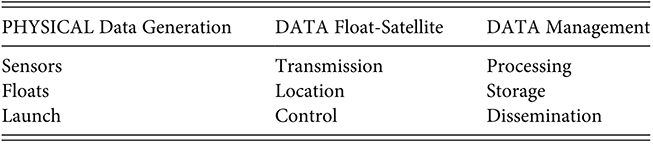
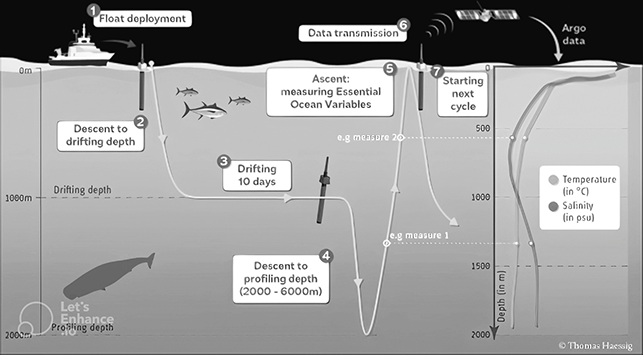

 Open access