Identifying and isolating factors that promote response readiness may be key to building paramedic capacities when responding to CBRN disasters. While paramedic response readiness is vital to protecting the public’s health and safety during a CBRN incident; especially in a pre-hospital setting when surge capacities are being met, their response readiness is highly dependent upon their risk perception of the situation. Reference Smith, Morgans and Qureshi1 Some additional concerns affecting paramedic willingness to work during disasters include concerns for their personal health and safety, as well as that of their family and friends. Reference Smith, Morgans and Qureshi1–Reference Smith3
In addition, paramedics’ comfort level, Reference Reilly, Markenson and DiMaggio4 which is their sense of self-efficacy and willingness to work, are affected by several principal factors including relative levels of focused training, education, and the ability to access necessary protective equipment. Reference Smith, Morgans and Qureshi1,Reference Smith3,Reference Reilly, Markenson and DiMaggio4
Just like the 2003 SARS outbreak, paramedics were required to work throughout the novel Coronavirus SARS-CoV-2 (COVID-19) pandemic. In Italy, high rates of infection among healthcare workers were partially attributed to a lack of Personal Protective Equipment (PPE). Reference Ranney, Griffeth and Jha5 Despite these concerns, paramedics are still required to care for patients that may have been exposed to, infected, or contaminated by CBRN materials. Reference Reilly, Markenson and DiMaggio4
The goal of this study was to identify factors related to paramedic response readiness to CBRN threats in the Ontario region of Canada. Understanding the attitudes and factors associated with response readiness among this population of first responders is crucial to developing response plans to actual CBRN threats.
Methods
Setting and ethical approval
This study was performed in partial fulfilment of the master’s degree program in Public Health in Emergency and Disaster Management, at Tel-Aviv University. The study was approved by the Tel-Aviv University ethical committee (approval number 0000066-1, dated August 20, 2019).
Study type and procedure
A cross sectional study was carried out in October 2019 in conjunction with the Ottawa Paramedic Service to explore which factors affect paramedic response readiness to CBRN threats in this region of Canada. The study tool (see Tools and variables) was dispersed via a link that connected participants to an internet-based survey using Google™ Survey (Mountain View, California, United States), an online survey development software. The survey was set so that each respondent could only use the link once and was dispersed by email at each start of shift briefing, through the service wide newsletter. Additionally, 2 reminder emails were sent out to encourage participation before the deadline. Paramedics who wanted to take part in the study were given a 2-week period between October 4 to October 18, 2019, to complete the survey. Participation in the study was voluntary and was conducted at the free will of the respondent without penalty. All responses were collected anonymously.
Population and sample
There are 3 paramedic certification levels in Ontario: Primary Care Paramedics (PCP), Advanced Care Paramedics (ACP), and Critical Care Paramedics (CCP). The PCP certification is a standard level of practice among paramedics compared to the ACP certification which allows a paramedic to act within a broader in scope of practice. The Critical Care Paramedic (CCP) certification is offered by Ornge, a private air ambulance service. This certification provides paramedics with the highest scope of practice to provide care in an intensive care unit setting. 6
The sample population were all active-duty personnel who may have been needed to report for duty at a CBRN event during the time that the survey was dispersed. This included all personnel who in might participate in the response efforts both on and off the scene. The final sample included 102 participants representing approximately 11% of personnel who might report to a CBRN event.
Tools and variables
This study was based on a mildly adapted tool previously validated in New South Wales (Australia) that assessed the paramedic response readiness for CBRN threats. Reference Stevens, Jones and Smith7 Permission was obtained by the corresponding author before commencement of the study. A few questions were removed to better suit the purposes of this study while maintaining its central themes of risk perception, self-efficacy, deployment concerns, and resilience. In addition, a 2-question section entitled Reporting for Duty was added. The 2 questions in this section were: ‘To what extent do you feel morally obligated to report to duty during CBRN terrorism,’ and ‘How likely are you to report to duty for a CBRN terrorism incident if you are not sure that your family is safe.’ Wording in the questions relating to ‘intense stress effects’ was changed to ‘operational stress injury’ (OSI) - a term used to describe any persistent psychological stress from operational duties. Reference DeBay, Simkins-Burrows and Vacon8 Both items were opting for responses on a 1 to 5 linear numeric response scale ranging from (‘not at all’ to ‘extremely’). During a pilot study, the adjusted section demonstrated an internal consistency with a Cronbach’s alpha coefficient of 0.82.
The primary outcome of this study was ‘response readiness.’ For the purposes of this study, the Stevens et al.’s definition Reference Stevens, Jones and Smith7 was used to define response readiness as ‘the perceived competence to complete functional roles within CBRN operational environments, including suspected terrorism.’ The outcome variable of response readiness was based upon the participants perceived ability to respond to CBRN terrorism. Terrorism was used as the index event to better evaluate paramedics capacity to respond to the deliberate use of such agents. The variable response readiness was comprised of 5 items on a Likert scale ranging from 1 to 5 points. Possible answers include ‘Not at all,’ ‘A little,’ ‘Moderate,’ ‘Very,’ and ‘Extremely’ ranging from 1 to 5 points respectively, and up to a maximum total of 25 points per index event. No points were assigned to the ‘Don’t know’ option. As defined in Stevens et al.’s 2010 original study, Reference Stevens, Jones and Smith7 higher points are associated with higher response readiness. The index score for response readiness was computed as the mean score of all items of the scale.
The questionnaire included 6 sections (demographics, your views, role, and tasking, role, and support, reporting for duty, and tools and training) that measured demographic, occupational, and dispositional factors, all of which contained several questions. These were examined against their perceived response readiness to see if an affiliation exists. The demographic and occupational factors included, sex, age, education, relationship status, years in service, rank, and experience. The dispositional (internal) factors included deployment concerns, perceived self-efficacy, risk perception, and personal beliefs. The response readiness scores for each dispositional factor were computed as the mean score of all index scores as defined in the original study by Stevens et al. The questionnaire is available in the supplementary materials.
Statistical analysis
STATA/ IC 15.1 (Stata Corp., College Station, Texas, USA) was used to perform univariate and multivariate analysis. The univariate analysis was carried out using Poisson regression analysis. Both the response readiness means and incidence rate ratio (IRR) with 95% confidence intervals (CI) were calculated. This was followed by a stepwise regression analysis (multivariate analysis) to remove the influence of the other variables on response readiness. For each CI, intervals greater than 1.00 were associated with higher response readiness and intervals lower than 1.00 were associated with lower response readiness. 95% CI were found to determine if the results were significant (CI that included 1.00 were non-significant). All tests were 2 tailed.
Results
Demographic characteristics, roles and training
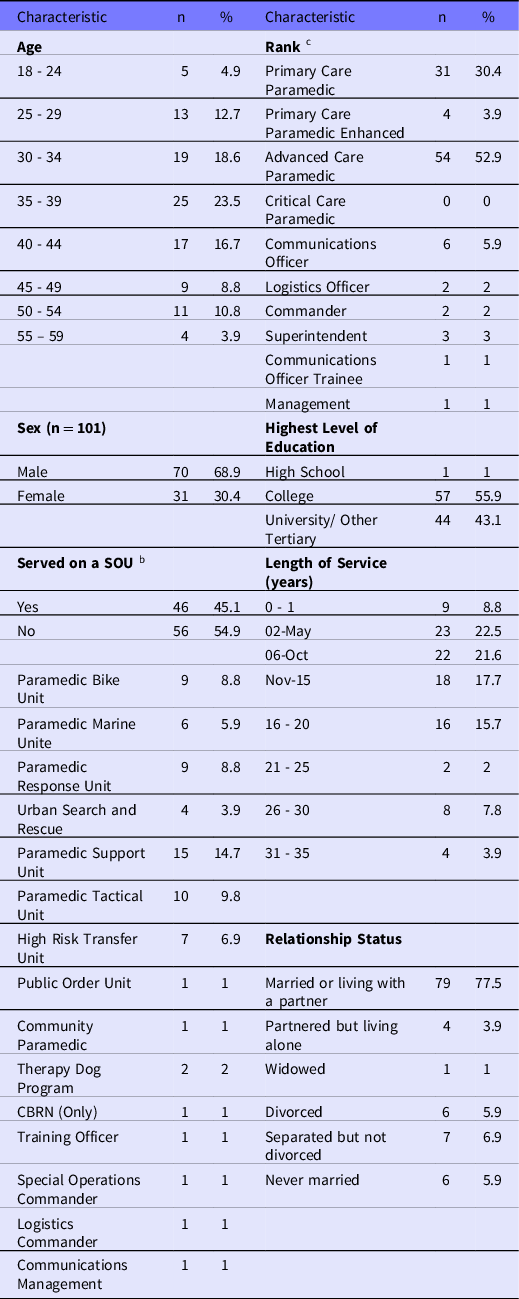
The exact number of staff who received the link is unknown but is estimated to be 900 service members. Of the 900 service members, 102 surveys were completed and accepted. See Table 1 for demographic data.
Demographic profile of the Ottawa Paramedic Service sample (N = 102) a

a Paramedic sample unless otherwise stated
b Paramedics may serve on more than 1 SOU
c Commanders, Training Officers, or Superintendents may also hold paramedic certifications
Approximately 85% of the surveyed sample were certified as paramedics, and 81.4% listed their main duties as operational. Most of the sample (72.5%) had general response roles only, about 15% had specialist CBRN roles, and the remaining respondents were among other leadership roles.
There was a relatively low proportion of the workforce that had underwent CBRN training (31.4%) or multi agency incident training (MAIT) (23.5%) within the last 3 years. Contrary to this, most of the workforce believed that they required additional CBRN training relating to general CBRN incidents (88.2%), CBRN terrorism (86.3%), fear/behavior of affected members of the public (80.4%), and potential stress effects on colleagues or themselves (69.6%).
Threat perception components
In terms of the service members’ views on terrorism, 67% of respondents reported being a little or moderately concerned about CBRN terrorism in Ontario. While 95% said assisting affected members of the public was a general requirement of their job, 4% were not sure. Approximately 64% said they have previously attended a scene affected by the release or presumed release of a CBRN or Hazardous Material (HAZMAT) agent. Almost 50% (49%) of the respondents were either a little or moderately confident in handling/ transporting a patient following decontamination.
Most respondents reported that the likelihood of CBRN terrorism in Ontario is little to moderate. Of the possible terrorism scenarios, chemical terrorism was suspected to be the most likely to happen followed by biological, radiological, and nuclear respectively.
Competence to respond
Most respondents felt moderately, a little, or not at all confident with their skills to respond to the effects (73.5%), cope with public behavior and fear (70%), or had the resources to respond and cope (62%) with a CBRN terrorism event. Participants were also asked to describe in open text what they believe were the most stressful aspects associated with CBRN incident management. Participants’ main concerns were about their health and safety, the unknowns of such terrorist events, and potential logistical issues. Other concerns included the psychological effects following an incident, proper scene management; and poor inter-intra agency coordination, communication, and leadership. With respect to OSI, approximately 88% of opinion respondents believed they would be able to recognize these effects in a colleague and 94% believed that they would recognize these effects in themselves. However, 65% said that the service provides effective, immediate post-incident support while 41% believed the service provided longer term post-incident support. Moreover, 92% of opinion respondents also stated that they knew where to go to get help for a colleague or themselves.
Response readiness
In terms of reporting for duty, 71% felt either extremely or very obligated to report to duty during a CBRN terrorism event. This figure dropped to 29% when presented with a hypothetical situation in which respondents did not know whether their own family was safe.
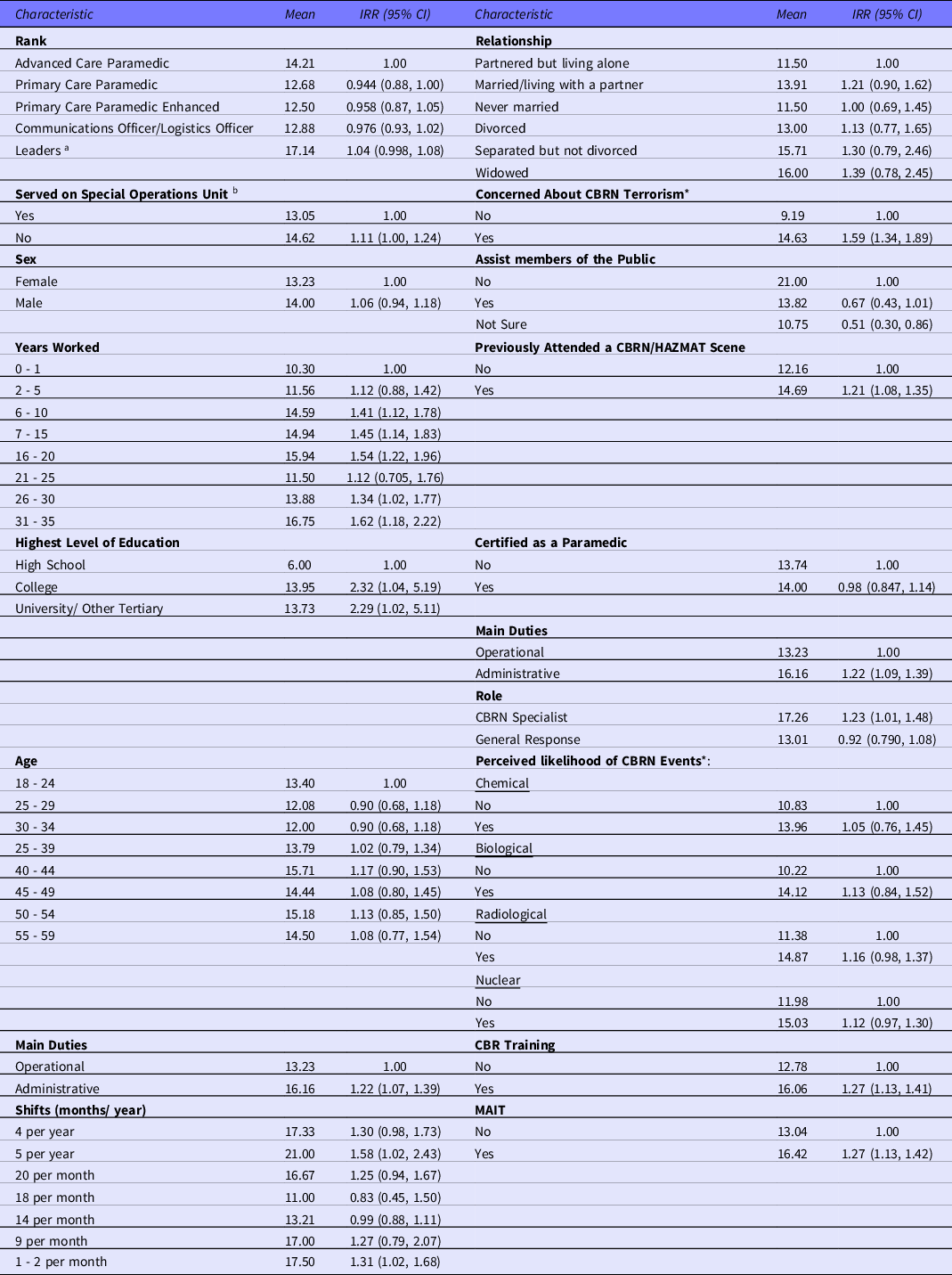
The univariate analysis for mean readiness scores were higher in respondents with a university/college education, recent CBRN training, and for paramedics who underwent MAIT. Respondents who indicated that CBRN threats were even a little likely to happen also showed higher readiness (Table 2).
Response readiness means and univariate analysis of the survey variables (n = 102)

a Leaders include commanders, superintendents, management, and communications and trainee officers
b Respondents who indicated that they served on a special operation unit were placed into the ‘yes’ category and those who didn’t were placed into the ‘no’ category
* The ‘yes’ category includes answers from “a little,” “moderately,” “very,” and “extremely” while answers in the ‘no’ category included “not at all” and “don’t know”
The multivariate analysis indicated that, undergoing CRBN training (IRR:1.24, 1.09-1.40) and having CBRN concerns (IRR:1.33, 1.09-1.61) were significant indicators when predicting response readiness.
Limitations
There were several limitations that were initially evoked by the research design. First, the cross-sectional design cannot be used to observe the response readiness of the service over time or conclude on any causal relationships. The study design also only reflects the sample population at the time the survey was carried out. The timing of the study may have also affected how well the results represent the paramedic service. As well, it does not indicate how the service had or will perform following the study. Second, the study reflects the respondents’ self-rated, perceived response readiness to hypothetical CBRN threats. Consequently, reporting biases may have developed in various ways. Third, the survey did not analyze why some respondents were more concerned about CBRN terrorism than others. Fourth, the question ‘How many ambulance shifts do you work per month (or per year),’ was removed because 30 respondents did not indicate if the frequency of shifts they worked were in months or years. Lastly, Ottawa is a bilingual city with English and French occupying equal status. The survey questions were presented in English with a bilingual introduction and consent form. It is likely that a few of the respondents who completed the survey did not have English as a first language.
Discussion
The survey represents a hypothetical situation and may not attest to paramedics’ moral obligation to report to work and duty to treat during a CBRN event. A report by the University of Toronto mentions that during the SARS pandemic, many health care workers “showed heroism and altruism”; however, some workers failed to report to work. Reference Upshur, Singer and Wilson9 This may have significant policy implications for the Ottawa Paramedic Service wherein the family unit, however that is defined, of the paramedics may need to be supported in times of threat to ensure paramedic readiness. During unconventional situations, ethical codes should provide guidance to protect the workforce’s health and safety. As mentioned in a study by Smith et al., a health care worker’s duty to treat should be “neither absolute nor unlimited” during a disaster. Reference Smith, Burkle and Gebbie10 This may also provide a mandate to further examine the impact of concerns (e.g., family, fear etc.) on response readiness and address them throughout the response framework.
Both CBRN training, and previous experience analyzed in this study were associated with higher levels of response readiness. Although these were significant throughout the univariate analysis, previous experience did not continue to serve as predictor for increased response readiness. This could indicate that the types of CBRN/HAZMAT experience that 1 may expect to encounter may be limited and minute in nature compared to the more drastic nature of a terrorism. Further training allows for experiential learning through trial and error, greater opportunity for risk taking, and a chance for critical feedback. Reference Stevens, Jones and Smith7 Also, training presents an opportunity for first responders to familiarize themselves with the mental and physical competencies needed when responding to such events. Perhaps, communicating real time threat levels to paramedics will help to emotionally prepare them for times when a crisis is likely to take place, as suggested by the findings of this study. Future research may assess which integrant of training provides the most benefit to achieving a higher response readiness.
Conclusion
Addressing factors that promote response readiness are important to understanding workforce competencies, vulnerabilities, and for protecting workforce occupational health and safety. Acts of terrorism around the world continue to foster fear and demonstrate that we are just as susceptible. In the instance of a CBRN terrorism event, or at the very least, following a simulated drill, this study could be administered again and used to see how paramedics’ perceived competencies change with time. Additionally, future research could assess how different concerns (e.g., family, fear etc.) correlate with response readiness and what aspects of training provide the most benefit to achieving a higher response readiness. This study adds to the literature which provide a cross sectional look at occupational, dispositional, and demographic factors that affect paramedic response readiness in one of Canada’s largest cities, while highlighting the importance of maintaining awareness, increasing knowledge, and exploring first responders’ attitudes to assess their potential performance during crisis.
Supplementary material
To view supplementary material for this article, please visit https://doi.org/10.1017/dmp.2022.184
Acknowledgements
This study would not have been possible without the help of Commander Robert Davidson (retired), Acting Chief Peter Kelly who facilitated the implementation of the study with the Ottawa Paramedic Service, and Commander Shannon Leduc who helped revise the survey to better fit the Ottawa Paramedic Service. The authors would also like acknowledge Commander Andrew Gleeson for his support throughout the final stages of the project. Finally, we would like to thank everyone else who helped throughout the study.
Competing interests
The authors declare no competing interests.