

Introduction
The use of Earth Observation (EO) satellites for agricultural purposes started in the late 1970s (Moran et al., Reference Moran, Inoue and Barnes1997) and since then their impact in vegetation monitoring has been substantial (Rajendran et al., Reference Rajendran, Al-Sayigh and Al-Awadhi2016). EO satellites are used for irrigation management (D’Urso et al., Reference D’Urso, Richter, Calera, Osann, Escadafal, Garatuza-Pajan, Hanich, Perdigao, Tapia and Vuolo2010), agricultural production risk assessment (Kostyuchenko et al., Reference Kostyuchenko, Bilous, Movchan, Marton and Kopachevsky2013), pests and disease monitoring (Marques da Silva et al., Reference Marques da Silva, Damasio, Sousa, Bugalho, Pessanha and Quaresma2015), climate change research (Guo et al., Reference Guo, Zhang and Zhu2015) and crop yield estimation (Bastiaanssen and Ali, Reference Bastiaanssen and Ali2003).
The current developments in computing technologies and infrastructure (e.g. better internet connection, higher computational power) and satellite technology (e.g. free imagery, high resolution images) help to provide added value web services to farmers at low costs (Vuolo et al., Reference Vuolo, Essl and Atzberger2015). As a result, more and more platforms that offer satellite based services to farmers are being developed. However, the adoption of these technologies and the integration into the farmers’ daily agriculture operations is a complex process and favorable uptake depend on several technical, social, and economic factors (Baptista and Sousa, Reference Baptista and Sousa2006; Lawson et al., Reference Lawson, Pedersen, Sorensen, Pesonen, Fountas, Werner, Oudshoorn, Herold, Chatzinikos, Kirketerp and Blackmore2011; Fountas et al., Reference Fountas, Sorensen, Tsiropoulos, Cavalaris, Liakos and Gemtos2015). For this reason, user requirements need to be specified before and during the development of services to achieve higher engagement of end users to the final product (Yousuf and Asger, Reference Yousuf and Asger2015). User requirements can be defined as a property that must be exhibited in order to solve a problem of the real world to satisfy a specific target group (Sawyer and Kotonya, Reference Sawyer and Kotonya2001). There are different levels and types of software requirements, such as business requirements, business rules, constraints, external interface requirements, features, functional requirements, nonfunctional requirements, quality attributes, system requirements and user requirements (Wiegers and Beatty, Reference Wiegers and Beatty2013).
The APOLLO project (http://apollo-h2020.eu/) aims to develop a platform that will bring the benefits of precision agriculture to farmers through affordable information services, making extensive use of free and open Earth Observation data, such as those provided by the European Union’s Copernicus programme. The aim of this study was to identify farmers’ requirements for the development of APOLLO platform in terms of offered services, platform’s usability and subscription policy from a questionnaire survey.
Materials and methods
The questionnaire survey took place at the three pilot sites of the APOLLO project, Giannitsa (Greece), Ruma (Serbia) and Castilla-La Mancha (Spain) during June and July 2016. The questionnaire had closed and semi closed questions for getting both a wider and in-depth view of what the farmers would expect from the APOLLO platform. The questionnaire was divided into four main sections. The first section was the demographics, where information related to the age and education of the interviewees was assessed. The second section was related to crop practices, including information on crop cultivation and technologies that are incorporated at farm level. Specifically, there were questions on the devices they use to connect with the internet, on familiarity with applications that use maps, on the importance of smart agriculture and satellite use in today’s agriculture, and if they are users of precision agriculture technologies. The third section related to the importance, according to their needs, of the agricultural services that are going to be offered by APOLLO platform. The offered services will be tillage scheduling, irrigation scheduling, crop growth monitoring and crop yield estimation. The fourth section included questions related to APOLLO’s platform implementation such as communication method of the services, spatial information level, refresh rate (temporal resolution) of the data, ways of interaction between end-users and the platform, ways of payment and spatial resolution of the offered services.
The partners of the APOLLO project were responsible for recruiting the farmers of their region to the questionnaire survey. Specifically, word-of-mouth was used as the main recruitment strategy for engaging farmers in each survey site.
The statistical analysis of the questionnaire results was conducted using SPSS 23 (IBM Inc., New York, USA). It included the frequencies of the given answers regarding the total population of farmers participated in the survey and the frequencies of answers given by the farmers of each country. Finally, the significant differences of the given answers were identified using pairwise comparisons.
Results and discussion
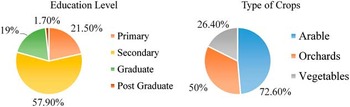
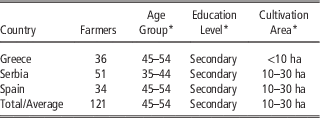
There were 121 farmers that participated in the survey. They were mainly between 45–54 years old and they had finished secondary education. They cultivate 10 to 30 ha on average mainly with arable crops (Table 1 and Figure 1).
Answers on education level and type of crops.

Average demographics and cultivation area per country

*Refers to the answer with the highest frequency
The personal computer is the most common device that farmers use to connect to the internet (57.7%) with smartphones being in the second place (46.3%). However, there were significant differences regarding the country responses, where Spanish farmers use their smartphones more compared to personal computers (44.1% and 41.1% accordingly). Another finding of the survey was the familiarity with thematic maps in agricultural applications, where Serbian farmers were more familiar with their use, 80.4% compared to 41.7% for the Greek famers and 50% for the Spanish farmers.
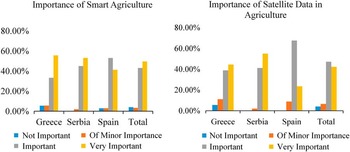
All farmers believed that smart agriculture and use of satellite data in agriculture are important. 55.6% of the Greek farmers and 53% of the Serbian farmers believe that smart agriculture is very important compared to Spanish farmers where 53% of them believe that it is important and 41.2% of them consider it very important. Regarding the importance of satellite data in agriculture the survey results presented similar pattern. Both Greek and Serbian farmers believe that satellite data are very important in agriculture (44.4% and 54.9% accordingly), while Spanish farmers believe that are just important (67.6%) with Serbian farmers presenting significant differences with Greeks and Spanish farmers (p=0.018 and p=0.002 accordingly) (Figure 2). These findings came in contrast due to the fact that 79.4% of the Spanish farmers identified themselves as users of smart agriculture technologies compared to 16.7% of the Greek farmers and 17.6% of the Serbian farmers (significant difference p<0.001). The latter findings came in accordance with Ruef and Markard (Reference Ruef and Markard2010), where they concluded that expectations before technology adoption are high while expectations after adoption lowers and may lead to moderate disappointment.
Answers on importance of smart agriculture and satellite data in agriculture.

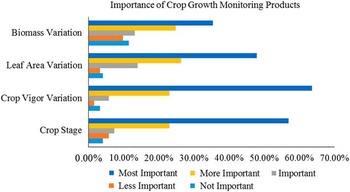
Each of APOLLO platform’s offered services (tillage scheduling, irrigation scheduling, crop growth monitoring and crop yield estimation) was considered of high importance and thus received high acceptance by more than 50% of the farmers in average. However, the different products received different degree of acceptance. For instance, more than 50% of farmers found very important to receive information on crop vigor variation and crop stage compared to 36% of farmers that found very important to have information on biomass variation and 48% of them who wanted to receive information on leaf area variation (Figure 3).
Answers on importance of crop growth monitoring products.

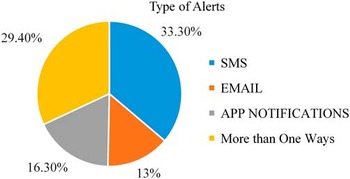
Farmers expressed an interest in receiving alerts mainly through SMS (33.3%) and followed by applications (web/smartphone) (16.3%), while 29.3% of the farmers wanted to receive information using more than one way (Figure 4).
Answers on the preferable type of alerts of APOLLO platform.

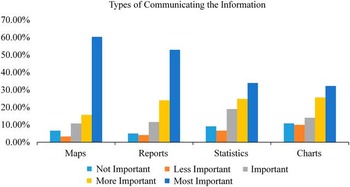
Most farmers wanted to receive the APOLLO platform information directly (68.3%) and secondly from crop consultants (31.7%). Furthermore, the farmers wanted to receive the information in different ways such as reports, maps, charts and statistics. However, maps and reports were considered as the most important types of communicating the information by more than 50% of the farmers participating in the survey (Figure 5). Additionally, most farmers from each country answered that they would like to have access to historical data (87%). Moreover, more than 87% of the farmers want to interact both with other farmers and crop consultants through the APOLLO platform.
Answers on different types of communicating the information.

According to their country of origin, farmers gave different answers on the ability of changing the alert levels. Specifically, Greek farmers would not prefer to have the ability to change the alert levels of the APOLLO platform (52.8%) compared with the Serbian and Spanish farmers that wanted to have this ability (78.4% and 82.4% respectively). Moreover, no Greek farmers wanted the ability to create custom algorithms compared to Serbian farmers where only 57% of the farmers answered the same. On the contrary, 59% of the Spanish farmers wanted to have the ability to create custom algorithms. Furthermore, 40% of the total number of farmers expressed their willingness to pay for APOLLO platform’s services if it was affordable and provided cost effective results, compared to 27% of the farmers that are willing to pay without second thought and 33% of the farmers that are not willing to pay for the services. Most farmers wanted to pay in a flexible way according to their needs and their use (above 40% for the farmers of each country) compared to annual subscription and monthly subscription to all services (21.6–26.5% and 2.9–8.3% respectively). In addition, 88.6% of farmer wanted to have the ability to choose the services according to their needs. However, Greek farmers expressed this in a significant lower percent (72.2%) compared to their colleagues in Serbia (90.2%) and Spain (91.2%) (p=0.014 compared to Serbian farmers and p=0.007 compared to Spanish farmers).
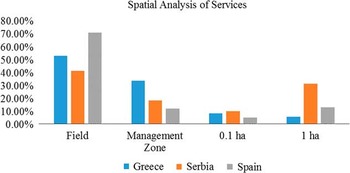
Finally, the farmers were asked for the spatial resolution at which they wanted to receive information from the APOLLO platform services. The farmers wanted to receive information mainly at field level. However, there were statistical significant differences on the answers between the Serbian farmers and the other farmers. Specifically, the Serbian farmers wanted to receive information at 1 ha level as a second choice compared to Greek (p=0.026, p<0.05) and Spanish farmers (p=0.003, p<0.05) who wanted to receive information at the management zones level (Figure 6).
Answers on spatial analysis of services.

Conclusions
Determining user requirements is a very complicated process that can be done using various methods. Questionnaire survey is one of the most efficient methods for identifying user requirements that can be also applied for the development of satellite based advisory platforms for farmers. Surveys should be performed in different countries and regions to better understand the needs of local farmers. Farmers of different countries may differ in technology adoption levels, expectations from technology adoption, ways of communicating information, level of spatial analysis needs, and other requirement. All these differences must be taken into account in developing a successful satellite-based advisory platform that will meet the needs of all relevant farmers.
Acknowledgements
This study has received funding from the European Union’s Horizon 2020 research and innovation programme under the project APOLLO (Advisory platform for small farms based on earth observation; grant agreement No 687 412). The authors would like to thank Ioulia Anastasiadou, Stylianos Kotsopoulos, Anastasia Chatzistrati, Vasileios Kolovos, Milan Kilibarda, Aleksandar Sekulic, Stefan Milutinovic, Ognjen Antonijevic, Ugljesa Trkulja, Milan Delic, Bojana Lanc, Vicente Bodas, Andres Questa, Fran Jara, Maria Ruiz and Jose Emerito Gomez for their contribution to the questionnaire survey. Finally, the authors would like to thank all the farmers and agronomists participated in the questionnaire survey.