Medical and surgical services for children with congenital and acquired heart disease in most industrialized nations are easily obtained and comprehensive, regardless of the expense. In many parts of the world, nevertheless, children with similar types of cardiac disease continue to be unable to achieve entrance to adequate diagnosis and care.Reference Cohen, Tamir and Houri1 Efforts to supply greater access to appropriate care for these children range from “pro bono” long-term commitments to the establishment of entire institutional programmes.Reference Pezzella2, Reference McGrath3 In 1993, we established a programme to make paediatric cardiovascular services available to children in developing countries.Reference Novick, Stidham and Karl4 No such programme would be complete without imparting the knowledge to maintain advanced surgical techniques after departure of the team. Accordingly, we endeavored to train local personnel to carry on a programme that was more advanced than prior to our intervention. This report presents the details of the impact that we have had on a selected group of institutions over our 14-year experience.
Methods
Acquisition of data and statistical methods
We reviewed all the records of the International Children's Heart Foundation database, and databases at host sites for numbers of patients, the types of operation, and the results performed by the foundation team. Survival was defined as in our previous publication, representing survival at the time of departure of the visiting team.Reference Novick, Stidham and Karl4 For this report we also assessed the number of surgeons, cardiologists, intensivists, anaesthesiologists, perfusionists, nurses and other members of the cardiovascular team that were trained. Training included on-site practical experience, with side-by-side hands on training between the host personnel and their team counterpart, didactics, and programmatic experiences in designated sites abroad. When applicable, the data were analyzed as the mean, plus or minus the standard deviation. Comparisons of variables were made using the chi-squared and Student’s t tests. Differences were considered significant when p was less than 0.05.
Patient database
Data on each surgical patient was recorded in a central database. Surgical procedures were coded according to the European Congenital Heart Surgery Database, and all operations were assigned a categorization for risk using the classification system described by the Paediatric Cardiac Care Consortium.Reference Jenkins, Gauvreau, Newberger, Spray, Moller and Iezzoni5 All data were kept contemporaneously by the foundation team. Demographic, anaesthesia, perfusion, operative procedures and data relating to post-operative care are stored on the foundation laptop that travels with the team on each trip, or on hardcopy sheets that are returned to the foundation upon completion of the trip. The local team also tabulated their data on the results achieved, and sent them to the central office of the International Children's Heart Foundation. Reconciliation of the 2 databases was performed by one of the authors (WMN) for every trip. This allowed us not only to evaluate our own results, but also to assess the complexity of cases being performed in the teaching arena. Each site assisted was encouraged to maintain their own database using the categories of Pediatric Cardiac Care Consortium Risk Classification. To assess improvement within our organization, we divided our effort over 14 years into 3 different eras, two of 5 years, the first and second eras, and the third era of the last 4 years.
Criterions for inclusion of sites and advancement
We arbitrarily set a minimum of 4 visits by our teams, or 8 weeks, as the minimal criterion for assessment of impact. The purpose was to eliminate those programmes which we felt were not acceptable for development, and/or where a majority of the contribution to improvement may have been made by teams other than ours. The benchmarks that we selected to determine advancement of a local programme were an increase in the case load, and/or an increase in the complexity of surgeries performed. Each of these centres was asked to supply the number of operations performed each year at that facility prior to and after our training period. In addition, we requested information regarding a change in the difficulty of the types of operations performed either subjectively or objectively, the latter using the risk adjusted categories established by the Pediatric Cardiac Care Consortium prior to and after our intervention. We did not attempt to assess the varying levels of expertise at each centre at the beginning of our intervention. To assure anonymity, each centre was assigned a single letter designation in this report.
Recruitment of the volunteer team
Team members were recruited based upon direct solicitation by one of the authors, based upon prior experience as team members, or using the volunteer page of the Foundation Web site. All volunteers provided curriculums, appropriate licenses, diplomas, and references. Team acquisition and organization was regularly started 3 months prior to a planned mission. All team members had a University affiliation, and therefore were conversant with the teaching approach.
Determination of patients
After we received a requested list of surgical candidates, along with any pertinent cardiac studies, patients were prioritized based upon the data provided. The priority list was then returned to the site for consideration and confirmation. Patients requiring urgent or emergent operations, such as neonates, were added to the list of operative procedures as dictated by their time of admission to the institutions. So, although a list of patients for operation may have been decided upon prior to the trip, the final operative list was adjusted as needed after arrival.
Financial aspects
We have previously published the methods used to determine the costs associated with the program.Reference Novick, Stidham and Karl4 In this report, as in our previous report, all expenses are expressed in US dollars, and no attempt was made to correct for inflation or devaluation of the dollar.
Results
Trip and sites visited
Between April, 1993, and March, 2007, we made 140 trips to 27 sites in 19 countries. We made 44 trips to Central Europe, 26 to South America, 21 to Central America and the Caribbean, 13 to China, 12 to Central or Southern Asia, 16 to Eastern Europe, 1 to the Middle East, and 7 to Africa. Of the 27 institutions assisted, 13 did not fulfill criterions for inclusion into this report. A total of 19 trips were made to these 13 institutions. We made 3 trips to 2 centres not reaching the criterions, while the others received either 1, in 9 instances, or 2 instances for 2 trips. The number of institutions who fulfilled criterions, therefore, was 14. A total of 121 trips were made to these 14 institutions, resulting in a total time for education of 242 weeks. The number of visits to these sites ranged from 4 to 33. In 1 country, there were 3 sites that we assisted, all in the same city. Initially, we started our programme at the Children’s Hospital, but when the decision was made to upgrade the cardiac surgical ward, and add an entirely new institution for operating rooms and intensive care units, we moved to another centre to continue education and clinical services. Upon completion of the new centre, we then moved to this new institution. Individually, 4 trips were made to each site, for a total of 12 trips. If we consolidate the trips in this city to 1 institution, then the average number of trips made to the sites that reached the criterions was 10.1 plus or minus 8.2. Those not reaching the criterion had an average of 1.5 plus or minus 0.8 trips. The range for the number of trips per year increased from a low of 3 during 1993 through 1998, to a high of 18 over the period 2004 through 2007. The average number of trips per year differed significantly between the different time periods, being 4.8 plus or minus 1.9 for the first era; 11.8 plus or minus 1.9, p < 0.001, for the second era, and 14.9 plus or minus 2.8 for the third era, p versus the first era less than 0.001, and versus the second era equal to 0.08).
Children undergoing surgery
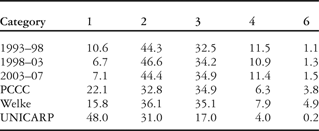
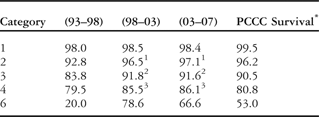
Over the entire period, we carried out 2,780 primary operations. The types operations performed spanned the entire spectrum of the risk adjusted categories. The percentage of cases performed in each category is shown in Table 1. The percentage of patients in the first class over the first 5 years is significantly more than those undergoing surgery in either the second 5 years or the last 4 years (p < 0.01). For each group of years, we performed surgery on a lower percentage of patients in the first class when compared to the recent reports from the Paediatric Cardiac Care ConsortiumReference Jenkins, Gauvreau, Newberger, Spray, Moller and Iezzoni5 and the Congenital Heart Surgeons SocietyReference Welke, Shen and Ungerleider6. Thus, we believe that the patients undergoing surgery provided an ample variety to add to the experience of the host institution. In addition, our data regarding survival achieved over the entire spectrum of categories was reasonable. We had significant improvement in survival in the second through fourth categories in the second and third eras of our programme (Table 2). Those falling within the sixth class were insufficient in any of the eras to allow comparison with the “gold standard” reports.Reference Jenkins, Gauvreau, Newberger, Spray, Moller and Iezzoni5, Reference Jenkins and Gauvreau7
Case mix by categories for assessment of risk for congenital cardiac surgery.
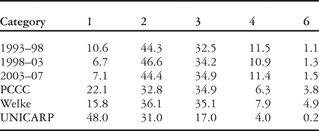
All values are expressed as percentages of the total caseload. PCCC = Pediatric Cardiac Care Consortium; Welke = Welke KF et al. Ann Thorac Surg 2006; 82: 164–171; UNICARP = Larrazabal LA et al. Circulation 2007; 116: 1882–1887.
Survival by risk adjusted congenital cardiac surgery category.
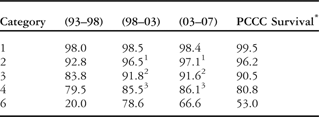
Comparison of survival between the three different time periods for our programme, taking as a point of reference the PCCC data from *Jenkins et al. JTCVS, 2002. During the second and third periods, survival did not differ for any category. When the results from these eras were compared to those from the initial era, significant differences were noted in survival; 1 = p-value < 0.01, 2 = p-value < 0.001, 3 = p-value = 0.05, all values are expressed as percentages.
Participation of volunteers
There were 1,073 volunteers recruited from the United States of America, United Kingdom, Belgium, Australia, Denmark, Spain, Croatia, Peru, Colombia, Chile, Costa Rica, Germany, Serbia, Turkey, Japan and Switzerland. In all, 359 physicians volunteered, including cardiac surgeons, paediatric cardiologists, cardiac anaesthesiologists, and paediatric intensivists. We had 566 nursing volunteers who staffed the intensive care unit, the operating room, and the catheterization laboratory. There were 148 volunteer technicians, including perfusionists, respiratory therapists, echocardiographic and catheterization lab technicians, and bioengineers. The number of volunteers per trip for the first era was 11.7 plus or minus 2.1, was 8.7 plus or minus 1.1 for the second era, and 12.4 plus or minus 1.8 for the third era. There was no difference between the number of volunteers during the first and third eras, but both were significantly greater than for the second era (p < 0.05).
Medical education
A total of 338 professionals received education at the institutions that fulfilled the criterion for inclusion in this study. Education was provided to 199 nurses, 37 surgeons, 20 anaesthesiologists, 28 cardiologists, 17 intensivists, and 29 perfusionists. The geographical distribution and total number educated is shown in Table 3. Of these, 6 surgeons, 4 nurses, 4 cardiologists, 2 intensivists, 8 anaesthesiologists and 6 perfusionists received additional training in designated sites abroad. The interval of additional training was from 1 to 6 months.
Individuals receiving an education on site.

All values represent the total number of individuals in each specialty that received a minimum of 2 months exposure to our visiting team.
Advancement
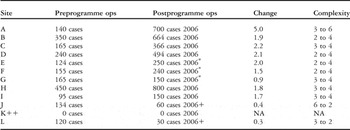
As explained, advancement was dependent upon the institution increasing the number of cases performed, and/or the complexity of the cases performed. The total number of sites that qualified for assessment was 12, combining the 2 sites in one city to make the third site. In 9 sites, we identified an increase in the number, and/or the complexity of cases treated after our intervention. Of these sites, 1 is in Central Europe, 2 in Eastern Europe, 3 are in South America, and 3 in Asia. The differences in number of cases performed before and after our intervention can be found in Table 4. All sites that advanced, A through I in the Table, reported that they are currently performing neonatal surgery, along with complex procedures in infants, including, but not limited to, repair of tetralogy of Fallot, repair of atrioventricular septal defect with common atrioventricular junction, creation of the Fontan circulation, and the arterial switch procedure. A total of 7 centres have advanced to routine repair of common arterial trunk, interrupted aortic arch with ventricular septal defect, and the arterial switch procedure combined with closure of ventricular septal defect, elevating them to the fourth class in terms of complexity. In 1 centre, a programme has recently been implemented for the palliation of hypoplastic left heart syndrome, which represents the sixth category of complexity, making this site our most advanced surgically. Three sites have not advanced, listed as J through L in the Table, neither by increasing the number nor the complexity of the operations performed. Indeed, in 2 of these sites, J and L, the programmes have collapsed considerably since our intervention, and the other, K, has not increased numbers or performed any open cardiac surgical procedures in our absence. The average length of time committed to the sites that advanced was 5.1 plus or minus 2.1 years, and for those that failed to advance 8.1 plus or minus 4.9 years. No difference existed between these two periods (P = 0.11).
Institutional results.

A-L are the 12 sites who met the criterion for inclusion into the study; Preprogramme ops are the number of operations performed at a site the year prior to the institution of our programme; Postprogramme ops are for the year ending Dec 31, 2006; Values under complexity are the Categories in the Risk Adjusted Congenital Heart Surgery classification that were performed at our the start of our programme, and at evaluation in December, 2006; NA = Not Applicable; * = programmes we no longer regularly assist; + = failed programme we no longer assist. ++ = Site that had not performed an open case prior to our arrival or at anytime since institution of the programme.
Financial aspects
The costs of the programme were significantly different for the first 5 years, at $277,462 plus or minus $53,454, when compared to both the second 5 years, at $482,304 plus or minus $105,515, p < 0.01), and the last 4 years, at $625,383 plus or minus $89,345 (p < 0.005). When the costs of the programme for each year were evaluated as the costs per child, there was no significant difference between the first 5 years, at $2625 plus or minus $176, the second 5 years, at $2245 plus or minus $475, or the last 4 years, at $2159 plus or minus $350. In addition, the total for donated materials did not differ significantly from the first 5 years, at $800,000 plus or minus $467,761, the second 5 years, at $595,750 plus or minus $350,113, or the last 4 years, at $623,433 plus or minus $232,345). The services donated by our professional volunteers also did not differ significantly between the first 5 years, at $529,500 plus or minus $72,904 and the second 5 years at $625,853 plus or minus $136,002, but the value for donated services in the last 4 years, at $1,087,220 plus or minus $167,001, was significantly greater (P less than 0.05) from both previous eras. The financial support for the programme involved a partnership with a variety of stakeholders. The host country was always involved in part of the effort. Financial assistance within the host country came from charitable, governmental, or hospital organizations. Additional sources of financial support from the United States of America came from fund raisers for the foundation, as well as civic and charitable organizations and the State Department of the United States Government.
Discussion
The inability to obtain satisfactory cardiac care for most of the children of the world is now well-known,Reference Pezzella2 and is not only limited to AfricaReference Eze and Ezemba8, Reference Livesay9 and Asia, but exists even in Europe.Reference Placci, Begic, Loroni, Picchio, Gargiulo and Casanova10, Reference Begic, Tahirovic, Meshovic-Dinarevic, Ferkovic, Atic and Latifagic11 The impediments to delivery of cardiovascular services in underserved areas are well described.Reference Borst12, Reference Kalangos13 They are not limited to the economics of the given country.Reference Novick14, Reference Neirotti15 The opportunity to improve this situation lies clearly within the resources of the nations of the world whose surgeons perform complex procedures. Perhaps Bill Williams, of Toronto, said it best when stating “The evolution of congenital heart surgery has reached a point in time when we should extend care to patients in under serviced emerging countries.”Reference Williams16 At present, there are many organizations in the United States of America and Europe who have approached this problem.Reference Pezzella17
Moreover, the development of independent and sustainable programmes within the countries needing help should be the ultimate goal of an organizational intervention. This requires a long-term commitment by both the visiting team and the local receiving institution. We support the notion that surgical tourism is not acceptable unless those visiting are truly interested in building the capabilities of the local medical and surgical teams.Reference Wolfberg18 We do not agree with the premise, however, that a team should not operate on the last day before departure. There are simply too many children who need operations.Reference Novick, Stidham and Karl4, Reference Wolfberg18 Our focus has changed over the years, from providing only paediatric cardiac clinical services to implementing programmes by performing multiple visits each year to selected sites so as to provide education, training, and experience.Reference Novick, Stidham and Karl4 Certainly, our commitment to 12 programmes, for which we averaged 10 trips to each site, reflects this approach. The development of paediatric cardiac services may require a commitment over many years if independent performance of neonatal, infant, and complex surgery is the goal. Each site has a different baseline fund of knowledge and skills. Thus, what might be accomplished in 3 years at one site may require 5 to 6 years at another site. Our average yearly commitment of 5 years to those sites that showed advancement is consistent with this philosophy.
The capacity to supply travelling teams of paediatric cardiovascular specialists is dependent upon the success of recruiting an ample number of skilled volunteers who can work together to achieve satisfactory results for each trip.Reference McGrath3 Initially, our trips to any site usually required the recruitment of a full complement of individuals in all specialties. Our volunteers originated from a number of centres in the United States of America, the United Kingdom, Europe, Canada, and South America. This mix provided our partner sites with a well-rounded approach to the care of children with cardiovascular disease. Our physicians, nurses, and perfusionists worked side by side with their local colleagues in all areas. Moreover, our staff provided didactic sessions on specific issues related to the care of children with cardiovascular disease. Depending on the appraisal made by each team member of the understanding and abilities of their local counterparts, they would steadily allow them to assume a more responsible role in the care of the children. As the capabilities of the local team improved, we decreased the size of our team. This is reflected in the decrease in team members between the first and second eras. As we have provided assistance to new centres, we have had to increase our volunteer staff again in the last 4 years.
The goal of increasing the complexity of operations performed by the local team in our absence required that, during our trips, we performed these operations as a means of providing the local team with exposure to, and experience with, neonatal, infant and complex surgical cases. We believe that the data presented herein reflect this point. In the first 5 years of our programme, one-tenth of our cases were in the first category of complexity, compared to just over one-fifth for the Pediatric Cardiac Care Consortium, one-sixth in the recent data compiled from members of the Congenital Heart Surgeons Society,Reference Welke, Shen and Ungerleider6 and almost half in a more recent report from the UNICARP program.Reference Larrazabal, Jenkins and Gauvreau19 Furthermore, those in the third and fourth categories accounted for almost half of the patients in our study, as opposed to only one-fifth in the UNICARP project. As our program matured, and the locals became more confident in their skills, the percentage of our total caseload in the first category dropped to 6.7% in the second 5 years, and 7.1% in the last 4 years. The opposite was true for the more complicated cases in the second to fourth categories. We were performing a higher percentage of complex cases over the last nine years compared to both the above mentioned databases. Only 3 of our sites have made attempts at a programme of palliation for hypoplastic left heart syndrome. We believe that, given the expense required to treat these children, and the level of sophistication necessary for a successful programme, few of our institutions are poised to undertake surgery for hypoplastic left heart syndrome. Only one site that we assisted maintains a programme for these children. We have focused most of our operative caseload, therefore, on those cases that fit in the second to fourth categories of complexity.
The published mortality for paediatric cardiac surgical procedures is widely available in the literature. Moreover, we are aware that there is debate relating to under-representation of published data that compares results from centre to centre.Reference Anyanwu and Treasure20, Reference Mavroudis and Jacobs21 With this in mind, we have selected the method pioneered by the team representing the Paediatric Cardiac Care ConsortiumReference Jenkins, Gauvreau, Newberger, Spray, Moller and Iezzoni5, Reference Jenkins and Gauvreau7 as a way of stratifying the risk in our surgical caseload. The results reported herein show improvement in mortality between the different eras. In the second and third periods, the results are not too dissimilar from those reported by Jenkins et al.Reference Jenkins, Gauvreau, Newberger, Spray, Moller and Iezzoni5, Reference Jenkins and Gauvreau7 We cannot be certain, but it would be intuitive to suggest that, as experience has been gained by the local team, their results have also improved. We made no attempt in this study to determine changes in mortality rates at the assisted institutions during the time of our programmes. We are in the process of accumulating these data for study and analysis. As pointed out by Welke, Shen and UngerleiderReference Welke, Shen and Ungerleider6, one cannot expect that the results obtained by high quality programmes be obtained at all sites. We would take this philosophy a step further, and note that, in 1983, when the Congenital Heart Surgeons Society started its study of the correction of discordant ventriculo-arterial connections, a number of the programmes we are now assisting did not even perform paediatric cardiac surgery.Reference Turley and Verrier22 So, if it takes years to improve results, even in these centres of high quality, which have been performing paediatric cardiac surgery for decades, then expecting the same benchmark results at assisted institutions is like comparing apples to oranges.Reference Blackstone23 To assess the results in developing and transitional countries, where western teams are assisting to improve outcomes and care, we along with Boston Children’s Hospital, UNICARP in Guatemala, and the University of Geneva, are developing a registry for paediatric cardiac surgical cases performed by the visiting and local teams. Hopefully we will be able to determine what benchmarks can be expected to be achieved for institutions in developing and third world countries.
The financial aspects of maintaining multiple programmes cannot be underestimated. Significant investments are required in order to maintain a longstanding commitment to a programme. We believe that a commitment is made to a prolonged programme, and everything possible must be done financially to support it until its conclusion. Our data indicates an increase in financial support over the years. This was most likely a function of the very significant increase in the number of yearly trips. When the cost per child is evaluated, the costs have not increased with time. Critical to the success of any programme similar to ours is the donation of time by qualified individuals. The significant increase in donated services by our volunteers over the years reflects their commitment and belief in our programme and its results. The increase in donated services in the last 4 years is most likely secondary to the initiation of new programmes, and an increase in the total number of programmes per year. The source of dollars that are necessary, and the financial participation of the host country, cannot be underscored. Yacoub, in a recent editorial regarding the development of paediatric cardiovascular services in underserved areas of the world, stressed the role played by non-governmental organizations similar to those employed by our group, as well as local national and International bodies such as the World Health Organisation, the World Heart Federation, and others, in accomplishing the final goal.Reference Yacoub24 Another critical element of our program is the donation of materials. The support of medical companies cannot be overstated.
The goals of an international endeavour should include the immediate provision of vitally needed care to those children in need, but also the need to imbue the necessary knowledge to local physicians and staff to carry on with the needed care.Reference Shekerdemian, Penny and Novick25, Reference Novick, Sandoval and Lazorhysynets26 The challenges of starting or upgrading a standing programme in paediatric cardiac surgery vary from country to country. Those sites that have been able to maintain and continue a successful programme have done so through the combined efforts of the national and/or regional governmental agencies and local support, along with a well organized team approach within the institution. We had three programmes which failed, in 2 of which we invested considerable time and effort.Reference Novick, Anić, Ivančan and Di Sessa27 We are no longer assisting two sites that failed, but we have taken a unique approach to the third site. We have placed a North American paediatric cardiac surgeon there full-time, in an effort to overcome the lack of advancement. Only time will tell if this will be a successful alternative to periodic team trips. There are a number of reasons to which failure of a prolonged programme of training and education can be attributed. Interpersonal disputes within the institution always led to failure of progress. Political appointees, by either the hospital or government, of individuals who were not capable of advancing the programme, perhaps because of ego as suggested by Pezzella,Reference Pezzella17 were another reason for failure. Frequently we were aware of these disputes, and tried to overcome them, usually without success. We have recently reported the failure of a programme due to such personality disputes, as well as the failure of local leadership to recognize the need for concentrated training of surgical staff.Reference Novick14 On occasion, lack of hospital support was an insurmountable problem. A change in national government leadership can also impede progress. We often limited our number of missions to a site to only one or two when we recognized that the local impediments to progress could not be overcome. Unfortunately, not all sites that want a paediatric cardiac surgical programme realize the complexity of this service, and the commitment that is necessary to succeed in its development.
We have proposed one method of upgrading the paediatric cardiovascular surgical abilities of a developing country. Alternative approaches, such as establishing a programme within a country by living in a country for a period of time, or providing an intense educational programme for cardiovascular care at a site with an advanced cardiovascular surgical practice, need to be considered. These two alternative methods offer the advantage of a continuous training period without interruption. The former approach would require installation of a paediatric cardiovascular surgeon, cardiologist, intensivists, perfusionists and nursing staff in the country of need for optimal results. The recruitment of such a dedicated group would be difficult. Moreover, the expense of maintaining such a group would probably be considerable, making this approach impractical. The latter method would require bringing an entire cardiovascular team from an under-developed country to an advanced cardiovascular surgical centre for training. Based on our experience, we believe that such an endeavour would also be quite expensive. Furthermore, in the United States of America, the problem of licensing, along with insurance against malpractice, impede the trainee from receiving hands-on experience. Most of the centres for cardiovascular teaching in advanced countries are dedicated to training future physicians for the country in which they exist. They have little room to expand their teaching effort. Attention to an extramural group of foreign trainees would detract from the education of the physicians within the advanced country. One final challenge that we have had to overcome has been the difference in language between our team and the host country. It is difficult to pass comment on how such difference in language would affect the latter two endeavours. We have attempted to include team members who have fluency in the language of the host institutions on all our trips.
The requirement for clinical services and education in paediatric cardiovascular disease throughout the underserved areas of the world is critical. Improvement in paediatric cardiac services requires a significant time and commitment by the provider and a dedicated local team. An increase in the number of cases provided, and the complexity of the operations performed, can be expected when all the proper elements are present.
Acknowledgements
Our programme would not have been possible without the volunteer services of our physicians, nurses, perfusionists, respiratory therapists and biomedical engineers. We are truly indebted to these individuals. Furthermore we would like to acknowledge the countless donors to our program over the years, including but not limited to Chernobyl Children’s Project, the Gift of Life programmes of Rotary Districts 7500, 7470, 7980 and 7910, as well as the Rotary Clubs of District 6800. Federal Express deserves special recognition for the donation of shipping services for our programmes world-wide.
Support: Paul Nemir Professorship and Endowment Fund, University of Tennessee Health Sciences Centre, International Children’s Heart Foundation and United States Department of State, EUR/ACE Grant # S-LMAQM-106-GR-174.