INTRODUCTION
Explanations for the heterogeneous health patterns observed among Latinos and immigrants in the United States often invoke culture through the use of the concept of acculturation. At the core of acculturation-based explanations for health outcomes lies the assumption that, as individuals lose cultural traits—presumably associated with the country of origin—their health deteriorates (Escarce et al., Reference Escarce, Morales, Rumbaut, Tienda and Mitchell2006). The centrality of the concept of acculturation in examining Latino health has been the topic of growing debate and critique, with scholars increasingly calling for studies that move beyond acculturation and its underlying assumptions. By drawing attention to the processes of ethnic identity formation within the racialized social structure of the United States, this paper heeds this call; in so doing, it seeks to decouple ethnic identity formations from the simplistic notions of cultural change embedded in acculturation models. My examination of these processes focuses on the experiences of Mexican-origin women in Detroit and builds on the premise that “one of the routes through which material disadvantage affects behavior and health is through people's ability to construct a sense of identity and purpose under very difficult social and economic conditions” (Williams Reference Williams2003, p. 148).
Beyond Acculturation
Typically defined as “cultural change that is initiated by the conjunction of two or more autonomous cultural systems” (Social Science Research Council 1954, p. 974), the concept of acculturation has been used extensively in attempts to explain Latino health outcomes. Critics of acculturation-based explanations for Latino health outcomes have pointed out multiple flaws in the concept's underlying assumptions. In particular, scholars have suggested that, despite the growing psychometric sophistication in measuring acculturation, “conceptually the assumption of a dichotomy between mainstream and ethnic culture persists” (Hunt et al., Reference Hunt, Schneider and Comer2004, p. 977). Such treatment of culture fails to capture the complexity of collective systems of meaning and action that culture comprises and the ways these systems emerge and shift under specific social, historical, and political contexts. Acculturation-based explanations for Latino health outcomes are also problematic in that they presume individuals acculturate against a normative White European culture. In addition, because they locate culture within individuals, such models divert attention from addressing the structural conditions that impinge on individuals and communities and, thus, run the risk of inadvertently promoting victim-blaming explanations (Acevedo-García and Bates, Reference Acevedo-García, Bates, Rodriguez, Saenz and Menjivar2008; Bhatia and Ram, Reference Bhatia and Ram2001; Carter-Pokras and Bethune, Reference Carter-Pokras and Bethune2009; Hunt et al., Reference Hunt, Schneider and Comer2004; Kao et al., Reference Kao, Hsu and Clark2004; Santiago-Irizarry Reference Santiago-Irizarry1996; Viruell-Fuentes Reference Viruell-Fuentes2007; Zambrana and Carter-Pokras, Reference Zambrana and Carter-Pokras2010).
The limitations of the concept also become evident in the ways complex dimensions of social integration—such as generational status, length of residence in the United States, Spanish language use, and ethnic identity—are often used alone or in combination as proxy measures for acculturation. For example, the common use of generational status as an indicator of acculturation ignores the various histories of colonization, immigration, exclusion, and racialization that have shaped the experiences of Latinos in the United States (González Reference González2000; Hurtado et al., Reference Hurtado, Gurin and Peng1994; Telles and Ortíz, Reference Telles and Ortíz2008; Viruell-Fuentes Reference Viruell-Fuentes2007). In other words, generational status requires a more nuanced interpretation within health research than the cultural norm-swapping suggested by acculturation. Perhaps because of this tendency to subsume complex dimensions of Latino and immigrant lives under one umbrella concept, attention to how processes of ethnic identity formation relate to health remains, by and large, limited.
Scholars who have examined the relationship between ethnic identity and well-being among Latinos generally conceptualize ethnic identity formation as a developmental process whereby an individual progresses along a set of sequential stages to arrive at a stable ethnic identity (Phinney and Ong, Reference Phinney and Ong2007). Phinney (Reference Phinney1992), for instance, proposes that individuals move along three key stages: from having an unexamined ethnic identity, to exploring notions of identity, to achieving a stable ethnic identity. Although some scholars have sought to add nuance to this model by attending to the contexts that influence ethnic identity achievement (Umaña-Taylor and Fine, Reference Umaña-Taylor and Fine2004; Umaña-Taylor et al., Reference Umaña-Taylor, Bhanot and Shin2006), many works in this area share two assumptions: that a stable ethnic identity is not only desirable but achievable, and that once ethnic identity is achieved, primarily during adolescence and young adulthood, the process of ethnic identity construction is relatively complete. These assumptions are limiting, in part, because they ignore the ongoing negotiations involved in constructing ethnic belonging throughout the life course.
This paper seeks to draw attention to the complexities embedded in negotiating ethnic identity beyond early adulthood and to theorize about how these processes, in turn, may affect health. To these ends, I examine the processes in which first-generation Mexican immigrant women and second-generation Mexican American women engage as they construct ethnic identities within a hierarchical ethnoracial structure that places Mexicans in its lower rungs. This manuscript highlights how Mexican women work through the tensions and complexities embedded in the process of negotiating a sense of ethnic belonging while also confronting and resisting U.S.-based stereotypes of Mexicans. The narratives herein analyzed suggest that the stigmatizing social hierarchy of the United States represents one set of difficult circumstances under which Mexican women construct and negotiate ethnic belonging. Based on my analysis of Mexican women's narratives, I propose that the stress involved in negotiating ethnic identities under such environments might be one of the ways in which living in a racialized society affects health outcomes.
METHODS
This analysis draws on interviews conducted between 2001 and 2003 with forty first-generation Mexican immigrant women and second-generation Mexican American women in Detroit, Michigan. Following Rumbaut (Reference Rumbaut, Ahearn and Athey1991, Reference Rumbaut, Levitt and Waters2002), I define the first generation as women born and raised in Mexico, who migrated to the United States after the age of twelve. The second generation includes those born in the United States of at least one immigrant parent, and those born in Mexico who migrated at or before the age of twelve. The first- and second-generation women in this study were unrelated to each other.
Study participants were recruited through snowball sampling, with initial participants asked to help identify other women who met the study criteria—namely, generational status (first or second generation); sex (female); and age (eighteen years and older). To ensure variability in sampling, a preliminary list of potential study participants was generated with the assistance of formal and informal community leaders and through my participation in various community events.Footnote 2
Data were collected via semistructured in-depth interviews. The interview schedule consisted of a list of themes addressed in a conversational, open-ended manner to derive detailed narratives about women's immigrant histories. Themes included the following: the circumstances leading to participants' or their parents' migration; participants' experiences as Mexicans in Detroit; their transnational and local social interactions; their perceived well-being; and their sociodemographic characteristics. The majority of the interviews lasted approximately two hours.Footnote 3 The interviews were conducted in English or Spanish, based on interviewee preference. All first-generation women were interviewed in Spanish, and all but five second-generation women were interviewed in English. The taped recordings of the interviews were transcribed verbatim.
This study was conducted in Detroit, which had the largest concentration of Latinos (15%) in the state of Michigan in 2000 (U.S. Census Bureau 2000a). These data have the added value of furthering our understanding of Mexican immigrants outside the Southwest, where the majority of studies on this population have been conducted. Most Mexicans in Detroit reside in the southwest part of the city, also known as Mexicantown. This term emphasizes the historical presence of people of Mexican origin, which dates back to the turn of the twentieth century and, more recently, to the immigration trends of the 1990s when the Mexican population in the United States grew by 89% (U.S. Census Bureau 1990, 2000a). However, in the highly racially segregated city of Detroit, this area is also known as the city's most diverse, encompassing various racial and ethnic groups (Brand-Williams Reference Brand-Williams2001; U.S. Census Bureau 2000b, 2000c). Thus, the term Mexicantown reflects but one of the many identities of this locale.
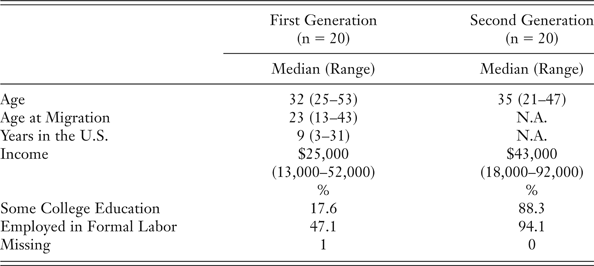
As Table 1 outlines, the second generation had attained higher levels of education than the first. The majority of the first generation had completed their education prior to high school, but the majority of the second generation had completed at least some college. In fact, at the time of the interview, several second-generation women were actively pursuing college degrees. Women of both generations were similarly involved in the labor force, but their employment statuses differed. Nearly all of the second-generation women were employed in the formal labor market, compared to approximately half of the first generation. However, nearly all unemployed first-generation women engaged in informal and occasional income-generating activities, such as providing child care in their homes, selling beauty products, and making food and crafts for sale.
Sociodemographic Characteristics of Study Participants

Data analysis involved a multistep process that integrated procedures suggested by various authors (Charmaz Reference Charmaz and Emerson1983; Chesler Reference Chesler1987; Patton Reference Patton1990, Reference Patton2002; Strauss and Corbin, Reference Strauss and Corbin1998; Tesch Reference Tesch1990). A coding scheme was developed inductively from initial readings of a subset of transcripts and informed by the research aims. This coding scheme guided the systematic review of the qualitative data and their organization into analytical categories. Once the women's narratives were coded, a set of recurring patterns emerged. These patterns were analyzed across interviews within each generation, and then across generations.Footnote 4
All the participants' names have been changed to ensure anonymity. The excerpts from the Spanish-language interviews were translated by the author.
“IT'S A LOT OF WORK”: CONSTRUCTING ETHNIC IDENTITIES IN DETROIT
The narratives of women in this study suggest that the process of constructing an ethnic identity within the racialized contexts of the United States is a dynamic one, rife with tensions, contradictions, and resistance. The following results describe some of the ways in which women work through these tensions. I highlight two key themes of women's ethnic identity formation processes, which entail (1) learning about the stigmatized status the racialized structure ascribes to their identity, and (2) distancing themselves from the negative meanings ascribed to Mexican ethnicity. The analysis makes evident that the women exert agency in constructing their identities against structural constraints, such as assimilation pressures, negative stereotypes of Mexicans, and depressed socioeconomic opportunities in their neighborhood and city. Under these conditions, the process of “becoming Mexican” in the United States is quite stressful; as one woman stated, it is “a lot of work.”
“They Tried to Make Me an Outcast”: Learning about Stigmatized Identities
Women's narratives described several ways that they learn about their ascribed status as “the other” under the racialized social hierarchy of the United States. While differences emerged in women's length of exposure to “othering” experiences by generational status, the narratives of women of both generations indicate that learning about one's status as “the other” is a painful process, as evidenced by emotional, and often tearful, expositions of these experiences. Because these themes have been examined in fuller detail elsewhere (see Viruell-Fuentes Reference Viruell-Fuentes2007), I only highlight several key issues here to help contextualize the analyses presented in subsequent sections of this paper.
“Othering” messages refer to those that contribute to “essentializing difference through stereotyping” (Hall Reference Hall and Hall1997, p. 8). As Grove and Zwi (Reference Grove and Zwi2006) explain, the “person or group being ‘othered’ experiences this as a process of marginalization, disempowerment and social exclusion” (p. 1933). For Mexicans and other groups of color, “othering” is one of the processes that results in their being differentially located within the U.S. racial/ethnic structure. Although Mexicans are defined as an ethnic group within the federally mandated Latino racial/ethnic category, historical and contemporary processes of exclusion have rendered them, in practice, a racialized group (Gómez Reference Gómez2007; Gutiérrez Reference Gutiérrez1995; Telles and Ortíz, Reference Telles and Ortíz2008). Accordingly, in this paper, I use the term “racialized” to refer to the macrolevel processes that ascribe Mexicans a stigmatized, lower status in the ethnoracial hierarchy of the United States.
The women's narratives exemplify some of the ways in which they experience processes of exclusion—processes that vary by generational status. For first-generation women, exposure to “othering” messages occurred mostly in their workplaces or when they ventured out of the ethnic neighborhood. Patricia, for instance, spoke about a racial encounter at a store in a mostly White outskirt of the city of Detroit:
You feel that people are looking at you ugly [because you are Mexican]. And sometimes people do show it openly, right? They look at you up and down…. And [the other day at the store] there were two older White women behind me, and they were looking me up and down just like that; I tried smiling at them, but they wouldn't smile back. They were staring at me; it upset me.
Liliana, a food service worker, said: “Most of the time, they try to humiliate us Mexicans. Like in everything, I think this happens everywhere, for not knowing English, for being Hispanic … Americans hate us.” Marta, in speaking about her work environment, echoed this sentiment: “We are discriminated against because of being Mexican.” Narratives of women like Patricia, Liliana, and Marta indicate that women are keenly aware of being ascribed a stigmatized status. Nevertheless, compared to the second generation, the first generation's exposure to these messages is for a shorter length of time, in part because they come to learn about their stigmatized status through the migration and settlement processes in their adult years (Viruell-Fuentes Reference Viruell-Fuentes2007).
In contrast, the second generation revealed that exposure to “othering” messages began early in their lives and continued through their life course. These experiences included not only being directly targeted with these messages as children and as adults, but also witnessing the maltreatment of other Mexicans and simply living in a racialized society where, as one woman said, such “othering” messages “linger in the air” (Viruell-Fuentes Reference Viruell-Fuentes2006, Reference Viruell-Fuentes2007). Rosa, for instance, said, “Growing up, they [kids] would call me names, and stuff like that; they tried to make me an outcast. They were like, ‘you're a wet-back.’” Clara added, “I always saw [my stepfather's] struggle and I would see the prejudice around him sometimes. And it would hurt me…” Alma echoed other women's sentiments when she said:
I remember growing up … we were on our way to school, me and my sister … and we heard some kids talking about, “They're coming, they're coming … get away 'cause they're going to take all the Mexicans and they're going to take you back to your country. You have to go.” And we just looked at each other and we got scared…. And we just turned around went back home because we were afraid. You know, I mean, we would hear things…. We heard that the White people would come and get us and would take us away and steal us. And it was, like, wow! Where do you run? Where do you go?
As other scholars have indicated, that second-generation women are targeted with such messages—“you're a wet-back”; “they're going to take all the Mexicans and they're going to take you back to your country”; and so forth—speaks to the conflation of Mexicanness with immigrant status (De Genova Reference De Genova2007). Thus, although they were born in the country, the second-generation women are perceived as foreigners and targeted with the same messages that first-generation Mexican immigrants often encounter. Exposure to these messages left women with the tacit sense of being different; Lourdes and Teresa put it succinctly when they said: “I didn't fit anywhere” and “I always knew I wasn't White.” As they struggled to make sense of their ascribed status as “the other,” women often asked themselves, “Where do I fit in?”
The relevance of these narratives partly lies in that they represent the backdrop against which women negotiate a sense of belonging. These “othering” narratives, as the extensive historical and contemporary literature on Mexican immigration has documented, represent but one set of a barrage of practices that depict Mexicans as an inassimilable people and a threat to the nation (Chavez Reference Chavez2008). Women's experiences with “othering” messages provide a context from which to better understand the sometimes contradictory strategies that they use to negotiate a sense of belonging. By necessity, women's ethnic identity formation strategies engage the stigmatized meanings of Mexicanness, even as they attempt to resist such meanings.
“We Were Different”: Distancing from Stigmatized Ethnicities
In this section, I describe the women's efforts to resist the stigmatized meanings ascribed to their ethnicity by the larger society. Their narratives reveal the tensions that arise in this process, for in attempting to refute such negative meanings, they unwittingly accept the very meanings they are attempting to resist.
One dimension of ethnic identity formation that women highlighted involved figuring out what it meant to be Mexican in an economically depressed context. In other words, understanding one's ethnic identity involved making sense of the economic stagnation some women observed among their co-ethnics. This process is best illustrated by narratives in which the women paradoxically distance themselves from negative meanings of Mexicanness, even as they use that same negative language to explain the limited mobility they witness among other Mexicans in their neighborhoods and workplaces. For instance, Irma, a first-generation woman, had this to say about her second-generation Mexican boss:
To tell you the truth, speaking about my manager, I don't know what happened to him. He was born and raised here [in the United States]. I don't know what he's doing being a manager at a restaurant. He could have had a job sitting down in front of a computer, or another job less physically exhausting…. And that's why I say I don't know what happened to him. Why didn't he take advantage of the educational opportunities here? He's the son of Mexican parents; he was born and raised here. He could have had a better paying job; he could be doing better economically, but I don't know what happened.
Irma is puzzled that her manager, who, despite being been born in the United States, works at a service-sector job—in a higher position than hers, but still one that she associates with hard menial work and low socioeconomic status. To her, as to many first-generation women, being born in the United States implies access to opportunities unavailable to those with limited English language skills and undocumented immigrant status. Irma is baffled that her boss's economic position is inconsistent with her notion that the combination of hard work, English language proficiency, and documented immigrant status or citizenship leads to unequivocal economic betterment. She is so distraught by the inconsistency that she often returns to it in her narrative; moreover, in her efforts to bridge the cognitive dissonance, she falls back upon stereotypes—e.g., Mexicans as unmotivated to succeed—to make sense of the situation. For instance, she says, “Mexicans who are born here are apathetic … they are so blasé and don't get far.”
Other women also engaged in similarly problematic readings of U.S.-born Mexicans as lazy, lacking in drive, and being welfare-dependent; Silvia, for example, said:
Sometimes, because they have been born here, they [U.S.-born Mexicans] don't like to work. They don't like to work; they just want to live off the government. Not us, we [Mexican immigrants] like to work…. They are like, more dependent on the government, like they can ask for everything they want…. Not me, I find a way if I need money or something. Even if I don't have anything, I make food to sell or other things.
Through such interpretations of U.S.-born Mexicans' lives and socioeconomic paths, women like Irma and Silvia distance themselves from the stereotype of Mexicans as being unambitious and lacking in effort, even as they consider those same stereotypes to be valid for U.S.-born Mexicans. Such contradictions suggest how potent and divisive is the threat of being stigmatized by the racialized society for one's class and ethnicity.
On the other hand, second-generation women also engaged in similar, contradictory processes, in which they distanced themselves from negative meanings of Mexicanness while simultaneously reinscribing such meanings on other Mexicans. For Diana, as for other second-generation women, the struggle was evident in the frequency with which she returned in her narrative to how her way of being Mexican—and her family's ways—differed from those of other Mexicans in her immediate social sphere. Below are two examples from Diana's narrative:
You know, my parents were different [from other Mexicans]…. [In my family] there isn't like, alcohol abuse, there was never domestic violence…. You know, he [my father] was never late or absent from work, you know. If he didn't know how to do something, he would find a way to get it done, or to learn how to do it….
Later on she said:
And he [my father] is like, well, I have to go and learn English, because I need to learn to be able to get around. And so I think, you know, that was different, because even [now], some of his friends [have] never learned the language…. He wanted us to go to school…. My father was very different…. We were different. And like I said, some of the other [Mexicans we knew] … they dropped out of school, or they just finished high school, you know, and they're working at restaurants or they're working construction, or they're doing other things, when they could have been doing, you know, getting an education.
Lourdes, similarly, attempted to distance herself from stereotypes of Mexicans; her narrative is insightful because she points to the gendered meanings of Mexicanness that she seeks to reject. She said:
I've talked to some other women who were from Mexico, and they teach their daughters to cook, to clean, to sweep the floor. “You're going to grow up, and you have to be a good wife. So you need to know how to do these things.” As opposed to my husband and I, even though he was from Mexico, we'd say, “Okay, you're going to go to school, you're going to go on to college, get a good education, and do something good with your life….” I don't hear other parents saying that…. I was involved in the parents' group at school and some other groups in the community, and I always felt out of place because my ideas were not like the other [Mexican] women in the group… .
The accounts of second-generation women like Silvia, Irma, Diana, and Lourdes exemplify their struggle to create a narrative that endows their ethnic identity with positive qualities in the context of depressed economic opportunities. In the process, they simultaneously “accept” and resist the stereotypes of Mexicans that depict them, for example, as having poor work ethic, low educational aspirations, and engaging in dysfunctional behaviors. Their narratives reveal the contradictions and tensions that arise in claiming an ethnic identity under stigmatizing conditions, which renders their resistance contradictory.
Even as women of both generations recounted the ways by which they distanced themselves from negative meanings ascribed to their ethnicity, they also noted being at the receiving end of others' distancing efforts. Narratives around this theme often pointed to tensions across generations about what it means to be Mexican in the United States. For instance, some first-generation women spoke about their disappointment at sometimes being mistreated or witnessing other immigrants being mistreated by U.S.-born Mexicans, from whom they expected at least fair treatment, given their common heritage. Speaking on this theme, Victoria said, “Those are the ones that treat you the worst.” She also said, “It makes me angry and frustrated…. Just because you are Mexican and do not speak the English language, they treat you as if you were less. And that's very sad … that your own people would treat you badly.” Thus, first-generation women felt rebuffed by U.S.-born Mexicans because of their immigrant status.
On the other hand, the second generation also reported being disparaged by Mexican immigrants for “not being Mexican enough.” For instance, Lourdes spoke about how these experiences, combined with “othering” by Whites, put second-generation women like her in a tight spot. She said:
We've had people who've just come here from Mexico, friends of [my children who] say, “Well, you're not really Mexican.” And yet you have the White people who say that you are not White…. I like to identify myself as being Mexican, but if I say that, then the Mexican people will say you're not Mexican. People—my neighbors will say well, you're not really Mexican. You don't go to Mexico, your kids don't speak with a Spanish accent; you can't read it [Spanish].
These narratives illustrate the intra-group tensions that arise as first- and second-generation women endeavor to construct an ethnic identity in relation to other Mexicans, especially with Mexicans of differing generational status. More importantly, women of both generations made evident that their ethnic identity formations involve battling with the negative meanings ascribed to their ethnicity. This is an emotionally strenuous process that results in conflicting stances in relation to their co-ethnics. In engaging with the messages ascribed to them by the larger society even as they resist them, women's distancing strategies resemble the forms of dissenting citizenship enacted by participants in Maira's study of Muslim youth (Reference Maira2009).
The narratives analyzed above also have parallels in other studies that have documented similar distancing strategies enacted by U.S.-born Mexicans and Mexican immigrants. Ochoa (Reference Ochoa2004), for instance, documented how U.S.-born Mexicans who ascribe to assimilationist perspectives were more likely to distance themselves from Mexican immigrants and to chide them for not speaking English. Jiménez (Reference Jiménez2010) also noted how working-class Mexican Americans actively distance themselves from Mexican immigrants by avoiding places that immigrants frequent. Conversely, as with the women in my study, U.S.-born Mexicans in studies by Ochoa (Reference Ochoa2004) and Jiménez (Reference Jiménez2010) were also at the receiving end of criticism from Mexican immigrants. In their studies, the ethnic authenticity of U.S.-born Mexicans, especially along the lines of Spanish-language proficiency, was called most often into question by immigrants.
The narratives of women in this paper add a layer of complexity to these previous studies. Both first- and second-generation women in this study seem to be grappling less with expectations of each other in terms of language or cultural authenticity, than with making sense of the economic and social stagnation that they, and many of their co-ethnics, experience. In attempting to navigate the marginalized meanings ascribed to their ethnoracial and class positions, they distance themselves from each other. Strategies like these, along with those used by participants in other studies, illustrate how Mexicans in the United States both internalize and attempt to resist stereotypes advanced by nativist and racialized ideologies—ideologies that render Mexicans as foreigners, unwilling to learn English, lacking in educational motivation, and ultimately being culturally deficient. In addition, they highlight how women's distancing efforts are also strategies to avert class-based stigma. Problematic as such efforts might be, they make evident that “a lot of work” is involved in constructing ethnic identities under difficult social and material circumstances.
DISCUSSION
The experiences of first- and second-generation women described in this paper suggest that the processes of integration into U.S. society entail more than linear cultural trade-offs, as acculturation-based explanations for Latino and immigrant health outcomes imply. Rather, the processes involve exposure to the stigmatized meanings that the racialized society ascribes to Mexican women's ethnicity and their active resistance to them. These results confirm the need to move beyond models that cast culture in simplistic terms and highlight the need to consider the conditions under which the lives of immigrants and the U.S.-born generations unfold. Women's narratives suggest some ways in which their ethnic identity formation processes may impact health outcomes.
Stigmatized Identities, Discrimination, and Health
The “othering” experiences that women recounted may have implications for health in several ways. First, “othering” processes are part and parcel of the production and reproduction of inequality (Schwalbe et al., Reference Schwalbe, Godwin, Holden, Schrock, Thompson and Wolkomir2000). Thus, at the structural level, “othering” functions to differently locate individuals within the ethnoracial hierarchy of the United States. As the vast literature on social stratification and health has documented, those ascribed a lower status within this hierarchy experience severe limitations in accessing life opportunities, which, in turn, influence exposure to deleterious health conditions (Berkman and Kawachi, Reference Berkman and Kawachi2000; Williams and Sternthal, Reference Williams and Sternthal2010). Second, because it attaches stigma to individuals' identities, “othering” is likely, at the individual level, to be experienced as a psychosocial stressor (Viruell-Fuentes Reference Viruell-Fuentes2007). Like perceived discrimination, it may be linked to health through the chronic production of stress-related hormones, which, in turn, has deleterious effects on a number of physiological processes, including those within the cardiovascular, immune, and nervous systems (McEwen and Lasley, Reference McEwen and Lasley2002; Thoits Reference Thoits2010).
Third, while stigmatizing environments make the construction of positive ethnic identities all the more important, the narratives of women in this study suggest that these processes are not without their tensions and contradictions, as such inhospitable environments render the processes of ethnic identity formation to be very stressful. Thus, as women of both generations illustrate, in attempting to arrive at a positive sense of self, they engage with and actively resist negative meanings about being Mexicans in contradictory ways. The vigilance and related responses involved in enacting such resistance strategies may be another factor that impacts health (James Reference James1994).
Lastly, as the narratives of women in this study and the vast literature on immigration suggest, for Latinos and Mexicans, “othering” processes reflect prevalent racialized nativist ideologies (Chavez Reference Chavez2008; De Genova Reference De Genova2004; Sanchez Reference Sanchez1997). Since the time of these interviews, efforts to single out undocumented immigrants have escalated. Most recently, the introduction of a wide range of anti-immigrant policies aimed at curtailing the rights of immigrants and encouraging their expulsion in several states across the nation have further contributed to creating hostile environments for immigrants and anybody else suspected of being one. In practice, these policies translate into racial profiling of “brown” bodies. These sentiments are aimed at undocumented immigrants, particularly Mexicans, and place them at high risk of discrimination. But such hostile environments also have repercussions for Latinos as a whole because “illegality” is conflated with being an immigrant, which, in turn, is conflated with being Mexican, and more generally with being Latino (De Genova Reference De Genova2007). The dangers of these conflations are most evident in the recent increase of hate crimes against Latinos (Leadership Conference on Civil Rights Education Fund 2009).
Under these tense environments, exposure to “othering” and the stressors embedded in constructing an ethnic identity under hostile environments are likely to increase for many Latinos and take a toll on their health and well-being. Because racialized nativisms generate not only anti-immigrant but also anti-Latino sentiments, they can potentially have deleterious health effects on Latinos across generational and legal statuses. Despite the paucity of research examining the effects of anti-immigrant environments on the health and well-being of immigrants and their U.S.-born counterparts, a few studies do provide evidence of the relevance of anti-immigrant contexts for health. For instance, Williams and Mohammed's (Reference Williams, Mohammed, Lin and Harris2008) analysis of data from the California Health Interview collected in 2001 showed that, compared to previous years, immigrants experienced a decline in health. The authors suggest that “the anti-immigrant rhetoric and fear of impending policies [at the time] adversely affected immigrants' levels of self-rated ill-health and emotional distress” (p. 164). Similarly, Lauderdale (Reference Lauderdale2006) found that Arab American women experienced poorer pregnancy outcomes following the heightened anti-Arab sentiments in the years following 9/11. Future research that considers the impact of anti-immigrant environments on health and well-being across generational and legal status, however, is necessary.
Limitations and Directions for Future Research
This study focused on two aspects of ethnic identity formations: learning about being ascribed an “other” status and about intra-group tensions that emerge in the processes of resisting the stigmatized meanings associated with being considered “the other.” This is not to suggest that women's efforts at resistance only include distancing, for they indeed employ a broader set of strategies such as making use of social resources available in their neighborhoods and their transnational social ties in order to construct an ethnic identity imbued with pride and solidarity (Viruell-Fuentes Reference Viruell-Fuentes2005, Reference Viruell-Fuentes2006; Viruell-Fuentes and Schulz, Reference Viruell-Fuentes and Schulz2009). How these dimensions of ethnic identity construction function alongside “othering” and “distancing” to impact health, however, require further study. Under marginalizing environments, having access to resources for constructing a positive ethnic identity can potentially be health-protective. Indeed, Cross et al. (Reference Cross, Parham, Helms and Jones1998) propose that a positive racial/ethnic identity is important because it offers “protection … from psychological harm that may result from daily existence in a racist society” (p. 11). Several studies, for instance, have documented a positive relationship between certain dimensions of ethnoracial identities and psychological well-being across various groups, such as Latino youth (Suarez-Orozco and Suarez-Orozco, Reference Suarez-Orozco and Suarez-Orozco2001; Umaña-Taylor and Updegraff, Reference Umaña-Taylor and Updegraff2007), African Americans (Caldwell et al., Reference Caldwell, Zimmerman, Bernat, Sellers and Notaro2002; Munford Reference Munford1994; Njai Reference Njai2008; Sellers et al., Reference Sellers, Caldwell, Schmeelk-Cone and Zimmerman2003), and Asian Americans (Mossakowski Reference Mossakowski2003).
The use of qualitative analysis enabled the examination of processes women engaged in as they navigated the racialized structure of the United States within a specific context and at a particular point in time; this methodological strategy was useful in gaining a deeper understanding of how the specific urban context intersected with women's ethnic identity formations. The findings presented here, however, should be read as bounded by place and time. As such, this study is limited in its ability to address ethnic identity formation processes prior to migration. Longitudinal and transnational research designs would help shed light on pre- and post-migration ethnic identity formations.
The findings in this paper suggest that the contexts of women's lives are integrally connected to the dynamics of ethnic identity formations (Mahalingam et al., Reference Mahalingam, Balan and Haritatos2008; Mullings and Schulz, Reference Mullings, Schulz, Schulz and Mullings2006). Examining potential variations in these processes across different geographic, social, and economic contexts can contribute greatly to our knowledge and understanding of how these processes impact immigrant health.
Women's narratives call attention to the socioeconomic contexts and gender dimensions of ethnic identity constructions. In so doing, these stories highlight the importance of examining the intersections among ethnicity, socioeconomic position, immigrant identities, and gender ideologies. Examining the women's ethnic identity formations in relation to other racialized groups, such as African Americans, is also important and necessary in future research.
CONCLUSION
This study reinforces the importance of theoretically informed research on the reciprocal relationships between culture and structure (Ford and Harawa, Reference Ford and Harawa2010). The complexities and patterns highlighted here contribute to a more nuanced examination of how ethnic identity formations may impact health. The findings suggest an expanded conceptualization of ethnic identity formation as intersecting with class and gender, unfolding across the life span, and as “never complete, always in process” (Hall Reference Hall and Rutherford1990, p. 222). Lastly, this study contributes to a broader conceptualization of culture in health research, one that treats culture as influenced both by the structural contexts within which individuals find themselves and their active efforts to navigate those contexts (Ortner Reference Ortner1989).