[T]he purchase by the American [Telegraph and Telephone] company, either in its own name or in the names of others, of the majority stock of the Kellogg [Switchboard and Supply] company with the purpose and intent of controlling the latter and putting it out of business as a competitor … was an attempt to exercise a power which it did not have. … [I]t would seem to follow that each and every stockholder in the latter company would have the right to say that the American company … should be restrained.
—Justice Jacob W. Wilkin, Illinois Supreme Court (1906)Footnote 1In 1903 the American Telephone and Telegraph Company (AT&T) bought a majority interest in the Kellogg Switchboard and Supply Company, allegedly with the aim of eliminating competition in the telephone business. Perhaps it is not remarkable that the Illinois Supreme Court ruled this acquisition of an Illinois corporation to be illegal. What is noteworthy, however, is that the court took this step at the behest of a group of Kellogg's minority shareholders who had filed suit to block the deal. Judges had long responded skeptically to such actions, worried that shareholders would clog the courts with challenges to managers’ decisions or, even worse, use the courts opportunistically to extract payouts from their companies. But they began to change their minds during the Great Merger Movement of the turn of the century. As thousands of previously competing firms disappeared into giant consolidations that controlled the lion's share of their industries, judges concerned about the increase in market power in the United States economy came to see “each and every stockholder” as a potential ally in the struggle against monopoly.
As we show in this article, judges went through a similar progression in their thinking about voting trusts; that is, agreements by which stockholders transferred their shares in a corporation, and the voting rights that went along with them, to one or more trustees who then exercised control. Initially judges had responded positively to such agreements, recognizing that they could further desirable goals such as ensuring managerial stability or inducing bankers to come to the aid of a company in financial distress. By the late nineteenth century, however, the Standard Oil Company and other large consolidations had demonstrated that voting trusts could also be used to evade state laws forbidding corporations from owning stock in other companies and to suppress price cutting by merging competitors into giant combines. After New Jersey famously liberalized its general incorporation statute to permit holding companies, this use of voting trusts abated, but by the 1910s, critics were again presenting evidence that the “money trust” was exploiting the device for purposes of economic domination. Both sets of revelations encouraged judges to rethink the legal rules governing voting trusts, and to restore market competition, they increasingly supported shareholders’ attempts to invalidate these agreements.
Scholars have long understood that the American regulatory system differs from its European counterpart in the extraordinary extent to which it relies on private lawsuits. Political scientist Sean Farhang has shown, for example, that conflict with the president during the 1960s led Congress to build a “private enforcement regime” for the Civil Rights Act of 1964 by deliberately embedding provisions in the legislation that empowered any person “aggrieved” by discriminatory behavior to seek injunctive relief.Footnote 2 Legal scholars have similarly highlighted the important role in American jurisprudence played by “private attorneys general.” Judge Jerome Frank coined the phrase in a 1943 federal appeals court decision interpreting the Bituminous Coal Act of 1937, which granted standing to persons “aggrieved” by orders of the coal commission to appeal to the relevant federal circuit.Footnote 3 In fact, however, this type of regulatory design goes back at least to the False Claims Act of 1863, which authorized private citizens to sue and collect damages from individuals who defrauded the government.Footnote 4 It also played an important role in antitrust enforcement from the very beginning. The Sherman Act of 1890 gave any person or company injured by anticompetitive behavior the right to sue in federal court and recover treble damages, and most state antitrust statutes included similar inducements. Although the number of private antitrust suits filed over the next couple of decades was small by the standards of the late twentieth century, it surpassed contemporary prosecutions by federal and state officials combined.Footnote 5
Important though these private antitrust actions were in the late nineteenth and early twentieth centuries, they were only part of the story of how private litigants advanced competition policy. As we show in this article, lawsuits brought by shareholders under state general incorporation laws also played a significant role in limiting anticompetitive conduct and extending the government's regulatory capacity, though one that has largely gone unnoticed in the literature. Whereas the literature on private enforcement regimes and private attorneys general highlights the conscious way in which legislatures harnessed private litigation for policy ends, we extend this analysis by documenting for the case of antitrust law the parallel efforts that judges made to turn private civil suits in adjacent areas of the law into tools of regulatory policy. In the process, we also contribute to the growing body of literature challenging the conventional wisdom that the states, which early on had taken the lead in antitrust prosecutions, had largely ceded this terrain to the federal government by the early twentieth century. Scholars have documented the ongoing vigor of antitrust initiatives in states like Texas and Kansas and have shown that these efforts reshaped the structure of important national industries like petroleum.Footnote 6 We go beyond this literature by showing that state legislatures throughout the United States reinforced judges’ initiatives by revising their corporation laws in ways that made it easier for shareholders to challenge anticompetitive mergers. More importantly, we show that legislatures responded to the legal uncertainty that judges’ changing views of voting trusts produced by passing laws that effectively removed the devices from the monopolists’ tool kit. In the end, we argue, these revisions to state incorporation statutes were as important as the Clayton Act in limiting finance capitalism's reach over the American economy. In combination with federal and state antitrust statutes, they exerted an enduring check on monopoly power in the United States economy.
The Ongoing Importance of State Antitrust Enforcement
Standard Oil sparked the antitrust movement in the 1880s when its lawyers figured out how to evade state prohibitions on holding companies by using a voting trust to consolidate the petroleum industry. Although courts generally allowed majority shareholders to form voting trusts to stabilize control in their own companies, exploitation of the device as a tool of horizontal combination was something new, and Standard's innovation inspired imitators in a number of industries, ranging from sugar to cottonseed oil to whisky to lead.Footnote 7 It also provoked a political backlash. Even before Congress enacted the Sherman Antitrust Act in 1890, more than a dozen states had passed laws criminalizing combinations that restrained trade or aimed to create a monopoly, and most of the rest would follow over the next decade.Footnote 8 At the same time, state attorneys general began to launch quo warranto suits to revoke the charters of corporations that participated in trusts. Literally meaning “by what authority,” quo warranto proceedings allowed state courts to dissolve corporations that joined combines on the grounds that the arrangements violated the terms of their charters.Footnote 9 All that prosecutors had to document was the ultra vires character of the agreement—not the extent to which it restrained trade. As New York's high court declared in a case involving the sugar trust, “[T]he defendant corporation has violated its charter and failed in the performance of its corporate duties. … Having reached that result, it becomes needless to advance into the wider discussion over monopolies and competition and restraint of trade.”Footnote 10
The ability to bring quo warranto suits meant that states had a powerful weapon to wield against combines that the federal government did not possess. Some contemporaries believed that the states’ regulatory powers over corporations took precedence over, and hence constrained, those of the federal government. Others worried that federal intervention would undermine states’ authority over their corporate creatures. As legal historian Charles McCurdy has shown, Chief Justice Melville Fuller's infamous distinction between manufacturing and commerce in United States v. E. C. Knight (1895), a federal antitrust suit against the sugar trust, was a deliberate effort to preserve the states’ power to regulate corporations. If the Supreme Court had invoked the Constitution's commerce clause to break up the trust, it would have pre-empted state law, creating what Fuller feared would be a legal vacuum. Contemporaries tried several times to resolve the problem by securing a federal incorporation law, but these efforts failed.Footnote 11
Notwithstanding Fuller's concern, the locus of antitrust activity shifted during the early twentieth century from the states to the federal government. Scholars have advanced three related explanations for this development: New Jersey's liberalization of its general incorporation laws and the resulting regulatory race to the bottom, states’ reluctance to inflict harm on their domestic economies by prosecuting combines chartered in other states, and states’ increasing inability to control businesses operating in broader national or even international markets.Footnote 12 Although the heightened importance of federal antitrust initiatives was certainly very real, more recent scholarship has cast doubt on these explanations, highlighting the ongoing vigor with which at least some states continued to pursue antitrust agendas and suggesting that the literature has exaggerated the extent to which states raced to the bottom. What emerges from this newer research is not a simple story of a shift from state to federal authority, but rather a more complex political-economic analysis that points to the persistence of variation across states in the extent and significance of antitrust activity.Footnote 13
Most state attorneys general were popularly elected. They had considerable discretion about whether or not to proceed against trusts, and they responded to the enormous political pressures to which they were subject in heterogeneous ways. At one extreme, Ohio's attorney general filed suit to dissolve the Standard Oil Company despite overt threats to his political future from Republican Party bosses.Footnote 14 At the other, Massachusetts’ top lawyer resisted a concerted newspaper campaign that he take action against the trusts.Footnote 15 New York's attorney general went after the American Sugar Refining trust when it sought to close down a company in the state, but none of his predecessors had taken any action against the combine, even though it had existed for some years and controlled all the sugar refineries in the state. Nor did New York officials bring suit against any of the other trusts that, like Standard Oil and the Cotton Oil Trust, maintained headquarters in New York City.Footnote 16
This variation continued through the first several decades of the twentieth century. Some of the states that pursued quo warranto actions in the 1880s and 1890s became relatively quiescent in the new century (Pennsylvania is a good example), but other states stepped up their activities.Footnote 17 Texas's antitrust initiative in petroleum, which played a major role in restructuring that industry, began after the discovery of the Spindletop oil field in 1901 and continued for several decades after the United States Supreme Court broke up the Standard Oil Company in 1911.Footnote 18 Missouri and Kansas joined Texas's attack on Standard and then took on other trusts, most notably International Harvester.Footnote 19 Other states also moved against these companies, with as many as thirteen state attorneys general meeting in St. Louis in 1907 to coordinate their prosecutions.Footnote 20 These lawsuits were sufficiently bothersome that International Harvester and other affected companies repeatedly appealed them (mostly unsuccessfully) to the United States Supreme Court, claiming that the prosecutions violated the Fourteenth Amendment's due process and equal protection clauses.Footnote 21
Regardless of their determination to challenge the trusts, state attorneys general commonly lacked the funds and administrative capacity needed for effective enforcement. As a result, some of the early quo warranto suits depended on private parties to initiate the complaint, coordinate the investigation, and/or fund the proceedings. Illinois's victory against the Chicago Gas Trust, for example, owed much to the activism of the Citizens’ Association of Chicago (CAC), a municipal reform league. The state's 1872 general incorporation law stipulated that corporations could only be formed for legal purposes, and required them to declare their purpose along with other information when registering with the secretary of state.Footnote 22 Yet no official in that office seems to have noticed that the Chicago Gas Trust Company, organized in 1887, aimed to control all the gas companies in the city, contrary to law. Francis Peabody, the CAC's president, brought this fact to the attention of Attorney General George Hunt in 1888 and asked him to bring suit against the illegal corporation. Hunt agreed with Peabody's assessment and, when the CAC also offered to pay for a special assistant, brought a quo warranto suit against the company and won.Footnote 23 Taking the CAC's position, Justice Benjamin Magruder of the Illinois Supreme Court declared, “To create one corporation that it may destroy the energies of all other corporations of a given kind, and suck their life blood out of them, is not a ‘lawful purpose.’” The court ordered the company dissolved.Footnote 24
Over time most states took steps to build up their antitrust capabilities by increasing funding and staffing of the attorney general's office.Footnote 25 Some states also created new administrative bodies to scrutinize corporate charters and enforce conformity with both general incorporation and antitrust laws. For example, in 1898 Kansas created a charter board to review applications for charters by domestic companies and also all requests by foreign (out-of-state) corporations to do business in the state.Footnote 26 Some states even wrote provisions into their constitutions mandating the creation of “corporation commissions” responsible for regulating railroads and utilities but also for overseeing corporations more generally. For example, Oklahoma's 1907 constitution mandated that “[t]he records, books, and files of all corporations shall be, at all times, liable and subject to the full visitorial and inquisitorial powers of the State.” It vested these powers in a commission, to which any resident could submit grievance.Footnote 27
Despite these investments, attorneys general complained that their budgets were not sufficient for effective enforcement, and they probably were not. Even in Texas, a state with many successful antitrust prosecutions, the attorney general's office was woefully underfunded. Texas compensated for the lack of administrative capacity at the top by granting district and county attorneys a share of any damages from antitrust suits, thus providing “an undersized attorney general's department with investigators.”Footnote 28 Other states imposed statutory obligations on local officials to aid in antitrust enforcement, and most also included incentives in their antitrust laws for private parties injured by anticompetitive behavior to sue.Footnote 29 In addition, as we will show in the next section, shareholders might be enlisted in the struggle against the trusts.
The Antitrust Applications of Shareholders’ Derivative Suits
If state attorneys general lacked the capacity (or the will) to ensure that corporations conformed to the law, there was still the possibility that shareholders would take action under state incorporation statutes or more general principles of law and equity. Shareholders had two basic ways to proceed. They could bring direct action suits in a court of law if the corporation's officers had violated their rights, for example, by preventing them from voting at a general meeting or denying them access to the corporation's books. Shareholders could also file derivative suits in a court of equity if they had evidence that the corporation's officers and directors had engaged in illegal or fraudulent activities to the detriment of the firm. In the latter case, the injured party was technically the corporation itself, but shareholders had legal standing to sue if they could show that the corporation was under the control of the alleged wrongdoers.Footnote 30 Although most shareholders’ suits involved disputes over internal business decisions that had nothing to do with competition policy, during the merger waves of the late nineteenth and early twentieth centuries, combines often acquired businesses with the aim of shutting them down—what is today referred to as a “killer acquisition.” Shareholders who were adversely affected by the closings sometimes launched derivative suits to block the mergers, claiming that the majority was using its voting control for illegal purposes. In this way, private suits about corporate governance might advance broader antitrust goals.
Nineteenth-century policy makers understood that shareholders could serve as a check on those in control of corporations, and for this reason, many states imposed voting rules that boosted the power of minority shareholders.Footnote 31 But policy makers also worried that self-interested shareholders might use litigation to extract more than their fair share of corporate revenues. Mergers were particularly problematic because, under common-law rules, they required shareholders’ unanimous consent and hence gave unscrupulous owners the ability to block profitable deals unless they were paid off. Following New Jersey's lead in 1888, most states solved this problem by enacting statutes that routinized the merger process, setting a voting threshold for approval and providing a procedure for buying out dissenting stockholders. The voting threshold could be lower or higher depending on where policy makers wanted to set the balance of power between shareholders and directors. New Jersey's law required only a simple majority vote, but Massachusetts, Illinois, and California mandated two thirds.Footnote 32
Derivative suits posed similar trade-offs. On the one hand, judges recognized that the purpose of these suits was to provide shareholders with a remedy against exploitation by corporate directors. On the other, they worried that shareholders would use these challenges opportunistically to extract payouts or that the courts would be deluged with cases from shareholders who disagreed with directors’ business strategies. These concerns led judges to impose high evidentiary requirements for such actions. Not only did shareholders have to demonstrate that they had no means of addressing the problem through normal corporate governance procedures, but they also had to show that the directors’ behavior was illegal or fraudulent. If the disagreement was simply a matter of “business judgment,” then the courts would not intervene, even if the corporation sustained heavy losses.Footnote 33
In the early years of the antitrust movement, the high bar that judges applied to derivative suits carried over to cases involving anticompetitive mergers. In 1891, for example, a Louisiana court rebuffed a minority shareholder in the Bienville Oil Works, who sued to recover damages after the company was dissolved and its assets sold to the American Cotton Oil Trust. Four years earlier, a district court in the Parish of Orleans had issued an injunction prohibiting the trust from doing business in Louisiana because it had not incorporated under state laws, paid no taxes, and aimed to monopolize Southern oil mills.Footnote 34 Piggybacking on this ruling, the Bienville shareholder claimed that the directors had, “by a secret and fraudulent combination and bargain with the American Oil Trust, an alleged unlawful organization,” transferred their stock to the trust “to subserve its own interests, and in disregard of their obligations to the other stock holders and in violation of their rights, have thus wrecked the company, thereby destroying the value of its stock other than that held by the trust.”Footnote 35 The Louisiana Supreme Court determined, however, that the plaintiff—“an unfortunate and improvident loser”—could have followed the other stockholders’ example and exchanged his shares for certificates in the trust. Even after the deadline for the exchange expired, he had been offered some money for his shares, but he held out for a higher price. His losses therefore were his own fault, and he had “no occasion legally to complain.” In the absence of any express statutory prohibition or fraud, the requisite majority of stockholders had “absolute” discretion to wind up the corporation's affairs “for reasons by them deemed sufficient,” and the court had no authority to second guess their decision.Footnote 36
Judges were willing to limit controlling shareholders’ “absolute” discretion in cases in which government officials, rather than minority shareholders, challenged a merger as ultra vires. For example, in 1890, Nebraska's attorney general brought suit to revoke the charter of a corporation whose shareholders had sold its property to a trust. In this case, the court ruled that “the fact that the corporation has authority to put an end to its existence by a vote of a majority of its stockholders … does not authorize it to terminate its existence by a sale and disposal of all its property and rights” to an “illegal combination” out to “destroy competition and create a monopoly.”Footnote 37 Judges were reluctant, however, to allow shareholders to usurp the attorney general's powers and make claims on the basis of public policy. Illinois's Supreme Court dismissed a suit by a shareholder who sought the dissolution of the National Linseed Oil Company on the grounds that it was an illegal combination, insisting that “[o]nly the State can complain of injury to the public or that public rights are being interfered with, and enforce a forfeiture of defendant's franchise for that reason.”Footnote 38 In this case, the state's activist Attorney General, Maurice Moloney, followed up by filing a quo warranto suit, which National Linseed belittled as just “a rehash of a bill previously filed” by the stockholder.Footnote 39
There was no guarantee that attorneys general would take action, however, and so, as the Great Merger Movement gained momentum in the late 1890s, some judges began to lay out a legal justification for private derivative suits that served public antitrust objectives. Just one year after the Illinois Supreme Court dismissed the private suit against National Linseed, it permitted a shareholder in another corporation to block the sale of its factory to the American Glucose Company, a consolidation organized as a New Jersey corporation.Footnote 40 Justice Magruder, who had earlier written the decision dissolving the Chicago Gas Trust, delivered the court's opinion. A thrice-elected Republican jurist, he would be remembered, posthumously, for his “righteous indignation at the schemes of fraud and indiscretion by which some of the great enterprises of modern business life have been accomplished.”Footnote 41 After a detailed recounting of the glucose combination's scheme to have “six corporations shut down their manufactories, and abandon their business” for the purpose of reducing competition in the industry, Magruder ruled that the stockholder who brought the case had standing to sue because the value of his shares would be adversely affected by the planned closure. “If the purpose of such dissolution is not the bona fide discontinuance of the business, but is the continuance of the business by another new corporation, then the . . . dissolution is practically a fraud on dissenting stockholders.”Footnote 42 That declaration would have been enough to decide the case, but Magruder went further. Citing William Cook's treatise on corporations, he asserted that selling the company to the combine exceeded the powers of the corporate directors, violating not only public policy but also shareholders’ rights. “Any act or proposed act of the corporation, or of the directors, or of a majority of the stockholders, which is not within the expressed or implied powers of the charter of incorporation, or of association—in other words, any ultra vires act—is a breach of the contract between the corporation and each one of its stockholders.” Therefore, “any one or more of the stockholders may object thereto, and compel the corporation to observe the terms of the contract as set forth in the charter.”Footnote 43
This ruling granted shareholders formidable powers to challenge anticompetitive mergers. That the court intended to embolden shareholders to contest mergers was confirmed a few years later in Dunbar v. American Telephone and Telegraph Company, a decision written by another long-serving Republican jurist on the Illinois Supreme Court, Jacob W. Wilkin. Shareholders in the Kellogg Switchboard and Supply Company had brought suit to prevent AT&T from acquiring their firm. As in the American Glucose case, the court held that AT&T had purchased the company's stock with “the unlawful purpose and intention of putting [it] out of business or so using and controlling it as to prevent rivalry in business and creating a monopoly.” To allow the acquisition to go ahead “would be against the law of this State and its public policy.” It therefore followed that “each and every stockholder” in the switchboard company had the right to sue to restrain AT&T from voting “stock which it did not and could not legally own.”Footnote 44
Judges remained wary of opportunistic shareholders and, especially where antitrust concerns were not involved, continued to impose high barriers to derivative suits. The very next year after the Illinois Supreme Court found against AT&T in Dunbar, an appeals court in the same state dismissed a suit by shareholders in the Universal Voting Machine Company who charged that the directors had “fraudulently contrived to wreck” their company by transferring its property to an out-of-state corporation. The court distinguished the case from Dunbar, which also involved a foreign corporation, on the grounds that the transfer did “not appear to have been performed for the furtherance of any illegal trust or combination.” Because the acquisition was not “contrary to the general public policy of the state of Illinois,” the court would not intervene. “To grant the relief prayed would be clearly an interference with the internal management of a foreign company” and therefore beyond the court's jurisdiction.Footnote 45 Nonetheless, the Dunbar and American Glucose cases show how judges’ concerns about anticompetitive mergers could over-ride their reservations about derivative suits. Whether shareholders were opportunistic or not, they offered jurists a valuable ally in an environment where attorneys general often lacked either the capacity or the will to move against monopolistic combinations.
Many state legislatures revised their general incorporation laws to facilitate this kind of assistance, often adding anti-monopoly provisions that expanded the grounds on which shareholders, as well as state attorneys general, could challenge anticompetitive mergers. For example, when New York liberalized its merger provisions in response to New Jersey's enactments, it added the proviso that “[n]o stock corporation shall combine with any other corporation for the prevention of competition.”Footnote 46 A number of other states, including Ohio and Illinois, similarly amended their general incorporation laws to facilitate ordinary mergers but prohibit them for anticompetitive purposes.Footnote 47 Even New Jersey followed suit when it enacted its so-called “Seven Sisters” antitrust laws in 1913, although the resulting loss of its chartering revenues caused it quickly to backtrack.Footnote 48
That these statutes facilitated shareholders’ suits can be seen from the experience of Clarence H. Venner, a professional litigant who made a career of filing derivative suits against deep-pocket financiers and major public corporations.Footnote 49 Venner used the prohibition against anticompetitive mergers in New York's stock company law to bring a complaint against the Interborough Rapid Transit Company and the financiers who underwrote the combination. Venner ultimately was not able to convince the federal judge who heard the suit that Interborough was an illegal monopoly, in part because he was exactly the kind of plaintiff jurists distrusted. As the judge observed sarcastically, “Much time has been devoted to picturing the evil result of monopoly, but nothing has been done toward showing that complainant has lost a dollar by exactly what Mr. Venner knew was going to be done when he caused the stock to be purchased.”Footnote 50 Nonetheless, without the existence of New York law, it is doubtful whether Venner would even have gotten his day in court. In an earlier proceeding, the transit company had tried to block the lawsuit, but another federal judge allowed it to proceed on the grounds that the complainants had properly alleged the company to be an unlawful monopoly under the merger section of New York's stock company law.Footnote 51
Shareholders’ Challenges to the Use of Voting Trusts for Monopoly Control
Just as judges’ openness to shareholders’ derivative suits waxed and waned in response to the perceived threat of anticompetitive combinations, so too did their receptivity toward corporate voting trusts. Traditionally judges had seen nothing wrong with voting trusts and had looked with disfavor on shareholders’ suits to invalidate them. The growing use of the device as a tool of horizontal combination seems to have spurred judges to rethink the matter, however, and by the late 1880s, they had begun to question the validity of voting trusts in which stockholders irrevocably transferred control over their shares to a group of external trustees—that is, precisely the kinds of agreements that consolidations like Standard Oil were exploiting. Once Standard and other trusts reorganized as New Jersey holding companies, the issue lost much of its urgency, and the case law began to revert to its original posture. But judges’ concerns came back as a result of Congress's Money Trust investigation in 1912–13, when investigators charged that J.P. Morgan and other bankers were using voting trusts to control broad swaths of the American economy.
The first judicial turn against irrevocable voting trusts had its origin in a dispute among railroad tycoons that raged in Standard's home state of Ohio during the 1880s. Investors allied with Collis P. Huntington had sought to withdraw the shares they held in the Cincinnati, Hamilton & Dayton Railroad from a voting trust controlled by Hugh J. Jewett, former president of the Erie Railroad. When Jewett and his allies denied their request, they sued and won in Griffith v. Jewett.Footnote 52 The local Ohio judge who heard the case thought there was nothing illegal about such agreements per se, but he insisted that they had to be revocable. Citing precedents asserting that “the right to vote is an incident of the ownership of stock, and can not exist apart from it,” he ruled that shareholders could not be prevented from withdrawing from voting trusts if they so desired. Otherwise “it may come to pass that the ownership of a majority of the stock of a company may be vested in one set of persons, and the control of the company irrevocably invested in others.” Such a state of affairs, he declared, would be “intolerable” and contrary to the “universal policy” of law that “the control of stock companies shall be and remain with the owners of the stock.”Footnote 53 Of course, this “intolerable” state of affairs was exactly what was happening at that very moment in the companies acquired by Standard Oil and the other trusts, although the judge did not make the connection in his opinion.
The decision in Griffith v. Jewett caught the attention of Simeon E. Baldwin, a prominent professor at the Yale Law School and later chief justice of the Connecticut Supreme Court.Footnote 54 Baldwin had agreed to represent a group of shareholders seeking to withdraw from the voting trust organized to transfer control over the Shepaug, Litchfield & Northern Railroad to the Mercantile Trust Company of New York, and it was most likely he who brought Griffith to the attention of the Connecticut judge who heard the resulting Shepaug Voting Trusts Cases. The judge not only cited the Ohio decision in his opinion invalidating the trust but elaborated on the underlying principle: “It is the policy of our law that ownership of stock shall control the property and the management of the corporation, and . . . this good policy is defeated, if stockholders are permitted to surrender all their discretion and will, in the important matter of voting, and suffer themselves to be mere passive instruments in the hands of some agent who has no interest in the stock, equitable or legal, and no interest in the general prosperity of the corporation.” Voting was a duty that the shareholder owed to other members of the corporation. The shareholder “may shirk it perhaps by refusing to attend stockholders’ meetings, or by declining to vote when called upon, but the law will not allow him to strip himself of the power to perform his duty.”Footnote 55
The following year, Baldwin summarized the Shepaug decision and the cases that preceded it in the Yale Law Journal with the explicit purpose of making these rulings “accessible to the profession.”Footnote 56 He seems to have succeeded; just two years later the Connecticut judge's words found their way into a New Jersey chancery court decision, White v. Thomas Inflatable Tire Company.Footnote 57 The New Jersey court had already come to the conclusion that voting trusts could not be irrevocable in an 1891 decision in Cone v. Russell & Mason, but it had decided that case without reference to the Connecticut or Ohio litigation.Footnote 58 The two streams of case law thus came together in the White case, and a flurry of similar decisions followed based on the Connecticut and New Jersey precedents.Footnote 59
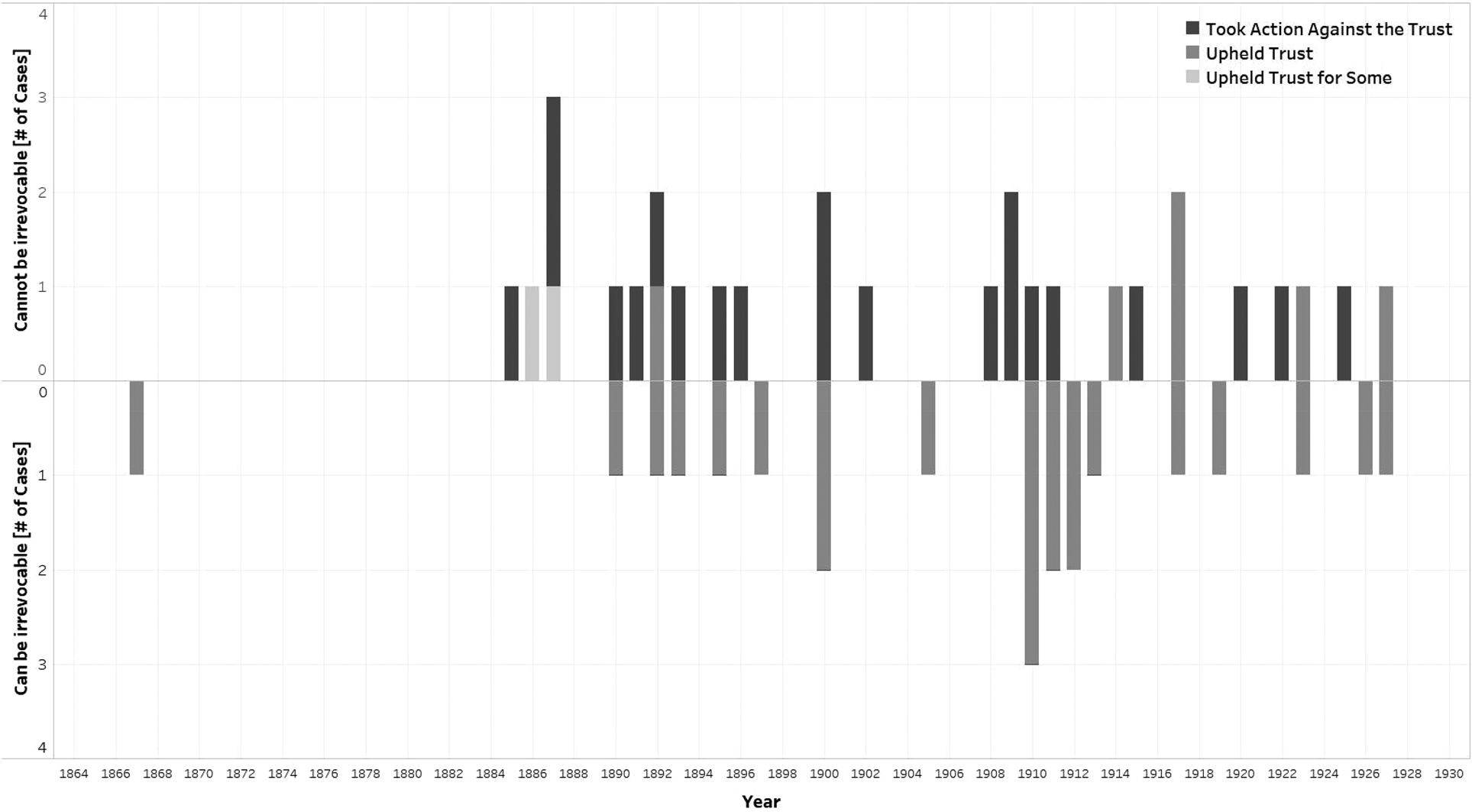
There were still, however, some contrary decisions upholding shareholders’ contractual freedom to enter into voting-trust agreements, whether they were revocable or not.Footnote 60 After Standard and other combines abandoned voting trusts in favor of New Jersey charters, concerns about the misuse of these kinds of agreements seem to have ebbed, and, as Figure 1 shows, decisions upholding voting trusts increased in frequency relative to those invalidating them.Footnote 61 Judge James Keith of the Virginia Supreme Court reflected on this shift in a 1910 decision, Carnegie Trust Co. v. Security Life Insurance Co., upholding an irrevocable 25-year voting trust. It was “impossible,” he declared, “not to be impressed with the change of opinion which has taken place with respect to the true nature of such contracts.” Whereas “a very strong sentiment” against voting trusts had once prevailed, “experience has demonstrated their usefulness, and the hostility evinced toward them has by degrees diminished.”Footnote 62 For Keith, the cases of the preceding decade had clarified the legal parameters of voting trust agreements and, in the absence of a statute regulating them, he thought that voting trusts should be judged by the reasonableness of their objectives: “Where the object of the trust is legitimate … the trust should be upheld and carried out.”Footnote 63
Judicial rulings on voting trusts. Sources and notes: See the Appendix table. The figure excludes cases in which the court's position on the revocability of a voting trust was coded as unclear in the table. The length of the bars represents the number of cases in each category. Cases above the horizontal line are those in which judges ruled that voting trusts could not be irrevocable. Below the line the rulings supported irrevocability. In some cases, judges declared that voting trusts could not be irrevocable but refused to invalidate the particular voting trust at stake in the case. In other instances, they supported irrevocability but invalidated the trust on other grounds. Dark shadings indicate cases in which the voting trust was invalidated or not enforced. Light shadings indicate that the trust was upheld or enforced. The medium gray is for cases in which the trust was upheld for some shareholders but not others.

Whether the case law would have continued to evolve in this more permissive direction is impossible to say, but attitudes toward voting trusts were shaken up again by the Money Trust hearings that Congress held in 1912. Headed by Louisiana Representative Arsène Pujo, the investigating committee focused its attention on the activities of J.P. Morgan & Company and allied banking houses, and its report detailed the ways in which these financiers used interlocking directorates and voting trusts to assert control over important sectors of the American economy.Footnote 64 Although scholars have since challenged the validity of the committee's findings, the hearings were enormously influential, dominating newspaper headlines whenever prominent witnesses like J.P. Morgan were called to testify and also when the committee issued its final report in 1913.Footnote 65 The investigation's impact was magnified, moreover, by a series of polemical essays that Louis Brandeis published in Harper's Weekly in late 1913 and early 1914 under the title “Breaking the Money Trust.” The essays were subsequently collected and published, along with several other pieces on the same subject, in a popular book entitled Other People's Money and How the Bankers Use It, which echoed the Pujo Committee's findings.Footnote 66
According to the Pujo Committee's report and Brandeis's exposé, bankers had extended their dominance over a myriad of other businesses—financial and industrial—by means that included direct investments, interlocking directorates, and voting trusts. Because voting trusts did not require the bankers to make any substantial investment outlays, they were a particularly attractive way of controlling non-financial companies. Morgan had first experimented with the device in 1886 when he reorganized the bankrupt Philadelphia and Reading Railroad, shifting oversight of the railroad's business to a board of trustees headed by himself. The board not only monitored the internal operation of the road but negotiated a division of the market with the Pennsylvania Railroad and organized a pool among anthracite coal producers, the railroad's main source of freight. From the beginning, therefore, Morgan's use of the device to reorganize an insolvent railroad was coupled with initiatives to reduce competition.Footnote 67 The experiment was so successful that Morgan repeated it again and again, and his example was widely copied by other bankers. At the time of the Pujo hearings, Morgan and his allies were using voting trusts to assert managerial authority over a wide variety of concerns, including the Bankers Trust Company, the Guaranty Trust Company, the Southern Railway Company, the Chicago Great Western Railroad, the Cincinnati, Hamilton & Dayton Railway, the International Mercantile Marine Company, William Cramp Ship & Engine Building Company, and the International Agriculture Corporation.Footnote 68
Although the Pujo Committee was primarily concerned with documenting the ways in which the money trust had extended its control over major sectors of the economy, the investigation also emphasized the dire effects that banker-dominated voting trusts could have on minority shareholders in the affected companies. The report accused Morgan and other bankers of abusing their positions of control by extracting high fees for their underwriting services and by acquiring securities at prices below their fair market value.Footnote 69 The investigators also charged them with more direct forms of minority oppression. For example, when the voting trust formed to reorganize the Southern Railway expired in 1902, Morgan asked certificate holders to extend the agreement. A majority agreed and obtained new trust certificates to replace the old. The new certificates were then listed on the New York Stock Exchange and the old ones were de-listed. Only the railroad's trust certificates traded on the exchange, not its shares. As a result, the holders of 183,938 shares who had voted against joining the new trust “found themselves with a security not listed on the exchange, and, therefore, without a ready market and not available as collateral.”Footnote 70 Accounts from the time treated the de-listing as punishment for the “stubborn” shareholders’ refusal to support the renewal of the trust. As one newspaper put it, “recalcitrant stockholders” were “feeling the iron hand of the financial autocrat.”Footnote 71 When the Pujo Committee revisited these events a decade later, the situation for these shareholders had not materially improved, and Morgan's voting trust still controlled the railroad.Footnote 72
The Pujo Committee's revelations prompted judges once again to rethink their acquiescence in voting trusts. None of their subsequent rulings contained a smoking gun in the form of an explicit mention of the Pujo hearings or Brandeis's writings, which of course would have represented an inappropriate intrusion of politics into the cases they were deciding. That there was a change in their views, however, can be seen from two contradictory decisions about voting trusts handed down by the Illinois Supreme Court in 1913 and 1915, both written by the court's chief justice, Frank K. Dunn—a Republican who succeeded Justice Wilkin on the bench. The first, Venner v. Chicago City Railway Company, was a derivative suit that targeted Morgan directly, charging him with using a voting trust to combine Chicago's street railway lines into an illegal monopoly. In this case, the court upheld the agreement, in part because the plaintiff, the aforementioned Clarence H. Venner, was exactly the kind of opportunistic litigant who raised judges’ suspicions.Footnote 73 The second case, Luthy v. Ream, involved a single firm, the Peru Plow Company, and had no antimonopoly implications. Nonetheless, the suit turned on issues that the Pujo hearings had made notorious, including the claim that the voting trust was a cover for insider dealing. Not only did the plaintiffs win, but Chief Justice Dunn used his decision to attack the legitimacy of voting trusts as a tool of corporate control, insisting that they must be made revocable at the will of participating shareholders.Footnote 74
Venner brought the first case after acquiring a minority interest in the Chicago City Railway Company (CCRC), using his status as a shareholder to challenge the legality of the voting trust formed to coordinate its operations with those of four other Chicago street railways. In his filing, Venner named Morgan, along with the CCRC, as a defendant, charging that the trust agreement “irrevocably deprived” shareholders of their “deliberative powers and duties” and transferred management of the railway to “the hands of strangers.” He further claimed that the effect of the trust agreement was to create an illegal transit monopoly in the city of Chicago.Footnote 75
Writing for the Illinois Supreme Court, Chief Justice Dunn systematically rejected each of Venner's claims. Reaching back for precedent to an Illinois case, Faulds v. Yates, decided in 1870—long before Griffith v. Jewett, Shepaug, or any of the other cases invalidating irrevocable voting trusts—he ruled that voting trusts were an acceptable means of centralizing managerial or financial control in corporations.Footnote 76 He bolstered this assertion by citing two of the most prominent decisions that had led the turn-of-the-century swing back toward validating voting trusts, Smith v. San Francisco & North Pacific Railway Company (California, 1897) and Brightman v. Bates (Massachusetts, 1900). Dunn recognized that there had been an important line of contrary decisions between Faulds and these later cases, and he even affirmed them in dicta. However, he dismissed their relevance to Venner's suit. The contrary cases had been brought by shareholders seeking to withdraw their securities from voting trusts, but since Venner was not a party to the CCRC trust agreement, those precedents did not apply. “A majority of the stockholders may . . . confer upon an agent unlimited discretion to vote their stock, and there is no policy of the law to prevent their transferring the stock to a trustee with the like unrestricted power.”Footnote 77
Dunn's position in his CCRC opinion was the same as that of Virginia Supreme Court Justice Keith in Carnegie Trust Company. If voting trusts were not illegal per se, “[i]t is the purpose for which the trust was created which must determine its legality.”Footnote 78 Dunn found Venner's claim that Morgan and his partners were creating an illegal transit monopoly unconvincing because most of the details of the consolidation had been approved by a city ordinance, which Venner had earlier been unsuccessful in challenging.Footnote 79 The one exception was the proposed merger of the elevated with the street railway lines, which still required enabling legislation from the state legislature as well as approval by the city. The railways denied they were proceeding with the plan without this authorization, and Dunn dismissed Venner's charges as “mere apprehension.” Although “anticipated unlawful acts of the directors of a corporation may furnish ground for an injunction, fear, alone, of such illegal action is not sufficient.”Footnote 80
Two years later, however, in the wake of the Pujo report and Brandeis's influential writings about the machinations of the money trust, Dunn took a very different position, severely limiting the use of voting trusts regardless of the legality of their purpose. Luthy v. Ream involved charges of self-dealing levied against officers of the Peru Plow Company, who had used their control of a voting trust, the minority shareholders complained, to set their own salaries. The trial court declared the trust void, but the appeals court overturned the decision, quoting extensively from Dunn's opinion in Venner v. Chicago City Railway.Footnote 81 In siding with the trial judge, Dunn could have simply ruled that the plow company's voting trust served an illegal purpose and was therefore invalid. However, he went on to quote extensively from the opinion of the local Connecticut judge in the Shepaug Voting Trust Cases, declaring that shareholders could not irrevocably commit their shares to voting trusts, and laying out the blanket rule that shareholders could not “be deprived or deprive themselves” of their voting power.Footnote 82 “It matters not whether the end be beneficial,” Dunn opined, “because it is not always possible to ascertain objects and motives, and if such a severance were permissible it might be abused.”Footnote 83
Dunn acknowledged that in Venner he had previously held it “legitimate for the owners of a majority of the stock of a corporation to combine” through a voting trust or other similar arrangement.Footnote 84 But he attempted to gloss over the extent to which he had reversed his previous opinion by claiming that the Peru Plow agreement went “much farther than any case which has heretofore arisen in this court” because it separated the voting power of the stock from its ownership for a fixed term of ten years, “so that the real owners of the property are during that time entirely divested of its management and control.”Footnote 85 By contrast, the agreement in the CCRC case had specified a complicated mechanism whereby shareholders in the trust voted annually for a committee of eight who then instructed the trustees on the choice of directors, maintaining at least the appearance of shareholders’ control.Footnote 86 The decision in Luthy, however, turned on the issue of revocability, and it is not at all clear that the CCRC agreement was any different in this respect. The court had simply refused to look into the matter on the grounds that Venner was not a party to the agreement. Moreover, Dunn effectively admitted that Luthy represented a reversal when he acknowledged that the Virginia Supreme Court's assertion of a rule of reason, as well the California and Massachusetts cases he had cited as precedents in Venner, were “inconsistent with the views we have expressed” and hence with “the true rule.”Footnote 87
Although Dunn made no reference to the Pujo report in his Luthy decision, some contemporary observers blamed it for the shift in his attitude and for his resuscitation of precedents from the 1890s. In an often-cited review essay, for example, Fordham University law professor I. Maurice Wormser disapprovingly summarized the findings of Pujo Committee, asserting that its “agitation was not without its effect upon the courts” and citing Luthy v. Ream as an “unprogressive and reactionary” decision that reflected “the popular whim and caprice of the passing moment.” Moreover, he implied, a similar influence was at work in the Missouri Public Service Commission's decision in 1916 to reject a plan proposing a “just and reasonable” voting trust to reorganize the St. Louis & San Francisco Railroad.Footnote 88
Other legal scholars applauded the new trend. Responding directly to Wormser, Marion Smith saw Luthy as the culmination of a set of decisions that began with the Shepaug Voting Trust Cases in 1890 and that collectively established the now “prevailing doctrine” that “a voting trust whereby the beneficial ownership in stock is separated from the voting power is contrary to public policy and illegal, except under certain circumstances.”Footnote 89 The problem, in Smith's view, was to define the “certain circumstances” under which the courts would find voting trusts permissible. He attempted to articulate some basic principles in his article, and others made similar efforts around the same time.Footnote 90 But considerable legal uncertainty remained. As Figure 1 shows, in the absence of statutory guidance, judges continued to be divided on the issue of whether voting trusts could be irrevocable, finding that they could not be in seven of the cases reported on the issue between 1916 and 1930, but deciding the other way in five.
Statutory Relief
With the legal status of irrevocable voting trusts increasingly unclear, state legislatures began to provide the statutory guidance needed to resolve the situation. Two states had responded to the first wave of judicial concern about voting trusts, but they had taken opposite positions on the issue. New York had amended the state's general corporation law in 1901 to permit any stockholder to enter into a written agreement to “transfer his stock to any person or persons for the purpose of vesting in him or them the right to vote thereon for a time not exceeding five years.”Footnote 91 California, by contrast, made all voting trusts revocable. Responding to a decision by its high court to enforce an irrevocable agreement, the legislature in 1905 enacted a “clarifying” amendment to its general incorporation law that limited the terms of such arrangements and mandated that they must always be revocable at the will of the shareholder.Footnote 92 Maryland followed New York's lead in 1908, but no other state adopted either the New York or the California model until fallout from the Pujo hearings induced an increasing number to adopt a statute like New York's. By 1940, twenty states (California now included) had enacted legislation legalizing irrevocable voting trusts but restricting their duration (usually to ten years), and by 1960, the number had increased to thirty-nine. The Model Business Corporation Act adopted by the American Bar Association in 1950 also included such a provision.Footnote 93
These statutes made it possible for business people again to use voting trusts for purposes long regarded as legitimate, such as inducing lenders to come to the aid of corporations in financial difficulty. Thus, when the United States Food Products Corporation was reorganized in 1924, the bankers who underwrote the rescue created voting trusts for both classes of the new enterprise's shares.Footnote 94 Similarly, voting trusts formed a key part of the plan to refinance the Fox Film Corporation and the Fox Theatres Corporation in 1930.Footnote 95 In some cases, the courts themselves played an important role in setting up the trusts. For example, a 1937 plan to salvage the New York Title and Mortgage Company proposed placing the capital stock of the reorganized company in a voting trust whose trustees would be appointed by a state judge.Footnote 96
Although the new statutes preserved voting trusts’ traditional utility, the requirement that shareholders vote regularly to renew the agreements reduced their attractiveness for anticompetitive purposes. If promoters wanted shareholders to vote to continue the trust, they would have to pass along more of the monopoly gains to them or risk shareholder withdrawal. Not only that, but given the courts’ changing views, it would no longer be advisable to limit the benefits to participants because disadvantaged minority shareholders were likely to sue.Footnote 97 The courts, moreover, seem to have strictly enforced both the statutory time limits on voting trusts and the legal procedures for renewing the agreements. In one important decision, Delaware's chancery court held that a voting trust whose duration exceeded the statutory limit was invalid, even for the part of the term that was within the bounds of the law.Footnote 98 The same court nullified a vote to extend a trust on the grounds that the members voted several years in advance of the agreement's expiration, whereas the statute required the vote to occur within a year of the trust's terminal date.Footnote 99 A New York court similarly abrogated a provision in a voting trust allowing the trustees to extend the agreement automatically at the end of its term.Footnote 100
One indication of the effectiveness of the change is that reformers who railed against the use of voting trusts for monopoly control were no longer able to find many such agreements to criticize. William O. Douglas, a member of the newly formed Securities and Exchange Commission, declared at a Bankers Club luncheon in 1937 that voting trusts were “little more than a vehicle for corporate kidnapping,” but he furnished no evidence to support his claim.Footnote 101 Adolph Berle and Gardiner Means complained about the use of voting trusts as a tool for separating ownership from control in their 1932 book, but they were able to muster few examples, and only one was really on the mark: the voting trust set up by Morgan to control the much-litigated Interborough Rapid Transit Company, which included an automatic renewal arrangement of the type that the courts would very soon invalidate.Footnote 102 Nor did the massive investigations of the late 1930s and early 1940s conducted by the Temporary National Economic Committee (TNEC) into “The Concentration of Economic Power” uncover much more. Although committee members interrogated the country's leading investment bankers, as well as other witnesses, about voting trusts whenever they caught wind of them, they turned up almost no examples. The committee questioned witnesses extensively about a 10-year voting trust that the Harrimans had created to pool stock held by family members and their associated companies in the private bank of Harriman Ripley & Company. It also reproduced documents about a deal in which members of the banking house of Ladenburg, Thalmann resigned from the voting trusts that managed a group of Pittsburgh utilities in order to sell their shares in those companies.Footnote 103 But that was all the TNEC managed to come up with. The contrast with the Pujo Committee's findings were striking. Voting trusts, it seemed, were no longer an important tool for bankers or anyone else to use to concentrate economic power.
The Pujo Committee had recommended that the federal government prohibit the use of voting trusts in national banks.Footnote 104 Congress took no action on this advice or on voting trusts more generally, but it did write a ban on certain kinds of interlocking directorates into the Clayton Act of 1914. Scholars generally agree that this ban significantly limited bank control of railroads.Footnote 105 We would add that the dramatic decline in bankers’ use of voting trusts between the Pujo and TNEC investigations suggests that shareholders’ lawsuits and the ensuing state statutes regulating voting trusts deserve equal credit for the disappearance of finance capitalism in the United States. We would also note that the Clayton Act's provision prohibiting corporate acquisitions if the effect “may be to substantially lessen competition … or tend to create a monopoly” echoed the provisions restricting mergers that states were already writing into their general incorporation laws, setting up a symbiotic relationship between federal and state competition policy.Footnote 106 Hence when Illinois rewrote its general incorporation law in 1919, it in turn copied the Clayton Act's language into its own merger provision, making federal antitrust decisions relevant for interpreting Illinois corporation law.Footnote 107 In this way too, federal law bolstered state law and vice versa, rather than simply superseding it.
Conclusion
Scholars have long recognized that the states’ authority over their corporate creatures bolstered their antitrust powers in ways that were not available to the federal government. Our article adds to this literature—and also to the literature on private enforcement regimes and private attorneys general—by highlighting the ways in which judges used lawsuits that minority shareholders brought against their own companies to further antitrust goals. Historically, judges had been reluctant to intervene in corporations’ internal affairs and were particularly wary of shareholders’ challenges to directors’ business decisions. By the end of the nineteenth century, however, they had come to view shareholders’ private actions as potentially useful checks on anticompetitive conduct. Concerned to forestall further concentrations of economic power, judges who normally would not have allowed shareholders to challenge the business judgment of their corporations’ officers found ways to encourage them to block anticompetitive mergers.
They also reconsidered the legitimacy of voting trusts. Again, judges had historically seen nothing wrong with such agreements. If a majority of shareholders wanted to combine their interests for the purposes of control, there was nothing legally to prevent them, as long as they did not exploit their power to oppress minority shareholders. However, evidence that the device was being used for anticompetitive purposes—first by Standard Oil and other industrial trusts and then by J.P. Morgan and allied bankers in the money trust—led judges to regard the enforcement of shareholders’ voting rights as a critical tool of public policy, and they increasingly invalidated agreements that irrevocably transferred corporate voting rights to a set of trustees.
Judges’ changing treatment of shareholders’ suits in turn provoked state legislatures to respond. Because the case law develops in piecemeal fashion, with some judges pushing the legal rules in novel directions and others adhering to older precedents, this type of private regulatory enforcement could heighten legal uncertainty. Thus a number of states rewrote their general incorporation laws to make it illegal for corporations to merge for anticompetitive purposes, transforming what had been derivative suits into direct actions and effectively lowering the bar for shareholders to enforce competition. Similarly, judges’ growing willingness to invalidate irrevocable voting trusts led most states to legalize the devices but only for limited periods of time. These statutes restored the utility of voting trusts for purposes that the courts had traditionally regarded as legitimate, such as reorganizing companies in financial distress, but they also reduced the trusts’ effectiveness for consolidating economic power.
Scholars have long appreciated the complex matrix of enforcement regimes that developed at both the national and state levels through public and private antitrust suits, but they have neglected the ways in which shareholder actions and changes in state corporation law and equity jurisprudence shaped competition policy. Our study of the lawsuits brought by shareholders to challenge anticompetitive mergers and irrevocable voting trusts has begun to redress this imbalance. Not only did these actions reinforce contemporary initiatives in the antitrust arena, they also mattered over the long run, reducing the arsenal of weapons that the wealthy and powerful could deploy for anticompetitive purposes and transforming “each and every stockholder” into a potential competition watchdog.
Appendix. List of Cases for Figure 1