




No CrossRef data available.
Article contents
Determinants of death in an inpatient hospice for terminally ill cancer patients
Published online by Cambridge University Press: 19 July 2005
Abstract
Objective: Despite the strong emphasis on home-based end-of-life care in the United States and the recognition of dying at home as a gold standard of quality of care, hospice home care is not a panacea and death at home may not be feasible for every terminally ill cancer patient. Admission to an inpatient hospice and dying there may become a necessary and appropriate solution to distressing patients or exhausted families. However, the factors associated with death in an inpatient hospice have not been examined in previous studies.
Methods: A prospective cohort study was conducted to investigate the determinants of death in an inpatient hospice for terminally ill cancer patients. Approximately two-fifths (40.8%) of the 180 terminally ill cancer patients in this study died in inpatient hospices over the 3-year study period.
Results: Results from Cox proportional hazards model with adjustment for covariates revealed several factors that were significantly associated with dying in inpatient hospice, as opposed to home, in a nursing home, or in the hospital. Patients were more likely to die in an inpatient hospice if they received hospice care before death (hazard ratio [HR] = 7.32, 95% confidence interval [CI]: 3.21–16.67), if they had a prestated preference to die in an inpatient hospice (HR = 4.86, 95% CI: 2.24–10.51), if they resided in New Haven County (HR = 1.70, 95% CI: 1.00–2.93), or if they experienced higher levels of functional dependency (HR = 1.05, 95% CI: 1.02–1.08).
Significance of results: The high prevalence of inpatient hospice deaths for terminally ill cancer patients in this study was related to the local health care system characteristics, health care needs at the end of life, and personal preference of place of death. Findings from this study may shed light on future directions for developing end-of-life care tailored to the needs of cancer patients who are admitted to hospices and eventually die there.
Information
- Type
- Research Article
- Information
- Copyright
- © 2004 Cambridge University Press
INTRODUCTION
End-of-life care strives to honor terminally ill patients' preferences regarding the way they die (Stewart et al., 1999). Recently, Patrick et al. (2001) defined quality of dying and death as the degree to which a person's preferences for dying and the moment of death are consistent with how the person actually dies. They identified one component of quality of dying and death as dying in the place of one's choice. The actual place of death can provide a measure of whether this proposed goal of end-of-life care is being achieved. Therefore, place of death has been increasingly recognized as an outcome to evaluate end-of-life care interventions (Hearn & Higginson, 1998; Higginson & Sen-Gupta, 2000; Cobbs, 2001).
Since 1977, researchers have investigated the determinants of place of death for terminally ill cancer patients. Except for Hunt and colleagues (Roder et al., 1987; Hunt et al., 1993, 2001), who systematically tracked the trend and determinants of deaths at home, hospital, hospice, and nursing home in South Australia over time, and, recently, Gatrell et al. (2003), who analyzed cancer deaths at different settings, the majority of published studies compared either home versus “institutionalized” deaths by combining hospital and inpatient hospice deaths together (Mor & Hiris, 1983; Higginson et al., 1998; Costantini et al., 2000; Ryan, 2000; Gallo et al., 2001) or deaths in hospitals versus deaths in other places (Pritchard et al., 1998; Bruera et al., 2002). However, research showed that each place has unique meanings for terminally ill cancer patients to choose as the place that they would like to spend the rest of their life and to die (Fried et al., 1999; Tang, 2003a). Each health care setting also has its own mission, philosophy, and practices. Undistinguishingly categorizing deaths at a hospital, inpatient hospice, or nursing home as institutional deaths cannot provide the whole picture about place of death and also cannot retain the dying experiences of terminally ill cancer patients at each setting.
Although freestanding facilities and dedicated units currently provide only a small fraction (3%) of the hospice care now delivered in the United States (National Hospice and Palliative Care Organization, 2002), inpatient hospice services have always been recognized as an important and essential element in the continuum of services that make up a fully comprehensive hospice program (Doyle, 1998; Emanuel & Emanuel, 1998). Despite the strong emphasis on home-based end-of-life care in the United States and the recognition of dying at home as a gold standard of quality of care (Grande et al., 1998; Cobbs, 2001), home hospice care is not a panacea, and death at home may not be feasible for every terminally ill cancer patient. Admission to an inpatient hospice at some point during the dying trajectory may occur because dying there may become a necessary and appropriate solution to distressing patients or exhausted families. Understanding what factors predispose terminally ill cancer patients to dying in an inpatient hospice may shed light on the future directions for developing end-of-life care tailored to the needs of cancer patients who are admitted to hospices and eventually die there. A prospective cohort study was therefore conducted to investigate the determinants of dying in an inpatient hospice for terminally ill cancer patients.
METHODS
Study Sample
Terminally ill cancer patients were recruited from six study sites in Connecticut by a convenience sampling strategy. These study sites included four tertiary care hospitals (Yale New Haven Hospital, VA Hospital, Hospital of Saint Raphael, Hartford Hospital) and two home care programs (VNA Home Care HOPE program and Hospice and Palliative Care of Connecticut). The Yale University Human Subjects Research Review Committee approved this study and the Institute Review Board of the six study sites granted formal access to patients. Cancer patients were eligible for participation if they (1) had a disease at a terminal stage based on the clinical judgments of patients' primary physicians, (2) had a disease that continued to progress with distant metastases and was unresponsive to current curative cancer treatment, (3) were aged 21 years or older, (4) knew the terminal status of their disease, and (5) could communicate in English. Patient recruitment lasted from March 1 to December 15, 2001. Subjects were continually followed until death or through March 31, 2004 (for participants who died during the study period, median survival time after data collection was 52 days (range: 1–761 days). On average, subjects were followed for 169 days (range: 1–883; median = 63 days). Written informed consent was obtained from all subjects.
Measures
Outcome Variable
The outcome variable was death in an inpatient hospice and was considered censored for patients who were alive at the last day of follow-up or who died at places other than an inpatient hospice. Inpatient hospices included freestanding facilities and dedicated units located in hospitals as defined by Lupu (1996) for the National Hospice Organization. Information about place of death was obtained from medical records, obituaries in local newspapers, or family reports after the subjects' deaths.
Independent Variables
Factors influencing place of death as proposed by Mor and Hiris (1983) were organized into (1) sociodemographics, (2) support network, (3) clinical condition and care needs, and (4) health system factors. Preference of place of death was another independent variable explored in this study as suggested by researchers as an important factor related to place of death (Hinton, 1994; McWhinney et al., 1995; Karlsen & Addington-Hall, 1998; Cantwell et al., 2000). To elicit preferences of place of death, patients were asked: “Some people prefer to die at home, whereas other people prefer to die in a hospital, a hospice, or a nursing home. Considering your current situation, where would you prefer to be?”
Sociodemographic variables included gender, marital status, age, race, and family financial status. Marital status was categorized as married or unmarried. Race was dichotomized into native-born white Americans or others based on statistics showing that the predominant users of hospice care in the United States are non-Hispanic white people (National Hospice and Palliative Care Organization, 2002). Self-reported family income was characterized by three categories: <$20,000, $20,000–$40,000, and >$40,000, each of which contained about one-third of the income distribution.
Support network variables included living status and availability and identity of primary family caregivers. The identity of primary family caregivers was dichotomized into spouse and others. Subjects were asked how supportive and how capable they perceived their families were to help them achieve their preference of place of death using a five-point Likert scale (1 = not at all supportive or capable; 5 = very supportive or capable).
Disease-related variables, including diagnosis, comorbidities, cancer-related treatment, and health care needs, were obtained from the subjects' medical records and were supplemented by self-reported information from subjects and their family caregivers when necessary. Length of survival postinitial diagnosis was categorized as <1 year, 1–5 years, and >5 years to reflect the well-established cancer survival intervals. Health care needs at the time of data collection interviews included home care services and hospice care, advance directives, and do-not-resuscitate (DNR) preference. After the data collection interview had been conducted, information on the use of hospice care was retrieved from the patient's medical records.
Clinical conditions of subjects were self-reported at the time of the data collection interviews as levels of symptom distress and functional dependency. Symptom distress was measured by the Symptom Distress Scale (SDS; McCorkle & Young, 1978), an instrument assessing 13 common symptoms of cancer patients. Each symptom was rated by the patient on a scale ranging from 1 (normal or no distress) to 5 (extensive distress). Responses to symptoms range from 13 to 65, with higher scores indicating greater distress. Reported Cronbach's alphas of the SDS ranged from 0.72–0.89 for cancer patients and evidence of both concurrent and predictive validity was reported in various studies on cancer patients (McCorkle et al., 1998). In the current study, the standardized Cronbach's alpha of the SDS was 0.75. Functional dependency was measured by the Enforced Social Dependency Scale (ESDS; Benoliel et al., 1980). The ESDS measures personal and social competence. Personal competency includes six activities: eating, dressing, walking, traveling, bathing, and toileting. Dependency in each activity was reported by the patient and rated by the interviewer on a 6-point scale. Social competence includes home, work, and recreational activities, rated on 4-point scales, and communication, rated on a 3-point scale. Total scores of the ESDS range from 10 to 51, with higher scores reflecting greater dependency. Reported Cronbach's alphas of the ESDS for various types of cancer ranged from 0.73 to 0.96. Validity of the ESDS has been established by concurrent and predictive validity, criterion validity, factor analysis, and responsiveness of this instrument to detect the effectiveness of a home care intervention in adults with lung cancer (McCorkle et al. 1989). The standardized Cronbach's alpha of the ESDS in this study was 0.93.
Health-system factors used in this study included dummy variables indicating residence in New Haven County and the availability of acute inpatient beds and hospice care providers as proposed by Gallo et al. (2001). The variable of residence in New Haven Country was used to indicate residence in close proximity to the largest university-based hospital and the only inpatient hospice and Veterans Affairs (VA) hospital in Connecticut. The number of staffed acute care hospital beds was used to measure the availability of inpatient hospital care within 15 miles of the center of subjects' town of residence. The number of hospice care programs within the same area reflected the availability of hospice care. With one exception, these were home care based services. Information on hospice services was obtained from the 1997–8 Guide to the Nation's Hospices (National Hospice Organization, 1999) and data on staffed acute adult care hospital beds were obtained from State of Connecticut Office of Health Care Access Health System Data—acute care staffed beds, FY 1998–2000 (State of Connecticut, 2002). Both measures were dichotomized at their median values for analysis.
Statistical Analysis
The study sample and the distribution of place of death were described by means and standard frequency analyses. Bivariate analyses were performed to assess the crude associations between likelihood of dying in an inpatient hospice and various potential determinants including the variables of sociodemographics, support network, clinical conditions and care needs, and health-system related factors. The chi-square test and the two independent sample Student's t test were used in the bivariate analyses to declare the statistical significance of the crude associations. For binary variables in which there were significant differences between the inpatient-hospice death and the censored group, unadjusted relative risk ratios (RR) were calculated to explore the unadjusted associations between the outcome variable and the selected independent variables in bivariate analyses.
Survival analysis by Cox proportional hazard model with backward selection was chosen as the statistic to model the determinants of death in an inpatient hospice to allow inclusion of those who survived at the end of follow-up as censored observations. Only the variables that showed significantly crude associations with likelihood of dying in an inpatient hospice were included in the initial model. The effect of the individual explanatory variable on the outcome variable was estimated by the covariate adjusted hazard ratio (aHR) and the corresponding 95% confidence intervals (CI). The significance level of the above analyses was set to be 5%, and the statistical analyses were conducted using Statistical Analysis System (SAS) version 8.2.
RESULTS
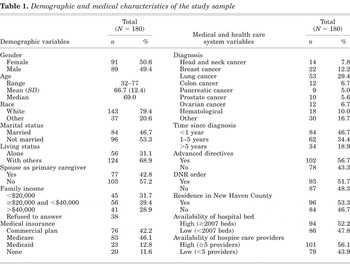
Of 207 eligible patients, 180 patients (87% response rate) agreed to participate. Disabling physical conditions (55.6%) and lack of interest (25.9%) were the two primary reasons that potential subjects gave for their nonparticipation in the study. Due to the restriction of access to patients' medical records for those who refused to participate in the study, no further comparison of characteristics of participants and nonparticipants could be performed. Demographic characteristics of these 180 patients are listed in Table 1. At the end of the study period, 164 (91.1%) subjects had died. The place of death for 12 subjects could not be identified; therefore, those subjects were treated as censored observations. For those whose actual place of death could be obtained, they most frequently died in an inpatient hospice (n = 62, 40.8%), followed by in a hospital (n = 38, 25.0%), at home (n = 36, 23.7%), and in a nursing home (n = 16, 10.5%).
Demographic and medical characteristics of the study sample

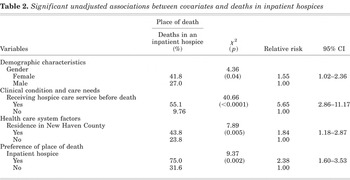
Bivariate analyses showed that except for gender, the inpatient-hospice-death group and the censored group were comparable on all sociodemographic variables. For female terminally ill cancer patients, the relative risk of dying in an inpatient hospice was 1.55 (95% CI = 1.02–2.36) times greater than male patients (Table 2).
Significant unadjusted associations between covariates and deaths in inpatient hospices

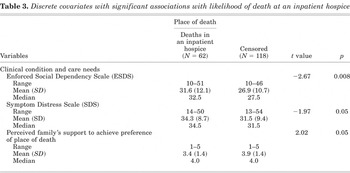
There were no differences in variables related to living status and the identity of primary caregivers between subjects who died in an inpatient hospice and those in the censored group. Terminally ill cancer patients who died in an inpatient hospice perceived significantly lower levels of support (mean ± SD: 3.4 ± 1.4) for their family to help achieve their preference of place of death than those who did in the censored group (mean ± SD: 3.9 ± 1.4; Table 3).
Discrete covariates with significant associations with likelihood of death at an inpatient hospice

There were major differences in disease-related variables or care needs between subjects who died in an inpatient hospice and those in the censored group. Terminally ill cancer patients in the inpatient-hospice-death group were significantly more likely to receive hospice care services before death (Table 2). Terminally ill cancer patients dying in an inpatient hospice scored significantly higher on the ESDS and experienced significantly greater symptom distress than those in the censored group (Table 3). No other different patterns of health care needs and health care resources utilization were found between the two groups in terms of use of home or hospice care or with advance directives or DNR orders at the time of data collection.
Except for the variable of residing in New Haven County, health care system factors (availability of acute inpatient beds and hospice care providers) did not play a significant role in distinguishing terminally ill cancer patients who died in an inpatient hospice from those who were in the censored group. Subjects residing in New Haven County were about twice (RR = 1.84, 95% CI = 1.18–2.87) as likely as their counterparts to die in an inpatient hospice (Table 2).
Preference of place of death influenced the probability of dying in an inpatient hospice. If terminally ill cancer patients expressed a preference to die in an inpatient hospice, they had a 2.38 times (95% CI = 1.60–3.53) higher likelihood to die in an inpatient hospice than those who preferred to die elsewhere (Table 2).
In summary, the results of bivariate analyses indicated that terminally ill cancer patients who died in an inpatient hospice (1) experienced higher levels of functional dependency and greater symptom distress at the time of interview, (2) were referred to hospice care services more frequently during the final days of their life, (3) were more likely to live in New Haven County, (4) were more likely to be female, (5) preferred to die in an inpatient hospice, and (6) perceived their families as lacking the support to achieve their preferences of place of death. These variables were examined by a multivariate Cox proportional hazards regression model to select the determinants of dying in an inpatient hospice.
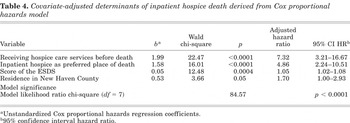
Variables that were retained in the final best fitting multivariate Cox proportional hazards regression model are presented in Table 4. Important determinants of deaths in an inpatient hospice included receiving hospice care before death, inpatient hospice as preferred place of death, higher levels of functional dependency, and residence in New Haven County. The adjusted hazard ratio showed that, if terminally ill cancer patients received hospice care services before death, preferred to die in an inpatient hospice, and resided in New Haven County, they had a 7.32 (95% CI: 3.21–16.67), 4.86 (95% CI: 2.24–10.51), and 1.70 (95% CI: 1.00–2.93) times, respectively, higher likelihood than their counterparts to die in an inpatient hospice. At the time of the interview, if terminally ill cancer patients experienced higher levels of functional dependency, they were also more likely to die in an inpatient hospice (aHR [95% CI] = 1.05 [1.02–1.08] with each unit increase in the score of the ESDS).
Covariate-adjusted determinants of inpatient hospice death derived from Cox proportional hazards model

DISCUSSION
Terminally ill cancer patients in this study most frequently died in an inpatient hospice, followed by in a hospital, at home, and in a nursing home. The prevalence of deaths in inpatient hospices was much higher than national statistics (Higginson et al., 1998; Hunt et al., 2001; National Center of Health Statistics, 2002) and those reported from large-scale studies (Gallo et al., 2001; Bruera et al., 2002). In South Australia, Hunt et al. (2001) reported that from 1990 to 1999, 54.6% of cancer patients died in a hospital, 19.9% in a hospice, 15.8% at home, and 9.7% in a nursing home. In England, Higginson et al., (1998) documented that from 1985 to 1994, 48.9% of cancer patients died in a hospital (including National Health Service [NHS] and non-NHS all types of hospitals and nursing homes), 16.7% in a hospice, 26.3% at home, and 3.1% at communal establishments (data derived from the table and information provided in the article). In the United States, according to the National Center for Health Statistics, in 2000, for all causes of deaths, 50.0% of deaths occurred in a hospital, 22.7% at home, 22.3% in a nursing home, and 5.1% occurred elsewhere (including inpatient hospices). For subjects in the Study to Understand Prognoses and Preferences for Outcomes and Risks of Treatments (SUPPORT), the distribution of place of death was as follows: 56% in an acute care hospital, 25% at home, and 9% in either a nursing home or an inpatient hospice (Pritchard et al., 1998). Gallo et al. (2001) reported cancer deaths in Connecticut and showed that 42% of the study sample died in a hospital, 29% at home, 17% in a nursing home, and 11% in an inpatient hospice (only freestanding hospices included). The high prevalence of inpatient hospice deaths for terminally ill cancer patients in this study may be related to the local health care system characteristics—a factor that has well been documented as a powerful determinant of place of death (Pritchard et al., 1998; Wennberg & Cooper, 1998). Over half (53.3%) of the study participants resided in New Haven County in Connecticut. The first inpatient hospice in the United State was founded in New Haven County and this institute is one of the few inpatient hospices existing in the United States. The influence of this inpatient hospice on the place of death for the study participants is substantial. The State of Connecticut, or, specifically, New Haven County, provides groundwork for a natural experiment on the impact of institutionalized hospice care on directing end-of-life care away from hospitals to inpatient hospices for terminally ill cancer patients. Findings from this study make a valuable contribution to our understanding of how inpatient hospice care can influence the place of death for terminally ill cancer patients.
Reported relationships among age (Hunt et al., 1993, 2001; Gilbar & Steiner, 1996), race (Hunt et al., 2001), socioeconomic status (Sims et al., 1997; Hunt et al., 2001), presence of family caregivers (Roder et al., 1987; Dunphy & Amesbury, 1990), and hematological malignancies (Hunt et al., 1993; Gatrell et al., 2003), and the likelihood of death in an inpatient hospice could not be detected in this study. The positive association of female gender and inpatient hospice deaths in bivariate analysis was consistent with the conclusion made by Hunt et al. (2001). There was a significant trend that more women than men were admitted to the inpatient hospice and this finding was not surprising because women have traditionally assumed caregiving roles at home more than men but have lacked caregivers when they become sick. However, gender was not retained in the Cox proportional hazards regression model. The negligible influence of sociodemographic and social support network variables on home deaths asserted by Mor and Hiris (1983) was also observed for inpatient hospice deaths. Due to the lack of knowledge about impact of gender on the place of death in an inpatient hospice from the existing studies, these data support the need to look closer at this issue in future studies, including the influencing of gender on the preference of place of death and health of the caregivers (Bradley, 2003).
Findings from the bivariate analysis showed that perceived support of their families to help achieve their preference of place of death was inversely associated with the likelihood of dying in an inpatient hospice. Consistent with the conclusion made from a systematic review of preferences of place of death from terminally ill cancer patients (Higginson & Sen-Gupta, 2000), participants in this study overwhelmingly indicated a preference of dying at home (Tang, 2003a). Further analyses indicated that, when study subjects perceived their families having stronger support and ability to help them achieve their preference of dying at home, they were more likely to recognize dying at home as a feasible and achievable goal and to use hospice home care services as a strategy to achieve their preference of dying at home (Tang, 2003b). Consequently, the probability of dying in an inpatient hospice was decreased; however, this variable was not significantly related to site of death in the fully adjusted model.
In line with the literature that preference of dying at home facilitates home death (Hinton, 1994; McWhinney et al., 1995; Lupu, 1996; Karlsen & Addington-Hall, 1998; Cantwell et al., 2000), the findings of this study suggest that terminally ill cancer patients who prefer to die in an inpatient hospice have a greater likelihood of actually dying there. However, the small number of subjects who indicated a preference for dying in an inpatient hospice (n = 12, 6.7%) should be acknowledged. The impact of a preference for dying in an inpatient hospice on inpatient hospice deaths needs to be validated with a larger and representative population.
The finding that terminally ill cancer patients who experienced higher levels of functional dependency at the time of the data collection interview were more likely to be admitted to an inpatient hospice and eventually died there was consistent with the literature in regard to the impact of accelerating symptom distress and dramatic deterioration of physical function and clinical conditions on admission to inpatient hospices (Mor et al., 1985; Addington-Hall et al., 1998). Recent studies also observed that admitting to an inpatient hospice at the end of life predisposes terminally ill cancer patients finally to dying there (Addington-Hall et al., 1998; Bruera et al., 2000; Hogan et al., 2001). The patient's functional status may have represented a demand for greater levels of care. Home-based care may become nonviable when the patient passes a threshold of significantly uncontrolled pain and with other symptoms resulting in higher demands of care. If the only alternative to home care is to receive care in a hospital, patients, families, and physicians have no choice but to rehospitalize the patient. With the availability of an inpatient hospice and the promise of providing state-of-the-art end-of-life care, admission to an inpatient hospice and dying there serve as an attractive third option to all stakeholders to address the dilemma of preference for where to die.
Results from the Cox model indicated that receiving hospice care services at the end of life increased the likelihood of dying in an inpatient hospice. Hogan et al. (2001) suggested that Medicare beneficiaries' likely place of death was strongly associated with use of hospice care. In addition, Ryan (2000) observed that the presence of dedicated inpatient hospice units increased the likelihood of inpatient deaths (including hospital and inpatient hospice deaths). All of the referred hospice services in this study were affiliated with either a freestanding hospice or dedicated hospice units. Availability and ease of access to the parent organization's inpatient hospice services might encourage their use and predispose subsequent inpatient hospice deaths.
A major limitation of this study was related to the generalizability of the findings due to the convenience sampling of subjects from six study sites in a single state. In addition, this study did not explore family caregivers' preferences of place of death for the patient as well as the impact of caregiving burden on inpatient hospice deaths. The numerous distressing symptoms, a great burden of sustained personal care, and tremendous financial strain posed by advanced cancer may overwhelm the capability of family caregivers to take care of dying patients at home and therefore may result in admitting patients into inpatient hospices.
Despite these limitations, there are substantial implications of this study for end-of-life care and health policy. For terminally ill cancer patients who choose an inpatient hospice as their preferred place of death, dying and death in an inpatient hospice is in accord with their wishes—an important component of a “good death” and high quality of dying and death as defined by the Institute of Medicine (1997) and Patrick et al. (2001), respectively. At a time when everything seems gradually to fall apart, the ability to achieve the preference of dying at a desirable place may breed a feeling of empowerment. Every effort should be made to develop effective interventions and to modify health care systems to help terminally ill cancer patients spend their final days of life and eventually die at a place that they prefer.
Deaths in inpatient hospices may represent a shift of end-of-life care; this shift represents dying away from acute care hospitals to an institutionalized hospice. Considering the well-known unsatisfactory quality (McCarthy et al., 2000) and high cost (Scitovsky, 1994) of end-of-life care provided in acute care hospitals, inpatient hospices may present a potential for improving quality of end-of-life care and controlling the spiraling costs at the end of life. More research is needed to compare the outcomes, including quality and costs of care for patients with different constellations of needs that are provided in an acute hospital and inpatient hospice. Consistent findings across several studies are warranted before the promotion of large-scale development of inpatient hospice programs.
For the majority of terminally ill cancer patients who prefer to die at home (Higginson & Sen-Gupta, 2000; Ryan, 2000) and live in an area where a variety of end-of-life care services are available but who experience high levels of symptom distress and functional dependency, does the presence of an inpatient hospice serve as a deterrent to hospice home care referral or does an inpatient hospice serve as a viable option? Further research is needed to investigate whether this pattern of admission is appropriate given the symptoms, dependency levels, and social situation of patients. More research efforts need to focus on illustrating whether the inpatient and home hospice care programs serve different populations and can be regarded as strategies that are directed toward distinct sets of problems. Knowledge gained from such research will guide the planning of end-of-life care to develop each program to best serve the needs of its particular constituency.
References
REFERENCES
Addington-Hall, J.,
Altmann, D., &
McCarthy, M.
(1998).
Which terminally ill cancer patients receive hospice in-patient
care?
Social Science & Medicine,
46,
1011–1016.Google Scholar
Benoliel, J.Q.,
McCorkle, R., &
Young, K.
(1980).
Development of a social dependency scale.
Research in Nursing & Health,
3,
3–10.Google Scholar
Bradley, P.J.
(2003).
Family caregiver assessment: Essential for effective home health
care.
Journal of Gerontological Nursing,
29,
29–36.Google Scholar
Bruera, E.,
Neumann, C.,
Brenneis, C.,
et al.
(2000).
Frequency of symptom distress and poor prognostic indicators in
palliative care patients admitted to a tertiary palliative care unit,
hospices, and acute care hospitals.
Journal of Palliative Care,
16,
16–21.Google Scholar
Bruera, E.,
Russell, N.,
Sweeney, C.,
et al.
(2002).
Place of death and its predictors for local patients registered at a
comprehensive cancer center.
Journal of Clinical Oncology,
20,
2127–2133.Google Scholar
Cantwell, P.,
Turco, S.,
Brenneis, C.,
et al.
(2000).
Predictors of home death in palliative care cancer patients.
Journal of Palliative Care,
16,
23–28.Google Scholar
Cobbs, E.L.
(2001).
Improving quality in end-of-life care: Dying at home.
Journal American Geriatric Society,
49,
831–832.Google Scholar
Costantini, M.,
Balzi, D.,
Garronec, E.,
et al.
(2000).
Geographical variations of place of death among Italian communities
suggest an inappropriate hospital use in the terminal phase of cancer
disease.
Public Health,
114,
15–20.Google Scholar
Doyle, D.
(1998).
The provision of palliative care. In
Oxford Textbook of Palliative Medicine
(2nd ed.),
Doyle, D.,
Hanks, G.W.C. &
MacDonald, N. (Eds.), pp.
41–53.
New York:
Oxford University Press.
Dunphy, K.P. &
Amesbury, B.D.W.
(1990).
A comparison of hospice and home care patients: Patterns of
referral, patient characteristics and predictors of place of death.
Palliative Medicine,
4,
105–111.Google Scholar
Emanuel, E.J. &
Emanuel, L.L.
(1998).
The promise of a good death.
Lancet,
351(Suppl. II),
21–29.Google Scholar
Fried, T.R.,
van Doorn, C.,
O'Leary, J.R.,
et al.
(1999).
Older persons' preferences for site of terminal care.
Annals of Internal Medicine,
131,
109–112.Google Scholar
Gallo, W.T.,
Baker, M.J., &
Bradley, E.H.
(2001).
Factors associated with home versus institutional death among cancer
patients in Connecticut.
Journal American Geriatric Society,
49,
771–777.Google Scholar
Gatrell, A.C.,
Harman, J.C.,
Francis, B.J.,
et al.
(2003).
Place of death: An analysis of cancer death in part of North West
England.
Journal of Public Health and Medicine,
25,
53–58.Google Scholar
Gilbar, O. &
Steiner, M.
(1996).
When death comes: Where should patients die?
Hospice Journal,
11,
31–48.Google Scholar
Grande, G.E.,
Addington-Hall, J.M., &
Todd, C.J.
(1998).
Place of death and access to home care services: Are certain patient
groups at a disadvantage?
Social Science & Medicine,
47,
565–579.Google Scholar
Hearn, J. &
Higginson, I.J.
(1998).
Do specialist palliative care teams improve outcomes for cancer
patients? A systematic literature review.
Palliative Medicine,
12,
317–332.Google Scholar
Higginson, I.J.,
Astin, P., &
Dolan, S.
(1998).
Where do cancer patients die? Ten-year trends in the place of death
of cancer patients in England.
Palliative Medicine,
12,
353–363.Google Scholar
Higginson, I.J. &
Sen-Gupta, G.J.A.
(2000).
Place of care in advanced cancer: A qualitative systematic
literature review of patient preferences.
Journal of Palliative Medicine,
3,
287–300.Google Scholar
Hinton, J.
(1994).
Can home care maintain an acceptable quality of life for patients
with terminal cancer and their relatives?
Palliative Medicine,
8,
183–196.Google Scholar
Hogan, C.,
Lunney, J.,
Gabel, J.,
et al.
(2001).
Medicare beneficiaries' costs of care in the last year of
life.
Health Affairs,
20,
188–195.Google Scholar
Hunt, R.W.,
Bonett, A., &
Roder, D.
(1993).
Trends in the terminal care of cancer patients: South Australia,
1981–1990.
Australia New Zealand Journal of Medicine,
23,
245–251.Google Scholar
Hunt, R.W.,
Fazekas, B.S.,
Luke, C.G.,
et al.
(2001).
Where patients with cancer die in South Australia, 1990–1999:
A population-based review.
Medical Journal of Australia,
175,
526–529.Google Scholar
Institute of Medicine.
(1997).
Approach Death: Improving Care at the End of Life (p.
4).
Washington, DC:
National Academy Press.
Karlsen, S. &
Addington-Hall, J.
(1998).
How do cancer patients who die at home differ from those who die
elsewhere?
Palliative Medicine,
12,
279–286.Google Scholar
Lupu, D.E.
(1996).
Hospice inpatient care: An overview of NHO's 1995 inpatient
survey results.
Hospice Journal,
11,
21–39.Google Scholar
McCarthy, E.P.,
Phillips, R.S.,
Zhong, Z.,
et al.
(2000).
Dying with cancer: Patients' function, symptoms, and care
preferences as death approaches.
Journal of the American Geriatric Society,
48,
S110–S121.Google Scholar
McCorkle, R.,
Benoliel, J.Q.,
Donaldson, G.,
et al.
(1989).
Randomized clinical trial of home nursing care for lung cancer
patients.
Cancer,
64,
199–206.Google Scholar
McCorkle, R.,
Cooley, M.E., &
Shea, J.A.
(1998).
A User's Manual for the Symptom Distress Scale.
New Haven, CT:
Yale University School of Nursing.
McCorkle, R. &
Young, K.
(1978).
Development of a symptom distress scale.
Cancer Nursing,
1,
373–378.Google Scholar
McWhinney, I.R.,
Bass, M.J., &
Orr, V.
(1995).
Factors associated with location of death (home or hospital) of
patients referred to a palliative care team.
Canadian Medical Association Journal,
152,
361–367.Google Scholar
Mor, V. &
Hiris, J.
(1983).
Determinants of site of death among hospice cancer patients.
Journal of Health and Social Behavior,
24,
375–384.Google Scholar
Mor, V.,
Wachtel, T.J., &
Kidder, D.
(1985).
Patient predictors of hospice care: Hospital versus home care
programs.
Medical Care,
23,
1115–1119.Google Scholar
National Center of Health Statistics.
(2002).
Death by place of death, age, race and sex: United States,
2000—CDC/NCHS National Vital Statistics System.
Mortality unpublished tables. Accessed September 1, 2003.
www.cdc.gov/nchs/data/statab/mortfomal2000_work309.pdf.
National Hospice and Palliative Care Organization.
(2002).
NHPCO Facts and Figures.
Alexandria, VA:
National Hospice and Palliative Care Organization.
National Hospice Organization.
(1999).
The 1997–8 Guide to the Nation's Hospices.
Arlington, VA:
National Hospice Organization.
Patrick, D.L.,
Engelberg, R.A., &
Curtis, J.R.
(2001).
Evaluating the quality of dying and death.
Journal of Pain and Symptom Management,
22,
717–726.Google Scholar
Pritchard, R.S.,
Fisher, E.S.,
Teno, J.M.,
et al.
(1998).
Influence of patient preferences and local health system
characteristics on the place of death.
Journal of the American Geriatric Society,
46,
1242–1250.Google Scholar
Roder, D.,
Bonett, A.,
Hunt, R.,
et al.
(1987).
Where patients with cancer die in South Australia.
Medical Journal of Australia,
147,
11–13.Google Scholar
Ryan, C.W.
(2000).
Association between administrative and ownership characteristics of
hospices and their proportion of inpatient death.
Hospice Journal,
15,
63–74.Google Scholar
Scitovsky, A.A.
(1994).
“The high cost of dying” revisited.
Milbank Quarterly,
72,
561–591.Google Scholar
Sims, A.,
Radford, J.,
Doran, K.,
et al.
(1997).
Social class variation in place of cancer death.
Palliative Medicine,
11,
369–373.Google Scholar
State of Connecticut.
(2002).
State of Connecticut Office of Health Care Access Health System
Data—Acute care staffed beds, FY 1998–2000.
Accessed February 25, 2002.
http://www.ohca.state.ct.us/HealthData/StatewideTable/Acutecarestaffedbeds.pdf.
Stewart, A.,
Teno, J.,
Patrick, D.,
et al.
(1999).
The concept of quality of life of dying persons in the context of
health care.
Journal of Pain and Symptom Management,
17,
93–108.Google Scholar
Tang, S.T.
(2003a).
When death is imminent, where terminally ill cancer patients prefer
to die and why.
Cancer Nursing,
26,
245–251.Google Scholar
Tang, S.T.
(2003b).
Determinants of hospice home care use among terminally ill cancer
patients.
Nursing Research,
52,
217–225.Google Scholar
Wennberg, J.E. &
Cooper, M.M.
(1998).
The Dartmouth Atlas of Health Care, 1998.
Chicago:
American Hospital Publishing.
Demographic and medical characteristics of the study sample
Significant unadjusted associations between covariates and deaths in inpatient hospices
Discrete covariates with significant associations with likelihood of death at an inpatient hospice
Covariate-adjusted determinants of inpatient hospice death derived from Cox proportional hazards model
 You have
Access
- 10
- Cited by