Introduction
When employees perceive that at least one organizational member is engaging in abnormal and negative actions against them, or terminating normal and positive actions toward them, they are likely to feel mistreated (Cortina & Magley, Reference Cortina and Magley2003). Although organizations have taken various measures to maximize employees’ perceptions of fair treatment, mistreatment stemming from a supervisor or an organizational policy remains highly prevalent (Boswell & Olson-Buchanan, Reference Boswell and Olson-Buchanan2004; Mayer, Thau, Workman, Van Dijke, & De Cremer, Reference Mayer, Thau, Workman, Van Dijke and De Cremer2012). Employees have several options for responding to perceived mistreatment, including work withdrawal or leaving the organization (Boswell & Olson-Buchanan, Reference Boswell and Olson-Buchanan2004), voicing a complaint, and remaining silent (Olson-Buchanan, Reference Olson-Buchanan1996). In this study, we focus on employees’ voice – ‘all of the ways and means through which employees attempt to have a say about, and influence, their work and the functioning of their organization’ (Wilkinson, Barry, & Morrison, Reference Wilkinson, Barry and Morrison2020). Employee voice covers a range of different domains and topics (e.g., working conditions, policies, and procedures). One important type of voice is driven by an employee’s self-interests (Wilkinson, Barry, & Morrison, Reference Wilkinson, Barry and Morrison2020). Through voice, employees can communicate their interests and dissatisfaction with their supervisor or management. This important type of voice is also known as remedial voice (e.g., Olson-Buchanan, Boswell, & Lee, Reference Olson-Buchanan, Boswell and Lee2019; Pohler & Luchak, Reference Pohler, Luchak, Wilkinson, Donaghey, Dundon and Freeman2014), which has been a major topic in the literature (Barry & Wilkinson, Reference Barry and Wilkinson2016; Kwon & Farndale, Reference Kwon and Farndale2020; Wilkinson, Barry, & Morrison, Reference Wilkinson, Barry and Morrison2020). Remedial voice is defined as the practice in which employees complain about their perceived mistreatment to blamed others or a third party in order to resolve the dispute (Hirschman, Reference Hirschman1972; Olson-Buchanan & Boswell, Reference Olson-Buchanan and Boswell2008).
Employees’ remedial voice can be divided into formal voice and informal voice (Olson-Buchanan & Boswell, Reference Olson-Buchanan and Boswell2002). Two significant differences exist between formal and informal voice. First, formal voice means employees need to follow a structured procedure (Marchington & Suter, Reference Marchington and Suter2013), whereas informal voice means they express their concern directly to the blamed others (Olson-Buchanan & Boswell, Reference Olson-Buchanan and Boswell2008). Second, employees who use formal voice will be accompanied by a third party who has a formal labor dispute resolution role. The blamed person must explain his (or her) actions to this third party according to the organization’s specified procedure. On the other hand, when employees use an informal voice, employees choose whether and how to respond to the mistreatment shown by the blamed others (Klaas, Olson-Buchanan, & Ward, Reference Klaas, Olson-Buchanan and Ward2012). Employees may also choose to remain silent instead of using remain voice.
Previous studies have largely treated employees’ remedial voice as a single stage. Olson-Buchanan and Boswell (Reference Olson-Buchanan and Boswell2002) listed 10 possible responses to mistreatment (e.g., ignore it; communicate with the person(s) who committed the unfair treatment; file a grievance), and classified them into three categories: remain silent, use formal voice, or use a less formal voice. However, it is problematic to describe employees’ response as a single stage because, in reality, employees may use silence, informal voice, and formal voice in a sequence. Only small portion of the extant research has proposed a multiple-stage model of employees’ response to mistreatment (e.g., Lewin, Reference Lewin1987; Peirce & Pruitt, Reference Peirce and Pruitt1993). For example, Peirce and his colleagues (Reference Peirce and Pruitt1993) suggested that employees may respond through informal voice channels first, and then utilize formal voice if that effort fails to resolve the mistreatment. However, they did not empirically test the idea.
The studies that have theorized remedial voice as one stage may potentially have missed valuable information or failed to recognize reasonable explanations of some results. For example, formal voice could be either the direct use of formal voice as an immediate response to mistreatment or a subsequent action after an unsuccessful attempt of using informal voice. These two kinds of formal voice may result from two different decision-making process. For the former, employees need to compare the expected gains and losses associated with informal versus formal voice. For the latter, they need to choose either escalate further with formal voice or give up by remaining silent, when their first informal remedial voice was ignored. Our study proposes and examine a three-stage process model that illustrate the decision-making process of employees in displaying remedial voice.
Furthermore, we investigate the influence of three situation-centered variables – mistreatment severity, mistreatment source, and employees’ high-quality job alternatives (Harlos, Reference Harlos2010) on employees’ responses in the three stages. By doing so, we seek to clarify the factors that contribute to employees’ reactions in different stages. First, mistreatment severity is employees’ perception of the mistreatment’s seriousness or negative effect on them (Olson-Buchanan & Boswell, 2008). Todor and Owen (Reference Todor and Owen1991: 44) have suggested that mistreatment severity is ‘perhaps the central factor in determining the responses of the parties involved.’ Second, the source of mistreatment could be supervisor or organizational policy. While some mistreatment is due to a supervisor’s discretionary actions, others may be due to an organizational procedure or administration of a work policy) (Klaas & DeNisi, Reference Klaas and DeNisi1989). Olson-Buchanan and Boswell (2008) argued that the mistreatment source has important implications for employees’ reactions after experiencing such abuse. For instance, employees experiencing supervisor mistreatment engaged in greater job withdrawal than those faced with policy-related mistreatment (Boswell & Olson-Buchanan, Reference Boswell and Olson-Buchanan2004). Third, external job opportunity refers to employees’ alternative opportunities in the labor market. According to power-dependence theory (Emerson, Reference Emerson, Berger, Zelditch and Anderson1972), external job opportunity is an important reflection of employees’ power (Lawler & Bacharach, Reference Lawler and Bacharach1979), and will affect both the use and the effectiveness of remedial voice. For example, Rusbult, Farrell, Rogers, and Mainous (Reference Rusbult, Farrell, Rogers and Mainous1988) found that employees with high-quality alternatives were more likely to use their voice options.
In summary, we seek to provide a process model of employees’ remedial voice at work by investigating the influences of mistreatment severity, mistreatment source, and employees’ external job opportunities on employees’ subsequent actions toward the perceived mistreatment. This research yields two contributions to the literature. First, whereas existing research has tended to view employees’ remedial voice as a single ‘snapshot,’ this study develops a three-snapshot framework to deepen the understanding of employee voice. Second, based on the three-stage framework for remedial voice, this study reevaluates the effects of mistreatment severity, mistreatment source, and employees’ external job opportunities on employees’ remedial voice.
Literature review and hypotheses
Employees’ response process after experiencing mistreatment
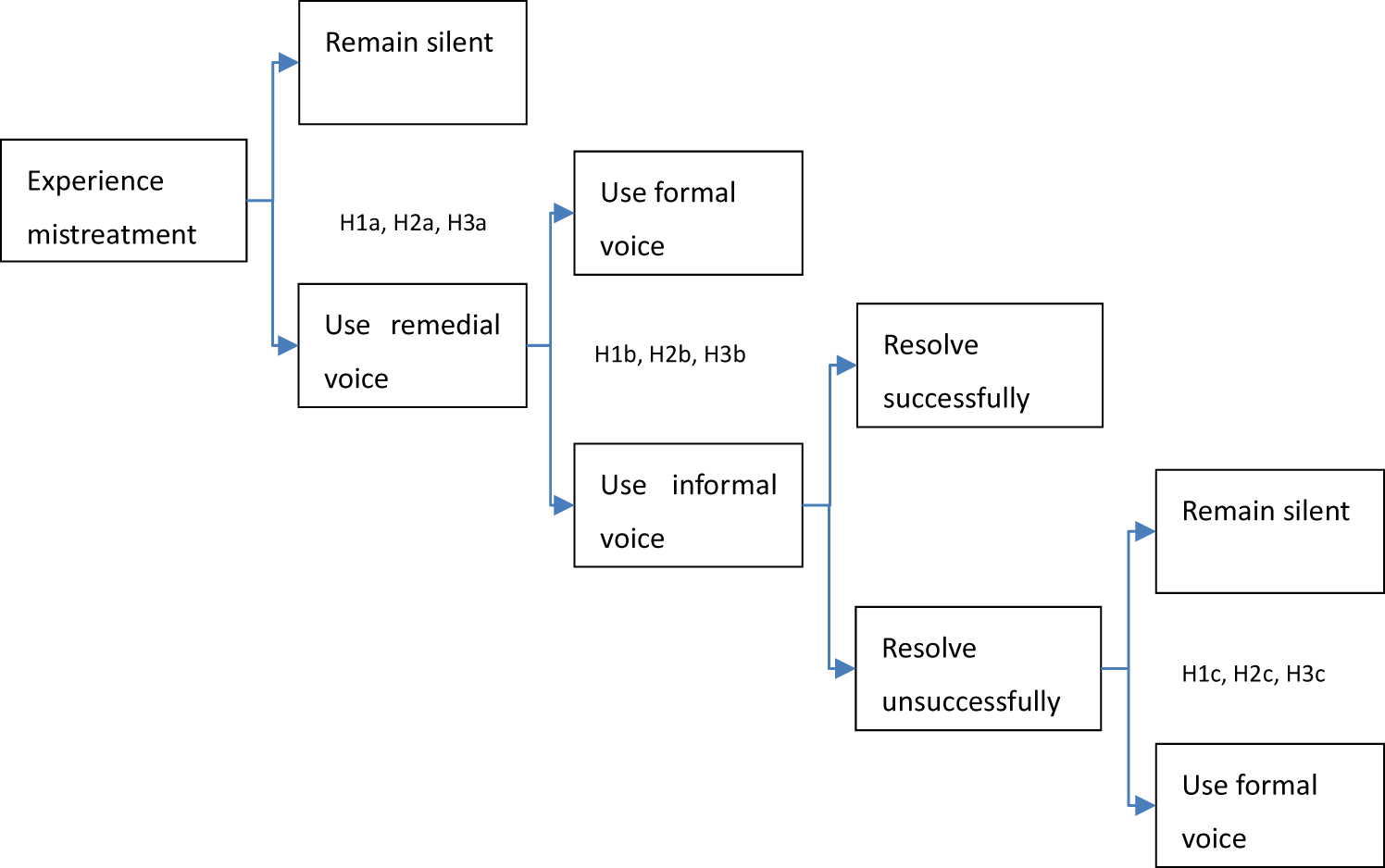
Figure 1 indicates the process of employees’ behavioral responses after they are mistreated by a supervisor or organizational policy.
A model of employees’ response of experiencing mistreatment.

When a concern arises, employees choose to either use their voice or withhold it (silence) (Morrison, Reference Morrison2011). In state 1, the initial decision that employees make is either speaking up or remaining silent when they perceived mistreated. In Olson-Buchanan and Boswell’s (Reference Olson-Buchanan and Boswell2002) survey, 87% employees chose voice and 13% employees chose staying silent. Once they decide to voice, they need to choose how. In stage 2, employees may choose informal voice to solve disputes confidentially, or they may choose formal voice to express their complaint to a third party who has a formal role in resolving the issue. Most mistreatment in the workplace is dealt with through informal voice (Lewin, Reference Lewin, Gold and Gold1999). Indeed, Lewin and Peterson (Reference Lewin and Peterson1988) estimated that the ratio of use of informal voice to use of formal voice is about 10:1 in organizations where employees are unionized. Therefore, in Stage 2, once employees choose to voice their concerns about the mistreatment, they must decide which voice channel (formal voice or informal voice) to use.
If employees talk to the blamed other, they might not receive an answer that allays their concerns. At that point, employees will face the same problem as they did in Stage 1: Do they raise their voice or stay silent? Some employees may choose to escalate the complaint to those with a formal role in resolving labor disputes (Klaas, Olson-Buchanan, & Ward, Reference Klaas, Olson-Buchanan and Ward2012). Therefore, in Stage 3, if informal voice does not work, employees need to choose between remaining silent or going further by accessing formal voice channels.
Decision-making process
Morrison (Reference Morrison2011) established a benefit–efficacy–safety (BES) model to explain employees’ prosocial voice. He argued that two key factors will influence employees’ voice. First is voice’s perceived efficacy, referring to the employee’s judgment about whether voice is likely to work, and second is voice’s perceived safety, referring to the employee’s judgment about whether using voice might potentially have a negative outcome.
According to the BES model, while assessing the attractiveness of the contemplated action, employees will weight such factors as the value and likelihood of resolving the mistreatment against the risk of retaliation. Specifically, the value of resolving the mistreatment is the ‘benefit’ component of the BES model – that is, the mitigated loss, such as correcting wrongdoing and accepting an apology or penance from the blamed party. The likelihood of resolving the mistreatment is the ‘efficacy’ component of the BES model, and equates to the probability that using voice will attain satisfactory results. In this regard, previous studies demonstrated that employees with power speak up more frequently compared to those without power (Pfrombec, Levin, Rucker, & Galinsky, Reference Pfrombec, Levin, Rucker and Galinsky2022). Finally, the risk of retaliation is the ‘safety’ component of the BES model: It indicates the probability that using voice will lead to punishment (e.g., lower performance ratings and promotion chances) from the blamed party. Thus, in each stage of the decision-making process, employees conduct a calculus involving voice’s benefit, efficacy, and safety. Employees decide to take an action only when its perceived attractiveness exceeds that of alternatives (Klaas, Reference Klaas1989; Walker & Hamilton, Reference Walker and Hamilton2011).
Mistreatment severity
Stage 1: voice or silence
Mistreatment severity means employees’ perceptions of the negative impact of mistreatment on themselves (Olson-Buchanan & Boswell, 2008). According to employee silence theory (Pinder & Harlos, Reference Pinder, Harlos and Ferris2001), employees’ personal significance determines their voice behaviors toward their experienced mistreatment. For instance, Fitzgerald and colleagues (Reference Fitzgerald, Swan and Fischer1995) found that employees tend to file more complaints as the severity of mistreatment increases. In BES model’s rationale, employees are more willing to take risks that pertain to their voice to alleviate the severe mistreatment (Harlos, Reference Harlos2010; Olson-Buchanan & Boswell, 2008). In contrast, when mistreatment perceived as relatively minor may not be perceived as significant enough for the employees to take the risk. Similarly, Rubin (Reference Rubin1980) discovered that individuals involved in low-intensity conflict are more incline to stay silent instead of approaching another person in an attempt to resolve the situation. Thus, those employees may decide to give up their voice and remain silent. Therefore, we argue that in Stage 1, employees tend to remain silent when they experience minor mistreatment.
Stage 2: informal voice or formal voice
According to Wheeler’s (Reference Wheeler1976) industrial discipline theory, employees who use formal voice by filing official complaints are likely to be labeled as troublemakers (Klaas & DeNisi, Reference Klaas and DeNisi1989) and may be punished for violating the organization’s informal rules (Walker & Hamilton, Reference Walker and Hamilton2011). Several studies have provided evidence to support formal voice’s ‘punishment effect.’ For example, Lewin (Reference Lewin1987) investigated the nonunion appeal systems in three large U.S. companies over a 4-year period, finding that employees who filed appeals had significantly lower promotion rates, lower performance ratings, and higher turnover rates than employees who did not file appeals. Similarly, in a sample of 136 employees who worked in a public university and had filed complaints at least once, Boswell and Olson-Buchanan (Reference Boswell and Olson-Buchanan2004) found that employees who made formal complaints reported higher exit-related withdrawal than those who did not.
Compared to formal voice, employees’ informal voice may be regarded as essentially tentative and exploratory (Dundon & Rollinson, Reference Dundon and Rollinson2011), and is less likely to challenge the supervisor’s or administration’s judgments. Hence, informal voice is unlikely to trigger retaliation from higher-ups. Therefore, we argue that in Stage 2, after comparing voice’s expected value with the potential loss, employees who experience minor mistreatment will be more likely to choose informal voice, as compared with employees who suffer severe mistreatment.
Stage 3: formal voice or silence
Based on the formal voice’s ‘punishment effect’ (Olson-Buchanan, Reference Olson-Buchanan1996), we argue that in Stage 3, employees experiencing minor are more likely to remain silent because the possible retaliation cost may exceed the expected benefit. Therefore, we propose the following hypotheses:
Hypothesis 1a. Employees who experience a lower level of mistreatment are more likely to remain silent instead of voicing.
Hypothesis 1b. Employees who experience a lower level of mistreatment are more likely to choose informal voice instead of formal voice after they decided to choose voice.
Hypothesis 1c. Employees who experience a lower level of mistreatment are more likely to remain silent instead of using formal voice after they receive an unsatisfactory outcome from using informal voice.
Mistreatment source
Stage 1: voice or silence
Mistreatment resulting from the supervisor’s behavior may impact a single employee, requiring the victim to speak out against the specific wrongdoings of the supervisor. On the other hand, a policy-oriented mistreatment stem from the overall functioning of the entire organization. When employees experience policy-oriented mistreatment employee seek to rectify the relevant management system or policy (Ng & Dastmalchian, Reference Ng and Dastmalchian1989). Therefore, compared with a supervisor mistreatment, policy-related mistreatment is more difficult to resolve the dispute. Thus, we argue that in Stage 1, employees who experience supervisor mistreatment are more likely to use their voice.
Stage 2: informal voice or formal voice
Research on formal voice has shown that its post-settlement outcomes depend on the mistreatment source (e.g., Boswell & Olson-Buchanan, Reference Boswell and Olson-Buchanan2004; Klaas & DeNisi, Reference Klaas and DeNisi1989). Accordingly, we argue that the mistreatment source has important implications for the employee’s response in Stage 2. In prior studies, Klaas and DeNisi (Reference Klaas and DeNisi1989) argued that supervisors are more likely to feel offended or threatened when employees use formal voice against them. Therefore, compared to when they file complaints against an organizational policy, employees are more likely to suffer retaliation when they file against a supervisor. With a sample of 173 employees, Klaas and DeNisi (Reference Klaas and DeNisi1989) found that employees received lower supervisor-assigned performance ratings when they used their formal voice by filing complaints against their supervisor, whereas using formal voice against organizational policies appeared to have little impact on employees’ ratings, regardless of the outcome of the formal voice.
In addition, in Butler’s (Reference Butler2005) survey, 75% of employees reported a significant disparity in power between themselves and the organization in a way that they rely more on their organization than the reverse. A formal voice system helps rebalancing the power between employees and their organization, and it can sometimes be a great help to employees in resolving policy-related mistreatment (Dundon & Rollinson, Reference Dundon and Rollinson2011). Thus, when employees realize that it is more difficult to resolve a dispute against organizational policy by going it alone, they are more likely to use the formal voice system.
Combining these arguments, we suggest that in Stage 2, employees who are mistreated by a supervisor tend to use informal voice.
Stage 3: formal voice or silence
Similarly, according to Klaas and DeNisi’s (Reference Klaas and DeNisi1989) study, employees who use formal voice are more likely to be punished when that formal voice is directed against their supervisor. In contrast, using formal voice can narrow the power gap between employees and the organization when that formal voice is applied to protest an organizational policy. Therefore, we argue that in Stage 3, employees experiencing supervisor mistreatment who have failed to get satisfaction using an informal voice will tend to remain silent instead of using a formal voice. In sum, we hypothesize:
Hypothesis 2a. Employees are more likely to use their voice instead of remaining silent when mistreatment is due to their supervisor’s conduct than when it is policy-related.
Hypothesis 2b. Employees, if they decide to use their voice, are more likely to use informal voice instead of a formal voice when mistreatment is due to their supervisor’s conduct than when it is policy-related.
Hypothesis 2c. Employees, if they receive an unsatisfactory outcome from using informal voice, are more likely to remain silent instead of using a formal voice when mistreatment is due to their supervisor’s conduct than when it is policy-related.
Employees’ external job opportunities
Stage 1: voice or silence
According to power-dependence theory (Emerson, Reference Emerson, Berger, Zelditch and Anderson1972), an employee’s power is a function of his or her dependence on a supervisor or an organization, relative to the supervisor’s or organization’s dependence on him or her. The employee’s power is perceived to increase if the employee’s dependence on the supervisor or employer decreases (Bacharach & Bamberger, Reference Bacharach and Bamberger2004). Lawler and Bacharach’s (Reference Lawler and Bacharach1979) study identified alternatives (i.e., outcomes from other relationships) as a major dimension of dependence: An employee’s power will be perceived as greater when the employee has more external job opportunities (i.e., more alternatives in the labor market).
Not surprisingly, then, employees’ external job opportunities will affect the likelihood of resolving the mistreatment: The more external job opportunities that employees have, the less dependence they will have on the supervisor or organization, and subsequently the larger the loss (e.g., employees’ exit or withdrawal from the organization) for the supervisor or organization will be if mistreatment is not resolved to the employees’ satisfaction. When the threat of their exit or withdrawal is perceived as being stronger, employees with more external job opportunities will be more likely to achieve a satisfactory outcome from a supervisor or the organization’s administration in a case of mistreatment. Conversely, when employees have few external job opportunities, and the supervisor or organization is not anxious about their turnover, the two sides may have increased difficulty reaching an agreement in case of a dispute. Thus, we argue that in Stage 1, when employees have more external job opportunities, due to their higher likelihood of winning in a dispute they will tend to voice their mistreatment instead of remaining silent.
Stage 2: informal voice or formal voice
Employees’ external job opportunities will also shape employees’ and blamed parties’ perceptions of formal voice’s risk (Cortina & Magley, Reference Cortina and Magley2003; Morrison, Reference Morrison2011): The more external job opportunities employees have, the less dependence they will have on the supervisor or the organization, and the lower the risk of managerial retaliation if they choose to use formal voice will be. The blamed parties who engage in retaliation against formal voice users who have more external job opportunities may incur greater losses. In addition, employees who have more external job opportunities can choose to leave the organization to avoid punishment. By comparison, it is difficult for employees who have fewer external job opportunities to ‘answer’ the blamed supervisor’s retaliation, and they have fewer options for departing the organization to avoid punishment. Therefore, we argue that in Stage 2, when employees have fewer external job opportunities, due to the higher risk of retaliation they will tend to choose informal voice.
Stage 3: formal voice or silence
Similar to the argument made for Stage 2, if employees cannot receive a satisfying settlement by using an informal voice, we argue that in Stage 3, those employees having fewer external job opportunities will tend to remain silent instead of using formal voice for fear of managerial retaliation.
In sum, this study examines the following hypotheses:
Hypothesis 3a. Employees having fewer external job opportunities are more likely to remain silent instead of voicing.
Hypothesis 3b. Employees having fewer external job opportunities are more likely to choose informal voice instead of formal voice if they decide to use their voice.
Hypothesis 3c. Employees having fewer external job opportunities are more likely to remain silent instead of using formal voice if they receive an unsatisfactory outcome from using their informal voice.
Method
Respondents and procedures
To test our hypotheses, we used a professional survey platform WJX (www.wjx.cn) (WJX is the earliest and largest online survey platform in China. To date, 72.2 million users have collected 5.594 billion responses on this platform.) to recruit full-time employees to join this study. WJX sent an online survey link with a short explanation of our survey to registered users. In total, 620 workers joined our survey. We gave WJX 10 RMB for every respondent whom WJX recruited. The response rate was 87.7%.
Using Boswell and Olson-Buchanan’s (Reference Boswell and Olson-Buchanan2004) approach, respondents were first asked whether they had experienced mistreatment at work in the past year. We listed 10 examples of mistreatment to help respondents understand mistreatment’s meaning, such as unfair pay, unfair task allocation, and sex discrimination. Boswell and Olson-Buchanan (Reference Boswell and Olson-Buchanan2004) have argued that using a time span of 1 year will result in better recall of the mistreatment’s characteristics and lessen the chance for intervening factors to alter recall. In our study, a total of 382 employees indicated that they had experienced mistreatment in the past year.
Next, respondents experiencing mistreatment were asked to recall the most serious issue involved in this abuse (in case someone had experienced multiple incidents of mistreatment). Respondents were then asked to indicate this mistreatment’s characteristics, including severity and source (i.e., how serious the mistreatment was and whether this mistreatment involved a supervisor’s action or organizational policy). Next, respondents were asked to indicate their specific response to this mistreatment by choosing among five paths. Finally, the respondents were asked to report data on some variables, including their external job opportunities and demographics.
Our final sample included 167 men (43.7%) and 215 women (56.3%). Among the respondents, 33 employees (8.6%) were younger than age 25; 134 (35.1%) were between 25 and 30 years old; 183 (47.9%) were between 30 and 40 years old; and 32 (8.4%) were older than age 40. In terms of employment, 125 respondents (32.7%) worked in the public sector (e.g., government, public institution, state-owned firm), and 257 (67.3%) worked in the private sector (e.g., joint ownership firms, foreign-funded units, shareholding firms). In terms of organizational tenure, 19 employees (5.0%) had been at their jobs for less than 1 year; 92 (24.1%) for between 1 and 3 years; 118 (30.9%) for between 3 and 5 years; 96 (25.1%) for between 5 and 10 years; and 57 (14.9%) for more than 10 years. Finally, 240 employees (62.8%) worked in a manufacturing industry, and 142 employees (37.2%) worked in a service industry.
Measures
Mistreatment severity
We used one item to assess mistreatment severity since this construct is unidimensional; this measurement was commonly used by previous studies (e.g., Harlos, Reference Harlos2010, Grover, Abid-Dupont, Manville, & Hasel, Reference Grover, Abid-Dupont, Manville and Hasel2019) to assess supervisor mistreatment’s severity. Mistreatment severity was operationalized as negative impact on the employee consistent with its definition. This construct was assessed using a 7-point Likert-type scale, with anchors ranging from 1 (extremely low) to 7 (extremely high). The item that tested mistreatment severity was ‘What was the extent of the most serious mistreatment’s negative impact on you?’
Mistreatment source
Respondents were asked whether the most serious mistreatment came from their supervisor or from organizational policy. In all, 274 employees (71.7%) reported that the mistreatment was committed by their supervisor and 108 employees (28.3%) attributed their mistreatment to organizational policy. We coded supervisor mistreatment as 0 and policy-related mistreatment as 1.
Response to mistreatment
As shown in Figure 1, based on Olson-Buchanan and Boswell’s (Reference Olson-Buchanan and Boswell2002) measures of silence, informal voice, and formal voice, we integrated the silence and voice methods into the five paths and listed the five options for respondents to choose:
1. Do nothing (i.e., remain silent after experiencing mistreatment). In all, 72 employees selected this option.
2. Use a formal voice (e.g., consult a union, labor committee, or HR department in the organization or outside lawyers and governmental agencies that have a formal role in resolving labor disputes) directly after perceiving mistreatment. In all, 30 employees selected this option.
3. Voice discontent to the blamed parties (supervisor or organization’s administration) directly and reach an agreement. In all, 55 employees selected this option.
4. Voice discontent to the blamed parties (supervisor or organization’s administration) but not reach an agreement, and ultimately accept this result. In all, 103 employees selected this option.
5. Voice discontent to the blamed parties (supervisor or organization’s administration) but not reach an agreement, and ultimately use a formal voice. In all, 122 employees selected this option.
From respondents’ answers, we can infer the distribution of employees’ responses (see Table 1). Specifically, in Stage 1 (voice or silence), 72 employees selected path 1 and chose to remain silent, whereas 310 employees selected paths 2–4 and attempted to resolve the mistreatment through voice. In Stage 2 (informal or formal voice), 280 employees selected paths 3–5 and used informal voice first, whereas 30 employees selected path 2 and used formal voice directly. In Stage 3 (formal voice or silence), 225 employees failed to resolve the mistreatment informally. At that point, 103 employees selected path 4 and gave up formal voice/chose to remain silent, while 122 employees selected path 5 and chose to further pursue formal voice.
Distribution of employees’ responses

External job opportunities
We assessed the employees’ external job opportunities with a three-item scale developed by Price and Mueller (Reference Price and Mueller1981). A sample item is ‘It would be easy for me to find a job with another employer as good as the one I have now.’ Cronbach’s α for this scale was .85.
Results
We used binary logistic regression analysis to analyze our model. In the first step of logistic regression analysis, employees’ demographic variables were entered in these models as control variables. All antecedents were entered simultaneously in the second step. Model fit (chi-square and Hosemer and Lemeshow tests), Cox and Snell and Nagelkerke R 2 effect size estimates, logistic regression coefficients and their significance, and corresponding odds ratios (ORs) are all reported here.
According to our survey data, in Stage 1 (voice or silence), 72 employees chose to remain silent, and 310 employees chose voice. To test the Stage 1 model (Hypotheses 1a, 2a, and 3a), we created a dummy dependent variable (1 if employees chose voice and 0 if they chose silence). Table 2 presents the means, standard deviations, and correlations for the variables used for testing H1a, H2a, and H3a. The results of two logistic regression models are presented in Table 3. The chi-square test and Hosemer and Lemeshow tests indicated that Model 2 had a good fit. In addition, the coefficients for mistreatment severity (b = .28, p < .05, OR = 1.33), mistreatment source (b = -.97, p < .001, OR = .38), and external job opportunities (b = .34, p < .01, OR = 1.41) were significant, so Hypotheses 1a, 2a, and 3a were all supported. These results indicate that employees were 1.33 times more likely to choose voice when mistreatment severity had 1 more unit; if the mistreatment was due to the supervisor’s conduct, employees were 2.63 times (i.e., 1/.38) more likely to choose voice; and employees were 1.41 times more likely to choose voice when employees’ external job opportunities had 1 more unit.
Means, standard deviations, and correlations

Note: n = 382.
Coding went as follows: Age: 1 = younger than 25 years old, 2 = between 25 and 30 years old, 3 = between 30 and 40 years old, 4 = above 40 years old; Ownership: 0 = state owned, 2 = private owned.
* p < .05; **p < .01; ***p < .001.
Estimated coefficients of antecedents on voice (silence vs. remedial voice)

Note: n = 382.
+ p < .10; *p < .05; **p < .01; ***p < .001.
According to our survey data, in Stage 2 (informal or formal voice), 280 employees used informal voice and 30 employees used formal voice directly. To test the Stage 2 model (Hypotheses 1b, 2b, and 3b), we created a dummy dependent variable (1 if employees chose formal voice and 0 if they chose informal voice). Table 4 presents the means, standard deviations, and correlations for the variables used for testing H1b, H2b, and H3b. The results of two logistic regression models are presented in Table 5. The chi-square test and Hosemer and Lemeshow tests indicated that Model 2 had a good fit. In addition, the coefficients for mistreatment severity (b = .38, p < .10, OR = 1.46), mistreatment source (b = 1.10, p < .01, OR = 2.99), and external job opportunities (b = .31, p < .10, OR = 1.37) were significant, so Hypotheses 1b, 2b, and 3b are all supported. These results indicate that employees were 1.46 times more likely to choose formal voice when mistreatment severity had 1 more unit; if the mistreatment was due to organizational policy, employees were 2.99 times more likely to choose formal voice; and employees were 1.37 times more likely to choose formal voice when employees’ external job opportunities had 1 more unit.
Means, standard deviations, and correlations

Note: n = 310.
* p < .05; **p < .01; ***p < .001.
Estimated coefficients of antecedents on voice (informal vs. formal voice)

Note: n = 310.
+ p < .10; *p < .05; **p < .01; ***p < .001.
According to our survey data, in Stage 3 (formal voice or silence), 103 employees gave up formal voice and chose to remain silent, while 122 employees chose to further pursue formal voice. To test the Stage 3 model (Hypotheses 1c, 2c, and 3c), we created a dummy dependent variable (1 if employees chose formal voice and 0 if they chose silence). Table 6 presents the means, standard deviations, and correlations for the variables used for testing H1c, H2c, and H3c. The results of two logistic regression models are presented in Table 7. The chi-square test and Hosemer and Lemeshow tests indicated that Model 2 had a good fit. In addition, the coefficients for mistreatment severity (b = .26, p < .10, OR = 1.30) and external job opportunities (b = .28, p < .05, OR = 1.33) were significant, so Hypotheses 1c and 3c were supported. These results indicate that employees were 1.30 times more likely to choose formal voice when mistreatment severity had 1 more unit; they were 1.33 times more likely to choose formal voice when employees’ external job opportunities had 1 more unit. However, the coefficient for mistreatment source (b = −.36, p > .10) was not significant, so Hypothesis 2c was not supported.
Means, standard deviations, and correlations

Note: n = 225.
* p < .05; **p < .01; ***p < .001.
Estimated coefficients of antecedents on voice (silence vs. formal voice)

Note: n = 225.
+ p < .10; *p < .05; **p < .01; ***p < .001.
Discussion
Our study takes a fresh perspective on employees’ remedial voice in the workplace. Based on BES model, we presented a three-stage remedial voice process model explaining how employees respond to mistreatment in organizations. Understanding employees’ remedial voice process contributes to both theory and managerial practice in several ways.
Theoretical implications
Our study highlights the importance of extending the analysis of the remedial voice process. We identified three stages and five paths for employees’ responses. In our survey data, after experiencing mistreatment, 310 employees (81.2% of the total sample) chose remedial voice, and 122 employees (31.9% of the total sample) initially used informal voice, and then formal voice. As mentioned earlier, prior studies have tended to treat employees’ remedial voice as a single stage (formal voice or not), which may miss valuable information or hinder reasonable explanation of some results. Future research on remedial voice can use this three-stage process model to better examine remedial voice’s antecedents and outcomes.
Previous studies have largely focused on which factors affect employees’ choice of formal voice (or not). Our study examined mistreatment severity, mistreatment source, and external job opportunities’ effects on employees’ remedial voice in a three-stage model, thereby facilitating understanding of the impact of these variables on the remedial voice process. For example, Bacharach and Bamberger (Reference Bacharach and Bamberger2004) argued that the more power that employees have, the lower their perceived risk of managerial retaliation is; their study confirmed that employees’ power has a significant impact on employees’ use of formal voice. Consistent with this logic, we argued that fewer external job opportunities (i.e., less dependence on the supervisor or organization) translate into a lower likelihood of resolving mistreatment and a greater perceived risk of managerial retaliation. Our study found that employees with fewer external job opportunities tended to remain silent; if they wanted to resolve the mistreatment, they were more likely to talk informally; and if the informal voice did not work, they were inclined to choose silence instead of formal voice as the final resolution.
Similarly, past studies have found that mistreatment severity plays a significant role in the likelihood of using formal voice. For example, Rubin’s (Reference Rubin1980) study indicated that disputants in low-intensity conflict tend not to approach third parties for help in resolving their problem. We argued that resolving severe mistreatment meant mitigating greater potential losses, so that, in turn, severe mistreatment was likely to trigger a more extreme response. Our study confirmed this hypothesis, demonstrating that employees who experienced minor mistreatment tended to remain silent; if they want to resolve the mistreatment, they were more likely to talk informally; and if they failed to receive satisfactory results from using informal voice, they were inclined to choose silence instead of formal voice as a follow-up action.
Previous studies have shown that the mistreatment source has an important impact on formal voice’s post-settlement outcome (e.g., Boswell & Olson-Buchanan, Reference Boswell and Olson-Buchanan2004; Klaas & DeNisi, Reference Klaas and DeNisi1989). Relatively less is known about the mistreatment source’s effect on employees’ remedial voice after experiencing mistreatment. Based on the three-stage framework, we argued that it is difficult to win a dispute with the organization. Our findings confirmed that employees experiencing supervisor mistreatment tended to voice their dissatisfaction in Stage 1. In addition, based on the ‘punishment effect’ from filing a formal complaint against a supervisor, we hypothesized that employees experiencing supervisor mistreatment would be more likely to talk informally in Stage 2, and then choose silence instead of formal voice in Stage 3. Our study confirmed this hypothesis about Stage 2, but the hypothesis regarding Stage 3 was not supported.
Practical implications
Our findings have also implications for practice. First, our study suggests that informal voice plays an important role in resolving mistreatment. When employees wanted to voice their discontent, most chose informal voice. Managers, in turn, should be given more training in how to deal with employees’ informal voice, and should strive to reach agreement in disputes at the informal voice stage. In addition, informal voice reflects a cardinal principle of natural justice advanced by Dundon and Rollinson (Reference Dundon and Rollinson2011: 228): If one employee is dissatisfied with a supervisor’s conduct or organizational policy, the supervisor or administration should be the first to hear about it, and should have an opportunity to remedy the situation directly. In some organizations, employees may be prohibited from entering into subsequent formal stages of dispute resolution until informal voice has occurred (Dundon & Rollinson, Reference Dundon and Rollinson2011; Lewin, Reference Lewin1987).
Second, researchers generally believe that employees’ complaints have positive effects on work. If dissatisfaction is brought to the supervisor’s and administration’s attention, that gives them a chance to correct potential problems stemming from the managerial decision or policy system (Sheppard, Lewicki, & Minton, Reference Sheppard, Lewicki and Minton1992). If employees keep silent, dissatisfaction may fester ‘beneath the surface,’ and the supervisor or administration will miss an opportunity to fix weaknesses in the organization. In addition, if dissatisfaction cannot be dealt with, it may lead to sadness, anger, and other negative emotions, as well as exit or withdrawal from the organization (Boswell & Olson-Buchanan, Reference Boswell and Olson-Buchanan2004). As negative emotions accumulate, it becomes easier to induce more radical and extreme expressions, leading to a vicious ‘endure–burst’ mode of labor conflict (Cooke, Reference Cooke and Gall2013). To avoid this outcome, managers need to be trained to stay alert to employees’ silence in the two different stages.
Limitations and future research directions
Our study has some limitations that need to be acknowledged to properly explain its findings and that accordingly provide some additional potential directions for future studies. First, following Boswell and Olson-Buchanan’s (Reference Boswell and Olson-Buchanan2004) approach, we focused on isolated mistreatment incidents, and prior mistreatment experiences might have affected employees’ responses (Dundon & Rollinson, Reference Dundon and Rollinson2011). For example, a minor mistreatment event may incur a radical response if the accumulated negative effect crosses a threshold with such an incident. Thus, future research should control for the accumulated mistreatment severity to partition out its potential effect.
In addition, our study adopted a cognitive perspective, and future research should extend this approach by focusing on employees’ remedial voice from the perspective of emotion. Olson-Buchanan and Boswell (2008) proposed that personalized mistreatment is more likely to feel like a personal attack and, therefore, to trigger emotional and negative affect-related responses than policy-related reactions. Therefore, in Stage 3, when informal voice did not resolve the dispute with the supervisor successfully, on the one hand, employees might remain silent after evaluating formal voice’s risk from a cognitive perspective; on the other hand, they might choose to resolve this mistreatment because of their increased emotional arousal. These two opposite effects might have resulted in the lack of support we found for the mistreatment source’s effect on employees’ remedial voice in Stage 3.
Finally, the sample used for this study included only employees in China, so the generalizability of the results may be limited to that country. Cultural differences may play a role in shaping the employee remedial voice process (Kwon & Farndale, Reference Kwon and Farndale2020). For example, authoritarian leadership is a prevalent leadership style in Chinese organizations (Cheng, Chou, Wu, Huang, & Farh, Reference Cheng, Chou, Wu, Huang and Farh2004). Under authoritarian leadership, employees need comply and abide by their supervisor’s requests without dissent if they are to obtain rewards or avoid punishment. Therefore, if employees want to correct their supervisor’s wrongdoing, after estimating the risk associated with remedial voice, they are more likely to give up voice in China than in Western countries. Thus, future studies need to consider these possible effects of culture on the remedial voice process in the current cultural context versus what might happen in other cultural contexts.
Conclusion
Previous studies have treated employees’ remedial voice as a single stage after experiencing mistreatment at work. In this study, based on BES model, we presented a three-stage process model of employees’ remedial voice, and examined the effects of mistreatment severity, mistreatment source, and employees’ external job opportunities on this process. Our study provides insights into the stages through which remedial voice unfurls, and the factors that contribute to employees’ reactions in those stages. Furthermore, it suggests useful implications for future research and organizational practice.
Author Contributions
Zheng and Wu contributed equally to this project and thus they share equal first authorship.