The role of cognition and information processing biases in social phobia has received considerable attention in the research literature (Heinrichs & Hofmann, Reference Heinrichs and Hofmann2001), and the Clark and Wells’ Cognitive Model appears to be one of the most extensively studied models (Clark & Wells, Reference Wells1995). In particular, Clark and Wells proposed that individuals with social phobia hold negative beliefs about themselves, including perceived inability to create a favourable impression to others. This belief is accompanied by a heightened perception of the danger and negative consequences that may follow poor performance in a social situation. Of particular importance to this model, the authors propose that a number of cognitive processes prevent socially anxious individuals from disconfirming their negative beliefs, which results in the persistence of social phobia symptoms. In addition to cognitive processes that occur during social interactions, socially anxious individuals may also engage in post-event processing.
Post-event processing (PEP) is a prolonged ruminative process that follows social interactions (PEP; Clark, Reference Clark, Crozier and Alden2001; Clark & Wells, Reference Wells1995). In particular, following a social interaction, individuals with social phobia may continue to process and ruminate about the interaction in a manner that is consistent with their negative biases. This process is particularly problematic, because it may actually enhance negative evaluations of previous social interactions and may influence appraisals of subsequent social interactions (Clark, Reference Clark, Crozier and Alden2001). Another negative consequence of PEP is that anxiety may not necessarily end following the termination a social interaction (Clark & Wells, Reference Wells1995).
Consistent empirical support has been found for the association between PEP and social phobia symptoms. In one of the first studies to examine PEP, Rachman, Gruter-Andrew, and Shafran (Reference Rachman, Gruter-Andrew and Shafran2000) found a positive association between PEP and social anxiety. Further, socially anxious participants reported more frequent recall and intrusive memories of previous social interactions. These memories were also reported to interfere with concentration and to be difficult to control. In addition, higher levels of social phobia were associated with a desire to avoid similar social situations in the future, and a desire to relive the experience in order to correct perceived mistakes. Follow-up studies have provided additional support for the association between social phobia symptoms and post-event processing (Dannahay & Stopa, 2006; Fehm, Schneider, & Hoyer; Reference Fehm, Schneider and Hoyer2007; Kocovski, Endler, Rector, & Flett, Reference Kocovski, Endler, Rector and Flett2005; McEnvoy & Kingsep, Reference McEnvoy and Kingsep2006; McEnvoy, Mahoney, Perini, & Kingsep Reference McEnvoy, Mahoney, Perini and Kingsep2009). Although the relation between PEP and social phobia has been well supported, the examination of the underlying metacognitive processes that may lead a socially anxious individual to engage in excessive and negative PEP has received surprisingly little attention.
In order to better understand the underlying processes that may lead to PEP, it is noteworthy that similarities exist between the cognitive model of social phobia and metacognitive models for other psychiatric disorders, including generalised anxiety disorder and depression (Papageorgiou & Wells, Reference Papageorgiou and Wells2001; Wells, Reference Wells1995). In particular, post-event processing, depressive rumination and worry have been found to be overlapping constructs, and collectively these constructs have been described as ruminative or perseverative processes (McEnvoy, Mahoney, & Moulds, Reference McEnvoy, Mahoney and Moulds2010). Based on these similarities, it is possible that the underlying processes that maintain worry and depressive rumination may influence the tendency to engage in post-event processing. One potentially relevant construct is positive metacognitive beliefs.
In particular, positive metacognitive beliefs about worry, which is described as positive beliefs about the benefits and utility of worry, are a central construct in the metacognitive model of generalised anxiety disorder (GAD; Wells, Reference Wells1995). Consistent with the predictions of the metacognitive model of GAD, positive beliefs have been found to be associated with increased tendency to engage in worry processes and to be associated with symptoms of generalised anxiety disorder (Wells, Reference Wells, Davey and Wells2006a). A similar metacognitive model has been developed for depression, in which positive beliefs about rumination have been found to predict higher levels of depressive rumination and depression symptoms (Papageorgiou & Wells, Reference Papageorgiou and Wells2001; Roelofs, Huibers, Peeters, Arniz, & van Os, Reference Roelofs, Huibers, Peeters, Arntz and van Os2010).
Consistent with the above-mentioned metacognitive models, it is possible that individuals who hold positive beliefs about the benefits of PEP may be more likely to engage in PEP and be more likely to experience social anxiety. Although this premise seems to be a logical application of existing metacognitive models, the relation between positive metacognitive beliefs and social phobia symptoms has received surprisingly little attention. In one of the only studies in this area, Wong and Moulds (Reference Wong and Moulds2010) examined the relation between positive beliefs about ruminative processes and social anxiety symptoms. More specifically, the Positive Beliefs about Rumination Scale (Papageorgiou & Wells, Reference Papageorgiou and Wells2001) was modified to assess positive beliefs about rumination following social situations. The authors found positive beliefs about rumination to be associated with social anxiety and ruminative processes. Although Wong and Moulds (Reference Wong and Moulds2010) provide initial support for the relation between positive metacognitive beliefs and social phobia symptoms, their measure is a somewhat general measure of positive beliefs about rumination that may follow social interactions, and a comprehensive measure specifically designed to assess positive beliefs about post-event processing has yet to be developed.
Consequently, the purpose of the current study was to expand upon the work of Wong and Moulds (Reference Wong and Moulds2010) through the development and preliminary validation of a measure of positive beliefs about post-event processing. It was anticipated that the Positive Beliefs about Post-Event Processing Questionnaire (PB-PEPQ) would exhibit adequate psychometric properties. In addition to adequate reliability, this measure was expected to exhibit adequate criterion validity, as it was expected to be significantly associated with measures of social phobia and post-event processing. The PB-PEPQ was also expected to exhibit adequate incremental validity, by predicting variance in social phobia after controlling for metacognitive variables. Finally, it was anticipated that post-event processing would mediate the relationship between positive beliefs about post-event processing and social phobia symptoms.
Methods
Participants
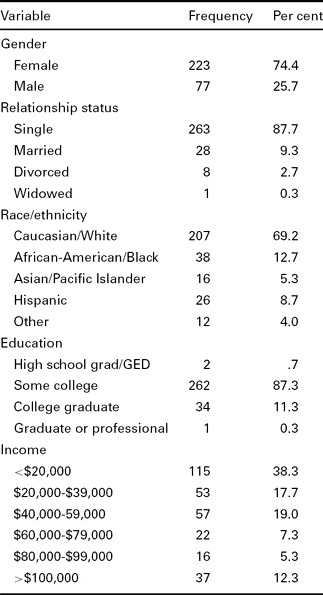
Three hundred participants (77 males, 223 females) were recruited from psychology classes at the University of North Florida, and participants were offered extra credit in exchange for participation. The mean participant age was 23.43 years (SD = 6.194, range 18–61), and the majority of participants identified themselves as Caucasian (69%). A more detailed summary of the descriptive statistics for demographic variables are provided in Table 1.
Descriptive Statistics for Demographic Variables

Measures
In addition to a demographic questionnaire, the following measures were administered:
Positive Beliefs about Post-Event Processing Questionnaire (PB-PEPQ)
The PB-PEPQ is a 23-item questionnaire developed for the purpose of this study to assess the positive beliefs that individuals hold about the benefits of engaging in post-event processing. More specifically, items assessed recent social interactions, thoughts about the interaction after it occurred, and motivation for reviewing the social interaction. The items are rated on a 5-point Likert scale, with responses ranging from 1 (do not agree) to 4 (agree very much). See the Appendix for a full questionnaire. Analyses of the PB-PEPQ showed strong internal consistency (Cronbach's alpha of .92).
Item development
First, authors generated a comprehensive list of potential items based on possible reasons that may lead an individual to engage in post-event processing. Once the initial list was completed, an item-by-item review of measures of similar constructs was conducted to search for content not included in the original item list. In particular, the review included the Post-Event Processing Questionnaire (PEPQ; Rachman et al., Reference Rachman, Gruter-Andrew and Shafran2000), Positive Beliefs about Rumination Scale (PBRS; Papageorgiou & Wells, Reference Papageorgiou and Wells2001), Meta-Cognitions Questionnaire (MCQ-30; Wells & Cartwright-Hatton, Reference Wells and Cartwright-Hatton2004), and Meta-Worry Questionnaire (MWQ; Wells, Reference Wells2005). Five items on the PB-PEPQ were reworded, based on existing measures, including two items from the MWQ (Wells, Reference Wells2005) and three items from the PBRS (Papageorgiou & Wells, Reference Papageorgiou and Wells2001). Items were reworded to be more specific to the construct of PEP.
Post Event Processing Questionnaire — Revised (PEPQ-R)
The PEPQ-R (McEnvoy & Kingsep, Reference McEnvoy and Kingsep2006) assesses the extent to which an individual engages in a post-event processing, or a detailed review of a social anxiety producing event. In the current study, the original visual analogue scale was changed to a 4-point Likert scale. The anchors for the first question were 1, none at all, to 4, a lot. The anchors for questions 2–14 were 1, not at all, to 4, very much. The anchors for question 1 were changed from that of the other questions to create an answer that best suited the wording of that particular item. The PEPQ-R has been found to be reliable and valid, showing high internal consistency and validity. In the current study, Cronbach's alpha indicated good reliability (α = .88).
Social Phobia Inventory (SPIN)
The Social Phobia Inventory evaluates fear, avoidance, and physiological discomfort in social situations (Conner, Davidson, Churchill, Sherwood, Weisler, & Foa, Reference Conner, Davidson, Churchill, Sherwood, Weisler and Foa2000). There are 17 items rated on a 4-point Likert scale (1 = not at all, 4 = extremely). The SPIN has been shown to have good psychometric properties. In particular, the measure has exhibited good test–retest reliability, internal consistency, and divergent validity (Conner et al., Reference Conner, Davidson, Churchill, Sherwood, Weisler and Foa2000). Further, good convergent validity was found when compared to other measures of social phobia (Conner et al., Reference Conner, Davidson, Churchill, Sherwood, Weisler and Foa2000). In the current study, Cronbach's alpha indicated good reliability (α = .92).
Positive Beliefs about Rumination Scale (PBRS)
The Positive Beliefs about Rumination Scale is a 9-item scale designed to assess the extent to which an individual believes rumination is a useful coping strategy (Papageorgiou & Wells, Reference Papageorgiou and Wells2001). Response options on the measure are based on a 4-point Likert scale (1 = do not agree, 4 = agree very much). The PBRS has been found to have good internal consistency and to possess good test–retest reliability (Papageorgiou & Wells, Reference Papageorgiou and Wells2001; Roelofs et al., Reference Roelofs, Huibers, Peeters, Arntz and van Os2010). The measure has exhibited adequate convergent validity, which includes a significant positive association with Meta-Cognitions Questionnaire (MCQ), and the Rumination Scale (Cartwright-Hatton & Wells, Reference Cartwright-Hatton and Wells1997; Nolen-Hoeksema, Reference Nolen-Hoeksema1991; Papageorgiou & Wells, Reference Papageorgiou and Wells2001). In the current study, strong internal consistency was found (α = .94)
Metacognitions Questionnaire-30 (MCQ-30)
The Meta-Cognitions Questionnaire (MCQ-30) is a 30-item self-report measure that assesses metacognitive beliefs that are considered essential in the metacognitive model of psychological disorders (Wells & Cartwright-Hatton, Reference Wells and Cartwright-Hatton2004). Responses are on a 4-point Likert scale (1 = do not agree, 4 = strongly agree). The five factors within the questionnaire are cognitive confidence, positive beliefs about worry, cognitive self-consciousness, negative beliefs about worry (including the uncontrollability and danger of worry), and beliefs about the need to control thoughts. Researchers have found positive correlations between the MCQ-30 and measures of worry and trait anxiety, suggesting adequate construct validity (Wells & Cartwright-Hatton, Reference Wells and Cartwright-Hatton2004). Further, the MCQ-30 been found to exhibit good reliability (Wells & Cartwright-Hatton, Reference Wells and Cartwright-Hatton2004). For the purpose of this study, positive and negative beliefs about worry subscales were utilised, and in the current sample, Cronbach's alphas were found to be good for both Positive Beliefs (α = .82) and Negative Beliefs (α = .88).
Design and Procedure
The study was survey based, and data was collected in classroom settings. Participants who took part in the study were first asked to complete an informed consent form. Following the completion of informed consent form, participants completed the survey packet. Surveys took approximately 20 minutes to complete, and a member of the research team was available to assure independent responding and to answer participant questions.
Results
Factor Structure of the PWM
The PB-PEPQ was subjected to an exploratory factor analysis via a principal axis analysis extraction method. An obtained value of .89 on the Kaiser-Meyer-Olkin measure of sampling accuracy (KMO) suggested that the correlation matrix was adequate for factor analysis.
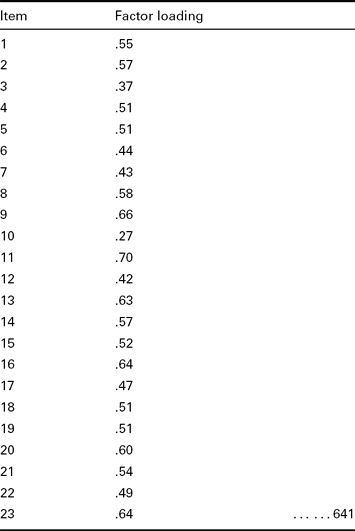
Examination of the scree plot and eigenvalues suggested a robust, single factor solution. The eigenvalue for this factor was 8.31, accounting for 36.27% of item variance. All items loaded significantly on this factor, and the range of factor loadings was from .72 to .43 (see Table 2). The scale exhibited strong reliability with an obtained Cronbach's alpha of .92. Item-total correlations ranged from .41 to .69, and the deletion of items with the lowest item-total correlation values had minimal impact on overall reliability.
Factor Loadings of Items from the Positive Beliefs About Post-Event Processing Questionnaire
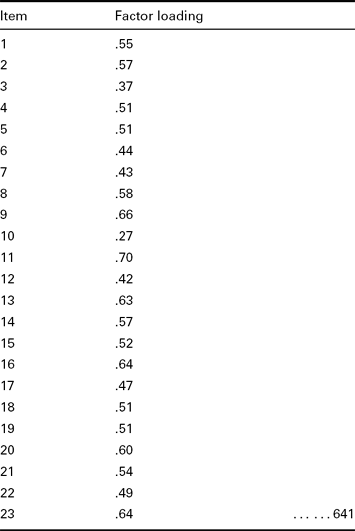
Note: A principal axis extraction method was used. All items exhibited factor loadings greater than .30.
Descriptive Statistics
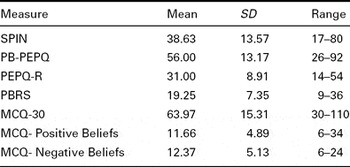
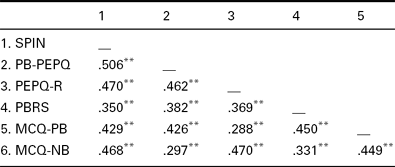
Descriptive statistics for the study variables, including mean, standard deviation and range are provided in Table 2. A correlation matrix of the study variables is provided in Table 3. It is noteworthy that all study variables share significant variance with the PB-PEQ. However, all correlation coefficients are below .80, suggesting appropriateness for inclusion in the subsequent multiple regression analyses.
Descriptive Statistics for Study Measures

Note: Social Phobia Inventory (SPIN), Positive Beliefs about Post-Event Processing Questionnaire (PB-PEPQ), Post-Event Processing Questionnaire Revised (PEPQ-R), Positive Beliefs about Rumination Scale (PBRS), Meta-Cognitions Questionnaire- Positive Beliefs Subscale (MCQ-Positive Beliefs), Meta-Cognitions Questionnaire- Negative Beliefs Subscale (MCQ-Negative Beliefs).
Correlation Matrix of Study Variables
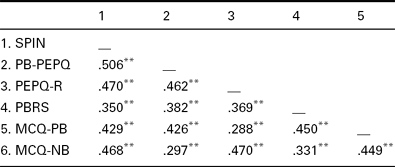
Note: **Correlations are significant at the .01 level. Social Phobia Inventory (SPIN), Positive Beliefs about Post-Event Processing Questionnaire (PB-PEPQ), Post-Event Processing Questionnaire Revised (PEPQ-R), Positive Beliefs about Rumination Scale (PBRS), Meta-Cognitive Questionnaire- Positive Beliefs About Worry Scale (MCQ-PB), Meta-Cognitive Questionnaire- Negative Beliefs About Worry Scale (MCQ-NB).
Positive Beliefs About Post-Event Processing, Post-Event Processing, and Social Anxiety
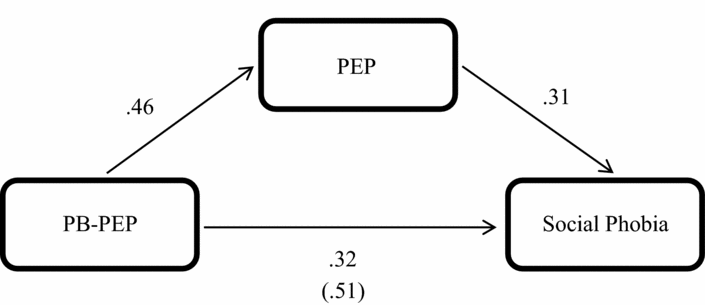
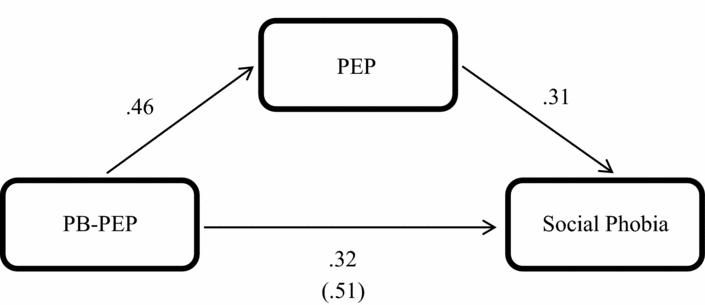
A series of regression analyses were conducted to examine the degree to which positive beliefs about post-event processing is associated with post-event processing and social phobia symptoms. The first regression analysis was conducted to examine the relation between positive beliefs about post-event processing, as measured by the PB-PEPQ, and social phobia symptoms as measured by the SPIN. The PB-PEPQ was found to significantly predict social anxiety symptoms, F(1, 282) = 96.84, p < .001, R 2 = .26, β = .51. The second regression analysis was conducted to determine the relation between positive beliefs about post-event processing and post-event processing as measured by the PEPQ-R. The PB-PEPQ was found to significantly predict PEPQ-R scores, F(1, 261) = 70.45, p < .001, R 2 = .21, β = .32. A third regression analysis was conducted to determine the degree to which positive beliefs about post-event processing and post-event processing simultaneously predicted social phobia. The overall model was significant, F(2, 251) = 52.43, p < .001, R 2 = .30) and both predictor variables were significantly associated with SPIN scores, β = .32, (PB-PEP), β = .31 (PEP). Collectively, the above findings provide evidence for the criterion validity of the PB-PEPQ, as the measure was found to be significantly associated with post-event processing and social phobia symptoms.
Next, based on previous models for depression, a mediation analysis was conducted to determine if PEP mediates the relationship between PB-PEP and social phobia (Papageorgiou & Wells, Reference Papageorgiou and Wells2001). The model was significant (z = 4.39, p < .001) and the mediation pathway accounted for 31% of the variance in relationship between PB-PEP and social phobia (see Figure 1).
Post-event processing as a mediator of the association between positive beliefs about post-event processing and social phobia symptoms. Note: Social phobia was measured by the Social Phobia Inventory (SPIN), Positive beliefs about post-event processing was measured by the Positive Beliefs about Post-Event Processing Questionnaire (PB-PEPQ), and post-event processing was measured by the Post-Event Processing Questionnaire Revised (PEPQ-R). Standardised coefficient values are reported. All values are significant at the p < .01 level. The value in parentheses represents the standardised coefficient value for the direct pathway.
Positive Beliefs About Post-Event Processing and Related Metacognitions
A hierarchical regression analysis was conducted to determine the degree to which PB-PEPQ scores predicted social phobia beyond the variance accounted for by the PEPQ-R, the Positive and Negative Beliefs subscales of the MCQ-30, and the PBRS. In the first step of the regression equation, the PEPQ-R, the positive beliefs about worry and negative beliefs about worry subscales of the MCQ-30, and the PBRS were entered as predictor variables. The SPIN was the criterion variable. The first step of the model was significant, F(4, 249) = 29.78, p < .001, R = .57, and the addition of the PB-PEPQ in the second step of the regression equation lead to a significant improvement in the model, F(5, 249) = 28.91, p < .001, ΔR 2 = .05. Further, based on an examination of the standardised beta weights, PB-PEPQ (β = .26) was the most robust predictor of social phobia. The PEPQ-R (β = .21), the positive beliefs about worry subscale of the MCQ (β = .13), and the negative beliefs about worry subscale of the MCQ (β = .21) were also significant predictors of SPIN scores. In contrast, the PBRS (β = .01) was not found to be associated with SPIN scores.
Discussion
The purpose of this study was to examine the potential role of positive beliefs about post-event processing as a metacognitive process that may underlie the tendency to engage in post-event processing and that may be related to social phobia symptoms. This was accomplished through the development and evaluation of the psychometric properties of the PB-PEPQ. The PB-PEPQ was found to exhibit strong criterion validity, as it was found to be associated with post-event processing and social phobia symptoms. Further, the association between the PB-PEPQ and social phobia was strong, and the PB-PEPQ predicted as much variance in social phobia symptoms as the PEPQ-R. Evidence was also found for the incremental validity of the PB-PEQ. In particular, the PB-PEPQ predicted variance in social phobia symptoms after controlling for similar metacognitive variables including positive and negative beliefs about worry, positive beliefs about rumination, and post-event processing.
Based on the metacognitive model of rumination (Papageorgiou, & Wells, Reference Papageorgiou and Wells2003; Roelofs et al., Reference Roelofs, Huibers, Peeters, Arntz and van Os2010), it was also hypothesised that post-event processing would mediate the association between positive beliefs about post-event processing and social phobia. As anticipated, post-event processing was found to be a significant, partial mediator of this association, and the mediation pathway accounted for 31% of the variance in relationship between PB-PEP and social phobia. These findings provide initial evidence for a cognitive pathway in which individuals who tend to hold positive beliefs about post-event processing are more likely to engage in negative and excessive post-event processing, which may in turn lead to social phobia symptoms.
Although previous studies have found ruminative processes to be associated with post-event processing and social phobia symptoms (Wong & Moulds, Reference Wong and Moulds2010; Wong & Moulds, Reference Wong and Moulds2012), the current study provides a unique contribution to social phobia literature as the first study to directly assess the construct of positive beliefs about post-event processing. The current findings also provide additional insight into the underlying metacognitive processes that may motivate individuals to engage in PEP and that may lead to social phobia. Based on this line of research, it is possible that cognitive models of post-event processing can be modified and expanded to include positive beliefs about post-event processing (Clark & Wells, Reference Wells1995).
The findings from the current study also provide additional evidence for the underlying metacognitive processes related to internalising disorders, including depression, generalised anxiety disorder, and social phobia. More specifically, previous studies have found that similar and overlapping ruminative processes exist for these disorders (McEnvoy, Mahoney, & Moulds, Reference McEnvoy, Mahoney and Moulds2010), and the current study also contributes to a growing body of research indicating that positive metacognitive beliefs may facilitate ruminative processes in each of these disorders (Papageorgiou & Wells, Reference Papageorgiou and Wells2001; Wells, Reference Wells, Davey and Wells2006a; Wong & Moulds, Reference Wong and Moulds2010). Overall, similarities appear to exits in underlying metacognitive processes associated with depression, generalised anxiety disorder, and social phobia. A possible direction for future research is to examine the potential specificity versus overlap of particular positive metacognitive beliefs in relation to these disorders.
The current study also has potential implications for the treatment of social phobia. In particular, metacognitive treatments for generalised anxiety disorder and depression both focus on the identification and reduction of positive metacognitive beliefs. These treatment approaches have received empirical support (Wells, Reference Wells, Davey and Wells2006b; Wells et al., Reference Wells, Fisher, Myers, Wheatley, Patel and Brewin2012), and based on the current findings, it is possible interventions designed to reduce positive metacognitive beliefs in depression and generalised anxiety disorder can be adapted for the treatment of social phobia.
Although the findings of the current study are promising, a number of limitations and directions for future research are noteworthy. First, this study provides only a preliminary evaluation of the psychometric properties of the PB-PEPQ, and follow-up research is needed to confirm of the factor structure of this measure. Further, although the measure exhibited adequate internal consistency, follow-up studies examining the test–retest reliability of the PB-PEPQ are needed. Another limitation is that the current study was based on a non-referred sample of college students. Consequently, follow-up studies are recommended to determine the degree to which the PB-PEPQ can discriminate clinical from non-clinical samples. It is also noteworthy that the current study relied exclusively on self-report measures, including the degree to which participants recall the tendency to engage in post-event processing. Follow-up studies are recommended in which post-event processing is assessed following an actual social interaction. Finally, it is noteworthy that the SPIN and PEPQ were the only criterion variables assessed in the current study. Consequently, follow-up research is recommended in which the association between the PB-PEPQ and other measures relevant to social phobia are assessed. Overall, despite the above mentioned limitations, the results of the current study are promising, and the findings have relevant theoretical and clinical implications.
Appendix
Positive Beliefs About Post-Event Processing Questionnaire
Instructions: Consider your recent social interactions, including interactions with friends, other students, coworkers, and authority figures (including bosses and teachers) over the past few weeks. Many people think about these interactions after they happen. Below are some possible reasons that may motivate you to think about these interactions. Please indicate the degree to which each of the items below motivates you to think about past social interactions.