Insect outbreaks play an important role in the disturbance regime of Newfoundland and Labrador (Canada) boreal forests (Arsenault et al. Reference Arsenault, LeBlanc, Earle, Brooks, Clarke, Lavigne and Royer2016), where one of the most common defoliators is the hemlock looper, Lambdina fiscellaria (Guenée) (Lepidoptera: Geometridae). Its larvae can feed on any native species of conifer or broad-leaved tree (Carroll Reference Carroll1956), stripping and eventually killing the trees and undergrowth after only one or two years of severe defoliation (Otvos et al. Reference Otvos, Clarke and Durling1979). Outbreaks last generally two to three years, after which, populations decline naturally due to adverse climate, natural enemies, starvation, or a combination of these factors (Otvos Reference Otvos1973a; Otvos et al. Reference Otvos, Clarke and Durling1979; Carleton et al. Reference Carleton, Royer, Hébert, Delisle, Berthiaume, Beauce and Quiring2009; Delisle et al. Reference Delisle, Royer, Bernier-Cardou and Labrecque2012, Reference Delisle, Labrecque, Royer, Bernier-Cardou, Bauce, Charest and Larrivée2013). Some studies have suggested that parasitoids may cause significant looper mortality on the island of Newfoundland (Carroll Reference Carroll1956; Otvos Reference Otvos1973a; Carleton et al. Reference Carleton, Quiring, Heard, Hébert, Delisle and Berthiaume2010). Consequently, parasitoids may reduce the level of damage caused by this pest, indicating potential as biological control agents.
In 2006, pockets of defoliation caused by hemlock looper were detected in the Eagle River area of Labrador (Crummey Reference Crummey2007). The outbreak grew over the next two years, reaching a maximum size of 26 000 ha in 2008 before collapsing in 2009 (Carter Reference Carter2010). The severity of defoliation was unprecedented in this area of Labrador, providing a unique opportunity to study egg and larval parasitism of hemlock looper at the northern limit of its range. To facilitate comparison with other studies, we also compiled a list of all known parasitoids of this insect in Canada from an exhaustive review of published literature and specimens housed in the Canadian National Collection of Insects, Arachnids, and Nematodes in Ottawa, Ontario, Canada. Furthermore, we updated all nomenclature as many of the species and generic combinations have changed through time.
Sampling in Labrador was done in three sites south of Happy Valley-Goose Bay in 2009 (Site 1: 53°08'N, 60°29'W; Site 2: 53°11'N, 60°28'W; Site 3: 53°14'N, 60°27'W). To determine egg parasitism, one 1-m long, low, mid-crown branch (~6 m high) was collected from 10 randomly selected balsam fir trees at each site in June, and was washed to dislodge eggs using the method of Otvos and Bryant (Reference Otvos and Bryant1972). Eggs were placed individually in 1-mL gelatin capsules (Model #00-clearlocking, PCCA Corporation, London, Ontario, Canada), and maintained at 20.0±0.5°C, 75±5% relative humidity and 16:8 light:dark hours until either parasitoids or hemlock looper larvae emerged. None of the eggs were collapsed or hatched/emerged at the collection time. Unhatched eggs were dissected to determine if they had been parasitised. Parasitoid adults were identified, and a mean percent parasitism±standard error for each site was calculated.
To determine larval parasitism, hemlock looper larvae were collected in August by beating the branches of 10 trees over a 2.15×2.75 m canvas sheet at each site. Larvae were reared on fresh balsam fir branches in 11.4 L storage boxes (Model #2220; Rubbermaid, Wooster, Ohio, United States of America), and kept in a growth chamber at 20.0±0.5°C, 75±5% relative humidity and 16:8 light:dark hours. Balsam fir foliage was changed weekly, and boxes were checked every three days. Looper pupae, larvae/cocoons/puparia of parasitoids, and dead looper larvae were transferred into individual plastic cups (Model P100; Solo Cup, Toronto, Ontario, Canada) and monitored daily until the emergence of adult moths or parasitoids. Tachinidae (Diptera) larvae were reared as described by Otvos (Reference Otvos1973b). Unemerged pupae, cocoons or puparia were overwintered in a cold room at 2°C in case some parasitoid species required overwintering, and were incubated again the next spring. All dead loopers were dissected to assess the presence of parasitoids. Per cent parasitism at each site was calculated for each parasitoid species.
Adult parasitoids were identified by A.M.R.B. and J.E.O., except for Telenomus Haliday (Hymenoptera: Platygastridae), which were identified by G. Pelletier (Laurentian Forestry Centre, Sainte-Foy, Québec, Canada). Voucher specimens are stored at Laurentian Forestry Centre and the Canadian National Collection of Insects, Arachnids, and Nematodes. The names of tachinid species follow the catalogue of O’Hara and Wood (Reference O’Hara and Wood2004). Hymenoptera species names were taken from the following sources: Chalcidoidea: Noyes (Reference Noyes2016); Ichneumonoidea: Yu et al. (Reference Yu, van Achterberg and Horstmann2012); Telenomus: Pelletier and Piché (Reference Pelletier and Piché2003).
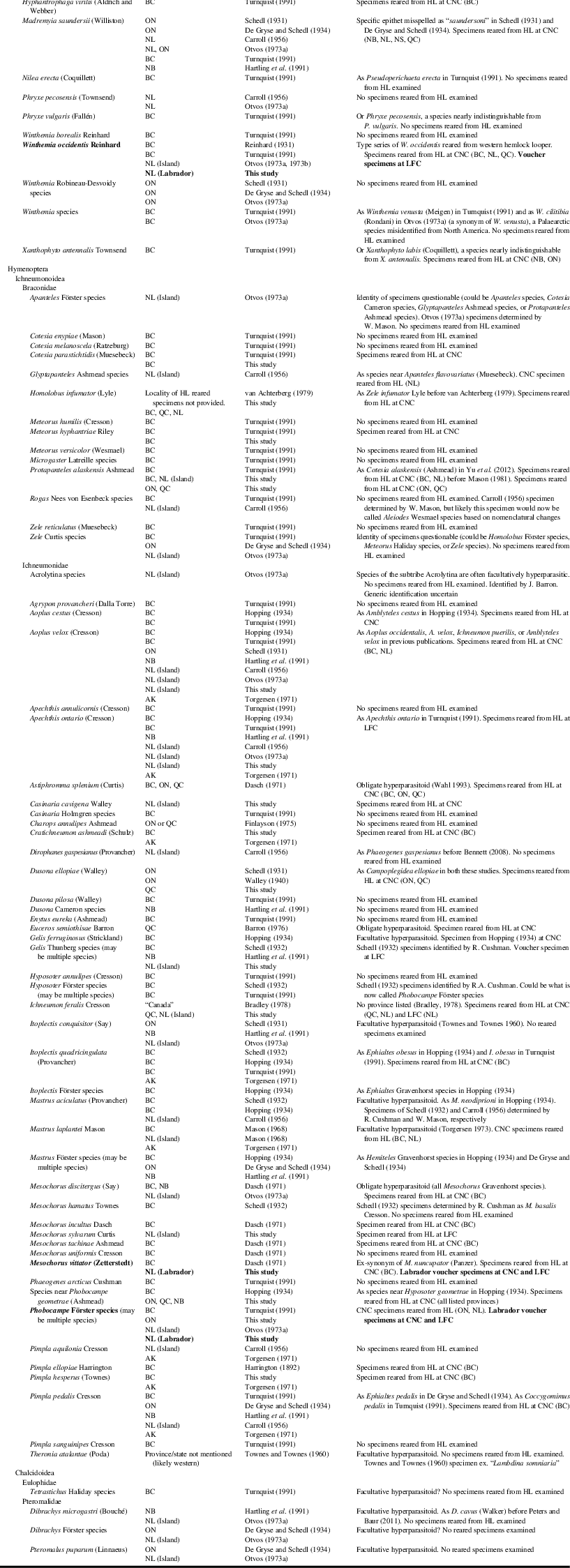
The parasitoid assemblage identified in Labrador represented only a subset of the species found throughout the range of hemlock looper in Canada (Table 1). An important caveat, however, is that the degree of evidence supporting the validity of records is variable. While some species have multiple references (often from multiple provinces and/or years), voucher specimens, and information on collectors and who did the identification, other records have less evidence and should be treated more cautiously.
Parasitoids associated with hemlock looper, Lambdina fiscellaria Footnote *, in CanadaFootnote ≅ .

Notes: Species names in boldface are those reared in this study from Labrador.
* As defined in Sperling et al. (Reference Sperling, Raske and Otvos1999).
≅ Some records also included for Alaska, United States of America as indicated.
HL, hemlock looper; CNC, Canadian National Collection of Insects, Arachnids, and Nematodes; LFC, Laurentian Forestry Centre. AK, Alaska; BC, British Columbia; NB, New Brunswick; NL, Newfoundland and Labrador; NS, Nova Scotia; ON, Ontario; QC, Québec.
In Canada, at least six species of egg parasitoids have been recorded from two families: Platygastridae (previously Scelionidae) and Trichogrammatidae (Hymenoptera) (Table 1). It is recommended that the identification of these tiny parasitoids be left at the generic level unless they are compared to authoritatively identified material. In Labrador, only two of these species were found, Telenomus coloradensis Crawford, which was the most common with 47 adults reared, and T. droozi Muesebeck, a rare species in our study with two adults reared from the most northern site (site 3). The site-specific estimates of egg parasitism from south to north were 40.0±15.0% (n=15), 0% (n=41) and 72.1±9.6% (n=69). As adults of known egg parasitoids emerge in the spring at the same time or after the hatching of looper eggs, our June samples should have contained all the parasitoid species that were present. Moreover, the mean number of looper eggs per branch was 4.2±1.3 (mean±standard error), indicating that looper populations were still at a moderate level according to the egg density classification of the Newfoundland and Labrador Government (Lavigne Reference Lavigne2011). Therefore, our sampling was undertaken during the declining phase of the outbreak, when parasitoids are generally most abundant. Although a few egg parasitoids are consistently associated with hemlock looper in Canada, spring parasitism by Telenomus is known to cause the collapse of its outbreaks (Hébert et al. Reference Hébert, Berthiaume, Dupont and Auger2001).
Table 1 lists 62 described species of larval and pupal parasitoids reared from hemlock looper in Canada (one Sarcophagidae and 15 Tachinidae species of Diptera plus nine Braconidae, 35 Ichneumonidae, and two Pteromalidae species of Hymenoptera). This number does not include species that are identified only to genus, for example, Tetrastichus Haliday (Hymenoptera: Eulophidae), although some of these unidentified species (e.g., Glyptapanteles Ashmead species) are important parasitoids of hemlock looper (Carroll Reference Carroll1956). There are very few additional non-Canadian records, as hemlock looper is mostly a northern Nearctic species and most parasitoid records for the northern United States of America are shared with Canada. One exception is Homolobus truncator (Say) (Hymenoptera: Braconidae), which has been reared from hemlock looper in the eastern United States of America (Virginia), but not yet in Canada (Petrice et al. Reference Petrice, Strazanac and Butler2004, as Zele mellea (Cresson)).
Of the 800 collected larvae in Labrador, 344 (mean±standard error: 43.3±2.3%) developed into moths, 323 (mean±standard error: 40.0±5.1%) died at the larval or pupal stage without any sign of parasitism or disease, and 133 (mean±standard error: 16.7±3.4%) were parasitised. The site-specific estimates of parasitism from south to north were 14.6% (n=240), 23.4% (n=265), and 12.2% (n=295), which was caused by three species of primary parasitoids.
The most common parasitoid was the tachinid Winthemia occidentis Reinhard (120 specimens), accounting for all but one of the adult tachinids identified in Labrador. The abundance of W. occidentis in our samples is of particular interest because this species was introduced from British Columbia, Canada to several locations in insular Newfoundland between 1949 and 1951 for control of hemlock looper (Clark et al. Reference Clark, Otvos and Pardy1973).
One tachinid, Blondelia eufitchiae (Townsend), emerged from a looper pupa in site 1. This species was previously reported from hemlock looper in Newfoundland and Ontario (Table 1). Therefore, two of the four tachinid species reported from Newfoundland were reared in this study.
The third primary parasitoid that emerged from looper larvae was the ichneumonid wasp Phobocampe Förster species (Table 1). This solitary species accounted for 0.4% (n=1), 0.8% (n=2), and 0.7% (n=2) of the parasitism in sites 1, 2, and 3, respectively. Phobocampe were previously reared from hemlock looper in Newfoundland, British Columbia, and Ontario (Table 1). Unfortunately, the taxonomy of this genus remains unclear and a revision is needed before the species from Labrador can be accurately identified and determined whether it is conspecific with those reported elsewhere.
The hyperparasitoid wasp, Mesochorus vittator (Zetterstedt) (Hymenoptera: Ichneumonidae), was reared during the study (Table 1). Mesochorinae are obligate endoparasitic hyperparasitoids of wasps, but can sometime attack tachinids (Wahl Reference Wahl1993). Four specimens of this species (site 1: n=2, site 2: n=1, site 3: n=1) emerged from ichneumonid cocoons that were very similar to those of Phobocampe. Although the impact of hyperparasitism was negligible in our Labrador samples, many obligate and facultative hyperparasitic species are associated with hemlock looper (at least 16 species in Table 1), suggesting that they could play a much larger role in the population dynamics of this pest.
Dipteran and hymenopteran parasitoids may play an important role in the control of hemlock looper populations. It is hoped that the compilation in Table 1 of all the parasitoids known to attack this pest in Canada will facilitate future work quantifying parasitoid impact and identifying potential biological control agents. We hope that this review will prompt the development of a comprehensive identification key specifically for parasitoids of hemlock looper. The Labrador samples did not add new species to the known list of hemlock looper parasitoids, but it is the first record of these six parasitoid species north of the 52nd parallel in Canada.
Acknowledgements
Thanks are due to C. Hébert (Laurentian Forestry Centre, Québec), V. Martel (Laurentian Forestry Centre, Québec), P. Mason (Agriculture and Agri-Food Canada, Ottawa), and two anonymous reviewers for many constructive comments on earlier versions of this manuscript and to K. McCarthy, T. Rideout, E. Wheeler, and C. Wilcox for laboratory and field assistance. The authors would like to thank H. Crummey, D. Jennings, and G. Holloway from the Department of Natural Resources of Newfoundland and Labrador for their collaboration. G. Gibson (Agriculture and Agri-Food Canada, Ottawa) and J. Huber (Canadian Forest Service, Ottawa) provided information on natural history and nomenclature of Chalcidoidea, and J. Fernandez (Agriculture and Agri-Food Canada, Ottawa) and G. Pelletier (Laurentian Forestry Centre, Québec) did the same for Braconidae and Platygastridae, respectively. This study was financed by the Natural Resources Canada, Canadian Forest Service, Department of Natural Resources of Newfoundland and Labrador, and Department of Natural Resources of Nova Scotia.