INTRODUCTION
Leishmaniasis is a complex of neglected tropical diseases caused by different species of protozoa of the genus Leishmania, transmitted by the bite of phlebotomine sand flies. The clinical forms vary from the morbid and most common cutaneous leishmaniasis (CL) causing 1 000 000 annual new cases worldwide to fatal visceral leishmaniasis (VL) (World Health Organization, 2015).
As there are no vaccines, drugs remain the most important tool for the control of human leishmaniasis (Srivastava et al. Reference Srivastava, Shankar, Mishra and Singh2016).In comparison with VL, there are limited treatment options for CL, in which the response to injectable pentavalent antimonials, amphotericin B lipid formulations, pentamidine and oral miltefosine is unpredictable and/or may cause severe adverse effects (Monge-Maillo and López-Vélez, Reference Monge-Maillo and López-Vélez2015; Sundar and Chakravarty, Reference Sundar and Chakravarty2015). Local therapies have found variable degrees of efficacy (Navin et al. Reference Navin, Arana, Arana, de Mérida, Castillo and Pozuelos1990; López et al. Reference López, Robayo, Vargas and Vélez2012; Ben Salah et al. Reference Ben Salah, Ben Messaoud, Guedri, Zaatour, Ben Alaya, Bettaieb, Gharbi, Belhadj Hamida, Boukthir, Chlif, Abdelhamid, El Ahmadi, Louzir, Mokni, Morizot, Buffet, Smith, Kopydlowski, Kreishman-Deitrick, Smith, Nielsen, Ullman, Norwood, Thorne, McCarthy, Adams, Rice, Tang, Berman and Ransom2013; Sosa et al. Reference Sosa, Capitán, Nieto, Nieto, Calzada, Paz, Spadafora, Kreishman-Deitrick, Kopydlowski, Ullman, McCarthy, Ransom, Berman, Scott and Grogl2013), and so new safe drugs particularly for local or oral use that increase patient compliance are urgently needed for CL.
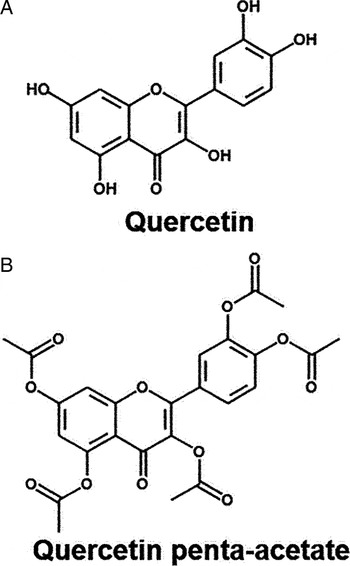
Natural and synthetic flavonoids, such as chalcones and quercetin (Qc, Fig. 1), have been reported with safe antileishmanial properties (Torres-Santos et al. Reference Torres-Santos, Rodrigues, Moreira, Kaplan and Rossi-Bergmann1999; Sen et al. Reference Sen, Mandal, Roy, Mukhopadhyay and Biswas2005; Boeck et al. Reference Boeck, Bandeira Falcão, Leal, Yunes, Filho, Torres-Santos and Rossi-Bergmann2006; Muzitano et al. Reference Muzitano, Falcão, Cruz, Bergonzi, Bilia, Vincieri, Rossi-Bergmann and Costa2009; Sen and Chatterjee, Reference Sen and Chatterjee2011). Qc is the most abundant antioxidant of fruits and vegetables, with a wide range of therapeutic actions including chemoprevention (Gibellini et al. Reference Gibellini, Pinti, Nasi, Montagna, De Biasi, Roat, Bertoncelli, Cooper and Cossarizza2010), anti-inflammatory (Li et al. Reference Li, Yao, Han, Yang, Chaudhry, Wang, Liu and Yin2016a ) and antiallergic activities (Mlcek et al. Reference Mlcek, Jurikova, Skrovankova and Sochor2016). Qc and its penta-acetylated derivative (PQc, Fig. 1B) were previously demonstrated with in vitro activity against Leishmania spp. (Muzitano et al. Reference Muzitano, Tinoco, Guette, Kaiser, Rossi-Bergmann and Costa2006; Marín et al. Reference Marín, Boutaleb-Charki, Díaz, Huertas, Rosales, Pérez-Cordon, Guitierrez-Sánchez and Sánchez-Moreno2009). Its antileishmanial effect seems to be related to the inhibition of parasite arginase, an important enzyme in reactive oxygen species detoxification mechanisms (Fonseca-Silva et al. Reference Fonseca-Silva, Inacio, Canto-Cavalheiro and Almeida-Amaral2011). In vivo, we and others have shown the oral efficacy of Qc in murine CL caused by L eishmania amazonensis (Muzitano et al. Reference Muzitano, Falcão, Cruz, Bergonzi, Bilia, Vincieri, Rossi-Bergmann and Costa2009) and in hamster VL caused by L eishmania donovani (Sen et al. Reference Sen, Mandal, Roy, Mukhopadhyay and Biswas2005). Therefore, Qc is a good oral compound prototype for further development.
Chemical structures of (A) Qc and (B) PQc.

Since the lipophilic nature of Qc may impair its oral absorption, lipid nanosystems capable of drug protection against gastric digestion while promoting intestinal uptake would be ideal carriers for Qc oral delivery (Li et al. Reference Li, Zhao, Ma, Zhai, Li and Lou2009; Sun et al. Reference Sun, Gao, Pei, Guo, Li, Cao, Yu and Zhai2010; Tran et al. Reference Tran, Guo, Song, Bruno and Lu2014). In this sense, lipid-core nanocapsules (LNCs) made of a poly(ε-caprolactone) shell have emerged as a safe carrier system to improve intestinal uptake in vivo (Frozza et al. Reference Frozza, Bernardi, Paese, Hoppe, da Silva, Battastini, Pohlmann, Guterres and Salbego2010; Venturini et al. Reference Venturini, Jäger, Oliveira, Bernardi, Battastini, Guterres and Pohlmann2011). Besides their potential to increase oral drug bioavailability (Frozza et al. Reference Frozza, Bernardi, Paese, Hoppe, da Silva, Battastini, Pohlmann, Guterres and Salbego2010), in vitro studies using rhodamine B-labelled LNCs showed that they can be effectively internalized and compartmentalized inside the phagocytic vacuoles of macrophages (Poletto et al. Reference Poletto, Fiel, Lopes, Schaab, Gomes, Guterres, Rossi-Bergmann and Pohlmann2012), the host cells of Leishmania parasites. Recently, we described the production and characterization of LNCs loaded with Qc and PQc (LNC-Qc and LNC-PQc, respectively) (Poletto et al. Reference Poletto, De Oliveira, Wender, Regent, Donida, Teixeira, Guterres, Rossi-Bergmann and Pohlmann2015). By introducing sorbitan monostearate into the oil core, the drug-loading rate could be increased by 40-fold as compared with conventional nanocapsules.
Thus, both LNC-Qc and LNC-PQc formulations with maximized drug loadings seemed suitable for oral administration and were evaluated here for their capacity to treat CL in mice infected with L. amazonensis.
MATERIALS AND METHODS
Chemicals
Qc was supplied by Henrifarma (São Paulo, Brazil). PQc was synthesized from Qc by our group as previously described (Poletto et al. Reference Poletto, De Oliveira, Wender, Regent, Donida, Teixeira, Guterres, Rossi-Bergmann and Pohlmann2015). Poly(ε-caprolactone) (PCL; MW = 14 000 g mol) was obtained from Aldrich (Strasbourg, France); sorbitan monostearate (Span 60®) was from Sigma (St. Louis, Missouri, USA); and caprylic/capric triglyceride was acquired from Alpha Química (Porto Alegre, Brazil). Polysorbate 80 was supplied from Gerbras (São Paulo, Brazil). All chemicals and solvents were of analytical or pharmaceutical grade.
LNC-Qc and LNC-PQc preparation
LNC-Qc and LNC-PQc were prepared in aqueous suspensions by interfacial deposition of preformed polymer (Poletto et al. Reference Poletto, De Oliveira, Wender, Regent, Donida, Teixeira, Guterres, Rossi-Bergmann and Pohlmann2015). Briefly, 0·400 mg of Qc or 0·500 mg of PQc was added to the organic phase comprising 0·100 g of poly(ε-caprolactone), 0·16 mL of capric/caprylic triglyceride, 0·040 g of sorbitan monostearate and 27 mL of acetone at 40 °C. These organic phases were injected into 53 mL of an aqueous phase containing 80 mg of polysorbate 80 at 40 °C, under moderate stirring for 10 min. Finally, the acetone was eliminated and water partially evaporated to approximately 9 mL under reduced pressure at 40 °C (Rotative evaporator, Buchi, Switzerland). Then, the volume was adjusted in a volumetric flask to 10 mL. This process yielded LNC-Qc and LNC-PQc nanocapsules with unimodal size distributions with volume-weighted diameters of 222 and 217 nm with a polydispersity (expressed as span) lower than 1·8. Liquid chromatography showed compound contents of 40·2 and 50 µg mL−1, respectively.
Mice
BALB/c mice originally purchased from Jackson Laboratory (Bar Harbor, Maine, USA) were bred and maintained in our facilities at Federal University of Rio de Janeiro under controlled temperature, with filtered air, filtered water, autoclaved bedding and pelleted food. Female mice at 8 weeks of age (approximately 20 g of body weight) were used in this study. All experiments were performed in conformity with the Guide for the Care and Use of Laboratory Animals (National Institutes of Health, NIH) and were approved by the Committee on the Ethics of Animal Use of the Federal University of Rio de Janeiro under the code CAUAP180.
Treatment efficacy
The efficacy of Qc, PQc and their LNC formulations was evaluated in a murine model of CL. For this purpose, BALB/c mice were infected in the ear with 2 × 10⁶ promastigotes of L. amazonensis (MHOM/BR/75/Josefa strain) transfected with green fluorescent protein (L. amazonensis-GFP) (Rossi-Bergmann et al. Reference Rossi-Bergmann, Lenglet, Bezerra-Santos, Costa-Pinto and Traub-Czeko1999). Seven days after infection, animals were treated daily by intragastric gavage with 200 µL of LNC-Qc or LNC-PQc (0·4 mg of drug kg−1) or with the free drugs Qc or PQc (16 mg kg−1) in 200 µL of soybean oil plus 2% ethanol as previously (Muzitano et al. Reference Muzitano, Falcão, Cruz, Bergonzi, Bilia, Vincieri, Rossi-Bergmann and Costa2009) for 51 days. Controls received 200 µL of soybean oil plus 2% ethanol by the oral route. For clinical follow-up, ear thicknesses were periodically measured using a dial caliper. For parasite burden evaluation, the animals were euthanized with isofluorane overdose on day 59 of infection, and the infected ears were surgically removed. The tissues were homogenized in 1 mL of phosphate-buffered saline with a tissue grinder. The parasite loads were quantified in the single-cell suspensions by both limiting dilution assay (LDA) (Lima et al. Reference Lima, Bleyenberg and Titus1997) and fluorimetry (435 nm excitation and 538 nm emission – FLx800, Bio-Tek Instruments, Winooski, Vermont, USA) (Demicheli et al. Reference Demicheli, Ochoa, da Silva, Falcão, Rossi-Bergmann, de Melo, Sinisterra and Frézard2004).
Toxicity studies
Mice were treated as above with the free drugs and their nanoformulations. In the next day after treatment suspension (day 59), the levels of aspartate aminotransferase (AST), alanine aminotransferase (ALT) and creatinine were measured in the individual sera using commercial analytical kits (Doles, Brazil) adapted for microvolumes (da Cunha-Júnior et al. Reference da Cunha-Júnior, Pacienza-Lima, Ribeiro, Netto, do Canto-Cavalheiro, da Silva, Costa, Rossi-Bergmann and Torres-Santos2011). Positive sera were from mice receiving 200 µL of 1% carbon tetrachloride in soybean oil by the intraperitoneal route 3 days before the experiment (Otsuka et al. Reference Otsuka, Takagi, Horiguchi, Toyoda, Sato, Takayama and Mori2002). The normal reference was sera from untreated mice.
Statistical analysis
Data were statistically analysed by Student's t-test or one-way analysis of variance with the Tukey's post-test using GraphPad Prism 6 software. Values were considered different when P < 0·05.
RESULTS AND DISCUSSION
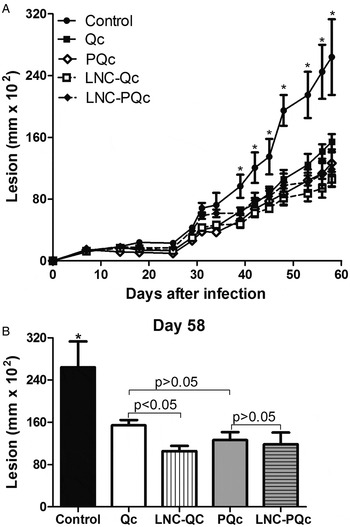
L eishmania amazonensis-infected BALB/c were used here as a sensitive experimental model of CL to test the oral efficacy of LNC-Qc and LNC-PQc. The free drugs were given in therapeutic doses (16 mg kg−1) (Muzitano et al. Reference Muzitano, Falcão, Cruz, Bergonzi, Bilia, Vincieri, Rossi-Bergmann and Costa2009), whereas the LNC formulations were given in doses 40-fold smaller (0·4 mg kg−1), the maximal intragastric dose possible in 200 µL. Qc at 0·4 mg kg−1 produces no effect in CL using the same treatment protocol (not shown). Figure 2A shows that from day 40 of infection, all treatments prevented lesion growth. When data are depicted separately as in day 58 (Fig. 2B), the efficacy of PQc appears slightly higher than Qc, reducing lesion sizes by 38 and 47%, respectively, but this difference is not statistically significant (P > 0·05). This is in agreement with the similar in vitro activities of both compounds against L eishmania (V.) peruviana and L eishmania (V.) braziliensis promastigotes (Marín et al. Reference Marín, Boutaleb-Charki, Díaz, Huertas, Rosales, Pérez-Cordon, Guitierrez-Sánchez and Sánchez-Moreno2009) and is the first in vivo demonstration of PQc efficacy in leishmaniasis. Besides, this finding indicates that introduction of acetyl groups does not affect Qc antileishmanial activity. Treatment with LNC-Qc led to lesions significantly smaller (P < 0·05) than those obtained with Qc, indicative of a clear increase in drug potency after encapsulation. The same can be said about LNC-PQc and PQc, considering the 40-fold lower dose in the former.
Clinical cure evaluation. BALB/c mice were infected in the right ear with 2 × 10⁶ promastigotes of L eishmania amazonensis-GFP. On days 7–58 of infection, animals were daily treated with 16 mg kg−1 of the free drugs Qc or PQc, or 0·4 mg kg−1 of the encapsulated drugs LNC-Qc or LNC-PQc by the oral route. The control group received vehicle alone (200 µL−1 of soybean oil plus 2% ethanol). (A) Infected and non-infected ear thicknesses were measured in the indicated days with a digital caliper. Lesion sizes were expressed as the difference between them in each time point. (B) The lesion sizes picked in day 58 in (A) were expressed in bars. These results are representative of three different experiments. Means ± s.e.m. (n = 5). *P < 0·05 in relation to all treated groups.

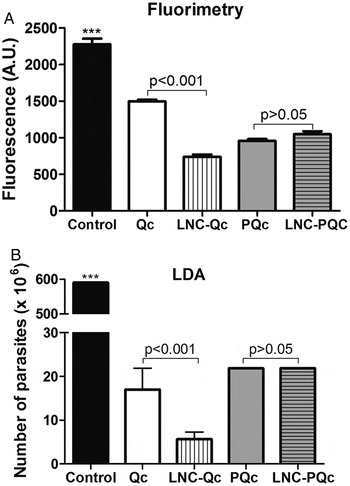
Lesion thickness should not be used as a sole efficacy parameter due to the possibility of inflammation and oedema. For greater accuracy, at the end of the treatment, the parasite loads were estimated by an indirect (fluorimetry) and direct (LDA) assay. The superior effectiveness of LNC-Qc in relation to Qc was confirmed in Fig. 3A and B. When the 40-fold lower drug intake is taken into account, an 80- to 160-fold decrease in parasite loads after drug encapsulation into LNC is assumed using each method. These findings are in line with previous studies showing increased Qc bioavailability after encapsulation in solid lipid nanoparticles (Li et al. Reference Li, Zhao, Ma, Zhai, Li and Lou2009), self-nanoemulsifying system (Tran et al. Reference Tran, Guo, Song, Bruno and Lu2014) or nanosuspension (Sun et al. Reference Sun, Gao, Pei, Guo, Li, Cao, Yu and Zhai2010).
Parasitological cure evaluation. BALB/c mice were infected and treated as in Fig. 1. After 59 days of infection, the animals were euthanized, and parasite burden was determined by (A) fluorimetry and (B) LDA. Fluorimetric values are expressed as arbitrary units (A.U.) and are corrected for background uninfected ear values (A.U. = 2083). These results are representative of three different experiments. Mean ± s.e.m. (n = 5). *P < 0·05 and **P < 0·001 in relation to all treated groups.

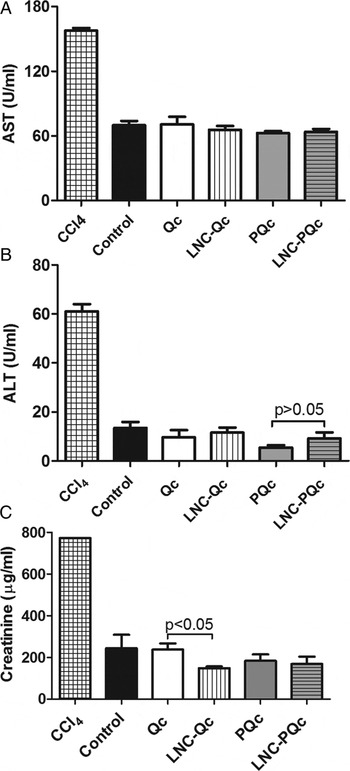
The reason why encapsulation in LNC greatly increases Qc efficacy may be associated with at least one of the steps from oral intake to drug release inside the infected cells. The assumption that the LNC polymeric shell protects Qc against extensive gastric and intestinal degradation and elimination as reported earlier (Graf et al. Reference Graf, Ameho, Dolnikowski, Milbury, Chen and Blumberg2006) is supported by the better sustained antioxidant activity exhibited by Qc encapsulated in LNC also containing octyl methoxycinnamate in the lipophilic core (Weiss-Angeli et al. Reference Weiss-Angeli, Poletto, De Marco, Salvador, Da Silveira, Guterres and Pohlmann2012). LNCs are orally absorbed intact, as previously demonstrated in the treatment of glioma in mice (Rodrigues et al. Reference Rodrigues, Fiel, Shimada, Pereira, Guterres, Pohlmann and Farsky2016). Nanoparticle uptake by intestinal M cells may also play an important role in oral absorption (Lopes et al. Reference Lopes, Abrahim, Cabral, Rodrigues, Seiça, de Baptista and Ribeiro2014). In addition, the polymeric shell may prevent active Qc conjugation with the small-intestine cells (Crespy et al. Reference Crespy, Morand, Manach, Besson, Demigne and Remesy1999), thus allowing better drug absorption. Finally, LNC may confer structural integrity in blood circulation (Li et al. Reference Li, Chen, Su, Sun and Ping2016b ) up to internalization by Leishmania-infected macrophages in inflamed lesions. Oral biodistribution studies with free and LNC-encapsulated compounds particularly in the infected tissue would help clarify this issue. Treatment toxicity was assessed by measuring serum AST, ALT and creatinine, whose elevated levels are markers of cardiac, hepatic and kidney damage, respectively. After 51 doses, when treatment toxicity is expected to be maximum, none of those markers were elevated (Fig. 4), indicative of treatment safety. That was further supported by the observation that mouse weight gain was not statistically different amongst all the groups throughout treatment (not shown). These findings are in agreement with other studies demonstrating the safety of nanocapsules containing poly(ε-caprolactone) as a polymeric matrix (Pohlmann et al. Reference Pohlmann, Fonseca, Paese, Detoni, Coradini, Beck and Guterres2013). The oral safety of blank LNCs as used here has also been demonstrated in an acute and subchronic treatment in rats (Bulcão et al. Reference Bulcão, Freitas, Venturini, Dallegrave, Durgante, Göethel, Cerski, Zielinsky, Pohlmann, Guterres and Garcia2013). As to Qc safety, only after a long period (2 years) of daily consumption of high Qc dose (1900 mg kg−1 day−1) did Qc show carcinogenic activity (Dunnick and Hailey, Reference Dunnick and Hailey1992): a toxic Qc dose that was far higher (100-fold) than the dose used previously (Muzitano et al. Reference Muzitano, Falcão, Cruz, Bergonzi, Bilia, Vincieri, Rossi-Bergmann and Costa2009) and in the present work (16 mg kg−1 day−1), and it was considerably decreased when using LNC.
Chronic toxicity evaluation. BALB/c mice were infected and treated as in Fig. 1. At the end of the treatment, the serum from each mouse was collected to evaluate the cardiac, hepatic, and renal toxicity by measuring the indicated enzyme concentrations. CCl4 is positive sera obtained from animals pretreated with CCl4. The control is the reference sera from untreated mice. These results are representative of two different experiments. Mean ± s.e.m. (n = 5).

Concluding remarks
We conclude that encapsulation in LNC safely increases the oral efficacy of Qc and, to a lesser extent, its PQc derivative in the murine model of CL. These nanosystems have good oral potential not only in CL but also all conditions where Qc may show therapeutic potential.
FINANCIAL SUPPORT
This work was funded by the Brazilian agency Conselho Nacional de Desenvolvimento Científico e Tecnológico – CNPq, grant # 402787/2013-7, and also PRONEX/FAPERGS-CNPq.