Introduction
Increases in life expectancy enable individuals to spend an extended amount of time in older age. Rather than viewing this period as a time of decline, dependency or stagnation, an alternative approach recognises older adults as productive, independent and valuable members of society who contribute a diversity of skills, experience and knowledge (National Seniors Council, 2010). One method by which older adults can improve their health, foster resilience, increase life satisfaction and maintain purpose in life is through volunteerism (O'Neill et al., Reference O'Neill, Morrow-Howell, Wilson, Settersten and Angel2011). Volunteering can be broadly defined as an activity in which time is given without pay to benefit others (Wilson, Reference Wilson2000; Gottlieb and Gillespie, Reference Gottlieb and Gillespie2008). Formal volunteering is distinct from informal helping, an activity that is typically private and not carried out within the context of a formal organisation (Wilson and Musick, Reference Wilson and Musick1997).
Volunteering is a common pastime for many older adults. In Canada, while those aged 55 and over are less likely to volunteer compared to younger age groups, they tend to give more hours on average (National Seniors Council, 2010). In 2013, 41 per cent of Canadians aged 55–64 volunteered at least once per year, with an average of 203 hours per year. Results from the 2013 Canadian General Social Survey on Giving, Volunteering, and Participating also indicated that 38 per cent of Canadians aged 65–74 volunteered at least once per year (with an average of 231 hours per year) and 27 per cent of those aged 75+ volunteered at least once per year (with an average of 196 hours per year) (Turcotte and Statistics Canada, Reference Turcotte2015). International volunteering rates are similar to Canada. In the United States of America, the volunteer rate among individuals aged 16 and over was found to be 24.9 per cent in 2016, and the rate among the older adult population (65+) was estimated at 23.5 per cent (Bureau of Labor Statistics, 2016). In the United Kingdom, slightly higher rates of volunteerism were determined using the 2017–2018 Community Life Survey, with a rate of 38 per cent for individuals aged 16 and above, 29 per cent for those aged 65–74 (higher than any other age group), and 25 per cent for those aged 75 and above (Department for Digital, Culture, Media and Sport, 2017).
Research has found that older adults are motivated to volunteer for many different reasons. These include altruistic concerns, such as helping those in need and to better one's community, as well as extrinsic factors, including a desire for greater purpose in life, to increase a sense of identity, to provide structure and to keep busy (Bradley, Reference Bradley1999; Callow, Reference Callow2004; Fraser et al., Reference Fraser, Clayton, Sickler and Taylor2009). Other common motivations include meeting new people and making friends, and leaving a personal legacy for the next generation (Hunter and Rowles, Reference Hunter and Rowles2005; Dávila and Díaz-Morales, Reference Dávila and Díaz-Morales2009; Yamashita et al., Reference Yamashita, López, Soligo and Keene2017). In addition to personal motivations, research has also identified numerous predictors of volunteerism among older adults. Volunteerism is more likely to be engaged in among individuals who possess specific demographic characteristics and socio-economic resources. For instance, educational attainment is one of the strongest predictors of volunteering (Musick and Wilson, Reference Musick and Wilson2008; Turcotte and Statistics Canada, Reference Turcotte2015), perhaps because it fosters empathy for the less fortunate, teaches individuals about social problems and injustice, and increases the size of an individual's social network, thus increasing the likelihood of being asked to volunteer (Musick and Wilson, Reference Musick and Wilson2008). Other common predictors of volunteerism include good physical and mental health status, high income, high levels of social participation, being a home-owner, being employed and religiosity (Okun et al., Reference Okun, Pugliese and Rook2007; Musick and Wilson, Reference Musick and Wilson2008; Tang and Morrow-Howell, Reference Tang and Morrow-Howell2008; Choi and Chou, Reference Choi and Chou2010; McNamara and Gonzales, Reference McNamara and Gonzales2011). Individuals with past experiences of volunteerism are also more likely to volunteer, as well as those who are asked to volunteer (Tang and Morrow-Howell, Reference Tang and Morrow-Howell2008; Lancee and Radl, Reference Lancee and Radl2014; Greenfield and Moorman, Reference Greenfield and Moorman2018). Finally, characteristics of older adults’ social environments, including living in a rural area with high demands for volunteer-run social services, the degree of social homogeneity in one's neighbourhood (i.e. race, ethnicity, religion), neighbourhood safety and accessibility, and organisational density of non-profit and religious organisations can influence the likelihood of volunteering (Mair, Reference Mair2009; Rotolo and Wilson, Reference Rotolo and Wilson2012; Dury et al., Reference Dury, Willems, De Witte, De Donder, Buffel and Verté2016; Warburton and Winterton, Reference Warburton and Winterton2017; Johnson et al., Reference Johnson, Latham-Mintus and Poey2018).
There are numerous positive benefits of volunteering for older adults. It can provide purpose and structure to everyday life, allow for the creation and maintenance of important friendships and fulfil a desire to help others (Pinquart, Reference Pinquart2002; Morrow-Howell et al., Reference Morrow-Howell, Hinterlong, Rozario and Tang2003; Greenfield and Marks, Reference Greenfield and Marks2004; Cattan et al., Reference Cattan, Hogg and Hardill2011; Chen, Reference Chen2016). There is also consistent evidence that volunteering improves health, including a decreased risk of mortality (Musick et al., Reference Musick, Herzog and House1999; Van Willigen, Reference Van Willigen2000; Harris and Thoresen, Reference Harris and Thoresen2005), dementia diagnosis, cognitive decline (Griep et al., Reference Griep, Hanson, Vantilborgh, Janssens, Jones and Hyde2017; Proulx et al., Reference Proulx, Curl and Ermer2018), functional decline and the progression of physical disabilities (Carr, Reference Carr2018), and increased psychological wellbeing and lower rates of depression (Piliavin and Siegl, Reference Piliavin and Siegl2007; Kahana et al., Reference Kahana, Bhatta, Lovegreen, Kahana and Midlarsky2013; Huang, Reference Huang2019; Russell et al., Reference Russell, Nyame-Mensah, de Wit and Handy2019).
Despite this research on motivations, predictors and outcomes of volunteering among older adults, significant gaps remain with regards to volunteer experiences within ethnocultural minority communities, that is, groups of people who share a unique cultural history, including languages, traditions and ancestry (Hall, Reference Hall2005). Studies have compared the rates of volunteerism and selected predictors among various racial groups (Sundeen et al., Reference Sundeen, Garcia and Raskoff2009; Tang et al., Reference Tang, Copeland and Wexler2012; Gonzales et al., Reference Gonzales, Shen, Wang, Martinez and Norstrand2016; Johnson and Lee, Reference Johnson and Lee2017) and immigrant populations (Dudley, Reference Dudley2007; Thomas, Reference Thomas2012; Guo, Reference Guo2014). However, there has been virtually no research on specific ethnocultural minority groups, as well as ethnoreligious groups, defined as an ethnic group in which individuals share a common religious background, such as the Jewish people (National Seniors Council, 2010; Dulin et al., Reference Dulin, Gavala, Stephens, Kostick and McDonald2012; Guo, Reference Guo2014). These nuances may be critical, since volunteering may be highly specified, and population-based studies have overlooked the investigation of ethnicity. The purpose of this study is to address these research gaps by exploring the volunteer motivations among Jewish older adults as forms of generativity.
Theoretical framework
Generativity was applied to ethnocultural dimensions of volunteering among older Jewish individuals to formulate the research questions, interpret the data and to contextualise research findings. The concept of generativity first emerged as part of psychologist Erik Erikson's theory of psycho-social development (Erikson, Reference Erikson1959), which proposed that individuals move through eight distinct lifestages. This stage theory suggests that in mid-life, adults reach the stage of generativity versus stagnation in which they choose to either guide and serve the next generation, thus becoming something greater than themselves, or remain stagnant or self-interested, choosing to invest in oneself. Various critiques have been applied to Erikson's original conception and generativity has since evolved to become a theoretical perspective used to describe volunteering among older adults. Notably, generativity is no longer accepted as a fixed stage occurring in mid-life but is understood as a process and impulse that may occur at various times over the lifecourse (Kotre, Reference Kotre1984). The concept of generativity has also evolved from being concerned primarily with the guidance of children; Erikson et al. (Reference Erikson, Erikson and Kivnick1994) described how generativity might be achieved through various forms of ‘vital involvement’ of older adults in society, including grandparenting, freedom, responsibility, lifelong learning and the arts. Moreover, Kotre (Reference Kotre1984: 10) redefined the concept of generativity by describing it as a ‘desire to invest one's substance in forms of life and work that will outlive oneself’. McAdams and de St Aubin (Reference McAdams and de St Aubin1992) have created an integrated model linking generative concern with generative action. In addition to an inner desire for generativity, this model acknowledges the importance of the external factors of cultural demand and one's own generativity narrative on generative behaviour. With these contributions to Erikson's stage model, generativity has become a prominent theoretical perspective in volunteer research and empirical research has identified generativity as a key motivator for older adults’ volunteerism (McAdams and de St Aubin, Reference McAdams and de St Aubin1992; Theurer and Wister, Reference Theurer and Wister2010; Son and Wilson, Reference Son and Wilson2011; de Espanés et al., Reference de Espanés, Villar, Urrutia and Serrat2015).
Kotre (Reference Kotre1984) suggests four distinct types of generativity: biological (including fertility and begetting children); parental (nurturing and disciplining offspring); technical (teaching and enduring of skills); and cultural, which Kotre suggests is the most important, yet underresearched, category. In this study, we focus on cultural generativity which includes the creation, renovation and conservation of a culture, including its institutions and ideas that are subsequently passed on as an identity (Kotre, Reference Kotre1984). Culture includes more than one's ethnicity, heritage and ancestry; Kotre (Reference Kotre1984: 14) describes how cultures may be ‘religious, artistic, ideological, scientific, commonsensical, social, ethnic, as diverse as the communities that build them’. Generativity research demonstrates that personal values and culture are common aspects of life that older adults desire to pass on (Hunter and Rowles, Reference Hunter and Rowles2005; Warburton and Winterton, Reference Warburton and Winterton2010) and that volunteerism can be an effective method for cultural generativity to be expressed by older adults (Warburton and Gooch, Reference Warburton and Gooch2007; Warburton and Winterton, Reference Warburton and Winterton2010; Warburton, Reference Warburton2014; Lewis and Allen, Reference Lewis and Allen2017). To build on this existing body of literature, we have explored volunteer motivations as a form of cultural generativity among Jewish older adults.
The Jewish community context
In order to engage in cultural generativity, Kotre (Reference Kotre1984) states that one must possess a sense of belonging to that culture. Applied to Jewish older adults, motivations to volunteer may be influenced by a desire to preserve the legacy of their cultural community. For older adults who are embedded within the Jewish community, they may experience a sense of connection and a desire to pass their cultural heritage on to others. In this sense, we consider cultural generativity as a specialised form of reciprocity.
Founded over 3,500 years ago in the Middle East, Judaism is thought to be one of the oldest monotheistic religions in the world. The 613 laws governing the Jewish way of life, covering family relationships, social interactions and rituals, are known collectively as the Torah. The list of commandments in the Torah asks Jewish people ‘to not stand by idly when a human life is in danger’, ‘to give charity according to one's means’ and ‘to love the stranger’ (Rich, Reference Rich2011). The Torah does not present these commandments as ideals, but rather as values that should be learned and demonstrated by all Jewish people. The Hebrew phrases ‘Tikkun Olam’, to heal, repair and transform the world by helping others, and ‘Tzedakah’, to practise the virtues of justice and righteousness, are principles commonly referred to within the Jewish religion and are often associated with Jewish charitable and community organisations (Cnaan et al., Reference Cnaan, Kasternakis and Wineburg1993; Tobin, Reference Tobin2002). Judaism not only expects its people to believe, but to act as well; Tzedakah is distinguished by being a ‘must, not a should; a command, not a consideration’ (Tobin, Reference Tobin2002: 11). The Jewish people are often described as a ‘Peoplehood’, with a collective identity, belonging to an extended family with a purpose (Ravid, Reference Ravid2014). This collective identity is said to be the result of the long, shared history of Jewish people over centuries of success, oppression and challenge, as well as the continued shared responsibility to improve the world (Ravid, Reference Ravid2014). The importance of community among Jewish people today is supported and facilitated by numerous Jewish organisations and institutions, including philanthropic organisations, charities, schools, community centres and synagogues, many of which rely on volunteerism. Despite this emphasis on community involvement and volunteerism, there has been little research on Jewish older adults who volunteer. For older Jewish adults, there may be particular aspects of their ethnocultural history (e.g. the Holocaust), identity and involvement with the Jewish community over the lifecourse that have led them to volunteer in later life. To examine this, we posed the following research questions:
(1) What are the motivations to volunteer among older Jewish adults?
(2) Do these motivations align with the concept of generativity applied to Jewish culture?
Methods
Research design
An exploratory, qualitative research approach was utilised in order to contextualise the various aspects of older adults’ volunteer experiences. Qualitative methodology is particularly useful when exploring the lives of older adults, an increasingly complex and diverse group of individuals (Warren-Findlow, Reference Warren-Findlow2013), as well as when conducting research on relatively unexplored phenomena. In-depth, face-to-face interviews were conducted with 20 participants, exploring their motivations to begin and continue volunteering. This study was approved by the Simon Fraser University Office of Research Ethics.
Recruitment
Purposeful sampling was utilised in this study. This entails a non-random method of selecting research participants in which individuals are selected based on their ability to provide insight related to the phenomenon of interest (Sargeant, Reference Sargeant2012). For this study, participants were selected based on their status as an older Jewish adult volunteer in the Jewish community of Vancouver. In order to gain access to this population, the first author of this study utilised previously established connections within the Jewish community of Vancouver. These associations were based on established volunteer roles at the Jewish community centre from May 2016 to August 2017. Two Jewish organisation leaders acted as ‘gatekeepers’ for participant recruitment, that is, persons acting as intermediaries between the researcher and potential participants (Andoh-Arthur, Reference Andoh-Arthur, Atkinson, Delamont, Cernat, Sakshaug and Williams2020). These gatekeepers were first contacted by telephone or email and subsequently met in person with the first author to discuss study goals and to establish trust. Gatekeepers and their staff were asked to reach out to volunteers (i.e. potential participants) who met inclusion criteria for the study and provided them with a recruitment flyer, which included a study description. Recruitment flyers were also placed on the bulletin boards at a Jewish community centre and an advertisement was placed in a magazine for Jewish older adults. Interested volunteers contacted the first author by telephone or email to arrange an interview. Participants were recruited through local community organisation contacts (N = 14), snowball sampling, in which participants referred other volunteers whom they thought would be interested in participating to the first author (N = 5), and the magazine advertisement (N = 1). Eligibility for this study was restricted to individuals aged 65 and over who identified as Jewish, who were currently committed to a formal volunteer role within the Jewish community of Vancouver and spoke English fluently.
Study participants
This study originally aimed to interview 20–30 participants or to proceed until data saturation was reached, that is, until no new information or themes were observed in the data being collected (Patton, Reference Patton2014). After data from 20 participants was reviewed, the researchers determined that no new concepts were being described by participants and data collection was concluded.
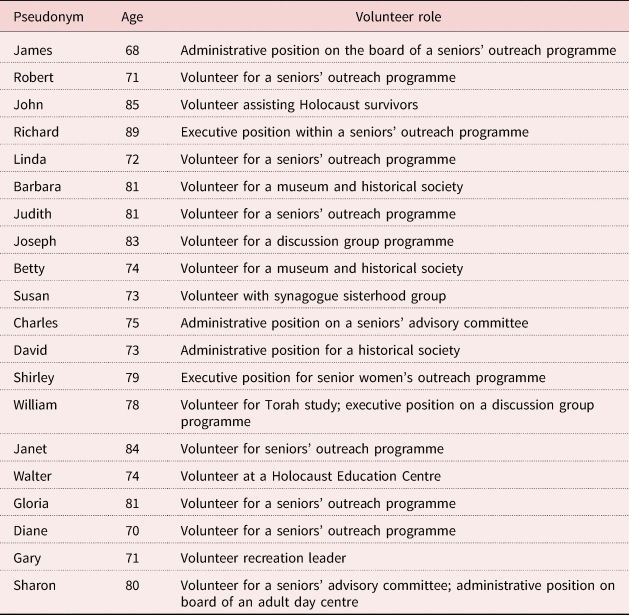
Our sample included a diverse group of participants who engaged in a wide variety of volunteer roles in the Jewish community. Some participants had chosen ‘hands-on’ volunteer experiences, working directly with children or older adults, while others took on more ‘behind the scenes’ duties, working on an administrative level of an organisation or serving on a board. A few participants engaged in roles that required weekly preparation and research outside the scope of their actual volunteer role. All participants volunteered time to organisations on a regular, committed basis. Nine participants were aged 65–74, nine were aged 75–84 and two were aged 85 + . Eight participants were born outside Canada. Thirteen participants were married or in common-law relationships, five were widowed, one was divorced/separated and one never married. Eight had completed high school, seven had attended college or university and five had completed graduate school. Seventeen participants self-rated their health as ‘good’, ‘very good’ or ‘excellent’, while one rated their health as ‘fair’, and two did not know. Eighteen participants were retired and two continued to work part-time. Of the 20 participants, 14 had been volunteering in one way or another for most of their lives. To maintain the anonymity of study participants, all names used in this article are pseudonyms (Table 1).
Jewish community volunteer participants

Data collection
In-depth interviews were conducted by the first author from September to November 2017 using a semi-structured interview guide. Interviews were scheduled at participants’ convenience in their home. To begin, a brief socio-demographic survey was administered to obtain descriptive data pertaining to participant health status, education level, employment status, marital status, income level, number of years as a volunteer, among other characteristics. Participants were then asked questions from a semi-structured interview guide that was developed based on extant research and the study's purpose. All interviews were audio-recorded and transcribed verbatim. Participants were given assurances of confidentiality, freedom to withdraw at any time and anonymity. As a self-identified Jewish person and a member of the Jewish community of Vancouver, the first author was able to bring an understanding of Jewish culture and history to participant interviews. Self-reflection and reflexivity were practised through the use of journaling throughout data collection and analysis.
Data analysis
Following the verbatim transcription of each interview by the first author, reflexive thematic analysis (Braun et al., Reference Braun, Clarke, Hayfield, Terry and Liamputtong2019) was performed using both handwritten notes and qualitative analysis software (NVivo 11). Reflexive thematic analysis is a method in which themes are conceptualised following a process of identification and exploration of patterns across the data, as well as the practice of reflexivity and transparency with regard to one's own assumptions and experiences (Braun et al., Reference Braun, Clarke, Hayfield, Terry and Liamputtong2019). The first step in this process was the first author's familiarisation with the data through repeated reading and notation of ideas for future coding. This was followed by the generation of initial codes, accomplished by identifying features of the data that were related to the study purpose. At this stage of the coding process, three of the interviews were independently reviewed by the first and third authors to compare and contrast initial codes, which led to establishing coding techniques and early agreement of themes. The codes were then organised into potential themes, which were then reviewed by both researchers for validity and coherence. As new themes were conceptualised and reflected upon, the first author provided regular updates to the second and third authors to ensure agreement was reached before progressing to defining and naming the themes (Braun et al., Reference Braun, Clarke, Hayfield, Terry and Liamputtong2019). Based on this analysis process and research discussion and agreement, themes related to cultural generativity and volunteering were organised into three categories.
Findings
Participants in this study expressed cultural generativity through their volunteer roles within the Jewish community in the following ways: (a) volunteering to preserve and pass down Jewish traditions and teachings; (b) a Jewish ethic of giving back perceived as a duty; and (c) experiences of anti-Semitism and discrimination motivating Jewish participants to volunteer.
Volunteering to preserve and pass down Jewish traditions and teachings
Participants volunteered with organisations aimed at improving the Jewish community and servicing the next generation. Volunteer roles included working with a Jewish museum and archives where participants preserved documents and transcribed interviews of prominent members of the Jewish community; working with children in Jewish educational settings; and working to create new Jewish community infrastructure, such as community centres and synagogues. These participants described the importance of preserving Jewish culture and heritage, and how this was accomplished through their volunteer efforts. One participant, Betty, 74, who transcribed and archived biographies of Jewish community members, described the importance of commemorating the lives of these individuals for the sake of future generations:
What I am doing is important. It contributes to the knowledge of future generations if they have an interest. And I think the people who have died … I believe that recording them is very important, to know these people lived and died, and had a life here. So they should be acknowledged.
Another participant, Barbara, 81, described her experiences working with a group of older adults at a Jewish community centre to write their personal memoirs as the ‘biggest accomplishment’ in her two decades as a volunteer. She emphasised the importance of the effort for the families and descendants of those involved in the memoir writing project, stating: ‘If we didn't interview these people, we don't have their stories. And some of them couldn't wait to tell us their stories, and so it died with them.’ She further described this project by saying:
I have to tell you that at least 12 of these people have passed on, maybe 15, and we have their stories. And their families would never have got those stories if we hadn't held the workshop.
Participants also reported being able to witness the impact of their volunteer contributions on the community. David, 73, who once occupied a volunteer role in which he oversaw the reconstruction and renovation of a local Jewish community centre, expressed the pride and satisfaction that was felt when subsequently visiting the facility:
Seeing the centre now, what it is, what it has become, has been the most gratifying of volunteer work I have ever done. When I was there yesterday, I was just sort of blown away as to how busy it was, I was delighted. Old people, young people, all those mothers sitting there in the café with their little babies.
Taking on volunteer positions suggests a desire to provide for and to leave a legacy for the next generation. Indeed, participants spoke of an internal impulse that inspired them to volunteer many years ago or that motivated them to continue in their role. For instance, the role as a volunteer at a Holocaust Education Centre has provided Walter, 74, with the opportunity to educate school children about the history of the Holocaust and oppression of the Jewish people and other minority groups, and the responsibility of future generations to prevent these atrocities from occurring again:
The goal is to keep people informed of what happened during the war, and what the Holocaust was all about, and dispelling any myths that the Holocaust didn't exist. In addition to that, our goal is to educate school children in the history of the Holocaust.
Participants also described entering volunteerism to support their own children, to provide them with a programme that did not exist in the community at the time, or to ensure they had the best experience possible in their various activities. Richard, 89, described his feelings of needing to provide a sense of Jewish community life that did not exist in his hometown in the 1950s, which motivated him to establish a synagogue:
Being Jewish, I thought it was very important for me to give a Jewish background to my children and the only way I could do that is to volunteer and create organisations, and I did in order to supplement what did not exist in that community. So if something that I detected was important to me, and I found that it was not available in that particular community, I would start it. And I did. I am the founder of a synagogue in the city, in 1957, only because it did not exist. We had just moved to a new area, and it had to be there for the children to get their background, their education, a sense of being Jewish. And I was one of the ones who started it; I realised there was a need for it.
These experiences highlight the ways in which participants were motivated to volunteer in order to build and preserve Jewish history, teachings and traditions. By performing altruistic acts, including educating youth about the Holocaust, supporting the construction of a new community centre or synagogue, and transcribing interviews and memoirs, participants were able to contribute to the maintenance of the Jewish community and its history.
A Jewish ethic of giving back perceived as a duty
Providing help to those less fortunate and to one's community is rooted in Jewish tradition and evident in modern Jewish life. The Jewish community is widely known for having established numerous voluntary, charitable and philanthropic organisations around the world, embodying these teachings by supporting members of the Jewish and larger community in various ways (Rothenberg, Reference Rothenberg2006; Berman, Reference Berman2020). When asked why volunteering and giving back to their communities was important to them, participants stated that their volunteer efforts satisfied the ‘Jewish ethic of giving back’. William, 78, described volunteering and helping people in need as being part of the Jewish ‘schtick’ (i.e. interest, area of activity) and a part of ‘our DNA’ (i.e. genetic makeup). Indeed, participants reported that giving back and supporting one's community were inherent, Jewish characteristics. Janet, 84, explained:
On the whole, Jewish people are very empathetic, very involved with other people, I mean I feel, rightly or wrongly, that it is a Jewish trait. I mean my parents always helped other people, whether they were poor, my mother would go to the grocer and make up parcels for people who didn't have enough food. It is very prevalent among Jewish people to do that kind of thing.
William, 78, a regular volunteer at his synagogue, described how those in the Jewish faith are raised to believe the importance in giving back to one's community and that being taught these lessons as a young person makes an individual more inclined to volunteer in later life:
It is not unusual in the Jewish community, because most people are raised, even if they are very secular, there is this business about charity, about supporting the needy in some way.
Indeed, when discussing this aspect of the Jewish faith, participants described a sense of responsibility to volunteer, and how it was part of ‘the Jewish way of life.’ John, 85, a lifelong volunteer in the Jewish and wider community, described his belief about the concept of Tzedakah:
One of the commandments, is something called Tzedakah. And people … they mistranslate it. It doesn't mean charity. The easiest thing in the world is to write a cheque. You should give to charity … but unless you are giving of yourself, unless you are doing something, not necessarily within the Jewish community, but in the wide community you live in, then it is not Tzedakah. It is not adequate to just give money. That is the way I was brought up, and that is the life I have lived.
From participants’ perspectives, multiple influences, including religious teachings and family values, made volunteerism and community service an obligation so engrained among Jewish individuals that they attribute it to part of their genetic makeup and blood.
Experiences of anti-Semitism and discrimination motivating Jewish participants to volunteer
The final theme related to volunteering as a form of cultural generativity among participants is the experience of the persecution or discrimination against those of Jewish faith known as anti-Semitism. Participants recalled growing up during a time when anti-Semitism was pervasive and accepted in their countries of origin, as well as in Canada, which they connected to their current volunteer roles. Participants described how historically, community organisations would not allow Jewish members or participants. As a result, new organisations were formed, often under Jewish volunteer initiative. Robert, 71, who regularly volunteered by reaching out to isolated seniors, reported having recently assumed a volunteer role within a Jewish branch of the Royal Canadian Legion. He described how when legions were being formed in Canada shortly after the First World War, many restricted Jewish people from membership. As a result, Jewish veterans started their own initiatives. Another participant, Sharon, 80, recalled how her father worked to establish a local golf and country club when she was a child, an act which inspired her present-day volunteering in the Jewish community.
For other participants, experiences with anti-Semitism shaped the volunteer roles they chose. Walter, 74, described how the persecution and eventual deaths of his family members in the Holocaust inspired a life-long fascination with the history and events of the Second World War, and ultimately, his current position as a volunteer at a Holocaust Education Centre:
I have such a tremendous interest in the Holocaust, and one of the main reasons was that my father's whole family was wiped out in Lithuania in 1941. And we knew nothing about it at the time … my sister who lives in London discovered more about it, and she gave me the information, and we followed through. So it's still … can I say a pet love, it is part of my life; and if they ask me to do a class every week, I will do it.
Another participant, William, 78, described how he had worked to form a group to support young students at a local university following reports of anti-Semitic activity on campus:
In the early 2000s, is when we started to see more anti-Semitic activity on campus. And people were starting to complain. And we had this sort of ad-hoc group that was brought together, and we worked together on some publicity, and just to let people know that there was a group around to support them.
Similarly, John, 85, whose primary volunteer role is working with Holocaust survivors, explained how his long-standing role at a Holocaust Education Centre, as well as volunteering with a Jewish Family Service Association, stems largely from his late wife's childhood experiences during the Second World War:
You may or may not be familiar with the fact that Canada turned away a ship full of refugees, all of whom went back to concentration camps and died. The question was asked: How many refugees would you let in? And the answer was, none is too many. Canada relented in 1947 and let in 1,000 orphans. My late wife was one of them. And so my looking for volunteer activities at the Holocaust Centre flows quite naturally from that.
Discussion
The goal of this study was to examine motivations to volunteer among older Jewish adults within the context of cultural generativity. To our knowledge, though the Jewish community has been described as charitable and philanthropic (Rothenberg, Reference Rothenberg2006; Berman, Reference Berman2020), this study is one of very few to examine volunteerism among older Jewish adults. Findings included three related themes: volunteering to preserve and pass down Jewish traditions and teachings, a Jewish ethic of giving back perceived as a duty, and experiences of anti-Semitism and discrimination motivating Jewish participants to volunteer. These themes suggest that participants hold a strong sense of cultural motivation to volunteer. Reflecting McAdams and de St Aubin's (Reference McAdams and de St Aubin1992) model linking generative concern with generative action, a diverse number of volunteer roles allowed participants to practise cultural generativity, including teaching children about the Holocaust, leading synagogue congregation members, working to prevent anti-Semitic activity on a university campus, building new Jewish community infrastructure, preserving Jewish historical documents and helping older Jewish adults write their memoirs.
Participants were motivated to volunteer by the prospect of helping the Jewish community, elucidating dimensions of generativity, including the desire to take the focus away from oneself and leave a legacy for future generations (Son and Wilson, Reference Son and Wilson2011). By supporting individuals and organisations in a community that they are bound to by history, family and cultural values, participants sought to preserve aspects of past and current generations, while providing a legacy for future generations. Participants described their desire to pass on ethnocultural traditions of Judaism, preserve Jewish history, and create and maintain Jewish infrastructure for the next generation. In the case of Jewish culture, which has been threatened throughout its entire existence, a sense of cultural generativity may be particularly strong among members of the community. Such practices are not uncommon among ethnocultural and ethnoreligious minority groups, as well as subcultural groups. In a study documenting Alaskan Native elders recovering from alcohol use disorder, Lewis and Allen (Reference Lewis and Allen2017) describe the desire held by participants to preserve and pass down various aspects of their culture and traditions, including teaching skills of subsisting off the land, cutting and preparing salmon, and speaking of Native languages for the benefit of the entire family, community and culture. Warburton and McLaughlin (Reference Warburton and McLaughlin2007:57) examined the community volunteer experiences of Australian older adults from a mix of culturally and linguistically diverse backgrounds who described themselves as ‘cultural repositories’. These individuals were found to support cultural maintenance within their communities by providing information on cultural traditions to younger people, performing cultural ceremonies, keeping the language alive and volunteering to help at-risk youth. Thang (Reference Thang2006) described the intergenerational volunteer activities of Japanese older adults who survived the 1995 Hanshin-Waji earthquake, which included teaching younger generations about the history and impact of this natural disaster on their country, as well as the importance of learning from and respecting one's elders. Additional studies document similar processes in which volunteerism and community engagement serve as an outlet for older adults to pass down cultural knowledge to the next generation and their communities (Hunter and Rowles, Reference Hunter and Rowles2005; Warburton and Chambers, Reference Warburton and Chambers2007; Warburton and Winterton, Reference Warburton and Winterton2010; Lewis, Reference Lewis2011; Bower et al., Reference Bower, Lewis, Bermúdez and Singh2021). While these studies suggest that various ethnocultural groups may possess similar volunteer motivations and experiences related to cultural generativity, it is also likely that each of these groups holds unique motivations and experiences of volunteering that represent their specific ethnocultural values and identities. In order to better determine the similarities and differences that exist between these groups, further research is needed.
Findings from this study suggest that being raised in the Jewish faith and belonging to the Jewish community influenced participants’ values to help others and their decisions to volunteer. Participants described the ‘Jewish ethic’ of giving back, the sense of duty, and the expectation among Jewish people to give back to their communities and those in need. This feeling was also described as Tzedakah, a phrase meaning justice or righteousness, often used to signify charity, giving aid, assistance or money to those less fortunate. While no previous research has specifically examined the relationship between Jewish ethnocultural values and volunteerism, several research studies have focused on the positive relationship between volunteering and religiosity (Becker and Dhingra, Reference Becker and Dhingra2001; Monsma, Reference Monsma2007; Loveland et al., Reference Loveland, Stater and Park2008; Clerkin and Swiss, Reference Clerkin and Swiss2013; Johnston, Reference Johnston2013; Okun et al., Reference Okun, O'Rourke, Keller, Johnson and Enders2015), describing the influence of church attendance and religious affiliation on the likelihood of volunteering. Other research describes the ways in which religion (in particular, Judeo-Christian religions) can influence motivation to volunteer, by teaching congregants to serve those in need without renumeration and to be a Good Samaritan (Cnaan et al., Reference Cnaan, Kasternakis and Wineburg1993; Einolf, Reference Einolf2011), as well as inspiring collectivism and supporting communal values that result in giving and volunteerism (Eckstein, Reference Eckstein2001). Similarly, club theory (Cnaan et al., Reference Cnaan, Kasternakis and Wineburg1993, Reference Cnaan, Boddie, Handy, Yancey, Schneider and DiIulio2002) posits that belonging to a religious community that is active in helping others influences group members to act according to group norms and a culture of volunteerism, as well as to recruit fellow members into volunteer work. In our study, membership within the ethnoreligious Jewish community was reported to provide exposure to such values and influence participants’ norms of volunteerism. Future research, however, is needed to determine the temporal nature of when cultural norms and expectations may have more or less of an influence on motivations to initiate and maintain volunteer activities among Jewish persons across their lifecourse.
Finally, findings highlight how early life experiences of discrimination, exclusion and oppression because of religious beliefs, cultural traditions and ethnic identity influenced participants’ decisions to volunteer in roles that would allow them to counteract their experiences and, in some cases, establish a legacy for future generations. These reports align with historical examples of Jewish community leaders establishing Jewish organisations in order to strengthen community ties and bring individuals together, while also buffering anti-Semitism, including the revitalisation and growth of the Canadian Jewish Congress, a lobbying group for the Canadian Jewish community following the rise of anti-Semitic behaviour (Lipinsky, Reference Lipinsky2011). Scholars have examined how older adults who have experienced trauma and persecution based on their religious, ethnic, racial and sexual identity seek to ‘make meaning’ of their experiences by leaving a legacy for future generations, often by volunteering. This includes the limited research that has explored volunteering among older Jewish adults, more specifically the connection between the experience of anti-Semitism and volunteering by Holocaust survivors. Studies conducted by Armour (Reference Armour2010), Greene (Reference Greene2002) and Greene et al. (Reference Greene, Hantman, Sharabi and Cohen2012) document the later-life experiences of Holocaust survivors who have chosen to use their traumatic experiences to teach children about the Holocaust by speaking at museums and schools. Bower et al. (Reference Bower, Lewis, Bermúdez and Singh2021) explored the generative desires of lesbian, gay, bisexual, transgender, queer/questioning and other sexual identities (LGBTQ+) older adults who have experienced life-long discrimination and trauma to leave a legacy of resilience for the younger LGBTQ+ population through helping to address stigma surrounding HIV/AIDS (Bower et al., Reference Bower, Lewis, Bermúdez and Singh2021). Slevin (Reference Slevin2005) explored the volunteer roles of retired professional African American women whose experiences of racial discrimination and segregation influenced their community engagement activities. Women in this study described how their desire and motivation to help others ‘evolved through material and historical circumstances that emphasized survival and resistance through collective responsibility’ (Slevin, Reference Slevin2005: 313). Similarly, our participants felt compelled by experiences of anti-Semitism and discrimination to volunteer within the Jewish community. These findings suggest that ethnocultural minority groups are motivated to prevent cultural erosion by passing on cultural traditions to the next generation and ensuring that discrimination is recognised and prevented from occurring in the future. Future research should continue to explore both how different types of religions and ethnic identities may influence engagement in volunteerism among older adults (Eckstein, Reference Eckstein2001), as well as the impact of ethnocultural oppression and discrimination on decisions related to volunteering among older adults.
Study strengths and limitations
Limitations of this study include potential selection bias associated with non-random, purposeful sampling, as well as potential personal biases of the volunteer participants. Individuals who agreed to participate in this study potentially were healthier, had higher volunteer participation, and were more willing to share their volunteer experiences than those who did not agree to participate. In addition, this study sample and location focused on the Jewish community in Vancouver, BC, which may limit the generalisability of findings to other older Jewish adults who volunteer in other communities, such as individuals living in cities with larger Jewish populations and more extensive Jewish community resources (i.e. Toronto, New York). In these cities, factors including religiosity, cultural lifestyle and overall feelings of community engagement may be heightened and lead to different interpretations of the volunteer experience. Finally, the design of the study did not utilise a method to maximise diversity of the sample, such as quota sampling on specific groups.
Despite these limitations, this is one of few studies that has examined the experiences and motivations of older Jewish volunteers, and the first to do so within the context of cultural generativity. By acknowledging the experiences of an underresearched ethnocultural group, the findings from this study strengthen the emerging areas of gerontological research on both cultural generativity and ethnocultural identity and the relationship of these constructs to volunteerism. This research also provides support for the potential relationship between ethnoreligious discrimination and volunteerism among older adults, an area of research that is currently in its infancy. Additional strengths include the study participants, who represent a large spectrum of ages (68–89) and volunteer roles in the Jewish community.
Conclusion
By examining the motivations to volunteering among older Jewish adults, this study contributes to the concept of cultural generativity and highlights the importance of volunteer work among an underexplored ethnocultural minority group. Findings from this research also suggest that Jewish older adults may hold similar volunteer motivations and experiences as other ethnocultural minority groups, although this requires further study. Ethnocultural identity may be crucial to understanding older adults’ motivations to volunteer, what volunteer activities they select, when they decide to initiate volunteer activities and potential benefits of volunteering. If all older adults are to enjoy the benefits associated with volunteering, future research is essential, particularly as the older adult population becomes increasingly diverse. As countries continue to diversify in terms of ethnic composition, volunteering opportunities must be made accessible to and inclusive of older adults from all backgrounds. To achieve this, it is imperative that future research encompasses the experiences and stories of older adults themselves.
Acknowledgements
For support with participant recruitment, we would like to thank Leah Deslauriers. We would also like to thank the time and contribution of all research participants.
Conflict of interest
The authors declare no conflicts of interest.
Ethical standards
This study was approved by the Simon Fraser University Office of Research Ethics (study number 2017s0328).