1. Introduction
Expressive adjectives (e.g., damn) convey an attitude (generally negative) toward the situation described. Expressive adjectives may be understood as one example of what Potts (Reference Potts2005) called not-at-issue content. Potts drew a distinction between at-issue content (the asserted proposition conveyed by some utterance) and not-at-issue content, which assists the listener in interpreting the asserted content. Examples of structures that canonically encode not at-issue content include parentheticals, appositives, expressives, and honorifics. Potts offered an analysis of not at-issue content that treated it as a separate dimension of meaning associated with a sentence. On this analysis, expressives will not be interpreted as part of the compositional interpretation of at-issue content. If this is correct, then this suggests that expressives need not be interpreted with respect to the constituent that they syntactically modify. Compare (1) with the expressive damn and (2) with a non-expressive attributive adjective.
(1) a. The damn dog is on the couch.
b. The dog is on the damn couch.
(2) a. The brown dog is on the couch.
b. The dog is on the brown couch.
Although (1a) and (1b) seem largely interchangeable, (2a) and (2b) are not. This suggests that the interpretive contribution of the expressive is relatively independent of its syntactic position.
Potts (Reference Potts2005)Footnote 1 modeled expressives, like other not-at-issue content, as a commitment on the part of the speaker. This is thought to hold except in contexts where an agent is available that might be the source of a quotative meaning, e.g., My father screamed that he would never allow me to marry that bastard Webster (see Kratzer, Reference Kratzer1999). On this view, the interpretations available for an expressive are due to the lexical meaning of the expressive being interpreted as expressing an attitude toward an entity or a proposition. The entity or proposition in question may be identified by the DP the expressive syntactically modifies, or by the entire clause containing the expressive.
This behavior contrasts with that of descriptive adjectives, which semantically combine with their sister, e.g., a noun in simple DPs like the black cat. Both the descriptive adjective and the noun may be treated as predicates. Thus, for example, the predicate black and the predicate cat can be intersected to yield the predicate black cat. To refer to a particular individual, this predicate is combined with a determiner (the black cat). As mentioned, expressive adjectives need not be interpreted with their sister in the syntactic tree. Instead, the expressive in my damn dog expresses a negative attitude toward the individual referred to by my dog, and so it appears that the expressive combines with the entire DP containing it (see Potts Reference Potts2007).Footnote 2 In other words, although an expressive attributive adjective might behave syntactically like other attributive adjectives, semantically it does not.
Indeed much of the interest in studying expressives like damn derives from their challenge to the regular compositional interpretation of linguistic input. As discussed immediately above, in the phrase the damn dog, damn targets the referent of the entire DP, not just dog. Challenges to compositional interpretation of adjectives are not restricted to expressives but include other adjectives as well, e.g., enjoy a quiet cup of tea (Hall, 1973), an occasional sailor strolled by (Zimmermann, Reference Zimmermann, Jackson and Matthews2000). What may be special about expressives, however, is that including a situation variable is not likely to be sufficient to account for their behavior (see Janssen, Reference Janssen, Benthem and Meulen1997, Lauer, Reference Lauer2011, for discussion of kinds of compositionality).Footnote 3
In the present paper we report an experiment designed to determine the conditions under which the negative attitude conveyed by an expressive like damn does or does not get interpreted with respect to the constituent containing it. We simply assume that in (2) brown modifies the constituent that is its sister, i.e., dog in (2a) and couch in (2b). But for expressives, we expect that in subject position and object position it is possible for damn to express a negative attitude toward the entire situation. Indeed, when damn stands alone as a preceding utterance (3), we expect that the preferred interpretation will be that it expresses a negative attitude toward the entire situation.
(3) Damn. The dog is on the couch.
In addition to a situation interpretation, there are (at least) two other potential interpretations. We will say that the ‘subject’ interpretation expresses a negative attitude toward the referent of the subject, and the ‘object’ interpretation expresses a negative attitude toward the referent of a constituent inside the predicate. We suspect that these latter two interpretations come about by inference. One way that a speaker may code a subject or an object interpretation of an expressive is by syntactically associating the expressive adjective with either the subject or the object of a sentence (compare the damn dog is on the couch and the dog is on the damn couch). Given multiple possible placements of the expressive, a reader may wonder why the author placed the expressive adjective where she did. One explanation is that the author may have wanted to imply that the negative attitude expressed is directed toward the referent of the constituent containing the expressive adjective, rather than the whole proposition itself. In short, observing that the placement of damn has an impact on interpretation does not by itself serve to decide between a compositional interpretation mechanism and a pragmatic one. Therefore, we also included a contrast in ‘causality’ which might be expected to have an effect on the pragmatic approach, but not on a compositional approach to the interpretation of damn.
Our intuitions suggest that the likelihood of interpreting damn as a negative attitude toward the object of the verb, when damn occurs in the object, will be greater when the utterance expresses a state of affairs which is not under the control of the referent of the subject, e.g., The holiday is on the damn weekend. By contrast, when the referent of the subject might be responsible for the state of affairs described (My son totaled the damn car.), an expressive may be less likely to be construed as commenting negatively on the object. Based on our intuitions, examples with ‘causal’ relations seemed easy to interpret in terms of laying blame on the person or entity responsible (henceforth, the ‘culprit’ hypothesis). In other words, the reader may infer that the author has a negative attitude toward the entity responsible for bringing about the unwanted situation. In this case, the negative attitude toward the situation may transfer to the person or entity responsible for the situation − in a sentence with a truly causal structure, the agent.
We have suggested elsewhere (Dillon, Clifton, & Frazier, Reference Dillon, Clifton and Frazier2014) that not-at-issue content may in effect be a quasi-independent speech act from the speech act expressed by the at-issue content. We dub this the ‘speech act hypothesis’. If damn is taken to be not-at-issue, the hypothesis leads us to expect some interpretations involving a ‘negative attitude toward the situation described’ regardless of the placement of damn. We expect more object/predicate interpretations when damn occurs in the object/object of preposition than when it occurs in the subject, especially for non-causal examples. For ‘causal’ examples, if the culprit hypothesis is correct, we expect more subject interpretations than for non-causal examples.
2. Experiment
2.1. materials
We constructed fifteen ‘non-causal’ triples of sentences, as illustrated in (4), and fifteen ‘causal’ triples, as illustrated in (5). All items appear in the ‘Appendix’.
(4) Non-causal
a. The holiday is on the damn weekend.
b. The damn holiday is on the weekend.
c. Damn. The holiday is on the weekend.
(5) ‘Causal’
a. The dog is on the damn couch.
b. The damn dog is on the couch.
c. Damn. The dog is on the couch.
The three forms of each item differed in the placement of the expletive (damn in the examples). One form contained the expressive in the object of a verb or preposition (4a, 5a), one in the subject (4b, 5b), and one as a prior utterance (4c, 5c). The interpretation of the utterance was tested using a 3-choice question, as illustrated in (6).
(6) a. Question for non-causal example
question: Which is the speaker most likely to have a negative attitude toward?
i. the weekend
ii. the holiday
iii. the holiday being on the weekend
b. Question for causal example
question: Which is the speaker most likely to have a negative attitude toward?
i. the couch
ii. the dog
iii. the dog being on the couch
If the expressive is a largely separate speech act from the at-issue content when the expressive appears internally, then the separate utterance form (4c, 5c) is not expected to behave that differently from the forms where the expressive appears sentence internally as in the a- and b-forms. Based on the assumption that damn expresses a negative attitude toward a situation, we expected lots of negative situation interpretations in all types of example. Further, we expected a substantial number of local interpretations (subject-interpretations if damn is in the subject; object if damn is in the object) relative to non-local (object if in subject; subject if in object) interpretations, assuming the reader will wonder why the speaker/author placed the expressive where she did. We tested both non-causal and causal examples. If the referent of the subject was an animate entity, presumably it could be held responsible for the state of affairs described, and thus the example could be classified as causal. In contrast, the non-causal items had inanimate entities as subjects. By our intuitions, these were not likely to be taken to be causal agents responsible for the state of affairs described by the sentence. We checked our intuitions by asking thirty Mechanical Turk ‘workers’ (https://requester.mturk.com/) to judge whether each of the sentences (lacking the expressive) indicated that its subject was responsible for the event or state of affairs described by the sentence. The mean proportion of ‘yes’ responses was 0.96 (SD = 0.20) for the causal items, and 0.23 (SD = 0.42) for the non-causal items.
The culprit hypothesis predicts that causal examples like (5) will show more subject/agent and fewer object interpretations than non-causal ones like (4).
2.2. subjects and procedures
Forty-eight University of Massachusetts undergraduates received course extra credit for participating in individual half-hour sessions. The thirty experimental sentences were combined with ninety-six other sentences and short dialogs from other, unrelated, experiments, and presented visually in an individually randomized order. The subject was instructed to read a sentence or discourse as it was presented as a whole on a computer terminal, press a keyboard key to indicate comprehension, and then read and respond to a question about the item. Some questions asked for acceptability ratings, but the questions of the present experimental items presented the three choices illustrated in (6). The computer recorded the subject’s response and response time. Responses were scored as indicating a negative attitude toward the object (as in option i of (6)), the subject (option ii), or the situation (option iii).
2.3. results
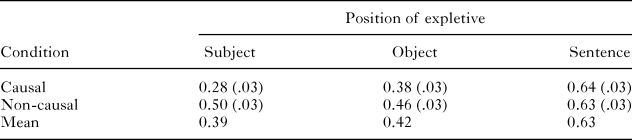
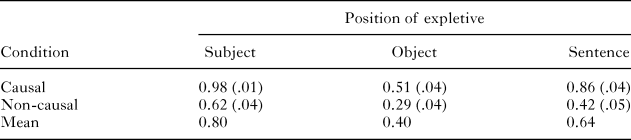
The results are presented in Table 1 in terms of the proportion of all trials on which a situation response (option iii in (6)) was made, and in Table 3 in terms of subject responses given that a situation response was not made (i.e., considering subject and object responses only).
Mean proportions of situation responses for damn in subject position (4a, 5a), in the object/predicate (4b, 5b) and in a previous utterance (4c, 5c) (with SEs)

Proportion of subject responses given that situation was not chosen
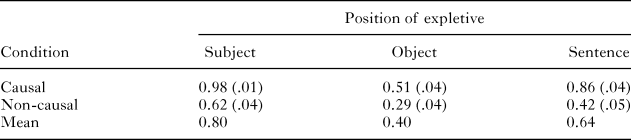
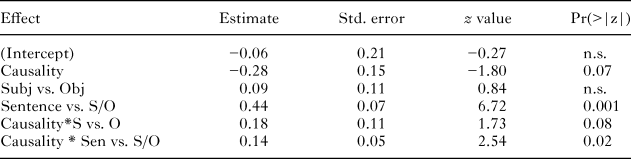
A logistic mixed-effects analysis of the proportions of situation responses was conducted with two fixed effects, position of expletive and causality (Table 2). Helmert contrasts were used for the position of the expletive, first contrasting the expletives that had been presented in subject vs. object position (S vs. O), and then contrasting the average of these with prior-sentence expletives (Sen(tence) vs. S/O). Sum (ANOVA-style) contrasts were used for the causality factor. Since a model with fully interacting random slopes did not converge, the reported results come from a model with non-interacting random slopes of subjects and items. The model indicated more situation responses in the prior sentence condition than when it was in subject or object position, and marginally more situation responses overall for non-causal than for causal items. The significant interaction of causality and sentence vs. subject or object position, and the marginal interaction of causality and subject vs. object, indicated that there were bigger positional effects for the causal sentences than the non-causal sentences.
Parameters of linear mixed model, proportion of situation responses
Table 3 presents the proportion of subject interpretations given that the situation interpretation was not chosen, i.e., considering only subject and object interpretations.
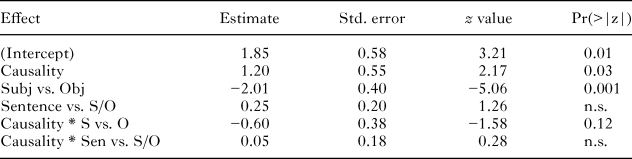
Analyzing just the subject and object interpretations, again using a logistic mixed model with Helmert coding for position of expletive and sum coding for causality (and with non-interacting slopes for subjects and items), there were more subject responses in causal than in non-causal sentences, and more when damn was in the subject than when it was in the object (see Table 4). There were virtually 100% subject responses when damn was in the subject in the causal sentences, which contributed to the marginally significant interaction between causality and subject vs. object position of the expletive. When the expressive appeared on the object of a non-causal sentence, there was a marginal relation between the frequency in the Mechanical Turk norms with which the subject was judged to be responsible for the event and the frequency with which the negative attitude was attributed to the subject (by-items r = 0.23). However, the relation between the norms and the attitude attributions was negligibly small in the other conditions of the experiment.
Parameters of linear mixed model, proportion of subject responses (causal/subject baseline)
The expectation was that the separate sentence damn would behave similarly to subject and object damns was confirmed in that there were situation responses chosen for all positions of damn. The culprit hypothesis further predicted more subject interpretations for causal than for non-causal items, and this too was confirmed across all positions of the expletive. Finally, effects of subject vs. object position were observed, more markedly for causal than non-causal sentences.
The fact that causal items with damn in object position received 51% subject responses, once the situation responses were set aside, speaks to the strength of the culprit hypothesis, and the fact that 49% of the non-situation responses were object responses indicates that syntactic placement also matters, presumably because one reason for the author to have placed damn in object position is that the negative attitude is directed toward the referent of the object. The relatively high proportion of object responses (38% vs. 62% subject responses) in the non-causal items with damn in subject position presumably reflects the negativity of the predicates (stinkbugs, mildew, anchovies), as pointed out to us by Chris Potts.
3. General discussion
The experiment reported here explored the interpretation of expressives, guided by two hypotheses: the speech act hypothesis and the ‘culprit’ hypothesis. The former claims that an expressive like damn constitutes a speech act separate from the speech act of the at-issue content conveyed by the rest of the sentence (Potts, Reference Potts2005, Reference Potts2007), and permits the expressive to be interpreted with respect to portions of the utterance (including the entire utterance) other than its syntactic sister. The latter claims that the negative attitude conveyed by the expressive tends to be construed with respect to an individual/entity that could be held responsible for the eventuality described.
Support was provided for both hypotheses. The expressive was frequently interpreted as expressing a negative attitude toward the entire situation not only when it occurred in a prior utterance (e.g., Damn. The dog is on the couch.), where it presumably must be analyzed as a speech act, but also when it was a sister of the subject noun or the object noun. In contrast to descriptive adjectives, interpretation of a sentence-internal expressive was not limited to modification of its sister. In fact, in some conditions the frequency of situation interpretations of sentence-internal expressives approached 80% of the frequency of such interpretations of prior sentence expressives. Further, while there was some tendency for a sentence-internal expressive to be interpreted as indicating a negative attitude toward its associated DP (e.g., toward the referent of the object if damn was in the object), this tendency was affected by the causal status of the sentence containing the expressive.
Such an effect was taken to support the culprit hypothesis. As predicted, more subject interpretations were reported in the causal than the non-causal items. Further, this was true for the prior utterance examples as well as the sentence-internal examples. For the causal items, given that something other than a situation interpretation was made, regardless of the position of the expressive, subject interpretations were the most frequent. For the non-causal items, given that something other than a situation interpretation was made, the frequency of subject vs. object interpretations was affected by the placement of the expressive.
Expressives like damn thus have far greater freedom of interpretation than descriptive adjectives like brown. Following Potts (Reference Potts2005), we can say that syntactically they are attributive adjectives, but (as discussed earlier) semantically they are interpreted with something of the type of an entity or of a proposition. When an expressive is interpreted with the phrase containing it, e.g., my damn cars, the interpretation is not with respect to the sister of damn (cars) but with respect to the full DP, as Potts (Reference Potts2007) noted. So even when the expressive is taken to indicate an attitude toward the entity denoted in the phrase containing the expressive, the mode of composition is special: the expressive is interpreted as if it were higher in the syntax than it actually is. This of course will follow from the semantic type restriction that damn imposes: it is my cars not cars that will denote something of the type of an entity.
Damn conveys a negative attitude, but it requires a pragmatic inference for the listener to determine what that attitude is directed toward. Presumably the negative attitude can be interpreted as directed toward the dog in the damn dog because this would justify the author having placed the adjective in this particular DP. But, as we have shown here for sentences that mention an entity that is potentially responsible for the eventuality, the expressive could appear inside the predicate (the damn couch) and still be interpreted as expressing a negative attitude toward the dog. The culprit hypothesis is intended to capture a condition under which this is particularly likely, and presumably reflects a pervasive cognitive tendency to postulate causal relations when they might be warranted (see Hobbs, Reference Hobbs1979; Kehler, Reference Kehler2002, for example). It is an open question whether, when the negative attitude is transferred to the entire situation, there is a remaining residue of negative affect directed toward the entity mentioned in the phrase containing the expressive damn.
We suggest that the expressive effects we have shown here are not limited to damn. In all likelihood, they extend to other expressives such as blasted and bloody (although these do not easily permit expression in a prior utterance, as required for the design of the present experiment). Going beyond such lexical items in English, Fortin (unpublished observations) discusses a variety of devices such as the Spanish diminutive and Greek and Korean complementizers which may convey expressive content that attaches to an entire proposition as well as to the term with which it is syntactically or morphologically associated. Emotive prosody may have a similar effect. Intuitions suggest that one may place exaggerated negative prosody (whatever its phonetic correlates are) on John’s shoes or on the table in (7).
(7) John’s shoes are on the table.
The interpretation seems to be very much like the interpretation of damn. There is some temptation to interpret the negative attitude as being toward the phrase with negative prosody, but the negative attitude may also be taken to be toward the entire situation or toward the entity blamed for the situation.
4. Conclusion
The normal compositional mechanisms responsible for the interpretation of sentences do not readily supply the interpretation of expressives. Accounting for a negative attitude targeting the subject of a clause when the expressive appears in the object phrase, or vice versa, will require highly exceptional behavior if movement (May, 1977) or type-shifting (Barker, Reference Barker and Thielecke2004) are involved. The present results suggest that the position of the expressive matters, but it matters primarily when other factors such as the causal agent may not be inferred. Further, regardless of whether damn is expressed as an utterance by itself, where it must be analyzed as a speech act, or internal to the subject or object, a substantial number of responses take the negative attitude to target the entire situation described. A pragmatic account of these effects best explains why the various interpretations of damn emerge under the particular conditions that they do.
APPENDIX
Non-causal
1 a. The holiday is on the damn weekend.
Which is the speaker most likely to have a negative attitude toward?
i. the weekend
ii. the holiday
iii. the holiday being on the weekend
b. The damn holiday is on the weekend.
c. Damn. The holiday is on the weekend.
2 a. The house is filled with damn stinkbugs.
b. The damn house is filled with stinkbugs.
c. Damn. The house is filled with stinkbugs.
3 a. The car is making those damn noises again.
b. The damn car is making those noises again.
c. Damn. The car is making those noises again.
4 a. The rain is predicted to arrive during my damn vacation.
b. The damn rain is predicted to arrive during my vacation.
c. Damn. The rain is predicted to arrive during my vacation.
5 a. The roses are covered in that damn yellow mildew.
b. The damn roses are covered in that yellow mildew.
c. Damn. The roses are covered in that yellow mildew.
6 a. The TV is making those damn irregular flickers.
b. The damn TV is making those irregular flickers.
c. Damn. The TV is making those irregular flickers.
7 a. The glasses are covered with that damn mineral residue.
b. The damn glasses are covered with that mineral residue.
c. Damn. The glasses are covered with that mineral residue.
8 a. The schedule is posted on the damn wall.
b. The damn schedule is posted on the wall.
c. Damn. The schedule is posted on the wall.
9 a. The tree is losing its damn branches.
b. The damn tree is losing its branches.
c. Damn. The tree is losing its branches.
10 a. My leg feels like a damn log.
b. My damn leg feels like a log.
c. Damn. My leg feels like a log.
11 a. The curtains smell like a damn campfire.
b. The damn curtains smell like a campfire.
c. Damn. The curtains smell like a campfire.
12 a. The trial is scheduled on a damn national holiday.
b. The damn trial is scheduled on a national holiday.
c. Damn. The trial is scheduled on a national holiday.
13 a. The museum is closed the whole damn intersession.
b. The damn museum is closed the whole intersession.
c. Damn. The museum is closed the whole intersession.
14 a. The science fiction story is filled with those damn alien insects.
b. The damn science fiction story is filled with those alien insects.
c. Damn. The science fiction story is filled with those alien insects.
15 a. The pizza has those damn anchovies on it.
b. The damn pizza has those anchovies on it.
c. Damn. The pizza has those anchovies on it.
Causal
1 a. The dog is on the damn couch.
Which is the speaker most likely to have a negative attitude toward?
i. the couch
ii. the dog
iii. the dog being on the couch
b. The damn dog is on the couch.
c. Damn. The dog is on the couch.
2 a. The director fired the damn publicist.
b. The damn director fired the publicist.
c. Damn. The director fired the publicist.
3 a. A teenager wrote the damn article.
b. A damn teenager wrote the article.
c. Damn. A teenager wrote the article.
4 a. The underlings thought up those damn ads.
b. The damn underlings thought up those ads.
c. Damn. The underlings thought up those ads.
5 a. My neighbor drove over my damn lawn.
b. My damn neighbor drove over my lawn.
c. Damn. My neighbor drove over my lawn.
6 a. The policeman gave me a damn ticket.
b. The damn policeman gave me a ticket.
c. Damn. The policeman gave me a ticket.
7 a. The secretary handed in her damn resignation.
b. The damn secretary handed in her resignation.
c. Damn. The secretary handed in her resignation.
8 a. The cleaning lady broke the damn sculpture.
b. The damn cleaning lady broke the sculpture.
c. Damn. The cleaning lady broke the sculpture.
9 a. The lawyer trained the damn witness.
b. The damn lawyer trained the witness.
c. Damn. The lawyer trained the witness.
10 a. The driver backed into the damn mailbox.
b. The damn driver backed into the mailbox.
c. Damn. The driver backed into the mailbox.
11 a. The director promoted the damn receptionist.
b. The damn director promoted the receptionist.
c. Damn. The director promoted the receptionist.
12 a. The painter spilled the damn paint on the lawn.
b. The damn painter spilled the paint on the lawn.
c. Damn. The painter spilled the paint on the lawn.
13 a. The guests scuffed the damn wood floor.
b. The damn guests scuffed the wood floor.
c. Damn. The guests scuffed the wood floor.
14 a. The coach yelled at the damn assistant.
b. The damn coach yelled at the assistant.
c. Damn. The coach yelled at the assistant.
15 a. The chef burned my damn steak.
b. The damn chef burned my steak.
c. Damn. The chef burned my steak.