INTRODUCTION
The Taranto Seas, Mar Piccolo and Mar Grande, are semi-enclosed basins of the northern Ionian Sea (eastern-central Mediterranean Sea). They are subject to different anthropogenic activities, such as sewage outputs, industrial activities, intense naval traffic and mussel breeding (Cardellicchio et al., Reference Cardellicchio, Annichiarico, Ciannarella, Marra and Ragone1986, Reference Cardellicchio, Annichiarico, Leone, Ragone and Rochira1989, Reference Cardellicchio, Annichiarico, Leone, Marra, Paterno, Piraino and Ragone1991, Reference Cardellicchio, Marra and Ragone1995; Tursi et al., 1978). The benthic communities of the Taranto Seas have been severely influenced by these anthropogenic activities. In fact, the sea grass meadows of Cymodocea nodosa (Ucria) Ascherson and Posidonia oceanica (Linnaeus) Delile mapped by Parenzan (Reference Parenzan1969, Reference Parenzan and Congedo1983) had almost completely disappeared after a decade while the presence of a drifting nitrophilic algal bed was found to be widespread in both the Mar Piccolo and Mar Grande by Cecere et al. (Reference Cecere, Cormaci and Furnari1991, Reference Cecere, Saracino, Fanelli and Petrocelli1992). The SPICAMAR project (Pilot Study for the Environmental Characterization of ‘at risk’ Marine Areas), financed by the Ministry of University and Scientific Research was conducted in the Taranto Seas during 2000–2003 with the aim of evaluating the condition of this marine environment. A study on the benthos was carried out using side-scan sonar and an underwater video camera (Matarrese et al., Reference Matarrese, Mastrototaro, D'Onghia, Maiorano and Tursi2004). A large scale benthic map (1:20,000) was produced highlighting significant changes in the benthic communities referred to in the past (Parenzan, Reference Parenzan1969, Reference Parenzan and Congedo1983). In particular, the observations reported by Cecere et al. (Reference Cecere, Cormaci and Furnari1991, Reference Cecere, Saracino, Fanelli and Petrocelli1992) were confirmed; the abundance of some dominant native species was found to be markedly reduced and the occurrence of some invasive alien species was observed confirming previous records (e.g. Mastrototaro et al., Reference Mastrototaro, Matarrese and D'Onghia2003, 2004; Carriglio et al., Reference Carriglio, Fanelli and Rubino2004; Cecere & Petrocelli, Reference Cecere and Petrocelli2004). Furthermore, most of the bottoms of both basins were covered with sludge and mud (Matarrese et al., Reference Matarrese, Mastrototaro, D'Onghia, Maiorano and Tursi2004).
Further quantitative samplings carried out as part of the above-mentioned project provided information on the distribution and abundance of the benthic species related to the sediment type in the Taranto Seas. The relevant results are presented in this paper with the aim of providing a contribution to the knowledge on the diversity of the soft bottoms in these semi-enclosed basins of the eastern-central Mediterranean.
Study area
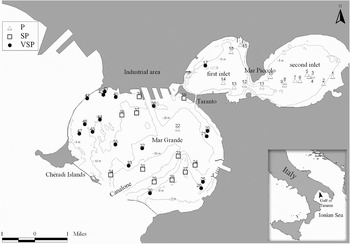
The town of Taranto is located on the coast of the north-western Ionian Sea (eastern-central Mediterranean). It overlooks the open sea to the south-west in the Mar Grande basin and to the north-east in the basin of Mar Piccolo, which is made up of two smaller inlets (first inlet and second inlet) (Figure 1).
Map of the study area (Mar Grande and Mar Piccolo of Taranto) with allocation of the sampling stations and indication of sediment type (P, pelite; SP, sandy pelite; VSP, very sandy pelite).

The Mar Piccolo covers an area of 20.72 km2. Its maximum depth is 13 m in the first inlet and 9 m in the second one (Cardellicchio et al., Reference Cardellicchio, Annichiarico, Leone, Marra, Paterno, Piraino and Ragone1991). The Mar Piccolo basin is connected to the Mar Grande through two small channels. The Mar Grande basin covers an area of 35.5 km2. It is an oval bay with the north–south and east–west axes 5300 and 7800 m long, respectively. Its maximum depth is 42 m. The Mar Grande is limited to the south by the Chéradi Islands. The central part of the Mar Grande is known as the Canalone (big canal) which is about 1300 m wide and 40 m deep.
MATERIALS AND METHODS
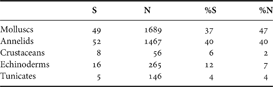
Data were collected during July 2002. After underwater video camera and side scan sonar explorations (July 2001) (Matarrese et al., Reference Matarrese, Mastrototaro, D'Onghia, Maiorano and Tursi2004), 47 sampling stations were randomly allocated in areas free from harbour and mussel breeding structures. The samples (three replicates for each sampling station) were taken using a Van Veen grab with surface of 0.1 m2 and volume of 0.02 m3. For each station a granulometric analysis of the sediment was carried out. Three sediment types were identified: pelite (P), with sandy percentage less than 5%, sandy pelite (SP), with sandy percentage ranging between 5 and 30%, and very sandy pelite, with sandy percentage between 30 and 50%. The allocation of stations with an indication of the sediment type in each of them is presented in Figure 1. The benthic fauna was sorted and identified to species level only for the following taxonomic groups: molluscs, annelids, crustacean decapods and stomatopods, echinoderms and tunicates. The percentages of species and individuals belonging to these taxonomic groups were computed (Table 1). Since molluscs and annelids constituted 77% of the species and 87% of the individuals, only data from these two groups were used to study benthic biodiversity of the soft bottoms in the Mar Grande and Mar Piccolo of Taranto (Sanders, Reference Sanders1968; Gambi et al., Reference Gambi, Fresi and Giangrande1982).
Species and individual numbers and percentages of main taxonomic groups collected in the Taranto Seas during July 2002.

S, species; N, individuals
A matrix of abundance data (average of three replicates referred to 0.1 m2) per species–station was compiled using square root transformation. Classification of the sampling stations was performed by means of hierarchical clustering, based on Bray–Curtis similarity; grouping was identified using a cut-off similarity percentage of 20%. Grouping by sediment type was identified by multidimensional scaling (MDS) ordination of the sampling stations (Clarke & Ainsworth, Reference Clarke and Ainsworth1993; Clarke & Warwick, Reference Clarke and Warwick2001). Analysis of similarities (ANOSIM) was applied to test for differences among and between groups of species–station identified by multivariate analysis. Individual species contributions (up to about 90%) to average similarity within each group were examined by the SIMPER procedure (Clarke & Warwick, Reference Clarke and Warwick2001). Indicator species analysis (ISA) was also carried out in order to further characterize the different groups derived from multivariate analysis (Dufrêne & Legendre, Reference Dufrêne and Legendre1997), combining the relative abundance of the species with their relative frequency of occurrence in the various groups.
By means of rarefaction curves, the biodiversity of the groups of stations identified was compared. This method has the advantage of being sample-size and density independent (Sanders, Reference Sanders1968).
RESULTS
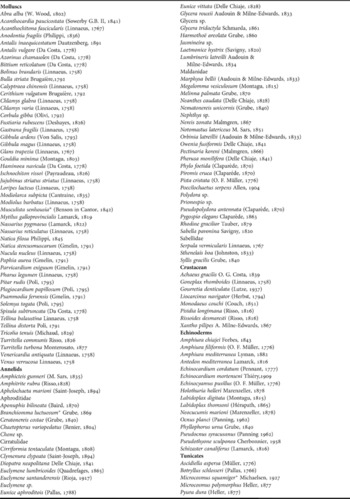
The list of 130 species collected in the Taranto Seas is shown in Table 2.
List of the species collected in the Taranto Seas during July 2002 (*Alien species).

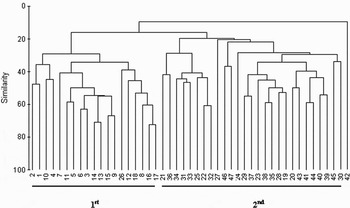
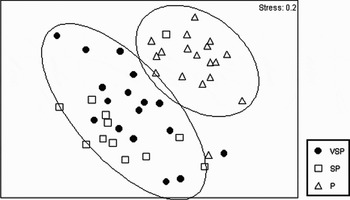
The dendrogram of the stations obtained from cluster analysis indicated the presence of two main groups (20% of similarity) (Figure 2). The first group consisted of 19 sampling stations, all located in the Mar Piccolo, apart from one (Station 26). The second group consisted of 27 stations, all located in the Mar Grande. One sampling station (Station 42) did not belong to either of the two identified groups. Two main groups were also identified with MDS ordination using the superimposition of the sediment granulometry (Figure 3). These two groups corresponded to the stations with sediment that was exclusively characterized by pelite (P), almost exclusively located in the Mar Piccolo, and to the stations with sediment that was characterized by pelite with increasing percentages of sand (sandy pelite (SP) and very sandy pelite (VSP)), almost exclusively located in the Mar Grande. The ANOSIM test confirmed that these species–station groups were significantly different (Global R = 0.499, P < 0.001).
Dendrogram of 47 sampling stations carried out in the Taranto Seas during July 2002.

Multidimensional scaling ordination of the sampling stations with indication of granulometric sediment characteristics (P, pelite; SP, sandy pelite; VSP, very sandy pelite).

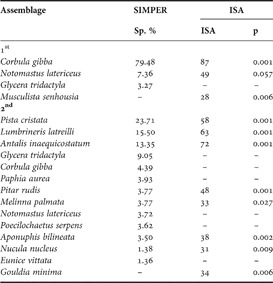
The species-group contributions obtained from SIMPER and ISA are reported in Table 3. Using the first method, the stations with pelitic sediment and located in the Mar Piccolo showed an average similarity of 31.07% and were mostly characterized by the mollusc Corbula gibba followed by the annelid Notomastus latericeus. The assemblage of stations with sandy pelitic sediment and located in the Mar Grande had an average similarity of 20.11% and was mainly represented by the annelids Pista cristata, Lumbrineris latreilli and Glycera tridactyla, and the mollusc Antalis inaequicostatum. In the Mar Piccolo the species with the highest values of ISA was Corbula gibba, followed by Notomastus latericeus and the exotic mussel Musculista senhousia (alien species), while in the Mar Grande the highest values were found for Antalis inaequicostatum and Lumbrineris latreilli, followed by Pista cristata, Pitar rudis and Aponuphis bilineata.
Species percentage contribution (Sp. %) from SIMPER and values of indicator species analysis (ISA), with significance, for each species assemblage identified in the Taranto Seas.

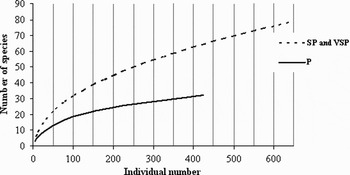
The rarefaction method applied to these two distinct groups provided a higher level of diversity for the stations characterized by sandy pelitic sediment located in the Mar Grande, than for the stations with pelitic sediment located in the Mar Piccolo (Figure 4).
Rarefaction curves obtained according to the assemblages identified in the Taranto Seas during July 2002 (P, pelite; SP, sandy pelite; VSP, very sandy pelite).

DISCUSSION
The benthic diversity studied in the Taranto Seas seems to be linked to the geomorphological features of the study area and to the sediment types of the bottoms. In fact, the two inlets of the Mar Piccolo differ largely from the Mar Grande in morphology, size, depth, sediment supply, water mass circulation and recycling as well as benthic community (Matarrese et al., Reference Matarrese, Mastrototaro, D'Onghia, Maiorano and Tursi2004; Scroccaro et al., Reference Scroccaro, Matarrese and Umgiesser2004). The first species assemblage is located in the shallow waters of the Mar Piccolo, the restricted basin mainly fed by a Pleistocene clay formation. These species usually live on muddy bottoms rich in organic matter (e.g. the bivalve Corbulidae Corbula gibba and the Capitellidae Notomastus latericeus) (Picard, Reference Picard1965; Nodot et al., Reference Nodot, Bourcier, Jeudy de Grissas, Heusner, Régis and Tine1984; Rebzani-Zahaf et al., Reference Rebzani-Zahaf, Bellan, Bakalem and Romano1996). The second assemblage belongs to the Mar Grande basin, reached by the constant current of the northern Ionian Sea and fed by rocks of different age and composition outcropping in the southern Apennines. This assemblage consists of a greater number of species, usually occurring on different types of bottoms. In fact, in this basin there is a greater variability of the substrate than in the Mar Piccolo (Matarrese et al., Reference Matarrese, Mastrototaro, D'Onghia, Maiorano and Tursi2004). Species with a wide ecological distribution were found in the Mar Grande, where they colonized sandy–muddy bottoms, bottoms partially covered with Caulerpa racemosa (e.g. Lumbrineris latreilli) and bottoms with a dead muddy matte of Posidonia oceanica (e.g. Pista cristata, Lumbrineris latreilli, Antalis inaequicostatum and Paphia aurea) (Picard, Reference Picard1965; Gray, Reference Gray1974; Nodot et al., Reference Nodot, Bourcier, Jeudy de Grissas, Heusner, Régis and Tine1984; Rebzani-Zahaf et al., Reference Rebzani-Zahaf, Bellan, Bakalem and Romano1996).
The rarefaction curves show a higher diversity in the Mar Grande than in the Mar Piccolo. In fact, the curve for the Mar Piccolo flattens off after a small number of species, indicating that the organisms are exposed to physiological stress conditions and the community is mostly controlled by physical–chemical changes in the environment (Sanders, Reference Sanders1968). Indeed, mainly in the Mar Piccolo, the species assemblage is characterized by a few broadly tolerant native species adapted to the eutrophic conditions and environmental instability which, on the other hand, have most probably favoured the settlement of opportunistic alien species (Galil, Reference Galil2000; Occhipinti-Ambrogi, Reference Occhipinti-Ambrogi2000), such as the Asian date mussel Musculista senhousia (Mistri, Reference Mistri2003; Mastrototaro et al., Reference Mastrototaro, Matarrese and D'Onghia2003), the annelid Branchiomma luctuosum and the ascidian Microcosmus squamiger (Mastrototaro et al., Reference Mastrototaro, Petrocelli, Cecere and Matarrese2004). The mud deposition and mussel farms seem to cause conditions of continuous instability of the bottoms, which do not allow the settlement of well structured biocoenoses, but only seem to favour species with wide ecological tolerance (Nicolaidou et al., Reference Nicolaidou, Pancucci and Zenetos1989; Currie & Parry, Reference Currie and Parry1999; Leppäkoski et al., Reference Leppäkoski, Helminen, Hänninen and Tallqvist1999; Cornello & Giovanardi, Reference Cornello and Giovanardi2003). Finally, from a methodological point of view, analyses from SIMPER and ISA provided consistent results.
ACKNOWLEDGEMENTS
The authors thank M. Gherardi and P. Panetta for the identification of annelid and mollusc species, respectively.