CHD represents almost one-third of all major congenital birth defects, occurring in about 1% of all live births and leads to roughly 40,000 paediatric cardiac operations in the United States per year. Reference Liu, Chen and Zuhlke1,Reference Jacobs, Mayer and Pasquali2 Although post-operative survival has improved over the past 30 years, surgical repair or palliation with cardiopulmonary bypass still carries significant morbidity, with a risk of major complication up to 38% for the highest risk children. Reference Jacobs, Mayer and Pasquali2,Reference Jacobs, O’Brien and Jacobs3
Cardiopulmonary bypass leads to a systemic inflammatory response driven by numerous factors including interactions with the bypass circuit, tissue ischaemia and reperfusion, haemolysis, altered flow characteristics, and complement and cytokine activation. Reference Kozik and Tweddell4 The resulting increased endothelial permeability and interstitial oedema, combined with neurohormonal changes, activate the renin-aldosterone system, increase anti-diuretic hormone release, and contribute to fluid overload after cardiac surgery with cardiopulmonary bypass. Reference Nadim, Forni and Bihorac5-Reference McCammond, Axelrod, Bailly, Ramsey and Costello7 Fluid overload is estimated to occur in up to 40% of children following cardiopulmonary bypass and is seen more commonly in children who are younger, have cyanotic heart lesions, and undergo more complex surgeries. Reference Shi, Zhao and Liu8-Reference Vaara, Korhonen and Kaukonen14 Fluid overload is associated with increased morbidity and mortality, including higher risk of acute kidney injury and need for renal replacement therapy, prolonged duration of mechanical ventilation and inotropic support, prolonged ICU and hospital stay, and decreased overall survival. Reference Shi, Zhao and Liu8-Reference Vaara, Korhonen and Kaukonen14 Understanding the drivers of fluid overload is critical to developing potential therapies and improving post-operative outcomes.
To improve fluid balance, several classes of diuretics are used in the post-operative setting despite no current labelling for this indication by the US Food and Drug Administration. Reference Torok, Li and Kannankeril15 Label guidance for appropriate diuretic dosing and adjunct therapies may allow for improved efficacy with lower risk of adverse events. Reference McCammond, Axelrod, Bailly, Ramsey and Costello7 However, studies to determine optimal dosing strategies in children with CHD are difficult to perform due to both limited numbers and disease heterogeneity, as well as challenges obtaining informed consent in a vulnerable population when there may be parental reluctance to enroll in placebo-controlled trials. Reference Torok, Li and Kannankeril15,Reference Zimmerman, Gonzalez, Swamy and Cohen-Wolkowiez16 Additionally, a lack of consistent, validated endpoints may make interpreting study results difficult and can prevent comparisons across studies. This systematic review aims to summarise the existing literature of diuretic use following cardiac surgery with cardiopulmonary bypass in children with CHD to guide clinical practice and inform areas where further research is needed.
Methods
Search strategy
PubMed and EMBASE were searched to identify studies investigating the use of diuretics in children after cardiac surgery with cardiopulmonary bypass, similarly to research previously described. Reference King, Thompson and Foote17 Studies from 2000 to 2020 were included to reflect medication use in the context of current clinical practice. Children were defined as birth to age 18 years. The search terms “postoperative care,” “heart surgery,” “cardiopulmonary bypass,” “pediatric,” and “diuretic” were used to generate an initial group of studies. We excluded animal studies, studies in a language other than English, and studies focused on pre- or intraoperative medication use. Case reports, letters, editorials, and comments were excluded. The search strategies are shown in the Appendix. A total of 124 studies were identified.
Study selection
Identified studies were imported into EndNote (Clarivate Analytics, Philadelphia, PA, USA). Two reviewers independently screened and reviewed study abstracts and titles. Studies were eligible for inclusion if the primary focus was diuretic administration in the post-operative period for children following cardiac surgery with cardiopulmonary bypass. The full article was then reviewed to ensure appropriateness prior to data extraction. A total of nine studies were included in the final analysis.
Data extraction and synthesis
A standardised data collection form was used to extract the relevant data from each eligible study. The following data were collected: study characteristics (including study design and years of study), study population characteristics (including age and cardiac defects), intervention (including medication administered and the presence and type of control used), study endpoints, and results. For each medication, the dose, timing of administration, primary outcome, and secondary outcomes were compiled and analysed.
Results
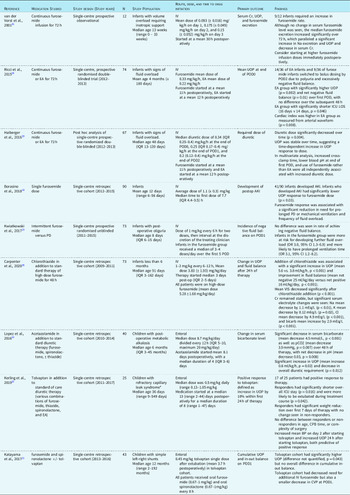
Overall, nine studies in 430 children met our inclusion criteria, all of which were single centre. Reference Borasino, Wall and Crawford18-Reference Carpenter, Kouyoumjian, Moromisato, Lieu and Amirnovin26 Study characteristics are summarised in Table 1. Three studies were prospective trials, one was a post hoc analysis of a prospective trial, and five were retrospective cohort studies. Of the prospective studies, two were randomised controlled trials comparing two therapies without a placebo arm, and one was an open-label, one-arm trial without a control group. Seven studies used a surrogate marker of efficacy as the primary outcome, most commonly urine output or fluid balance. One study used development of acute kidney injury as a primary endpoint, and none evaluated mortality as a primary outcome, although two studies explored this as a secondary outcome. None of the included studies evaluated pharmacokinetic data in their design or analysis. Medications studied were loop diuretics (furosemide [8/9], ethacrynic acid [2/9]), thiazides (chlorothiazide [1/9]), vasopressin antagonists (tolvaptan [2/9]), and carbonic anhydrase inhibitors (acetazolamide [1/9]). Reference Borasino, Wall and Crawford18-Reference Carpenter, Kouyoumjian, Moromisato, Lieu and Amirnovin26 The median age in all studies was ≤12 months.
Characteristics of included diuretic studies and study populations

AKI = acute kidney injury; CI = confidence interval; CPB = cardiopulmonary bypass; Cr = Creatinine; CVP = central venous pressure; EA = ethacrynic acid; IQR = interquartile range; IV = intravenous; LOS = length of stay; Na = sodium; PD = peritoneal dialysis; POD = post-operative day; OR = odds ratio; SD = standard deviation; UOP = urine output; VIS = vasoactive infusion score
* Capillary leak syndrome defined by clinical symptoms (volume overload, intravascular hypovolaemia) and subcutaneous-thoracic ratio > 97th percentile
Loop diuretics
Loop diuretics act at the ascending loop of Henle and reversibly bind to the Na-K-2Cl cotransporter to reduce NaCl reabsorption. Reference Wittner, Di Stefano, Wangemann and Greger27 Loop diuretics are extensively protein bound and require active transport to reach the tubular lumen to block active sodium transport, with sodium excretion proportional to urinary drug excretion rather than serum concentration. Reference Brater28 Loop diuretics include furosemide, torsemide, and bumetanide, differing by duration of action and potency. Reference Brater29 Ethacrynic acid is a non-sulfonamide loop diuretic that is less commonly used due to concern for increased ototoxicity and cost. Reference Ikeda, Oshima, Hidaka and Takasaka30,Reference Ker and Gangadharan31
The loop diuretics furosemide and ethacrynic acid are labelled for use as diuretics in paediatric populations: Intravenous and oral furosemide are labelled by the Food and Drug Administration for the treatment of oedema in paediatric patients of all ages with congestive heart failure, hepatic cirrhosis, and renal disease, 32 and oral ethacrynic acid is Food and Drug Administration-labelled for the short-term management of oedema in hospitalised paediatric patients with CHD or nephrotic syndrome. 33 Notably, both intravenous and oral ethacrynic acid are contraindicated for use in infants by Food and Drug Administration labelling.
Furosemide is the most commonly used loop diuretic in children and was included in all studies as either active drug, comparator, or standard of care. No studies on torsemide or bumetanide met inclusion criteria. In an uncontrolled, prospective trial of 12 infants (postnatal age range 0–33 weeks) with fluid overload, continuous furosemide infusion, started at a mean of 30 (range 21–48) hours postoperatively, up to a mean rate of 0.175 (± 0.045) mg/kg/h, resulted in significantly increased urine output. Reference van der Vorst, Ruys-Dudok van Heel and Kist-van Holthe25 In a single-centre randomised controlled trial of 74 children (mean age 4 months [± 180 days]), continuous ethacrynic acid infusion was superior to continuous furosemide infusion, each starting at 0.2 mg/kg/h of furosemide equivalent dose, titratable up to 0.8 mg/kg/h to achieve net even or negative fluid balance on post-operative day 0. Compared to furosemide, ethacrynic acid resulted in improved urine output and net fluid balance on post-operative day 0 (mean urine output 6.9 ml/kg/h vs. 4.6 ml/kg/h, p = 0.002; mean fluid balance −43 ml/kg/h versus −17 ml/kg/h, p = 0.01). Reference Ricci, Haiberger, Pezzella, Garisto, Favia and Cogo24 Although no difference was seen on subsequent post-operative days, the ethacrynic acid group trended towards shorter duration of mechanical ventilation and had significantly shorter ICU stays (mean 14 days vs. 16 days, p = 0.046). A significantly lower dose of ethacrynic acid was required compared to furosemide (mean 0.22 mg/kg/h vs. 0.33 mg/kg/h, p < 0.0001).
A post hoc analysis of this cohort demonstrated high initial loop diuretic doses (median dose 0.34 mg/kg/h on post-operative day 0) with a significant decrease over the following 48 hours (p = 0.04). Reference Haiberger, Favia, Romagnoli, Cogo and Ricci20 Urine output remained stable over the study period, suggesting an initial loop diuretic resistance in these infants that improved over 72 hours postoperatively. Lower blood pH after the first post-operative day and longer cross-clamp time both independently predicted the need for increased loop diuretic dose.
None of these studies found deleterious effects on renal function, with continuous infusions being associated with improving serum creatinine over time in one study. Reference van der Vorst, Ruys-Dudok van Heel and Kist-van Holthe25 Metabolic alkalosis and hypokalaemia were common, with more severe alkalosis seen in children receiving ethacrynic acid than those receiving furosemide.
No studies that met our inclusion criteria compared continuous dosing to bolus dosing regimens. Bolus dosing of intravenous furosemide was compared to peritoneal dialysis in a single-centre randomised trial of 73 infants (median age 9 days for furosemide group, 8 days for peritoneal dialysis group). Reference Kwiatkowski, Goldstein, Cooper, Nelson, Morales and Krawczeski23 All randomised infants had a peritoneal dialysis catheter placed in the operating room and upon development of oliguria during the first post-operative day were randomised to bolus dosing of 1 mg/kg furosemide every 6 hours or peritoneal dialysis. No difference was seen in the primary outcome – incidence of negative fluid balance on the first post-operative day. However, the furosemide group was at higher risk for developing at least 10% fluid overload (OR 3.0, 95% CI 1.3–6.9) and for needing prolonged mechanical ventilation (OR 3.1, 95% CI 1.2–9.2).
A retrospective study of 90 infants (mean age 12 days, range 6–56 days) found that urine output response following a bolus dose of furosemide predicted development of acute kidney injury as well as need for prolonged mechanical ventilation and prolonged peritoneal dialysis. Reference Borasino, Wall and Crawford18 However, no specific cutoff point or urine output threshold that could be used to prospectively predict acute kidney injury risk in future children was defined.
Thiazides
Thiazide diuretics inhibit the Na-Cl cotransporter in the distal convoluted tubule, blocking sodium and chloride reabsorption. Reference Ellison, Velazquez and Wright34 Their use as a diuretic is primarily in combination with loop diuretic therapy to augment diuresis and blunt loop diuretic resistance, with well-documented efficacy in adult patients with congestive heart failure. Reference McCammond, Axelrod, Bailly, Ramsey and Costello7,Reference Ellison35,Reference Jentzer, DeWald and Hernandez36 Thiazides, including chlorthalidone and hydrochlorothiazide, are used in children with CHD, but their usage remains off-label. Reference Pasquali, Hall and Slonim37 Two retrospective studies have looked at thiazide usage in the paediatric cardiac ICU, suggesting that the thiazide-like metolazone, but not chlorthalidone, was associated with increased urine output. Reference Moffett, Tsang, Kennedy, Bronicki, Akcan-Arikan and Checchia38,Reference Wise, Moffett, Akcan-Arikan, Galati, Afonso and Checchia39 Neither study specifically investigated the post-operative population. One study of chlorothiazide met our inclusion criteria.
In a single-centre retrospective study of 73 children (median age 91 days, interquartile range 9–162 days), the addition of chlorothiazide (mean dose 3.83 mg/kg/day, started at a median 3 days postoperatively) to furosemide was associated with a significant increase in urine output and improvement in fluid balance after 24 hours of therapy (mean urine output 3.6 ml/kg/h vs. 5.6 ml/kg/h, p < 0.001; mean fluid balance +16 ml/kg/day versus −25 ml/kg/day, p < 0.001). Reference Carpenter, Kouyoumjian, Moromisato, Lieu and Amirnovin26 Of note, the dose of furosemide also increased significantly after chlorothiazide initiation (mean dose 0.20 vs. 0.24 mg/kg/h, p < 0.001), but the improvements in urine output and fluid balance persisted after adjusting for furosemide dose. Although serum creatinine remained stable with chlorothiazide therapy, its initiation was associated with significant electrolyte changes, notably, decreased serum sodium (mean 136.6 vs. 135.5 mEq/L, p < 0.01), potassium (mean 3.36 vs. 3.24 mEq/L, p = 0.02), and chloride (mean 101.0 vs. 96.1 mEq/L, p < 0.001) and increased metabolic alkalosis (mean serum bicarbonate 29 vs. 32 mEq/L, p < 0.001).
Vasopressin receptor antagonists
Tolvaptan is a selective vasopressin 2 receptor antagonist that leads to increased renal free water excretion without increased electrolyte wasting and is only available in an oral formulation. Reference Amin and Danny40 In adult patients with acute heart failure, tolvaptan improved weight loss and oedema but had no mortality benefit. Reference Konstam, Gheorghiade and Burnett41 Recently, tolvaptan has been shown to be safe in a paediatric heart failure population, leading to improved urine output in children with acute heart failure exacerbations, but its use in paediatric populations remains off-label. Reference Higashi, Murakami and Ishikawa42 The inflammatory and neurohormonal response after cardiopulmonary bypass leads to interstitial oedema and free water retention, suggesting a potential role of tolvaptan for enhanced free water excretion in the acute post-operative setting. Reference Seghaye, Grabitz and Duchateau6 Two studies of tolvaptan met our inclusion criteria.
A retrospective study of 43 children (median age 12 months, range 2–192 months) compared cohorts before and after instituting a policy of a single dose of 0.45 mg/kg tolvaptan in addition to standard oral diuretic therapy following extubation after surgical repair of simple left to right shunts. Reference Katayama, Ozawa, Shiono, Masuhara, Fujii and Watanabe21 The addition of tolvaptan was associated with increased urine output (p = 0.043) but similar net fluid balance to the control group on the first postoperative day. In a separate study, the addition of daily doses of tolvaptan (starting dose 0.25 mg/kg/day) in post-operative infants with capillary leak syndrome (median age 35 days for responders, 37.5 days for nonresponders, range 9–549 days) was associated with at least a 10% increase in urine output in 17 of the 25 children, although no control group was used. Reference Kerling, Toka and Rüffer22 Therapy was started a median of 13 days postoperatively. Responders were able to be extubated significantly earlier (10/17 of responders vs. 1/7 of nonresponders were extubated during treatment course; p = 0.042) with shorter overall length of stay (median days after tolvaptan administration 15 vs. 41; p = 0.016). Both studies looked at the effect of therapy on renal function and serum sodium concentration. Treatment was overall well tolerated, with only one child developing significant hypernatremia and no evidence of worsening glomerular filtration rate.
Carbonic anhydrase inhibitors
Post-operative metabolic alkalosis is common, especially in infants less than 1 year old, and is often driven by high-dose loop diuretic use. Reference Wong and Chundu43 Alkalosis is associated with decreased respiratory drive and increased mortality in critically ill patients. Reference Wilson, Gibson and Percinel44,Reference Anderson and Henrich45 Hypochloremic metabolic alkalosis is associated with loop diuretic resistance, leading to higher required doses. Reference Hanberg, Rao and Ter Maaten46 Acetazolamide is a carbonic anhydrase inhibitor that causes increased urinary sodium and bicarbonate excretion and improvement of metabolic alkalosis. It has been used safely in the paediatric population despite being used off-label. Reference Moviat, Pickkers, van der Voort and van der Hoeven47-Reference Andrews, Johnson, Lammers, Harrison and Miller49
One study of acetazolamide met our inclusion criteria. In a single-centre retrospective study of 40 children (mean age 6 months) who developed post-operative metabolic alkalosis (mean 8.1 days postoperatively), the addition of acetazolamide was associated with a significant improvement in serum bicarbonate (p < 0.001) and pH (p=.006). Reference Lopez, Alcaraz, Toledo, Cortejoso and Gil-Ruiz19 After 48 hours of therapy, these children also had a significant increase in urine output (p = 0.02) and a decrease in total diuretic requirement (p = 0.012). All children were concomitantly treated with both furosemide and spironolactone, with over half on high doses of continuous furosemide infusion (58% on >0.3 mg/kg/h) at therapy initiation. Treatment was associated with an improvement of hypercapnia in ventilated children, but the study was not designed to assess mechanical ventilation duration as an outcome.
Discussion
Our review identified nine trials in 430 children across four medication classes. The majority of these studies were retrospective. Of those that were prospective, only two trials of 147 children had a control arm. None of the studies were multicentre trials, and both the intervention – single dose, repeated bolus dosing, or continuous infusion – and outcome were variable between studies, limiting comparisons across trials and the broader application of their findings.
Diuretic resistance is seen early in the post-operative period, suggesting that higher initial doses of diuretic may decrease fluid overload, although timing of diuretic initiation remains unknown. Reference van der Vorst, Ruys-Dudok van Heel and Kist-van Holthe25 Current evidence suggests that ethacrynic acid may be superior to furosemide but may result in increased electrolyte abnormalities. Reference Haiberger, Favia, Romagnoli, Cogo and Ricci20,Reference Ricci, Haiberger, Pezzella, Garisto, Favia and Cogo24 The use of adjunct diuretic therapies may improve urine output and fluid balance, but may also adversely affect electrolytes. Reference Lopez, Alcaraz, Toledo, Cortejoso and Gil-Ruiz19,Reference Katayama, Ozawa, Shiono, Masuhara, Fujii and Watanabe21,Reference Kerling, Toka and Rüffer22,Reference Carpenter, Kouyoumjian, Moromisato, Lieu and Amirnovin26
One major limitation in comparing conclusions across studies and translating these conclusions into clinical practice is the lack of validated, standardised endpoints for diuretic medications. The included studies primarily used urine output or fluid balance as their primary endpoint. Previous studies have demonstrated a correlation between fluid overload and morbidity and mortality, but it has not been clearly demonstrated that therapy directed toward improving fluid overload improves those outcomes. Reference Shi, Zhao and Liu8-Reference Lex, Toth and Czobor12 Endpoints of morbidity – prolonged intubation time, prolonged hospital stay – or mortality may be more clinically relevant but require a large sample size and face significant confounding factors in these complex children. All identified studies included 90 or fewer children, limiting the power to detect significant differences in mortality, and preventing correlation between improvements in the surrogate markers of urine output or fluid balance and the more clinically important markers of morbidity and mortality.
For assessment of dose response to a single drug, urine output may be a feasible and immediate outcome to monitor. However, to assess efficacy for treating fluid overload in critically ill children post-cardiopulmonary bypass, overall fluid balance may be a more physiologically relevant marker. Previous studies from the late 1990s compared intermittent dosing to continuous infusions of furosemide, with some data suggesting that larger intermittent urine output required additional compensatory fluid administration to stabilise haemodynamics, limiting the total net volume decrease. Reference Singh, Kissoon, Al Mofada, Bennett and Bohn50-Reference Luciani, Nichani, Chang, Wells, Newth and Starnes52 Further, differences in fluid overload have been associated with clinically important outcomes such as length of intubation, length of hospital stay, and overall mortality. Reference Shi, Zhao and Liu8,Reference Hassinger, Wald and Goodman10-Reference Lex, Toth and Czobor12 Active de-escalation and improvement of fluid balance have also been associated with reduced mortality in critically ill adult patients. Reference Silversides, Fitzgerald and Manickavasagam53 Accordingly, using fluid balance as a surrogate marker of diuretic efficacy may allow for smaller sample sizes, real time data collection and analysis, and better comparison of medications across trials if this association holds in paediatric populations.
Most (6/9) of our included studies looked at diuretic use in the first 72 hours after surgery, during which children require inotropic support and undergo significant volume shifts and profound physiologic alterations. These effects may alter both drug disposition and exposure–response relationships. Haiberger et al demonstrated a time-dependent increase in urine output response to loop diuretic dose during this early period, suggesting early diuretic resistance, but dose response at other times remains unknown. Reference Haiberger, Favia, Romagnoli, Cogo and Ricci20 Underlying cardiac diagnosis, such as one- or two-ventricle physiology, and developmental related changes also affect drug disposition, but most (8/9) studies also did not evaluate outcomes in this context. Reference van Saet, de Wildt, Knibbe, Bogers, Stolker and Tibboel54,Reference Bailey, Miller, Lu, Tosone, Kanter and Tam55 These factors should be considered in future studies to inform optimal regimens (diuretic type, dose, duration, and timing of initiation) and appropriate adjunct therapies specific to underlying physiology.
Although there are over 40,000 paediatric cardiac surgeries annually, only nine studies with 430 total children met our inclusion criteria over a 20-year period. Reference Jacobs, Mayer and Pasquali2 The paucity of trials is reflective, at least in part, of the complexity of conducting traditional trials in this vulnerable and high-risk population with complex clinical care needs. Pragmatic trial designs, master protocols, and the use of real-world data may provide feasible alternatives to traditional clinical trials by simplifying protocols, supporting enrollment, allowing for collaboration across sites, and minimising the need for trial-specific data collection and analysis. Reference Torok, Li and Kannankeril15,Reference Hill, Baldwin and Bichel56,Reference Woodcock and LaVange57 Additionally, combining dosing and demographic data from the electronic health record with advanced pharmacokinetic/pharmacodynamic modelling may allow for dose optimisation in specific populations while avoiding the challenges of performing clinical trials.
Our objective was to evaluate the existing evidence for diuretic use in children with CHD following surgery with cardiopulmonary bypass. We found that ethacrynic acid may be superior to furosemide, and adjunct therapies may be beneficial in treating fluid overload. Higher initial diuretic doses should be considered. Significant study heterogeneity, limited enrollment, and lack of validated, consistent endpoints make trial results difficult to translate into clinical practice. Novel trial designs may allow for improved evidence-based drug selection and delivery, resulting in improved outcomes in children with CHD undergoing surgery with cardiopulmonary bypass.
Acknowledgements
The authors would like to acknowledge Duke Pediatric Research Scholars.
Financial support
None.
Conflicts of interest
HP Foote reports no relevant disclosures.
CP Hornik receives salary support for research from National Institute for Child Health and Human Development (NICHD) (1K23HD090239), the National Heart Lung and Blood Institute (NHLBI) (R61/R33HL147833), the United States Food and Drug Administration (1R01-FD006099, PI Laughon; and 5U18-FD006298, PI: Benjamin), the United States government for his work in pediatric clinical pharmacology (Government Contract HHSN275201800003I, PI: Benjamin under the Best Pharmaceuticals for Children Act), the non-profit Burroughs Wellcome Fund, and other sponsors for drug development in adults and children (https://dcri.org/about-us/conflict-of-interest/).
KD Hill reports no relevant disclosures.
AT Rotta reports being the scientific advisor for Vapotherm Inc and Breas US and has received honoraria for producing educational materials for these companies. Dr. Rotta also receives royalties from Elsevier for editorial services.
R Chamberlain reports no relevant disclosures.
EJ Thompson reports no relevant disclosures.
Ethical standards
All procedures performed in studies involving human participants were in accordance with the ethical standards of the institutional and/or national research committee and with the 1964 Helsinki declaration and its later amendments or comparable ethical standards.