


Introduction
Large-scale clinical trials are essential to advance pain research, but their impact depends on generating results that are valid and generalizable to the target population. When study participants do not represent the individuals suffering from chronic pain in the United States, findings lose generalizability, limiting the impact of their results and reducing their value to public health [Reference Kennedy-Martin, Curtis, Faries, Robinson and Johnston1]. Chronic pain has emerged as a leading global public health challenge impacting personal and social roles worldwide [Reference Zhu, Zhang and Liang2–Reference Almalki, BinBaz and Alamri6]. Yet, these burdens are not evenly distributed as disparities in prevalence, severity, and quality of care are well documented among Hispanic/Latinx and other non-English-speaking communities [Reference Hollingshead, Vrany, Hsueh, Stewart and Hirsh7–Reference Hollingshead, Vrany, Stewart and Hirsh12]. Language barriers and culturally discordant assessments can undermine recruitment, retention, and data quality [Reference Nguyen, Ugarte, Fuller, Haas and Portenoy13–Reference Pardhan, Sehmbi, Wijewickrama, Onumajuru and Piyasena15], creating costly, poorly generalizable, and biased outcomes from long term, high-cost research efforts. Addressing these gaps is a prerequisite for scientific rigor and optimal use of research investment.
In response to these challenges, the National Institutes of Health (NIH) Helping to End Addiction Long-term (HEAL) Initiative – a trans-agency effort to address pain and opioid use disorder, prioritized the inclusion of participants that reflect the U.S. population. Efforts have included funding supplements to support recruitment and engagement of populations experiencing health disparities, funding announcements soliciting culturally and linguistically representative study samples, and the development of Spanish-language versions of HEAL Common Data Elements (CDEs) to promote standardized measurement across studies (NIH HEAL CDE Program, 2021). Inclusion of individuals with diverse linguistic, cultural, or access-related needs can enhance research quality by ensuring that trial outcomes are applicable to populations most affected by pain or more broadly, the health condition under study. However, while such structural supports are critical, they do not guarantee consistent implementation across trials [Reference Adams, Hassett, Clauw and Hurley16,Reference Wandner, Domenichiello and Beierlein17].
In practice, multisite clinical trials implementing cultural and linguistic adaptations face substantial barriers. Coordinating Institutional Review Board (IRB) approvals across sites, securing high-quality translations, covering translation costs, and hiring or training bilingual staff all introduce delays and resource burdens [Reference Beauchemin, Ortega and Santacroce18,Reference Hoffman, Doan and Migliori19]. Even with system-level tools like standardized Spanish CDEs, trial teams often must develop study-specific solutions to meet recruitment targets and maintain participant engagement. Funding shifts, such as the reduction or elimination of diversity and inclusion initiatives, may further complicate these efforts. Without systematic documentation of these real-world processes, effective implementation and the identification of successful recruitment remain elusive. More importantly, the impact and return on investment of cultural and linguistic adaptations are difficult to quantify, limiting opportunities for improvement.
This study sought to engage experts with prior experience in cultural and linguistic adaptations in pain‑focused clinical research and to incorporate their insights to generate practical, evidence‑informed guidance for implementing such adaptations. This manuscript describes pain-focused clinical research efforts that implemented cultural and/or linguistic adaptations to improve recruitment and retention of Hispanic/Latinx and/or non-English-speaking participants. We present strategies, facilitators, barriers, and study-specific solutions, along with recruitment outcomes before and after implementation, to inform future large-scale trials seeking to optimize generalizability and health equity.
Materials and methods
Survey development & distribution
The survey was developed collaboratively by the study authors. Initial questions were informed by themes identified from a prior symposium on cultural and linguistic adaptations in multicenter pain-focused clinical studies. The survey was circulated and edited among collaborators for feedback on content/themes, question wording, and response options. The final survey instrument and study protocol received exempt approval from the University of Iowa Institutional Review Board, and all study participants received an exempt information sheet prior to completing the survey. The final survey contained 34 questions organized into six content areas (Vance et al. Supplementary Material 1): (1) study context and respondent information, (2) non-English recruitment strategies, (3) material translation, (4) interpreter services, (5) cultural adaptations, (6) reflections on implementation experience (barriers, facilitators, and recommendations).
The survey was administered using REDCap and sent to the designated contacts of 36 NIH-HEAL–funded studies. Studies with evidence of recruiting non-English-speaking participants were identified through the HEAL Initiative website and the NIH Pragmatic Trials Collaboratory. Respondents included PIs, research coordinators, and study staff familiar with recruitment processes and cultural or linguistic adaptations.
Survey data extraction & analysis
Closed-ended survey items were summarized using frequencies and proportions to characterize study contexts, implementation strategies, and reported recruitment outcomes. Open-text responses were analyzed using an iterative, descriptive, qualitative analytic approach [Reference Sandelowski20]. The analytic goal was to systematically characterize real-world implementation experiences related to cultural and linguistic adaptations in large clinical trials.
Responses were first reviewed to achieve familiarity with the content and the range of implementation experiences described. Open-text responses were iteratively reviewed and organized into provisional domains to support synthesis of facilitators, barriers, and implementation recommendations. Analytic decisions were refined through discussion among study authors to ensure consistency and coherence. Quantitative summaries and qualitative findings were integrated to synthesize implementation experiences (Vance et al. Supplementary Material 2).
Results
Survey respondent & study characteristics
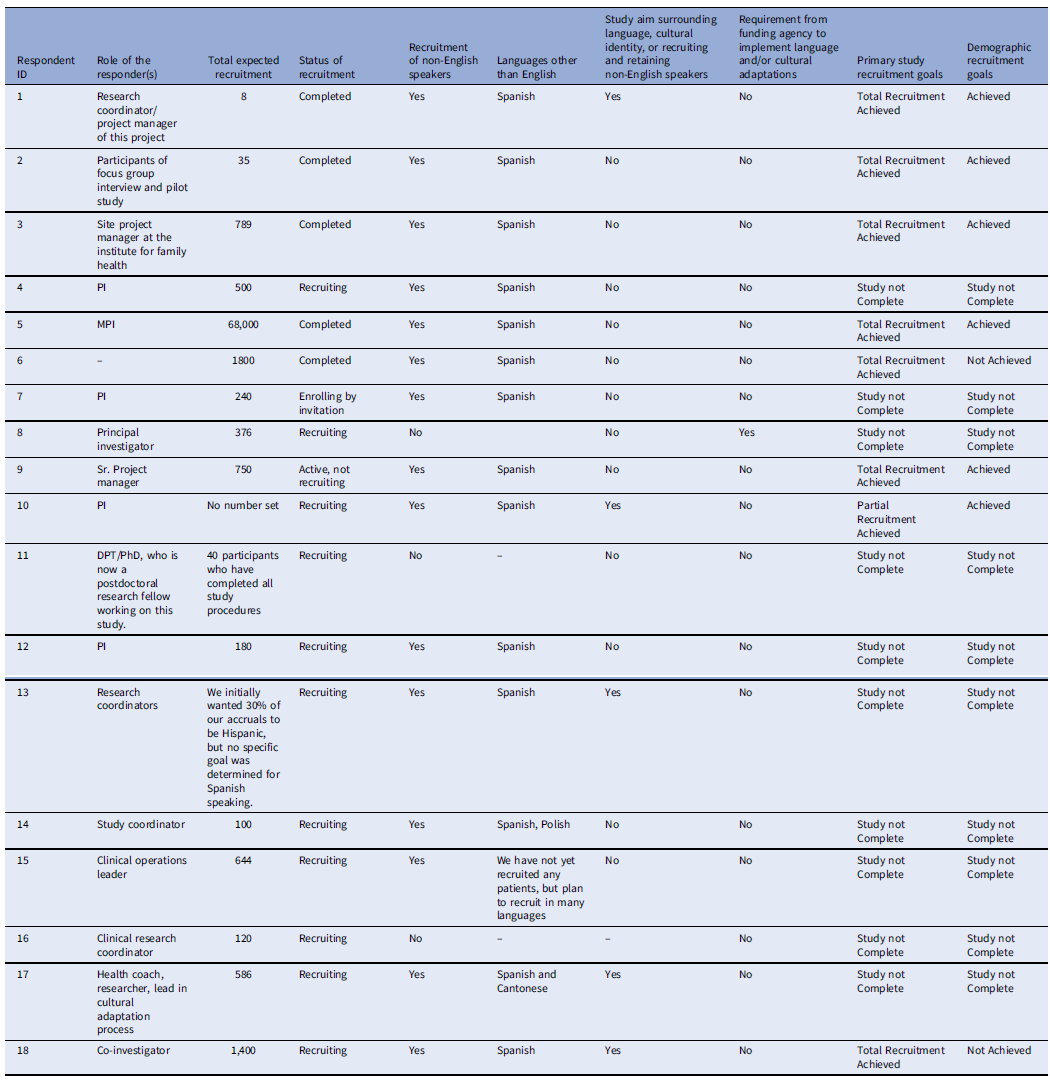
Eighteen of 36 studies returned survey responses. There was one respondent per survey which included principal investigators (7), project managers/research coordinators (7), and staff directly involved in recruitment and implementation of linguistic and/or cultural adaptations (4). The studies represented a wide range of recruitment contexts, with expected sample sizes ranging from 8 participants to 68,000. At the time of response, five studies had completed recruitment, while twelve studies were actively recruiting or enrolling participants, and one study had yet to begin recruitment. Five studies reported that recruitment of non-English speakers was a central study aim, yet only one respondent indicated a formal funding requirement to implement language or cultural adaptations (Table 1).
Survey respondent and study characteristics

Table 1. Long description
Table of 18 study responses describing recruitment goals, language inclusion, and study status. Respondents include principal investigators, project managers, coordinators, and other research staff. Expected recruitment ranges from 8 to 68,000 participants, with some studies reporting nonnumeric targets. Most studies are recruiting, while several have completed recruitment. Fourteen studies recruit non-English speakers, primarily Spanish speakers; additional languages include Polish and Cantonese, and one study plans recruitment in multiple languages. Six studies report aims related to language, cultural identity, or recruiting and retaining non-English speakers. Only one study reports a funding requirement for language or cultural adaptations. Completed studies generally achieved overall recruitment goals, though demographic goals were not always met. Most ongoing studies report that recruitment outcomes are not yet complete.
Characterization of linguistic adaptation efforts
Materials
Respondents reported translating a range of materials used throughout the research process. This included informed consent documents (83%), recruitment materials (78%), outcome measures or questionnaires (72%), patient-facing study-specific documents (72%), and standardized study-specific instructions (39%).
Efforts to ensure accuracy
Respondents reported employing multiple strategies to support the accuracy of translated materials, reflecting varying levels of translation quality assurance. The most commonly reported approach was review by a native speaker (89%), representing an informal validation strategy often embedded within study teams. Some respondents also reported using contracted translation services with 44% using forward translation and 28% using a combination of forward and backward translation. No additional translation methods were applied beyond the initial translation. Fifty-six percent reported employing more than one approach, indicating that translation accuracy was frequently supported through multiple quality assurance strategies.
Interpreter availability
Most respondents reported having interpreters available during study procedures (83%), for recruitment tasks (78%), and for follow-up questions (78%).
Characterization of cultural adaptation efforts
Twelve of the 18 respondents (67%) reported implementing cultural adaptations. Compared with linguistic adaptations, the survey included fewer items characterizing cultural adaptations, limiting respondent’s descriptions. Cultural adaptations were most commonly described as modifications to recruitment and assessment materials, while adaptations to consent processes, retention strategies, and outcome measures were infrequently described. Cultural adaptations to recruitment materials (22%) included incorporating culturally representative imagery, developing population-specific recruitment materials, and tailoring messaging to improve cultural relevance and avoid potentially inflammatory language. Survey assessment-related cultural adaptations (22%) included revising content and examples to improve cultural relevance (e.g., removing “golfing” from a list of activities), incorporating culturally relevant patient narratives, and reviewing materials for cultural appropriateness. To support these cultural adaptations, eight respondents described formal engagement strategies such as engaging community advisory/leadership boards, clinic partners, focus groups, and pilot testing with target users. In addition, three respondents reported leveraging study staff or institutional colleagues who shared a similar cultural background. Notably, two of the twelve respondents that responded “yes” to implementing cultural adaptations subsequently described implementing only linguistic adaptations and reported no stakeholder engagement. This highlights the variability in how cultural adaptations were conceptualized by respondents.
Endorsement-based orientations
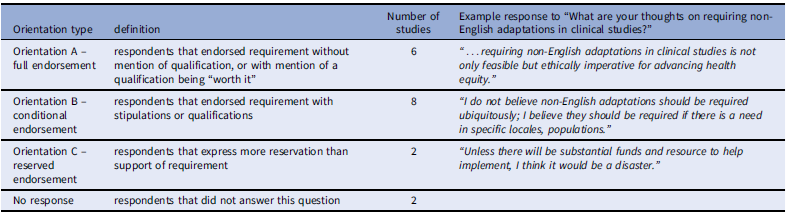
Survey respondents were asked an open-ended item regarding their views on requiring non-English adaptations in clinical studies, drawing on their overall experience and advantages and disadvantages of such requirement. Analysis of recommendation responses revealed three groups based on endorsement-based orientations: Orientation A-full endorsement (6/18), Orientation B-conditional endorsement (8/18), and Orientation C-reserved endorsement (2/18), while 2 respondents did not answer the survey item. See Table 2 for definitions and example responses of each endorsement-based orientation. These orientations are used as an analytic lens for organizing subsequent findings.
Description of recommendations-based orientations

Table 2. Long description
Table categorizing 18 study respondents’ views on requiring non-English language adaptations in clinical studies. Four orientation types are presented. Orientation A (Full endorsement) includes 6 studies whose respondents supported the requirement without qualifications or felt any challenges were worthwhile; an example cites language adaptation as ethically imperative for health equity. Orientation B (Conditional endorsement) includes 8 studies whose respondents supported requirements only when justified by local population needs. Orientation C (Reserved endorsement) includes 2 studies expressing more concern than support, often citing resource and funding limitations. Two respondents provided no answer. Overall, most respondents supported non-English adaptations, either fully or conditionally, while a small minority expressed reservations or did not respond.
Implementation motivations
Distinct patterns of motivational emphasis were observed across recommendation orientations. Respondents with Orientation A commonly cited alignment with local clinic or city demographics (83%) and increasing accessibility (83%) for non-English speakers as motivations. These motivations were often but not always reported alongside the motivation to recruit a more diverse population (67%). Among respondents expressing conditional endorsement, Orientation B, the most commonly reported motivation, was recruiting a more diverse population (88%) often along with increasing accessibility (75%) and local demographics (75%). Uniquely, only respondents with Orientation B reported feedback from patient partners as a motivation, however infrequently (38%). For those with Orientation C (reserved endorsement), respondents most frequently cited the goal of recruiting a more diverse study population (100%) as a motivation for non-English adaptations, while references to local clinic or city demographics (50%) and accessibility (50%) were less commonly endorsed.
Implementation of adaptations. Implementation of non-English adaptations varied in both timing and resourcing strategies across studies. These variances aligned with recommendation orientations, reflecting distinct ways of operationalizing linguistic inclusion within trial workflows.
Timing of implementation
Survey respondents with full endorsement, Orientation A, commonly reported incorporating non-English recruitment strategies at study outset (83%). In contrast, respondents with conditional or reserved endorsement less frequently described initiating recruitment of non-English-speaking participants at study launch (Orientation B = 50%, Orientation C = 0%).
Methods of translation
Respondents expressing full endorsement, Orientation A, reported using a variety of methods for translating study materials including pre-existing validated translations (67%), contracted services (50%), and most commonly reported using study staff (83%). Respondents with Orientation B also reported using a variety of methods for translating study materials, more frequently relying on pre-existing validated translations (63%) and contracted services (63%), and limited use of study staff (38%). Respondents expressing reserved endorsement, Orientation C, reported relying on contracted translation services only (100%).
Type of interpreter
Respondents expressing full endorsement, Orientation A, reported a mix of interpreter modalities, including contracted services (67%), research team members (67%), and, less frequently, family or friends (17%). Respondents expressing conditional and reserved endorsement, Orientations B and C, reported use of contracted services (50%) and research team members (50%), with no reported use of family or friends as interpreters.
Study recruitment status
Across all responding studies, five reported achieving demographic recruitment targets, eight reported that recruitment was ongoing, and three reported partial recruitment achievement. Patterns of demographic recruitment status varied across recommendation orientations. Among studies that completed recruitment with Orientation A (2), both reported achieving demographic recruitment targets. Among studies that completed recruitment with Orientation B (4), 3 reported achieving demographic recruitment targets and one reported partial achievement. Among studies that completed recruitment with Orientation C (2), both reported achieving total study recruitment targets without achieving their planned demographic breakdowns.
Implementation barriers by recommendation-based orientations
Across studies, respondents described several recurring sources of implementation challenges and barriers, including IRB and regulatory processes, costs, site selection constraints, scheduling and coordination activities, and access to specialized staff. Patterns of barrier salience varied across recommendation orientations. Respondents with Orientation A reported a heterogeneous mix of study-specific barriers at the level of participants and administrative considerations. A common barrier reported among respondents who expressed full endorsement (3/6) was related to constraints of hiring bilingual staff. For example, Respondent 17 reported challenges with identifying and retaining bilingual research staff, and Respondent 1 reported “The study also operated with a small bilingual team, which created additional demands.”
Barriers emphasized by respondents expressing conditional endorsement, Orientation B, clustered around regulatory processes and resource constraints. For example, Respondent 3 reported delaying recruitment of Spanish-speaking individuals, “8-9 months after the recruitment of English-speaking patients began…largely a result of IRB queue bottleneck.” Respondent 13 reported, “The process for approval of materials before being able to move forward with translation and uploading those translated materials is lengthy. The IRB also requires translations be done by a certified company only, so this can add time and budget constraints.” In addition, several respondents with Orientation B described challenges related to the absence of bilingual staff. For example, Respondent 9 reported “the absence of Spanish-speaking staff within study teams further hindered recruitment efforts for this population” and Respondent 8 reported, “our community partners felt that translating materials was insufficient; we would need to hire and train Spanish speaking program facilitators as well as research support staff.”
Among the two respondents expressing reserved endorsement, Orientation C, both reported the number of people available or electing to use the non-English path as a barrier. For example, Respondent 6 reported, “Ultimately, we did our best and spent an enormous amount on these efforts but had very few people take advantage of those resources” and Respondent 18 reported, “The number of available subjects (Spanish Speaking) was very low and most of the Hispanic population brought family or other English speaking individuals with them so they tended not to choose to use the linguistically adapted information.”
Implementation facilitators by recommendation-based orientations
Respondents described several enabling conditions that supported implementation of non-English adaptations, including access to specialized staff, trust-building efforts, and stakeholder-informed adaptation practices. These enabling conditions varied in form and salience across studies and recommendation orientations.
Employing study team members with specific cultural and linguistic expertise emerged as a crosscutting facilitator across all recommendation orientations. Across Orientations A, B, and C, respondents described bilingual or culturally concordant staff as facilitating communication with participants and supporting implementation and use of linguistically adapted study materials. For example, Respondent 1 (Orientation A) reported “bilingual facilitators was key to building rapport and ensuring smooth communication.” Similarly, Respondent 14 (Orientation B) reported “having bilingual staff members on the team enabled direct communication with participants,” and Respondent 18 (Orientation C) reported “Having study staff that were native Spanish speakers. Also had African American study staff that would reach out to like individuals. The staff needs to be part of the study to be most effective.”
Trust-building was described explicitly as a facilitating factor in a subset of studies, most specifically among those expressing full endorsement, Orientation A. Respondents 2 and 17 reported creating strong partnerships with community agencies and trusted relationships with local stakeholders.
Several respondents reported implementing cultural adaptations or incorporating stakeholder input into study design and recruitment approaches. The presence of these practices varied across orientations. Among respondents expressing full endorsement, Orientation A, 67% reported implementing cultural adaptations and 50% reported incorporating stakeholder input. Respondents expressing conditional endorsement, Orientation B, more frequently reported both cultural adaptations (75%) and stakeholder input (75%). In contrast, respondents expressing reserved endorsement, Orientation C, reported limited stakeholder-informed practices, with 50% reporting cultural adaptations and no respondents reporting stakeholder input.
Advice and lessons learned
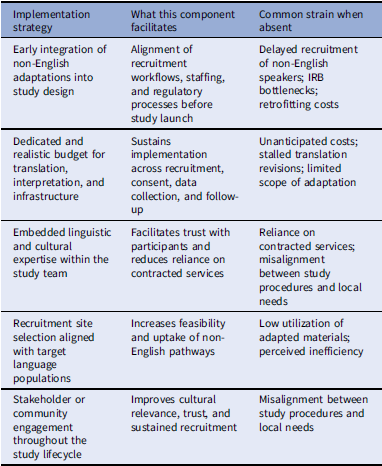
In addition to reporting implementation methods, barriers, and facilitators, respondents were asked to reflect on lessons learned and to offer advice based on their experience. Despite differences in respondents’ experiences implementing cultural and linguistic adaptations, respondents consistently emphasized a small set of priorities they viewed as central to successful implementation (Table 3).
Examples of success and strain with varying implementation strategies

Table 3. Long description
Table outlining five strategies for implementing non-English adaptations in clinical studies. Early integration into study design helps align recruitment, staffing, and regulatory processes and prevents recruitment delays, IRB bottlenecks, and retrofitting costs. Dedicated funding for translation, interpretation, and infrastructure supports recruitment, consent, data collection, and follow-up, while lack of funding can stall adaptation efforts. Embedding linguistic and cultural expertise promotes participant trust and reduces dependence on external contractors. Selecting recruitment sites that serve target language populations increases use of adapted materials. Ongoing stakeholder and community engagement improves cultural relevance, trust, and recruitment and helps ensure study procedures meet local community needs.
Timing of implementation
Respondents emphasized the importance of early and intentional planning for non-English adaptations, particularly with respect to timing and translation processes. As respondent 14 (Orientation B) noted, “To successfully recruit non-English speaking individuals, it’s essential to prioritize intentional planning and resource allocation from the outset.” Respondent 6 (Orientation C) similarly emphasized the importance of initiating efforts early, “it probably isn’t worth it to try and do in the middle of the study…you have to be all in from the start.” Several respondents (3-Orientation B, 5-Orientation B & 12-Orientation A) underscored that the time required for implementing non-English adaptations should not be underestimated, with others (2-Orientation A & 5-Orientation B) specifically identifying translation as a central component of early planning efforts.
Respondents reported varied strategies for navigating these constraints. For example, Respondent 3 (Orientation B) described beginning translation of English materials prior to IRB approval to prevent regulatory delay, “It is important to start translating the English materials as soon as possible, even before they are approved by the IRB.” Respondent 15 (Orientation A) emphasized planning ahead for non-English recruitment and leveraging existing institutional resources. They reported relying on existing IRB-approved translation resources, using available short-form translations and escalating to long-form translations only if usage thresholds were met, as a way of managing the time demands associated with non-English adaptations.
Resource allocation and costs
Respondents consistently articulated budgeting as a complex, under-recognized, and structurally expansive condition of implementing non-English adaptations. Several respondents (5-Orientation B, 7-Orientation A & 12-Orientation A) identified budgeting as not only important, but difficult (3, 18). The cost of translating materials was reported as burdensome by numerous respondents, with Respondent 13 (Orientation B) advising others to “consider the cost of translations when doing your grant budget” noting that revisions to translated materials “requires a re-translation to some extent.” Respondents also emphasized the importance of allocating funds beyond the translation of materials, noting the scope of costs depending on existing infrastructure. In addition to budgeting for costs of translating materials, Respondent 3 (Orientation B) stressed the importance of budgeting for “the building of Spanish instruments into study databases,” while Respondent 9 (Orientation B) advised, “allocate dedicated funding for translation services and interpreter fees, particularly for sites lacking existing infrastructure…especially those without access to centralized resources, should plan for these expenses, including the cost of validated translated measures.” Respondent 14 (Orientation B) echoed the breadth of costs related to implementing non-English adaptations, “it’s important to account for translation and interpretation services – not just for recruitment materials but for all participant interactions and study procedures. These costs can be significant, so funders should recognize and support them as fundamental to inclusive research.”
Recruitment site selection
Some respondents described site selection as an integral aspect in shaping the feasibility of recruiting non-English-speaking participants, particularly in relation to local demographics. Respondents emphasized the importance of careful site selection based on the populations served. Respondents 8 (Orientation B) and 9 (Orientation B) advised careful evaluation of local demographics and recruitment goals. Respondent 14 (Orientation B) advised, “Sites located in diverse, urban areas with large non-English-speaking communities are more successful in enrolling participants than those in less diverse areas.”
Linguistic and cultural expertise within study teams
Respondents consistently described linguistic and cultural expertise embedded within the study team as a key relational and technical facilitator in recruiting non-English speakers. Several respondents advised hiring specialized staff to meet the needs of the community, as respondent 18 advised, “Hire diverse staff and try to match staff up with the patients as much as possible. This is the best way to obtain good interaction between the potential subject and the research team.” Some respondents emphasized the role of specialized staff in building trust, as respondent 1 (Orientation A) reported, “Having bilingual staff members who have prior experience working with this population played a key role in establishing rapport and creating a safe, welcoming space.” Respondent 14 (Orientation B) similarly noted, “Investigators should ensure that their teams include bilingual staff members who not only speak the language but also understand the cultural nuances of the communities they are engaging with. These team members serve as vital bridges, facilitating clear communication and building trust.” The same respondent reported that “direct communication facilitated by bilingual staff…improved participant trust and study retention.” Respondents 13 (Orientation B) and 3 (Orientation B) emphasized the technical role of specialized staff in developing appropriate materials, as respondent 3 advised, “It is important to have at least one member on the team who is a native speaker…This will help significantly in designing materials that are understandable to the target population.” In addition to individual staff expertise, one respondent emphasized the importance of investigator- and institution-level experience working with non-English-speaking populations. Respondent 3 highlighted the value of partnering with investigators and organizations that bring established experience in delivering care and conducting research in participants’ primary languages, noting that “investigators with a track record of working with non-English speaking participants…it is essential to partner with an investigator and organization that possesses this experience.” They described how collaboration with an experienced site and investigator enabled the incorporation of language-specific materials and culturally relevant modifications that supported both recruitment and retention.
Early and sustained community engagement
Respondents consistently described early and sustained stakeholder and community engagement as foundational to successful recruitment and implementation of non-English adaptations. Respondents emphasized the importance of orienting to language and culture as part of a broader understanding of the community, as respondent 17 (Orientation A) advised “Think culture/language first - rather than just focusing on translating intervention.” Some respondents highlighted the importance of initiating engagement efforts early to better understand the communities they aimed to recruit, including conversations with representative persons or stakeholders prior to study launch. Respondents described a range of approaches to community engagement, including direct conversations with community members, compensating community advisory boards, hiring community ambassadors, conducting design studios, and partnering with trusted local organizations that already serve non-English-speaking populations. Engagement strategies were described as directly beneficial to recruitment by several respondents. Respondent 1 (Orientation A) reported “partnering with community-based organizations that already have trusted relationships with participants made a significant difference. These partners provided warm handoffs and referrals to the study.”
Discussion
We identified varying support for the implementation of cultural and linguistic adaptations in clinical research studies. Additionally, there was substantial heterogeneity in how linguistic and cultural adaptations were conceptualized, resourced, and operationalized. Survey respondents represented a wide range of study sizes, recruitment contexts, and roles, with only one study reporting a formal funding requirement tied to language or cultural adaptations. Implementation strategies varied widely across studies, particularly in terms of when non‑English recruitment began, how translation and interpretation services were arranged, and how staffing resources were allocated. Despite this variability, several consistent patterns emerged.
First, respondents described three distinct orientations toward the need for non-English adaptations, ranging from full endorsement to conditional endorsement to reserved endorsement of implementing cultural and linguistic adaptations. These endorsements aligned with differences in motivations, timing of implementation, resourcing strategies, and perceived barriers which ultimately contributed to successful implementation. Second, respondents consistently identified regulatory processes, costs, and workforce constraints as salient barriers, while highlighting embedded linguistic and cultural expertise, stakeholder engagement, and trust-building as key facilitators. Third, respondents’ reflections and advice converged on a small set of priorities, including early planning, realistic resourcing, alignment between recruitment sites and target populations, and sustained engagement with communities and stakeholders.
Recommendation-based orientations aligned with several facilitators and barriers to implementation. One third of respondents articulated unqualified support for requiring non-English adaptations in clinical studies, framing adaptations as inherently necessary. This orientation aligned with early integration of non-English recruitment strategies, motivations grounded in local demographics and accessibility, and the use of diverse translation and interpretation modalities. The barriers that aligned with Orientation A were limited in scope and less frequently framed as constraints to implementation (i.e. study-specific staffing or logistical challenges). Studies in this category were successful in meeting demographic recruitment goals associated with cultural and linguistic adaptations.
Nearly half of respondents expressed support for non-English adaptations while emphasizing that requirements should depend on study context, population characteristics, or feasibility considerations. Regulatory and operational barriers were especially salient within this orientation: regulatory delay and costs associated with translation and interpretation constrained implementation. Only two respondents were categorized within Orientation C, both expressing skepticism toward requiring non-English adaptations and emphasizing the substantial effort and resources involved relative to anticipated benefit. This orientation aligned with delayed implementation and relatively limited use of translation and interpretation modalities. Motivation centered primarily on increasing sample diversity, with less frequent reference to local demographics or access barriers. Studies in category B were in general partially successful in attaining demographic recruitment goals while neither study with Orientation C was successful. Taken together, successful implementation of non-English adaptations is driven less by goals of increasing representation and more by alignment with the needs of specific population and local access barriers, which is associated with earlier adoption and a needs-based approach towards linguistic and cultural adaptations.
Respondents described a recurring set of challenges that shaped the implementation of non-English adaptations. These factors were not experienced uniformly but varied in salience depending on study context, institutional infrastructure, and recommendation-based orientation. Regulatory and administrative processes emerged as prominent barriers, particularly among respondents expressing conditional endorsement (Orientation B). Delays associated with IRB review and requirements for certified translation services constrained implementation. These findings align with prior work documenting regulatory complexity as a common friction point in pragmatic and multisite trials [Reference ORourke, Carrithers and Patrick-Lake21,Reference Sugarman and Califf22]. Respondents with Orientation A did not report regulatory friction or delay as a barrier to implementation, likely due, in part, to early implementation and linguistic expertise embedded within study teams, as these factors provide adaptability and flexibility in the face of constraint. Early and intentional planning was recommended by respondents across Orientations to safeguard against regulatory delays. One respondent described using short-form measures and switching to the long-form once usage thresholds were met as a strategy to prevent regulatory delay, however, at a cost of reduced standardization.
Misalignment between the scope of adaptations and available infrastructure can impede feasibility due to resource constraints. Direct and unanticipated costs were found to be salient barriers to implementation by respondents expressing conditional and reserved endorsement (Orientations B and C). Costs beyond initial document translation, such as database integration, interpreter services, and ongoing revisions, were unanticipated hinderances to sustained implementation and recruitment, demonstrating that adaptations frequently entail broader and more sustained resource demands than initially anticipated. Consistent with implementation science frameworks, these findings suggest that linguistic adaptations function as system-level modifications rather than discrete tasks, requiring alignment between adaptation scope, staffing, and infrastructure to avoid unanticipated cost and delay [Reference Damschroder, Aron, Keith, Kirsh, Alexander and Lowery23]. Respondents with Orientation A did not report resource constraints and unanticipated costs as barriers, likely reflecting higher implementation capacity rather than lower resource demands [Reference Damschroder, Aron, Keith, Kirsh, Alexander and Lowery23]. Linguistic expertise embedded within the study teams may have increased organizational readiness and flexibility, reducing the disruptive impact of direct and unanticipated costs [Reference Weiner24]. Across Orientations, respondents emphasized the importance of deliberate resource allocation and budgeting to ensure successful implementation of cultural and linguistic adaptations. Established institutional resources, including translation and interpreter services, bilingual staff, and local implementation expertise supports successful implementation. Institutions that sustain these resources have likely established relationships with diverse communities.
In addition to regulatory and cost barriers to implementation, respondents with Orientation C reported limited perceived benefit of implementing adaptations as recruitment of non-English-speaking participants was low. These respondents did not report motivations grounded in alignment with local populations and stakeholders, whereas respondents from successful studies emphasized the importance of site selection to ensure adaptation efforts align with the populations served. Alignment with the populations served is essential given cultural and linguistic diversity. For example, Spanish language use and cultural norms vary across the United States, reflecting communities of Mexican, Puerto Rican, Cuban, and other origins. Engaging local communities can inform more effective language adaptations and build trust. Low uptake of non-English services may reflect a self-reinforcing cycle in which abstract motivations and delayed or minimal implementation can limit visibility, accessibility, and integration, thereby suppressing use and complicating interpretation of uptake as a true barrier.
Workforce-related barriers, especially hiring and maintaining bilingual or culturally concordant staff, were found across recommendation stances. The absence of culturally concordant staff often constrained recruitment efforts. In contrast, the presence of bilingual staff served as a key facilitator, enhancing communication and reducing implementation barriers. This duality reinforces findings from prior studies demonstrating that bilingual staff are central to successful linguistic and cultural adaptations [Reference Nagy, Solorzano, Stafford, Mercado Emerson and Gonzalez-Guarda25,Reference Ragavan and Cowden26]. Beyond translation, respondents noted that bilingual staff contributed to cultural adaptation in more embedded and often informal ways, including development of study materials to enhance comprehension, facilitating culturally appropriate communication, and fostering trust with participants. These contributions were not typically described as discrete or formal adaptation activities [Reference Brockman, Balls-Berry and West27].
Taken together, these findings suggest that barriers and facilitators to implementing non-English adaptations arise due to the alignment between study goals, study team expertise, involvement of concordant stakeholders, and available resources. These findings underscore that the feasibility and success of implementing cultural and linguistic adaptations is shaped by the interaction of multiple components, including regulatory processes, funding mechanisms, staffing models, and community relationships. Consistent with implementation science frameworks, these elements do not operate independently; rather, misalignment in one domain can amplify constraints in others, while alignment across domains can reduce implementation burden [Reference Damschroder, Aron, Keith, Kirsh, Alexander and Lowery23]. Understanding these elements as interacting components of an implementation system rather than isolated obstacles may help investigators and funders better anticipate where support is most needed to increase participation of non-English-speaking participants in clinical research. This consideration is important as non-English-speaking populations represent a meaningful proportion of the US population [28], individuals affected by chronic pain [Reference Lim, Fortier and Kain29,Reference Lor, Xiong, Yang and Koleck30] and other health conditions [Reference Vélez-Bermúdez and Myaskovsky31–Reference Qureshi, Romesser and Jalisi34]. Furthermore, incorporating individuals with diverse lived experiences into culturally and linguistically adapted study protocols can enhance the generalizability of findings to populations in need of care.
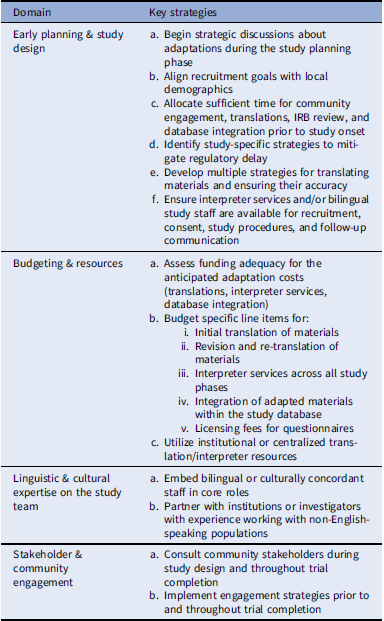
Recommendations for effective implementation of cultural and linguistic adaptations within clinical research are provided in Table 4. These findings align with community-engaged research principles that emphasize early and sustained stakeholder involvement [35–Reference Aguilar-Gaxiola, Ahmed and Anise38]. Successful implementation was associated with early integration of adaptations, alignment with local populations, and relational practices such as bilingual or culturally concordant staffing and community partnerships, whereas delayed implementation and limited alignment were linked to greater burden and poorer recruitment outcomes. Before implementing these recommendations, study teams should reframe cultural and linguistic adaptations as core components of research rather than optional additions. Demonstrating how well-adapted communication enhances reach, engagement, and outcomes, while reducing downstream costs such as misunderstandings or low uptake can shift stakeholder perceptions of these efforts. It encourages them to see these efforts as meaningful contributions to the people and communities they serve. Prioritizing adaptations for underserved populations and individuals from diverse cultural and linguistic backgrounds can enhance institutional reach and strengthen meaningful community engagement.
Recommendations to guide effective implementation of cultural and linguistic adaptations

Table 4. Long description
Table summarizing recommended strategies for implementing non-English adaptations in clinical studies across four domains. Early planning includes discussing adaptations during study design, aligning recruitment goals with local demographics, allowing time for translation, community engagement, IRB review, and database integration, addressing regulatory delays, and ensuring access to interpreters or bilingual staff. Budgeting recommendations include funding for translation, retranslation, interpreter services, database integration, and questionnaire licensing, while using institutional resources when available. Team expertise recommendations emphasize including bilingual or culturally concordant staff and partnering with experienced investigators or institutions. Stakeholder and community engagement recommendations include consulting community members during study design and maintaining engagement throughout the study lifecycle.
This study has several strengths, including the incorporation of feedback from multiple large-scale studies with varying degrees of success in cultural and linguistic adaptations, as well as a set of coherent and overlapping responses that supported the development of clear themes related to successful implementation. This study has several limitations inherent to qualitative survey methodologies. Because responses were collected through open-ended survey items rather than interviews, the depth and richness of participant narratives were constrained, and we were unable to probe for clarification or elaboration. Response quality varied considerably across participants, with some providing extensive detail and others offering only brief statements. The survey format favored capturing linguistic adaptations as discrete procedural steps, resulting in more detailed characterization of these adaptations, while cultural adaptations were less frequently assessed and likely underrepresented. Additionally, participation was voluntary, introducing the possibility of self-selection bias; individuals with stronger opinions or greater engagement with the topic may have been more likely to respond. Lastly, most respondents reported adapting study materials for Spanish-speaking individuals and recommendations for cultural and linguistic adaptation may be broadly applicable to other languages and cultures, however certain contextual nuances may not be captured. From our study, most respondents described adapting materials for Spanish-speaking populations. These adaptations often reflect culturally specific assumptions, values, and modes of interaction that are not inherently generalizable to other linguistic or cultural groups. Language translation alone does not ensure cultural relevance, and research teams should consider social, historical, and community contexts. As an example, respondents reported the importance of utilizing family members or culturally specific community champions to improve outreach and engagement in Latino communities. However, this approach may not be successful in populations where individual autonomy or other social structures are more salient.
Conclusion
Implementing cultural and linguistic adaptations in clinical research requires extensive planning, engagement of bilingual study staff and population‑specific stakeholders, and adequate financial and personnel resources. Although study teams commonly encounter multiple barriers in this process, we outline several strategies to address these challenges and support effective implementation and participant recruitment.
Supplementary material
The supplementary material for this article can be found at https://doi.org/10.1017/cts.2026.10821
Author contributions
Kari G. Vance: Conceptualization, Data curation, Formal analysis, Investigation, Methodology, Project administration, Writing - original draft, Writing - review & editing; Raymond Teets: Conceptualization, Methodology, Writing - review & editing; Lisa Doan: Conceptualization, Methodology, Writing - review & editing; Sydney Whack: Conceptualization, Writing - review & editing; Dixie Ecklund: Conceptualization, Methodology, Writing - review & editing; Laura Wandner: Conceptualization, Investigation, Methodology, Writing - review & editing; Kathleen A. Sluka: Conceptualization, Methodology, Project administration, Supervision, Writing - original draft, Writing - review & editing; Giovanni Berardi: Conceptualization, Data curation, Formal analysis, Investigation, Methodology, Project administration, Resources, Supervision, Validation, Writing - original draft, Writing - review & editing.
Funding statement
This work was supported by the National Institutes of Health (KAS, U24NS112873), (GB, KAS, U24NS112873-03S2); and the National Center for Advancing Translational Sciences to the University of Iowa (UM1TR004403).
Competing interests
The authors declare none.


 Open access

