Introduction
Public interest law organizations (PILOs) are important institutions for providing access to justice in the United States. Historically, PILOs challenged discrimination in housing, education, and employment, mobilized the law to protect consumers and the environment, and provided representation to low-income clients in civil matters (Handler, Ginsburg, and Snow Reference Handler, Ginsberg, Snow, Allen Weisbrod, Handler and Komesar1978; Weisbrod et al. 1978; Katz 1982; Davis Reference Davis1995; Houseman Reference Houseman2001, Reference Houseman2002; Houseman and Perle Reference Houseman and Linda2007; Johnson Reference Johnson2013). In the late 1960s and early 1970s, legal services attorneys won landmark Supreme Court victories on poverty issues, including Fuentes v. Shevin,Footnote 1 Goldberg v. Kelly,Footnote 2 and Shapiro v. Thompson Footnote 3 (Davis Reference Davis1995; Johnson Reference Johnson and Regan1999, Reference Johnson2013). PILOs that focus on civil liberties and civil rights, such as the ACLU and the NAACP Inc. Fund, also achieved significant legal victories, most notably Brown v. Board of Education (Kluger Reference Kluger1976; Tushnet Reference Tushnet1987, 1994). Thus, PILOs not only represent disadvantaged individuals, but also mobilize resources and legal expertise to define access to justice in the United States.
Although PILOs are a well-established feature of the legal landscape today, this was not always the case. Important political, economic, and institutional factors influenced how PILOs developed in path-dependent ways (Pierson Reference Pierson2000). In the early twentieth century, local bars established legal aid organizations in an effort to meet their ethical obligation to provide representation to the indigent (Houseman Reference Houseman2002; Johnson Reference Johnson2013). During the 1960s and 1970s, PILOs expanded dramatically, fueled by new civil rights statutes, the War on Poverty, and the newly established Legal Services Corporation (Handler, Ginsburg, and Snow 1978; Albiston and Nielsen Reference Albiston and Laura2014). As time went on, PILOs spread across issue areas and ideology, and some became politically embattled (Houck Reference Houck1984; Southworth Reference Southworth2004; Nielsen and Albiston Reference Nielsen and Albiston2006; Teles Reference Teles2008). PILOs' tumultuous history influenced how these organizations developed and shaped how the United States provides access to justice today.
This article examines the modern state of the PILO field, considers how the field came to look the way it does, and explores how patterns of PILO development shaped access to justice in the United States. How did public interest law organizations as form of law practice develop? What political, economic, and institutional factors contributed to the development of the field? What is the relative distribution of organizations across practice area and scope of practice? Where are public interest organizations located in the United States and how does their distribution relate to poverty and population? Do these organizations primarily focus on direct services or impact litigation? What do these patterns tell us about PILOs' contribution to access to justice in America?
We investigate these questions by drawing on original data from a national representative survey of public interest law organizations in the United States. Our study takes an innovative approach by combining these survey data with geographical information system (GIS) data to investigate the relationships among PILOs, poverty, and population, as well as the services available in particular geographic locations. Our results offer some surprising findings about the contours of public interest practice, geography, and access to different types of representation for low-income communities.
Our data illuminate how political, social, and economic factors shaped the contours of the field. We find patterns of development among the PILOs in our study that track three distinct periods of historical development, consistent with the political, economic, and institutional factors associated with each period. We also find that PILOs established later in time mimicked early successful organizations, and that after rapid growth among poverty and civil rights PILOs in the 1960s, PILOs spread into others areas of practice. In addition, our analysis shows that PILOs are geographically distributed in ways that disadvantage rural and poor communities. Our findings have important implications for understanding how public interest law organizations contribute to access to justice.
Factors Shaping Public Interest Law Organizations
This section lays the foundation for our empirical analysis by discussing factors that contributed to PILO development during three historical eras: the Emergent Era prior to 1965, the Expansion Era from 1965 until 1980, and the Embattled Era from 1980 on (Albiston and Nielsen Reference Albiston and Laura2014). A complete analysis of all factors contributing to PILO development is beyond the scope of this article. Here, we focus on theoretically grounded political, economic, and institutional factors that contributed to PILO development, and contrast how these factors changed across these three historical periods.
With regard to political factors, we focus on how political pressures and social movements shifted over time, as well as policy changes that accompanied these shifts. Scholars have long recognized that politics and policies shape the formation and structure of organized interests (Walker Reference Walker1991; Pierson Reference Pierson1993; Barnes and Burke Reference Barnes and Burke2014). In particular, scholars argue that policies are not only outcomes of organized interests, but also cause interests to mobilize (Pierson Reference Pierson1993; Barnes and Burke Reference Barnes and Burke2014), and we discuss that relationship here. Resources also matter for establishing and maintaining social movement organizations (McCarthy and Zald Reference McCarthy and Zald1977; Jenkins Reference Jenkins1983; Haines Reference Haines1984). With regard to resources, we examine how public policies and other factors expanded and restricted sources of economic support for public interest law organizations across these three eras. For example, over time, PILOs increasing rely on resources from governmental sources rather than private charity, and fee-shifting provisions become a significant source of support (Staggenborg Reference Staggenborg1988; Nielsen and Albiston Reference Nielsen and Albiston2006; Albiston and Nielsen Reference Albiston and Laura2014). With regard to institutions, we consider how legislative changes and judicial interpretations mark PILOs as legitimate entities engaged in constitutionally protected activities, but later restrict their activities and their advocacy (Walker Reference Walker1991; Quigley Reference Quigley1998; Albiston and Nielsen Reference Albiston and Laura2007, Reference Albiston and Laura2014). Specific policies help institutionalize and shape courses of action by marking some forms of mobilization as legitimate and appropriate, or, conversely, prohibited (Pierson Reference Pierson1993; Meyer and Boutcher Reference Meyer and Boutcher2007; Albiston and Nielsen 2014). We also discuss processes of legitimation and mimicry that organizational scholars have identified as relevant to the development of organizational fields (Meyer and Rowan Reference Meyer and Rowan1977; Meyer and Scott Reference Meyer, Scott, DiMaggio, Powell and Chicago1991; Suchman and Cahill Reference Suchman and Cahill1996; Scott Reference Scott2014). We examine these three sets of factors across three eras of development below.
The Emergent Era
The Emergent Era prior to 1965 was characterized by ad hoc free legal services provided by local bar associations and private philanthropy. Public interest and pro bono representation was relatively unstructured, scattered, and individualized, funded almost exclusively by private sources rather than government grants (Johnson Reference Johnson2013). Initially, legal aid primarily consisted of private attorneys taking on pro bono clients as part of their ethical responsibilities. In 1919, Harvard Law School graduate Reginald Heber Smith published his book Justice and the Poor, challenging the legal profession to do more to provide free legal assistance for the poor (Houseman Reference Houseman2002; Johnson Reference Johnson2013). The ABA and allies responded by encouraging the profession to finance organized legal aid to represent the indigent (Houseman Reference Houseman2002). At the ABA's urging, local bar associations and communities opened small legal aid offices (Houseman Reference Houseman2002; Johnson Reference Johnson2013). Some early legal assistance offices opened as law school clinics, which were partnerships between legal education and legal aid societies to provide both legal training and public service (Sandefur and Selbin Reference Sandefur and Selbin2009). Virtually all these organizations operated on the charity model, with inadequate funds, and they were reluctant to challenge the established business and legal interests that funded them (Johnson Reference Johnson2013).
A few other early organizations, such as the ACLU and the NAACP Legal Defense Fund Inc., focused on strategic impact litigation with social change objectives (Handler, Ginsburg, and Snow 1978; Tushnet Reference Tushnet1987). Economically, these organizations relied primarily on membership dues to survive (Handler, Ginsburg, and Snow 1978). In the early twentieth century, advocates also used litigation to challenge the Chinese Exclusion Act and to champion labor rights (Forbath Reference Forbath1991; Salyer Reference Salyer1995). Although relatively limited in number compared to later eras, these emergent legal aid societies and legally-oriented advocacy organizations represented a new organizational form of public interest law. They were harbingers of the expansion to come in the civil rights era of the 1960s.
The Expansion Era
The Expansion Era from 1965 through 1980 was characterized by explosive growth in organized interest groups, including public interest law organizations (Weisbrod et al. 1978; Walker Reference Walker1991). The public interest law field developed rapidly, along with growing activism in the areas of civil rights, women's rights, and environmental protection, among others (Handler Reference Handler1978; Handler, Ginsburg, and Snow 1978). Politically, public interest representation of disenfranchised groups was perceived to be a way to channel growing social unrest around civil rights issues into legal avenues of redress. Indeed, the NAACP Legal Defense Fund Inc.'s success in Brown v. Board of Education provided a conspicuous model for social change through legal reform (Kluger Reference Kluger1976; Tushnet 1994; Meyer and Boutcher Reference Meyer and Boutcher2007). At the same time, rapidly expanding rights though the Civil Rights Act of 1964 and citizen suit provisions of environmental legislation gave citizens and social movements unprecedented access to policy making through the courts (Zemans Reference Zemans1983; McCann Reference McCann1992; Epp Reference Epp1998). Growth in public interest law organizations tracked the rise of the environmental movement in the 1970s, and of the consumer movement driven by the advocacy of Ralph Nader, who published Unsafe at Any Speed in 1965 (Nader Reference Nader1965; Buckhorn Reference Buckhorn1972). In this era, PILOs became the organizational embodiment of rights litigation as a powerful tool for social movements (Handler Reference Handler1978; Rosenberg Reference Rosenberg1991; McCann Reference McCann1992).
During this period, public interest law organizations benefited from significant resources from the federal government and from private foundations, particularly the Ford Foundation (Harrison and Jaffe Reference Harrison and Sanford1973; Handler, Ginsburg, and Snow 1978; Teles Reference Teles2008; Albiston and Nielsen 2014). The Ford Foundation provided support for a variety of PILOs, including law school clinical programs (Harrison and Jaffe 1973; Sandefur and Selbin Reference Sandefur and Selbin2009). In addition, President Johnson established the OEO Legal Services Program, which later became the Legal Services Corporation (LSC), as part of the War on Poverty (Johnson Reference Johnson2013). LSC funding fueled rapid geographic expansion of legal aid offices; by 1981, 1,450 LSC-funded legal aid offices operated throughout the fifty states and American territories (Houseman and Perle 2007).
Policy changes helped mobilize interests by institutionalizing sources of funding for public interest law organizations (Walker Reference Walker1983; Pierson Reference Pierson1993). For example, for a brief period of time, the Supreme Court recognized a common law right to recovery of attorney's fees for successful litigation in the public interest (Albiston and Nielsen 2007). Later, civil rights and environmental statutes institutionalized fee-shifting provisions, creating a new source of support for cause-oriented strategic litigation firms (Albiston and Nielsen 2007). Thus, increasing political pressure for access to justice and social change, growing civil unrest, and the infusion of resources from private foundations, the LSC, and fee shifting statutes help spur rapid growth of PILOs during this time.
Policy changes also conferred legitimacy and stature on PILOs as a strategy for social change. Meyer and Boutcher (Reference Meyer and Boutcher2007) argue that Brown v. Board of Education was a watershed in social movement practice and signaled to social movements that courts, and the Supreme Court in particular, were receptive toward litigation as a social change strategy. Indeed, courts and lawyers embraced these organizations as a legitimate form of political expression by changing the rules of the profession to support these practices. For example, the Supreme Court explicitly recognized legal representation by PILOs as a form of free expression exempt from restrictions otherwise applicable to the practice of law (NAACP v. Button 1963; In re Primus 1978). Organizational theorists argue that such rule changes indicate that an organization form has become an accepted way of organizing activities (DiMaggio and Powell Reference DiMaggio and Powell1983; Scott Reference Scott2014). Thus, these rule changes suggest that PILOs had become a legitimate strategy for pursuing social change through the courts (Meyer and Boutcher Reference Meyer and Boutcher2007).
When an organizational form, like a PILO, becomes accepted and recognized, theorists argue that activists in new substantive areas may adopt this organizational form to gain legitimacy and recognition (Meyer and Rowan Reference Meyer and Rowan1977; Southworth Reference Southworth2009; Scott Reference Scott2014). Indeed, as PILOs became more common and more accepted, some evidence suggests that newer organizations copied the successful form and strategies of prior successful organizations (Handler, Ginsburg, and Snow 1978). Thus, the Expansion Era brought not only more PILOs, but also changing acceptance, legitimacy, and recognition of these organizations, and the spread of the PILO form to areas beyond civil rights and poverty practice. This rapid expansion changed both access to justice and the social meaning of public interest law (Chen and Cummings Reference Chen and Cummings2013).
The Embattled Era
The Embattled Era that began in 1980 was a period of retrenchment for progressive PILOs and of expansion for conservative PILOs. After rapid expansion of PILOs in the 1960s and 1970s, political opposition to PILOs emerged, especially from businesses that were targets of consumer or environmental suits championed by these organizations (Aron Reference Aron1989; Southworth Reference Southworth2004, Reference Southworth2009). The Reagan administration exhibited hostility toward public interest law organizations, reflecting Reagan's longstanding animosity toward the LSC-funded California Rural Legal Assistance from his days as California governor (Houseman Reference Houseman2002). Reagan introduced accounting rules that prohibited political advocacy by charitable organizations that were supported even in part by public funds (Albiston and Nielsen 2014). In 1996, Congress passed legislation that prohibited LSC-funded organizations from attempting to influence rule making or law making, participating in class actions, or challenging welfare reforms (Quigley Reference Quigley1998; Luban Reference Luban2003; Albiston and Nielsen 2014). In 2001, the Supreme Court overturned some of these prohibitions as an infringement of free expression, reaffirming public interest representation as a form of democratic participation (Legal Services Corp. v. Velazquez 2001). Nevertheless, significant restrictions on the practice of LSC-funded organizations remain (Quigley Reference Quigley1998; Houseman and Perle 2007). Even law school clinical programs came under attack during this era; environmental law clinics at a number of law schools lost their funding, their standing, and even their institutional homes at the behest of local business interests that they had challenged in court (Luban Reference Luban2003).
Political opposition also affected PILOs' resources. By the 1980s, the Ford Foundation had withdrawn support from PILOs, in part because of perceptions that public interest law organizations that litigated against big corporations were “biting the hand that fed them” (Stone Reference Stone1991). In addition, political opponents attempted to starve PILOs of resources by limiting fee recovery, reducing the budget of the LSC, and challenging state-funded legal aid programs supported through interest on lawyers' trust accounts (IOLTA programs) (Albiston and Nielsen 2014). Congress significantly reduced funding for the LSC in the 1980s and 1990s in response to criticism of LSC organizations' social change activities (Quigley Reference Quigley1998; Houseman and Perle 2007). In the 1990s, conservative PILOs supported by private funds challenged IOLTA programs, claiming they were constitutionally prohibited takings, and thus threatened to cut off another major source of support of PILOs (Albiston and Nielsen 2014). Courts also restricted other sources of funding for public interest law organizations by limiting fee recovery in civil rights cases (Albiston and Nielsen 2007).
Not all PILOs suffered during this time, however. Somewhat ironically, given conservative political, economic, and legislative attacks on established progressive PILOs, the Embattled Era brought growth of PILOs on the right. As Teles (Reference Teles2008) has documented, the public interest law organization strategy was a key component of the conservative movement that began in earnest in the late 1970s. Tracking the conservative trend in politics, the conservative legal movement sought to establish its own public interest law organizations to pursue conservative goals in the courts, and to respond to the legal victories of progressive PILOs (Houck Reference Houck1984; O'Connor and Epstein Reference O'Connor and Epstein1983; Teles Reference Teles2008). As the courts began to move to the right, conservative PILOs won landmark Supreme Court victories supporting religious freedom and restricting affirmative action (Albiston and Nielsen 2014).
Conservative foundations poured significant private support into conservative PILOs, which are not as dependent as progressive PILOs on government funding (Teles Reference Teles2008; Albiston and Nielsen 2014). Conservative PILOs also copied the organizational form and strategies of the progressive PILOs to gain acceptance as legal actors. For example, in her interviews with prominent conservative public interest lawyers, Southworth (2004, 2009) finds that conservative leaders consciously mimicked the forms and strategies of progressive PILOs not only because they sought strategies that worked, but also because they sought the legitimacy that attached to the public interest law organization. Southworth notes that “by embracing the organizational form and rhetoric of the public interest movement, conservatives engaged in a form of ‘legitimacy politics'” (Stryker Reference Stryker1994; Southworth Reference Southworth2009). Thus, even in the Embattled Era, the PILO field grew and expanded into new areas of law.
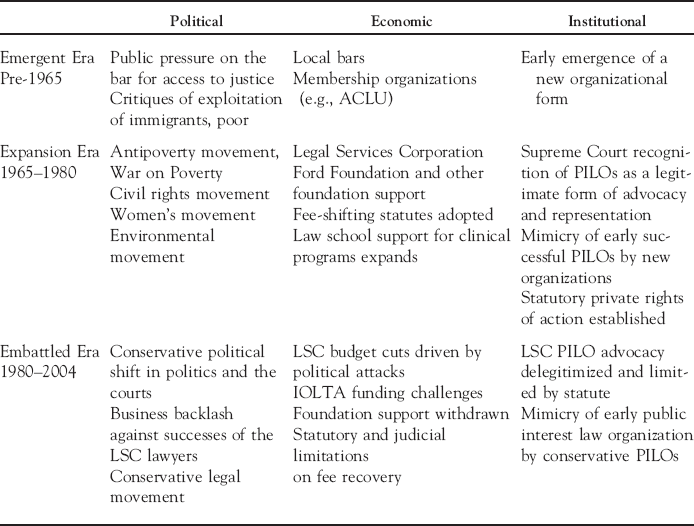
Table 1 briefly summarizes the political, economic, and institutional factors we have discussed and contrasts how they vary across historical periods. Our discussion of these factors lays the foundation for the empirical analysis of the current state of the field that follows.
Political, Economic, and Institutional Factors in the Development of PILOs

| Political | Economic | Institutional | |
|---|---|---|---|
| Emergent Era Pre-1965 | Public pressure on the bar for access to justice Critiques of exploitation of immigrants, poor |
Local bars Membership organizations (e.g., ACLU) |
Early emergence of a new organizational form |
| Expansion Era 1965–1980 | Antipoverty movement, War on Poverty Civil rights movement Women's movement Environmental movement |
Legal Services Corporation Ford Foundation and other foundation support Fee-shifting statutes adopted Law school support for clinical programs expands |
Supreme Court recognition of PILOs as a legitimate form of advocacy and representation Mimicry of early successful PILOs by new organizations Statutory private rights of action established |
| Embattled Era 1980–2004 | Conservative political shift in politics and the courts Business backlash against successes of the LSC lawyers Conservative legal movement |
LSC budget cuts driven by political attacks IOLTA funding challenges Foundation support withdrawn Statutory and judicial limitations on fee recovery |
LSC PILO advocacy delegitimized and limited by statute Mimicry of early public interest law organization by conservative PILOs |
Understanding Pilos and Access to Justice Today
When PILOs flourished in the Expansion Era, scholars eagerly investigated the development of this new field (Scheingold Reference Scheingold1974; Handler Reference Handler1978; Handler, Ginsburg, and Snow 1978; O'Connor and Epstein Reference O'Connor and Epstein1983; Houck Reference Houck1984; Olson Reference Olson1984; Aron 1989). Some scholars continued to study the field into the period of retrenchment, focusing especially on the rise of conservative PILOs with different policy goals (O'Connor and Epstein Reference O'Connor and Epstein1983; Teles Reference Teles2008; Southworth Reference Southworth2009). Later comprehensive studies of the field, particularly variation within the field, are scarce, however. A few basic descriptive studies of PILOs exist from the 1970s and 1980s (e.g., Handler, Ginsburg, and Snow 1978; Aron 1989), but public interest law expanded dramatically over the last three decades and these studies are outdated. Although there has been a renaissance in scholarship about public interest practice and cause lawyers (Sarat and Scheingold Reference Sarat and Scheingold1998, Reference Sarat and Scheingold2006), much of the empirical research focuses on particular segments of the public interest bar (Houck Reference Houck1984; Olson Reference Olson1984; Heinz, Paik, and Southworth Reference Heinz, Paik and Southworth2003; Southworth Reference Southworth2004, Reference Southworth2009; Paik, Southworth, and Heinz, Reference Paik, Southworth and Heinz2007), or on cause lawyering at the individual, rather than organizational, level (Kilwein Reference Kilwein, Sarat and Scheingold1998). Several studies examine lawyers and organizational settings in other segments of the bar, such as in-house counsel in large corporations (Nelson and Nielsen Reference Nelson and Laura2000), sole practitioners and lawyers in small firms (Sarat and Felstiner Reference Sarat and Felstiner1989; Seron Reference Seron1996; Mather et al. Reference Mather, Maiman and McEwen2001), large firm lawyers (Nelson Reference Nelson1988; Galanter and Palay Reference Galanter and Palay1991), pro bono work within large firms (Cummings Reference Cummings2004; Sandefur Reference Sandefur2007a; Boutcher Reference Boutcher, Mather and Granfield2009, Reference Boutcher2013), and lawyer/lobbyists (Heinz et al. 1993). A few recent articles have considered broader trends in the field (Rhode Reference Rhode2008; Cummings Reference Cummings2008), but we are not aware of any representative study of public interest law organizations comparable to our own.
Understanding the PILO field is crucial to understanding access to justice because PILOs are key entry points into the legal system for disadvantaged individuals. Studies of access to justice, however, tend to survey individuals' legal needs rather than examine the institutions and organizations that deliver services (Sandefur Reference Sandefur2008; Sandefur and Smyth Reference Sandefur and Smyth2011). Recent studies of PILOs, on the other hand, have been anecdotal or based on purposive, nonrandom samples. The PILO survey data analyzed in this study speak directly to these supply-side questions, and are the only recent representative data on public interest law organizations in the United States. They provide representative data from which to explore how the field developed, and how the resulting geographical dispersion and variation among public interest law organizations in the United States relate to access to justice.
A Word on Types of PILOs and Political, Economic, and Institutional Constraints
Although definitions vary, PILOs are typically understood to be private, nongovernment organizations that represent disadvantaged or underrepresented clients who could not otherwise obtain legal representation in civil adjudicatory forums such as administrative hearings or court proceedings (Weisbrod et al. 1978; Nielsen and Albiston Reference Nielsen and Albiston2006; Chen and Cummings Reference Chen and Cummings2013). Literature about social movement organizations more generally and PILOs in particular suggests considerable variation among them across geographical scope (e.g., national, regional, local), strategies employed (e.g., direct services vs. impact litigation), sources of support (e.g., membership dues, foundation funding, government grants), and practice area (Walker Reference Walker1991; McCarthy Reference McCarthy, Davis, McAdam, Scott and Zald2005; Nielsen and Albiston Reference Nielsen and Albiston2006; Albiston and Nielsen 2014). We have explored some of these factors among our organizations elsewhere (Nielsen and Albiston Reference Nielsen and Albiston2006; Albiston and Nielsen 2014), and address others in the analysis below.
The history of PILOs, however, suggests caution about identifying and classifying types of PILOs. PILOs are not static or consistent over time. Instead, PILOs reconfigure themselves in response to political, economic, and institutional factors. As an example, consider the distinction often made between organizations focused primarily on individual direct service and organizations focused on test case or impact litigation (Chen and Cummings Reference Chen and Cummings2013). Scholars sometimes present the distinction between direct services and impact litigation as a naturalized characteristic of PILOs that derives from the nature of their practice areas. Poverty practice in particular is perceived to be closely associated with direct client representation, whereas civil rights and environmental organizations are seen as engaged in impact litigation.
PILOs' history of development suggests, however, that this naturalized distinction is the product of political backlash against the early success of poverty organizations (Quigley Reference Quigley1998). For example, the poverty-oriented PILOs of the 1960s not only sought to represent poor people, but also to produce systematic legal reform (Davis 1995). This changed when legal services organizations' significant victories over both business and government defendants brought political backlash against government-funded LSC organizations (Houseman and Perle 2007), and resulted in drastic cuts to the LSC budget and restrictions on the activities of LSC lawyers. As a result, some organizations became wary about taking on landmark social change cases, and others were prohibited by statute from doing so (Albiston and Nielsen 2014). By contrast, organizations that relied on fee recovery through fee-shifting statutes under the civil rights and environmental protection laws had more independence to take impact litigation cases (Albiston and Nielsen 2007, 2014). Thus, path dependent changes in political, economic, and institutional factors, rather than the static type of organization, shaped how PILOs structured their advocacy (Pierson Reference Pierson2000). As a result, organizations that practice in these different areas are likely to provide very different types of services, and PILOs will likely vary in their scopes of practice, from national to local and regional. We provide basic descriptions of PILOs' characteristics below, but we caution that these are merely current characteristics shaped by past practices and policies, and not naturalized types of organizations in the field.
Geographical Patterns and Distribution of PILO Organizations
How the field of PILOs developed over time and the resulting shape of the field have important implications for the relatively understudied supply side of access to justice in the United States (Albiston and Sandefur Reference Albiston and Rebecca2013). Very little empirical information exists about the areas in which these organization practice or stratification by geography or population served in how they provide services (Rhode Reference Rhode2011; Sandefur and Smyth Reference Sandefur and Smyth2011). A rare study conducted by the American Bar Foundation found significant fragmentation and inequality in resources available for civil legal assistance. It concluded that “services available to people from eligible populations who face civil justice problems are determined not by what their problems are or the kinds of services they may need, but rather by where they happen to live” (Sandefur and Smyth Reference Sandefur and Smyth2011, v). In other words, the limited available evidence on the supply side of civil legal service provision indicates geography is destiny for Americans facing civil justice issues. We take this geographical insight as a starting point for mapping the location of PILOs in the United States.
One basic question is where PILOs are located across the United States in relationship to the concentration of population and poverty. At one point, the LSC established legal aid offices in virtually every county in the country in an effort to ensure access to representation was available to those who could not afford a lawyer regardless of where they lived (Houseman Reference Houseman2002). The available evidence today, however, suggests a more patchwork pattern (Sandefur and Smyth 2011). Other political, economic, and institutional factors may be related to the location of PILO organizations. For example, existing research suggests that the local bar is both an important supporter and also a potentially powerful constraint on PILOs' ability to provide access to justice (Kessler Reference Kessler1990). Therefore, public interest organizations may be primarily located in relatively progressive states in which the local bar and population may be more willing to support representing disadvantaged groups or provide legal services for the poor. PILOs may also be concentrated around population centers because these areas have the greatest number of people who need legal services. In addition, areas with larger populations may be more likely to generate community resources sufficient to sustain public interest law organizations. In fact, most legal aid societies of the early twentieth century were concentrated in major cities (Quigley 1988).
PILOs also may concentrate around centers of policy making, such as Washington, DC or other big cities. Some PILOs have moved away from a primary focus on litigation toward a more diversified strategy that includes policy work as well as outreach and education (Nielsen and Albiston Reference Nielsen and Albiston2006). Locating near the capital facilitates organizations' influence with established policy makers, allows them testify in Congress about their clients' interests, and provides potential influence over legislative developments that affect their goals (Southworth Reference Southworth2009). Proximity to political institutions and population centers also connects organizations to political elites important for organization survival (Haines Reference Haines1984; Staggenborg Reference Staggenborg1988). Thus, any analysis of PILO location in relation to poverty and population must take into account the pull of the DC area and other large cities.
Data and Methods
This study draws on original data from a representative sample of 221 public interest organizations in the United States that were surveyed in 2004.Footnote 4 This survey is part of a larger study documenting variation in strategy, structure, and mission among public interest organizations, investigating how these organizations interact with their environment, and examining how they integrate traditional adjudicatory strategies with other strategies for social change. The study seeks to understand how institutional constraints, such as doctrinal developments, funding structures, and ethical rules shape public interest practice.
Definition of Public Interest Law Organization
For purposes of this study, we focus on private organizations that use law, at least in part, as a strategy to pursue their goals. We define “public interest law organization” to include organizations in the voluntary sector that employ at least one lawyer at least part time, and whose activities (1) seek to produce significant benefits for those who are external to the organization's participants, and (2) involve at least one adjudicatory strategy.Footnote 5 We chose this definition in part to replicate earlier studies of public interest organizations, and to focus the inquiry on the voluntary, private-sector organizations that are central to the field (Handler Reference Handler1978; Handler, Ginsburg, and Snow 1978; Aron 1989). We acknowledge that defining public interest law is a notoriously difficult enterprise (Menkel-Meadow Reference Menkel‐Meadow, Sarat and Scheingold1998); we do not claim that ours is the only acceptable approach to this question.
Sampling Frame and Strategy
To produce a random sample of public interest law organizations that meet this definition, we first developed a sampling frame of organizations that potentially fit our criteria using a variety of sources. These included records of amicus briefs filed by public interest organizations before the Supreme Court; scholarly books and articles that list public interest legal organizations; current directories of public interest organizations; current lists of providers of free legal services obtained from state bar associations and Internet websites; current lists of organizations receiving funding from Interest on Lawyer Trust Accounts (IOLTA) obtained from state IOLTA programs; current lists of organizations receiving funding from the Legal Services Corporation; and Internet searches to identify potential public interest organizations. With the exception of some lists published in scholarly work, lists of providers, directories, and lists of organizations supported by governmental funding were obtained first from the most current lists available. We designed this strategy to capture existing public interest organizations in all their diversity. For example, our amicus brief strategy captures organizations seeking to influence policy by participating in high-profile litigation. In contrast, the information from IOLTA programs and free legal service providers ensures that smaller organizations that provide direct legal services on a more local level are also represented. We also searched lists and national directories that spanned the political spectrum. Some public interest law organizations consist of a national headquarter office with a network of local and regional offices; for purposes of this survey, we treated each local and regional office as a separate public interest law organization, even if those individual offices were also part of a larger, national organization.
Our strategy was to err on the side of inclusion and leave the final determination of whether an organization met our formal criteria until a later stage of the process. Through this approach we constructed a sampling frame of 4,588 organizations, not all of which ultimately fit our formal definition of public interest law organization. Based on the size of this sampling frame, we sought to survey approximately 250 public interest law organizations to obtain the most accurate estimates possible within our resource limits for the survey. We then drew a random sample of 1,200 organizations from the sampling frame, and focused our efforts on narrowing this group to only those organizations that met our criteria.Footnote 6 We accomplished this narrowing process through information available from public sources such as Web sites or literature published by the organization. In some instances we contacted the organization directly by telephone to clarify its status, or, where only a mailing address was available, by sending a short questionnaire that asked about adjudicatory strategies and employment of lawyers to clarify the organization's status. This yielded a sample of 327 organizations that met our criteria.
Organizational Survey
We contracted with the University of Wisconsin Survey Center to administer our telephone survey, which consisted of primarily closed-ended questions with a few open-ended questions that could be answered with a short response. Short responses were recorded and transcribed. This approach gave us much richer data that quantitative measures alone; the qualitative data allow us to interpret our quantitative findings in light of the nuances and meaning provided in these open-ended responses. Prior to telephone contact, respondents received an advance letter regarding the nature of the study, and returned letters were traced to find accurate contact information for each organization in our sample. The survey center then contacted organizational representatives by phone to complete the survey using CATIFootnote 7 software. The survey included screening questions to ensure that the organization met our criteria for inclusion in the study; fifty-seven organizations were excluded from the study because they did not meet these criteria. Of the remaining 270 eligible organizations, 221 completed the survey, yielding a response rate of 82 percent, which is quite good for an organizational survey such as this.Footnote 8
The survey addressed the organization's history and mission, budget and structure, and goals and activities. We asked about a number of organizational characteristic, including the founding year of the organization; the annual expenditures of the organization; the area of law in which the organization practiced; the ideological orientation of the organization; whether the organization was a local, regional, or national organization; and what percentage of the organization's efforts were dedicated to direct services and impact litigation, respectively. We also collected detailed information about a number of other factors that are not reported in this article; details are reported elsewhere (Nielsen and Albiston Reference Nielsen and Albiston2006; Albiston and Nielsen 2007, 2014).
GIS Coordinate Data
Our GIS coordinate data for population, poverty, and voting patterns from the 2004 election were drawn from the data set made available by the Penn State GeoVISTA center.Footnote 9 We integrated these data with GIS coordinate data for our survey organizations that were hand coded from the street address of each organization. We then combined the GIS coordinate data and survey data to construct a descriptive map showing the location of our sample organizations across the United States, including how location relates to the geographic distribution of poverty.Footnote 10 In addition, we used logistic regression techniques to investigate how poverty, population, and political attitudes relate to the presence of a PILO from our study sample within a given county. We also used GIS coordinate data to map and compare the location of organizations providing different types of services across the United States. For clarity of presentation, we provide more specific information about key variables in the analysis sections below.
Analysis and Results
Patterns in the PILO Field
We begin our analysis by exploring some of the characteristics of our organizations, including the areas in which they practice, the scope of that practice, their reported origins in other organizations, and the historical period in which they were established. These data give us a basic sense of the contours of the field, and also some sense of how the historical factors we outline above may have shaped the state of the field today.
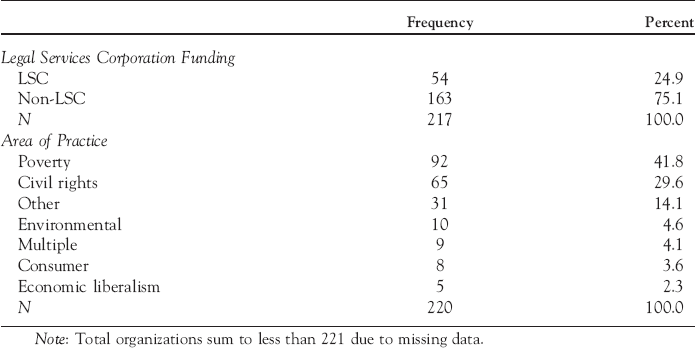
As Table 2 shows, among the PILOs in our sample, about 25 percent are funded by the LSC, with all the restrictions that entails. A larger percentage—42 percent overall—have a poverty-oriented practice.Footnote 11 The next largest practice area among our organizations is civil liberties and civil rights, which constitutes nearly 30 percent of our organizations. Thus the PILO field as a whole remains dominated by the civil rights and poverty organizations that characterized its emergence. Nevertheless, nearly a third of our organizations practice in areas other than civil liberties, civil rights, or poverty, indicating that the field is more diverse now than in its early years. Although only 2 percent of our organizations reported a primary practice area around economic liberalism, a signature conservative cause, about 10 percent of our organizations self-reported a conservative political orientation, again confirming at least modest expansion beyond the progressive political ideology that characterized the beginning of the field.
Characteristics of PILOs

| Frequency | Percent | |
|---|---|---|
| Legal Services Corporation Funding | ||
| LSC | 54 | 24.9 |
| Non-LSC | 163 | 75.1 |
| N | 217 | 100.0 |
| Area of Practice | ||
| Poverty | 92 | 41.8 |
| Civil rights | 65 | 29.6 |
| Other | 31 | 14.1 |
| Environmental | 10 | 4.6 |
| Multiple | 9 | 4.1 |
| Consumer | 8 | 3.6 |
| Economic liberalism | 5 | 2.3 |
| N | 220 | 100.0 |
Note: Total organizations sum to less than 221 due to missing data.
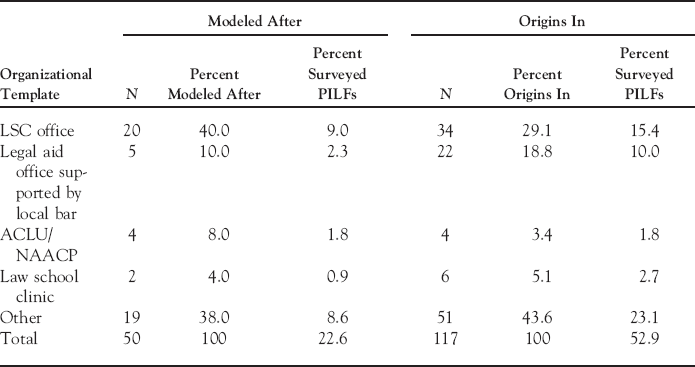
Consistent with the institutional factors we discussed in the introduction, a substantial proportion of the organizations in our study reported that they were modeled after, or had origins in, the early leaders in the field (Meyer and Rowan Reference Meyer and Rowan1977; Southworth Reference Southworth2009). Fifty of our respondent organizations, or about 23 percent, reported that their organizations were modeled after another organization (Table 3). Asked to specify the model for their organization, respondents most often identified the early leaders in the field in the core areas of poverty and civil rights. Twenty respondents indicated that their organization was modeled after the federally funded LSC legal aid office, and eleven more cited volunteer lawyer organizations sponsored by bar associations, the ACLU or the NAACP, or law school clinical programs. The remaining nineteen organizations identified one-off organizations that did not overlap with one another.
Organizations Modeled After or with Origins in Other Organizations

| Modeled After | Origins In | |||||
|---|---|---|---|---|---|---|
| Organizational Template | N | Percent Modeled After | Percent Surveyed PILFs | N | Percent Origins In | Percent Surveyed PILFs |
| LSC office | 20 | 40.0 | 9.0 | 34 | 29.1 | 15.4 |
| Legal aid office supported by local bar | 5 | 10.0 | 2.3 | 22 | 18.8 | 10.0 |
| ACLU/NAACP | 4 | 8.0 | 1.8 | 4 | 3.4 | 1.8 |
| Law school clinic | 2 | 4.0 | 0.9 | 6 | 5.1 | 2.7 |
| Other | 19 | 38.0 | 8.6 | 51 | 43.6 | 23.1 |
| Total | 50 | 100 | 22.6 | 117 | 100 | 52.9 |
We also asked whether PILOs in our study had origins in any other organizations; 117 respondents, or a little more than half, reported that they did. Thirty-four organizations identified origins in LSC-funded organizations, but this pattern primarily reflected contraction rather than expansion in the field. Several organizations indicated that they were the product of the merger of multiple LSC organizations, and a few indicated that they had split off from an LSC-funded organization and no longer accepted federal funds. In the short-answer responses to these questions, several respondents identified 1996 as a year in which many significant mergers among legal services organizations took place, indicating how the restrictive 1996 legislation affected PILOs as a whole. These responses are consistent with our historical discussion above and with other accounts of the effects of the 1996 legislation on the operation, consolidation, and survival of LSC-funded organizations (Quigley Reference Quigley1998; Luban Reference Luban2003; Albiston and Nielsen 2014). In addition, one respondent pointed out that all LSC-funded organizations mirror each other's structure because they must comply with LSC rules, suggesting how institutionalized legal requirements shape PILOs' structure (Scott Reference Scott2014).
Among the remaining PILOs that reported origins in another organization, twenty-two identified volunteer lawyer programs organized by the local bar, suggesting a greater formalization of these programs over time. Six organizations said they had origins in law school clinical programs and four indicated they had origins in the ACLU. The remaining fifty-one either identified one-off organizations that did not overlap or did not provide enough information to be coded. These findings confirm prior anecdotal accounts of organizational mimicry, and suggest how important early organizations were in establishing the foundation for the field of PILOs to come.
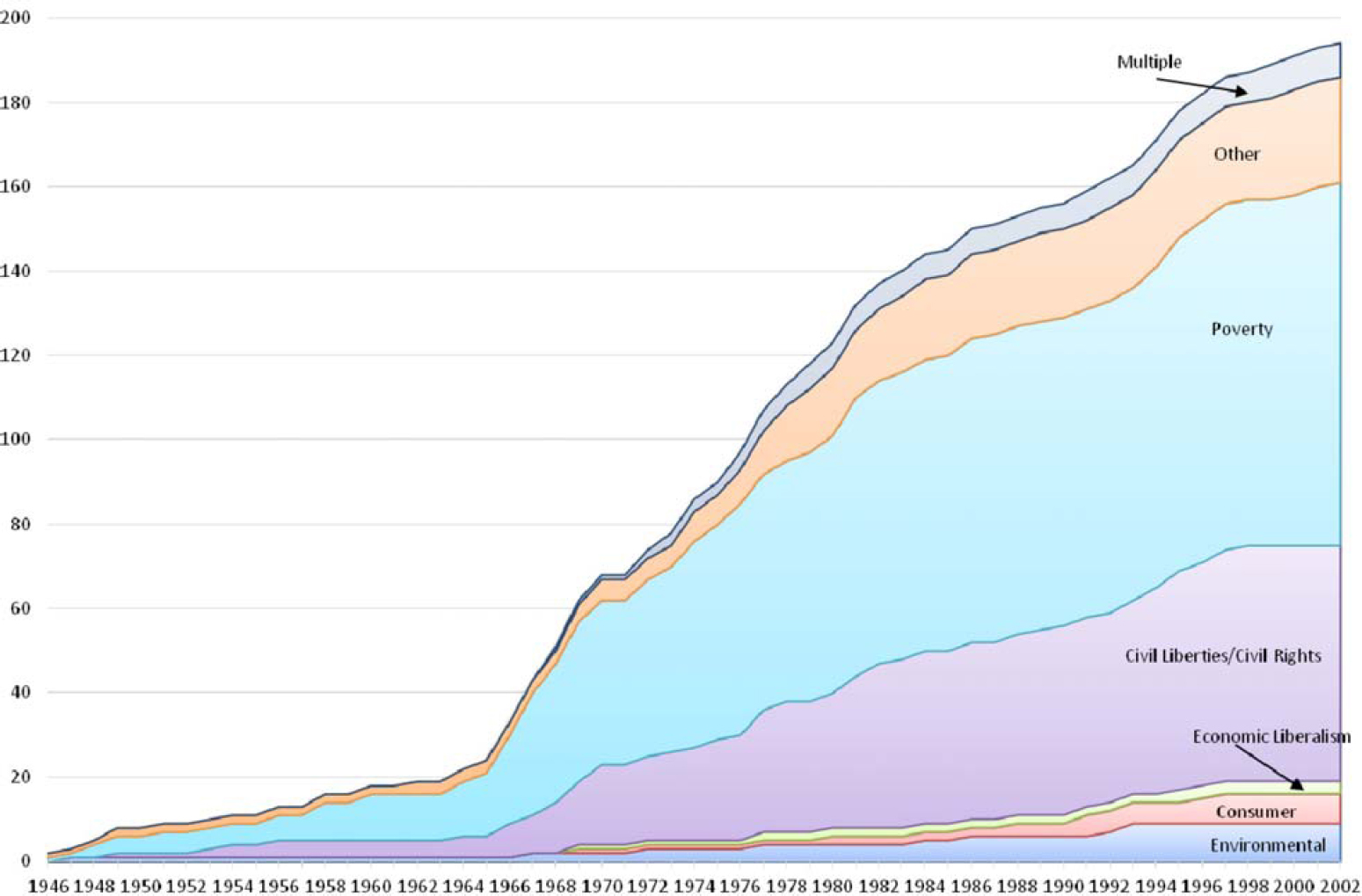
In line with the historical factors we outline above, we also investigated when our sample organizations were established and variation in their substantive practice areas. We grouped organizations into seven categories based on their self-report of their practice areas—environmental, consumer, economic liberalism, civil liberties and civil rights, poverty, multiple, and other—and considered the patterns of establishment over time of the organizations in our sample. Figure 1 charts the date of founding for our sample organizations over time as a cumulative trend.Footnote 12 We caution that our data only include information about organizations that were in existence as of 2004. Therefore, these data cannot be considered complete indications of the relative population of organizations over time, and Figure 1 may overstate the rate of growth in public interest organizations by undercounting those organizations that were established in earlier years but did not survive.
Foundings Over Time of Sample Organizations by Practice Area [Color figure can be viewed at wileyonlinelibrary.com]
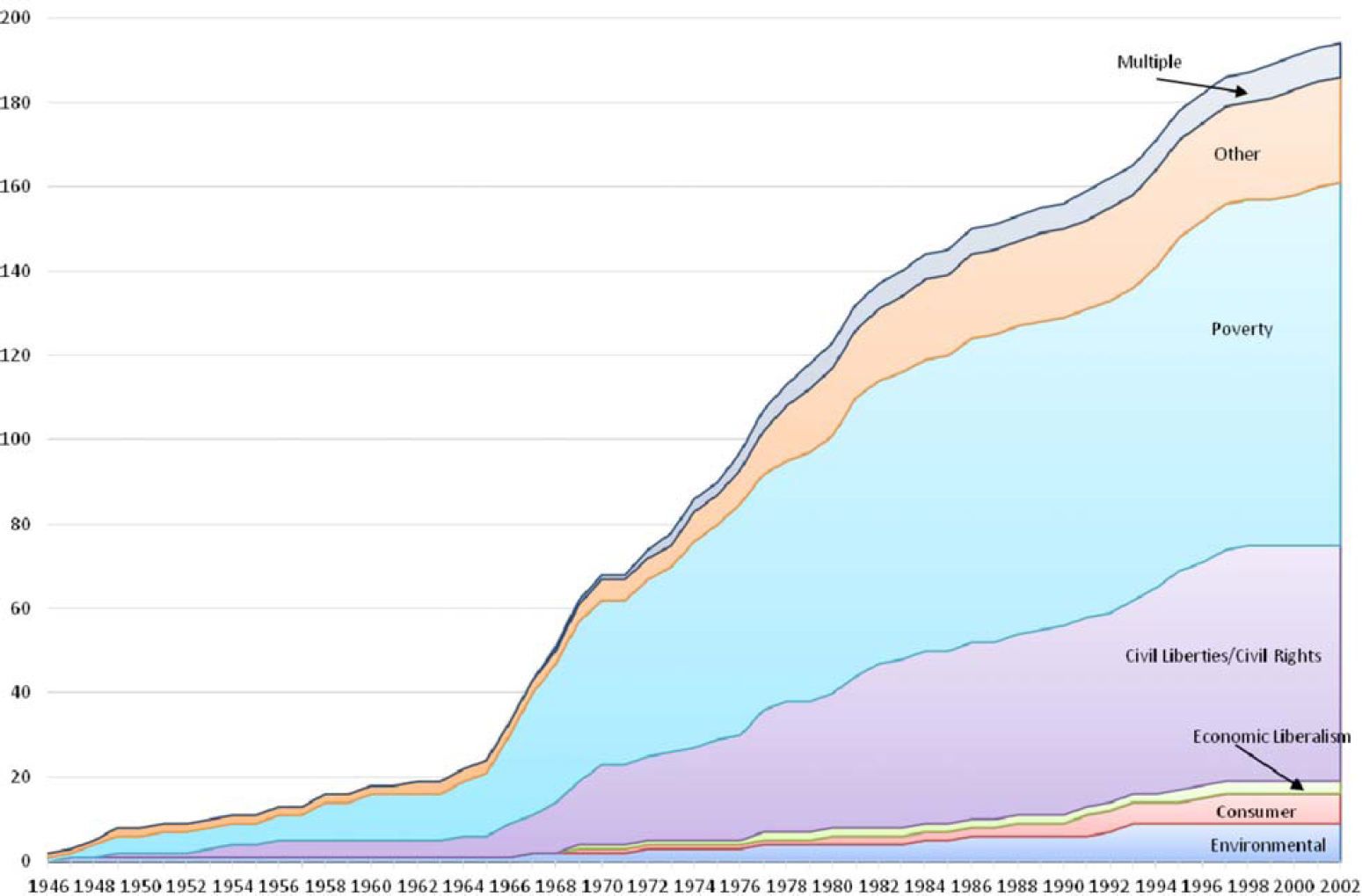
Nevertheless, Figure 1 does suggest some patterns in the development PILOs that are consistent with the political, economic, and institutional factors we discuss above. Poverty and civil rights organizations predominated in the early years, well before the substantial growth among these organizations in the late 1960s and early 1970s. This is not surprising given the early-twentieth-century establishment of local legal aid societies to provide representation to the poor, and the strength and mid-century success of civil rights movement legal organizations such as the NAACP Legal Defense Fund, Inc. (Regan Reference Regan1999; Houseman Reference Houseman2002). Organizations in other practice areas tended to be established in later years, after this initial period. As we discussed above, other evidence indicates that expansion during the 1960s and 1970s reflected growth not only in numbers but also in legitimacy and stature for PILOs (NAACP v. Button 1963; In re Primus 1978; Meyer and Boutcher Reference Meyer and Boutcher2007).
As public interest litigation became more common and more accepted, it may be that advocates across diverse areas of interest began to mimic this strategy as an accepted and expected means of pursuing their goals. PILOs in the areas of environmental, consumer, and economic liberalism in our sample reach significant numbers only in later years. The growth in economic liberalism organizations may also reflect changes in political opportunity structures, which can influence patterns of diffusion (Campbell Reference Campbell, Davis, McAdam, Scott and Zald2005). For example, the conservative turn in the federal judiciary, coupled with conservative countermobilization against progressive public interest organizations and business backlash against antibusiness litigation, may have spurred conservative activists to establish PILOs of their own (Houseman and Perle 2007). Indeed, there is significant evidence of the spread of PILOs to conservative causes from the late 1970s through the Reagan era (O'Connor and Epstein Reference O'Connor and Epstein1983; Houck Reference Houck1984; Teles Reference Teles2008), and that conservative leaders consciously copied the forms and strategies of progressive PILOs because they sought the legitimacy that attached to the PILO form (Southworth Reference Southworth2009). PILOs also spread to more eclectic areas; the number of sample organizations in the category “other” increases over time. This diffusion across issues areas is consistent with PILOs becoming institutionalized as a legitimate organizational form for pursuing social change through legal action (Meyer and Rowan Reference Meyer and Rowan1977; Powell and DiMaggio Reference Powell and Dimaggio1991).
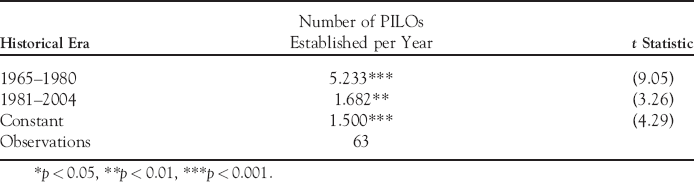
Figure 1 suggests that the patterns of foundings over time track the events of the three-era history of PILOs outlined above. To investigate these time-specific influences further, we conducted a multiple regression analysis predicting the number of PILOs established each year from 1900 to 2004 by the periods of development described above as the Emergent Era (1900–1964), the Expansion Era (1965–1980), and the Embattled Era (1980–2004). In this analysis, the unit of analysis is the year, and the reference era is 1900–1964. As Table 4 shows, the number of PILOs increased the fastest from 1965–1980, and more slowly for 1981 through 2004. The era from 1900–1964 was the slowest in terms of the sample PILOs established.

Although alternative explanations may be possible, these findings are consistent with the political, economic, and institutional factors we identified above. In the initial Emergent Era, political pressure primarily focused on the bar to meet its ethical obligation to provide representation to the poor, economic resources came from private philanthropy rather than more institutionalized government sources, and PILOs were just emerging as an organizational form. In the Expansion Era, social movement pressure for social change and legal recognition, along with substantial resources from governmental and foundation sources, spurred rapid expansion of the PILOs. In addition, PILOs became recognized legally and their sources of support institutionalized through Supreme Court rulings holding they engaged in constitutionally protected free speech, through fee-shifting provisions in new statutes, and through the establishment of the LSC. The Embattled Era brought political backlash and severe restrictions on progressive PILO funding through government sources and fee shifting, but at the same time produced the conservative legal movement and significant foundation funding for PILOs serving conservative causes. All these factors are consistent with the patterns of development and expansion we see in Figure 1 and Table 4. Rather than a linear development over time, the field is marked by slow initial development, rapid expansion accompanied by new resources and legitimating events during the middle period, and a slowing of expansion following political attacks on PILOs beginning in 1980.
Geographic Location, Poverty, and Access to Representation
Now that the PILO field has matured, what is the geographical distribution of PILOs relative to population and poverty patterns across the country? Recall that recent research found significant geographical fragmentation and inequality in resources available for civil legal assistance (Sandefur and Smyth 2011). We explore patterns in that fragmentation below.
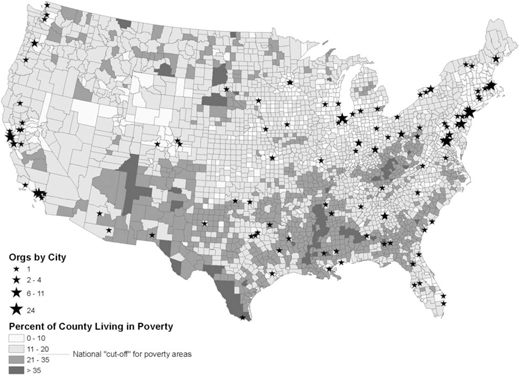
Figure 2 uses county-wide poverty statistics to map the location and number of sample public interest law organizations against the concentration of poverty at the county level.Footnote 13 The greater the concentration of poverty, the darker the county appears. Two important findings stand out from this figure. First, public interest law organizations are concentrated in large cities, such as San Francisco, Los Angeles, Chicago, and New York. Figure 2 also reveals a heavy coastal bias, with a large concentration on the eastern seaboard and in California. The single largest concentration of public interest law organizations was in Washington, DC, which contained twenty-four organizations, with another ten organizations located in the greater Washington, DC area.
Poverty and Location of Sample Organizations
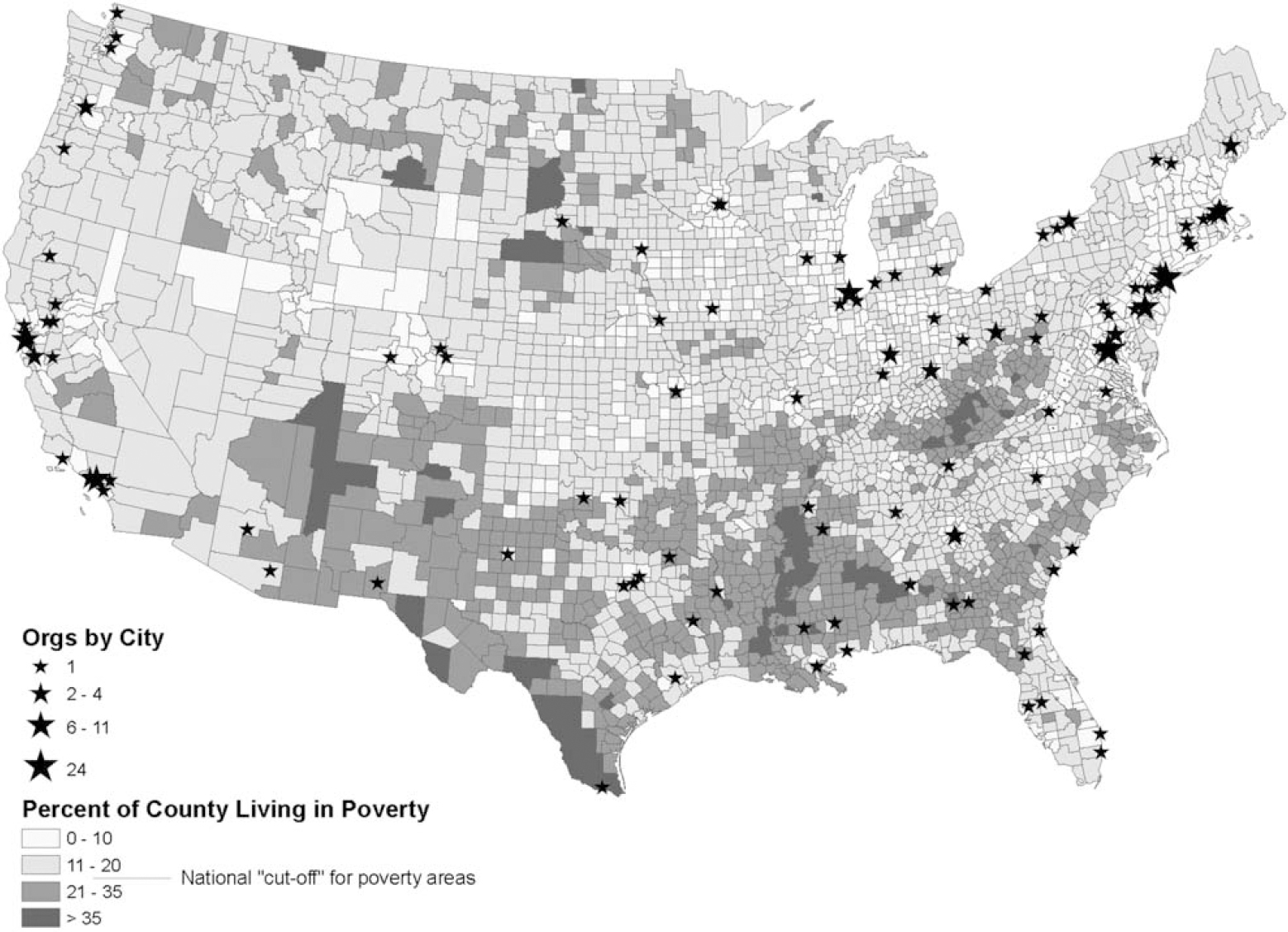
Second, the distribution of PILOs across the country shows a somewhat surprising relationship to the geographical concentration of poverty. There are significant concentrations of PILOs from our sample in the more affluent areas of the country, but PILOs are more thinly distributed across relatively poor counties. The rural South and West seem particularly underserved, although population may be a factor here.
To investigate this relationship further, we conducted logistic regressions predicting whether a county contains a PILO from our study sample utilizing population and poverty information at the county level. The dependent measure for this analysis is a binary variable indicating whether a county contains a PILO from our sample.
Key Variables
Population: We measure population through the variable population by 1,000, which is the population, in thousands, of the county.
Poverty: We constructed three separate independent variables as measures of poverty at the county level.
-
1. Census poor cnty is a binary variable indicating whether 20 percent or more of the county population is below the federal poverty line, which is the national cutoff for designated “poverty areas” that qualify for additional federal support of various kinds. This measure is a basic threshold measure of whether a county is considered as matter of federal policy to be a location in which to target aid.
-
2. N poor in county by 1,000 is the number of county residents, in thousands, below the federal poverty cutoff, and thus is a measure of the number of poor individuals within a county. This measure captures the number of poor individuals within a geographic location, regardless of whether that particular county qualifies as a poverty area for federal support. For example, a large city may have a large population of poor individuals in need of legal assistance, but not qualify as a poverty area for purposes of federal aid.
-
3. PCT poor in county is the percentage of county residents below the federal poverty cutoff, and thus is a measure of the concentration of poverty within the county. Although similar to the Census poor cnty measure, this continuous measure captures more nuance regarding the relative concentration of poverty even among counties that meet the federal poverty threshold.
Progressiveness of the population: Recall that prior research suggests PILOs depend on the support of the local bar and community (Kessler Reference Kessler1990). As a result, PILOs may be more likely to locate in counties with relatively progressive populations that are willing to provide political and financial support for their activities. We account for progressiveness of the population, a proxy of general support for PILOs, through pct sppt Kerry, which is the percentage of voters in the 2004 election who supported John Kerry. We use 2004 election data because our organizational survey was conducted in 2004.
DC policy orientation: As discussed above, because there is reason to believe that PILOs may locate in DC for reasons other than the relative poverty or population of the district, we also include a control, DC county, for whether the organization is located in Washington, DC.
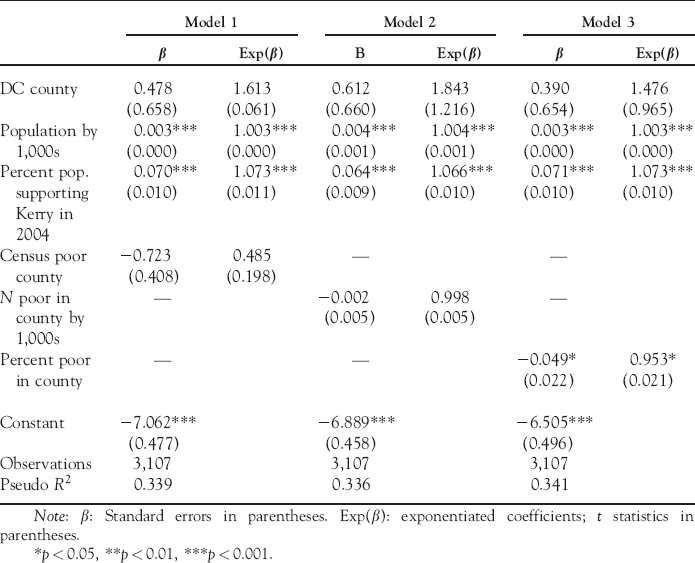
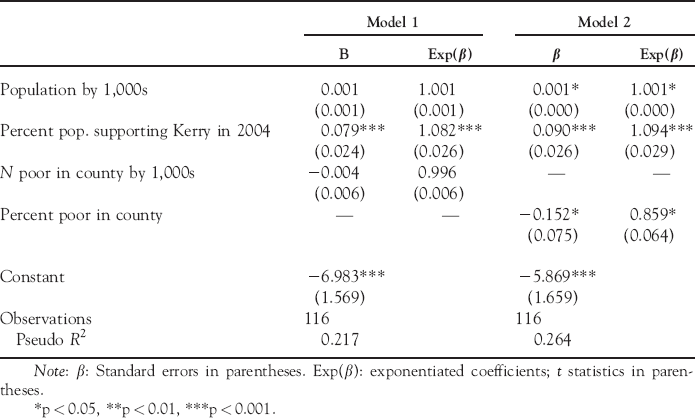
Table 5 reports results from three logit models predicting whether a county contains a PILO office. At the county level, each model contains measures of size of population, progressiveness of the population, and a control for whether the county is in the District of Columbia. Each model differs in the measure of poverty included, that is, whether the county is classified as a poor county under federal guidelines, the number of poor individuals in the county (in thousands), or the percent poor in the county.
Logit Models Predicting if a County Has at Least One PILO

| Model 1 | Model 2 | Model 3 | ||||
|---|---|---|---|---|---|---|
| β | Exp(β) | β | Exp(β) | β | Exp(β) | |
| DC county | 0.478 | 1.613 | 0.612 | 1.843 | 0.390 | 1.476 |
| (0.658) | (0.061) | (0.660) | (1.216) | (0.654) | (0.965) | |
| Population by 1,000s | 0.003 *** | 1.003 *** | 0.004 *** | 1.004 *** | 0.003 *** | 1.003 *** |
| (0.000) | (0.000) | (0.001) | (0.001) | (0.000) | (0.000) | |
| Percent pop. supporting Kerry in 2004 | 0.070 *** | 1.073 *** | 0.064 *** | 1.066 *** | 0.071 *** | 1.073 *** |
| (0.010) | (0.011) | (0.009) | (0.010) | (0.010) | (0.010) | |
| Census poor county | −0.723 | 0.485 | — | — | ||
| (0.408) | (0.198) | |||||
| N poor in county by 1,000s | — | −0.002 | 0.998 | — | ||
| (0.005) | (0.005) | |||||
| Percent poor in county | — | — | −0.049 * | 0.953 * | ||
| (0.022) | (0.021) | |||||
| Constant | −7.062 *** | −6.889 *** | −6.505 *** | |||
| (0.477) | (0.458) | (0.496) | ||||
| Observations | 3,107 | 3,107 | 3,107 | |||
| Pseudo R 2 | 0.339 | 0.336 | 0.341 | |||
Note: β: Standard errors in parentheses. Exp(β): exponentiated coefficients; t statistics in parentheses.
* p<0.05,
** p<0.01,
*** p < 0.001.
As Table 5 shows, size of population and progressiveness of population were both significantly positively related to the presence of a PILO within the county in all three models. In Model 3, however, the percentage of poor individuals within the county was negatively significantly related to the presence of a PILO within the county once size of population and progressiveness of population were taken into account. The measures of poverty in Models 1 and 2 also were negatively related to the presence of an organization within the county, although the coefficients were not statistically significant. In other words, the poorer the county, the less likely it was to contain a PILO from our sample.
These findings are consistent with the visual impressions from Figure 2, which suggest that PILOs tend to be concentrated in population centers in relatively progressive and affluent areas of the country. These findings raise concerns about whether PILOs adequately serve counties with the highest concentration of people below the poverty line, particularly if those counties are also rural. In addition, to the extent these counties are less progressive and have local bars that are less supportive of access to justice, particularly around civil rights issues, there may not be sufficient alternative sources of pro bono representation to meet the legal needs of poor individuals within those counties.Footnote 14
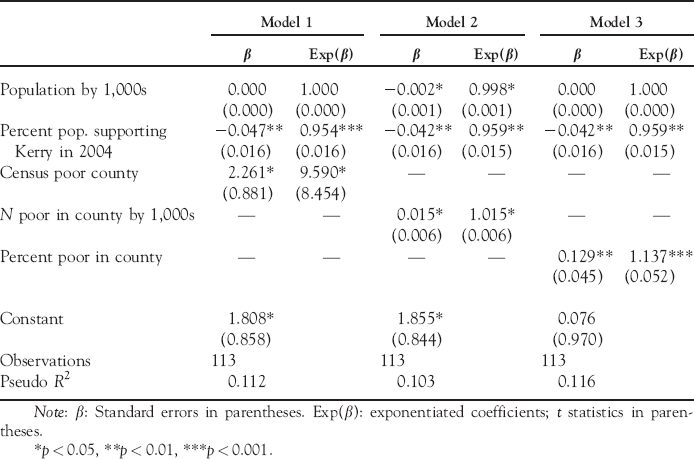
Because LSC organizations have a different history of development and stronger poverty orientation than other organizations, we also conducted a second set of analysis focused solely on whether among counties with at least one public interest law organization, a county contains a LSC-funded PILO from our sample. In this model, only counties that contain at least one PILO are included, and the dependent measure is whether the county contains an LSC organization. Table 6 presents the results of these three models, in which percentage support for Kerry in the 2004 election is negatively related to the presence of an LSC organization in the county. In addition, all three poverty measures are positively related to the presence of an LSC organization in the county, relative to counties with PILOs that were not LSC-funded organizations.Footnote 15 Note in particular that the odds are more than nine times higher that a county will have at least one LSC-funded PILO if it is a county where 20 percent or more of the population is below the federal poverty line (Table 6, Model 1).
Logit Models Predicting if a County Has at Least One LSC-Funded PILO, Among Counties with at Least One PILO

| Model 1 | Model 2 | Model 3 | ||||
|---|---|---|---|---|---|---|
| β | Exp(β) | β | Exp(β) | β | Exp(β) | |
| Population by 1,000s | 0.000 | 1.000 | −0.002 * | 0.998 * | 0.000 | 1.000 |
| (0.000) | (0.000) | (0.001) | (0.001) | (0.000) | (0.000) | |
| Percent pop. supporting Kerry in 2004 | −0.047 ** | 0.954 *** | −0.042 ** | 0.959 ** | −0.042 ** | 0.959 ** |
| (0.016) | (0.016) | (0.016) | (0.015) | (0.016) | (0.015) | |
| Census poor county | 2.261 * | 9.590 * | — | — | — | — |
| (0.881) | (8.454) | |||||
| N poor in county by 1,000s | — | — | 0.015 * | 1.015 * | — | — |
| (0.006) | (0.006) | |||||
| Percent poor in county | — | — | — | — | 0.129 ** | 1.137 *** |
| (0.045) | (0.052) | |||||
| Constant | 1.808 * | 1.855 * | 0.076 | |||
| (0.858) | (0.844) | (0.970) | ||||
| Observations | 113 | 113 | 113 | |||
| Pseudo R 2 | 0.112 | 0.103 | 0.116 | |||
Note: β: Standard errors in parentheses. Exp(β): exponentiated coefficients; t statistics in parentheses.
* p<0.05,
** p<0.01,
*** p<0.001.
These results indicate that relative to non-LSC-funded organizations, LSC-funded organizations tend to be located in less progressive counties with a greater concentration of poverty. It may be that federal funding through the early years of the LSC enabled PILOs to open in counties with significant legal need related to poverty but little local support for providing free legal services. Because those organizations could depend on federal money, rather than local bar and community support, they could reach communities that would not otherwise support institutionalized provision of legal services. As the next section shows, however, that federal funding may have had unanticipated consequences as the PILO field developed over time.
Models of Representation, Geography, and Access to Justice
Access to justice through PILO representation may mean different things depending on whether the organization is national, regional, or local in scope. According, we were interested in how organizations' self-report of the scope of their activities as local, regional, or national related to geographical dispersion. Organizations were about evenly divided among local (34 percent), regional (38 percent), and national (28 percent) focus.Footnote 16 Because organizations with a national scope of practice arguably are likely to have the largest impact, we conducted a logistic regression predicting the presence of national organizations in a county among all counties that contained at least one PILO from our sample. Table 7 reports the results from this analysis, which shows that the presence of an organization with a national scope of practice was positively related to the progressiveness of the county and, in Model 2, negatively related to the percentage poor in the county. None of the national PILOs were located in counties that met federal guidelines for designation as a poor county.
Logistic Regression Predicting Whether County Contains a National PILO, Among Counties with at Least One PILO

| Model 1 | Model 2 | |||
|---|---|---|---|---|
| β | Exp(β) | β | Exp(β) | |
| Population by 1,000s | 0.001 | 1.001 | 0.001 * | 1.001 * |
| (0.001) | (0.001) | (0.000) | (0.000) | |
| Percent pop. supporting Kerry in 2004 | 0.079 *** | 1.082 *** | 0.090 *** | 1.094 *** |
| (0.024) | (0.026) | (0.026) | (0.029) | |
| N poor in county by 1,000s | −0.004 | 0.996 | — | — |
| (0.006) | (0.006) | |||
| Percent poor in county | — | — | −0.152 * | 0.859 * |
| (0.075) | (0.064) | |||
| Constant | −6.983 *** | −5.869 *** | ||
| (1.569) | (1.659) | |||
| Observations Pseudo R 2 | 116 | 116 | ||
| 0.217 | 0.264 | |||
Note: β: Standard errors in parentheses. Exp(β): exponentiated coefficients; t statistics in parentheses.
* p<0.05,
** p<0.01,
*** p<0.001.
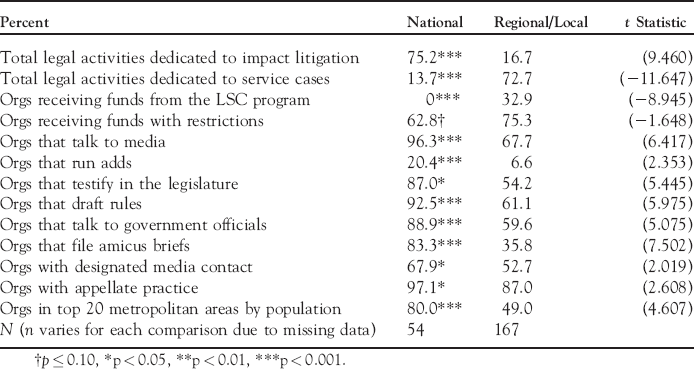
What does it mean to be a national organization as opposed to a regional or local organization? Given the relative geographical location of national versus regional/local organizations, differences among these organizations could affect access to justice for communities outside the geographic scope of national organizations. To be sure, there are some national organizations that operate a network of regional and local organizations as well, such as the ACLU. Recall, however, that in our study, local and regional offices of national organizations are treated as independent PILOs, so their social change activities are attributed to the regional or local office. One might also argue that organizations that are national in scope may serve clients geographically distant from their headquarters. Data about how individuals find lawyers when they need civil representation, however, indicate that people rely on local sources of information, in the form of intimate personal networks such as family, friends, and colleagues, to find lawyers to represent them (Sandefur Reference Sandefur, Trebilcock, Duggan and Sossin2012). Even in the Internet age, only 7 percent of Americans who responded to a recent survey indicated they would search online to locate a lawyer; the vast majority indicated they would rely on personal networks instead (ABA 2011). Thus, individuals are most likely to find representation through organizations known to their intimate personal networks, and unlikely to use other means to seek out national organizations to represent them.
Table 8 summarizes significant differences between national organizations and other organizations on a number of characteristics relevant to the services they provide and the strategies they use. Compared to other organizations, national organizations dedicate a larger percentage of their legal activities to impact litigation and a smaller percentage to service cases; indeed, national organizations are near mirror images of other organizations in terms of their allocation of effort to these two forms of legal representation. None of the national organizations receive funds from the LSC corporation, and they are less likely than other organizations to receive funds that came with restrictions, although this latter difference was not statistically significant (p = .10). Compared to other organizations, national organizations are more likely to utilize broad law reform strategies, such as talking to the media, running ads about their cause, testifying in the legislature, drafting legal rules, talking to government officials, and filing amicus briefs. National organizations also are more likely than others to have a staff person who was a dedicated media contact, and are more likely to have an appellate practice. They also are more likely than other organizations to be located in one of the top twenty metropolitan areas by population, that is, they tended to be concentrated in large cities.
Comparison of Organizational Characteristics Between National and Regional/Local Organizations

| Percent | National | Regional/Local | t Statistic |
|---|---|---|---|
| Total legal activities dedicated to impact litigation | 75.2 *** | 16.7 | (9.460) |
| Total legal activities dedicated to service cases | 13.7 *** | 72.7 | (−11.647) |
| Orgs receiving funds from the LSC program | 0 *** | 32.9 | (−8.945) |
| Orgs receiving funds with restrictions | 62.8 † | 75.3 | (−1.648) |
| Orgs that talk to media | 96.3 *** | 67.7 | (6.417) |
| Orgs that run adds | 20.4 *** | 6.6 | (2.353) |
| Orgs that testify in the legislature | 87.0 * | 54.2 | (5.445) |
| Orgs that draft rules | 92.5 *** | 61.1 | (5.975) |
| Orgs that talk to government officials | 88.9 *** | 59.6 | (5.075) |
| Orgs that file amicus briefs | 83.3 *** | 35.8 | (7.502) |
| Orgs with designated media contact | 67.9 * | 52.7 | (2.019) |
| Orgs with appellate practice | 97.1 * | 87.0 | (2.608) |
| Orgs in top 20 metropolitan areas by population | 80.0 *** | 49.0 | (4.607) |
| N (n varies for each comparison due to missing data) | 54 | 167 |
† p ≤ 0.10,
* p<05,
** p < 0.01,
*** p < 0.001.
A critic might argue that it is entirely appropriate for local and regional organizations to focus their efforts on direct client services because of the acute need for representation where these organizations are located. By contrast, national organizations located in large cities may rely on other local organizations to meet the demand for direct representation of needy clients. This argument, however, presumes that direct services and impact litigation are entirely separate, rather than complementary strategies. It too easily equates poverty practice with direct services without considering how political backlash effectively deterred poverty impact litigation after the initial success of the 1960s and 1970s. This argument also ignores Marc Galanter's (Reference Galanter1974) insight that repeat players can play for the rules again one-shot opponents (e.g., direct service clients) by settling cases they are likely to lose and litigating cases they are likely to win, thus building up precedent favorable to their interests in a given jurisdiction. Without a credible threat of broader impact litigation and appeals to create precedent, local and regional organizations may be relegated to negotiating individual cases as one-shot players, rather than challenging problematic laws and pushing for broader reform. LSC organizations in particular, which are disproportionately represented among local and regional organizations, are hamstrung by legislative prohibitions against bringing class actions that allow more sweeping reform than piecemeal litigation on an individual level.
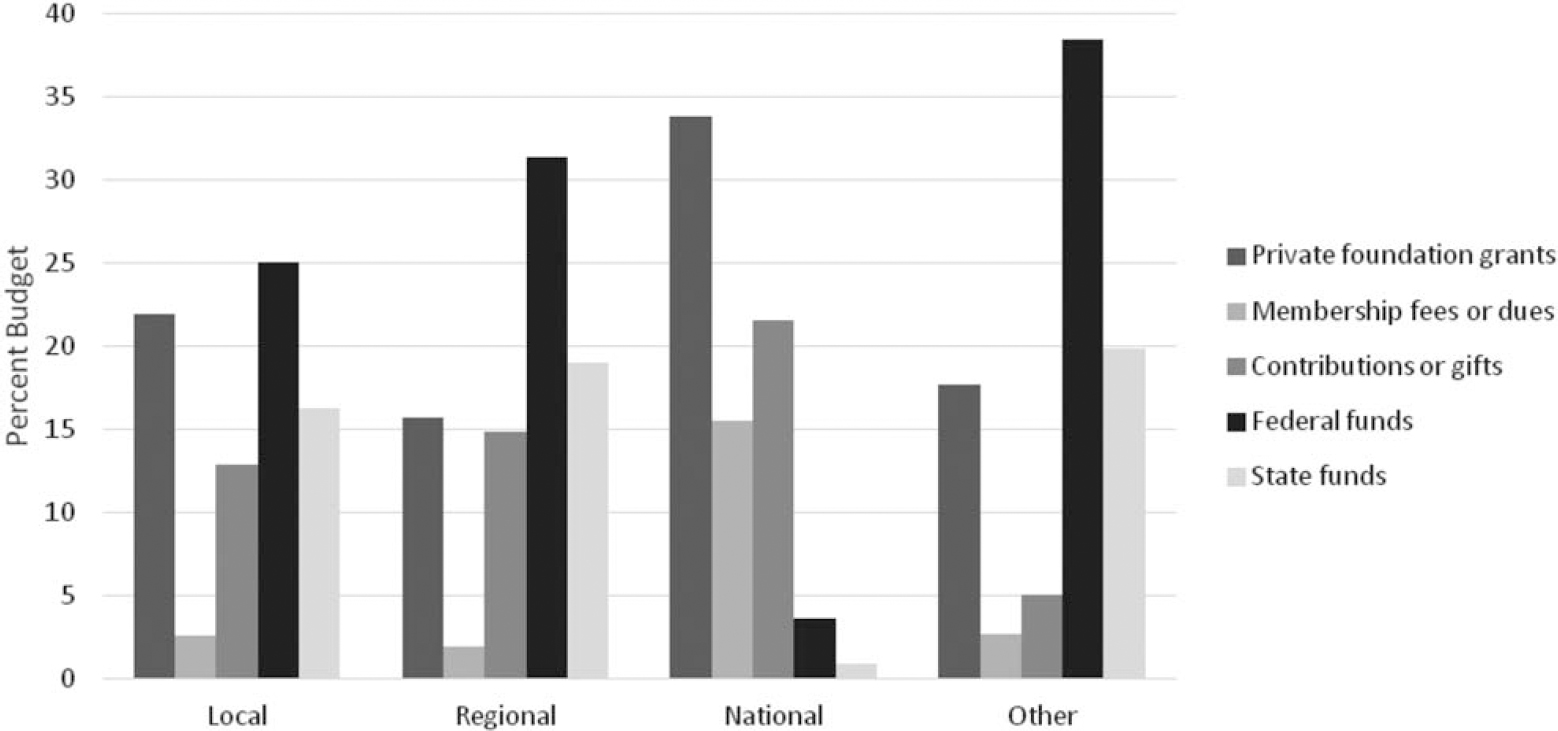
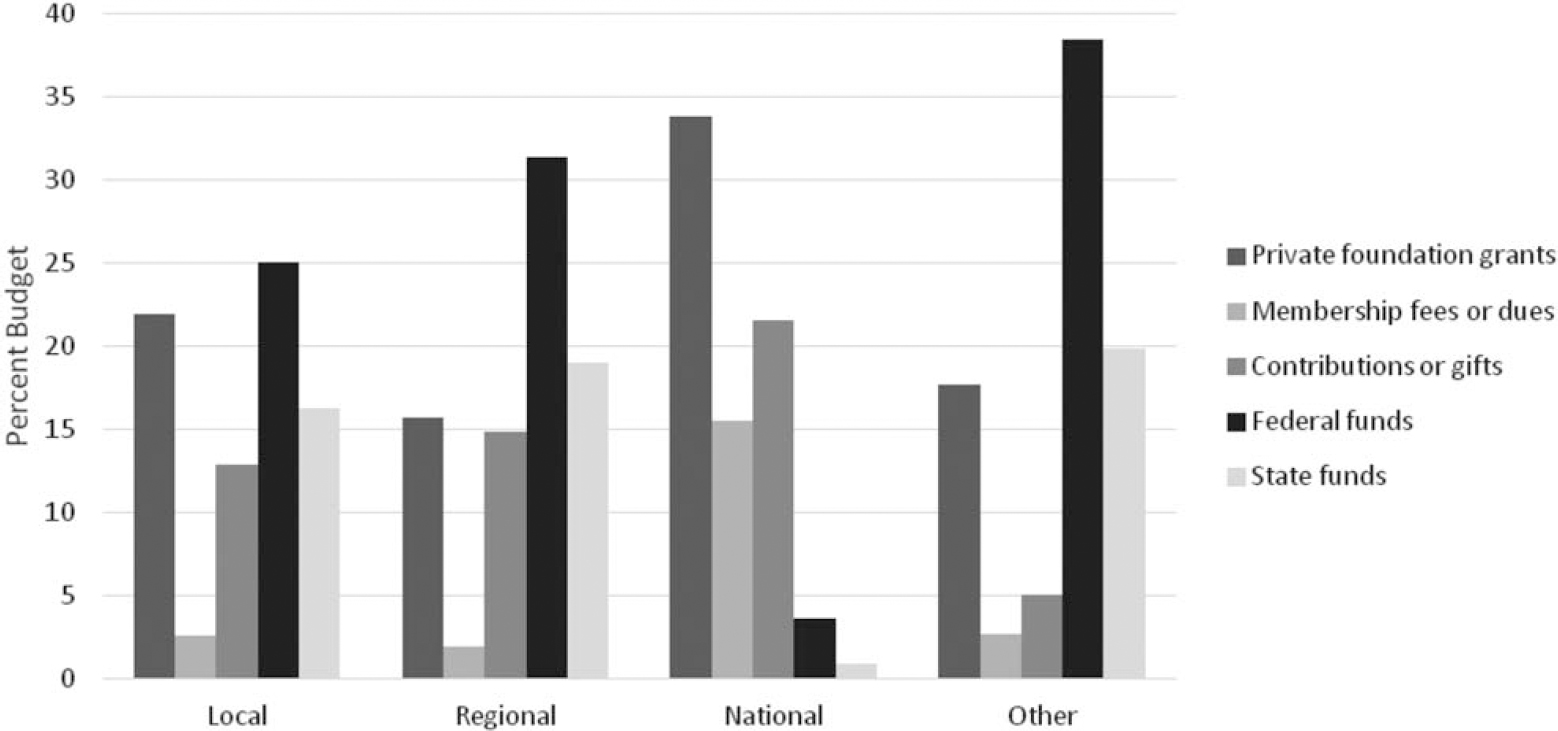
One more difference between national organizations and other organizations bears mentioning because it likely affects both the activities of these organizations and their autonomy from political and community pressures. As Figure 3 demonstrates, national organizations rely far less than any other organizations on federal and state funding, instead obtaining most of their budgets from private foundation grants, membership dues, and other contributions and gifts. The different funding model of national organizations may insulate them from legal and political constraints on their activities, such as the LSC restrictions mentioned above (Albiston and Nielsen 2014). National organizations also draw from a more diverse source of foundations and contributions than local and regional organizations, and thus are more insulated from community pressures about their activities (Alexander Reference Alexander, Powell and Clemens1998). These stark differences in funding models between national organizations and others raise important questions about institutional design for creating supply-side organizations for access to justice.
Sources of Budgetary Support by Scope of Practice
Discussion and Conclusion
In this article, we investigate how political, economic, and institutional factors influenced the development of the PILO field. We combine original data from the only available recent and representative survey of PILOs with GIS data on population and poverty to assess the effects of those patterns of development on access to justice. Bringing together these two important sources of data allows us to investigate systematic patterns in the distribution of the location and activities of PILOs that provide access to justice in the United States.
Three findings stand out from our analyses. First, our data confirm that geography is indeed destiny when it comes to local access to a PILO. Our analysis shows variation not only in the number of PILOs available in particular geographical areas, but also in the types of representation and strategies those organizations are likely to employ. Rural counties, and especially relatively poor rural counties, are less likely to have a PILO, and even if they do, that PILO is more likely to focus on direct services, less likely to have an appellate practice, and less likely to engage in systemic law reform strategies such as legislative advocacy, amicus brief work, or concerted media strategies.
Individual direct services litigation without the threat of a precedent-setting appeal or the potential for public exposure of illegal practices through the media leaves individual disadvantaged clients in the classic one-shot position (Galanter Reference Galanter1974). They must litigate each case individually, for an individual remedy, without the systematic advantage of a more powerful repeat player who can play for the rules and negotiate with more powerful actors to level the playing field. This approach may be neither more effective nor more cost efficient than more systemic strategies for change. Ironically, one of the solutions that Marc Galanter recommended to the one-shot player dilemma was to make one-shot players more like repeat players through representation by public interest lawyers (Galanter Reference Galanter1974). Galanter likely had in mind the wide-ranging social change litigation of poverty lawyers in the 1960s and 1970s, however, not the politically and financially constrained world of many PILO lawyers today. Our data suggest that the restrictions on LSC organizations, and on PILOs dependent on government funds more generally, have had their intended effect; these restrictions limit these organizations' ability to mount systemic, multi-strategy challenges to rules and practices that disadvantage their clients.
Second, our data suggest how political, economic, and institutional factors that influenced PILO development helped produce the current patchwork patterns of access to justice today. In the Expansion Era, these factors fueled efforts to provide access to justice. For example, the LSC provided institutionalized government support to put organizations providing legal representation in counties across the country. As our findings show, progressive LSC-funded organizations were more likely than other organizations to be located in low-income communities, tracking the poverty-focused orientation of the field's expansion in the 1960s and 1970s. They were also more likely than other organizations to be located in less progressive counties, suggesting that financial support and political legitimation from the LSC helped place legal aid offices in locations that might not otherwise support pro bono representation (see Kessler Reference Kessler1990). Moreover, during the 1960s and 1970s, expanding representation in this manner led to major law reform victories as well as individual relief.
By the Embattled Era, however, those victories brought backlash against the network of organizations created by the federally-funded LSC, and we see those changes reflected in the activities of PILOs. These political, economic, and institutional developments rendered this broad network of organizations in underserved communities the most politically and legally restricted organizations within the field. Federal legal restrictions on LSC organizations even developed an isomorphic pattern of their own, as some state-administered IOLTA accounts adopted similar restrictions on the organizations that they fund (Albiston and Nielsen 2007). As a result, even organizations beyond the LSC's poverty-focused mandate were affected by these restrictions. Thus, while legitimation and governmental support brought many PILOs to rural and poor communities, political backlash produced legislative restrictions and economic cuts that now constrain those same PILOs' law reform potential.
Third, our findings overall suggest that a two-tier system of access to justice through public interest law organizations is the legacy of these patterns of development. On the one hand, our data show a vigorous network of national organizations engaged in impact litigation, legislative advocacy, media strategies, and appellate practice. These organizations are predominately located in large cities on the coasts or in Chicago, in relatively progressive counties, and in counties with less poverty. None of the nationally-oriented organizations in this network accept support from the LSC (see Table 6), and they depend far less than local or regional organizations on any form of government support. On the other hand, there is also a network of organizations across the country that provides legal representation on a regional or local basis. These organizations primarily engaged in direct service cases, and are less likely to engage in the systemic reform activities of legislative advocacy or appellate practice than their more nationally-orientated counterparts. They also rely heavily on state and federal governmental support.
Although some of the national organizations may reach out geographically to rural and poor counties across the country, or even operate satellite offices in other areas, the barriers to mobilizing the law, particularly for disadvantaged individuals, are significant and well known (Sandefur Reference Sandefur, Pleasence and Buck2007b, Reference Sandefur2008 2008; Albiston, Edelman, and Milligan Reference Albiston, Edelman and Milligan2014). Individuals may not realize that their problems are potentially justiciable without the assistance of a lawyer or other agent of transformation to frame social events, for example (Felstiner, Abel, and Sarat Reference Felstiner, Abel and Sarat1981). Many will not know national organizations exist, or how to contact them for assistance, as most people find lawyers through their intimate personal networks of family, friends, and colleagues (ABA 2011; Sandefur Reference Sandefur, Trebilcock, Duggan and Sossin2012). Moreover, most legal claims are resolved through settlement (Miller and Sarat Reference Miller and Sarat1981; Siegelman and Donohue Reference Siegelman and Donohue1990), yet it seems unlikely that national-impact-litigation-oriented organizations will take on a claim in a remote area if it is likely to end in settlement. Yet is often through a series of such claims and settlements handled by lawyers with expertise and experience in the field that systemic problems suitable for legislative or class action resolution are identified. Thus, the effect of the physical presence of a legal office dedicated to representing disadvantaged individuals cannot be discounted.
We argue in this article that this two-tier system reflects the political, economic, and institutional factors that shaped development of the PILO field. Regional and local law offices are to some extent the descendants of the neighborhood law offices and legal aid movement of the 1960s and 1970s. Today, however, they lack the social reform and impact litigation power of that movement, a movement that litigated seventy cases before the Supreme Court between 1967 and 1973 (Davis Reference Davis1995; Johnson Reference Johnson and Regan1999). We have argued that political attacks and legislative constraints have limited the scope of their activities, and developed a striking, empirically documented divide between local and regional organizations that provide direct services and national organizations that seek law reform. It bears mention that conservative critics of the legal aid movement expressly sought to constrain legal aid to this more limited direct services role in response to their success on the law reform front (Southworth Reference Southworth2009).
What would the landscape of public interest law organizations look like were we to level the field? Lifting restrictions on the activities of LSC organizations would enable many local and regional organizations in less progressive, more poverty stricken counties to engage in systemic law reform. Indeed, systemic reform and rule change may be a more efficient and cost-effective means of assisting their disadvantaged clients than serial litigation of cases one at a time. But only about a third of regional and local organizations receive LSC funding; there are many more organizations in this category with similar patterns of activities. Prior research suggests that local bar associations and communities may put informal, agenda-setting constraints on these organizations by threatening to withdraw support (Kessler Reference Kessler1990). Funding models matter (Albiston and Nielsen 2014), and the very different funding models among these organizations that we have uncovered may affect the independence and activities of local and regional organizations regardless of whether they rely on the LSC. Indeed, choices among market, government, or nonprofit foundation approaches to providing legal representation force difficult tradeoffs among political vulnerability, independence, sustainability, and strategic resources available to PILOs (Luban Reference Luban2003; Rhode 2008; Abel Reference Abel, Granfield and Mather2009; Cummings Reference Cummings2012; Albiston and Nielsen 2014). Leveling the playing field, then, may also require national sources of private funding for regional and local organizations to help insulate them from local pressures and constraints.
It may also be that a culture change is needed. The divide between direct services and impact litigation is not a natural or functional phenomenon; it is the product of the political, economic, and institutional factors that shaped the PILO field over time. Although it has become natural and normal to think of these as separate strategies, scholars have long argued that even litigating a single case presents opportunities for political participation and policy reform (Zemans Reference Zemans1983). Perhaps it is time to think of access to justice in different terms; not as either direct services or impact litigation, but as an additive set of strategies focused on improving both access and substance for disadvantaged clients. Substantial evidence in addition to our own indicates that at least some PILOs engage in a broad suite of strategies (Southworth Reference Southworth2009), and to the extent that repeat players on the other side of the courtroom employ these strategies, PILOs must consider them as well.
Many of these strategies, such as media campaigns, amicus briefs, and legislative advocacy, also help bring to light unjust practices and policies that otherwise might go unnoticed by society and by those in a position to change them. In this sense, then, it is important to think about the contribution PILOs make to improving access to justice on a systemic basis: by deterring problematic practice by their presence, by putting injustices that would otherwise go unnoticed on the public agenda, by supporting one-shot clients against repeat players, and by taking a systematic approach to law reform. Public interest lawyering has matured; it is a multi-front, multi-strategy endeavor, and many of those strategies are directed as much at constructing meaning as at winning a particular case. Public interest law organizations, then, can serve as important civil society institutions by representing citizens against more powerful government and business interests in ways that not only protect their private interests but also facilitate deliberation about social problems and citizen participation in governance (Zemans Reference Zemans1983). It is all the more important, then, that we understand the barriers to providing access to justice in the United States, and the ways in which access through public interest law organizations may not be equally available to all.