


Introduction
In a comprehensive review, Lobban, Barrowclough and Jones (Reference Lobban, Barrowclough and Jones2003) reviewed studies that have examined the beliefs that people with psychosis have about their experiences and found that the specific beliefs about mental health that have been assessed have been varied and largely without a common theoretical framework. Studies into psychosis have generally focused on people's interpretations of internal and external experiences and how these interpretations contribute to the development and maintenance of psychotic symptoms (e.g. Birchwood, Meaden, Trower, Gilbert and Plaistow, Reference Birchwood, Meaden, Trower, Gilbert and Plaistow2000; Garety and Hemsley, Reference Garety and Hemsley1994; Garety, Kuipers, Fowler, Freeman and Bebbington, Reference Garety, Kuipers, Fowler, Freeman and Bebbington2001; Morrison, Reference Morrison2001).
Lobban et al. (Reference Lobban, Barrowclough and Jones2003) propose that attempts to develop an understanding of the role of beliefs in psychosis would benefit from drawing on the extensive work that has been done in understanding the role of beliefs in physical health. Research has focused primarily on social cognition models (Connor and Norman, Reference Connor, Norman, Connor and Norman1995). These models attempt to identify the key cognitions that mediate between the extrinsic factors associated with health behaviours, such as demographics and social factors.
One of the most widely used social cognition models to date is the Self-Regulation Model (SRM; Leventhal, Nerenz and Steele, Reference Leventhal, Nerenz, Steele, Baum and Singer1984). Research examining the beliefs people with mental health difficulties hold about their experiences has been found to be consistent with the SRM (Lobban et al., Reference Lobban, Barrowclough and Jones2003). Indeed, this model may highlight many important areas in clinical and psychosocial interventions (Lobban, Barrowclough and Jones, Reference Lobban, Barrowclough and Jones2004).
There is consistent evidence that up to 80% of people given a diagnosis of psychosis do not adhere to treatment (e.g. Corrigan, Liberman and Engle, Reference Corrigan, Liberman and Engle1990) and there is considerable variation in behaviours such as adherence to prescribed medication (Kane, Reference Kane1985), and emotional responses to psychosis, such as depression, which are both associated with outcome (Drake, Gates and Cotton, Reference Drake, Gates and Cotton1986). Drake, Hayley, Akhtar and Lewis (Reference Drake, Hayley, Akhtar and Lewis2000) assert that research investigating the factors that lie behind these variations in response to mental health is very important in order to improve outcomes for individuals.
The SRM proposes that illness perceptions influence emotional responses to health, and guides health-related behaviour (Hampson, Glasgow and Toobert, Reference Hampson, Glasgow and Toobert1990) including treatment adherence and insight (e.g. Janz and Becker, Reference Janz and Becker1984; Wichowski and Kubsch, Reference Wichowski and Kubsch1997; Yanos and Moos, Reference Yanos and Moos2007). Clifford (Reference Clifford1998; cited in Lobban et al., Reference Lobban, Barrowclough and Jones2003) explored illness perceptions of people with a diagnosis of schizophrenia and found an association between non-adherence to medication and a perception of fewer and less severe symptoms, a shorter duration of illness, external attribution of cause, and more negative consequences. Additionally, Lobban, Barrowclough and Jones (Reference Lobban, Barrowclough and Jones2005) found that people who attribute their experiences to mental health problems are more likely to take medication, whereas those who attribute mental health factors to factors other than mental health problems or medication side effects are less likely to take medication. Arguably, the concept of engagement with mental health services offers a broader perspective than assessing medication adherence alone. Engagement is a multifaceted concept that describes contact with healthcare providers in terms of several factors, such as remaining in contact with services, collaborative involvement in treatment, perceived usefulness of treatment, and openness about difficulties (Hall, Meaden, Smith and Jones, Reference Hall, Meaden, Smith and Jones2001). It is argued that individuals with psychosis often find it difficult to engage with mental health services (Meuser, Bond, Drake and Resnick, Reference Meuser, Bond, Drake and Resnick1998; Sainsbury Centre for Mental Health, 1998). Client non-engagement is seen as a major obstacle to effective treatment and support in the community and may be a risk factor for relapse and increased hospitalization (Song, Biegel and Johnsen, Reference Song, Biegel and Johnsen1998). Therefore, research into engagement is particularly relevant in the field of psychosis.
Broadbent, Kydd, Sanders and Vanderpyl (Reference Broadbent, Kydd, Sanders and Vanderpyl2008) suggest that beliefs about mental health affect treatment-seeking. More frequent visits to the GP were associated with perceptions of more severe symptoms, greater concern, higher emotional responses to illness and psychosocial causal attributions. The findings support the notion that illness perceptions provide a framework to assess a patient's ideas about mental health and a means of identifying maladaptive beliefs; interventions targeted at changing these beliefs may encourage better self-management. Therefore, it seems important to understand an individual's illness perceptions about both the mental health problem and treatments on offer. Indeed, the framework provided by the SRM encourages health professionals to be more person-centred and to pay attention to the patient's ideas and beliefs. Petrie and Weinman (Reference Petrie and Weinman1997) argue that the insights provided by the SRM are invaluable in understanding the factors that help and hinder responses to treatment. They assert that the SRM also allows a greater understanding of health-related behaviours that could enable a more effective delivery of care.
Preliminary evidence suggests that illness perceptions are associated with medication adherence in people with a diagnosis of psychosis (e.g. Lobban et al., Reference Lobban, Barrowclough and Jones2004); however, no direct attempts have been made to directly assess the relationship between illness perceptions and engagement in people with psychosis. A preliminary investigation that addresses this question may pave the way for future intervention work aimed at improving engagement through the manipulation of illness perceptions. Given that engagement has been shown to have a positive association with clinical outcome (Meaden, Nithsdale, Rose, Smith and Jones, Reference Meaden, Nithsdale, Rose, Smith and Jones2004), such research may have important clinical implications.
In view of previous research it was predicted that participant's ratings on the Illness Perception Questionnaire for Schizophrenia (IPQS) will be associated with their overall engagement score. More specifically, those individuals who have greater identity scores (i.e. a greater perceived severity of symptoms), have higher timeline scores, have greater treatment control scores (i.e. a greater belief in the treatment to control symptoms), and low coherence scores (i.e. a more coherent understanding of their mental health problem) will show greater levels of engagement than those who do not.
Method
Participants
Participants were identified and recruited via three NHS mental health trusts and were identified by the consultant psychiatrist or key worker (care co-ordinator). The criteria for inclusion were a clinical diagnosis of schizophrenia, schizoaffective disorder or psychosis and being aged 18–65. People with a primary diagnosis of learning disability or substance abuse were excluded. A total of 66 (73% male, n = 48; 27% female, n = 18) agreed to take part in the study. Due to the recruitment method it was not possible to ascertain the total response rate. Information about diagnosis was taken from the participant's case notes and confirmed by their psychiatrist or care co-ordinator. A total of 63% had a diagnosis of schizophrenia (n = 39), or schizoaffective disorder (n = 3), 32% had a diagnosis of psychosis (n = 21). The rest had a diagnosis of dissociative psychosis (n = 1), bipolar (n = 1), or affective disorder (n = 1). Additionally, demographic information and information about length of contact with services, and type of team contact was taken from hospital notes. All participants were in contact with secondary mental health services within the National Health Service (NHS) in England. A total of 10.6% (n = 7) of participants were in contact with community mental health teams (CMHT), 31.8% (n = 21) in contact with early intervention teams, 33.3% (n = 22) were in contact with assertive outreach teams, 10.6% (n = 7) were currently inpatients, and 9.1% (n = 6) were from residential rehabilitation and recovery units. The mean age of the sample was 34.06 years (SD = 13.40 years) and the average length of contact with mental health services was 10.98 years (SD = 9.54 years).
Procedure
In total 48 mental health teams were contacted and 28 agreed to take part from across three mental health NHS trusts in England. Information about the research was either sent to the team via the team manager or was presented by the lead researcher (KW) via attendance at a team meeting. The consultant psychiatrist and/or clinical team were asked to identify appropriate individuals to participate in the study. Eligible service users were contacted via their care co-ordinator and given an invitation letter and information sheet about the research. Participants were contacted after consent to be contacted forms had been returned to the researcher. All consenting participants were contacted to negotiate how they would like to complete the questionnaires (the IPQS and Engagement measure). They were offered the choice of completing the questionnaires individually without support (n = 5), completing the questionnaires with the support of their care coordinator (n = 11) or with the support of the lead researcher (KW) (n = 50). The measures took between 20 minutes and one hour to complete.
Design
A cross-sectional quantitative study using questionnaires was employed to assess if illness perceptions are associated with engagement scores in people with psychosis who are in contact with mental health services.
Measures
The Illness Perception Questionnaire for Schizophrenia (IPQS; Lobban et al., Reference Lobban, Barrowclough and Jones2005). The IPQS was used to assess beliefs about mental health problems. It has been shown to be internally reliable, and reliable over time (Lobban et al., Reference Lobban, Barrowclough and Jones2005). All of the subscales (except personal blame, which has been excluded from the current study) showed acceptable levels of internal consistency (α = 0.7–0.9) and stability over time (r s = 0.57–0.95), with subscales largely independent of each other (Lobban et al., Reference Lobban, Barrowclough and Jones2005). The subscales are identity; cause; timeline acute/chronic; timeline cyclical; consequences; personal control; treatment control; coherence (see Lobban et al., Reference Lobban, Barrowclough and Jones2005 for a detailed description).
Engagement measure (self-report version) (Gillespie, Smith, Meaden, Jones and Wane, Reference Gillespie, Smith, Meaden, Jones and Wane2004). This client-rated measure of engagement was chosen to ensure a flexible recruitment method. This is a self-report version of Hall et al.'s (Reference Hall, Meaden, Smith and Jones2001) observer-rated engagement measure. Scores on this client-rated measure of engagement have been shown to be correlated with staff ratings on the observer-rated engagement measure (Gillespie et al., Reference Gillespie, Smith, Meaden, Jones and Wane2004). It is an 11-item measure where the client rates engagement on six dimensions of engagement, which include appointment keeping (AK; two items), client therapist interaction (CTI; 1 item), openness (O; 3 items), perceived usefulness of treatment (PUT; 1 item), collaboration with treatment (CWT; 3 items), and compliance with medication (CWM; 1 item). All scales are marked 1 to 5 on a 5-point likert rating scale with 1 scoring as no engagement and 5 scoring as full engagement. A total score is obtained by adding together the scores on all of the engagement dimensions; scores ≥33 indicate progressively good engagement and scores <33 indicate poor levels of engagement. The range of possible scores is from 11 (no engagement) to 55 (full engagement). In analyzing the individual dimensions of engagement the total dimension score was divided by the total number of items in the scale. This was to aid interpretation of the total scores of each engagement dimension by putting it back in the original scale used for each of the individual measures (i.e. 1 representing no engagement to 5 representing full engagement) (Pallant, Reference Pallant2007).
Data analyses
Not all participants completed all items. Therefore, the exact n for each of the statistical tests is reported. Analyses were conducted using SPSS for windows version 16.0 (SPSS Inc., Chicago, IL, USA). Descriptive statistics are presented for all measures followed by bivariate correlations that measured the strength of association between the independent variables (illness perceptions) and the dependent variable (the total engagement score). Although a causal subscale is included in the IPQS, the items are not easily classified into meaningful dimensions (Lobban et al., Reference Lobban, Barrowclough and Jones2004); therefore, only the descriptive data of this scale is presented. Multiple regression analyses were then used to identify which of the independent variables are the best predictors of engagement.
Ethical considerations
The study was given favourable ethical opinion by an NHS research ethics committee and was registered with the NHS research and development departments of the three NHS trusts within which the research took place.
Results
Descriptive statistics
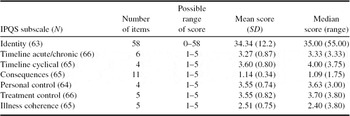
Beliefs about mental health (IPQS subscales). Table 1 shows the mean item score (total divided by the number of items) and the standard deviation for each subscale. Participants generally reported experiencing over half of the symptoms listed on the measure and generally viewed the timeline of their mental health difficulties as chronic and cyclical. They felt that they had some personal control over their symptoms and they perceived treatment as helpful. In general, the participants felt that they had a coherent understanding of their mental health difficulties and did not perceive that their problems had negative consequences. With the exception of lower consequence scores, this finding is consistent with previous findings (Lobban et al., Reference Lobban, Barrowclough and Jones2004, Reference Lobban, Barrowclough and Jones2005).
Mean scores, median scores and standard deviations for each subscale of the IPQS

A causal subscale is also included in the IPQS; however, the items are not easily classified into meaningful dimensions. Therefore, only the descriptive information is presented and the subscale has been excluded from further analyses. The most strongly held beliefs about the causes of mental health problems were that they had been caused by stress or worry, a trauma, chemical imbalance, thinking about things too much, mental attitude, or family problems, which is consistent with the findings of both Lobban et al. (Reference Lobban, Barrowclough and Jones2005) and Broadbent et al. (Reference Broadbent, Kydd, Sanders and Vanderpyl2008).
Engagement (Engagement measure – client version)
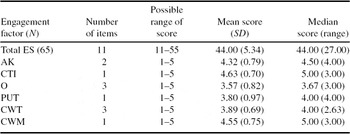
Table 2 shows the mean item score (total divided by the number of items) and the standard deviation for each engagement dimension and the overall engagement score.
Mean scores, median scores and standard deviations for each engagement dimension (including total engagement score) of the engagement measure

Total ES = total engagement score; AK = appointment keeping; CTI = client-therapist interaction; O = openness; PUT = perceived usefulness of treatment; CWT = collaboration with treatment; CWM = compliance with medication.
In total, 98% (n = 64) of the sample were classified as well engaged (i.e. obtained a total engagement score of 33 or above). Only one participant (2%) was classified as poorly engaged (Total ES = 28). The results show that participants were generally well engaged on all the dimensions of the engagement measure.
Bivariate analyses
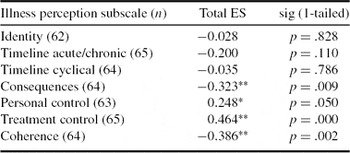
Associations between illness perceptions and engagement. The relationship between illness perceptions and the total engagement score was investigated using Pearson's product-moment correlation coefficient and the results are shown in Table 3. Preliminary analyses were performed to ensure no violation of the assumptions of normality, linearity and homoscedasticity (Pallant, Reference Pallant2007).
Associations between illness perceptions and the total engagement score

Significance levels:*p < .05; **p < .01.
The identity and timeline cyclical subscales were not significantly associated with engagement. However, lower acute/chronic timeline scores were associated with higher total engagement scores but failed to reach significance. Additionally, lower perceptions of negative consequences of the mental health problem, increased perceptions of personal ability to control the mental health difficulty, a belief that treatment is helpful in controlling symptoms of a mental health problem, and a more coherent understanding of the mental health difficulty were all significantly associated with higher engagement scores.
Multivariate analysis
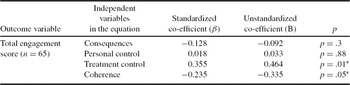
A standard multiple regression was conducted to estimate the proportion of variance accounted for in the dependent variable (total engagement score). Associations between the variables that reached the 0 < .05 level of significance were entered into a regression equation. This method was chosen in order to reduce the likelihood of a type II error occurring. It is generally accepted that for each independent variable entered into the regression equation, between 5 and 20 participants are required (Cohen, Reference Cohen1992). The number of participants in this study exceeded the number to obtain 80% power, assuming a large effect size and an α significance level of 0.05 (Cohen, Reference Cohen1992). Therefore, a statistical significance level of p < .05 was chosen for interpreting the results. Table 4 shows the results of the regression analysis. To check how well the regression equation fitted the data, the standardized residuals were checked. None had an absolute value greater than three, suggesting adequate fit of the data (Field, Reference Field2000). Preliminary analyses were performed to ensure no violation of the assumptions of normality, linearity, homoscedasticity and independence of residuals (Pallant, Reference Pallant2007).
Results of standard multiple regression with total engagement score as the dependent variable

Note: R 2 = 0.301(p < .0005). *Significant predictor.
A significant model emerged (F 4,58 = 6.256, p < .0005) and suggested that the illness perception constructs of coherence, personal control, treatment control and coherence explained 30% of the variance in engagement (R square = 0.301). Treatment control (β = 0.355, p = 0.008) and coherence (β = −0.235, p = .05) emerged as the strongest predictors of engagement. Both personal control and consequences failed to reach significance.
Discussion
The results of the study provide evidence that the illness perception constructs of treatment control, personal control, consequences, and coherence are associated with engagement in people with psychosis. This evidence provides partial support for the original hypothesis that those people who hold a greater belief in treatment and have a more coherent understanding of their mental health problem will show greater levels of engagement. These significant bivariate associations are similar to the findings of Lobban et al. (Reference Lobban, Barrowclough and Jones2005), Watson et al. (Reference Watson, Gartey, Weinman, Dunn, Bebbington, Fowler, Freeman and Kuipers2006), and Broadbent et al. (Reference Broadbent, Kydd, Sanders and Vanderpyl2008). Although these authors did not explicitly measure engagement, they did explore the relationship between illness perceptions and certain dimensions of engagement.
The current results do not provide significant evidence to support the hypothesis that those people who perceive a greater severity of symptoms (identity) or have a more acute and less cyclical timeline will have higher engagement scores. Therefore, the current study only provides partial evidence that illness perceptions can provide a useful framework for understanding engagement in people with psychosis. This finding is in contrast to previous research (e.g. Broadbent et al., Reference Broadbent, Kydd, Sanders and Vanderpyl2008; Lobban et al., Reference Lobban, Barrowclough and Jones2004; Lobban et al., Reference Lobban, Barrowclough and Jones2005), which has found that longer timeline perceptions are significantly associated with certain engagement dimensions (i.e. adherence to medication and frequent use of mental health services). A possible explanation for the lack of significance in the current study could be due to the relatively small sample size. Therefore, a larger study with increased power is needed to replicate the current findings.
Clinical implications
The results of the multiple regression analysis suggest that the illness perception constructs of personal control, coherence, treatment control, and consequences explained 30% of the variance in total engagement in people with psychosis. However, only the illness perception constructs of coherence and treatment control emerged as significant predictors in the multiple regression analysis. Indeed, Horne and Weinman (Reference Horne and Weinman2002) have shown that specific beliefs about treatment (rather than the health threat) are the key influences on treatment adherence, and that illness perceptions are related to these treatment beliefs in a logical way, particularly to an individual's belief about their need for treatment. These findings suggest that engagement may be improved if clinicians enable service users to develop a coherent understanding of their mental health problem and that they understand that there are things that they can do personally to help control their symptoms. Although no causal links have been identified, the current results highlight the likely importance for clinicians to check out services users' perceptions about whether treatment can help control their mental health problem and explore their concerns. However, as the results of the current study do not allow the interpretation of causality, additional research that addresses this limitation is needed.
The results of this study may provide some useful pointers for the development of cognitive behavioural therapy (CBT) in psychosis where the aim is to develop a collaborative explanation of symptoms and experiences and to increase control and decrease distress (Pilling et al., Reference Pilling, Bebbington, Kuipers, Garety, Geddeds, Orbach and Morgan2002). In addition, it may be important for therapeutic approaches to focus on challenging beliefs about the controllability of mental health; indeed, developing individualized “recovery action plans” have been shown to improve outcome in non-psychiatric conditions (Petrie, Cameron, Ellis, Buick and Weinman, Reference Petrie, Cameron, Ellis, Buick and Weinman2002). Therefore, the importance of clinicians working collaboratively with service users to develop individually tailored care plans that take into account individuals' beliefs about treatment may be paramount given the demonstrated association between beliefs about the ability of treatment to control symptoms and engagement. However, further research that investigates the causality of the demonstrated association is important. In support of the current findings Gibson et al. (Reference Gibson, Coughlan, Wilson, Abramson, Bauman, Hensley and Walters2000) found that asthma patients in receipt of a personalized action plan were more adherent to medication, were less likely to be hospitalized, and demonstrated improved outcome in comparison to those with no action plan. Additionally, there is evidence that giving service users choice increases engagement with mental health services (Dwight-Johnson, Unûtzer, Sherbourne, Tang and Wells, Reference Dwight-Johnson, Unûtzer, Sherbourne, Tang and Wells2001) and offering treatment choice reduces the likelihood of premature treatment drop-out (Rokke, Tomhave and Jocic, Reference Rokke, Tomhave and Jocic1999).
The current study suggests that having a more coherent understanding of a mental health problem may also be important in improving engagement with services. Although the results of the current study cannot infer causality, it may be important for clinicians to ensure that service users understand their mental health problem in order to help encourage engagement. This could be in the context of offering psychoeducation about the mental health problem or through formulation, where the clinician and the client collaboratively make sense and understand the client's experiences. A formulation is essentially a hypothesis about the causes, precipitants and maintaining influences of a person's psychological, interpersonal and behavioural problems (Eells, Reference Eells1997). Intervention studies in this area would be useful to determine if coherence does have a direct and causal link on self-perceptions of engagement. Indeed, Dudley, Siitarinen, James and Dodgson (Reference Dudley, Siitarinen, James and Dodgson2009) assert that a collaboratively generated formulation of an individual's experience may be helpful in building a therapeutic alliance, engagement in treatment, and ultimately improve outcome. Indeed, previous research has shown that when service users and clinicians shared an explanatory model of the mental health problem, it improved the therapeutic relationship with their key-worker and the level of service user satisfaction (Priebe, Watts, Chase and Matanov, Reference Priebe, Watts, Chase and Matanov2005). Additionally, Pollack and Aponte (Reference Pollack and Aponte2001) report that assessing an individual's perceptions about their mental health problem and discussing beliefs can be therapeutic in allowing service users to tell their story, consider new issues, and clarify aspects of their experiences. Indeed, anecdotal evidence from the current study would support this finding. Clinicians who administered the IPQS reported that they found it to be an extremely useful clinical tool that enabled them to understand how the service user viewed their mental health problem. Also, discussing illness perceptions with clients who have psychosis and their carers has been proposed as a way to improve family relations (Kuipers et al., Reference Kuipers, Watson, Onwumere, Bebbington, Dunn, Weinman, Fowler, Freeman, Hardy, Leventhal, Diefenbach and Leventhal2007). Therefore, further research about the clinical utility of the IPQS as a clinical interview tool, both for use with clinicians and family members, is warranted.
The current study and previous research suggests that less faith in the ability of treatment to control symptoms, a perception of a lack of personal control, worse consequences, and less coherent understanding are associated with lower levels of engagement (both overall engagement and specific engagement dimensions). These results may highlight the role of hope in people with psychosis. Indeed, White, McCleery, Gumley and Mulholland (Reference White, McCleery, Gumley and Mulholland2007) reported that hopelessness may be linked to personal beliefs about illness. Additionally, Perry, Taylor and Shaw (Reference Perry, Taylor and Shaw2007) found that hopelessness was associated with being treated with respect, not having control, and lack of information. These findings are in some ways consistent with the illness perception constructs of treatment control, personal control, consequences and coherence.
Limitations
The study has a number of limitations. First, as a cross-sectional study the directionality of the associations cannot be established. Additionally, a longitudinal study is needed to ensure that the model is stable over time especially as engagement has been shown to fluctuate (Priebe et al., Reference Priebe, Watts, Chase and Matanov2005). Also, intervention studies are needed to test both the causal mechanism of the relationship between beliefs and engagement and the potential to change this relationship that has a meaningful impact on people's lives. The results of a randomized control trial using a three-session intervention to challenge illness perception following a myocardial infarction found a reduction in negative beliefs and a reduced delay in returning to work for the intervention group (Petrie et al., Reference Petrie, Cameron, Ellis, Buick and Weinman2002). Currently, no intervention studies specifically focused on challenging negative illness perceptions about mental health problems have been reported.
A second limitation, as previously mentioned, is the small sample size. Although the number of participants included in the study exceeded the number to obtain 80% power, assuming a large effect size and a α significance level of .05 (Cohen, Reference Cohen1992), it is possible that a larger sample size may have generated more significant results. Therefore, the authors acknowledge that it is possible that a type II error may have occurred when interpreting the findings. Further research with a larger sample size is needed in order to replicate the current findings. Additionally, the study originally intended to assess the illness perceptions of service users with a wide range of engagement scores. However, 98% of the sample was classified as well engaged and only one participant was classified as poorly engaged. Consequently, the results of the current study do not represent the association of illness perceptions and engagement in poorly engaged service users who have psychosis. Therefore, the results may not be generalizable to poorly engaged service users or to people who are not engaged with services at all. It is possible that people who are poorly engaged with mental health services may not recognize that they have psychosis or may hold a different explanatory model. Further research that replicates the current study and includes poorly engaged service users is needed.
Also, when carrying out research into engagement, it is important to consider the potential selection bias of the recruitment method. It is possible that the lengthy nature of the IPQS may have deterred some people from taking part. Therefore, consideration should be given to using a shorter measure such as the Brief Illness Perception Questionnaire (BIPQ; Broadbent, Petrie, Main and Weinman, Reference Broadbent, Petrie, Main and Weinman2006), which may encourage a higher response rate. Additionally, the recruitment method relied on service users voluntarily taking part in the research. It is possible that this may have created a possible selection bias and that people who are reluctant to voluntarily participate may hold a very different explanatory model of their psychosis. It is likely, that service users who are less well engaged will be more reluctant to take part in research. Therefore, the current results do not and cannot claim to generalize to all people who have been given a diagnosis of psychosis. Future research should consider a range of recruitment methods that aim to minimize possible recruitment biases. The current study was interested in finding out about the association between engagement and beliefs about psychosis in people who are currently in contact with health services. However, it is important that future work focuses on the beliefs about mental health in people who are not in contact with health services. It is likely that a range of different recruitment methods will need to be used in order to achieve this.
Additionally, it is important to consider the self-report nature of the measures. In particular, the engagement measure is a self-report version of Hall et al.'s (Reference Hall, Meaden, Smith and Jones2001) observer-rated engagement measure. It is important to acknowledge that the subjective nature of the scale may have affected the reliability of the results. However, scores on this client-rated measure of engagement have been shown to be correlated with staff ratings on the observer-rated engagement measure (Gillespie et al., Reference Gillespie, Smith, Meaden, Jones and Wane2004). In order to minimize the possible impact of using subjective measures within research it is important that wherever possible they are complimented with the use of objective measures. Therefore, future work in this area may consider using both the client and staff rated measures of engagement. Additionally, other objective measures of engagement could be considered, such as percentage of appointments attended.
Finally, beliefs about causes of mental health problems and beliefs about personal responsibility and blame are assessed by the IPQS, but do not form internally consistent subscales (see Lobban et al., Reference Lobban, Barrowclough and Jones2005) and so were not used in this analysis. Therefore, future research should include an emphasis on uncovering if there is an association between the perceived cause of mental health and engagement with services.
Despite these limitations, the results may have important clinical implications that highlight important opportunities for interventions that aim to challenge negative illness perceptions using well developed cognitive and behavioural techniques. In conclusion, an awareness of illness perceptions and their interactions with engagement with mental health services may generate important improvements in interventions for people with psychosis.
Acknowledgements
We would like to acknowledge and thank all the service users who participated in the study. Additionally, we would like to thank all the teams who supported the recruitment of participants.



Comments
No Comments have been published for this article.