Introduction
Cucurbita pepo L. (pumpkin, squash, gourd; Cucurbitaceae) is among the economically most important vegetable crops. Most often, this species is grown for the consumption of its immature fruits, known as summer squash. Summer squash have been classified into six cultivar-groups based on fruit shape (Paris, Reference Paris1996), three of which, Crookneck, Scallop and Straightneck, all C. pepo subsp. texana (Scheele) Filov, are grown mainly in the USA. Three other groups, all C. pepo subsp. pepo, have a more widespread geographic distribution, these being Vegetable Marrow, which has short, tapered fruits, Cocozelle, which has long, bulbous fruits, and Zucchini, which has uniformly cylindrical fruits. Of these, the Zucchini Group has by far the greatest monetary value (Paris, Reference Paris, Prohens and Nuez2008). Based on historical records, the Zucchini Group was the last of the C. pepo cultivar-groups to be developed (Paris, Reference Paris2000). While phenotypic variation and DNA sequence polymorphism within the other C. pepo subsp. pepo cultivar-groups are high, the cultivars of the Zucchini Group exhibit little phenotypic variation and DNA sequence polymorphism among themselves (Katzir et al., Reference Katzir, Tadmor, Tzuri, Leshzeshen, Mozes-Daube, Danin-Poleg, Paris, Katzir and Paris2000; Paris et al., Reference Paris, Yonash, Portnoy, Mozes-Daube, Tzuri and Katzir2003, Reference Paris, Portnoy, Mozes-Daube, Tzuri, Katzir, Yonash, Davidson and Trehane2004), which is consistent with the recent evolution of this cultivar-group.
Since the 1950s, hybrids of C. pepo have been commercialized. Seed companies have focused much effort on the development of zucchini hybrids. At the outset, this effort was based on inter-cultivar-group crosses in order to better exploit the benefits of heterosis (Anido et al., Reference Anido, Cravero, Asprelli, Firpo, Garcia and Cointry2004; Paris, Reference Paris, Prohens and Nuez2008). Hence, the so-called zucchini hybrids that were marketed bore fruits which resembled true zucchini cultivars, but were based on crosses of a cocozelle or a vegetable marrow with a zucchini. Only beginning in the latter half of the 1960s were true zucchini hybrids offered for sale.
As C. pepo is highly susceptible to diseases, especially those caused by viruses, disease resistance has been considered to be the most important goal of summer squash breeding (Whitaker and Robinson, Reference Whitaker, Robinson and Bassett1986). The greatest pathogenic threats to production are zucchini yellow mosaic virus, watermelon mosaic virus, papaya ringspot virus, cucumber mosaic virus, and powdery mildew, mainly Podosphaera xanthii (Castagne) U. Braun & N. Shishkoff. As no sources of resistance to these pathogens are available in C. pepo, breeders have resorted to introgression of resistance from other species. For virus resistance, Cucurbita moschata Duchesne has been the primary source, as sparingly fertile progeny can be obtained from the interspecific cross of C. pepo with this species (Whitaker and Robinson, Reference Whitaker, Robinson and Bassett1986; Paris, Reference Paris, Prohens and Nuez2008). C. moschata ‘Nigerian Local’ has been the common source of nearly all virus-resistant, commercially deployed C. pepo (Provvidenti, Reference Saliba-Colombani, Causse, Gervais and Philouze1997). The ultimate source of powdery mildew resistance has been Cucurbita okeechobeensis (Small) Bailey, using C. moschata as a genetic bridge (Jahn et al., Reference Jahn, Munger, McCreight, Bélanger, Bushnell, Dik and Carver2002). Hybrid ‘zucchini’ cultivars that carry resistance to one or more of these pathogens are now commercially available, but they have not yet been examined to determine their relationship with other C. pepo subsp. pepo. The objective of the present work was to assess relationships among various susceptible and disease-resistant C. pepo, in order to obtain a general guide towards more efficient breeding for resistance.
Materials and methods
Plant material
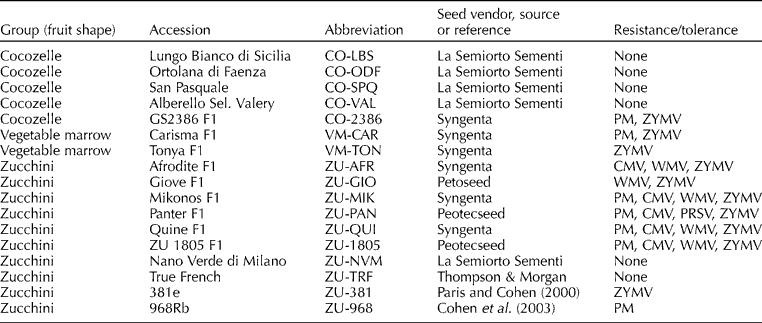
Seventeen accessions of C. pepo subsp. pepo were compared (Table 1). These accessions consisted of six open-pollinated cultivars, four of the Cocozelle Group and two of the Zucchini Group. Two accessions that have been considered as nearly isogenic to the zucchini ‘True French’ were also included, as they were obtained through six generations of backcrossing to that cultivar with selection for resistance in each generation. One of these near-isogenic accessions, designated 381e, was resistant to zucchini yellow mosaic virus (Paris and Cohen, Reference Paris and Cohen2000), and the other, designated 968Rb, was resistant to powdery mildew (Cohen et al., Reference Cohen, Hanan and Paris2003). The remaining nine accessions were hybrids obtained from several seed companies. Some plants of each accession were grown to maturity in order to verify their identity, especially with regard to their fruit shape so as to allow the assignment of each to a particular cultivar-group (Paris, Reference Paris1986).
Germplasm used for this study, including group affiliations, names of accessions and their designated abbreviations, seed vendors or sources, and resistances or tolerances as attributed by the vendor or source

PM, powdery mildew; ZYMV, zucchini yellow mosaic virus; CMV, cucumber mosaic virus; WMV, watermelon mosaic virus; and PRSV, papaya ringspot virus.
DNA extraction and analysis
Genomic DNA was isolated from young leaves of plants grown in an insect-free greenhouse. Each accession was represented by a bulk sample derived from three plants. Leaves were homogenized using liquid nitrogen, and DNA was extracted using the method of Fulton et al. (Reference Fulton, Chunwongse and Tanksley1995). The DNA was quantified and stored at − 20°C for analysis.
Amplified fragment length polymorphism (AFLP) analysis was performed using the method of Vos et al. (Reference Vos, Hogers and Bleker1995) and a commercial kit (AFLP analysis System I, Gibco-BRL, Life Technologies, Gaithersburg, MD, USA) that employs EcoRI and MseI as restriction enzymes. For selective amplification, four combinations of primers having three selective nucleotides at their 3′ ends were used (E-AGC+M-CAG; E-AGC+M-CAC; E-ACT+M-CAT; E-ACT+M-CAC). AFLP fragments were separated by capillary electrophoresis. AFLP fingerprints were compared, and polymorphisms were scored as 1 (presence of fragments) or 0 (absence of fragments).
Genetic similarity among cultivars was calculated using a simple matching coefficient (Sokal and Michener, Reference Sokal and Michener1958). Genetic similarity calculations and dendrogram construction, using the unweighted pair group method, arithmetic average (UPGMA) clustering algorithm, were performed using the NTSYS-pc package (Rohlf, Reference Rohlf1998). In addition, Nei's genetic distances (Nei and Li, Reference Nei and Li1979) were calculated for 100 bootstrapped data matrices using Phyltools 1.32 software (Buntjer, Reference Buntjer2000). Subsequently, a consensus phylogenetic tree based on the neighbour-joining algorithm was constructed using the PHYLIP 3.62 package (Felsenstein, Reference Felsenstein1993).
Results
The plants of 16 of the 17 accessions were observed to have in common erect, bushy growth and short internodes, as expected from modern summer squash cultivars; ‘Alberello Sel. Valery’ had viney growth and relatively long internodes. Each of the 17 accessions appeared to be uniform, but the accessions varied among themselves for some phenotypic traits, for example, the presence or absence of branches and silver leaf mottling, depth of incisions of the leaf laminae, and fruit colour. We examined and classified each of the accessions for fruit shape (Table 1). We observed that four of the open-pollinated cultivars were cocozelles, two open-pollinated cultivars and the two near-isogenic lines of ‘True French’ were zucchinis, and, of the hybrids, one was a cocozelle, six were zucchinis and two were vegetable marrows.
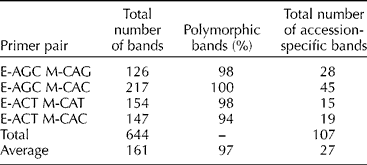
A total of 644 bands, ranging in size from 76 to 498 bp, were identified using the four primer pairs (Table 2). Of these bands, 632 (97%) were polymorphic. The number of fragments detected by an individual primer pair ranged from 126 to 217 with an average of 161.
Number of total, polymorphic and accession-specific bands identified using four AFLP primer pair combinations

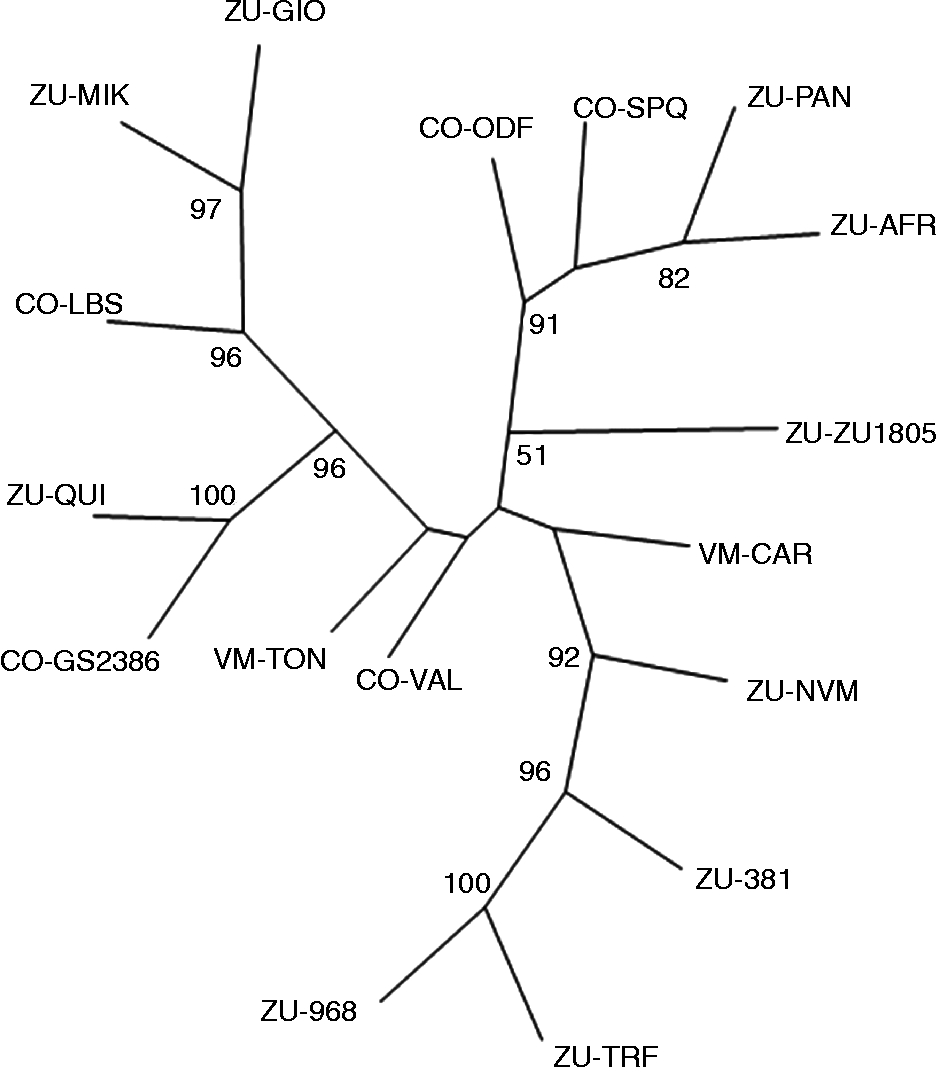
The dendrogram constructed using the PHYLIP package (Fig. 1) consists of three branches, the position of the accessions within each branch being supported, in most cases, by bootstrap values exceeding 90%. One branch includes the two open-pollinated zucchini cultivars, ‘Nero di Milano’ and ‘True French’, and the two disease-resistant near-isogenic lines of ‘True French’, 381e with zucchini yellow mosaic virus resistance and 968Rb with powdery mildew resistance. The other two branches account for three of the four open-pollinated cocozelle cultivars and seven of the nine hybrids, including all of those having zucchini fruit shape. The three remaining accessions, which are the viney cocozelle and the two vegetable marrow hybrids, appear in the centre of the dendrogram, but their positions there lack firm support as bootstrap values are less than 50%.
Unrooted dendrogram derived from a UPGMA cluster analysis of 17 Cucurbita pepo accessions, based on 644 AFLP bands. The bipartite designations are as given in Table 1, with the double letters representing cultivar-groups (CO, Cocozelle Group; ZU, Zucchini Group and VM, Vegetable Marrow Group) and the triple letters representing accessions. The numbers at the nodes are bootstrap percentages out of 100. Only values of ≥ 50% are indicated.

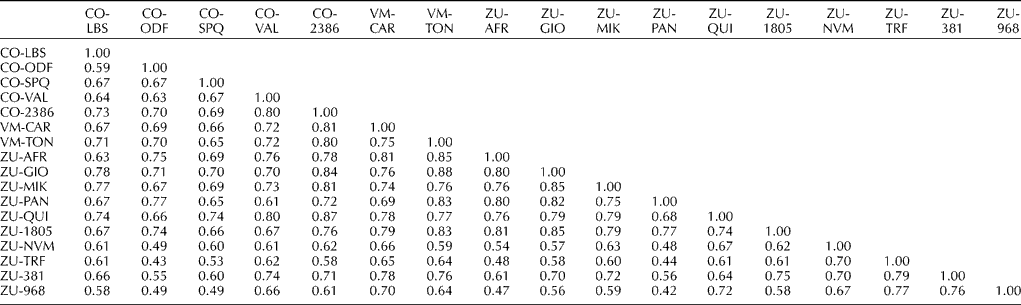
Genetic similarity indices ranged from 0.42 to 0.88 (Table 3). The open-pollinated cultivars of the Cocozelle Group had, overall, relatively high similarities with one another, ranging from 0.59 to 0.67, and the two cultivars of the Zucchini Group had an even higher similarity index of 0.70, while the similarities between cultivars of different groups were relatively low, ranging from 0.43 to 0.62. ‘True French’ and its two near-isogenic disease-resistant lines, 381e and 968Rb, had greater similarities, from 0.76 to 0.79, but these values are considerably lower than would be expected after six backcross generations. High similarities were observed among the disease-resistant hybrids, ranging from 0.72 to 0.88, regardless of fruit shape and regardless of the company that did the breeding. Indeed, the highest similarity, 0.88, was obtained between the zucchini ‘Giove’ and the vegetable marrow ‘Tonya’, which were developed by different companies.
Genetic similarity matrix among 17 cultivars of Cucurbita pepo based on 644 AFLP bandsa

a The bipartite designations are as given in Table 1, with the double letters representing cultivar groups (CO, Cocozelle Group; ZU, Zucchini Group; VM, Vegetable Marrow Group) and the triple letters representing accessions.
The UPGMA dendrogram constructed using the NTSYS-pc statistical package (not presented) consisted of two major clusters. One included the two open-pollinated zucchini cultivars, ‘Nero di Milano’ and ‘True French’, and the two disease-resistant near-isogenic lines of ‘True French’, 381e and 968Rb, the same that occurred while using the PHYLIP statistical package. However, the remaining accessions, that is, the four open-pollinated cocozelle cultivars and all nine of the hybrids, regardless of their fruit shape, formed one large cluster. This cluster had three of the four open-pollinated cultivars of the Cocozelle Group flanking all of the hybrids, which were distributed into two subclusters.
Discussion
The high proportion of polymorphic bands, 97% (Table 2), is even higher than that observed among other accessions of C. pepo (Ferriol et al., Reference Ferriol, Pico and Nuez2003; Paris et al., Reference Paris, Yonash, Portnoy, Mozes-Daube, Tzuri and Katzir2003). This could be attributable to the introgression of portions of the C. moschata genome. The number of accession-specific bands ranged from 15 to 45 with an average of 27 per primer. Several bands specific to each accession were identified. Such accession-specific bands are potentially useful for purposes of identification and tracing pedigrees (Ercolano et al., Reference Ercolano, Carli, Soria, Cascone, Fogliano, Frusciante and Barone2008).
Fruit colour and various foliar characteristics are each under monogenic or oligogenic control (Paris and Brown, Reference Paris and Brown2005), and therefore, each would not be expected, by itself, to necessarily be a reliable indicator of genetic affinity. However, fruit shape is a polygenic characteristic and therefore likely to be reflective of genetic relationships (Paris, Reference Paris1986). Indeed, of the open-pollinated cultivars, the ones with long, bulbous fruits, that is, the cocozelles, clustered separately from those with uniformly cylindrical fruits, that is, the zucchinis, in both the PHYLIP (Fig. 1) and NYSTS-pc (not presented) statistical packages. The separation between cocozelles and zucchinis was also evident from previous investigations (Katzir et al., Reference Katzir, Tadmor, Tzuri, Leshzeshen, Mozes-Daube, Danin-Poleg, Paris, Katzir and Paris2000; Ferriol et al., Reference Ferriol, Pico and Nuez2003; Paris et al., Reference Paris, Yonash, Portnoy, Mozes-Daube, Tzuri and Katzir2003, Reference Paris, Portnoy, Mozes-Daube, Tzuri, Katzir, Yonash, Davidson and Trehane2004). None of the six zucchini hybrids clustered with the open-pollinated zucchini cultivars and the near-isogenic disease-resistant zucchinis; instead, the zucchini hybrids clustered with the open-pollinated cocozelles. Indeed, in the dendrogram that was obtained using the NYSTS-pc package, all of the hybrids were embedded within the cluster of cocozelles, reflective of their greater genetic similarity as compared with that among the cocozelle cultivars (Table 3). Regardless of fruit shape and commercial breeder, all of the hybrids had greater similarity values among themselves than those observed among the four open-pollinated cocozelle cultivars (Table 3). Only by repeated backcrossing, to the sixth generation as in 381e and 968Rb, was it possible to recover a readily identifiable, by AFLP, proportion of the zucchini genome.
Nonetheless, ‘True French’ and its two near-isogenic disease-resistant lines, 381e and 968Rb, had genetic similarities of less than 0.80 (Table 3). As Cucurbita has 20 pairs of chromosomes (Whitaker and Davis, Reference Whitaker and Davis1962) and as the zucchini yellow mosaic virus resistance in 381e, introgressed from C. moschata ‘Menina’, is conferred by three genes (Paris and Cohen, Reference Paris and Cohen2000) and the powdery mildew resistance of 968Rb is conferred by one gene (Cohen et al., Reference Cohen, Hanan and Paris2003), a far greater amount than expected, after six generations of backcrossing, of DNA from the donor parents exists in the genome of these resistant lines. Therefore, classical genetic linkage alone cannot account for the total quantity of foreign DNA in these disease-resistant lines.
The genetic similarity among the hybrids, as observed using AFLP, could be attributed, in part, to the use of the same source of resistance by the different companies. Hybrids resistant to zucchini yellow mosaic virus and watermelon mosaic virus were developed by using the same virus-resistant accession, C. moschata ‘Nigerian Local’ (Provvidenti, Reference Provvidenti1997). However, this alone cannot explain their high degree of genetic similarity, as the resistance in ‘Nigerian Local’ to each of several viruses is conferred by a single dominant gene (Munger and Provvidenti, Reference Munger and Provvidenti1987; Brown et al., Reference Brown, Bolanos Herrara, Myers and Jahn2003).
If a considerable portion of the C. moschata genome is present in all of the resistant genotypes, then both phenomena, the high similarity of the resistant hybrids and the lower-than-expected similarity of the resistant near-isogenic lines to their recurrent parent, would be accounted for. In tomato, AFLP markers preferentially revealed polymorphism around centromeric and telomeric regions, where recombination tends to be suppressed (Haanstra et al., Reference Haanstra, Wye, Verbakel, Meijer-Dekens, van den Berg, Odinot, van Heusden, Tanksley, Lindhout and Peleman1999; Saliba-Colombani et al., Reference Saliba-Colombani, Causse, Gervais and Philouze2000). Possibly, the genes for disease resistance in Cucurbita are present in these portions of the genome.
Segregation anomalies have been encountered on numerous occasions in higher plants (Zamir and Tadmor, Reference Zamir and Tadmor1986). Quasi-linkage, that is, non-random assortment of genes located on different chromosomes (Miké, Reference Miké1977), has more recently been observed as a deviation from random recombination between molecular markers on non-homologous chromosomes (Peng et al., Reference Peng, Korol, Fahima, Röder, Ronin, Li and Nevo2000). This phenomenon has also been reported in the Cucurbitaceae, in crosses of watermelon, Citrullus lanatus (Thunb.) Matsum. & Nakai. Specifically, Levi et al. (Reference Levi, Thomas, Newman, Zhang, Xu and Wehner2003) observed, in an F2 population of a cross between a sweet watermelon and a citron watermelon, that non-homologous linkage groups behaved as one comprehensive linkage group, and suggested that this phenomenon might be the result of strong affinity among non-homologous chromosomes or chromosome regions, causing them to pass to the same pole during cell division. Levi et al. also suggested that this phenomenon might not be peculiar to the one particular cross that they studied, but rather a more general phenomenon of progeny resulting from wide crosses. Quasi-linkage could explain quite well both of the unusual phenomena that we observed, on the one hand, the high genetic similarity among disease-resistant squash hybrids of different fruit shapes that were derived from different commercial sources, and on the other hand, the lower-than-expected similarity among susceptible and disease-resistant near-isogenic squash lines (Table 3). Therefore, molecular characterization of germplasm can be useful for the evaluation of the progress of introgression of desirable traits, such as disease resistance, from foreign parents into horticulturally desirable germplasm, and it can help identify and possibly direct ways to overcome difficulties to introgression.
Acknowledgements
We thank La Semiorto Sementi S.r.l. of Sarno, Italy, for generous financial support.