Introduction
The time after hospital discharge can be seen as one of the pivotal periods of transition for people with severe mental illness (Thornicroft & Susser, Reference Thornicroft and Susser2001). Given the burden of frequent inpatient service use (‘revolving door’) on patient well-being and health system resources, it has been recommended to develop and test specific interventions specifically targeting needs for care in this patient group. Since previous research has shown that service use patterns of high utilisers appear to depend on service system rather than on individual patient variables (Hadley, Culhane & McGurrin, Reference Hadley, Culhane and McGurrin1992), it has been suggested to address gaps in current service provision (Kent, Fogarty M, Yellowlees, Reference Kent, Fogarty and Yellowlees1995).
As a large proportion of people discharged from inpatient mental health care do not receive aftercare (Klinkenberg & Calsyn, Reference Klinkenberg and Calsyn1996; Boyer et al. Reference Boyer, McAlpine, Pottick and Olfson2000), hospital discharge can be considered a lacuna in service provision, particularly in fragmented mental health-care systems such as in Germany (Puschner, Kunze & Becker, Reference Puschner, Kunze, Becker, Slade and Priebe2006). There is clear evidence that lack of contact with outpatient services during the transitional period after hospital discharge increases the risk of negative outcome including rehospitalisation, medication non-compliance, homelessness and suicide (Walker et al. Reference Walker, Minor-Schork, Bloch and Esinhart1996; Zygmunt et al. Reference Zygmunt, Olfson, Boyer and Mechanic2002; Dixon et al. Reference Dixon, Goldberg, Iannone, Lucksted, Brown, Kreyenbuhl, Fang and Potts2009). It has been shown that – as compared to patient characteristics such as illness severity and socio-economic status – service system variables such as availability and quality of discharge planning show stronger relations to receipt of aftercare (Klinkenberg & Calsyn, Reference Klinkenberg and Calsyn1996; Saarento et al. Reference Saarento, Oiesvold, Sytema, Gostas, Kastrup, Lonnerberg, Muus, Sandlund and Hansson1998). Also recent qualitative evidence suggests that increased communication at the interprofessional level may be highly beneficial especially for ‘difficult’ mental health patients (Koekkoek et al. Reference Koekkoek, van Meijel, Schene and Hutschemaekers2009).
There is some evidence on the efficacy of discharge planning interventions at the level of single (controlled) studies. First, in a sample of 229 inpatients with a primary psychiatric diagnosis, Boyer et al. (Reference Boyer, McAlpine, Pottick and Olfson2000) found that patients were significantly more likely to keep their initial outpatient appointment if they were involved in the outpatient programme before discharge or if the discharge plan was discussed between inpatient staff and outpatient clinicians. Second, in a recent RCT including a sample of 135 veterans with serious mental illness, Dixon et al. (Reference Dixon, Goldberg, Iannone, Lucksted, Brown, Kreyenbuhl, Fang and Potts2009) found that a brief 3-month critical time intervention promoted post-discharge continuity of care and community tenure. However, the intervention did not contribute to improved patient outcomes (symptomatic impairment and quality of life).
Reviews on the topic are scarce. First, an older ‘critically appraised topic’ (i.e. a shorter and less rigorous version of a systematic review) concluded that, due to the low evidence level of the seven studies included (published between 1981 and 1998), there is no satisfactory answer to the question of whether discharge planning prevents readmission to inpatient psychiatric units (Missio, Reference Missio2004). Second, a recent systematic review included 11 studies published between 1995 and 2007 (Steffen et al. Reference Steffen, Kösters, Becker and Puschner2009). Of these, six were randomised controlled trials, three were controlled clinical trials and two were cohort studies. The authors found that widely varying discharge planning strategies contributed to reducing inpatient readmission rate, to increasing attendance of aftercare appointments and to improving mental health outcomes, but not to improving quality of life.
In summary, insufficient discharge planning and follow-up can be considered as an important reason for limited community tenure and unfavourable clinical outcomes. Only a small number of RCTs have been conducted to test interventions aimed at closing this service gap. To date, no such study has been carried out in Germany where inpatient care is easily accessible and community care is less well integrated than in other countries (Becker & Kilian, Reference Becker and Kilian2006).
This paper will present the principal findings of a multicentre randomised controlled trial examining the efficacy of a manualised discharge planning intervention for the people with severe mental illness. A priori hypotheses to be tested are that – as compared to subjects allocated to the control group – subjects who received the intervention will show (a) fewer hospital days and readmissions (primary) and (b) better compliance with aftercare, better clinical outcome and quality of life (secondary).
Method
The study entitled ‘Effectiveness and Cost-Effectiveness of Needs-Oriented Discharge Planning and Monitoring for High Utilisers of Psychiatric Services’ (NODPAM) is a randomised controlled multicentre trial with four measurement points: baseline (T0, at hospital discharge), 3 (T1), 6 (T2) and 18 months (T3) thereafter. Study sites gained full approval for the study from the appropriate local ethics committee. All study participants gave written-informed consent. If the patient was under legal custody, the custodian's consent did not suffice. NODPAM's International Standard Randomised Controlled Trial Number is ISRCTN59603527. The trial protocol has been published (Puschner et al. Reference Puschner, Steffen, Gaebel, Freyberger, Klein, Steinert, Muche and Becker2008).
Study participants
Between April 2006 and July 2007, users of psychiatric inpatient care were invited to participate in NODPAM shortly after admission to one of the five study centres. These were university psychiatric inpatient services spread out over Germany covering urban and rural catchment areas (Günzburg, Düsseldorf, Greifswald, Regensburg and Ravensburg). Apart from currently receiving psychiatric inpatient care, inclusion criteria were (a) age 18–65 years, (b) a primary diagnosis of schizophrenia, bipolar affective disorder or major depression as recorded by the clinician at admission according to ICD-10 criteria and (c) previous high utilisation of psychiatric inpatient care which was defined as, during the 2 years prior to current inpatient treatment, (i) at least two admissions with a cumulative length of stay (LOS) exceeding 30 days or (ii) at least one admission with a cumulative LOS of more than 50 days. Exclusion criteria were (a) primary diagnosis of substance abuse; (b) presence of moderate or severe mental handicap (learning disability) or organic mental disorder; (c) current treatment by forensic psychiatric services; (d) insufficient command of the German language; (e) lacking capacity to give valid consent to participate; and (f) foreseeable inpatient or day psychiatric treatment (including rehabilitation) extending 7 days after discharge from psychiatric inpatient treatment.
Participants were given a remuneration of 30€ for each completed assessment. Clinicians received continuing medical education points for participating in the NODPAM intervention. In addition, clinicians at the inpatient service received a one-time book voucher worth 50€, and office-based outpatient clinicians were given 100€ per session.
Study procedures
Before the start of recruitment, efforts were made to make the study known to service users and providers. Study announcements were published in the major German psychiatrist professional journal (‘Nervenarzt’) as well as in local professional journals. Furthermore, a study brochure was sent to clinicians in local catchment areas together with an invitation for an information session at the respective study centre. The study was also presented to practitioners by local principal investigators and other study staff in clinic conferences and in meetings with outpatient clinicians.
Study staff at each centre consisted of a research worker (RW) and an intervention worker (IW) supervised by the local principal investigator (head of department) and a responsible investigator (senior research staff). The RW was responsible for the conduct of the study (i.e. recruitment and collection of outcome data), while the IW's task was to carry out the intervention. Before start of the study, the coordinating centre (Ulm/Günzburg) compiled information on the conduct of the study and on the intervention in two separate detailed manuals. Manual fidelity was ensured by intensive training of all RWs and IWs before the start of the study and ongoing instruction via regular study meetings and bi-weekly phone conferences.
Relevant information about new inpatients at each study centre to be considered for study participation was obtained by the RW from admission sheets, records, electronic documentation systems, clinic conferences or individual clinician contacts. After this initial screening, the RW met with the patient in order to substantiate that he or she fulfilled inclusion criteria and obtained informed consent if applicable.
Study intervention
Participants allocated to the intervention group received two NODPAM intervention sessions (pre-discharge and monitoring), participants allocated to the control group received treatment as usual in the clinical and community/outpatient services that did not include a manualised, structured discharge planning procedure.
The rational of the intervention was that the lack of coordination between in- and outpatient treatment was not considered a structural problem (as would apply to e.g. lack of outpatient services or financial resources), but conceptualised as a problem of communication and continuity between in- and outpatient services. The intervention aimed at improving this communication by means of information (needs assessment)-based standardised recommendations for outpatient treatment and monitoring of compliance with these recommendations. In the following, a brief description of the NODPAM intervention is given details that have been published in two conjoint German papers (Steffen et al. Reference Steffen, Kalkan, v Rad, Völker, Freyberger, Janssen, Ramacher, Klein, Sohla, Bergk, Grempler, Becker and Puschner2010; v Rad et al. Reference v Rad, Steffen, Kalkan, Puschner and Becker2010). The entire intervention manual can be accessed via the internet (Steffen, Puschner & Becker, Reference Steffen, Puschner and Becker2006).
Pre-discharge session
The session took place shortly (about 7 days) prior to discharge from inpatient care. Participants were patient, in patient clinician, carers if consented to by patient, and IW. Shortly before discharge, the IW had obtained the results of the T0 needs assessment (using the Camberwell Assessment of Need (CAN), see below) from the RW. A structured discussion moderated by the IW on areas of need identified by the patient constituted the core part of the session. At the end, a standardised summary was entered into the NODPAM discharge plan that was signed by all participants. This plan had every single need discussed with a precise problem definition, objectives, timeframe of its achievement and the person(s) responsible for implementation. After discharge, a typed version of the NODPAM discharge plan was sent to the treating outpatient clinician and to the patient. Both were instructed to discuss all relevant topics and to monitor progress of implementation at every aftercare appointment.
Post-discharge session
Three months after discharge, the discharge monitoring took place with patient, out-patient clinician, carer (if desired by patient) and IW. Again, the session was based on current standardised needs assessment including the comparison with care needs at baseline (‘needs development’). During a structured discussion, a resume was drawn of the course, critical problem areas and implementation of the discharge plan. Results of this discussion were summarised in a written NODPAM post-discharge plan which was signed by all participants. Again, the patient and clinician were asked to discuss and monitor implementation of this plan at every meeting during the next 3 months.
Outcome measures
Details of inpatient and outpatient service use were assessed using the ‘Client Sociodemographic and Service Receipt Inventory’ (CSSRI-EU; Chisholm et al. Reference Chisholm, Knapp, Knudsen, Amaddeo, Gaite and van Wijngaarden2000; Roick et al. Reference Roick, Kilian, Matschinger, Mory and Angermeyer2001) at T1–T3. The following standardised instruments' sum scales were applied at T0–T3: Needs: ‘Camberwell Assessment of Need – European Version’ (CAN-EU; McCrone et al. Reference McCrone, Leese, Thornicroft, Griffiths, Padfield, Schene, Knudsen, Vazquez-Barquero, Lasalvia and White2000), total number of (unmet) needs; Psychopathology: ‘Brief Psychiatric Rating Scale’ (BPRS sum score over all 24 items; Lukoff, Nuechterlein KH, Ventura, Reference Lukoff, Nuechterlein and Ventura1986) and ‘Symptom-Check-List’ (SCL-90-R global severity index (GSI); Franke, Reference Franke1995); Depression: ‘Hamilton Depression Scale’ (HAM-D sum score over all 21 items; Hamilton, Reference Hamilton1967); Quality of life: ‘Manchester Short Assessment of Quality of Life’ (MANSA mean total score over 12 subjective QoL items; Priebe et al. Reference Priebe, Huxley, Knight and Evans1999). Finally, clinicians were asked to provide information on psychosocial functioning using the ‘Global Assessment of Functioning Scale’ (GAF; Saß, Wittchen & Zaudig, Reference Saß, Wittchen and Zaudig1996) at T0 (at inpatient services) and T1 (at outpatient services). Researcher-led outcome scales (CAN-EU, BPRS and HAMD) were administered by trained study workers.
Randomisation
A central randomisation procedure was conducted by an independent unit (Ulm University's Institute for Biometrics). Stratification was being applied with the strata centre (five centres), primary diagnosis (ICD-10 Chapter V codes F20–F29 v. F30–F39), gender (male v. female) and chronicity (shorter v. equal to or longer than 3 years). In case a patient fulfilled the inclusion criteria and gave informed consent, the RW sent a fax to the randomisation centre where randomisation was performed, a patient code generated, and results sent back to the study centre.
Sample size
Power calculation for a panel study with four points of assessment was based on the approach suggested by Hedeker, Gibbons & Waternaux (Reference Hedeker, Gibbons and Waternaux1999). In a similar patient population, previous research (Kilian et al. Reference Kilian, Matschinger, Becker and Angermeyer2003) found the mean number of inpatient days during 12 months after discharge to be 47 (s.d. = 83) days (projected mean number for 18 months = 71 days). Based on existing studies, the mean reduction of inpatient days due to the intervention was assumed to be 40%. A small effect size (0.2 s.d.) should be detected with a power of 0.80 at a two-tailed significance level of 0.05. Panel attrition was estimated to be 10% at each measurement point. With regard to data analysis, a constant group effect over time with a random-effect structure and auto-correlated results was expected. Thus, sample size needed at baseline was 242 participants in each group. After rounding to no decimals, the total sample size needed was N = 490 participants (N = 98 at each site).
Procedures
Descriptive reports include absolute and relative frequencies for categorical variables, and means and standard deviation (and minimum, median and maximum as well the 25% and 75% percentiles where applicable) for continuous variables. Differences at baseline between the randomised groups (and by centre) were exploratively tested by χ2-tests for factors and by t-tests or ANOVAs respectively for continuous variables. The primary outcomes were the number of admissions and LOS at psychiatric and psychotherapeutic inpatient services including day-care during the entire 18-month observation period as derived from CSSRI-EU. The secondary outcome ‘compliance with aftercare’ was also obtained from the CSSRI-EU and included – again for the entire observation period – number and average duration of sessions with psychiatrists based at offices or at outpatient clinics, and with psychotherapists. Since service use variables during follow-up were distinctly right skewed, non-parametric procedures (χ2- and Mann–Whitney-U-tests) were used to ascertain differences by allocation. The effect of the intervention on needs, psychopathology, depression and quality of life was tested by means of hierarchical linear models (Raudenbush & Bryk, Reference Raudenbush and Bryk2001) with the time variable t (0, 3, 6 or 18 months). Random effects were observations ‘within’ subject over time, and fixed effects were effects of time and allocation on the given outcome measure (CAN total number of needs, etc.). Differences in slope due to allocation (i.e. on monthly change rates on a given scale) constituted the criterion for effect. Sum scales were prorated in case of missing values on less than 80% of the single items making up the score. All analyses followed the principle of intention-to-treat, i.e. were ignorant of participants allocated to the intervention group missing out on (parts of) the intervention, and all available data were used in the data analysis.
Results
Sample
Participants, on average, were in their early 40s on average, half of them were female, and most were single. Only about one-fifth of the participants had completed higher education, and more than half were not in paid employment (Table 1).
Socio-demographic sample characteristics at baseline

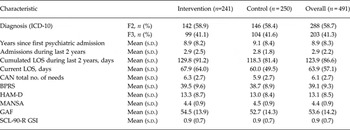
As shown in Table 2, participants with schizophrenia as the main diagnoses only slightly outnumbered those diagnosed with depression, and average duration of illness was 9 years. During the previous 2 years (excluding the index hospital stay that lasted 2 months on average), participants had three hospitalisations for mental health reasons for a total mean duration of 4 months.
Clinical sample characteristics at baseline

Notes: LOS, length of stay; CAN, Camberwell Assessment of Need; BPRS, Brief Psychiatric Rating Scale; HAM-D, Hamilton Depression Scale; MANSA, Manchester Short Assessment of Quality of Life; GAF, Global Assessment of Functioning; SCL-90-R, Symptom Check List-90-Revised. n = 427 for GAF; n = 456 for SCL-90-R; for other variables, n = 485–491.
Scores on outcome scales at intake indicated moderate impairment for the BPRS (cf. Leucht et al. Reference Leucht, Kane, Kissling, Hamann, Etschel and Engel2005), moderate symptoms for the GAF, and self-rated psychological distress on the SCL-90-R GSI was clearly in the dysfunctional range (cf. Schauenburg & Strack, Reference Schauenburg and Strack1999).
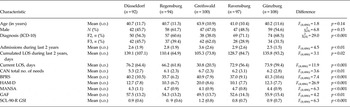
Substantial differences by site emerged on all variables shown in Table 3 except for age. Single comparisons (not reported in detail) yielded that participants in Greifswald stood out in showing a specific pattern of service use (more and shorter stays) and also higher impairment (more unmet needs and depression, and lower quality of life as well as level of functioning). Differences among the other (West German) centres were less prominent.
Key baseline characteristics by site

Notes: LOS, length of stay; CAN, Camberwell Assessment of Need; BPRS, Brief Psychiatric Rating Scale; HAM-D, Hamilton Depression Scale; MANSA, Manchester Short Assessment of Quality of Life; GAF, Global Assessment of Functioning; SCL-90-R, Symptom Check List- 90-Revised Global Severity Index; N see Tables 1 and 2.
Participant flow
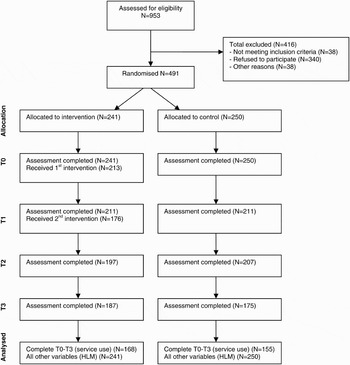
Figure 1 shows the flow of study participants through the different stages of the trial. Of 953 subjects screened, 491 (51.5%) fulfilled inclusion criteria, gave written-informed consent and were randomly allocated to either intervention or control group. Not all participants in the intervention group received the full dose (i.e. two sessions) of the intervention. Attrition total (loss between T0 and T3) was 26%, and attrition was highest for the early (14% between T0 and T1), but much lower for the later assessments (4% between T1 and T2, and 10% between T2 and T3 respectively), and attrition rates did not differ by allocation. N = 323 (two-thirds of the participants included) provided complete data at all four measurement points, and completion rate did not differ by allocation (52.0% intervention v. 48.0% the control group, χ2 n.s.). Furthermore, completers did not differ from non-completers (who participated less often than that) at baseline on any of the variables listed in Table 3 (results not reported in detail) except that they were a bit older (42.1 v. 39.9 years, T (489) = −2.06, p = 0.04).
Participant flow (CONSORT).

Primary endpoints
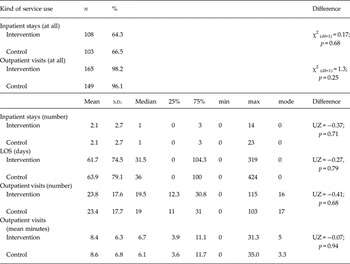
As shown in Table 4, more than half of the participants were rehospitalised during the 18-month follow-up period, and hardly any had no contact to specialist mental health outpatient services during that time. The median number of rehospitalisations was 1 with a median LOS of 24 days, and median number of outpatient specialist visits was 17 with a median average duration of 7 mins.
Service use during follow-up by allocation

Notes: Intervention N = 168; Control N = 155. UZ = Mann–Whitney UZ value; LOS, length of stay.
None of the service use variables analysed showed differences by allocation, i.e. participants in the intervention group neither exhibited lower inpatient service use nor higher number and duration of outpatient visits.
Secondary endpoints
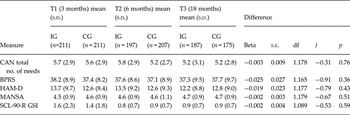
Table 5 (cf. also baseline values from Table 2) shows data of secondary outcome scales over time. Hierarchical linear models revealed overall substantial improvement over time, but pace of change (slope) did not differ by allocation on any of these variables.
Outcome at follow-up by allocation

Notes: CAN: 1669 observations of 489 participants; Goodness of fit: AIC (Aikaike information criterion) = 7736.0; BIC (Bayesian information criterion) = 7779.4; logLik (restricted log-likelihood) = −3860.0; BPRS: 1657 observations of 490 participants; Goodness of fit: AIC = 11 622.7; BIC = 11 665.9; logLik = −5803.4; HAMD: 1668 observations of 489 participants; Goodness of fit: AIC = 11 428.1; BIC = 11 471.4; logLik = −5706.0; MANSA: 1670 observations of 489 participants; Goodness of fit: AIC = 4066.6; BIC = 4109.9; logLik = −2025.3; SCL-90-R GSI: 1575 observations of 484 participants; Goodness of fit: AIC = 5073.1; BIC = 5115.9; logLik = −2528.6.
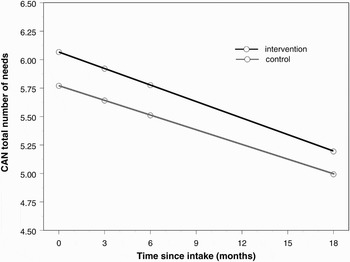
This result is illustrated for CAN total number of needs in Fig. 2 which shows that participants started with 5.9 unmet needs at baseline (intercept) with a marginal difference by allocation (0.15 points). Rate of change was −0.05 points per month (significantly different from zero) but does not differ by allocation (only by 0.003 points, cf. beta shown in Table 5).
Fitted (HLM) course over time of total number of needs.

Discussion
This multicentre randomised controlled trial, in a sample of N = 491 participants, tested the efficacy of needs-oriented discharge planning for people with severe mental illness with a defined high utilisation of mental health services. The NODPAM intervention consisted of two intertwined sessions administered at discharge from inpatient services (session 1) and 3 months thereafter (session 2). This study is the largest randomised controlled trial of discharge planning to be conducted to date (cf. Steffen et al. Reference Steffen, Kösters, Becker and Puschner2009), with the sample size allowing adequate statistical power to give clear answers to the research questions, and the outcome measures applied being well established in mental health services research and administered by trained raters.
Sample
Individuals included in the study were people diagnosed with schizophrenia or depression in their early 40s with significant severity of mental health problems in terms of illness duration (mean: 9 years), and inpatient mental health service use during the two preceding years (on average three inpatient stays and 4 months cumulated LOS). In other words, this population had been spending an average of 1 in 6 days at a mental health-care institution. Illness severity at baseline as indicated by a number of standardised outcome scales measuring needs, psychopathology, depression and functioning was moderate. This is what one would expect given that patients were recruited into the study before discharge from inpatient care.
The randomisation produced no substantial differences between intervention and control groups at baseline. However, there were considerable differences among the six sites with the one centre in East Germany standing out. There – as compared to the other sites all of which are located in the Western part of the country – participants were hospitalised more often and for shorter periods, and also scored higher on needs and depression, as well as lower on subjective quality of life and level of functioning. This might also relate to this region's structural problems including high rates of unemployment.
Effect of the intervention
Intention-to-treat analyses revealed no differences between intervention and control groups on neither primary nor secondary outcomes. This means that participants who received (or rather were intended to receive) the NODPAM intervention did not exhibit less inpatient service use during the follow-up period nor did they utilise more outpatient mental health services. They also had no superior ‘soft’ outcome with regard to unmet need, psychopathology, depression and quality of life.
We shall discuss the interpretation of our findings in terms of the intervention and the methods of analysis used. First, the intervention was intentionally low-key and comprised two sessions only. Personal continuity was sustained by the NOPAM IW being present at both sessions, but no effort was made to bring the two ‘systems’ (in- and outpatient care) together in person, e.g. by establishing close(r) personal contact between service providers as in another study on the subject, which yielded positive results (Boyer et al. Reference Boyer, McAlpine, Pottick and Olfson2000). Personal involvement of the NODPAM IW was limited to organising and conducting these very two sessions in line with the manual, but no more. There was no further investment of IW time, e.g. to assist a patient in implementing steps agreed upon to meet specific unmet needs during the intervention sessions. This is different from the (effective) critical-time intervention as applied in the USA (Dixon et al. Reference Dixon, Goldberg, Iannone, Lucksted, Brown, Kreyenbuhl, Fang and Potts2009) where participants were assigned a key worker who accompanied them closely, assisted with administrative errands and helped them get back to their daily routine outside the clinic. However, feedback from service users and clinicians as well as from NODPAM research and IWs suggests that this is a crucial issue in the transition phase and should be considered as a shortcoming of the NODPAM intervention. With hindsight, service users should have received more support in order for them to be able to better switch from the full provision of inpatient care towards taking (back) responsibility for themselves at the outpatient care setting. This appears to be particularly difficult for service users who are being discharged prior to full recovery and for whom a prolonged phase of aftercare with close monitoring is indicated.
Second, the method of analysis applied in this paper was rigorous and strictly followed the analysis plan as laid out in the study protocol (intention-to-treat). It might well be that the effect varied by e.g. the dose and quality of delivery of the NODPAM intervention, or by site; or that other endpoints – e.g. time until relapse – might have yielded different (positive) results.
The central idea underlying the NODPAM intervention (in line with the concept of ‘critical-time intervention’) was that delivering the intervention ‘on the point’ when most needed – i.e. at the time of hospital discharge – would yield a substantial effect, especially with a sample of high utilisers of mental health services with ‘much room to improve’. It is difficult to disentangle a possible plethora of reasons for the lack of an effect. The crucial question seems to be ‘How appalling is the misery such an intervention seeks to alleviate?’ On the one hand, as outlined above, the intervention itself may have been too weak resembling a hardly noticeable drop in the complex ocean of mental health care. On the other hand, treatment-as-usual might have been ‘good enough’ or at least very hard to further improve on. This is exemplified by the fact that almost all participants (96%) were in contact at least once with outpatient specialist services during follow-up. Also informal contacts between inpatient and outpatient clinicians – e.g. phone calls in especially in urgent cases – might have occurred notwithstanding the NODPAM intervention. This line of argument ties into recent critical views of ‘treatment-as-usual-studies’ (Burns, Reference Burns2009).
Finally, it should also be noted that interventions effective in improving discharge planning for people with mental illness (e.g. Boyer et al. Reference Boyer, McAlpine, Pottick and Olfson2000; Dixon et al. Reference Dixon, Goldberg, Iannone, Lucksted, Brown, Kreyenbuhl, Fang and Potts2009), almost exclusively produced effects on ‘hard’ outcomes such as readmission rate which have limitations in that they only measure what people get, but not what they need (Rössler et al. Reference Rössler, Löffler, Fätkenheuer and Riecher-Rössler1992). This, of course, is no point in favour of the NODPAM intervention that also failed to show effects on secondary outcomes such as needs, psychopathology and depression. Further analyses per-protocol and process evaluation (Oakley et al. Reference Oakley, Strange, Bonell, Allen and Stephenson2009) will investigate contextual factors and subgroup variations in detail in order to move beyond the question of an overall effect of the NODPAM intervention that has been clearly answered negatively in this paper.
On a broader perspective, results of this trial might also be interpreted to indicate that fragmented care systems such as the German one are generally not well equipped to meet the needs of people with severe mental illness for continuous care of varying intensity. This population might be better served by community teams delivering intensive outreach closely integrated with inpatient services (Burns et al. Reference Burns, Catty, Dash, Roberts, Lockwood and Marshall2007; Marshall, Reference Marshall2008; Malone et al. Reference Malone, Newron-Howes, Simmonds, Marriot and Tyrer2010). Such a team would then remain responsible for the patient during an inpatient episode, including discharge planning and continuity of care. Even though this RCT did not carry out a head-to-head comparison of the effectiveness of such different care models, it could be argued that it demonstrated just the same that the needs of patients with severe mental illness can be met only with comprehensive interventions in the community, and that time is ripe to modernise provision of mental health care in Germany into this direction (Weinmann, Puschner & Becker, Reference Weinmann, Puschner and Becker2009; Thornicroft et al. Reference Thornicroft, Alem, Antunes Dos Santos, Barley, Drake, Gregorio, Hanlon, Ito, Latimer, Law, Mari, McGeorge, Padmavati, Razzouk, Semrau, Setoya, Thara and Wondimagegn2010).
Acknowledgements
The NODPAM study is a multicentre collaboration between the Department of Psychiatry II, Günzburg, Ulm University, Germany; the Department of Psychiatry and Psychotherapy, Düsseldorf University, Germany; the Department of Psychiatry and Psychotherapy, Stralsund, Greifswald University, Germany; the Department of Psychiatry and Psychotherapy, Regensburg University, Germany; the Department of Psychiatry I, Ravensburg, Ulm University, Germany; and the Institute for Biometrics, Ulm University, Germany.
The views expressed in this publication are those of the authors and not necessarily those of the funders. We would like to acknowledge the contributions to this study of the following colleagues: Ulm/Günzburg site (Constanze Lahmeyer, Rana Kalkan, Katja Vitkin, Juliane Wieser), Düsseldorf site (Meike Ramacher, Helga Zimmer†, Katrin Fisahn), Greifswald site (Harald Freyberger, Britta Skoeries, Kathrin von Rad), Regensburg site (Katja Sohla, Veronika Steinkohl, Annett Janner, Verena Fischer, Natalie Philipp), Ulm/Ravensburg site (Jan Bergk, Andrea Döbler, Ute Scheck); Ulm/Biometrics (Friedericke Rohlmann); Trial Steering Committee (Wolfram Voigtländer/Heidenheim, Ursula Plagemann/Leipzig, Arno Gutmair/Dillingen); Data Monitoring Committee (Markus Kösters/Ulm, Paulo Kling Lourenço/Ulm); Advisory Board (Norbert Südland/Aalen, Eva Straub/Germersheim, Aart Schene/Amsterdam, Graham Thornicroft/London, Mike Slade/London, Michele Tansella/Verona, Ferdinand Beylacher/Augsburg). We also wish to acknowledge the contributions of the patients, carers and staff who have taken part in this study.
Declaration of interests
The study was funded by a grant from the German Research Foundation (DFG) in the Special Programme ‘Clinical Studies’ (Grant number BE 2502/3-1). Bernd Puschner, Sabine Steffen, Kathleen A. Völker, Birgit Janssen, Julia Grempler, Helmfried E. Klein and Rainer Muche declare that they have not received any form of financing including pharmaceutical company support or any honoraria for consultancies or interventions during the last 2 years. Carsten Spitzer has received travel funds and speakers' honoraria from Janssen-Cilag and Boehringer-Ingelheim, and he has received a research grant from the ‘Stiftung zur Aufarbeitung der SED-Diktatur’. Wolfgang Gaebel has received speakers' honoraria and research grants from Astra Zeneca, Janssen-Cilag, Eli-Lilly and Sevier, and he is member of the scientific advisory boards of Janssen-Cilag, Eli-Lilly, Lundbeck and Wyeth. Hermann Spiessl has received speakers' honoraria from Astra Zeneca, Bristol-Myers Squibb, Boehringer, Janssen-Cilag, Eli-Lilly and Merz. Tilman Steinert has received research grants from Astra Zeneca, from the German Network for Mental Health and from the German Foundation for Mental Health. Thomas Becker has received research grants from Astra Zeneca, AOK (health insurance company), the German Association for Psychiatry and Psychotherapy (DGPPN) and the Robert-Bosch-Foundation; his department has also received funds to a minor extent for symposia and in-house training from Affectis, Astra Zeneca, Bristol-Myers Squibb, Fresenius Kabi, Janssen-Cilag, Eli-Lilly, Lundbeck and Servier. All authors declare that they have no other involvements that might be considered a conflict of interest in connection with this article.