Introduction
Traumatic life events are risk factors for psychosis (Varese et al. Reference Varese2012; Green et al. Reference Green, Pariante and Lapiz-Bluhm2014; Read et al. Reference Read2014; Gibson et al. Reference Gibson, Alloy and Ellman2016) and are associated with morphological and functional alterations in brain regions critical for executive functioning (Hart & Rubia, Reference Hart and Rubia2012; Teicher & Samson, Reference Teicher and Samson2013; Lim et al. Reference Lim, Radua and Rubia2014; Teicher et al. Reference Teicher2016). Executive functions represent candidate cognitive endophenotypes that cut across diagnostic categories (Reichenberg et al. Reference Reichenberg2009; Hill et al. Reference Hill2013) with deficits in response inhibition, in particular, being proposed to underlie core symptoms of schizophrenia and related psychoses (Peters et al. Reference Peters2000; Ivleva et al. Reference Ivleva2012). Cognitive functions in psychotic disorders are influenced by childhood trauma exposure (Lysaker et al. Reference Lysaker2001; Aas et al. Reference Aas2011; Shannon et al. Reference Shannon2011), but the associated brain mechanisms are yet to be determined. Here, we investigated the effects of trauma exposure on functional brain indices of response inhibition in patients with schizophrenia or schizoaffective disorder (together referred to as SZ) or psychotic bipolar-I disorder (BD), relative to trauma-exposed and non-exposed healthy individuals.
Several studies now report trauma-related structural brain aberration in mixed samples of psychotic disorders (i.e. comprising schizophrenia, schizoaffective disorder, and psychotic bipolar cases), including reduced grey matter in the left dorsolateral prefrontal cortex (DLPFC) and the anterior cingulate cortex (ACC) (Sheffield et al. Reference Sheffield2013), or in the right DLPFC in a sample of schizophrenia patients only (Cancel et al. Reference Cancel2015). However, relatively few studies have examined the effects of childhood trauma on cognitive brain function in cross-disorder groups of psychosis patients. One functional brain imaging study of a mixed psychosis sample has shown trauma-related inefficient recruitment of the inferior parietal lobule (IPL) during working memory performance (Quidé et al. Reference Quidé2017). While this study was the first to show trauma-related dysfunction in this inhibitory brain region (IPL), adequate response inhibition also critically involves the supplementary motor area (SMA) and the inferior frontal gyrus (IFG), in addition to the functional integrity of the DLPFC and dorsal ACC (dACC) (Aron, Reference Aron2011; Criaud & Boulinguez, Reference Criaud and Boulinguez2013). Abnormal functionality of these regions has been demonstrated in previous studies without reference to trauma exposure. For example, schizophrenia patients have shown decreased activation in the dACC, right IFG and caudate, and increased connectivity between the dACC and bilateral DLPFC, IFG and IPL compared with healthy participants during an inhibitory (Go/No-Go Flanker) task (Sambataro et al. Reference Sambataro2013). Similarly, decreased IFG activation has been associated with fearful face inhibition (using a face-emotion Go/No-Go task) in youths at high risk for BD (Roberts et al. Reference Roberts2013), while dACC function appears to be intact in adult BD cases (Welander-Vatn et al. Reference Welander-Vatn2013).
In non-psychotic young people, trauma exposure is consistently associated with increased activation in the dACC during inhibition. Youth exposed to stress (some with posttraumatic stress symptoms) also show increased activation in the medial prefrontal cortex (mPFC), the IFG, pre-postcentral gyri, striatum and posterior insula, as well as decreased activation of the DLPFC during (competent) inhibition (Carrion et al. Reference Carrion2008; Mueller et al. Reference Mueller2010). Interestingly, trauma-exposed young people with psychiatric comorbidities, including phobia, mood, anxiety, conduct and posttraumatic stress disorders (PTSD) show increased activation in the dACC, SMA and dorsomedial PFC in the context of deficient inhibitory performance (Lim et al. Reference Lim2015). Overall, these findings indicate functional alterations in key brain regions (dACC, IFG, IPL, SMA and DLPFC) for response inhibition that have been independently associated with psychosis and childhood trauma exposure, but to date have not been investigated together.
Given the high prevalence of childhood trauma exposure reported in psychotic disorders (Duhig et al. Reference Duhig2015), it is possible that exposure to childhood trauma impacts brain maturation, and contributes to the development of psychosis-related brain alterations, via a traumatogenic pathway to psychosis (Read et al. Reference Read2014). Alternatively, symptoms of disorder may precede the development of brain abnormalities in psychosis and mood disorders arising in the context of trauma exposure. While we did not have access to a developmental sample here, we set out to examine brain activation and functional connectivity associated with childhood trauma exposure during a Go/No-Go Flanker task (Blasi et al. Reference Blasi2006; Sambataro et al. Reference Sambataro2013), in a mixed diagnostic group of patients with schizophrenia, schizoaffective disorder and psychotic BD, relative to non-exposed clinical cases, and both trauma-exposed and non-exposed healthy individuals. Given greater symptom severity associated with childhood trauma exposure (Alvarez et al. Reference Alvarez2011; Duhig et al. Reference Duhig2015), we explored associations between trauma, brain function and symptom severity, including formal tests of the potential mediation of the effects of trauma exposure on brain function by symptom severity, or whether brain function was a significant mediator of the effects of trauma exposure on symptom severity. We specifically hypothesized that trauma-exposure would be associated with increased activation of regions specifically involved in the performance of complex response inhibition (left and right IFG, right DLPFC, right IPL and right SMA; Criaud & Boulinguez, Reference Criaud and Boulinguez2013), and the dACC, regardless of diagnostic status. In addition, we expected to observe trauma-related alterations in the functional connectivity between regions specific to inhibition (IFG, SMA) and common cortical regions involved in executive functions (IPL, DLPFC). Given that previous studies have found psychosis-related abnormalities in these brain regions, regardless of trauma-exposure, we also expected to observe main effects of psychosis and trauma in overlapping regions such as the dACC, though differentiated in the direction of activation. That is, we expected decreased activation of the dACC in association with a diagnosis of schizophrenia, schizoaffective disorder or bipolar disorder (reflecting typical regional activation in psychosis patients) relative to healthy controls (HCs), while there would be increased dACC activation in trauma-exposed participants (cases and controls) relative to non-exposed individuals, on the basis of previous findings in ostensibly healthy individuals (Hart & Rubia, Reference Hart and Rubia2012; Teicher & Samson, Reference Teicher and Samson2013; Teicher et al. Reference Teicher2016). With regard to the tests of mediation, we expected that symptom severity would at least partially mediate the relationship between trauma exposure and inhibitory brain activation, in the mixed psychosis sample.
Methods
All participants were volunteers who provided informed consent according to procedures approved by the UNSW Human Research Ethics committees (HC12384), the South East Sydney and Illawarra Area Health Service (HREC 09/081) and St Vincent's Hospital (HREC/10/SVH/9).
Participants
Participants included 112 clinical cases meeting ICD-10 criteria (WHO, 2008) for lifetime diagnoses of schizophrenia (n = 36), schizoaffective disorder (n = 20) or BD with psychosis (n = 56). Diagnoses were confirmed using the OPCRIT algorithm (McGuffin & Farmer, Reference McGuffin and Farmer1991) applied to interviewer ratings on the Diagnostic Interview for Psychosis (Castle et al. Reference Castle2006). There were 53 HCs with no personal history of DSM-IV Axis-I disorder and no history of psychotic disorders in their first-degree biological relatives on the basis of the Mini-International Neuropsychiatric Interview (Sheehan et al. Reference Sheehan1998). Participants were recruited from local community health services, the Australian Schizophrenia Research Bank (ASRB; Loughland et al. Reference Loughland2010), the Black Dog Institute Bipolar Disorders clinic (Mitchell et al. Reference Mitchell2009), and via local community advertisements. All included participants were aged between 18 and 65 years old, were eligible for magnetic resonance imaging protocols and did not meet the following exclusion criteria: inability to communicate sufficiently in English, current neurological disorder, lifetime head injury with loss of consciousness, substance abuse or dependence in the past 6 months, and having received electroconvulsive therapy within the past 6 months.
Materials
Clinical and cognitive assessments
Current symptom severity was determined using the Depression, Anxiety and Stress Scale (DASS; Lovibond & Lovibond, Reference Lovibond and Lovibond1995), the Positive and Negative Syndrome Scale (PANSS; Kay et al. Reference Kay, Opler and Lindenmayer1989), the Montgomery-Åsberg Depression Rating Scale (MADRS; Montgomery & Asberg, Reference Montgomery and Asberg1979), the Bipolar Depression Rating Scale (BDRS; Berk et al. Reference Berk2007) and the Young Mania Rating Scale (YMRS; Young et al. Reference Young1978). Participants also completed the Wechsler Abbreviated Scale of Intelligence (WASI; Wechsler, Reference Wechsler1999) as an index of current IQ, and handedness was determined using the Edinburgh Handedness Inventory (Oldfield, Reference Oldfield1971). Medication dosages were measured in imipramine (IMI) equivalents for antidepressants and chlorpromazine equivalents (CPZ) for antipsychotic drugs (Leucht et al. Reference Leucht2003; Woods, Reference Woods2003); the number of cases using mood stabilizers (including lithium, carbamazepine, valproate and lamotrigine) was recorded in lieu of dosage equivalents for these drugs.
Childhood trauma exposure
Exposure to childhood trauma was measured using the short form (25 items) of the Childhood Trauma Questionnaire (CTQ; Bernstein et al. Reference Bernstein2003). The CTQ is a self-report questionnaire that retrospectively measures domains of emotional (EA), physical (PA) and sexual (SA) abuse, as well as physical (PN) and emotional (EN) neglect. For each domain, a score is calculated from five items rated on a five-point Likert scale ranging from 1 (never true) to 5 (very often true). Participants were allocated to trauma-exposed groups if they endorsed moderate to extreme levels of trauma on at least one CTQ subscale (i.e. EA > 12; PA > 9; SA > 7; EN > 14; PN > 9) (Bernstein et al. Reference Bernstein2003; Shannon et al. Reference Shannon2011; Mørkved et al. Reference Mørkved2017; Quidé et al. Reference Quidé2017). Non-exposed participants were defined as those not reporting moderate to extreme levels of trauma on any CTQ subscale. According to these criteria, there were 71 exposed clinical cases (20 schizophrenia, 14 schizoaffective and 37 bipolar cases), 41 non-exposed cases (16 schizophrenia, 6 schizoaffective and 19 bipolar cases), and 21 exposed HC relative to 32 non-exposed HC.
Functional magnetic resonance imaging (fMRI) stimuli and modified Flanker task
We measured blood-oxygenation level dependent (BOLD) signal changes during the performance of a standard Go/No-Go Flanker task (Blasi et al. Reference Blasi2006; Sambataro et al. Reference Sambataro2013). In this event-related paradigm, a central arrow pointing left or right was presented on each trial, and flanked by two pairs of symbols (arrows, boxes or X's). Participants were asked to indicate the direction of the central arrow as quickly and accurately as possible. All participants completed the same pseudo-random sequence of trials, which included four experimental conditions. On ‘Congruent’ trials (N = 41) the central arrow was flanked by congruently oriented arrows, while on ‘Incongruent’ trials (N = 40) the flanking arrows pointed in the opposite direction. On ‘Neutral’ trials (N = 31) the central arrow was flanked by task-irrelevant boxes, and on ‘No-Go’ trials (N = 33), two pairs of lateral X's instructed the participant to inhibit any motor response. Each trial was presented for 800 ms and a fixation crosshair was presented between each trial (inter-trial-interval = 2200–5200 ms). Stimuli were displayed by Presentation software (Neurobehavioral Systems, Inc.) on a Philips LCD monitor at the rear of the magnet, and viewed by the participant via a standard head coil mirror. A Cedrus Lumina response box was used to record behavioural responses. Before entering the scanner, participants were allowed to practice the behavioural task to ensure comprehension.
fMRI data acquisition and pre-processing
We acquired 306 whole brain T2* weighted echo-planar images (EPI), slice thickness 4, 0.3 mm gap, 32 axial slices in ascending order, TR 2000 ms, TE 30 ms, flip angle 80°, matrix 96 × 96, field of view 240 mm, on a Philips 3 T Achieva TX scanner (Philips Healthcare, Best, The Netherlands) with a 32-channel head coil, housed at Neuroscience Research Australia (Randwick, NSW, Australia). A high-resolution T1-weighted anatomical scan (MPRAGE) was also obtained for each participant for registration and screening; TR 8.9 ms, TE 4.1 ms, field of view 240 mm, matrix 268 × 268, 200 sagittal slices, slice thickness 0.9 mm (no gap). A radiologist reviewed all scans, and all images were visually inspected to ensure that no gross abnormalities were evident. Image processing and analyses were performed using SPM8 (Wellcome Trust Centre for Neuroimaging, London, UK; http://www.fil.ion.ucl.ac.uk/spm) in Matlab r2011b (Mathworks Inc., Sherborn, MA, USA), and SPM12 for the estimation of cluster extent accounting for multiple comparison correction for F-tests. The pre-processing pipeline is described in online Supplementary Material.
Regions-of-interest (ROIs)
ROIs for functional activation and connectivity analyses were defined as 6 mm radius spheres for the left and right IFG, the right IPL, right DLPFC, right SMA and dACC. The ROIs were built using the Marsbar toolbox for SPM8 (http://marsbar.sourceforge.net; Brett et al. Reference Brett2002) and placed around coordinates published in a meta-analysis of complex Go/No-Go tasks (Criaud & Boulinguez, Reference Criaud and Boulinguez2013). Details on ROIs derivation are provided in online Supplementary Material.
Task-related functional connectivity
Whole-brain functional connectivity (functional coupling) during response inhibition with each of the separate seed regions (defined above) was estimated using the generalized Psycho-Physiological Interactions toolbox (gPPI, v7.12, https://www.nitrc.org/projects/gppi; McLaren et al. Reference McLaren2012). Details are provided in online Supplementary Material.
Analyses
Behavioural and clinical data
Descriptive statistics were performed using SPSS 23 (IBM).
Brain imaging
Main effects of trauma, diagnosis, and their potential interaction on brain function in candidate ROIs were investigated using a 2 × 2 multivariate analysis of variance (MANOVA), with trauma (exposed/non-exposed) and diagnosis (cases/controls) as fixed factors, within SPM8. Statistical significance was set at p < 0.05 for the multivariate level, and was appropriately adjusted for the six ROIs at the univariate level using a strict Bonferroni correction (p < 0.008). A series of whole-brain 2 × 2 ANOVAs were also conducted to estimate main effects of trauma, diagnosis and their interaction on functional connectivity with each seed region separately. Statistical significance was set with an initial voxel-level threshold of p < 0.001 uncorrected, to which a FWE-correction at the cluster-level was applied [p(FWEc) < 0.05]; an additional Bonferroni correction was applied to the cluster statistics due to the number of seed regions explored [p(FWEc)⩽0.008].
Correlational analyses
Additional Pearson's correlations were used to explore associations between activation in each ROI separately and task performance (p < 0.05). Given differences in levels of antipsychotic drug use among trauma-exposed and non-exposed cases (see the ‘Results’ section), we investigated potential associations between brain function (ROIs) and CPZ-equivalent medication levels using Pearson's product-moment correlations (p < 0.05, two-tailed). Similarly, the association between symptom severity (PANSS positive, negative and general sub-scores) and brain function was explored (p < 0.05, two-tailed).
Mediation analyses
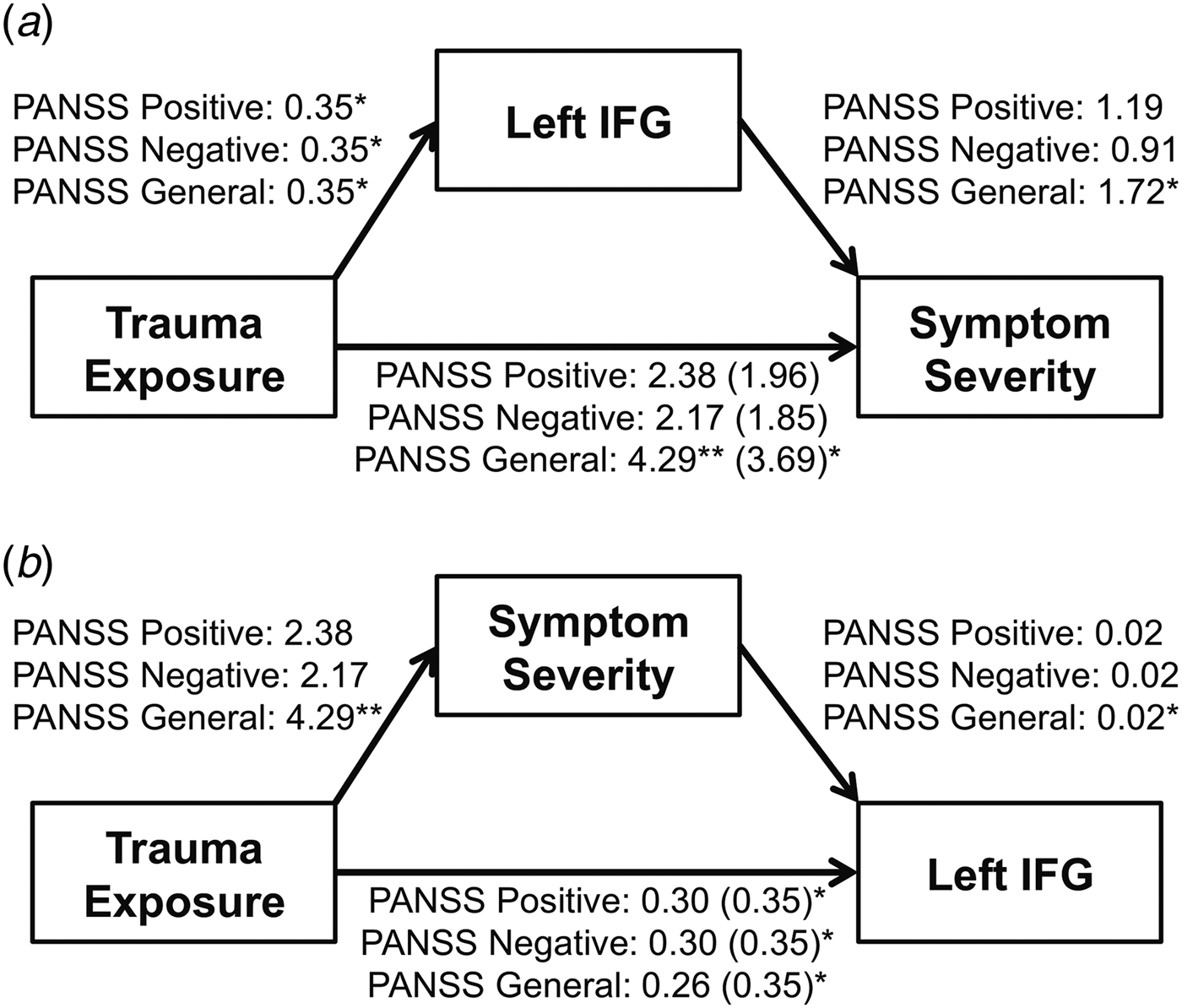
A power analysis using G*Power 3.1.9.2 (Faul et al. Reference Faul2007; Faul et al. Reference Faul2009) indicated that a minimum of 68 participants was necessary for these mediation analyses (F 2,65 = 3.14, λ = 10.20), and thus confirmed that our clinical sample (n = 112) was of sufficient size to achieve 80% power for detecting a medium (f 2 = 0.15) effect for two predictors (α = 0.05). Two mediation models were investigated using the PROCESS toolbox for SPSS (v2.16.1, www.afhayes.com; Hayes, Reference Hayes2013): (1) the potential role of left IFG activation in mediating the effects of trauma exposure on PANSS symptom severity (PANSS positive, negative and general scales, separately), and (2) the potential role of symptom severity in mediating the effects of trauma exposure on left IFG activation.
Results
Sample characteristics
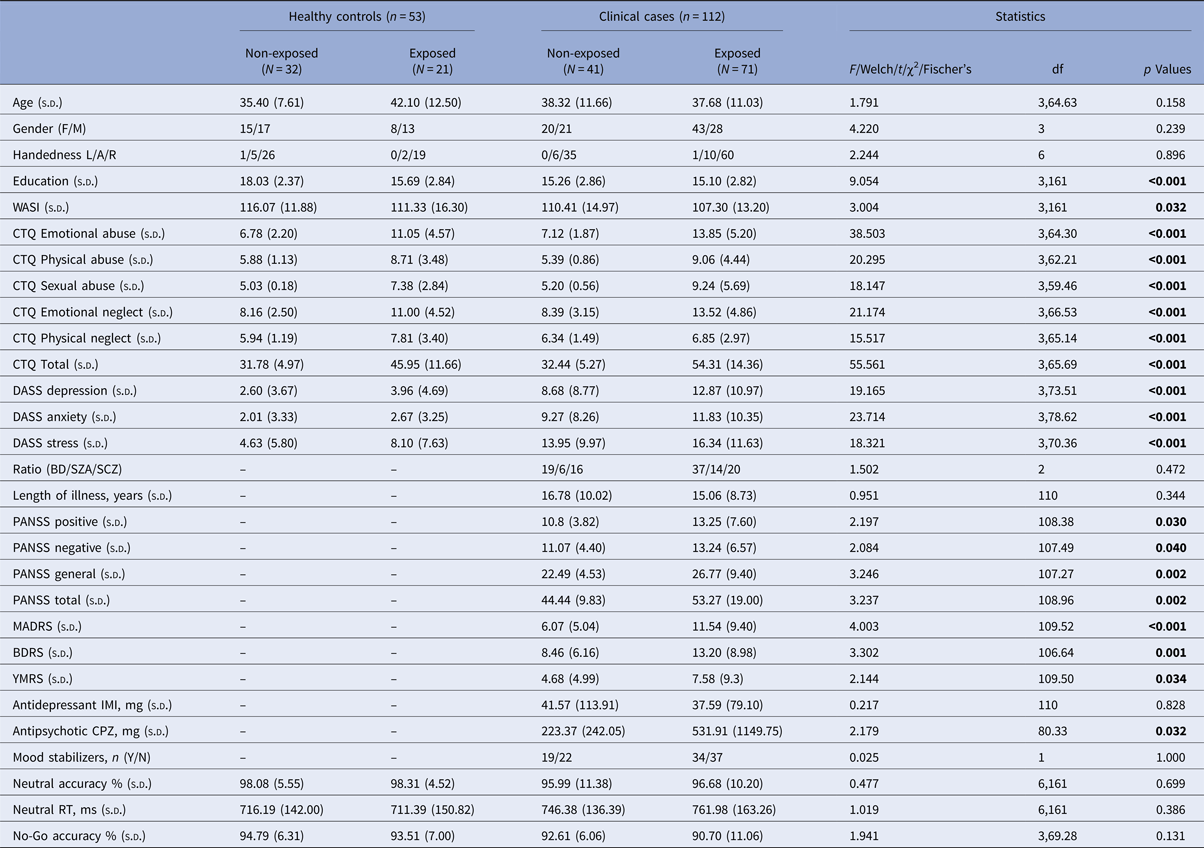
Table 1 presents descriptive details for experimental groups defined by trauma exposure. One-way analyses of variance (ANOVAs) and χ2 tests indicated that these experimental groups did not differ in age, sex or handedness. However, all cases (regardless of trauma exposure) and exposed HCs were significantly less educated than non-exposed HCs (all p ⩽ 0.015). Only exposed cases had lower IQ levels than non-exposed HCs (p = 0.018). Fischer's Exact test indicated that diagnoses were distributed equally across trauma-exposed and non-exposed clinical groups. Exposed and non-exposed cases did not differ in terms of antidepressant dosages (p = 0.828) or mood stabilizer use (p = 1.000), but exposed cases reported greater levels of antipsychotic dosages than the non-exposed cases (p = 0.032).
Sociodemographic, clinical and behavioural data and results of comparisons among trauma subtypes

df, degrees of freedom; s.d., standard deviation; BD, bipolar-I disorder; SZA, schizoaffective disorder; SCZ, schizophrenia; L/A/R, left handed, ambidextrous or right handed; WASI, Wechsler abbreviated scale of intelligence; CTQ, childhood trauma questionnaire; DASS, depression, anxiety and stress scale; PANSS, positive and negative syndrome scale; MADRS, Montgomery-Åsberg depression rating scale; BDRS, bipolar depression rating scale; IYMRS, Young mania rating scale; IMI, mean imipramine dosage equivalent in milligrams; CPZ, mean chlorpromazine dosage equivalent in milligrams; RT, reaction time in milliseconds. Significant group differences are in bold
One-way ANOVAs conducted on CTQ subscales indicated that the trauma-exposed groups (cases and HCs) reported greater levels of emotional and physical abuse compared with non-exposed groups (all post hoc tests p ⩽ 0.011); only the trauma-exposed cases additionally reported greater levels of sexual abuse (all p < 0.001), and emotional (all p < 0.001) and physical neglect (all p < 0.001), compared with non-exposed groups. Finally, exposed cases reported greater levels of emotional abuse when compared to exposed HCs (p = 0.029), who in turn reported greater levels of physical neglect than non-exposed HCs (p = 0.001). Overall, clinical and non-clinical trauma exposed cases reported greater CTQ total score than both non-exposed groups (all p < 0.001), with the exposed cases reporting a larger total trauma severity score than exposed HCs (p = 0.012).
One-way ANOVAs on the DASS-21 indicated that all cases reported greater levels of depression (for all post hoc tests, p ⩽ 0.019), anxiety (all p ⩽ 0.001) and stress (all p ⩽ 0.001), regardless of trauma exposure, relative to the non-exposed HC group. The DASS-21 subscales for exposed cases were also significantly greater than for exposed HCs (all p ⩽ 0.005). Two-sample t tests indicated that exposed cases also reported greater psychotic symptom severity (all PANSS subscales; all p ⩽ 0.040) as well as depression (MADRS; p < 0.001), bipolar (BDRS; p = 0.001) and mania (YMRS; p = 0.034) levels than the non-exposed cases.
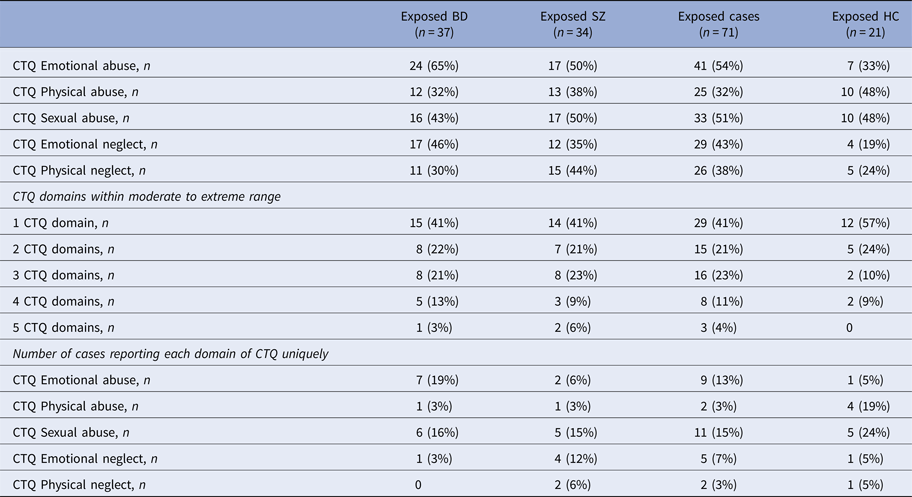
Among the exposed cases and controls, there were high rates of endorsing more than one type of trauma, with 59% of exposed cases and 57% of exposed HCs reporting significant levels of trauma exposure in more than one CTQ domain (see Table 2).
Number and type of CTQ domains endorsed by BD, SZ and HC groups

CTQ, childhood trauma questionnaire; BD, bipolar I disorder; SZ, schizophrenia/schizoaffective disorder; HC, healthy participants.
Behavioural results
One-way ANOVAs (Table 1) confirmed no group differences in task accuracy for the ‘Neutral’ (p = 0.699) and ‘No-Go’ (p = 0.386) conditions, and no difference in reaction time for the ‘Neutral’ condition (p = 0.131).
Brain imaging
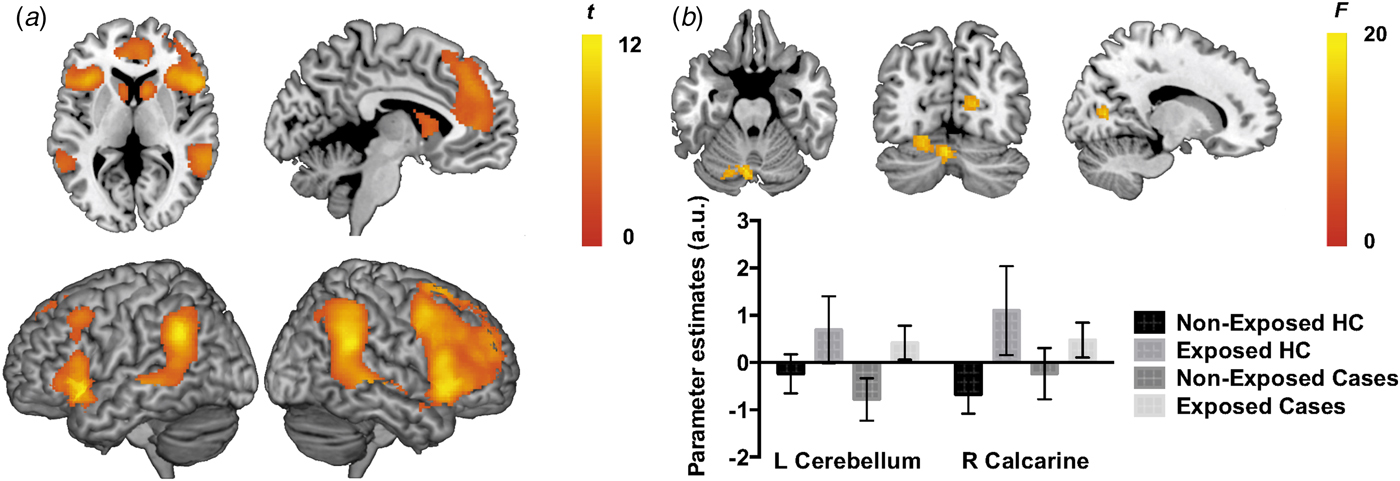
The positive effect of task (‘No-Go > Neutral’) across the whole sample was evident in regions classically implicated in response inhibition, including bilateral dACC/mPFC, IFG/anterior insular cortex (AIC), DLPFC, IPL and striatum (Fig. 1a).
Positive effect of task (a) and main effect of childhood trauma exposure on functional connectivity with the left inferior frontal gyrus (IFG) seed region (b). Colour bar represents F- or t-values values; error-bars represent 95% confidence interval; a.u.: arbitrary unit; initial p<0.001 uncorrected, with cluster-wise family-wise error (FWE) correction [p(FWEc) = 0.05].

Regions-of-interest
The initial ROI analysis (MANOVA including all ROIs as dependent variables: left and right IFG, right DLPFC, right IPL, SMA and dACC), revealed no significant trauma-by-diagnosis interaction (Wilks’ λ = 0.949; F 6,156 = 1.393, p = 0.221; partial η 2 = 0.051) or main effect of diagnosis (Wilks’ λ = 0.959; F 6,156 = 1.117, p = 0.355; partial η 2 = 0.041), but a significant main effect of trauma exposure (Wilks’ λ = 0.876; F 6,156 = 3.668, p = 0.002; partial η 2 = 0.124). When the results for the dependent variables were considered separately, the left IFG was the only region to reach statistical significance (F 1,161 = 13.151, p < 0.001, partial η 2 = 0.076), with trauma-exposed groups showing significantly increased activation (M = 1.137, s.e. = 0.106) relative to non-exposed groups (M = 0.607, s.e. = 0.101). Exploratory Pearson's correlation indicated that activation of the left IFG ROI was negatively associated with accuracy for the No-Go condition in non-exposed participants (independently of their clinical status; r = 0.268, p = 0.022), but not in the exposed sample (r = −0.022, p = 0.838).
In order to determine the potential interaction of diagnosis with trauma exposure, ROI analyses were repeated with diagnosis (HC, BD, SZ) included as an independent variable. There remained a significant main effect of trauma exposure (Wilks’ λ = 0.878; F 6,154 = 3.573, p < 0.001; partial η 2 = 0.520), but no significant effect of diagnosis (Wilks’ λ = 0.916; F 12,308 = 1.157, p = 0.314; partial η 2 = 0.043) and no diagnosis-by-trauma interaction (Wilks’ λ = 0.903; F 12,308 = 1.348, p = 0.190; partial η 2 = 0.050). The effect of trauma was again evident only on activation levels in the left IFG for all groups (F 1,159 = 12.647, p < 0.001, partial η 2 = 0.074).
Psychophysiological interactions (gPPI)
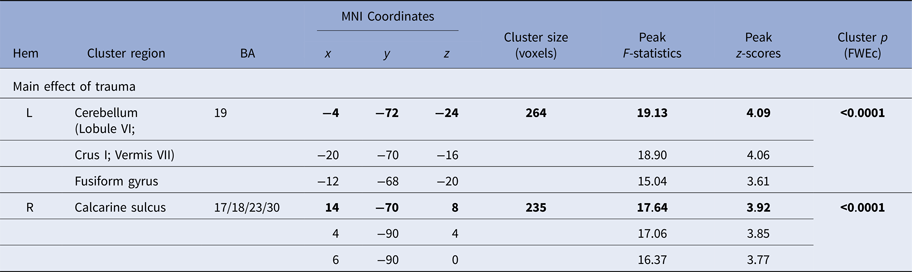
The 2 × 2 ANOVAs revealed a significant main effect of trauma exposure on functional connectivity between the left IFG seed region and a cluster including the left cerebellar lobule VI, Crus I, vermis VII and fusiform gyrus, as well as with a cluster covering the right calcarine sulcus (Table 3; Fig. 1b). There were no other significant effects of trauma exposure, diagnosis or interaction on functional coupling with any other seed region explored (right IFG, right DLPFC, right IPL, SMA or dACC).
Peaks of clusters showing significant main effect of trauma exposure on functional connectivity with the left IFG seed region revealed by between group 2 (trauma: exposed/non-exposed) × 2 (diagnosis: cases/HC) ANOVA during response inhibition

Hem, hemisphere; L, left; R, right; BA, Brodmann area; MNI, Montreal Neurologic Institute; FWEc, family-wise error correction for multiple comparisons at the cluster level; IFG, inferior frontal gyrus.
Main peaks within the cluster of interest are in bold.
Antipsychotic medication and symptom severity
Pearson's correlations indicated there were no significant associations between activation in the ROIs and CPZ equivalence levels (all p > 0.100) in the clinical group. However, increased activation in the left IFG was associated with increased PANSS Positive (r = 0.189, p = 0.046) and PANSS General symptomatology (r = 0.228, p = 0.016), but not with PANSS Negative symptoms (r = 0.166, p = 0.080).
Mediation analyses
The first model investigated the potential role for left IFG activation to mediate the effects of trauma on general symptom severity (Fig. 2a). We identified significant associations between key variables, as represented in (1) path a: the association between trauma exposure and left IFG activation (β = 0.35, s.e. = 0.17, t 110 = 2.01, p < 0.05); (2) path b: the association between left IFG activation during response inhibition and PANSS general symptoms (β = 1.72, s.e. = 0.85, t 109 = 2.35, p = 0.02), but not PANSS positive (β = 1.19, s.e. = 0.70, t 109 = 1.71, p = 0.09) or negative symptoms (β = 0.91, s.e. = 0.63, t 109 = 1.45, p = 0.15), and; (3) path c′: the direct effect of trauma exposure on PANSS general symptoms (β = 3.69, s.e. = 1.57, t 110 = 2.35, p = 0.02), but not PANSS positive (β = 1.96, s.e. = 1.28, t 110 = 1.53, p = 0.13) or negative symptoms (β = 1.85, s.e. = 1.17, t 110 = 1.58, p = 0.12). After controlling for left IFG activation, trauma remained a significant predictor of general symptom severity (path c′: β = 3.69, s.e. = 1.57, t 109 = 2.74, p = 0.02), indicating that activation levels in the left IFG during response inhibition is not a significant mediator of the effects of trauma exposure on general symptom severity.
Mediation analyses. (a) Mediation effects of left inferior frontal gyrus (IFG) activation during response inhibition on the effects of trauma exposure on levels of psychopathology as measured by the PANSS. (b) Effects of symptom severity on the effects of trauma exposure on activation of the left IFG. *p < 0.05; **p < 0.01.

The second model tested the role of general symptom severity on mediating the effects of trauma on activation in the left IFG. We identified significant associations between key variables, as represented in (1) path a: the association between trauma exposure and PANSS general symptoms (β = 4.29, s.e. = 1.56, t 110 = 2.74, p < 0.01), but not PANSS positive (β = 2.38, s.e. = 1.27, t 110 = 1.87, p = 0.06) or negative symptoms (β = 2.17, s.e. = 1.15, t 110 = 1.88, p = 0.06); (2) path b: the association between PANSS general symptoms and IFG activation during response inhibition (β = 0.02, s.e. = 0.01, t 109 = 2.02, p < 0.05), but not PANSS positive (β = 0.02, s.e. = 0.01, t 109 = 1.71, p = 0.09) or negative symptoms (β = 2.17, s.e. = 0.01, t 109 = 1.45, p = 0.09), and; (3) path c′: the direct effect of trauma exposure on activation in the left IFG (β = 0.35, s.e. = 0.17, t 110 = 2.01, p < 0.05). Because only PANSS general symptoms were associated with both trauma exposure and brain function, mediation was formally tested for this variable only. Trauma exposure was no longer a significant predictor of task-related activation of the left IFG after controlling for PANSS general symptom severity (path c′: β = 0.26, s.e. = 0.18, t 109 = 1.47, p = 0.15), consistent with partial mediation. General symptom severity accounted for over a quarter of the variance in left IFG activation (P M = 0.26). The indirect effect of trauma exposure on IFG was tested using a bootstrap estimation approach with 10 000 samples. These results indicated that the indirect coefficient was significant (a.b = c–c′ = 0.09, s.e. = 0.06, 95% CI 0.004–0.23). Trauma exposure was thus associated with a 9% increased activation in the left IFG during response inhibition in psychosis cases, mediated by general symptom severity (see Fig. 2b).
Discussion
This study identified increased levels of activation in the left IFG in association with childhood trauma exposure during response inhibition, regardless of clinical diagnostic status, and in the context of equivalent behavioural performance across clinical and health groups. There was no main effect of diagnosis with schizophrenia, and no interaction of trauma with diagnosis for any ROI (right IFG, right DLPFC, right IPL, SMA and dACC). In addition, increased functional connectivity between the left IFG seed region (only) and both cerebellar and calcarine regions were evident as a main effect of trauma exposure. Finally, mediation analyses within the clinical sample indicated that the effect of trauma on left IFG activation was mediated by the severity of the PANSS general psychopathology scores. However, left IFG activation did not mediate the effect of trauma exposure on PANSS general psychopathology scores.
In the context of equivalent behavioural performance, trauma-related increased activation within the left IFG suggests that stronger signals of salience from the left IFG may be required to adequately inhibit motor responses to the target stimulus. This is consistent with findings observed for a Stop-signal task in adolescents exposed to early-life stress (Mueller et al. Reference Mueller2010), and the known role of the IFG, together with the AIC and the dACC, within the so-called salience network (which designates and responds to task-relevant events/stimuli) (Uddin, Reference Uddin2015). In addition to salience signalling, the IFG/AIC is critical for adequate cognitive control functions including response inhibition (Criaud & Boulinguez, Reference Criaud and Boulinguez2013; Aron et al. Reference Aron, Robbins and Poldrack2014). While the right IFG is generally associated with response inhibition (Criaud & Boulinguez, Reference Criaud and Boulinguez2013; Aron et al. Reference Aron, Robbins and Poldrack2014), the left IFG is more specifically associated with successful inhibition of motor response (Swick et al. Reference Swick, Ashley and Turken2008; Boehler et al. Reference Boehler2010; Gu et al. Reference Gu2013), in line with the present findings. An alternative explanation might implicate functional compensatory mechanisms arising from trauma-related grey matter loss in the IFG, as has been reported elsewhere (Lim et al. Reference Lim, Radua and Rubia2014). The relationship between trauma-related structural and functional abnormalities in this region will need to be explicitly investigated in future studies using a multi-modal imaging approach in the same participants.
That the severity of general symptoms was a significant mediator of the effects of trauma exposure on left IFG function in the clinical group is perhaps not surprising given that trauma-exposed psychosis cases often present with greater levels of symptom severity (Duhig et al. Reference Duhig2015). Moreover, general symptoms were recently shown to mediate the effects of childhood trauma on both positive and negative symptoms in schizophrenia (Isvoranu et al. Reference Isvoranu2017). Importantly, only partial mediation was observed in the present study, indicating that other, unmeasured factors might play a role in mediating these effects. For example, given the emerging relationships between childhood trauma exposure, and psychotic and posttraumatic stress symptoms (Hardy et al. Reference Hardy2016; Powers et al. Reference Powers2016), PTSD phenomena may play a crucial role in this model. Future studies might therefore consider the use of comprehensive interviews to index PTSD symptoms for investigation in this context. The results also suggest that relevant trauma-focused treatments for psychosis patients reporting significant levels of childhood adversity, such as eye-movement desensitization and reprocessing (EMDR) or prolonged exposure therapy (van den Berg et al. Reference van den Berg2015), might assist in reducing anxiety or depressive symptoms.
Rather unexpectedly, trauma-exposure was also associated with increased connectivity between the left IFG seed and both primary visual regions (calcarine sulcus) and cerebellar (lobule VI, crus I) regions; these latter regions are essential for executive functions (Stoodley & Schmahmann, Reference Stoodley and Schmahmann2009) and are involved in event timing (Keren-Happuch et al. Reference Keren-Happuch2014). A plausible explanation may be that trauma-exposed individuals need greater inputs from these regions to rapidly integrate salient, task-relevant indices for accurate inhibition of motor response (equivalent levels of task performance) compared with non-exposed individuals. However, this interpretation remains speculative and requires further investigation using effective connectivity or independent component analyses to identify functional networks of brain regions impacted by psychosis and/or trauma exposure.
Finally, the absence of behavioural differences in response inhibition may also explain the lack of trauma- and/or psychosis-related differences in other brain regions classically implicated in cognitive (DLPFC, dACC and IPL) and sensorimotor (SMA) controls, as previously reported in schizophrenia (Sambataro et al. Reference Sambataro2013). The chronic nature of illness experienced by most of the patients [mean illness length (s.d.) = 15.69 (9.22) years], who had likely been taking medications to stabilize symptoms for much of this time, may have contributed to this observation. These drugs have long-term effects on grey matter integrity (Moncrieff & Leo, Reference Moncrieff and Leo2010; Ho et al. Reference Ho2011; van Haren et al. Reference van Haren2011; Fusar-Poli et al. Reference Fusar-Poli2013) that also influence brain function (Abbott et al. Reference Abbott2013), in particular in cortical dopaminergic target regions, such as DLPFC and ACC.
The present findings should be considered in light of the following limitations. First, we were unable to investigate the specific effects of any one type of trauma without potential contamination of the effects of other types of trauma because of the high rate of exposure to more than one type of abuse or neglect (see Table 2). Second, while endorsed elsewhere (Shannon et al. Reference Shannon2011; Mørkved et al. Reference Mørkved2017), the use of moderate to extreme range CTQ scores to define significant levels of trauma-exposure may be conservative, and/or may inappropriately lump together individuals who have experienced maltreatments of a different nature. Third, consistent with the chronic illness state of our clinical sample, medication use may have affected our results; the potential effects of specific types of medication were investigated statistically where possible, but the possibility of general effects on brain function cannot be completely ruled out and may have, at least partly contributed to the lack of main effect of psychosis and psychosis-by-trauma interaction on brain function. Finally, posttraumatic stress symptoms were not assessed here. Because positive symptoms may also be considered as trauma intrusions (Morrison, Reference Morrison2001), it will become important to include these measures to better understand the effects of childhood trauma in psychosis (Alsawy et al. Reference Alsawy2015; Powers et al. Reference Powers2016).
In conclusion, this study provides evidence for the impact of childhood trauma on the left IFG function during cognitive inhibition in adult patients diagnosed with schizophrenia, schizoaffective disorder or bipolar I disorder, as well as in healthy individuals. Exposure to childhood trauma was not associated with poor behavioural performance, but was associated with greater activation and increased task-related functional connectivity with the left IFG, suggestive of heightened salience signalling required for adequate response inhibition. Importantly, these trauma-related findings were mediated by symptom severity in psychosis cases. Future investigations are required to better understand the long-term implications of the exposure to childhood trauma on other domains of executive function, in particular conflict monitoring and attention.
Supplementary material
The supplementary material for this article can be found at https://doi.org/10.1017/S0033291717002884.
Acknowledgements
We would like to acknowledge Meelah Hamilton (now deceased), Jesseca E. Rowland, Nicholas Vella, and Inika Gillis for assistance with data collection and entry. We would also like to thank the volunteers who participated in this study. We acknowledge recruitment assistance from the Australian Schizophrenia Research Bank (ASRB), which was supported by the National Health and Medical Research Council of Australia (NHMRC) Enabling Grant (No. 386500), the Pratt Foundation, Ramsay Health Care, the Viertel Charitable Foundation and the Schizophrenia Research Institute.
This study was funded by Project Grants from the Australian National Health and Medical Research Council (NHMRC; APP630471 and APP1081603), the Schizophrenia Research Institute ‘Grant-in-Aid’ program, and the Macquarie University's ARC Centre of Excellence in Cognition and its Disorders. Green was supported by the NMHRC's R.D. Wright Biomedical Career Development Fellowship (APP1061875; 2014–17). The funding bodies had no role in the decision to publish these results.
Declaration of Interest
All of the authors declare that they have no conflicts of interest.
Ethical standards
The authors assert that all procedures contributing to this work comply with the ethical standards of the relevant national and institutional committees on human experimentation and with the Helsinki Declaration of 1975, as revised in 2008.