Introduction
The global climate has changed throughout time and there is evidence that these changes have impacts on organisms and ecosystems (Hoegh-Guldberg & Bruno, Reference Hoegh-Guldberg and Bruno2010). As global temperatures continue to rise, the relative abundance and composition of species continues to change. With projected future climate changes, more dramatic shifts are expected in marine ecosystems (Lawler, Reference Lawler2009; Magris et al., Reference Magris, Pressey, Weeks and Ban2014; Lathlean et al., Reference LathLean, Seuront and Ng2017). In the intertidal zone, the organisms are subject to considerable natural environmental variability (Tait & Dipper, Reference Tait and Dipper1998) and exposed to several stressors such as water temperature, desiccation and solar radiation, affecting their survival (Seabra et al., Reference Seabra, Wethey, Santos and Lima2011, Reference Seabra, Wethey, Santos, Gomes and Lima2016). Other factors such as the micro-topography, air temperature, wind speed, solar radiation and relative humidity also play an important role, particularly in the high shore (Helmuth et al., Reference Helmuth, Yamane, Lalwani, Matzelle, Tockstein and Gao2011; Seabra et al., Reference Seabra, Wethey, Santos and Lima2011; Lima et al., Reference Lima, Gomes, Seabra, Wethey and Seabra2016). These variations in the environment impact intertidal species in multiple ways, affecting their physiological and biochemical processes (Hawkins et al., Reference Hawkins, Sugden, Mieszkowska, Moore, Poloczansk, Leaper, Herbert, Genner, Moschella, Thompson, Jenkins, Southward and Burrows2009; Prusina et al., Reference Prusina, Balic-Ezgeta, Ljubimir, Dobroslavic and Glamuzina2014), morphology (Harley et al., Reference Harley, Denny, Mach and Miller2009), behaviour and biotic interactions (Firth & Crowe, Reference Firth and Crowe2010), and ultimately their geographic distributions (Sousa et al., Reference Sousa, Seabra, Wethey, Xavier, Queiroz, Zenboudji and Lima2012). Temperature variation in particular has a strong influence over organisms, controlling all life stages and conditioning fundamental biological processes, such as the metabolism, growth, reproduction and survival of the individuals (Helmuth et al., Reference Helmuth, Mieszkowska, Moore and Hawkins2006; Firth & Crowe, Reference Firth and Crowe2010; Moore et al., Reference Moore, Thompson and Hawkins2011; Stillman, Reference Stillman2019; Mieszkowska et al., Reference Mieszkowska, Burrows, Hawkins and Sugden2021).
Metabolism is a fundamental process that regulates the flux of energy and materials between the organism and the environment (Gillooly et al., Reference Gillooly, Brown, West, Savage and Charnov2001). The metabolic theory of ecology (MTE) offers a predictive framework for assessing and understanding changes in the abundance, distribution and diversity of organisms and the fluxes of energy and materials in ecological systems (Brown et al., Reference Brown, Gillooly, Allen, Savage and West2004). Basic metabolic theory predicts that warming might increase the performance of an organism by increasing its metabolic rate, until it reaches a given threshold (Mertens et al., Reference Mertens, Russell and Connell2015). However, the heterotrophic respiration and autotrophic productivity are scaled differently from temperature (Gillooly et al., Reference Gillooly, Brown, West, Savage and Charnov2001; Allen et al., Reference Allen, Gillooly and Brown2005; Mertens et al., Reference Mertens, Russell and Connell2015). Hence, the MTE suggests that producers will show a weaker temperature response than consumers (Brown et al., Reference Brown, Gillooly, Allen, Savage and West2004; Yvon-Durocher et al., Reference Yvon-Durocher, Jones, Trimmer, Woodward and Montoya2010; Mertens et al., Reference Mertens, Russell and Connell2015). The MTE predicts that grazers will be more sensitive to warming than their food sources. In fact, it has been used to predict increases in top-down control of algal assemblages (O'Connor, Reference O'Connor2009) responsible for surpassing the compensatory/grazing metabolic threshold. Afterwards, the community shifts from a top-down (herbivore-regulated) to a bottom-up (algae-regulated) system (Hawkins et al., Reference Hawkins, Sugden, Mieszkowska, Moore, Poloczansk, Leaper, Herbert, Genner, Moschella, Thompson, Jenkins, Southward and Burrows2009; O'Connor, Reference O'Connor2009; O'Connor et al., Reference O'Connor, Gilbert and Brown2011). The effect of reducing or removing grazers on the community is known to result in important changes in the community structure (Coleman et al., Reference Coleman, Underwood, Benedetti-Cecchi, Aberg, Arenas, Arrontes, Castro, Hartnoll, Jenkins, Paula, Santina and Hawkins2006).
Limpets promote spatial variation at northern latitudes by preventing establishment of fucoid algae, which colonize the exclusion plots, and decrease variation in the south, where outcomes are more contingent (Coleman et al., Reference Coleman, Underwood, Benedetti-Cecchi, Aberg, Arenas, Arrontes, Castro, Hartnoll, Jenkins, Paula, Santina and Hawkins2006). Limpets are mainly herbivorous marine gastropods that inhabit exposed and sheltered rocky shores along the western coast of Europe, the Mediterranean coast, the north-west of Africa and the Macaronesian islands (Guerra & Gaudencio, Reference Guerra and Gaudencio1986; Borges et al., Reference Borges, Doncaster, Maclean and Hawkins2015). They are considered key species that play an important ecological role in marine communities, exerting strong competitive intraspecific and interspecific pressures (Underwood, Reference Underwood1979; Underwood & Jernakoff, Reference Underwood and Jernakoff1981; Boaventura et al., Reference Boaventura, Ré, Fonseca and Hawkins2002). As grazers, limpets feed on large amounts of seaweed propagules, controlling their growth and regulating the ecological succession of biological communities established in the intertidal areas (Boaventura et al., Reference Boaventura, Ré, Fonseca and Hawkins2002). Hence, limpets are excellent models to investigate the MTE grazers–algal relationships described above.
The Portuguese coast constitutes a biogeographic transition zone (from the Mediterranean to the Atlantic biogeographic regions), resulting in high environmental variability with effects on populations dynamics (Boaventura et al., Reference Boaventura, Ré, Fonseca and Hawkins2002; Pereira et al., Reference Pereira, Lima, Queiroz, Ribeiro and Santos2006; Spalding et al., Reference Spalding, Fox, Allen, Davidson, Ferdana, Finlayson, Halpern, Jorge, Lombana, Lourie, Martin, McManus, Molnar, Recchia and Robertson2007). In the north-west coast of Portugal, the most abundant species are Patella ulyssiponensis Gmelin, 1961, Patella vulgata Linnaeus, 1758 and Patella depressa Pennant, 1777 (Casal et al., Reference Casal, Aceña-Matarranz, Fernández-Márquez and Fernández2018). These three species coexist in the intertidal zone but at different tide levels. Usually, P. ulyssiponensis occurs on the low shore and can also be found in tide pools on the mid-shore (Boaventura et al., Reference Boaventura, Ré, Fonseca and Hawkins2002). Patella vulgata occupies mainly the region between the mid shore and the upper shore (Blackmore, Reference Blackmore1969; Boaventura et al., Reference Boaventura, Ré, Fonseca and Hawkins2002). Patella depressa is present from the mid shore to the low shore, coexisting with P. vulgata (Boaventura et al., Reference Boaventura, Ré, Fonseca and Hawkins2002; Silva et al., Reference Silva, Boaventura and Ré2003). Patella rustica Linnaeus, 1758 is more abundant in the southern coast of Portugal than the north-western coast (Lima et al., Reference Lima, Queiroz, Ribeiro, Hawkins and Santos2006; Ribeiro et al., Reference Ribeiro, Xavier, Santos and Hawkins2009). This species occupies the upper shore in the intertidal zone (Lima et al., Reference Lima, Queiroz, Ribeiro, Hawkins and Santos2006). These species have overlapping distributions: P. ulyssiponensis, P. vulgata and P. depressa can be found from the British Isles to Portugal (Boaventura et al., Reference Boaventura, Ré, Fonseca and Hawkins2002; Borges et al., Reference Borges, Doncaster, Maclean and Hawkins2015). Patella ulyssiponensis and P. depressa are also present in North Africa (Borges et al., Reference Borges, Doncaster, Maclean and Hawkins2015). Patella rustica can be found from the Mediterranean Sea to the Atlantic coast of the Iberian Peninsula and North Africa (Lima et al., Reference Lima, Queiroz, Ribeiro, Hawkins and Santos2006). In this context, the goal of this study was to evaluate the influence of sea temperature on the metabolic rate of four species of the genus Patella present along the coast of Portugal. Thus, it contributes to the ability to understand and forecast climate change impacts upon limpet populations and algal assemblages across Portuguese continental seashores. The tested hypothesis was that increases in seawater temperature will result in increases in the metabolic rate across the four species of Patella in line with predictions from the MTE. For this purpose, trials were performed for assessing oxygen consumption rates in adult limpets under different sea temperatures. The experiment included water temperatures normally experienced along the Portuguese coast (e.g. 12 and 16°C), but also extreme temperatures (e.g. 6 and 28°C). Additionally, this work intended to study the effects of seawater temperature on the limpet probability of survival for three species of the genus Patella and to obtain their maximum and minimum temperature limits of survival.
Materials and methods
Sampling sites
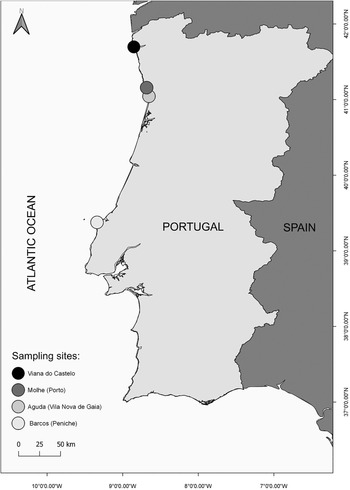
The organisms were collected in the intertidal zone during low tide at three rocky shores in the north of Portugal: Viana (Viana do Castelo: 41.696944°N 8.853056°W); Molhe (Porto: 41.157583°N 8.683500°W); Aguda (Vila Nova de Gaia: 41.045333°N 8.653139°W); and one in the centre of Portugal: Barcos (Peniche: 39.376556°N 9.339947°W) (Figure 1). The limpets were haphazardly collected from the rock with a pocketknife and immediately transported to the laboratory in net bags inside small coolboxes filled with seawater. Their size in length ranged from 26.98 ± 2.56 mm for Patella rustica, 32.05 ± 3.70 mm for Patella depressa, 33.88 ± 5.02 mm for Patella ulyssiponensis and 34.93 ± 3.29 mm for Patella vulgata. In addition, some stones with biofilm were also collected for food provision during the acclimation period.
Location of the sampling sites along the coast of Portugal.

Acclimation period and routine procedures
In the laboratory, each species was exposed to two acclimation periods. During the first period, individuals were placed on the top of rocks for one week, inside tanks with aeration and filtered seawater at the same sea temperature as the collection site. This period allowed the species to adjust to new conditions. After that period, the specimens were moved to a new system. This system comprised 14 tanks, grouped in pairs used as water baths under different temperatures (6, 8, 12, 16, 20, 24 and 28°C). Each tank had two cylinders with 2 litres capacity, and inside each cylinder one rock was placed with two limpets on top and covered by a mesh to prevent their escape (Figure 2). The tanks were aerated, and the seawater flow renewed every 20 min where new seawater entered the cylinder for 1 min. Overall, for each temperature tested and species there were a total of eight limpet replicates. The water temperature in each tank was increased or decreased by 1°C per day from the initial temperature of collection up to the established temperature to be tested. When the target temperature was achieved, limpets were left under these settings for 2 days for adaptation to the new conditions until the metabolic rate trials started.
Scheme of the second acclimation period: system with 14 tanks, grouped in pairs used as water baths under different temperatures.

Every day, during both acclimation periods, the mortality and temperature in each tank were recorded. The limpets that died were removed from the system.
Metabolic rate
The metabolic rate estimated was the oxygen consumption or respiration rate of 56 individuals per species. The system for the metabolic trials consisted of three simultaneous and independent chambers with one limpet placed inside each chamber, on top of a rock, with a known volume of filtered seawater. Prior to measuring oxygen consumption under different temperatures, the shells were cleaned to remove any attached organisms. To maintain the established temperature of the water in each chamber, a peristaltic pump transferred the water bath over the chambers. The incubation period lasted for 1 h and 20 minutes, the oxygen concentrations were measured every 20 s with optical O2 sensors (PreSens Oxy-4) and recorded with the aid of software PreSens Measurement Studio 2.
For each temperature, the oxygen consumption per individual was calculated from oxygen concentration changes in each chamber during the incubation corrected by the volume of water inside each chamber. During the trials, after the stabilization period, the oxygen consumption varied negatively with time. The absolute value of the slope for the initial linear trend represents the oxygen consumption under the tested temperature. This slope was extracted from all replicates, the blank controls were subtracted, and the mean slopes were calculated per temperature. The mean values were plotted to assess the relationship between oxygen consumption and temperature. Afterwards, the shells were removed, and the limpet body mass was left for 48 h at 60°C to estimate the Dry Weight (DW). The respiration rate was expressed as μmol O2 g DW−1 h−1.
Activation energy
The metabolic theory of ecology (MTE) is based on the principle that metabolic rate varies according to the organism's body mass and the environmental temperature, as described by equation (1) (Brown et al., Reference Brown, Gillooly, Allen, Savage and West2004):

where I is the metabolic rate, Io is a normalization constant, independent of the body size and temperature, M is the body mass (g) raised to 3/4 power, Ea is the activation energy expressed in electron volts (eV), K is Boltzmann's constant (8.61733 × 10⁻⁵ eV K−1) and T is the absolute temperature (kelvin).
The terms of equation (1) can be rearranged to yield equation (2). This equation considers ‘mass-corrected’ metabolic rate, I, by incorporating the logarithm of mass raised to the 3/4 power.

This method facilitates quantitative evaluation of the mass and temperature dependence predicted by equation (1), by incorporating the predicted scaling into the analysis and into the y-axis of bivariate plots (Brown et al., Reference Brown, Gillooly, Allen, Savage and West2004). The slope of this relationship gives the activation energy of metabolism. The activation energy (E) reflects the sensitivity of the metabolic rate to temperature (Watson et al., Reference Watson, Morley, Bates, Clark, Day, Lamare, Martin, Southgate, Tan, Tyler and Peck2014). Therefore, following the estimation of relationship between oxygen consumption and temperature, for each species, the respective E was calculated.
Mortality trials
In parallel with the assessment of the influence of temperature on the oxygen consumption, the relation of temperature to limpet probability of survival was investigated for P. ulyssiponensis, P. vulgata and P. depressa, but not for P. rustica due to the reduced number of specimens available, since a total of 84 individuals were used per species. In these trials, during the second acclimation period, the water temperature was increased or decreased by 1°C every 30 minutes, until the final target temperature was achieved (6, 8, 12, 16, 20, 24 and 28°C). For each temperature, there were two cylinders, each with three limpets placed on the top of a rock, making up a total of 12 replicates per species. The limpets were then left in the tanks at the final temperature and the ratio of alive/dead individuals was estimated every day for 15 days. Mortality was assessed by probing limpets that were detached from the rock and when no reaction was shown, individuals were considered dead. Then, mortality was calculated as the sum of all dead individuals after 15 days of exposure to each temperature. To ensure starvation was not influencing the probability of survival records, the rocks in each tank were replaced every 5 days.
For each species, the low thermal threshold for 50% of the population (LTT50) and the high thermal threshold for 50% of the population (HTT50) (Sagarin et al., Reference Sagarin, Barry, Gilman and Baxter1999; Tang et al., Reference Tang, Ikediala, Wang, Hansen and Cavalieri2000) were calculated based on the probability of survival plots for lower (6–12°C) and higher (16–28°C) temperatures, respectively.
Results
Metabolic rate
The oxygen consumption rates (μmol O2 g DW−1 h−1) seemed to rise with the increasing temperatures (°C), for the four species (Figure 3). The oxygen consumption rate of P. ulyssiponensis significantly increased with temperature (P < 0.05) (Figure 3A). The same pattern was observed for the remaining species, although with no statistical significance (P > 0.05).
Mean oxygen consumption (N = 6) (μmol O2 g DW−1 h−1) variation with temperature (°C) for each limpet species.

Activation energy
The activation energy values obtained for the four species ranged between 0.33–0.76 eV (Figures 4 and 5). Patella ulyssiponensis presented the highest activation energy value (0.76 eV). For the remaining three species, the activation energy values were similar, P. rustica having the lowest value (0.33 eV). Despite the low r-squared, the P-values (P < 0.05) indicate a statistically significant relationship between the mass-corrected metabolic rate (Ln (IM−3/4)) and temperature (1/kT).
Relationship between mass-corrected metabolic rate (Ln (IM−3/4)) and sea temperature (1/kT) for each individual of: (A) P. ulyssiponensis and (B) P. vulgata.

Relationship between mass-corrected metabolic rate (Ln (IM−3/4)) and sea temperature (1/kT) for each individual of: (A) P. depressa and (B) P. rustica.

Mortality trials
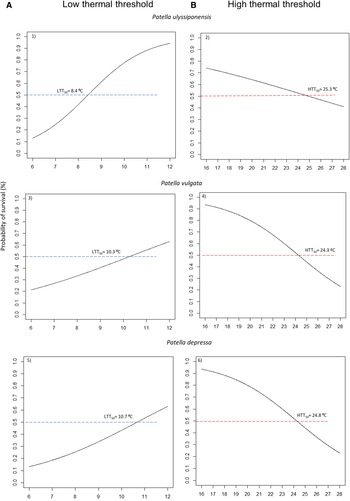
The logistic regressions of the probability of survival (%) under lower temperatures (6–12°C) and higher temperatures (16–28°C) were statistically significant (P < 0.05) (Figure 6) for the three species. The LTT50 and HTT50 values were very similar for both P. vulgata (10.3 and 24.3°C, respectively) and P. depressa (10.7 and 24.8°C, respectively). Patella ulyssiponensis had the lower LTT50 value (8.4°C) and a higher HTT50 value (25.3°C) compared with the other species.
(A) Probability of survival of three species at the end of the experimental period for lower temperatures: (1) P. ulyssiponensis (y = e−6−6 + 0.784x/1 + e−6−6 + 0.784x, P < 0.05); (3) P. vulgata (y = e−3.14 + 0.306x/1 + e−3.14 + 0.306x, P < 0.05); (5) P. depressa (y = e−4.29 + 0.402x/1 + e−4.29 + 0.402x, P < 0.05). (B) Probability of survival of three species at the end of the experimental period for high temperatures: (2) P. ulyssiponensis (y = e3.97 + 0.172x/1 + e3.97 + 0.172x, P < 0.05); (4) P. vulgata (y = e7.85 + 0.323x/1 + e7.85 + 0.323x, P < 0.05); (6) P. depressa (y = e15.9−0.664x/1 + e15.9−0.664x, P < 0.05).

Discussion
In the intertidal zone, organisms' metabolism is mostly regulated by the interplay among environmental conditions (e.g. temperature, salinity) and species eco-physiological traits (e.g. body size, activity level, growth and reproduction) (see classical studies from Davies, Reference Davies1966, Reference Davies1967; Newell & Roy, Reference Newell and Roy1973; Branch & Newell, Reference Branch and Newell1978; Newell & Branch, Reference Newell and Branch1980; Branch et al., Reference Branch, Borchers, Brown and Donnelly1988). Although several environmental parameters should be considered, in metabolic rate studies (e.g. respiration rates), temperature is one of the most influencing factors on the organisms' performance (Somero, Reference Somero2002). Understanding how various species respond to increasing temperatures is crucial to predict the effect of climate change events on natural populations and community structure (Helmuth et al., Reference Helmuth, Mieszkowska, Moore and Hawkins2006).
The present study aimed to evaluate the influence of sea temperature on the metabolic rate (in this case oxygen consumption) of four species of the genus Patella. The respiration rate of Patella spp. was investigated for the first time for populations from the Portuguese coast. The oxygen consumption for P. ulyssiponensis increased linearly with temperature within the range of tested temperatures (6–28°C) (Figure 3). The results observed are in agreement with the metabolic theory of ecology (MTE), which predicts that biological rates (e.g. respiration rate) show a similar temperature dependence (Brown et al., Reference Brown, Gillooly, Allen, Savage and West2004). Davies (Reference Davies1966, Reference Davies1967) studied the effect of body size, temperature and environmental acclimation on the metabolic rate of Patella aspera (currently P. ulyssiponensis) and P. vulgata. The results suggested that the low respiration rate of high-level limpets could result from either acclimation to the higher temperatures or lower nutritional conditions of the habitat (Davies, Reference Davies1967). For the remaining species, P. vulgata, P. depressa and P. rustica, no statistically significant linear relation between the variables was obtained. Despite being non-significant, the results suggest an increase of the oxygen consumption with the increase in temperature (Figure 3), following the tendency observed for P. ulyssiponensis. However, to confirm this pattern further studies are required, such as the use of a high number of individual replicates, which will improve the estimation of the relationship between oxygen consumption and temperature.
Activation energy
The activation energy determines the sensitivity of the metabolic rate to temperature (Watson et al., Reference Watson, Morley, Bates, Clark, Day, Lamare, Martin, Southgate, Tan, Tyler and Peck2014). In this study, the activation energy was determined using oxygen consumption (μmol O2 g DW−1 h−1) under different temperatures. Gillooly et al. (Reference Gillooly, Brown, West, Savage and Charnov2001) and Brown et al. (Reference Brown, Gillooly, Allen, Savage and West2004) studied the activation energy of both marine and freshwater species, achieving a general interspecific mean activation energy of 0.65 eV. However, variations from this value are often found ranging from 0.2–1.2 eV (Gillooly et al., Reference Gillooly, Brown, West, Savage and Charnov2001). The values of activation energy for Patella spp. ranged from 0.33 eV to a maximum of 0.76 eV, with an average of 0.47 eV (Figures 4 and 5), being within the predicted range by the MTE.
Thermal sensitivity in marine invertebrates varies considerably depending on the taxa. However, it is generally low under highly variable environments, with frequent extreme temperature events, such as those experienced in intertidal habitats (Folguera et al., Reference Folguera, Bastías, Caers, Rojas, Piulachs, Bellés and Bozinovic2011; Watson et al., Reference Watson, Morley, Bates, Clark, Day, Lamare, Martin, Southgate, Tan, Tyler and Peck2014). The activation energy obtained for P. ulyssiponensis (0.76 eV) suggests that this species is more sensitive to temperature variations. This could be related to its location in rocky shores, usually found in the low shore or tide pools. Due to this, during the low tides, P. ulyssiponensis is exposed to shorter periods of emersion than the other Patella species being protected from extreme temperature variations. For the remaining species, the obtained activation energy values – P. vulgata (0.43 eV), P. depressa (0.36 eV) and P. rustica (0.33 eV) – suggest lower sensitivity of these species to temperature changes. These species are usually found in the mid and upper shore (Boaventura et al., Reference Boaventura, Ré, Fonseca and Hawkins2002), suggesting a higher capacity to tolerate higher temperatures than species located in the low shore. Such relationship between the thermal sensitivity of the oxygen consumption and the shore level location of the organisms demands further investigation, with intraspecific studies at different tide levels, i.e. individuals of the same species would be collected from the low to high shore and the activation energy for the oxygen consumption investigated at multiple shores and different levels to assess the existence of possible patterns.
Mortality trials
In the intertidal zone, the survival of the organisms living at the interface of the marine and terrestrial realms requires withstanding a broad array of abiotic factors. Temperature gradients depend not only on the climate and seasons, but also fluctuate regularly during emersion and immersion through each tidal cycle (Harley et al., Reference Harley, Denny, Mach and Miller2009). Understanding the organism's thermal limits will be useful to investigate how the warming climate can influence the behaviour and distribution ranges.
Patella spp. are sensitive to fluctuations in the sea surface temperature, depending on microhabitat topography to oscillations in aerial conditions during emersion time (Chapperon et al., Reference Chapperon, Volkenborn, Clavier, Séité, Seabra and Lima2016; Lima et al., Reference Lima, Gomes, Seabra, Wethey and Seabra2016). Therefore, they are considered indicators of climatic variability (Lima et al., Reference Lima, Queiroz, Ribeiro, Hawkins and Santos2006). Particularly, for P. vulgata thermal stress levels are directly linked to increase in water temperature, while high air temperature is only stressful if water temperature is also high (Seabra et al., Reference Seabra, Wethey, Santos, Gomes and Lima2016). For sea temperatures between 6–12°C, the LTT50 of survival was 8.4°C for P. ulyssiponensis, 10.3°C for P. vulgata and 10.7°C for P. depressa. These values are the lower temperature limits for each species studied, indicating that P. ulyssiponensis tolerates lower temperatures than P. vulgata and P. depressa. For a higher range of temperatures (16–28°C), the HTT50 of survival was 25.3°C for P. ulyssiponensis, 24.3°C for P. vulgata and 24.8°C for P. depressa. Therefore, P. ulyssiponensis presented a higher thermal limit than the other two species, P. vulgata and P. depressa. For the same range of temperatures, Patella ulyssiponensis showed a higher thermal tolerance range, which could potentially be linked to their biological features and adaptation to adverse abiotic conditions. According to Evans (Reference Evans1948), limpets from the British Isles can survive temperatures higher than 40°C. Evans (Reference Evans1948) presented a lethal temperature of 42.8°C for P. vulgata, 43.3°C for P. depressa and 41.7°C for P. athelica (now called P. ulyssiponensis). In fact, this semblance in the upper thermal limit for P. vulgata and P. depressa was also reported by Vinagre et al. (Reference Vinagre, Dias, Cereja, Abreu-Afonso, Flores and Mendonça2019) when investigating the critical thermal maximum (CTMax) for several coastal taxonomic groups. In such study, P. vulgata presented not only the highest CTMax, but also the highest safety margin among the temperate species studied, with P. depressa values immediately below (Vinagre et al., Reference Vinagre, Dias, Cereja, Abreu-Afonso, Flores and Mendonça2019). Although the present study was only carried out for temperatures ranging between 6–28°C, in future studies, a wider range of temperatures should be considered to fully understand the thermal limits for survival of these species in the Portuguese mainland.
Patella ulyssiponensis respiration rate showed a marked response to temperature and given its highest activation energy is more sensitive to temperature than the other studied species, despite having the highest thermal limit. These results are in line with the tolerance–plasticity trade-off hypothesis, which predicts that individuals already adapted to high temperatures have limited potential to improve their heat tolerance via phenotypic plasticity (Heerwaarden & Kellermann, Reference Heerwaarden and Kellermann2020). Negative relationships between heat tolerance and plasticity have been detected across other tide pool species (see Vinagre et al., Reference Vinagre, Mendonça, Cereja, Abreu-Afonso, Dias, Mizrahi and Flores2018), and such trade-off patterns have been used to infer which species are more vulnerable to climate change because they cannot evolve both high tolerance and plasticity (Heerwaarden & Kellermann, Reference Heerwaarden and Kellermann2020). In this sense, P. ulyssiponensis may be at the greatest risk from future temperature increases and from the studied species is the most susceptible to climate change. This work provides information about the effect of temperature on the respiration rate in four species that occur on the rocky shores of mainland Portugal. It allows a better understanding of limpet species sensitivity to temperature increases, under climate change scenarios with possible extreme events, such as marine heatwaves. Extreme warm water conditions, as experienced during marine heatwaves, can exceed the thermal tolerance of marine taxa and lead to changes in the structure and function of intertidal communities (Wolfe et al., Reference Wolfe, Nguyen, Davey and Byrne2020; Amstutz et al., Reference Amstutz, Firth, Spicer and Hanley2021). This research also provides new data about the thermal limits for three Patella spp. from mainland Portugal. It is a valuable step to improve our understanding of the biological responses of limpets in the context of climate change, with the associated consequences upon the algal assemblages, but also as a starting point for future studies.
Overall, the results of this research could be integrated in studies to foresee the potential impacts of climate change on limpet distributions and the potential of these species to persist or to adapt under different climate scenarios.
Acknowledgements
The authors would like to thank João Franco, for his availability to collect and send us one of the species used (from the central area of the country), which allowed us to carry out the experimental work. We are grateful to the two anonymous reviewers for their constructive comments on this manuscript.
Author contributions
DF: literature review, fieldwork, wrote the first draft of the manuscript, analysing the data, interpreting the findings. FA: designing the study, supervision, providing laboratory facilities and instruments, writing – review and editing. CGV: writing – review and editing. ISP: providing laboratory facilities and equipment, writing – review and editing. DB: formulating the research questions, designing the study, fieldwork, supervision, analysing the data, interpreting the findings, writing – review and editing. All authors contributed to the refinement of the final manuscript.
Financial support
This research was supported by the Portuguese project SEEINGSHORE (PTDC/BIA-BMA/31893/2017), co-financed by NORTE 2020, Portugal 2020 and the European Union through the ERDF, and by FCT through national funds. This research was partially supported by national funds through FCT – Foundation for Science and Technology within the scope of UIDB/04423/2020 and UIDP/04423/2020. This research has been additionally funded from the European Union's Horizon 2020 research and innovation programme under grant agreement No. 869300 ‘FutureMARES’. Débora Borges was additionally funded by the project BlueForesting (PT-INNOVATION-0077) financed by the EEA Grants.
Conflict of interest
The authors declare no conflict of interests.