When the mirror does not reflect our own likeness, it does not prove there is nothing to perceive.
—Pierre ClastresFootnote 1Introduction
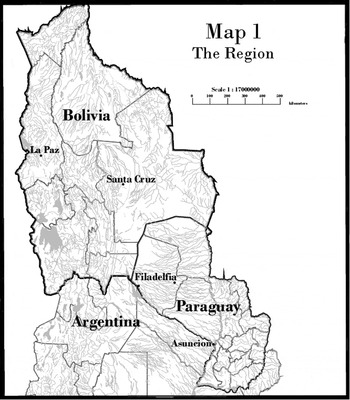
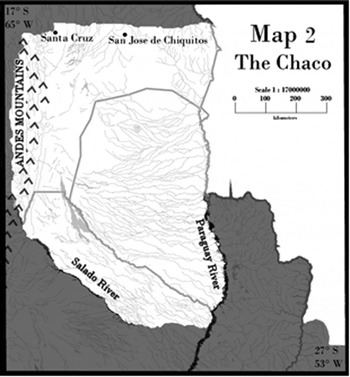
This essay compares two communities of common origin that now dwell in separate rural lowland South American settings, one in the Bolivian Chaco and the other in the Paraguayan Chaco (maps 1 and 2). South America's Gran Chaco is sparsely populated, averaging one person per three square kilometers (Censo Nacional Indígena [Paraguay], 2002). Nevertheless, the present essay takes as its analytic-theoretical point of departure a phrase invoked by Michael Warner in his Reference Warner1999 book on queer publics in New York City: “Urban space is always a host space” (1999: 190).
The Region

The Chaco

Although not otherwise evocative of rural, indigenous South America, Warner's analysis makes a formal claim also put forth by Pierre Clastres in Society against the State (Reference Clastres1987 [1974]). Clastres considers the acephalous societies of the lowland South American Tupí-Guaraní, and argues that these are not “pre-state” societies but instead societies that inhibit the emergence of state-like power: “Incompletion, unfulfillment, lack: the nature of primitive societies is not to be sought in that direction. Rather, it asserts itself as positivity … as the sovereign will to let nothing slip outside its being that might destroy it” (ibid.: 199). Warner, for his part, considers what he terms the “publicly accessible sexual culture” of gay neighborhoods in New York City. He argues that theirs is not a culture of amorality (still less of immorality) but rather one in which openness itself is a structuring ethic: “This kind of culture is often denounced as relativist, self-indulgent, or merely libertine. In fact, it has its own norms, its own way of keeping people in line” (1999: 35). What Warner's and Clastres' analyses share is the anthropological premise that an unfamiliar or unsettling presence may be mistaken—not least by unsympathetic observers—for an absence.
In what follows, I draw on my ethnographic fieldwork, and juxtapose the otherwise dissimilar work of Pierre Clastres and Michael Warner, to explore some under-recognized implications of what I see to be their shared theoretical premise. This requires reference to many other authors, but two in particular are so important that they too should be mentioned at the outset. David Graeber (Reference Graeber2004) has recently pointed out that Pierre Clastres' piece from 1974 may be of special relevance to the contemporary practice of anarchist politics because his Society against the State serves as both manifesto about what might be possible (purposive collective organization in the absence of permanent hierarchical leadership) and documentation of how at least one known human society has accomplished it. Nevertheless, Clastres only gives us ethnographic proof that “another world is possible,” not a picture of how such an alternative might look in a space and time other than that of pre-Columbian lowland South America. This is why Warner's Reference Viveiros de Castro and Howard1999 work is relevant, in a way that has probably been obscured by the fact that in that same book he presents a provocative critique of political mobilization in pursuit of legalization of gay marriage. A less-noted aspect of the book that I want to draw out here is its lucid discussion of the relationship between spatial and ethical possibility. While it cannot be said that Warner's book is in any way obscure, its comparative sociological utility has not been fully recognized.
There is something in the paucity of attention paid to the spatial aspects of Warner's work that is evocative for a scholar of lowland South America. Pierre Clastres' landmark work of political anthropology was followed closely by something of a companion study by his wife, Hélène Clastres, which focused on precisely that relationship between spatial and ethical possibility that is also treated in Warner's work. Her contribution has existed similarly in the shadow of the more self-evidently political argument of her husband. (Warner has accomplished the rare feat of putting some of his ideas in the shade of other of his own ideas). The recurrence of this problem in two such diverse contexts of study suggests it warrants proper attention in its own right. While there is a fine extant literature on indigenous peoples, space, and politics, it is structured in terms of the relationship between “indigenous peoples and the nation-state” (or, more recently, parastatal entities like NGOs) and/or “indigenous peoples and landscape.” I have no quarrel with that literature; I merely aim in another direction. By setting rural Guaraní experience, and previous writings about it, in dialogue with what Warner has had to say about urban queer experience, I gaze out the side of anthropology's Janus face that seeks to identify and explain commonalities rather than differences in the human experience. To put it another way: in connecting the historical tradition of anthropologically minded writing on the Guaraní to Warner's more immediately topical notion of “host space,” and arguing for provocative resonances between them, I aspire to consider the connections between space, ethics, and politics in the human story generally, and thus to take up Graeber's call to broad anthropological engagement with “alternative ethics” (2004: 24) in both theoretical and practical terms.Footnote 2
For reasons that I will describe, elsewhere I have written about the ways “public spaces are … effectively naked” (2007: 144) in the Bolivian setting where I have carried out fieldwork for over a decade. Here I propose that what I once interpreted as a negative absence in that Bolivian context is instead a positive presence with important ethical and political implications. I use two kinds of evidence to make my case on cultural and historical grounds: first, the internal and external political successes of that Bolivian community, and second, the internal and external political failures of the related Paraguayan community in which I began field research in more recent years.
Externally, the Bolivian community, Isoso, has achieved a transnational reputation as an exemplar of indigenous political vitality while also maintaining a thriving internal political life. By contrast, the Paraguayan community is externally almost invisible in national let alone international contexts, and internal attempts to generate unity or to create coherent formats for debating the terms of disunity have foundered repeatedly. A key difference between these two communities is what I propose, borrowing from Warner, to term “host space” in the former community and the impossibility of its existence in the latter.
This difference is easy to miss because the important characteristics of such host space are almost entirely negative, as I will show in the first part of the essay. In the second part, I recount the divergent twentieth-century historical experiences of these two related communities and show that it is in the Paraguayan context that these negative characteristics become “visible,” counter-intuitively because they do not exist in the Paraguayan context.Footnote 3 In the essay's third part, I offer a substantive definition of “host space” and analyze how the pragmatics and the ethics of host space have made an enormous difference for the political potentialities of these two communities. Because they share a common origin but were divided by war during the twentieth century, they offer an unusual opportunity for ethnographic comparison.
In my conclusion, I suggest some general consequences that follow from the analysis of this particular paired case. For all its formal (if not substantial) similarity to the earlier work, Warner's argument is a real advance on Pierre Clastres' (and one that may stimulate a renewed appreciation of the distinct contribution made by Hélène Clastres). Warner adds the dimension of real, material space to the phenomena they both observe and the dynamics they both suggest explain those phenomena. Like Pierre Clastres, Warner does not suppose individuals come readymade to their decisions about collective life: “Each touch, gesture, or sensation condenses lessons learned not only through one's own experience, but through the experience of others” (Reference Viveiros de Castro and Howard1999: 178). However, unlike him, Warner does not invoke a mysterious “sociological” or “structural” intention as the motor force of his account. He never ascribes an anthropomorphized “sovereign will” (Pierre Clastres supra) to gay culture or asks his readers to take his word that the traits he describes inhere in gay social life in some mysterious yet perduring fashion. Instead, Warner accounts for exactly why novel ethics are made possible and become potentially perpetual in certain kinds of emergent social spaces. He further argues that it follows that in the absence of those hospitable spaces those ethics will be vulnerable. Drawn from a very different ethnographic context, the comparative case presented here bears out those suppositions and begins to show their general explanatory power.
The Two Cases: One Bolivian, One Paraguayan
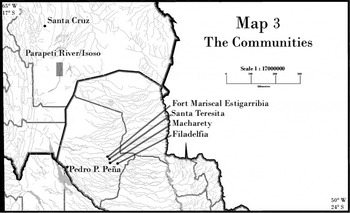
Since 1997, I have worked in a Guaraní-speaking community in southeastern Bolivia called Isoso. The ten thousand people living there in twenty-seven villages along the Parapetí River call themselves the Isoseño after their home region. Since 2005, I have worked also in a related Guaraní-speaking community in northwestern Paraguay. Three thousand people living in four settlements (three clustered near the military base at Mariscal Estigarribia) in the Paraguayan Chaco call themselves the Guaraní Occidental or “Western Guaraní” (see map 3). The Guaraní Occidental are the descendants of people from Bolivian Guaraní communities, including Isoso, who came to Paraguay either as war refugees or prisoners of war during and just after the 1932–1935 War of the Chaco between Bolivia and Paraguay.
The Communities

Between 1998 and 2000, I conducted eighteen months of doctoral fieldwork in Isoso and have returned there at least every other year since for visits lasting from two weeks to two months. I am a competent speaker of Bolivian Guaraní and have published various works on the basis of my Bolivian fieldwork, several of which I cite here. My time in Guaraní Occidental communities comprises four short visits: one of one month in 2005, one of two months in 2007, one of one month in 2008, and one of one month in 2009. The present article is my first and is likely my only publication pertaining directly to fieldwork among the Guaraní Occidental, for reasons that will be made clear in the course of the essay. I do not speak or understand Paraguayan Guaraní and to communicate there relied on Spanish and Bolivian Guaraní, spoken by older people in three of the four settlements and the majority of people in the fourth. My initial plan was to carry out a comparative study of patterns of work and engagement with the cash economy in Isoso and among the Guaraní Occidental. Due to conflicts over leadership and legitimate structures of decision-making in the latter communities, this became impossible. On my last trip to Paraguay, in October 2009, I left copies of all ethnographic materials (photos, interviews, field notes) collected along with a full-length version and summary translation into Spanish of the present essay with leaders of each of the four Guaraní Occidental communities, and I have no ongoing agenda of research there. The observations that follow, then, should be prefaced with a caveat. They are based on intimate knowledge of Isoseño community dynamics, but a lesser grasp of Guaraní Occidental community dynamics. Nevertheless, I will present what I believe to be a reasonable set of conclusions from the ethnographic and historical facts at my disposal. I will begin with the Bolivian case with which I am more familiar, and then draw out contrasts with the Paraguayan one.
Host Space in the Bolivian Case: Isoso and Its Ñemboati
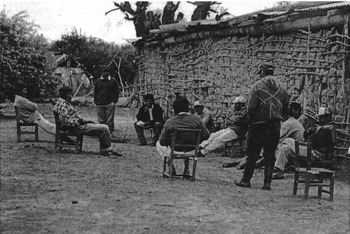
In Isoso, key elements of what I want to argue makes for “host space” are found in the ñemboati. The ñemboati (reflexive + to make + gather together: roughly, “to gather [itself, oneself] together”—usually translated into Spanish as asamblea, assembly) is a constitutive feature of Isoseño sociality and an institution attested to in a historical literature on Tupí-Guaraní-speaking groups that extends back to the sixteenth century.Footnote 4 What people do at ñemboati has been glossed in Spanish as nivelar la palabra—“to level the word” (Albó Reference Albó1990; Hirsch and Alberico Reference Hirsch and Alberico1996). This suggests a smoothing-out mechanism that is not entirely accurate. The Guaraní verb being translated is oyemboyovake, which means literally “to make reciprocally to face.” While this does not necessarily imply confrontation, it also does not presuppose an integrative function. The Guaraní verb describes well what happens at ñemboati. People sit or stand in a loose circle, facing one another, and speak and listen to one another. As Bartomeu Meliá has it, “The ñemboati can be considered as a generalized form of reciprocity in which what is communicated is the eloquence of speech” (Reference Meliá1988: 66). Ñemboati can be convened for a diversity of reasons: to discuss anything from school construction, to the clearing of brush from a community road, to sandbagging to prevent the flooding of fields, to adulterous conduct on the part of elected community representatives, to cases of witchcraft. However, whatever the ñemboati's content, its form is not dependent upon anyone's particular auspices and the format itself is permanently inconclusive. In all villages there is a standing ñemboati every Sunday unless specifically cancelled, and additional ñemboati take place at other times to deal with small issues. Multi-village ñemboati may be organized to deal with large issues, and any Isoseño person is free to come to any ñemboati, though, in practice, more men than women attend. Figure 1 shows a typical, if rather small, meeting. In recent decades, non-governmental organizations have found the ñemboati format amenable to their interventions into community dynamics because it is so reliably available. Isoso's leadership maintains offices in the Bolivian city of Santa Cruz and sometimes refuses particular individuals and organizations entry to the community. To be present in Isoso, however, is to be allowed to attend its ñemboati.
A ñemboati in Isoso. Author's photo.

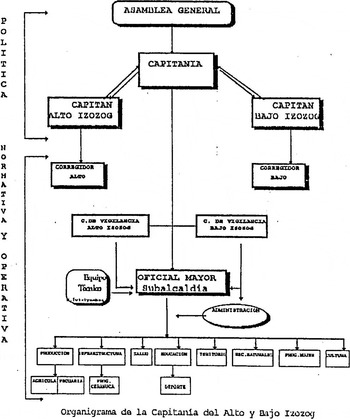
There is no voting at ñemboati, and while consensus outcomes are preferable they are far from usual (Lowrey Reference Lowrey2007). An issue unresolved at one ñemboati will be carried on to others, or dropped if it is unimportant. Contentious issues can be deferred indefinitely because everyone knows there will be another ñemboati sooner or later. In their diagrammatic representation of their own self-organization, first put together as part of their application for “juridical personhood” under Bolivian law, the ñemboati (“asamblea”), rather than any individual leader, occupies the locus of supreme authority (see figure 2).
A diagrammatic representation of the political structure. Reprinted from Combès Reference Combès1996, with permission.

Although the ñemboati is a meaningful institution of long standing, it has little in the way of material infrastructure. In any village, the meeting area is kept clear by community labor but is not visibly engineered to display human artifice. Once familiar with the meandering layout of Isoseño villages, one may be able to guess where the village meeting space is, but nothing definitive marks it. It tends to be in the shade of the canopy of one or more tall trees, which are scarce and appreciated in the hot dry Chaco. This location may or may not correspond to the center of the village clearing, and is only rarely near the homes of prominent village figures. An occasional giveaway is a long strip of metal hanging from the lower branches of a tree, which is clanged to announce gatherings. Attendees bring their own chairs, or stand, and are free to arrive or leave whenever they wish. A small child might wander in to slump against a favorite relation for a while, and the more waggishly friendly of village dogs may attempt to lie down in the center of the rough circle of seats unless or until someone banishes them. No one considers children or animals incompatible with the formal dignity of the proceedings.
In fact, the form of the proceedings receives little explicit attention. Just as there is no engineered site for meeting, there are no obligatory preambles, hushes, clapping, bowing, or other techniques of the body to physically mark its conduct. The only noteworthy speech tag that one hears often at ñemboati, but less so in everyday speech, is the phrase “jae jokua” (“that's what I say”) or “jaema” (“that's it”) to end an individual contribution. Any lone utterance or opinion is humbly offered, so much so that when it is the turn of notable figures (leaders, shamans) to speak they often preface or close their statements with a stereotyped disclaimer to the effect that, “I cannot speak for everyone, I can just say what I know.”
To understand why this might be important, it is useful to consider a contrast made available by anthropologist Laura Graham's description of the council meeting format in a different lowland South American society, the Xavante of Central Brazil. She writes of the “depersonalized collaborative construction of discourse” in that “Amazonian public sphere” (Reference Graham1993). Graham highlights the discursive role of speakers, which is occupied in an unfamiliar way by Xavante men (and men only) in their council meetings. They gather after sunset, lie on their backs in a circle, and gaze at the night sky rather than at one another. A pattern of cross-talk emerges across each session such that individual contributions to any discussion are not identifiable. Graham shows how the Xavante have a successful public sphere that works along different lines than those supposed to be essential by public sphere theorists working in the Western philosophical tradition. As Graham puts it, “Xavante represent discourse as an extra-individual phenomenon, a collective production of multiple voices” (Reference Graham1993: 718). The radical distinctiveness of the Xavante case, then, is in this manner of speaking that untethers particular utterances from particular utterers.
The Xavante institution of the central plaza, however, is a spatially marked (and gendered) forum for public speech that Westerners from ancient Greeks to contemporary C-SPAN watchers would recognize. What is alien about the Isoseño public sphere, by contrast, is the transparency of the speech-space itself. As far as the manner of speaking, the meetings take place in the light of day, speakers take turns, and the audience looks at whoever is holding forth. All villages now keep a minutes-book in which careful notes are kept of important discussions, and individual contributions are recorded as such for future reference. The difference here, then, is not discursive, as in the Xavante case, but rather material and infrastructural.
Could it be that this unadorned, unelaborated, apparently ad-hoc relationship to the physical mechanics of meetings is somehow motivated? This proposition contains both a perceptual and a conceptual challenge. Is the absence of a particular something indicative of something else, or of nothing? Is it a lack, or a different kind of presence? This is at the heart of both Pierre Clastres' and Michael Warner's arguments. To show why they make a uniquely suggestive pairing for the ethnographic analysis of this case, a brief treatment of the special role that Tupí-Guaraní evidence, and in particular Chaco material, has played in the development of anthropological theory is in order.
Clastres famously insisted that the South American Tupí-Guaraní did not have a primitive, “pre-state” society, but rather a sophisticated anti-state one. Warner argues that gay neighborhoods in New York City are not unethical, “disorderly” spaces, but instead are critical, ethical, queer-ordered ones. In both cases, any attempt to reform (or develop) these alter-polities is putatively benign but actually annihilating. If there is a real twinning here, I suspect Michael Warner's idea of “host space” links to “another, more secret equation, of a political nature” (Clastres 1974: 217) in many places—not just urban ones like New York City but also rural ones like Isoso. Note that the sticking point for both Clastres' and Warner's arguments is the question of where intentionality is located: in collectives and their emergent forms, or in individuals and their private choices? Writing at the end of the 1960s, Clastres simply asserted the active reality of “structural intention.” A scholar-activist of Warner's generation knows that premise is a political-intellectual fight all its own, which is perhaps why he specifies the spatial requirements of his sociological premise.
The Chaco is not remarked for its celebrated French anarchists or its urbane gay New Yorkers. Hardly anybody lives there at all (recall the population density). What is more, while considerable attention has been paid to the spatial peculiarities of Western metropoles and even to those of other South American polities, spatial relations have been little considered in the Chaco (Gordillo Reference Gordillo2004 offers a recent exception). Of course there are no cityscapes there, but in the South American Chaco neither does one find the tidy circular plans of Ge and Bororo villages in Amazonia nor the matched upper and lower moieties of Andean ayllus. In fact, the Chaco long has been considered relatively devoid of independently interesting characteristics for the purposes of anthropological theorizing as compared to Amazonia or the Andes. There might be something to this being a non-entity, however, which is one of the general premises of my argument here.Footnote 5
Until the twentieth century, the arid Chaco interior was home only to nomadic hunter-gatherers, speakers of Zamucoan, Guaycuruan, and Matacoan languages. Guaraní-speaking groups live on the more humid northern fringes of the Chaco where sedentary agriculture is possible.Footnote 6 There, the layout of Guaraní villages is rambling. Meandering paths connect homes, or pairs or clusters of homes. Village centers are less geographically central than customarily so. As Eduardo Viveiros de Castro has said in one of the few discussions of these social architectonics, “Compared to the crystalline properties of Ge societies, the Tupí-Guaraní evoke images of amorphous bodies—clouds or smoke—in their weak and casual social organization” (Reference Viveiros de Castro and Howard1992: 5). Is there something to be made of that formlessness? The tradition of ethnographic observation of the Tupí-Guaraní promises as much: it has produced a parade of putative lacunae, nestled within which are critical ethical lessons for each new generation of observers.Footnote 7 This cultivated taste for absent presences is what makes Warner's metropolitan material so evocative for a scholar of the Guaraní.
The Tupí-Guaraní first appear in the anthropological literature as the amoral (but not immoral) cannibals of French essayist Michel de Montaigne (1580). As a high-minded ritual marked by mutual displays of courage and generosity, Montaigne proposed, for all its cruelty Tupinambá anthropophagy came out rather well when contrasted to the low and ruthless brutality of religious conflicts in sixteenth-century France.Footnote 8 Perhaps the Tupinambá absence of moral scruples was to be preferred to the European excess of them, or, as Montaigne had it: “I am not sorry that we should here take notice of the barbarous horror of so cruel an action, but that, seeing so clearly into their faults, we should be so blind to our own” (Reference Montaigne and Donald M.1943 [1580]: 85).
Next they appear as the amiable atheists of the eighteenth-century Jesuit missions in Paraguay, those Guaraní acolytes possessed of a spirituality so pure that they cared nothing for the things of this world or the next. This made them conformable to the totalizing plans the Jesuit fathers had for both (a vision that informed the 1986 film The Mission). The innocence of these theologically empty vessels awaiting godly content threw into relief the willful doctrinal perversity of pagan idolaters, Muslim infidels, Protestant apostates, and Catholic sinners alike.
Finally, in the twentieth century the Tupí-Guaraní became the intentional anarchists of Pierre Clastres'Society against the State (1974). As mentioned previously, David Graeber (Reference Graeber2004) has through his own work on political anarchism brought renewed attention to Clastres' propositions. Viveiros de Castro (Reference Viveiros de Castro2002) treats this “sem fé, sem lei, sem rei” (without faith, law, or king) role of Tupí-Guaraní society in anthropological theory in a thought-provoking essay that returns to the first problem in this historical series: cannibalism. The tradition from Montaigne to Viveiros de Castro has been to demonstrate that the apparent anti-thesis presented by the Tupí-Guaraní encapsulates a thesis, one that if decrypted reveals a lesson for the culture of the observer-decoder, whether philosopher, theologian, revolutionary, or anthropologist. Although I follow that precedent here, I am mindful that it “takes entirely for granted that the divide between self and other can be securely and definitively drawn” (Faubion Reference Faubion, Faubion and Marcus2009: 148). It is in part because of the way Tupí-Guaraní materials have so often been turned to purposes of tidy complementarity, always equal-and-opposite to the Occidental instance of the hour, that this “negativity” came to interest me as a problem in its own right. Warner's skillful dissection of the same in putatively “disorderly” queer neighborhoods suggested a way in which to think about anti-order as an intriguing aspect of the general human condition, rather than as an exclusive quality of a particular Amerindian one.
Warner has a specific case in mind, as do I, but both cases are good for thinking about what kinds of individual experience and lived worlds are made possible by concrete contexts of “formal permissiveness.” What seems to be the indefiniteness of spatial organization of Isoseño collective life and the casual approach they take to the institutional aspects of public deliberation may in fact constitute a positive ethics of openness.
What are its pragmatic consequences in context? People in Isoso, as they will be the first to tell you, are poor.Footnote 9 However, they also are authors of a success story as indigenous peoples and their allies account for and celebrate these things locally, regionally, nationally, and internationally. What is even more striking for an indigenous group is that they have managed to turn a series of quite different state relationships to their own ends over many decades. Much has been made of the horizon of possibility opened up by the 2005 election of Bolivia's first indigenous president, Evo Morales, but Isoseño people have not placed their political projects on hold in anticipation of that new dawn. Isoso was the first indigenous community in Bolivia to obtain collective titles to many of their own lands, in 1927, 1932, and 1947, that is, before the 1952 National Revolution that enfranchised Andean peasants and long before the reforms of the 1990s that began establishing title for other lowland indigenous peoples (Albó Reference Albó1990; Combès Reference Combès1999). Isoseño representatives, along with those of the Chiquitano and Ayoreode indigenous peoples, in 1982 founded Bolivia's first pan-indigenous organization for lowland peoples, the Confederation of the Indigenous Peoples of Eastern Bolivia (Coordinador Indígena Del Oriente Boliviano, CIDOB; Riester Reference Riester and McDonald1985).Footnote 10 Isoso became the first “indigenous municipality” to be established under Bolivia's 1993 “Law of Popular Participation,” which recognized traditional authority structures as part of a plan to decentralize official administrative structures of national governance. In perhaps their most celebrated achievement, Isoseño people pioneered an agreement for the joint administration of a several-million-hectare national park established in 1995 under the funding auspices of the United States Agency for International Development, with technical support from the New York Zoological Society's Wildlife Conservation Society.Footnote 11 All of this is remarkable because it points to a supple Isoseño capacity for politicking that cannot be attributed to a diverse parade of alters: the Bolivian state of 1927 bears little resemblance to that of 2009, and yet Isoso has had its successes with both, and with many in between.
Be that as it may, by the early 2000s all of these external successes seemed internally to be producing a distinctly un-Isoseño outcome: the consolidation of material power in the hands of a closely networked hereditary elite. The existence of something like aristocratic lineages is evident in Isoseño history, and is probably an Arawakan legacy (Combès Reference Combès2005 has the most thorough discussion). However, before the 1990s there was little material differentiation among Isoseño people and a number of elite families jostled continually for pre-eminence. These permanent rivalries precluded rigid stratification. A series of external alliances beginning in the 1970s that had increasing financial impacts, combined with the post-1935 ascendancy of a single lineage, seemed for about a decade in the 1990s to be culminating in a fixing of Isoso's hitherto alternating social dynamics (see Lowrey Reference Lowrey2003; Combès Reference Combès2005; Reference Combès2010; Combès and Lowrey Reference Combès and Lowrey2006). Members of a single important extended family and their associates began to spend the majority of their time away from Isoso in the tropical Bolivian city of Santa Cruz de la Sierra, and to accumulate salaried positions that differentiated their standard of living from that of the average Isoseño person (Lowrey Reference Lowrey2006). Since 2000, however, a political schism in Isoso has resulted in the establishment of a second and then a third leadership organization that maintain competing offices in the city. NGO and government agencies working with the original organization lament this fractiousness and attribute it to the avarice of a few bad apples, but a longer view of Isoseño cultural history suggests that it is much more in keeping with Isoseño traditions than was the situation during the 1990s. In fact, the exact terms of the schism repeat a pattern that made its first documented appearance in 1855 (see Combès Reference Combès2010: 28).
I have written elsewhere about a multi-community ñemboati in the late 1990s that the then-ascendant faction attempted to use to affirm its own legitimacy, and how the very indefiniteness of the ñemboati institutional form undermined that attempt (2007). What I did not see then, but because of events since conclude now, is that this was not an exceptional case but rather displayed the long-standing historical genius of the ñemboati. The ñemboati fosters and embodies an ethic of self-organization that makes collective power elusive of capture. It becomes the springboard for Isoseño success vis-à-vis external political forces, and it allows a certain amount of internal hierarchy to perpetuate itself on a minor scale while preventing it from becoming fixed on a major one. To marry Pierre Clastres' ideas to Michael Warner's (even at the high cost of risking the distractions of a same-sex matrimonial metaphor): the ñemboati, I propose, is Isoso's host space.
In making such a proposition, it is important to clarify what, exactly, is “hosted” there. Isoseño host space is not welcoming so much to visitors from outside Isoso (of whom there are relatively few in the rural Chaco, as compared to, say, New York City) as it is to opportunities for people already in Isoso to oyemboyovake, “to make reciprocally to face.” While outsiders sometimes lament Isoseño factionalism as emblematic of the decadence consequent upon the community's encounter with the fallen mores of modernity, a historically informed view of Isoso and its successes suggests such “face-offs” are instead integral to its ethos. What seems to be key is to have unencumbered access to this reciprocal facing. In a lovely aside, Warner says, “Most people, I hope, have had the experience of discovering a deep pleasure in something they would not have said previously that they wanted” (Reference Viveiros de Castro and Howard1999: 8–9). He is making a point about the ethics of sexual politics that can be expanded to political ethics, generally, and to the vital resource that is discursive and physical access to the unexpected. The more form is prejudged, regimented, zoned, and made explicit, the more content, too, is pre-selected. With this in mind, one can appreciate the ñemboati for what it may well be: a masterpiece of anti-design. I will now attempt to underscore the real presence of this absence by turning to a context where its historical conditions of possibility have been destroyed; or to put it another way, to show how differently things look when this aperture is absent.
No Host Space: The Guaraní Occidental
The Guaraní Occidental are the descendants of refugees and prisoners fleeing or taken from Guaraní-speaking communities in Bolivia, including Isoso, during and just after the 1932–1935 War of the Chaco between Paraguay and Bolivia. They have used the ethnonym “Guaraní Occidental” since the early 1970s, when a community member active in Paraguayan indigenous politics suggested it to a visiting pair of Austrian anthropologists, Georg and Friedl Grünberg. The Grünbergs chose to use it in their 1974 monograph about the community, marking its first appearance in the ethnographic literature, and it has since replaced a mix of previous terms. The most commonly employed was “Guarayo,” which still comes up conversationally in Paraguay but is rejected by the Guaraní Occidental and anthropologists alike because it is properly the ethnonym of an entirely different group living in Amazonian Bolivia. The “Occidental” (“Western”) part of the label clarifies that these are different indigenous people than the indigenous Guaraní peoples like the Aché and Mbyá who live in eastern Paraguay.
The impact of the War of the Chaco on the indigenous peoples of Bolivia and Paraguay is only now receiving sustained scholarly attention (Richard 2008). What is clear is that before the war began both sides viewed the mobile hunter-gatherers of the interior (Enhlet, Manjui, Nivaklé, Ayoreode, and Ishir peoples) to be beneath consideration as national citizens.Footnote 12 The situation of the Guaraní-speakers living on the northern fringes of the Chaco, in Bolivian territory, was different. Before the war, both nations considered them as actual or at least potential citizens because they were “civilized” sedentary agriculturalists. During the war, both armies recruited them to build roads, wash laundry, and for other support work. However, the Bolivian command viewed them warily as possible internal enemies because they, like Paraguayans, were Guaraní-speakers. (Paraguay is the only South American nation in which an indigenous language, Guaraní, is widely spoken across social classes.) The Paraguayan command actively courted them as potential allies for the same reason.
Different populations of Bolivian Guaraní reacted in different ways to these expectations. The Parapetí River, and thus Isoso, marked the northernmost extension of the Paraguayan advance into Bolivia during the war. The Isoseño rejected Paraguayan overtures and the Paraguayan military responded by turning almost the entire population into prisoners of war. They marched twenty-five hundred Isoseño people across the Chaco and settled them at what is now Fort Mariscal Estigarribia in present-day Paraguay. The majority of these prisoners returned to Isoso at war's end, but about seven hundred decided to stay behind for reasons that are unclear (Schmidt Reference Schmidt1938; Bossert, Combès, and Villar Reference Bossert, Combès, Villar and Richard2008).Footnote 13
By contrast, Guaraní speakers from further south, in the region around the Bolivian Franciscan missions of Macharety and Buena Vista, cooperated with the Paraguayan military during the war. As it drew to a close, they learned from Paraguayan officers that despite considerable Paraguayan territorial gains under the terms of the armistice their home territory would remain on the Bolivian side of the border. Fearing post-war reprisals, they decided to flee Bolivia.Footnote 14 Five thousand abandoned their homes and farms under the auspices of the demobilizing Paraguayan forces. While the majority moved on to Argentina seeking work and better living conditions, about two thousand settled with the remnant Isoseño already in Paraguay (Bossert, Combès, and Villar Reference Bossert, Combès, Villar and Richard2008; Fritz Reference Fritz and Richard2008).
Although an enemy's enemy may be a circumstantial friend, the Bolivian refugees from the mission region were let down by the conditions of their settlement in the Paraguayan Chaco. Experienced farmers, they realized that the land they had been promised, but to which they did not receive title, would not in any event be amenable to agriculture since this part of the Chaco is much drier than the part they left. They felt no affinity for the Isoseño remnant already in Paraguay with whom they now had to share their lives. Indeed, the two groups had a history of mutual hostility stretching back to the pre-Columbian period (Combès and Lowrey Reference Combès and Lowrey2006). Finally, unlike the Guaraní from the missions, Isoseño people remained un-churched at the start of the twentieth century (first evangelical and then Catholic missions took hold in Isoso just before and after the war). To be lumped together in Paraguay, then, suited neither group.
Although Paraguay received the lion's share of territorial concessions after the war, the cost of conducting it had been high in demographic and economic terms and the nation was in a state of continual political turmoil until Alfredo Stroessner seized power in 1954 (Lewis Reference Lewis1980; Miranda Reference Miranda1990; Roett and Sacks Reference Roett and Scott Sacks1991). Because of this, the Paraguayan state left this motley crew of Guaraní-speaking arrivistes more or less to its fate. Their descendants now live divided among four communities in the Paraguayan Chaco. In only one do they have much in the way of land title, and everywhere their livelihood is precarious and dependent. There is nothing of the artful disorder of Bolivian Guaraní social space in this part of the Paraguayan Chaco, only hard-won footholds dependent on the tenuous goodwill of various patrons.
The four present-day Guaraní Occidental communities have been shaped by three institutional entities that are hugely important in the Paraguayan Chaco: the Paraguayan military, Catholic missions, and Mennonite colonies (sometimes locally shorthanded as “the three Ms”). Two original Guaraní Occidental settlements were established near military forts: one at Mariscal Estigarribia in the central Chaco and the second at Pedro P. Peña on the Argentine border. By 1940, the Guaraní who had previously lived in Franciscan missions in Bolivia requested Church assistance in their new, Paraguayan home. The Missionary Oblates of Mary Immaculate arrived soon after to establish missions in the Paraguayan Chaco. A first mission, Santa Teresita, was set up near Mariscal Estigarribia, and a second, San Agustín, near Pedro P. Peña (Fritz Reference Fritz2003; Siffredi Reference Siffredi1989). The first and second Guaraní Occidental communities remain linked to the military and the missions, while the third and fourth are associated with the Mennonites.
Mennonites from Canada and Russia settled in the Paraguayan Chaco just before the start of the Chaco War.Footnote 15 They came in search of religious non-interference and the Paraguayan state welcomed them, despite their pacifism, as hardworking literate farmers who could reinforce Paraguayan claims to the Chaco by their very presence.Footnote 16 After three difficult decades, with the completion of the Trans-Chaco highway in 1965 that connects Asunción, Paraguay to Santa Cruz, Bolivia and runs through the colonies, the Mennonites began to prosper. (They were joined in the late 1940s by a contingent from post-war Germany.) The main Mennonite town, Filadelfia, at first locked Indian day-laborers outside the township gates each night, but by the end of the 1960s capitalized on the convenience of permitting an indigenous neighborhood within the town limits. Like the rest of Filadelfia, this neighborhood is laid out in strictly demarcated ethnic quadrants: several blocks of Nivaklé, several of Enhlet, and several of Guaraní Occidental residents. By the early 1980s, Filadelfia's indigenous neighborhood was expanding at what town authorities considered an alarmingly rapid clip.Footnote 17 Mennonite authorities purchased land between Filadelfia and Santa Teresita and encouraged its settlement by Guaraní Occidental and by Ñandeva (a nomadic Chacoan group that has adopted Guaraní language) people.Footnote 18 This new colony is ethnically partitioned in the same way as is the Filadelfia indigenous neighborhood, and its Guaraní Occidental quadrant has been christened “Macharety” after a Bolivian village of ancestral origin for many Guaraní Occidental. The new Macharety constitutes the fourth of the four Guaraní Occidental communities.
This, then, is the present-day settlement pattern of the Guaraní Occidental. Unlike in Isoso, where multi-community meetings are made possible by the fact that villages are spaced out at approximately two- to seven-kilometer intervals along a river, all joined by a continuous dirt road, the four Guaraní Occidental communities lie at a minimum distance from one another of thirty kilometers and a maximum of three hundred. There are no collectively maintained paths between communities traveled on foot, bicycle, or horseback. Instead, the communities are only connected by paved highways or dirt roads maintained by the Paraguayan state or the Mennonite cooperative and traveled by four-wheel-drive vehicles, heavy trucks, and motorcycles. Very few Guaraní Occidental families own a vehicle and the distance to Pedro P. Peña is too long to traverse on a motorcycle. Although a weekly bus service to Pedro P. Peña is available, it is expensive enough that families with distant relatives use it only two or three times per year. The most common means of transport between the three more closely clustered communities—Santa Teresita, Macharety, and Filadelfia—is hitching rides with employers.
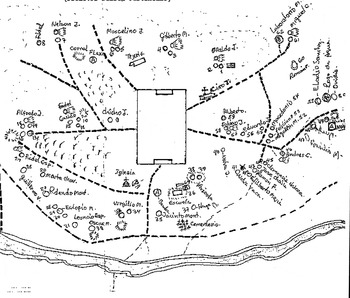
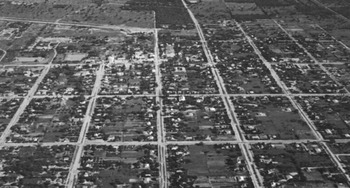
It is not just the far-flung nature of the communities that distinguishes them from Isoso. Community-internal layouts make an even more striking contrast, as figures 3 and 4 illustrate. Isoseño villages are higgledy-piggledy. They are confusing to visitors but from the perspective of lifetime residents comprise a cozy network of homey footpaths made by friends, family members, children, and animals. Figure 3, drawn by a middle-aged Isoseño man, represents the village soccer field, where ñemboati are also held, as if it were the geographic center of his community and marks the main paths radiating from it. By contrast, three of the four Guaraní Occidental communities follow the grid design—rectilinear quadrangles of varying size—employed by the Mennonites on their farms and in their towns (see figure 4). The result is widely spaced homesteads in Macharety and tidy blocks of fenced-in individual homes in Santa Teresita and Filadelfia. The most isolated community, Pedro P. Peña, has been displaced several times by shifts in the course of the Pilcomayo River and now consists of three nuclei, each several kilometers apart, one of which is likely to soon become a fifth community in its own right.Footnote 19
An Isoseño village layout, drawn by an Isoseño man (Nelson Justiniano). Reprinted from Combès Reference Combès1999, with permission.

An aerial view of Filadelfia. Reprinted from Stoesz and Stackley Reference Stoesz and Stackley1999, with permission from Canadian Mennonite Bible College Publications.

The most physically compact community, the one in Filadelfia, is not for that reason the most cohesive. For example, five years ago the Guaraní Occidental neighborhood was swept by rumors of a cannibalistic shape-shifter. Speculation ran high that s/he/it was a Nivaklé, but no one knew just who; they simply attributed keen shape-shifting skills to Nivaklé sorcerers. Families gathered together to sleep at night and organized patrols of their kinsmen to stand rotating guard against the anonymous enemy. Witchcraft rumors are also common in Isoso, but are never about unidentified door-to-door stalkers; Isoseño witchcraft stories always involve readily named neighbors and relatives.
This malevolent anonymity—one might call it facelessness—is telling. It is symptomatic of the relative paucity of ways and places to “oyemboyovake” (to make reciprocally to face) in the present experience of Guaraní Occidental people. In section one I described the organization of social space in Isoso, in Bolivia, as “studiedly” ad-hoc, but in Paraguay among the Guaraní Occidental it is genuinely so. There is nothing that could be called “sociological intention” behind present-day Guaraní Occidental spatial organization. Instead, their occupancy of social space is structured by externally imposed historical, political, economic, and even environmental conditions. The history of these two communities of common origin that were separated by war during the twentieth century creates a unique ethnographic opportunity to consider the difference this difference makes.
Host Space: What Is It and Why Is It Important?
Mario Blaser's recent ethnography of the political struggles of the Yshir nation of the Paraguayan Chaco offers a poignant demonstration of what a difference “host space” can make. Blaser describes how, during the 1990s, Yshir (known in older literature as Chamacoco) people hoped to access development resources putatively available to indigenous peoples of the Paraguayan Chaco through a project, called “Prodechaco,” funded by the European Union. While many Paraguayan NGOs working on indigenous issues insisted that resolving indigenous land claims ought to be a precondition of any such EU funding being disbursed in Paraguay, Paraguayan landowners successfully convinced evaluators that land claims were impossible to adjudicate because of the problem of “representation” in Paraguayan indigenous communities. Prodechaco redesigned its aims accordingly: “Now a central objective of the project would be to develop the representational skills of the communities … an objective that circumvented the land issue” (Blaser Reference Blaser2010: 184). Blaser quotes a Prodechaco officer articulating the importance of this objective: “The truth is that if the communities do not develop these skills, they will disappear as distinct communities as globalization advances” (ibid.: 186).
Of course, concern about this “disappearance” was what motivated indigenous organizations and their allies to press for resolution of land claims as a precondition of Prodechaco going forward at all. The tutelage of the Yshir by outsiders, which Prodechaco institutionalized as a step preparatory to addressing Yshir land claims, predictably became the basis for charges that the Yshir were not truly representing themselves. The Yshir continue to be described as occupying a state of perpetual, inescapable unreadiness for land claim resolution. I will return to the Guaraní Occidental, but I open with the Yshir because their case exemplifies the general relevance of a larger analytical point to be made in this section: formal explication is antithetical to “hosting.”
What I believe Michael Warner was invoking in his phrase “host space,” and the reason I found it so evocative for my own work done in such a different place, is exactly this: the way “hosting” is diminished by specific articulation. There is a reason that dinner invitations specify arrival times but not the hour guests are to depart, and why food is presented in communal dishes at the table rather than allotted to guests on individual plates in the kitchen, and why spaces of commercial hospitality are at pains to give the impression of open-ended largesse while subtly framing interactions so that customers eat in predictable quantities and depart at a regular clip. As Shryock puts it, “Hospitality is always partially unseen” (Reference Shryock2004: 59). Indeed, hosting is inimical to total transparency.Footnote 20 This is true in one way of the suburban householder who spends all day cleaning and arranging in order to present a casual, “thrown together” atmosphere for company in the evening, and in another way of the hospitality of fabulous, performative display, as in the potlatch that reaches its apogee when the host's generosity takes the form of “heedless” abandon.
To demand, then, that queer space in New York City articulate its norms so as to subject them to external review is to rob it of its capacity for hospitality, in the same way that the most passive-aggressive of guests is the one who assiduously asks after the “rules of the house” so as to ostentatiously keep to them and generally make sure every instance of proffered generosity is kept within determinate limits. Because definition presupposes exclusion, to definitively delineate host space is to erase that inviting quality that marks it as such. Guests know that they ought not look in the medicine cabinet, but if one posts a sign to that effect one rather undermines the very hospitality that their not doing so respects. If queer neighborhoods must exhaustively codify the conditions of their zoning in deference to encompassing community norms, this forecloses the very quality of emergence via encounter that makes them “alternative.”
What has this to do with indigenous peoples in the Paraguayan Chaco? It is emblematic of the argument of this article, that the toponym “Isoso” and the ethnonym “Isoseño” are isomorphic and in many circumstances interchangeable. To say “in Isoso” is as much as to say “among the Isoseño.” By contrast, explanatory circumlocutions are necessary to describe anything about the Guaraní Occidental—their far-flung communities, why they live to the east of their origins in Bolivia but nevertheless are called the “Western Guaraní,” in what their livelihood consists. This is true for not just the anthropologist describing them, but also their own self-accounts. If it is difficult to write about the collective entity “the Guaraní Occidental,” it is even harder to bring together that entity in any pragmatic way because explicit definitions tend to evacuate that which they aim to capture.
No one is more conscious of this than the young generation of Guaraní Occidental people who, under the auspices of the Catholic Church and the Assembly of Guaraní Peoples in Bolivia (APG, Asamblea de Pueblos Guaraní), and sponsored by a Bolivia-based UNICEF-funded educational institution called Teko Guaraní (Guaraní “culture” or “way of life”), during the 1990s and early 2000s traveled to Bolivia to learn about bilingual education, indigenous politics, and transnational identity-based alliance-making.Footnote 21 This group of about a dozen men and women in 2003 founded the Organization of Guaraní Peoples (OPG, Organización de Pueblos Guaraní) in Paraguay. At the time, they were undersignatories to a no-longer-extant entity called the Coordinadora de los Pueblos Indígenas del Chaco (CPI-Chaco, the Coordinator of Indigenous Peoples of the Chaco), launched from Bolivia in 2000 with help from the Swiss Red Cross as an initial attempt to create a Chacoan analog to the Amazonian Coordinator of the Indigenous Peoples of the Amazon Basin (COICA). The OPG organizers took the Bolivian APG as their model, but in particular hoped to emulate the example of the Isoseño. The Capitanía del Alto y Bajo Isoso (CABI, Captaincy of Upper and Lower Isoso) is a member entity of the Bolivian APG, which was in turn a member entity of CPI-Chaco, but for a while in the late 1990s CABI had a budget from international donor organizations of various kinds that far exceeded that of the entire APG.
These border-crossing emissaries absorbed the idea that the ñemboati is the key to Guaraní identity and political self-organization, but when they tried to utilize this format back in Paraguay they found it less an empowering tool than a dangerous trap. In part this was due to the structure of indigenous politics, and even national politics, in Paraguay. Although decried by all interested parties, official policy still revolves around securing “registered indigenous leader” status at the government headquarters of the Instituto Nacional Del Indígena (INDI, National Indigenous Institute) in Asunción. This is in part a legacy of the politics of “personalismo” under the Stroessner regime.Footnote 22 As is the case in most indigenous communities in Paraguay, at one time or another various Guaraní Occidental individuals (overwhelmingly men) have secured this registration. This means that they are officially entitled to speak “for the people,” apply for funding, pursue NGO affiliations, pressure regional and national government agencies, and the like. Since it was founded in the 1980s, Macharety has accumulated eleven such official leaders and it is now subdivided into rival districts; during my visits to Santa Teresita it has had at least two and sometimes three leaders simultaneously serving and hostile in varying degrees to one another. Annual elections of caciques in Filadelfia involve delicate negotiations to alternate between factions (the Mennonite town authorities insist on a single title-holder at any one time), and Pedro P. Peña (San Agustín) in 2008 elected a young new leader, one of whose principal concerns is his predecessor's unwillingness to relinquish office. The mission of San Agustín is now flanked by an alienated settlement of converts to evangelical Protestantism (most of whom, intriguingly, are of Isoseño origin) that, as already noted, may soon become the fifth Guaraní Occidental community.
And yet what is striking in the Paraguayan as contrasted to the Bolivian case is not factionalism itself, which is present in both settings; it is that factionalism is paralyzing for the Guaraní Occidental in Paraguay in a way that it is not for the Isoseño in Bolivia. The Guaraní Occidental have very limited land title and no dedicated NGO affiliations, and it has proved impossible to establish a corporate “Guaraní Occidental” entity as a container for internal debate that also serves the purpose of collective external representation.
The events that led to my abandoning my planned program of research among the Guaraní Occidental are illustrative in this regard. In 2008, two Guaraní Occidental men—both in early middle age—aspired to the presidency of the fledgling Organización de Pueblos Guaraní. One was in the first group that traveled to Bolivia and has a weekly radio program on a Catholic Church-supported rural radio station. Its format is a rotating schedule of programming in Spanish, Paraguayan Guaraní, and Chacoan indigenous languages, including Bolivian Guaraní. This radio-announcer learned imperfect but functional Bolivian Guaraní as an adult during the year he spent in Bolivia, and he presents a weekly “Bolivian Guaraní” hour of programming. His wife is a schoolteacher who also traveled to Bolivia and has helped to set up bilingual education programs (in Bolivian Guaraní as opposed to Paraguayan Guaraní) in elementary schools serving Guaraní Occidental children. She grew up in Pedro P. Peña and speaks Spanish, Paraguayan Guaraní, and Bolivian Guaraní with equal fluency. They live together in Filadelfia. In May 2008, the husband used his radio program to announce that an inter-community meeting would be held in June to ratify a new OPG charter and finally elect a leadership slate. Through her contacts as a schoolteacher, his wife obtained UNICEF funding to pay for a chartered bus to carry attendees to distant Pedro P. Peña where she has a base of relatives and supporters.
Much to this couple's chagrin, an older Guaraní Occidental leader long affiliated with a Mennonite-run NGO, whose term as president of the Asunción-based inter-indigenous Coordinadora de Autodeterminación de Pueblos Indígenas (CAPI: Coordinator of the Self-Determination of Indigenous Peoples) was coming to an end, traveled to the meeting in his own four-wheel-drive vehicle. He denounced as illegitimate the calling of the meeting “in the name of the Guaraní Occidental people” but nevertheless participated in the election proceedings, winning a close vote that elevated him to the presidency of the newly ratified OPG. The radio-announcer, the second runner-up, was made vice-president. Inauspiciously, the two men had a history of rivalry and were not on speaking terms. One of the new president's first acts was to forbid me to continue the research I had begun in collaboration with his opponent. (I was at the time the only foreigner with any kind of engagement with the community at all.)
The new president, however, was unable to convene any multi-community meetings in the year following his election and was ultimately laid low by the same logic that formed his campaign platform. What, indeed, gave the previously ascendant couple and their associates the right to speak “in the name” of the Guaraní Occidental people and to convene a community assembly? But what, in turn, might give the new aspirant any such right? This formula for critique is the acid-bath of Guaraní Occidental collective mobilization. It is unfailingly effective and universally devastating in the Guaraní Occidental context. Explicit questions about the proper form of convening—about hosting, where to do it, and under whose auspices—become an overwhelming obstacle to convening at all.
The OPG is moribund at present. Nevertheless, younger Guaraní Occidental people, confronting a new set of possibilities, are still interested in “gathering themselves together” in a new way. The task is made urgent by political and economic circumstances. In 2008, Paraguay elected the first president in sixty years not to belong to Stroessner's Colorado party. Fernando Lugo's administration is in sympathy with the moves toward popular self-determination, including indigenous political mobilization, already pioneered in Bolivia across the previous twenty years and with which the Isoseño in particular have been so successful even before that. Economically, the several means of livelihood once available to Guaraní Occidental are disappearing. The Catholic Church is promoting a self-sufficient national Church rather than an international-largesse-distributing charitable one (Father Lucio Alfert, Bishop of the Apostolic Vicariate of the Pilcomayo, personal communication, 2008). Mennonite dairy, ranching, and agricultural processing enterprises are now relying more on mechanization and less on hiring unskilled and semi-skilled indigenous labor. The military dictatorship and its putatively benevolent paternalism are long over. Guaraní Occidental people are at something of a loss.
Just as the election in Bolivia of President Evo Morales might assist but in no way has created Isoseño capacities for self-organization, the Guaraní Occidental case is a good reminder that state policies are not always predictive of outcomes for indigenous peoples. The extent to which a progressive Lugo government promises to be more indigene-friendly than were its predecessors cannot be read into the historical experience of every indigenous community in the same way.
Indeed, the Stroessner regime during the 1970s and 1980s saw two Guaraní Occidental presidents of the only officially tolerated NGO representing indigenous peoples, the Asociación de Parcialidades Indígenas (Association of Indigenous Communities). While the regime has rightly been criticized for its sometimes-brutal insensitivity to indigenous issues,Footnote 23 among older Guaraní Occidental there is considerable nostalgia for it. Stroessner periodically visited Guaraní Occidental communities to distribute largesse, always praised their contribution to the Chaco War effort, and in 1955 (the second year of what would become Stroessner's thirty-five-year regime) Guaraní Occidental people became the first indigenous persons in Paraguay to obtain full citizenship, in recognition of their military service to the nation (Grünberg and Grünberg Reference Grünberg and Grünberg1974: 7). Under Stroessner, indigenous affairs were tasked to the Ministry of Defense. For almost all other Paraguayan indigenous communities this was problematic because it in some sense assessed indigenous peoples as hostile aliens to the state. But for the Guaraní Occidental this kept in place the ambivalently protective auspices of the military under which they had arrived in Paraguay in the first place.
The contrast of the Bolivian and Paraguayan cases described here is a reminder that when indigenous peoples confront the state there are two parties to the encounter, and outcomes depend on indigenous political structures as well as the more obviously prepossessing state ones. Given present possibilities and constraints, the model of the Bolivian Guaraní, and especially that of the Isoseño, has seemed to young Guaraní Occidental in post-Stroessner Paraguay like a promising and natural fit for their future politics as an indigenous community. This essay has explored why that model's very formlessness has made it such a difficult pattern to replicate.
Conclusion
In the lowland South American context, Terence Turner (Reference Turner and Stocking1991), Michael Brown (Reference Brown1993), and Beth Conklin and Laura Graham (Reference Conklin and Graham1995) contributed landmark analyses to the now-large literature on why and how some Amazonian indigenous peoples have mobilized politically with such success over the past two decades. Those Amazonianist works guided my initial consideration of the Isoseño case that I began studying in 1996 in the nearby Chaco. What was striking, however, when I began working with the Guaraní Occidental in the early 2000s was how little recent literature I could find treating cases from anywhere in which indigenous attempts at collective mobilization, revitalization, and political engagement were frustrated rather than exemplary. In the end, the most illuminating case I came across was not indigenous at all.
It was Michael Warner's urbane urban exposition of what, exactly, is at issue when queer “host space” is eliminated from U.S. cities that most assisted me in dealing with my rustic rural Paraguayan material. Warner is concerned with the restrictive zoning of public space and its connections to the ascendancy of a spatially privatized, ethically normalized gay and lesbian politics in urban settings. His account is unexpectedly apropos to the constricted occupancy of territory and its connections to the ascendancy of a spatially subdivided, ethically personalized indigenous politics among the rural Guaraní Occidental. In both cases, a certain kind of content becomes impossible when a certain kind of form—or, better, formlessness—is precluded. Anthropologists have long been advocates of land rights for indigenous peoples and, in concert with those efforts, of leaving indigenous peoples be in many ways, of not intervening overmuch to “reform” their ways of life. The contrast described here strikingly illustrates the intangible values that go along with those tangible goods: host space in which directly engaging others and their ideas does not continually wait upon, nor therefore founder upon, the prior and explicit working out of norms of good form.
This is at the heart of Warner's concerns as well. Although not an anthropologist, he makes an anthropological point: for an observer surveying an unfamiliar scene, what looks like a striking absence might signal an important presence. He shows the relationship between “permissiveness” and queer ethics, and how spaces and practices that look chaotic, unregulated, and begging for reform in fact manifest and foster a critical and emancipatory politics. His argument perhaps resonated with me because of my own reaction to my first field site, Isoso: the many, many times I got lost just attempting to visit a sequence of friends' homes or travel between villages; the degree to which dogs and children at important meetings still strike me as matter out of place; my sense that the pacing of meetings was odd, lacking marked inaugurals and recessionals; how in every village I had not visited before I would try to determine its “center.” It took my experience in the Paraguayan Chaco—which at first struck me as comfortingly familiar, with its discrete towns subdivided into tidy quadrants—for me to begin to imagine that all of these no-things might add up to some-thing, to which Warner's analysis gave a name: host space.
At a time when Guaraní are again invoked as proto-anarchists (Graeber Reference Graeber2004), it is interesting that a Guaraní pair of examples gets also at a problem faced by contemporary political activists. The Guaraní Occidental relationship to space is more familiar to most of us than is the Isoseño one, after all. Saying that we can build another world “within the shell of the old” does not tell us where we can meet other people interested in doing so (a challenge of which anarchists are well aware). How might we “gather ourselves together” toward such a public project when we live in private units, and when we walk out of those private homes to confront an increasingly zoned-off world? This is Warner's problem, and the Guaraní Occidental's problem, and one that many readers of the present essay will recognize as their own as well.Footnote 24 Again, it is a political and ethical problem with temporal (this situation has a history) and spatial dimensions.
We have seen this before. Pierre Clastres' 1974 propositions about the Tupí-Guaraní were all about time—that rather than being a “people without history” they were a society mobilized precisely to prevent history of the putatively universal band-tribe-chiefdom-state sequential variety. Hélène Clastres' lesser-known 1975 treatment of the same phenomenon was all about space. She proposed that in the pre-Columbian era, Tupi-Guaraní people fled history on footFootnote 25: whenever a sclerotic social order threatened to establish itself, a prophet would emerge to encourage everyone to throw off everyday mores and embark upon the next massive migration in search of the Land without Evil. This paradise was not a utopia; it existed somewhere on earth, and the trick was to find it. Rather, it was a uchronia; once there, everyone would enjoy youth, summer, and feasting without end. It is not a solution that is presently applicable, but we can see the traces of this anti-social order in the very wide distribution of Tupí-Guaraní languages across lowland South America.
Over the years, Pierre Clastres' writings have received much more attention than have those of Hélène Clastres. Who wants to think about the material details of hostessing when embarked upon the transcendent business of history-(un)making? But the applicability of that aspect of Warner's urban thesis to this rural case-study suggests that the mechanics of how such historical dynamics get invited into material, sensual space is a very general human problem, and for that reason one warranting general scholarly attention.