INTRODUCTION
The US domestic response to the 2013–2016 West Africa Ebola epidemic required broad public health effort to evaluate, monitor, and manage individuals with potential exposure to Ebolavirus to rapidly identify, isolate, and treat infectious individuals. Reference Chevalier, Chung and Smith1-Reference Regan, Jungerman and Montiel3 The US Centers for Disease Control and Prevention (CDC) updated risk-based monitoring and movement restriction guidance on October 27, 2014. Reference Somander4 Although response policies sometimes differed, every state instituted some form of monitoring and movement restriction policies for at-risk individuals. Reference Sunshine, Pepin, Cetron and Penn5,Reference Sell, McGinty and Pollack6 Implementation of these policies presented many challenges, including the sheer number of people who required monitoring– more than 10000 in 2014–2015. Reference Stehling-Ariza, Fisher and Vagi7,Reference Schemm Dwyer, Misner, Chang and Fajardo8 This article describes implementation challenges and considerations for Ebola-specific monitoring and movement restriction policies. The findings aim to help federal, state, and local health officials anticipate potential policy implementation barriers during future infectious disease events.
METHODS
We reviewed literature on the domestic Ebola response to establish study themes and identify potential interviewees. We used purposive sampling to select interviewees (N=30), representing 17 states/jurisdictions with variability in adherence to CDC guidance, census region, majority political party affiliation, and public health governance structures. Reference Sell, Shearer and Meyer9 Additionally, 1 interviewee represented the CDC Division of Global Migration and Quarantine. Participants included health department and public health leadership, public health operations, emergency management, emergency medical services, healthcare, and academia and had direct knowledge of state-level Ebola policy development and implementation in their jurisdiction. Six invited states declined to participate. Semi-structured phone interviews were conducted January–May 2017, and audio recordings were transcribed and coded using a qualitative thematic coding rubric (NVivo 11 software, Melbourne, Australia). We piloted the rubric internally to achieve consensus on themes, and transcripts were then divided amongst the research team for coding. The findings and final project report were reviewed by 2 interviewees and 2 non-participants with experience in developing and implementing state-level Ebola monitoring and movement restriction policies.
RESULTS
The findings reflect a range of practice implications emerging from the application of policies managing individuals potentially exposed to the Ebolavirus. These implementation considerations are divided between monitoring programs and movement restrictions.
Monitoring Programs
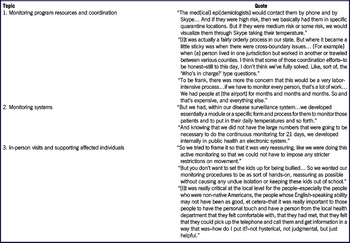
Interviewees highlighted the immense time and resources required to implement Ebola monitoring programs (Table 1, Topic 1). For example, 1 participant said, “The personnel available to [monitor] was stressed at times.” Active monitoring often required public health personnel to call or visit monitored individuals twice daily to record temperature/symptoms, drawing them away from daily responsibilities and negatively impacting routine operations. This difficulty limited the ability to actively monitor individuals. One participant noted, “They [public health staff] definitely weren’t visiting each person’s house…I don’t think they had the personnel to do that.” Interviewees cited the drain on public health resources from meeting necessary surge capacity as 1 of the most prominent implementation concerns.
Select Interviewee Quotes About Ebola Monitoring Policy Implementation for the Domestic Response to the 2013–2016 West Africa Ebola Epidemic

Some states had to identify or develop tracking systems, another substantial time and resource investment requiring surge capacity (see Table 1, Topic 2). Participants noted that passive monitoring systems allowed monitored individuals to report their own data to health officials, which helped mitigate time requirements. Passive systems enabled monitored individuals to report their twice-daily temperature and symptom checks via phone (often a provided cell phone) or video chat (eg, Skype, FaceTime) or enter their own data into an online system. While these reporting mechanisms reduced health officials’ workload, some required additional time or resources to establish, implement, monitor, and maintain. Additionally, interviewees identified privacy as a primary concern for these systems, and dedicated effort was required to protect personally identifiable and confidential medical information.
Local health officials often conducted initial visits with monitored individuals to establish trusted relationships (see Table 1, Topic 3). These visits provided an opportunity to establish rapport, discuss monitoring procedures and movement restrictions, provide instructions about reporting temperature/symptoms, and gather additional information about the individual’s exposure risk. Many individuals arriving from West Africa lacked a local support network, and visits from public health officials helped identify the need for ancillary support services related to their personal needs (eg, dietary restrictions, religious requirements), particularly for those under movement restrictions. One interviewee commented on the importance of providing support for affected individuals, especially those with language barriers, explicitly discussing the value of a “personal touch” and having “a person from the local health department that they felt comfortable with.” Health officials often collaborated with community or faith-based organizations to address these issues and make affected individuals comfortable during the monitoring period. Products and services such as cell phones– provided by the CDC at airport screening stations starting in July 2015– and Internet access provided monitored individuals with mechanisms to contact the health department for symptom reports and facilitated contact with family and friends during the monitoring period.
Movement Restrictions
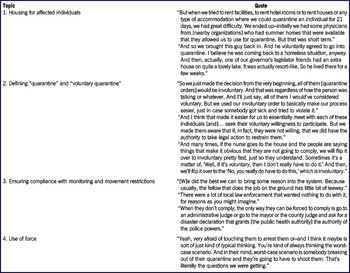
Movement restrictions ranged from limitations on non-local travel and use of public transportation to full quarantine. In addition to issuing and enforcing movement restriction orders, state and local health departments were required to manage associated logistical challenges ancillary to the implementation of movement restrictions. While some individuals were able to remain at home during their monitoring/restriction period, not everyone had a local residence. Issues arose in identifying housing for individuals under movement restrictions– including hotel rooms, rented properties, or properties owned by local health or elected officials (Table 2, Topic 1). This process was often difficult, or inordinately expensive, due to concern about Ebolavirus contamination and the owner’s ability to rent the property in the future. One interviewee described the process of renting houses for high-risk individuals, stating, “[W]e kept those two houses on contract for roughly a year. And we paid in that one year what…we could have purchased those houses for.” Additional concerns included security– both to enforce movement restriction orders and protect the safety and privacy of affected individuals– and support (eg, food, medical care, religious, and mental health services) for affected individuals.
Select Interviewee Quotes About Ebola Movement Restriction Policy Implementation for the Domestic Response to the 2013–2016 West Africa Ebola Epidemic

The legal environment for, approach to, and interpretation of “quarantine” varied between states. Some participants noted that they altered CDC guidance to account for state legislation regarding the process for ordering and enforcing quarantine or other movement restrictions. Some interviewees described “voluntary quarantine” or “home restriction” as less restrictive alternatives to mandatory quarantine, because formal orders were not issued and it was viewed as a cooperative effort between health officials and affected individuals (see Table 2, Topic 2). Without the formal process of issuing a mandatory order or the involvement of law enforcement, “voluntary” quarantine was easier to implement. Mandatory orders were available in the event that individuals indicated that they would not comply voluntarily. In fact, 1 participant stated that if individuals indicated that they would not comply with voluntary quarantine, health officials would show them the mandatory order in hopes of coaxing them into complying with the “voluntary” order.
Another challenge was cross-jurisdictional coordination, in particular, determining the authority responsible for enforcing movement restriction orders and the appropriate response for non-compliant individuals (see Table 2, Topic 3). In some jurisdictions, quarantine legislation and policies existed but had rarely been implemented or challenged. In contrast, isolation laws are used more regularly for infectious disease patients, and the processes, requirements, and legal authority are well established. Although some interviewees were confident their quarantines would hold up in court, others were not. One said that while his/her health department had successfully upheld isolation orders for tuberculosis patients in court, “[O]urquarantine authority has never really been tested in our courts…so we’re not really sure if that was going to hold up.” Additionally, responsibility for authorizing and enforcing movement restrictions may be spread across public health, judicial, and law enforcement agencies.
Questions and concerns, particularly from law enforcement officials, included how to operationally enforce movement restriction orders, particularly with respect to the level of force justified or authorized to ensure compliance and avoid exposure (see Table 2, Topic 4). Participants indicated that officers expressed concern about the prospect of touching a quarantined individual for fear of being infected, which would make it difficult to restrain someone without using elevated levels of force (eg, Tasers, firearms). One interviewee recalled a law enforcement officer asking, “Do you expect me to shoot somebody if they won’t stay in their house?” Another noted that explicit coordination was required with state law enforcement to ensure that the state would provide personnel to enforce quarantine orders if local law enforcement refused to do so.
DISCUSSION
Implementing public health policy reflects how public health practice takes shape in the context of real-world barriers and considerations. As 1 public health official stated, “The governor owns the policy. We own the details.” The difficult implementation of public health policies does not mean such policies should not be put in place, nor does it discount potential public health benefits resulting from them. Rather, these challenges should be accounted for in the policy-making process. Operational adjustments may be needed to account for unique public health and legal environments, which could result in deviations from the CDC’s recommendations. Study findings highlight the importance of considering how policies will be implemented and the second- and third-order consequences of policy-related decisions. The planning areas listed below integrate with existing Ebola planning and preparedness, including for health care, public health, emergency management, emergency medical services, waste management, and mortuary services.
Surge Capacity Is Needed for Similar Responses in the Future
A dominant theme was the considerable burden that response activities placed on public health personnel. The interviewees outlined numerous areas in which public health officials’ time, effort, and management were essential. Of particular note was the negative effect on routine health department operations, as personnel were drawn away from their daily duties during the response. In future responses, public health surge capacity, both personnel and systems, will be needed to effectively manage a large number of individuals requiring monitoring or movement restrictions. Reference Schemm Dwyer, Misner, Chang and Fajardo8
Implementation of Movement Restrictions Requires a Range of Ancillary Services and Considerations
In infectious disease responses requiring movement restrictions, including quarantine, specific plans are needed to provide support for affected individuals and responders alike. These include establishing quarantine locations with considerations for cost, including rent, security, transport, and potential decontamination/hazardous waste removal. Reference Gostin, Hodge and Burris10 Public health agencies were required to support various needs of restricted individuals, and protocols are needed to provide necessary support (eg, food, shelter, religious, and personal considerations). Such services require significant financial and human resources, but they are important components to maintaining trusted relationships with affected individuals and reducing the burden placed on them.
Unique Legal Environments Influence the Implementation of Monitoring and Movement Restriction Policies
The legal environment underpins how policies can be implemented, so clarity on legal authorities for movement restriction orders and requirements for due process is essential for supporting infectious disease response operations. Elected officials and health officials should understand legal limitations regarding the operational implementation of movement restrictions at the state and local levels, and model legislative language or letters of support from federal public health agencies may help update laws in advance of the next incident. Additionally, the authority and responsibility to issue and enforce movement restrictions and other policies may be spread across several individuals or agencies, so it is critical to determine the relevant lines of authority ahead of any response.
Cross-Jurisdictional Collaboration Is Essential to Coordinating Policy Implementation Activities
Early communication and collaboration, including just-in-time training with partners, is also an important component in implementing monitoring and movement restriction policies. Communication between jurisdictions (eg, local-local, local-state, inter-state), across sectors, and with external stakeholders will help coordinate policy implementation and integration with ongoing response activities. Additionally, active coordination between federal health authorities and local jurisdictions can help identify potential issues with implementing relevant policies and associated need for supplementary guidance.
Law Enforcement May Require Public Health-Specific Training to Work With Potentially Exposed Individuals
Concerns of law enforcement officers highlight the need for proactive coordination between public health and law enforcement regarding procedures for enforcing movement restrictions, including quarantine. Particular areas of focus include just-in-time training for health department and law enforcement personnel on personal protective equipment (PPE), handling monitored and restricted individuals (including authorized levels of force), and cultural sensitivity, especially for diseases that prompt fear and stigma.
Limitations
These findings may not capture all important themes, but they reflect the experience of multiple states and jurisdictions, and highlight key considerations for future infectious disease responses. This study did not address monitoring, follow-up, or clinical care for travelers who were ill or reported Ebola-related symptoms. The research population was not representative, and sampling may have been subject to bias and error in researcher judgment and low generalizability. Quotes are not representative of all participants.
CONCLUSIONS
Results highlight the need to consider policy implementation for infectious disease responses, particularly those that require monitoring or movement restrictions for potentially exposed persons. The myriad of implementation considerations reflects the need for a full understanding of the real-world consequences of infectious disease response policies from their inception and better anticipation of the consequences of implementing these policies at the local level. Proactive effort at the state and local levels to address these challenges before the onset of future emergencies can improve consistent implementation of monitoring and movement restriction policies and reduce associated confusion and uncertainty in the midst of a response.
Financial Support
This work was supported by the US Centers for Disease Control and Prevention through research contract, 200-2016-M-92090. The findings and conclusions in this study are those of the authors and do not necessarily represent the official position of the Centers for Disease Control and Prevention.
Conflict of Interest Statement
The authors have no conflicts of interest to declare.
Disclosure Statement
This research was designated “exempt” by the CDC Human Research Protection Office and “not human subjects research” by the Johns Hopkins Bloomberg School of Public Health Institutional Review Board Office.