1. INTRODUCTION
Recently Timothy Williamson (Reference Williamson2007) has argued that characterizations of the standard (i.e. intuition-based) philosophical practice of philosophical analysis are misguided because of the erroneous manner in which this practice has been understood. Let us refer to this practice as the standard justification procedure (SJP). Moreover, in doing so he implies that experimental critiques of the reliability of intuition are based on this misunderstanding of philosophical methodology and so have little or no bearing on actual philosophical practice or results.Footnote 1 A number of criticisms have been leveled against Williamson's reconstruction of the Gettier argument and the re-interpretation of SJP that he believes follows from it, but they have been addressed by Williamson.Footnote 2 His main point is that SJP is incorrect in that it treats philosophical thought experiments in such a way that they can be “filled in” in various ways that undermines their use as counter-examples and that intuition plays no substantial role in philosophical practice when we properly modify SJP as a result of the possibility of such filling in. In this paper Williamson's claim that philosophical thought experiments can be legitimately filled in this way will be challenged. As a result, it will be shown that one can salvage the original account of SJP in a much simpler way that both reflects an important fact about thought experiments and philosophical practice and makes the experimental critique of the intuition-based methods involved a serious issue.
2. WILLIAMSON'S “FILLING IN” OBJECTION AND PHILOSOPHICAL INTUITION
His critical attack on standard accounts of philosophical analyses is framed in terms of Gettier's infamous cases and he takes the standard form of such an appeal to involve the following claims:
-
K(x, p): x knows that p.
-
JTB(x, p): x has justified true belief that p.
-
GC(x, p): x stands to p as in the Gettier text.
According to Williamson, the Gettier argument is then supposed to have the following form that is characteristic of SJP:
 $$\eqalign{& {\rm P1} \,\diamond\!\exists {\rm x}\exists {\rm pGC}\left( {{\rm x, p}} \right). \cr & {\rm P2} \,\,\squ \forall {\rm x}\forall [{\rm GC}\left( {{\rm x, p}} \right) \to \big({\rm JTB}\left( {{\rm x, p}} \right){\rm} \& \,\neg \,{\rm K}\left( {{\rm x, p}} \right){\rm \big)]}{\rm.} \cr & \therefore {\rm C}\,\diamond\!\exists {\rm x}\exists {\rm p JTB}\left( {{\rm x, p}} \right){\rm \&} \,\neg \,{\rm K}\left( {{\rm x, p}} \right)}.$$
Williamson's formalization of this argument then just says that it is possible that some x stands to some p as described in the Gettier case and that necessarily if any x stands to any p as in the Gettier case, then x has a justified true belief that p but does not know that p. So, it is possible for p to have a justified true belief that p but not know that p. So, the theory Gettier (Reference Gettier1963) is challenging in his famous paper is of course the claim that knowledge is justified, true belief: □∀x∀p[JTB(x, p) ≡ K(x, p)]. But, the conclusion of the Gettier argument contradicts this claim. So, given this case of SJP so rendered, the intuition that □∀x∀p[GC(x, p) → (JTB(x, p) & ¬ K(x, p))] (i.e. the intuition that necessarily if any x stands to any p as in the Gettier case, then x has a justified true belief that p but does not know that p) is supposed to refute the JTB analysis of knowledge.
Williamson's attack on this account of SJP is based on the claim that □∀x∀p[GC(x, p) → (JTB(x, p) & ¬ K(x, p))] is false. In other words, it is not true that necessarily if any x stands to any p as in the Gettier case, then x has a justified true belief that p but does not know that p. His reason for making this contention is that GC(x, p) (i.e. the Gettier case) is an under-described model or simulation and that it can be “filled in” in a variety of ways. In some cases filled in versions of GC(x, p) – let us indicate them as the set GC(x, p)* – are such that it will be the case that ¬(JTB(x, p) & ¬ K(x, p)). In some cases filled in versions of the Gettier case will be such that it is not the case that x has a justified true belief that p but does not know that p. So, Williamson concludes that actual premises that serve the function of P2-type premises do not have the form that P2 has. He then proceeds to suggest an alternative form for the premises that serve the function of P2 in Gettier arguments and other philosophical thought experiments. He specifically suggests that they have the following form:
 $${\rm P{2}^{\prime}}\,\,\exists {\rm x}\exists {\rm pGC}\left( {{\rm x, p}} \right)\squ\!\! \to \forall {\rm x}\forall {\rm p}[{\rm GC}\left( {{\rm x, p}} \right) \to \left({\rm JTB}\left({{\rm x, p}} \right)\,{\rm \&} \,\neg\, {\rm K}\left({{\rm x, p}}\right)\right)].$$
This is just the counterfactual claim that if some x were to stand to some p as in the Gettier case, then x would have a justified true belief that p but not knowledge that p. But this formulation is problematic because were we to replace P2 with P2′ the conclusion does not follow.Footnote 3 Nor is it acceptable to replace P2′with the following principle:
 $${\rm P}{2}^{\prime \prime}\,\diamond\! \exists {\rm x}\exists {\rm pGC}\left({{\rm x, p}}\right)\squ\!\! \to \forall {\rm x}\forall {\rm p}[{\rm GC}\left({{\rm x, p}}\right) \to \left({\rm JTB}\left({{\rm x, p}}\right)\,{\rm \&} \neg\, {\rm K}\left( {{\rm x, p}} \right)\right)].$$
This is the claim that if some x were to stand to some p as in the Gettier case, then it would be the case that if any x stands to p as in the Gettier case, then x has a justified true belief that p but does not know that p. This is because Williamson does not accept the modal logic S5 and believes that requiring those who consider philosophical thought experiments to be aware of the relevant principle of S5 is simply too unrealistic.Footnote 4 But a number of problematic issues have been raised in reference to P2′ and P2′′.Footnote 5 Despite these worries he officially settles on P2′ as the correct form of P2-type premises in his 2007 book.Footnote 6 Ultimately, Williamson argues on this basis that (1) philosophical thought experiments do not deal with conceptual possibility; (2) that philosophical theories deal with metaphysical possibility; (3) that counterfactuals are more basic than metaphysical possibilities; and (4) that intuitions play no real role in philosophical thought experiments. So, as he sees the matter, SJP needs to be re-interpreted as the philosophical attempt to determine true counterfactuals which indicate metaphysical possibilities by appeal to the evidence that is constituted by the totality of our knowledge (rather than by our supposed intuitions).Footnote 7 As he says, “Paradigm thought experiments in philosophy are simply valid arguments about counterfactual possibilities” (Williamson Reference Williamson2007: 207). In support of (4) he tells us that,
Philosophers might be better off not using the word “intuition” and its cognates. The main current function is not to answer questions about the nature of the evidence on offer but to fudge them, by appearing to provide answers without really doing so. (Williamson Reference Williamson2007: 220)
Moreover, in a more positive manner he claims that, “In philosophy as in the natural sciences, our evidence consists of ordinary human knowledge” (Williamson Reference Williamson2007: 276). He expands on this theme and further claims that,
Our evidence in philosophy consists of miscellaneous mass of language, expressed in terms of all kinds, some from ordinary language, some from the theoretical vocabulary of various disciplines. Some of it consists of knowledge of our own mental states; most of it does not. Whatever we know is legitimate evidence … This messy epistemological predicament in which philosophers find themselves is not deeply different from the messy epistemological predicament of all human inquiry. (Williamson Reference Williamson2007: 277)
With respect to P2′-type propositions, Williamson then is committed to the idea that such propositions are not known in some special “intuitive” manner. Rather, they are known on the basis of a variety of common epistemic sources that are used to constrain imagination. He tells us explicitly that we evaluate counterfactual P2′-type premises in his modified version of SJP, “… using a mixture of imaginative simulation, background information and logic” (Williamson Reference Williamson2011: 216).Footnote 8 So Williamson's rejection of SJP and his modification of that account of philosophical practice ultimately lead to the conclusion that intuition plays no real role in philosophical method at all. Our evidence for counterfactual claims about metaphysical possibility is just our ordinary knowledge about how things are and about logic as applied to imaginary cases, rather than the outputs of some special faculty, special evidentially endowed propositional attitudes towards modal propositions or special knowledge of epistemic or conceptual possibilities.
3. RESPONDING TO THE “FILLING IN” OBJECTION
Recall that Williamson's motivation for rejecting P2 and considering P2′ and P2′′ is that G(x, p) can be “filled in” in different ways, some of which allow for the truth of [G(x, p) & ¬(JTB(x, p) & ¬ K(x, p))] (i.e. the claim that one can be in a Gettier case where it is not the case that one has a justified true belief but not knowledge). Consider the following sort of response to Gettier's second Jones case. Recall that in this version of GC(x, p) Smith infers that either Jones owns a Ford or that Brown is in Barcelona from the claim that Jones owns a Ford. Moreover, Smith has strong evidence for the claim that Jones owns a Ford. Suppose, for example that he has seen a title on the seat of Jones’ car for a Ford of that model. But, it is false that Jones owns a Ford and true that Brown is in Barcelona. Jones does not own a Ford because it is a rented Ford and it is merely coincidental that Brown happens to be in Barcelona. As a result, it is alleged that Smith meets the JTB conditions with respect to the proposition that either Jones owns a Ford or that Brown is in Barcelona but does not know that. Williamson's filling-in objection then amounts to the idea that there are legitimate ways to fill in thought experiments because they are chronically under-described and such that they undermine the P2-type sentence involved in that case of SJP. So, what Williamson has in mind are cases where the person considering the thought experiment adds details to the scenario that compromise the integrity of the case as a counter-example. Williamson claims that:
… in the Gettier case, if the subject's inference to the true belief p from false belief q bizarrely happens to trigger awkward memories or apparent memories that cast doubt on q, the effect may be to lose justification for q rather than gain it for p … Similarly, when moral philosophers assess imaginary examples, one can almost always fill out the case with unintended but morally relevant additions that would reverse the verdict. (Williamson Reference Williamson2007: 185)
With respect to the second Gettier case then, what Williamson is claiming is that P2 is false because we might fill out this particular schematic version of G(x, p) with additional information such that Jones no longer meets the JTB condition or such that Jones really does know, thus defusing the counter-example. For example, in an egregious case of filling in one might add to the second Jones case the factoid that Smith has been told that Jones was taking the title for the Ford of that model to a friend who is the holder of that title. But, the contention that this is permissible is not at all reflective of the way in which philosophical thought experiments (and scientific thought experiments) are employed. Essentially, the point to be made here is that the descriptions of thought experiments are not supposed to be filled in at all in the proper conduct of SJP. This is part and parcel of the practice of the sort of idealizing and abstracting that occurs in thought experiments in both philosophy and science.
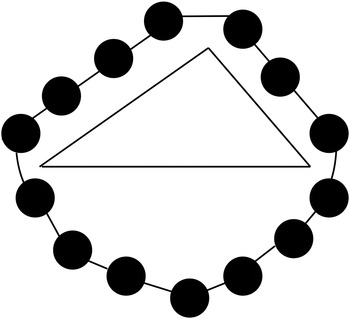
Consider the following analog of the alleged “filling in” phenomenon in a scientific context. Simon Stevin's work on the inclined plane was crucial in developing understanding of motion and friction.Footnote 9 He established that the force required to hold a ball in place on an inclined plane is inversely proportional to the length of the plane. This was accomplished by appeal to a thought experiment constructed as follows. Suppose that we have a prism shaped inclined plane over which we have draped a chain of fourteen closed balls as shown in Figure 1:
Uncut.

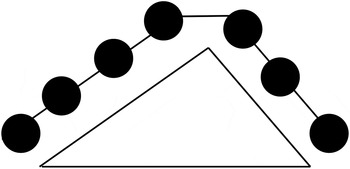
Suppose further that we want to know what will happen to an open chain draped over the plane as illustrated in Figure 2:
Cut.

What Stevins asks us to do is to imagine what motion will occur when the cut is made. The relevant possibilities are that the chain would move to the right, to the left or not at all, and we are asked to appeal to our intuition to determine what will happen. What is crucial is that we are supposed to understand that in Figure 1 the system is in equilibrium and so does not move. The point of the thought experiment is of course to come to understand that this will remain so when the chain is cut. However, this crucially presumes that we do not fill in the following fact: there is perpetual motion. If motion is allowed to be perpetual, then the conclusions about the motions involved and the force required to hold a ball in place do not follow. So, the presumption of the imaginary exercise involves precluding filling in this detail (as well as many others), and it would constitute a serious misunderstanding of the experiment to respond to Stevins’ ingenious experiment by supposing that perpetual motion is possible. To do so would undermine the crucial insight that the chain is in static equilibrium in both cases, and from a methodological perspective this is to miss the very point of the sort of idealizing and abstracting that is essential to the thought experiment. The context in which the imagined case is being employed simply presupposes that such filling in is not permitted. So, the prescription against filling in suggested here is not at all unique to philosophical thought experiments.
So, an alternative gloss of P2 that reflects this fact about thought experiments and models is as follows:
 $${\rm P}{2}^{\prime \prime \prime}\,\squ\forall {\rm x}\forall {\rm p}[\left({\rm GC}\left( {{\rm x, p}}\right) \,\& \, {\rm Ix} \right) \to \left({\rm JTB}\left( {{\rm x, p}} \right)\,{\rm \&} \,\neg\, {\rm K}\left( {{\rm x, p}} \right)\right)].$$
Here Ix stands for the claim that x's state is not affected by any factors not explicitly mentioned in G(x, p). P2′′′ then says that necessarily if anyone stands to p as in the Gettier case and there are no additional factors involved, then x has a justified true belief that p but not knowledge that p. So, Ix rules out all of the filled in scenarios that are elements of G(x, p)*. So, Ix is a sort of completeness idealization (much like those that are often assumed in the context of scientific thought experiments), whereby one who is entertaining G(x, p) properly is to wholly ignore any other factors that might influence what is supposed to be going on in GC(x, p). The content of the intuition represented by P2′′′ is then one that importantly involves a simplifying assumption. However, this correctly reflects a number of important features of thought experiments and their use in philosophy. First, this alternative rendering of P2 explains the familiar pedagogical practice of correcting students who respond to philosophical (and scientific) thought experiments by adding in features to such cases that defuse the counter-examples and thus result in their misunderstanding the argument in such cases. Second, this also explains why this kind of instruction is a key component of learning to be an academic philosopher in particular. What we learn to do in philosophy very early on is to examine abstract and simplified cases that are alleged to have philosophical import. Doing so correctly requires refraining from filling in any details. Third, filling in also fails to capture the idea that, at least in terms of SJP, philosophical results are typically highly abstract in nature.
4. CONCLUSION
So, filling in misrepresents pedagogical aspects of philosophical practice. To fill in the Gettier case so as to defuse the counter-example is also to misunderstand Gettier cases and other philosophical thought experiments as being elliptical descriptions waiting for completion by the person considering them. This is because philosophical thought experiments are not elliptical descriptions of the actual world, nor are they elliptical descriptions of other complete worlds. They are better understood to be representations of how things are in other simpler possible worlds that are still similar to complete worlds in some respects. As in the case of scientific thought experiments, they are supposed to allow us to focus on a small set of salient features completely independent of any factors not explicit in the description of the case. Ironically, Williamson actually defends this view himself in speaking of the character of an imaginary thought-experiment where a hunter imagines jumping a stream when he says,
But he neither makes himself imagine succeeding nor makes himself imagine failing. Rather, having forced the initial conditions, he lets the rest of the imaginative exercise unfold without further interference. For that remainder, his imagination operates in involuntary mode. He imagines the antecedent of the conditional voluntarily, the consequent involuntarily. Left to itself, the imagination develops the scenario in a reality-oriented way, by default. (Williamson Reference Williamson, Kind and Kung2016: 116)
All of this importantly means that philosophical thought experiments are designed to explore a much wider space of possibilities than in standard accounts of worlds that only include complete worlds and that they are importantly but implicitly qualified by “no-filling-on” qualifiers. This renders such results dependent on the simplifying assumptions and makes them often highly abstract, but this better reflects the nature of philosophical results as understood in terms of SJP. As a result, one can re-cast the SJP slightly without running into the sorts of problems with P2′ and P2′′ and such that it acknowledges these apparent features of philosophical practice as follows:
 $$\eqalign{& {\rm P}1\,\diamond\! \exists {\rm x}\exists {\rm p}\left( {{\rm GC}\left( {{\rm x, p}} \right)\,{\rm \&\, Ix}} \right) \cr & {\rm P{2}^{\prime \prime \prime}}\,\squ \forall {\rm x}\forall {\rm p[}\left( {{\rm GC}\left( {{\rm x, p}} \right)\,{\rm \&\, Ix}} \right) \to {\rm \big(JTB}\left( {{\rm x, p}} \right)\,{\rm \&} \,\neg\, {\rm K}\left( {{\rm x, p}} \right){\rm \big)]}{\rm.} \cr & \therefore {\rm C}\,\diamond\! \exists {\rm x}\exists {\rm p JTB}\left( {{\rm x, p}} \right)\,{\rm \&} \,\neg\, {\rm K}\left( {{\rm x, p}} \right)}.$$
First, on this schematic account of SJP such arguments are valid and pace Williamson the claims that play the role of P2-type propositions in his reconstruction of such arguments are not false in this alternative construction. These sorts of claims, when properly regimented as P2′′′-type propositions can be true, whether or not one endorses SJP and whether or not one is skeptical of the practice in general. Second, while it is surely possible that Williamson is correct in his assertion that P2-type propositions are actually counterfactuals, this is not because of the filling in objection. Moreover, all of this implies that the issue of whether P2′′′-type propositions can be the objects of intuition in a way that secures them as knowledge is a legitimate worry absent some other reason to hold that P2-type propositions are counterfactuals whose epistemic status is intuition-independent. It is likely that Williamson is right to point out that intuition does not play a role in philosophical thought experiments, but this is the case because appeals to intuition are unreliable (as suggested by various experimental studies) or irrelevant to philosophical practice and not because standard philosophical practice involves counterfactual scenarios that can be filled in so as to undermine their roles as counter-examples.