Introduction
Background
Mass-gathering events (MGEs) pose significant health risks to attendees and create challenges for the provision of medical care.Reference Arbon 1 , Reference Milsten, Maguire and Bissell 2 There is a dearth of literature examining medical usage rates and medical care models at MGEs on college and university campuses. Fun Day is an annual celebratory day held in April at Skidmore College, a small liberal arts college in Saratoga Springs, New York (USA). Fun Day is focused around an outdoor, single-stage, multi-genre music festival attended each year by approximately 2,000 undergraduate students (80.0% of the student body). Throughout the surrounding campus, students congregate and celebrate in dorm rooms, campus apartments, public open spaces, and academic buildings. Multiple varsity athletic events are simultaneously held. Significant high-risk consumption of alcohol and illicit drugs occurs on the campus throughout the day.
In 2013, a collegiate-based first response model for MGEs was developed in order to: (1) enable rapid emergency medical response on Fun Day, and to (2) reduce the burden of Fun Day on campus and community resources. Skidmore College Emergency Medical Services (EMS) – a collegiate-based, Basic Life Support (BLS), first-response service – commands medical operations and provides first response, while a contracted, private EMS agency staffs ambulances. Skidmore College EMS is managed and staffed by volunteer undergraduate students with clinical and operational oversight from the college’s departments of Health Services and Campus Safety. Collegiate or campus-based EMS (CBEMS) organizations are represented by the National Collegiate EMS Foundation (West Sand Lake, New York USA) and provide prehospital emergency care on over 200 campuses in North America;Reference Wolbrom, Rahman and Hilton 3 however, there is a paucity of research on CBEMS operations,Reference Friedman, Dingler, Nable and Koenig 4 particularly in the context of MGEs.
Research Objectives
The primary objective of this study was to determine medical usage rates and case mixes on Fun Day over a four-year period (2014-2017). The secondary objective was to describe the collegiate-based first response model.
Methods
This was a retrospective, descriptive study. Ethical approval was received from the Institutional Review Board of Skidmore College. Event and operational-related variables were obtained from college administrators, event organizers, and the study authors who served in medical and safety command staff roles. Meteorological data were acquired from the National Oceanic and Atmospheric Administration (Washington, DC USA) Climate Data Online archives. 5
De-identified data on patient encounters were provided by Skidmore College EMS after retrospective review of patient care reports. Patient care reports were originally completed on paper for each patient encountered by the chief emergency medical technician (EMT) on-scene. Data were analyzed for all patient encounters on the Skidmore College campus when dedicated medical staff were on-site (10:00am-5:00pm) on the respective Fun Day from 2014 to 2017. Data were also analyzed for patient encounters on the campus after 5:00pm if documentation specifically suggested that the given medical issue was a result of event attendance (eg, patient appeared intoxicated after reported consumption of alcohol during the festival). Cases in which individuals only requested non-medical information (eg, directions) or medical supplies (eg, ice pack) without medical evaluation were excluded from analysis.
Patient presentation rate (PPR) is defined as the number of patient encounters per 1,000 estimated attendees. Transport-to-hospital rate (TTHR) is defined as the number of patients transported to the hospital by ambulance per 1,000 estimated attendees. Mutual aid request rate (MARR) is defined as the number of patients transported to the hospital by ambulance – excluding ambulances stationed on campus for the event – per 1,000 estimated attendees.
Results
Event-Related Variables
Location
The music festival was located on an approximately 25,000 square meters field on the Skidmore College campus (Saratoga Springs, New York). From 2014-2016, the festival was unbounded; in 2017, the field and stage were bounded with a dual-entrance fence on opposite sides of the field. In addition to the festival, sanctioned and unsanctioned recreational and athletic events were held across the 1,000-acre campus.
Duration
The music festival was held from 11:00am to 3:00pm each year, on a Saturday in April.
Attendance
Attendance at the main-stage music festival was estimated at 2,000 attendees for each year (2014-2017).
Weather
The following temperatures were recorded at 4:00pm (one hour after the end of the music festival) for 2014, 2015, 2016, and 2017, respectively: 57°F (13.9°C), 54°F (12.2°C), 65°F (18.3°C), and 66°F (18.9°C). Significant rainfall (0.26 inches) was on record for 2014.
Hazards
Multiple carnival structures (eg, rock-climbing wall, inflatable slide) were present at the music festival. A pond, climbable trees, scalable building structures, and a paved road were located within 250 meters of the main stage.
Availability of Alcohol and Drugs
Alcohol was not served or permitted at the festival; however, many students consumed alcohol and marijuana on the festival grounds with limited intervention from law enforcement and security officers. Anecdotal reports from students revealed that alcohol and illicit drugs were consumed in academic buildings and on-campus residences before, during, and after the festival.
Off-Site Emergency Care Resources
The primary off-site transporting ambulance service – a professional fire-based service – was stationed approximately 2.3 kilometers (1.4 miles) from the campus. The nearest emergency department and Level 1 trauma center were approximately 2.4 kilometers (1.5 miles) and 62.6 kilometers (38.9 miles) from the campus, respectively.
Patient Encounters
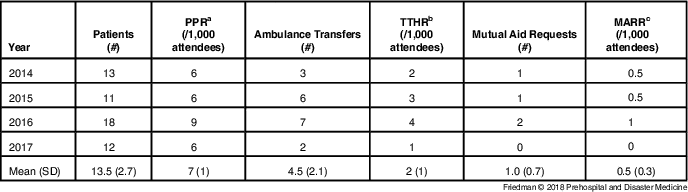
Fifty-four patients received emergency medical care on the campus on Fun Day over a four-year period (2014-2017). Thirty-one (57.4%) patients were documented on the patient care report as female; 23 (42.6%) were male. Forty-four (81.5%) patients were between the ages of 18 and 22, one (1.9%) patient was over the age of 22, and age was not documented for nine (16.7%) patients. Eighteen patients (33.3%) were transported to the hospital by ambulance and, of patients transported, off-site mutual aid was requested for four (22.2%). The mean (SD) PPR was 7.0 (SD = 1.0) per 1,000 attendees. The mean (SD) TTHR was 2.0 (SD = 1.0) per 1,000 attendees. The mean (SD) MARR was 0.5 (SD = 0.3) per 1,000 attendees (Table 1).
Annual Medical Usage Rates Over Four Years (2014-2017)

a PPR: Patient presentation rate per 1,000 attendees.
b TTHR: Transport-to-hospital rate per 1,000 attendees. Excludes patients (n = 3) who refused ambulance transport and medical care, but subsequently requested non-critical transport to a medical facility (eg, urgent care, hospital) by officers from the Department of Campus Safety.
c MARR: Mutual aid request rate per 1,000 attendees.
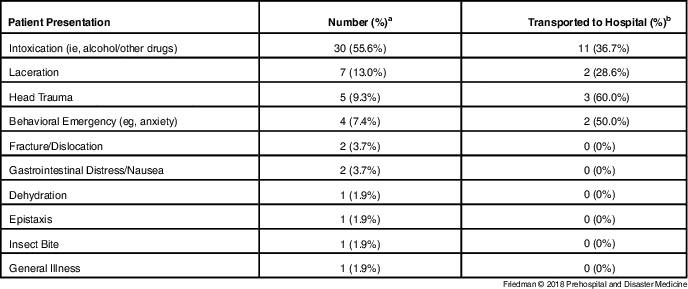
Thirty (55.6%) patients presented with intoxication, seven (13.0%) with laceration(s), and five (9.3%) with head trauma as the primary concern (Table 2). Alcohol or illicit drug consumption was documented for 48 (88.9%) patients, based on self-reports, bystander information, or evidence available on-scene (eg, scent of alcohol evident on patient). Specifically, 46 (85.2%) patients consumed alcohol, five (9.3%) marijuana, two (3.7%) cocaine, one (1.9%) Xanax, and one (1.9%) Adderall. Two (3.7%) patients were documented for intoxication without specification of substance consumed. All patients who were documented for consumption of an illicit substance other than alcohol were also documented for alcohol co-ingestion. No fatalities were reported by on-site medical staff, transporting EMS providers, or emergency department staff.
Presentation of 54 Patients Over Four Years (2014-2017)

a Percentage refers to percent of total patients encountered.
b Percentage refers to percent of patients with specified presentation (eg, intoxication).
Collegiate-Based First Response Operational Model
The model described in this section reflects operations on Fun Day in 2017. The model was iteratively developed over the four prior years.
On-Site Medical Staff
Excluding command staff, 16 volunteer undergraduate students from Skidmore College EMS were on-site. Providers were organized into mobile response crews of three to four persons. Crew Chiefs were licensed EMTs. All other crew members were licensed EMTs or cardiopulmonary resuscitation/CPR-certified assistants with additional first response training. Two ambulances each with two providers (Advanced Life Support [ALS] or BLS level) from a private, contracted service were stationed on-site and dedicated solely to on-campus response. On-site medical staff were available between 10:00am and 5:00pm; however, a single Skidmore College EMS first response crew was in-service for the entire 24-hour day.
Management Structure
A student from Skidmore College EMS was designated as the Medical Commander (MC). Along with one assistant, the MC was responsible for event preparations, communications, equipment and resource allocation, and crew dispatch. Another student was designated as the Field Commander (FC). The FC was responsible for overseeing operations at the Field Command Tent, including management of equipment supply and work-rest cycles. The FC was also available to respond to incidents in the field.
Organizational Layout
The MC was stationed in the Campus Safety Dispatch Center, located on the northwest side of the campus. A Field Command Tent was set up approximately 100 meters from the music festival main stage on the southeast side of the campus. Crews alternated between remaining in the tent and roving throughout the campus. Ambulatory patients encountered at the festival were brought to the tent for treatment. Two contracted ambulances were stationed in a closed parking lot adjacent to the Field Command Tent.
Dispatch and Communications
Individuals on campus were instructed to call Campus Safety, or to identify event staff, in the event of medical emergency. After receiving the call for help, the Campus Safety dispatcher notified the MC – who was located in the same room. The MC subsequently dispatched available first response crews via two-way radio. Crews were pre-assigned a primary and secondary on-campus response area (eg, field surrounding main stage, academic buildings, campus residencies). Requests by the first response crews for additional resources (eg, equipment, ambulance transport, law enforcement) were relayed through the MC via radio. Requests for mutual aid or law enforcement were subsequently routed to the county dispatch system by the Campus Safety dispatcher via landline. In the event of radio failure, providers were instructed to communicate via cell phone. Providers were also instructed to use a pre-designated text message system for non-urgent matters to limit radio traffic. Although not utilized, a “runner” with access to a golf cart was pre-designated to relay information between command and crew elements in the event of radio and cellular failure.
Equipment
Each first response crew was assigned standard BLS-level equipment. Stocks of commonly used equipment (eg, bandages) were stored in the Field Command Tent and in an office located in the center of campus. Given the limited number of certain items (eg, epinephrine autoinjectors), a “runner” with access to a golf cart relayed equipment between crews, as necessary. To monitor the location and availability of crews and resources, the MC’s assistant updated pre-programmed options for the location, availability, and resource requirements of each crew on Google Sheets (Google LLC; Mountain View, California USA).
Ambulance Transport
Transport decisions were made by the Crew Chief of the first response crew, based on regional EMS protocols and patient preference. If a patient who had consumed alcohol or illicit drugs wished to refuse care, an additional checklist protocol – based on work from El Paso County, Colorado (USA)Reference Ross, Schullek and Homan 6 – was employed to determine if the patient retained capacity and could safely refuse care (Table S1; available online only). Online physician medical control was contacted for direction, as necessary. If transport was indicated, available on-site ambulances were dispatched by the MC. If all contracted ambulances were unavailable, mutual aid was requested from the county EMS system.
Integration with Non-Medical Resources
Campus Safety officers were dispatched when available to all medical incidents to ensure scene safety. Law enforcement was requested as necessary for non-compliant patients.
Prevention and Harm Reduction Strategies
Prior to Fun Day, providers from Skidmore College EMS collaborated with college administrators and peer health educators to provide education on substance use and emergency care access via posters, presentations, mass emails, and information tables. During the music festival, Campus Safety officers assessed attendees at the entrance for signs of intoxication; attendees presenting with concerning signs received a preliminary evaluation from EMTs and additional care, as necessary. Providers from Skidmore College EMS routinely patrolled academic buildings and residencies on campus. In addition, providers routinely checked on persons who appeared to be sleeping at the festival. Free food and water bottles – labeled with information on accessing EMS – were provided in residence halls and at the festival.
Discussion
Patient Presentation Rates and Case Mixes
Relative to music festivals, concerts, and dance events described in the literature,Reference FitzGibbon, Nable and Ayd 7 – Reference Westrol, Koneru, McIntyre, Caruso, Arshad and Merlin 12 the mean PPR at Fun Day was moderately high. Pre-event education campaigns and the use of roving responders encouraged care-seeking behavior, and Fun Day was associated with several factors known to contribute to high patient loads: outdoor event; mobile, young, energetic crowd; and presence of alcohol and illicit drugs.Reference Milsten, Seaman, Liu and Bissell 10 , Reference Westrol, Koneru, McIntyre, Caruso, Arshad and Merlin 12 – Reference Zeitz, Bolton and Dippy 17 Moreover, the narrative surrounding Fun Day promotes risky behaviors, including the excess consumption of alcohol and illicit drugs. Indeed, the majority of patients presented with intoxication as the primary concern, and almost all patients, regardless of primary concern, had consumed alcohol and/or illicit substances – cited in the literature as major contributors to patient loads at comparable events.Reference Friedman, Plocki and Likourezos 8 – Reference Westrol, Koneru, McIntyre, Caruso, Arshad and Merlin 12 , Reference Hutton, Ranse, Verdonk, Ullah and Arbon 18 After intoxication, the most common presenting problems were traumatic injuries (ie, lacerations and head trauma) and behavioral emergencies, each of which may be associated with the consumption of alcohol and illicit substances.Reference Kaplan, Huguet and McFarland 19 – Reference Taylor, Irving and Kanteres 21 While variability across campuses and events is expected, medical staff at on-campus music festivals may benefit from targeted pre-event training on alcohol and other drugs, hemorrhage control, and behavioral crisis intervention.
Collegiate-Based First Response Model
Employing volunteer student first responders to command medical operations and provide initial care was feasible and may have offered distinct advantages over traditional models of event medical care. Students from Skidmore College EMS serve alongside Campus Safety officers and local responders (eg, municipal fire services or law enforcement) throughout the year, which facilitated communications and operations. Employing students to command medical operations also enabled Campus Safety command staff to focus on event safety and crowd management.
Mobile, roving student responders who were intimately familiar with the campus environment and patient population were capable of responding to non-ambulatory patients and of identifying individuals in-need. In fact, it has been suggested that students may be more willing to approach or to receive care from peers, especially in cases of alcohol and other drugs.Reference Rosen, Olson and Kelly 22 Moreover, student responders were capable of informally obtaining pre-event information from peers regarding expected activities and illicit consumption patterns, which facilitated targeted pre-event training. Similarly, student leaders of Skidmore College EMS were able to engage with event organizers, college administrators, and peer health educators to recommend safety precautions and contribute to prevention/awareness campaigns.
Notwithstanding the observed advantages of relying on student responders, there exist concerns surrounding student responders’ clinical and command experience, student responders’ access to private health care information, and the maintenance of volunteer staffing levels. In addition – although there are two reports of CBEMS organizations that transport patients from on-campus MGEsReference Ordway, Sarna, DeGeorge, Baird, Reid and Nable 16 , Reference Luchette, Isik, Rybasack-Smith, Asselin and Martin 23 – over 75.0% of CBEMS organizations in North America are not transport-capable.Reference Wolbrom, Rahman and Hilton 3 Contracting on-site ambulances and/or relying on mutual aid requires additional funding and pre-event coordination.
Ambulance Utilization and Emergency Department Avoidance
The use of a collegiate-based first response service may have limited strain on local medical resources (eg, ambulance services and emergency departments). For minor problems not requiring transport to the hospital, student responders were able to provide evaluation and treatment on campus and to educate patients on options for follow-up care (eg, urgent care, campus health services, or mental health consultation). In fact, two out of every three patients who were evaluated and/or treated by student responders on Fun Day refused further medical care, many returning to their residencies or the festival. To ensure that patients who had consumed alcohol were capable of legally and safely refusing care, measures were taken that included the use of a modified evidence-based checklistReference Ross, Schullek and Homan 6 and consultation with on-line physician medical control.
Staffing two on-site ambulances may have further reduced the burden on the local EMS system. Mutual aid from the county EMS system was requested in only 22.2% of cases in which patients were transported to the hospital. However, given that mutual aid was required during three of the four years analyzed – primarily from the local municipal fire service – additional on-site ambulances may have been warranted. Similarly, Luchette, et al.Reference Luchette, Isik, Rybasack-Smith, Asselin and Martin 23 found that mutual aid was required for 20.8% of transports at an on-campus outdoor concert attended by approximately 6,000 attendees despite staffing three on-site ALS-capable ambulances.
Overall, ambulance transport rates were high relative to comparable events,Reference FitzGibbon, Nable and Ayd 7 – Reference Lund and Turris 9 , Reference Munn, Lund, Golby and Turris 11 , Reference Westrol, Koneru, McIntyre, Caruso, Arshad and Merlin 12 although on-par with transport rates at rock concerts described by Milsten, et al.Reference Milsten, Seaman, Liu and Bissell 10 Previous literature suggests that staffing higher-level practitioners (eg, physicians or nurse practitioners)Reference Lund and Turris 9 , Reference Grange, Baumann and Vaezazizi 24 , Reference Martin-Gill, Brady and Barlotta 25 and implementing harm-reduction programs (eg, safe sanctuaries and peer-led conversations on safe drug use)Reference Munn, Lund, Golby and Turris 11 , Reference Luther, Gardiner and Lenson 26 reduce ambulance transports rates; these strategies may be feasible at campus events.
Research Limitations/Future Considerations
As a retrospective, descriptive case study, several limitations must be acknowledged. The model employed may not be appropriate on all campuses and medical usage rates may not reflect events at other institutions. Complete data sets of the following variables were not available: patient severity, treatments administered, response times, rates of non-emergent requests, medical usage rates in years prior to the establishment of Skidmore College EMS, and hour-by-hour temperature and precipitation. Attendance estimates were subject to error, given that no tickets were sold. In addition, the consumption of illicit substances may have been under-reported by patients due to fear of sanctions, and it is not known whether all patients presented for issues directly attributable to event attendance; however, as a point of reference, Skidmore College EMS responded on average to only 1.0 medical call per day and 2.2 medical calls per Saturday in the 2016-2017 academic year.
Further studies are needed to investigate medical usage rates and care models at MGEs on college and university campuses. In particular, the level of preparedness of student responders as well as students’ preferences regarding treatment by peers should be evaluated. Strategies that have been shown to successfully lower PPRs and TTHRs (eg, harm reduction or higher level of care) should be assessed in the campus environment.
Conclusion
Fun Day – an annual celebratory day focused around a music festival – presented significant risks to attendees. Relative to comparable events, high medical usage rates – in particular, ambulance transports – were observed, primarily due to alcohol/illicit substance use and traumatic injuries. The coordinated operations of a collegiate-based first response service with campus safety and a private ambulance agency serve as an innovative model for the delivery of emergency care at MGEs on college and university campuses.
Acknowledgements
The authors offer their sincere appreciation to Kristina Foley (Skidmore College EMS) who provided de-identified data on patient encounters; Robin Adams and Tory Atkins (Skidmore College Leadership Activities) who both provided attendance estimates and event-related variables; and Brittany Dingler who provided insightful comments on earlier drafts of the manuscript. The authors extend their gratitude to the entire team at Skidmore College EMS and Skidmore College Campus Safety for their dedication to service and excellence in care at on-campus MGEs. A description of the collegiate-based first response model for MGEs was presented in abstract form at the Mass Gathering Medicine Summit of the American Academy of Event Medicine in February 2018 (Miami, Florida USA).
Supplementary Material
To view supplementary material for this article, please visit https://doi.org/10.1017/S1049023X18001103