Introduction
Fire and grazing are considered large-scale disturbances that shape the structure and function of grasslands (Oesterheld et al., Reference Oesterheld, Loreti, Semmartin, Paruelo and Walker1999; Pausas and Bond, Reference Pausas and Bond2019). Grassy biomes are millions of years old (Jacobs et al., Reference Jacobs, Kingston and Jacobs1999) and have been historically associated with large grazing mammals (Coughenour, Reference Coughenour1985). In addition, natural fires have occurred in grasslands since the late Miocene, favoured by the accumulation of highly flammable dead standing litter (Bond and Parr, Reference Bond and Parr2010; Pausas and Bond, Reference Pausas and Bond2019), although their effects have been poorly studied. Grass-fueled fires are characterized by rapid combustion and spread, low fire residence time and low temperature (Zedler, Reference Zedler, Johnson and Miyanishi2007; Archibald et al., Reference Archibald, Lehmann, Gómez-Dans and Bradstock2013; Simpson et al., Reference Simpson, Ripley, Christin, Belcher, Lehmann, Thomas and Osborne2016). Fire acts directly on the established vegetation and its consequences consist basically of the removal of biomass, both living and dead (Knapp et al., Reference Knapp, Briggs, Hartnett and Collins1998), the reduction of surface albedo, the increase in soil temperature, and the volatilization and release of nutrients (Gibson, Reference Gibson2009). Nowadays, anthropogenic fires pre-empt natural fires in most parts of the world (Bond and Parr, Reference Bond and Parr2010).
Fire is associated with several plant traits, including whole-plant fire responses, serotiny, and fire-stimulated seed germination and flowering (He and Lamont, Reference He and Lamont2018; Archibald et al., Reference Archibald, Hempson and Lehmann2019). In fire-prone ecosystems, such as Mediterranean-type shrublands, fire or one of its components (e.g. heat, smoke, ash and charred wood) promotes the germination of soil-stored seeds (Dixon et al., Reference Dixon, Roche and Pate1995; Keeley and Fotheringham, Reference Keeley and Fotheringham1998; Moreira et al., Reference Moreira, Tormo, Estrelles and Pausas2010; Keeley et al., Reference Keeley, Bond, Bradstock, Pausas and Rundel2012). Increasing temperature breaks the physical dormancy of some hard-seeded species (Keeley, Reference Keeley1991; Moreira et al., Reference Moreira, Tormo, Estrelles and Pausas2010; Baskin and Baskin, Reference Baskin and Baskin2014), and plant-derived smoke or aqueous smoke extracts promote germination by breaking physiological dormancy in many plant families (Van Staden et al., Reference Van Staden, Brown, Jäger and Johnson2000; Keeley et al., Reference Keeley, Pausas, Rundel, Bond and Bradstock2011). Also, fire can indirectly stimulate germination by increasing the incidence of radiation reaching the soil (Keeley and Fotheringham, Reference Keeley, Fotheringham and Fenner2000).
In comparison to Mediterranean ecosystems, much less is known about the response of plants to grassland fires (Pausas and Paula, Reference Pausas and Paula2019). The Río de la Plata grasslands are one of the largest areas of natural temperate sub-humid grasslands in the world, covering more than 700,000 km2 distributed across eastern Argentina, the whole of Uruguay and southern Brazil (Soriano et al., Reference Soriano, León, Sala, Lavado, Deregibus, Cauhépé, Scaglia, Velázquez, Lemcoff and Coupland1991). The history of fire in the Río de la Plata grasslands is largely unknown, but palaeoecological data suggest that fire became frequent about 7000–3000 years ago, after the arrival of human populations in the region (Behling et al., Reference Behling, Pillar, Orlóci and Bauermann2004; Kaal et al., Reference Kaal, Gianotti, del Puerto, Criado-Boado and Rivas2019). Currently, grazing by livestock is the main productive activity, and in certain areas, controlled burns are used to increase primary production and forage quality (Pillar and de Quadros, Reference Pillar and de Quadros1997; Laterra et al., Reference Laterra, Vignolio, Linares, Giaquinta and Maceira2003; López-Mársico et al., Reference López-Mársico, Farías-Moreira, Lezama, Altesor and Rodríguez2019). Many species that grow in the region are herbaceous plants that exhibit a great variety of subterranean or near-ground bud-bearing structures that allow them to resprout after disturbances such as grazing, drought and fire (Overbeck and Pfadenhauer, Reference Overbeck and Pfadenhauer2007; López-Mársico et al., Reference López-Mársico, Farías-Moreira, Lezama, Altesor and Rodríguez2019). In Brazilian campos grasslands, Overbeck and Pfadenhauer (Reference Overbeck and Pfadenhauer2007) found that about 70% of the species are able to resprout from belowground organs, and only 1% are obligate seeders.
Despite the importance of belowground bud banks in survival and resprouting after a fire event (Pausas et al., Reference Pausas, Lamont, Paula, Appezzato-da-Glória and Fidelis2018; Pausas and Paula, Reference Pausas and Paula2019), plants may also persist and regenerate through recruitment by seeds stored in the soil. For this to happen, species must generate a fire-resistant seed bank, and recruitment of new individuals would be expected to be promoted, as in other fire-prone environments. However, seeds of several species that thrive in the Río de la Plata grasslands are not stimulated to germinate, despite being tolerant, when experimentally exposed to fire-related cues, such as heat shock and smoke (Overbeck et al., Reference Overbeck, Müller, Pillar and Pfadenhauer2006; Fidelis et al., Reference Fidelis, Delgado-Cartay, Blanco, Muller, Pillar and Pfadenhauer2010, Reference Fidelis, Daibes and Martins2016; López-Mársico et al., Reference López-Mársico, Farías-Moreira, Lezama, Altesor and Rodríguez2019). Similar results were also reported for herbaceous species from rocky outcrop vegetation of south-eastern Brazil (Le Stradic et al., Reference Le Stradic, Silveira, Buisson, Cazelles, Carvalho and Fernandes2015) and also from Brazilian savannas (Fichino et al., Reference Fichino, Dombroski, Pivello and Fidelis2016; Ramos et al., Reference Ramos, Liaffa, Diniz, Munhoz, Ooi, Borghetti and Valls2016, Reference Ramos, Valls, Borghetti F and Ooi2019). Accordingly, it was suggested that grassland species of southern South America rely mostly on their ability to resprout by means of subterranean or protected basal buds after a fire event (Overbeck and Pfadenhauer, Reference Overbeck and Pfadenhauer2007; López-Mársico et al., Reference López-Mársico, Farías-Moreira, Lezama, Altesor and Rodríguez2019).
While the evidence accumulated so far indicates an absence of fire-stimulated germination in these grasslands, scaling up individual responses to the community as a whole must be done with caution. The Río de la Plata grasslands is a highly diverse region that hosts nearly 5000 species belonging to 194 families (Andrade et al., Reference Andrade, Marchesi, Burkart, Setubal, Lezama, Perelman, Schneider, Trevisan, Overbeck and Boldrini2018), and fire could trigger the germination of many other species that have not yet been tested. In addition, the experimental germination tests oversimplify the overall effect of fire, which is known to cause a multitude of changes in the environment (Keeley and Fotheringham, Reference Keeley, Fotheringham and Fenner2000). On the other hand, certain forbs could be favoured by prescribed burns in Uruguayan grasslands. Grazed communities generally consist of a few matrix-forming C4 perennial grasses, and a diverse array of interstitial grasses and forbs (Rodríguez et al., Reference Rodríguez, Leoni, Lezama and Altesor2003; Altesor et al., Reference Altesor, Oesterheld, Leoni, Lezama and Rodríguez2005). For grasses, post-fire resprouting may play a major role in their regeneration, but forbs are a phylogenetically heterogeneous group of species (Fernández et al., Reference Fernández, Lezama and Rodríguez2019) and their dynamics seem to be regulated by processes other than grazing (Rodríguez et al., Reference Rodríguez, Leoni, Lezama and Altesor2003). In this context, we expected that seeder forbs would benefit most from the post-fire environment, contributing to the maintenance of these highly diverse communities.
In this study, we analyse the response of the seed community (i.e. seed bank) to heat shock, smoke, and their interaction and compare the effect of these fire signals with the overall effect of fire. Specifically, we aim to answer the following questions: (1) How do fire-related cues affect the germination of a temperate grassland seed bank? and (2) How close are the experimental effects to those of a field fire?
Materials and methods
Study area
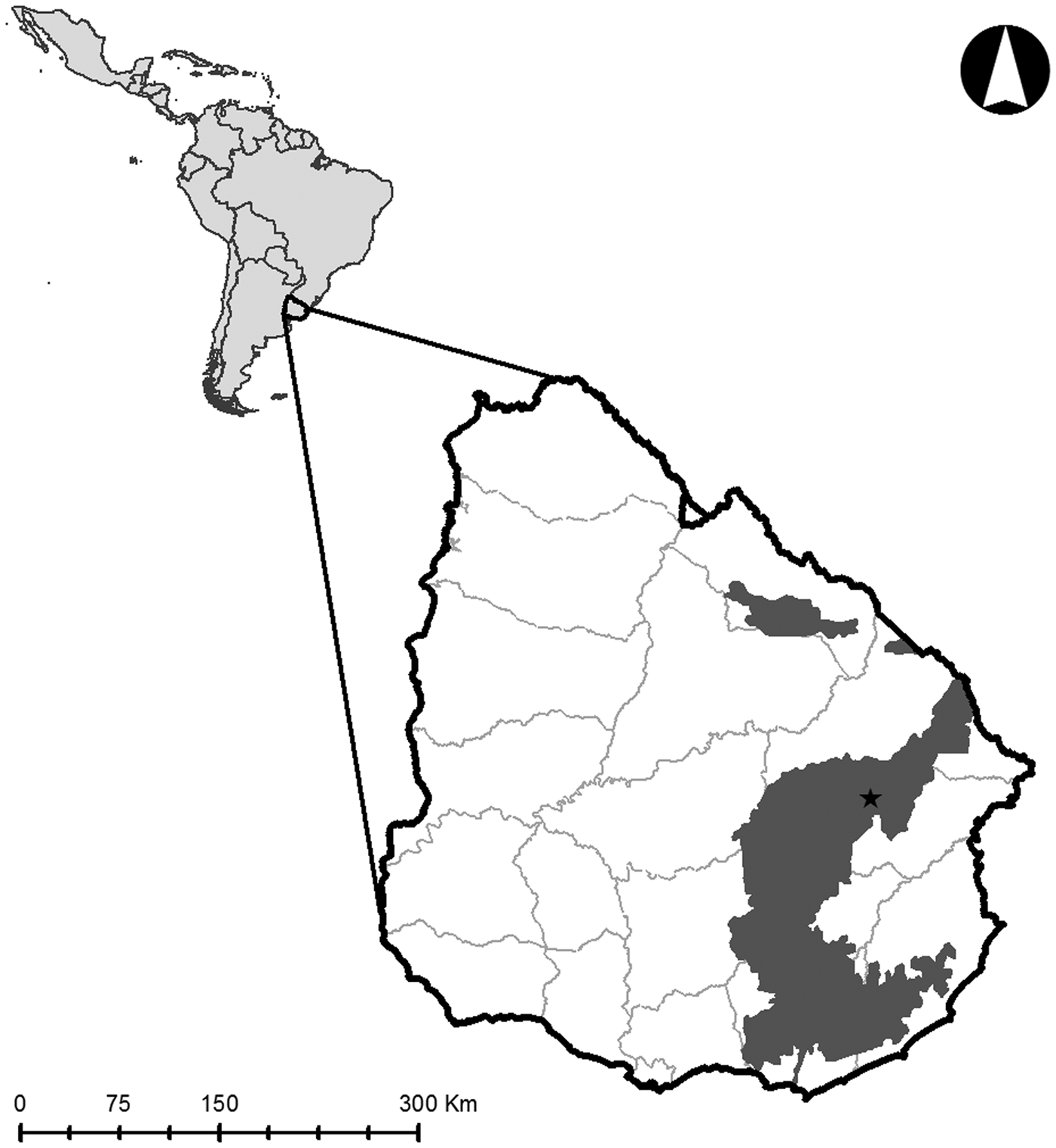
The site used for collecting soil seed bank samples is a natural grassland of the Quebrada de los Cuervos protected landscape, Uruguay (32°55′ S, 54°26′ W; Fig. 1). The site belongs to the geomorphological region Eastern Hills (Sierras del Este), which covers 25,000 km2 (14.3% of the country's surface) and is characterized by great heterogeneity in terms of relief, rocky outcrops, slope and soil depth (Baeza et al., Reference Baeza, Rama, Lezama, Altesor, López-Mársico and Paruelo2019). The average annual rainfall in the area is 1318 mm and the average annual temperature is 17°C (INIA-GRAS, 2018). The rainfall is distributed throughout the year, without distinction between dry and wet periods. Grasslands and shrubby grasslands occupy nearly 66% of the region, and grazing by livestock is the main productive activity (Baeza et al., Reference Baeza, Rama, Lezama, Altesor, López-Mársico and Paruelo2019). Three grassland communities are recognized in this region (Lezama et al., Reference Lezama, Pereira, Altesor and Paruelo2019): the densely vegetated grasslands (Eryngium horridum–Juncus capillaceus community, associated with medium and deep soils; plant cover around 90%), the sparsely vegetated grasslands (Trachypogon spicatus–Crocanthemum brasiliense community, associated with shallow soils; plant cover 60–80%) and the tall and densely vegetated grasslands (associated with humid or temporarily inundated soils; plant cover around 95%). The latter occupies the concave zones of the landscape (Gallego, Reference Gallego2013), on moderately drained Argisols with a time-limited perched water table when present (Durán, Reference Durán1985). Vegetation is distributed in two strata, one low (5 cm), conformed by grasses and perennial herbaceous forbs (e.g. Paspalum pumilum, Chascolytrum poomorphum, Eragrostis bahiensis, Axonopus fissifolius, Dichanthelium sabulorum, Centella asiatica), and one tall (60 cm) defined by the tussock grass Saccharum angustifolium (Ness) Trin (mean cover: 60–70%) (Lezama et al., Reference Lezama, Pereira, Altesor and Paruelo2019). Tussock grasslands are managed using prescribed burns to improve forage quality for cattle (Royo-Pallarés et al., Reference Royo-Pallarés, Berretta, Maraschin, Suttie, Reynolds and Batello2005). The large amount of dry standing dead matter and litter that accumulates over many growing seasons provides the necessary fuel for fire ignition and spread.
Geographic location of the geomorphological region Eastern Hills (Sierras del Este), Uruguay. The grey area denotes the limit of the region, and the star shows the location of soil collection. About 65% of the region is covered by natural grasslands.

Soil seed bank samples and treatments
The sampling was carried out in the austral spring (October 2017), before the dispersion of seeds of most species, in order to sample the seeds with longer persistence in the soil. About 75% of the species of the community are warm-season growers that set seeds during the austral summer (December–March). On the other hand, cool-season grasses and some winter forbs set seeds during November–December. Only a minor fraction of winter forbs set seeds before the sampling date (Rosengurtt, Reference Rosengurtt1979).
In total, 40 samples were collected, 8 of them from a recently burned site (2 h before sampling) and the remaining 32 from an adjacent site that had not been burned for at least 4 years. Sampling points were spaced every 2 m along a transect, avoiding the area below the canopy of S. angustifolium. Soil cores were taken with a core sampler of 8 cm in diameter, inserted 5 cm into the soil. Each soil sample was sectioned lengthwise, and one of the halves was discarded. The other half (126 cm3) was stored in a plastic bag and transported to the laboratory.
Samples were air-dried for 2 d. Subsequently, the soil was disaggregated and all plant debris was removed. Soil samples were spread evenly in aluminium trays (11 × 15 × 5 cm) containing a 1-cm deep layer of sterile sand. The 32 samples collected from the unburned site were subjected to four treatments (eight samples per treatment): (1) heat shock of 100°C (H), (2) smoke (S), (3) heat shock and smoke (HS) and (4) control (C; no heat shock and no smoke). A fifth treatment consisted of the samples taken from the burned site (B). Heat-shock treatment was applied to the samples for a period of 5 min using a preheated oven. The selected temperature is within the range of temperature used by Overbeck et al. (Reference Overbeck, Müller, Pillar and Pfadenhauer2006) and López-Mársico et al. (Reference López-Mársico, Farías-Moreira, Lezama, Altesor and Rodríguez2019), which is supposed to cover the thermal conditions potentially encountered by seeds during the fire in the Río de la Plata grasslands. The time of exposure is close to the maximum residence time of the fire at the soil surface (330 s) reported by Fidelis et al. (Reference Fidelis, Delgado-Cartay, Blanco, Muller, Pillar and Pfadenhauer2010) for experimentally burned plots – excluded from burning for 6 years – in Brazilian campos grasslands. For the smoke treatment, we used a bee smoker connected to a plastic chamber (60 × 40 × 30 cm), where the samples were placed and fumigated with smoke derived from burning 50 g of dry biomass of S. angustifolium. Once the chamber became saturated with smoke, it was left sealed for the same exposure time as the heat-shock treatment (5 min). The smoke methodology is an adaptation of the method proposed by Dixon et al. (Reference Dixon, Roche and Pate1995), and it was used by López-Mársico et al. (Reference López-Mársico, Farías-Moreira, Lezama, Altesor and Rodríguez2019) for individual seeds collected at our study site.
The soil seed bank was estimated using the seedling emergence method (Roberts, Reference Roberts1981; Simpson et al., Reference Simpson, Leek, Parker, Leek, Parker and Simpson1989). Trays were placed in a germination chamber with a 12/12 h light/dark and 25/20°C regime, simulating the environmental conditions of eastern Uruguay during spring (INIA-GRAS, 2018). The trays were regularly watered and rotated weekly to expose the samples to the same radiation conditions. Emerging seedlings were identified and removed. Unidentified seedlings were transplanted to a separate pot and grown until they were identifiable. All species were carefully revised, regarding taxonomic nomenclature, in online databases TROPICOS (http://www.tropicos.org, last accessed 18 April 2020) and Instituto de Botánica Darwinion (http://www.darwin.edu.ar/Proyectos/FloraArgentina/Especies.asp, last accessed 18 April 2020). The trays were monitored for 140 days, after which few seedlings emerged. One of the samples of the HS treatment was discarded because it presented a disproportionate number of seedlings compared to the rest of the trays.
Data analysis
Density (number of seedlings per m2) and richness of emerged seedlings (total and discriminated in dicotyledons and monocotyledons) were calculated for each treatment. The comparison of the variables among treatments was carried out through a one-way ANOVA, followed by Tukey's post hoc test (α = 0.05). Prior to analysis, total and dicot density data were log-transformed, as they did not meet the assumptions of normality and/or homoscedasticity. A chi-square test was performed to investigate whether the proportion of monocots and dicots varied in the different treatments. All analyses were performed with the software InfoStat (Di Rienzo et al., Reference Di Rienzo, Casanoves, Balzarini, Gonzalez, Tablada and Robledo2016).
Results
Throughout the experiment a total of 625 seedlings emerged, of which 425 were dicots and 200 were monocots. Of the total, 525 could be identified at the genus or species level, while the remaining 100 (63 dicots and 37 monocots) died before identification. Overall species richness was 54 (31 dicots and 23 monocots). The most species-rich plant families were Asteraceae (15 spp.), Poaceae (12 spp.) and Cyperaceae (6 spp.). The remaining species belong to 12 plant families (Supplementary Table S1).
Effect of treatments on seedling density and richness
Field burn treatment (B) significantly increased the emergence of seedlings from the soil seed bank by 161%, as compared with the control (C). Heat (H), smoke (S) and heat and smoke (HS) treatments did not significantly affect total seedling density, although the number of seedlings in S and in HS was 64 and 31% greater than in control, respectively, and did not differ from B. The density of dicots and monocots followed the same trend as the total density: treatment B was the only treatment that significantly enhanced seedling emergence, compared to the control (Fig. 2). The monocot/dicot ratio was 32/68% and there were no significant differences among treatments (χ2 = 0.526; gl = 4; P = 0.97).
Seedling density and species richness of the soil seed bank of an Uruguayan temperate grassland, in response to five different fire-related treatments: (A) total; (B) dicots and (C) monocots. Values are means (±SE; n = 8). Different letters indicate significant differences between treatments (P < 0.05) in a post-ANOVA Tukey test. B = field burn; H = heat shock; S = smoke; HS = heat shock and smoke; C = control.

Species richness (total and by taxonomic group) was significantly increased in treatment B, compared to the control. Species richness was not affected by heat, smoke or heat and smoke treatments (Fig. 2). The monocot/dicot ratio was 39/61%, having no significant differences among treatments (χ2 = 0.655; gl = 4; P = 0.96).
Germination timing
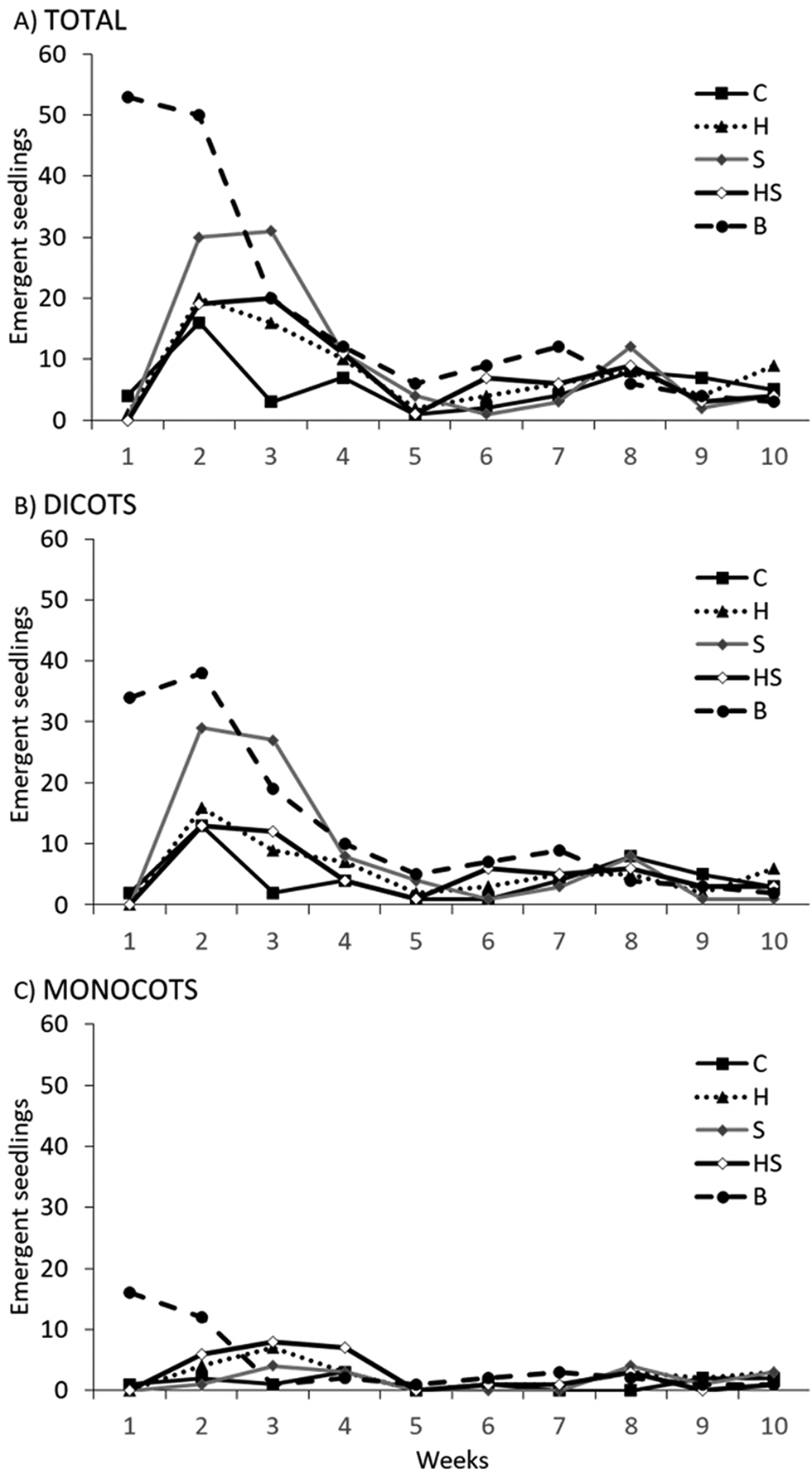
Seedlings emerged earlier in B, reaching a maximum in the first and second week of the experiment. In the remaining treatments, including the control, the maximum germination peak occurred between the second and third week of the experiment (Fig. 3). The smoke treatment produced the second highest germination peak, mainly due to the germination of dicots (Fig. 3B). After 10 weeks, nearly 80% of the total number of individuals recorded had already germinated.
Number of weekly germinants which emerged from the soil seed bank of an Uruguayan temperate grassland, in response to five different fire-related treatments: (A) total; (B) dicots and (C) monocots. Only the first 10 weeks of the total 20 weeks that the experiment lasted is shown. B = field burn; H = heat shock; S = smoke; HS = heat shock and smoke; C = control.

Species composition
The most abundant species in each taxonomic group (relative density >3%, considering all treatments as a whole) accounted for 80% of all emerging seedlings. Dominant dicots germinated in all treatments, but germination was especially enhanced in B. The germination behaviour of dominant monocots was more heterogeneous (Fig. 4). Species exclusive to a single treatment were rare (most with one or two individuals) and were mainly recorded in B (five dicots and seven monocots) (Supplementary Table S1).
Number of seedlings of the dominant (DR > 3%) dicots (A) and monocots (B) which emerged from the soil seed bank of an Uruguayan temperate grassland, in response to five different fire-related treatments. B = field burn; H = heat shock; S = smoke; HS = heat shock and smoke; C = control.

Discussion
This study provides evidence of positive effects of fire on seed germination in a temperate grassland of southern South America. Of all the treatments analysed, field burn was the treatment that differed most from the control. Field burn promoted a significant increase in the density and richness of germinants, without affecting the monocot/dicot ratio. In addition, the germination peak in this treatment preceded the peaks of the remaining treatments. On the other hand, fire-related cues (heat shock and smoke) did not affect seedling species richness and density, though the germination of some individual species was enhanced by some of the treatments, mainly those where the seeds were smoked. These results complement and challenge the conclusions of other studies carried out on several grasslands of the region, in which it was found that the effects of heat and smoke had neutral or negative effects on the germination of some species (e.g. Overbeck et al., Reference Overbeck, Müller, Pillar and Pfadenhauer2006; Fidelis et al., Reference Fidelis, Delgado-Cartay, Blanco, Muller, Pillar and Pfadenhauer2010, Reference Fidelis, Daibes and Martins2016; López-Mársico et al., Reference López-Mársico, Farías-Moreira, Lezama, Altesor and Rodríguez2019). This led researchers to suggest that species from these grasslands rely on their ability to resprout by means of subterranean or protected basal buds after a fire event, rather than on seed recruitment. Regeneration from seeds would be possible if seeds were to tolerate (or survive) a burning event (Overbeck and Pfadenhauer, Reference Overbeck and Pfadenhauer2007; Fidelis et al., Reference Fidelis, Daibes and Martins2016; López-Mársico et al., Reference López-Mársico, Farías-Moreira, Lezama, Altesor and Rodríguez2019), and our results show that several species of this grassland are stimulated to germinate by burning.
Treatments involving fire-related cues (heat, smoke and heat and smoke) were far from emulating the effects of a real field burn. Heat and smoke are the most commonly used fire signals in seed germination trials (e.g. Dayamba et al., Reference Dayamba, Tigabu, Sawadogo and Oden2008; Reyes and Trabaud, Reference Reyes and Trabaud2009; Moreira et al., Reference Moreira, Tormo, Estrelles and Pausas2010; Fichino et al., Reference Fichino, Dombroski, Pivello and Fidelis2016; Kin et al., Reference Kin, Suárez, Chirino, Ávila and Morici2016; Ramos et al., Reference Ramos, Liaffa, Diniz, Munhoz, Ooi, Borghetti and Valls2016, Reference Ramos, Valls, Borghetti F and Ooi2019; Tavşanoğlu et al., Reference Tavşanoğlu, Çatav and Özüdoğru2017; Arcamone and Jaureguiberry, Reference Arcamone and Jaureguiberry2018). In fire-prone ecosystems, such as Mediterranean-type shrublands, these signals stimulate the germination of many species and largely explain the recruitment of new individuals from seeds (Brown, Reference Brown1993; Dixon et al., Reference Dixon, Roche and Pate1995; Keeley and Fotheringham, Reference Keeley and Fotheringham1998; Paula and Pausas, Reference Paula and Pausas2008; Moreira et al., Reference Moreira, Tormo, Estrelles and Pausas2010). However, structurally distinct plant communities with historically different fire regimes may be expected to have different responses to fire-related germination cues (Maikano et al., Reference Maikano, Cohn and Di Stefano2018). Our results suggest that other fire-related cues, alone or in combination with heat and smoke, triggered germination in the field burn treatment. For example, it has been observed that germination can be stimulated by ash – the mineral remain of burned plants – that provide rich mineral nutrition (Ne'eman et al., Reference Ne'eman, Ne'eman, Keith and Whelan2009), by burned plant remains (Wicklow, Reference Wicklow1977; Keeley and Nitzberg, Reference Keeley and Nitzberg1984) or by burned soil (Blank and Young, Reference Blank and Young1998). Also, it has been shown that certain trace gases from smoke (e.g. nitrogen oxides) induce the germination of chaparral species (Keeley and Fotheringham, Reference Keeley and Fotheringham1997). Further studies testing other fire signals are needed to support this hypothesis.
On the other hand, it is also possible that the intensity and duration of heat and smoke applied in our study do not accurately simulate the conditions of a prescribed burn. In particular, the entire process of treating seeds with smoke is highly variable in the literature. Variations include application techniques (smoke fumigation, smoke water, ash/charate and karrikinolide), type of plant material, dilution of the aqueous smoke solution, and exposure time (5 min to 24 h, depending on the application technique), among others. In our experiment, we tried to simulate the low fire residence time of grass-fueled fires. It is possible that 5-min exposure was not enough to stimulate the germination of all the species, but we tried to be cautious as plant-derived smoke can both stimulate and inhibit germination depending on exposure time (van Staden et al., Reference Van Staden, Brown, Jäger and Johnson2000). For example, Keeley and Fotheringham (Reference Keeley and Fotheringham1998) found that several species of the Californian chaparral enhanced seed germination after 5-min exposure and reduced germination for exposures of 8-min or more. Also, the application technique may affect the results. Carthey et al. (Reference Carthey, Tims, Geedicke and Leishman2018) found that tests using smoke fumigation (as in our experiment) were significantly more likely to result in enhanced germination than tests using smoke water or ash/charate. Finally, it has been suggested that there are multiple compounds in smoke that stimulate germination, in addition to the non-specific karrikines (Keeley and Pausas Reference Keeley and Pausas2018). These chemicals could be species-specific, so burning a mixture of species (representative of the diversity of the community) rather than a single one could increase the number of species stimulated to germinate.
Field burn was the only treatment that promoted a significant increase in species richness of monocots and dicots germinants. Twelve exclusive species were registered in this treatment, albeit with very low abundances (one or two individuals). Fire frees up space and other resources (e.g. light and inorganic nutrients) and clears environments of competitors, leaving them ready to be colonized (Overbeck et al., Reference Overbeck, Müller, Pillar and Pfadenhauer2005; Keeley and Fotheringham, Reference Keeley, Fotheringham and Fenner2000). These spaces can be occupied by competitively subordinated species, which take advantage of the gaps left temporarily by the dominants (Overbeck et al., Reference Overbeck, Müller, Pillar and Pfadenhauer2005). The enhanced richness of germinants due to burning or its simulation has been observed in different ecosystems, such as forests (Enright et al., Reference Enright, Goldblum, Ata and Ashton1997; Read et al., Reference Read, Bellairs, Mulligan and Lamb2000; Maikano et al., Reference Maikano, Cohn and Di Stefano2018), shrublands (Figueroa et al., Reference Figueroa, Cavieres, Gómez-González, Molina-Montenegro and Jaksic2009) and prairies (Ren and Bai, Reference Ren and Bai2016).
Seedlings began to emerge at least 1 week earlier in the field burn treatment, compared to the other treatments. Smoke seems to be partly responsible for this advance since the peak of germination of this treatment was the closest to that of the field burn. Similarly, in other studies where the effects of heat and smoke on soil seed bank germination were evaluated, it was found that treatments with smoke promoted earlier germination (Read et al., Reference Read, Bellairs, Mulligan and Lamb2000; Ghebrehiwot et al., Reference Ghebrehiwot, Kulkarni, Kirkman and Van Staden2012). Early germination could be an advantage for opportunistic species growing in environments with highly unpredictable disturbances, such as prescribed burns, given that the first plants to germinate would be those that take advantage of the resources and space made available by fire (Le Stradic et al., Reference Le Stradic, Silveira, Buisson, Cazelles, Carvalho and Fernandes2015; Carthey et al., Reference Carthey, Tims, Geedicke and Leishman2018; López-Mársico et al., Reference López-Mársico, Farías-Moreira, Lezama, Altesor and Rodríguez2019).
Contrary to our expectation, none of the treatments affected the monocot/dicot ratio. In all treatments, the dicots accounted for the highest percentage of germinants, close to 70%. This proportion is very similar to that found in other seed bank studies carried out in Uruguayan grasslands under grazing (Haretche and Rodríguez, Reference Haretche and Rodríguez2006; Gallego et al., Reference Gallego, López-Mársico, Tommasino, Casás, Haretche, Rodríguez and Altesor2018), which was the initial condition of the study area, before the application of the treatments. High densities of dicots are common in grassland seed banks, and species that are hardly observed in the vegetation are frequently found in the soil samples (Roberts, Reference Roberts1981; D'Angela et al., Reference D'Angela, Facelli and Jacobo1988; Milberg, Reference Milberg1992). The dominant dicot in all treatments was Gamochaeta americana, a native small perennial Asteraceae, of medium to low frequency in vegetational surveys (unpublished data). Within the monocots, Juncus capillaceus was the most abundant species in most treatments. The species of this genus produce a large amount of small, long-lived seeds, forming large, persistent soil seed banks (Lunt, Reference Lunt1997; Bossuyt and Honnay, Reference Bossuyt and Honnay2008). High densities of Juncus spp. in seed banks are not exclusive to grassland soils. In a survey from very different ecosystems, Bossuyt and Honnay (Reference Bossuyt and Honnay2008) found that Juncus spp. were present in more than 50% of the soil seed banks analysed and were among the five most abundant species.
Our study contributes to the knowledge of the effects of fire on recruitment by seeds in a temperate sub-humid grassland of South America. By comparing the effect of fire as a whole with the effect of two of its components, we found that fire produces a postburn flush of seedlings, not entirely attributable to heat or smoke. However, all germination trials reported in the region have been directed to evaluate the effect of these fire-direct signals. The lack of response observed so far may be due to the fact that in this system, prescribed burns spread rapidly and are not very intense (Simpson et al., Reference Simpson, Ripley, Christin, Belcher, Lehmann, Thomas and Osborne2016), which most likely minimizes the effect of heat and smoke. Future research efforts are needed to quantify the net contribution of other fire signals to the germination of seeds of South American grassland species.
Supplementary material
To view supplementary material for this article, please visit: https://doi.org/10.1017/S0960258520000288.
Acknowledgements
We thank members of the Cooperativa Agraria Quebrada de los Cuervos and Daniel Erman, Director of the Paisaje Protegido Quebrada de los Cuervos for logistic support. We also thank Gastón Fernández for field assistance, Andrea Corona and Federico Gallego for technical support, and Federico Haretche and Felipe Lezama for taxonomic help. Two anonymous reviewers made valuable suggestions that improved the original manuscript.
Financial support
This research received no specific grant from any funding agency, commercial or not-for-profit sectors.