Introduction
The study of specific exposures in relation to schizophrenia and other psychoses is essential to identify putative risk factors. However, this approach can only take us so far, and none of the risk factors identified to date is sufficient or necessary to cause psychosis. To more fully understand the aetiology of these disorders we need to investigate both how putative risk factors interact with each other and the mechanisms through which they make an impact on individuals in what are most probably complex webs of causation. This necessitates moving beyond efforts to isolate independent factors to consider causal paths and interactions.
A useful illustration of this is the recent accumulation of evidence linking various socio-environmental factors (e.g. abuse, disadvantage, migration and ethnicity) with both psychotic disorders and psychotic experiences in general population samples (Morgan et al. Reference Morgan, Kirkbride, Hutchinson, Craig, Morgan, Dazzan, Boydell, Doody, Jones, Murray, Leff and Fearon2008; van Dam et al. Reference van Dam, van der Ven, Velthorst, Selten, Morgan and de Haan2012; Varese et al. Reference Varese, Smeets, Drukker, Lieverse, Lataster, Viechtbauer, Read, van Os and Bentall2012). The studies that have implicated such factors have tended to consider each exposure separately, albeit with some notable exceptions (e.g. van Os et al. Reference van Os, Pedersen and Mortensen2004; Zammit et al. Reference Zammit, Lewis, Rasbash, Dalman, Gustafsson and Allebeck2010b ; Bebbington et al. Reference Bebbington, Jonas, Kuipers, King, Cooper, Brugha, Meltzer, McManus and Jenkins2011). This is despite the fact that social adversities and disadvantages tend to cluster in individuals, families and neighbourhoods and persist over time (Pantazis et al. Reference Pantazis, Gordon and Levitas2006), and most aetiological theories imply co-participation of a number of risk factors. For example, the proposition that social factors increase risk for psychosis via sensitization of the dopaminergic system implies prolonged and cumulative exposure (Collip et al. Reference Collip, Myin-Germeys and Van2008; van Os et al. Reference van Os, Kenis and Rutten2010). In relation to understanding the high rates of psychosis in minority ethnic groups, where the current balance of evidence implicates socio-environmental factors (e.g. Cooper et al. Reference Cooper, Morgan, Byrne, Dazzan, Morgan, Hutchinson, Doody, Harrison, Leff, Jones, Ismail, Murray, Bebbington and Fearon2008; Morgan et al. Reference Morgan, Fisher, Hutchinson, Kirkbride, Craig, Morgan, Dazzan, Boydell, Doody, Jones, Murray, Leff and Fearon2009; Reininghaus et al. Reference Reininghaus, Craig, Fisher, Hutchinson, Fearon, Morgan, Dazzan, Doody, Jones, Murray and Morgan2010; Veling et al. Reference Veling, Hoek, Selten and Susser2011), we have proposed a theoretical model of a sociodevelopmental pathway to psychosis. In this, we hypothesize that the high prevalence of linked social adversities over time in certain minority groups accounts for the high rates of psychosis (Morgan et al. Reference Morgan, Charalambides, Hutchinson and Murray2010). Such a model explicitly implicates a dynamic interplay between social factors over time and at different levels.
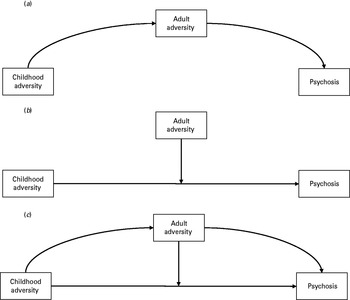
When considering how social and other factors may relate to each other in pathways to psychosis, there are a number of possibilities (Schwartz & Susser, Reference Schwartz, Susser, Susser, Schwartz, Morabia and Bromet2006). First, some social factors may impact on risk indirectly by increasing likelihood of exposure to more proximal risk factors. For example, childhood adversity may link to psychosis, in part, via subsequent poor educational attainment (previously found to be associated with psychosis; Morgan et al. Reference Morgan, Kirkbride, Hutchinson, Craig, Morgan, Dazzan, Boydell, Doody, Jones, Murray, Leff and Fearon2008) or via further adversity or via cognitive and affective mechanisms (e.g. self-esteem), such that childhood adversity is an early step on a causal path (i.e. a mediation model). A limited number of studies have examined mediation models linking, for example, exposure to trauma and psychological mechanisms such as self-esteem in paths to psychosis (Bebbington et al. Reference Bebbington, Jonas, Kuipers, King, Cooper, Brugha, Meltzer, McManus and Jenkins2011; Fisher et al. Reference Fisher, Schreier, Zammit, Maughan, Munafò, Lewis and Wolke2012). Second, social factors may combine synergistically (environment–environment interaction) to increase risk; that is, the impact of exposure to two factors may be greater than the sum of the individual effects of each alone (i.e. an interaction model). A larger number of studies have investigated synergistic effects for two environmental exposures (e.g. van Os et al. 2004; Clarke et al. Reference Clarke, Tanskanen, Huttunen, Leon, Murray, Jones and Cannon2011). To complicate this further, risk factors connected along a causal path (i.e. via mediation) may also interact (i.e. combine synergistically) (Hafeman, Reference Hafeman2008). For example, the effect of childhood adversity may both predict subsequent adversity and interact with adult adversity (i.e. a mediated synergy model) (Hafeman & Schwartz, Reference Hafeman and Schwartz2009). As far as we are aware, no studies have examined mediation and synergy in the same analyses in relation to psychosis. Assessment of these models (illustrated in Fig. 1) is one way to expand the standard approach beyond identification of single risk factors. Framed in this way, theoretical propositions about how factors combine over time in neuro- or sociodevelopmental models of psychosis become empirically testable hypotheses.
Models of mediation, synergy and mediated synergy. (a) Mediation model. The effect of the primary exposure (childhood adversity) is via its impact on likelihood of exposure to a more proximal exposure (adult adversity). (b) Synergy (interaction, effect modification) model. The effect of the primary exposure (childhood adversity) combines with (or depends on) another exposure (adult adversity) to increase risk. (c) Mediated synergy model. The primary exposure (childhood adversity) may both (i) (partly) make an impact on psychosis via a more proximal exposure (adult adversity) and (ii) interact with that exposure (adult adversity) to increase risk of psychosis.

In light of the above, we sought to extend previous analyses of data from the AESOP (Aetiology and Ethnicity in Schizophrenia and Other Psychoses) first-episode psychosis study on childhood and adult (Morgan et al. Reference Morgan, Kirkbride, Leff, Craig, Hutchinson, McKenzie, Morgan, Dazzan, Doody, Jones, Murray and Fearon2007, Reference Morgan, Kirkbride, Hutchinson, Craig, Morgan, Dazzan, Boydell, Doody, Jones, Murray, Leff and Fearon2008) markers of disadvantage to examine how they might combine to increase risk of psychosis. More specifically, we sought to test the hypotheses that childhood adversity both: (a) increases risk for psychosis in part via (i.e. is mediated through) poor education and adult disadvantage and self-esteem; and (b) interacts synergistically, on an additive scale, with poor education and adult disadvantage. Exposures and mediators were chosen on the basis of previous analyses demonstrating main effects of these variables on odds of psychosis (Morgan et al. Reference Morgan, Kirkbride, Leff, Craig, Hutchinson, McKenzie, Morgan, Dazzan, Doody, Jones, Murray and Fearon2007, Reference Morgan, Kirkbride, Hutchinson, Craig, Morgan, Dazzan, Boydell, Doody, Jones, Murray, Leff and Fearon2008). Our premise was that evidence supporting both hypotheses would be suggestive of mediated synergistic effects of these markers on risk of psychosis. In relation to ethnicity, we have previously noted that specific risk factors and mechanisms may contribute to higher rates of disorder in certain groups if they have a stronger effect or are more common. Having previously shown that markers of childhood and adult disadvantage are more common in black minority groups, we therefore further sought to test whether the effects hypothesized here, if evident, held for each of the main ethnic groups in our sample (white British, black Caribbean, black African). In this respect, our aim was to examine putative explanations of the increased incidence in black minority groups.
Method
AESOP is a multi-centre incidence and case-control study of first-episode psychosis. Full details of the methods are provided in previous reports (Morgan et al. Reference Morgan, Dazzan, Morgan, Jones, Harrison, Leff, Murray and Fearon2006).
Sample
The sample comprises cases with a first episode of psychosis and population-based controls. The inclusion criteria for cases were: aged 16–64 years; resident within defined catchment areas in south-east London and Nottingham, UK; presence of a first episode of psychosis within the time-frame of the study; and no previous contact with health services for psychosis. Exclusion criteria were: evidence of psychotic symptoms precipitated by an organic cause; and transient psychotic symptoms resulting from acute intoxication as defined by the International Classification of Diseases, 10th revision (ICD-10). Each patient meeting inclusion criteria was approached and informed consent sought. During the same period, a random sample of population-based controls with no history of psychosis aged 16–64 years was recruited from the same catchment areas. The study received approval from the relevant local research ethics committees and all participants provided informed consent.
Data collection
Detailed information on markers of adversity in childhood and adulthood was collected from cases and controls using the MRC Sociodemographic Schedule (Mallett et al. Reference Mallett, Leff, Bhugra, Pang and Zhao2002). The primary markers of childhood adversity used for the analyses presented in this paper were: (1) separation from a parent before the age of 16 years (with separation defined as not living in the same household as one or both parents for 1 year or more because of family breakdown); and (2) death of a parent before the age of 16 years (Morgan et al. Reference Morgan, Kirkbride, Leff, Craig, Hutchinson, McKenzie, Morgan, Dazzan, Doody, Jones, Murray and Fearon2007). With regard to current and long-term (i.e. 1 year prior to assessment) adult disadvantage and isolation we considered, where possible, five indicators: (1) unemployed; (2) living alone; (3) rented housing; (4) no relationship; and (5) limited social networks (Morgan et al. Reference Morgan, Kirkbride, Hutchinson, Craig, Morgan, Dazzan, Boydell, Doody, Jones, Murray, Leff and Fearon2008). To assess the impact of linked and cumulative disadvantage we created current and long-term indices by dichotomizing each variable to indicate the presence or absence of an indicator, with a score of 1 for present (e.g. unemployed) and 0 for absent. This produced a potential range on the current index of 0 to 5 and on the long-term index of 0 to 3. (Long-term data were available for three markers only: unemployment, living alone, no relationship.) Poor educational achievement was operationalized as not having achieved any formal educational qualifications.
Self-esteem was assessed with the Rosenberg Self-Esteem Scale (Rosenberg, Reference Rosenberg1989). The questionnaire comprises 10 items (e.g. ‘on the whole I am satisfied with myself’) on a five-point scale. Total scores range from 10 to 50, with a higher score indicating more positive evaluations of the self.
Data on ethnicity, gender and age were collected using the MRC Sociodemographic Schedule (Mallett et al. Reference Mallett, Leff, Bhugra, Pang and Zhao2002). Symptom data were collected using the Schedules for Clinical Assessment in Neuropsychiatry (World Health Organization, 1992). ICD-10 diagnoses were determined by consensus (Kirkbride et al. Reference Kirkbride, Fearon, Morgan, Dazzan, Morgan, Tarrant, Lloyd, Holloway, Hutchinson, Leff, Mallett, Harrison, Murray and Jones2006). Pre-morbid intelligence quotient (IQ) was estimated using the National Adult Reading Test and a parental history of psychosis was established using the Family Interview for Genetic Studies (National Institute of Mental Health, 1992).
Data analysis
To test our hypotheses, we first examined whether there was evidence that the effects of (a) parental separation and (b) parental death before the age of 16 years on case-control status were mediated through poor education and adult disadvantage and self-esteem using multiple mediation analysis (MacKinnon, Reference MacKinnon2008). In line with Preacher & Hayes (Reference Preacher and Hayes2008), the total effect of parental separation (and of parental death) on case-control status was apportioned into a direct effect and mediating or, synonymously, indirect effects through poor education and adult disadvantage and self-esteem. The total indirect effect was computed as the sum of specific indirect effects. Logit coefficients and odds ratios (ORs) for total and specific indirect effects of parental separation and parental death through the hypothesized mediators on case-control status were estimated using maximum likelihood (ML) estimation in MPlus, version 6.1 (Muthén & Muthén, Reference Muthén and Muthén1998–2012). All mediation analyses were repeated using the robust weighted least squares means and variance adjusted estimator (WLSMV) to compute probit coefficients, as this approach provides more accurate estimates of direct, indirect and total effects and allows for the use of bias-corrected bootstrapping (MacKinnon, Reference MacKinnon2008; Preacher & Hayes, Reference Preacher and Hayes2008). Findings from these analyses (see online Supplementary material) were in line with those produced using logit coefficients and ORs, which are presented in preference in the main body of the paper because they are more readily interpretable. Data were assumed to be missing at random, which allowed for inclusion of the full sample using WLSMV and ML estimators.
Next, we examined whether there was evidence that childhood adversity [i.e. (a) separation from a parent; (b) death of a parent] combined synergistically with poor education and/or adult disadvantage by testing for interaction on an additive scale (i.e. for departure from additivity) using interaction contrast ratios (ICRs), as described by Schwartz (Reference Schwartz, Hernandez and Blazer2006). Under the assumption that when the disorder is rare ORs approximate risk ratios, this approach uses ORs to estimate the relative excess risk due to interaction, i.e.
 $${\rm ICR} = {\rm OR}_{{\rm exposure}{\kern 1pt} {\rm A}{\kern 1pt} {\rm \&} {\kern 1pt} {\rm exposure}{\kern 1pt} {\rm B}} - {\rm OR}_{{\rm exposure}{\kern 1pt} {\rm A}{\kern 1pt} {\rm only}} - {\rm OR}_{{\rm exposure}{\kern 1pt} {\rm B}{\kern 1pt} {\rm only}} + 1.$$
In this model, deviation from additivity (i.e. interaction) is indexed by an ICR greater than 0. Confidence intervals (CIs) and p values for ICRs were generated using the nlcom procedure in Stata (StataCorp LP, USA).
Analyses were conducted using Stata version 12 and MPlus version 6.1.
Results
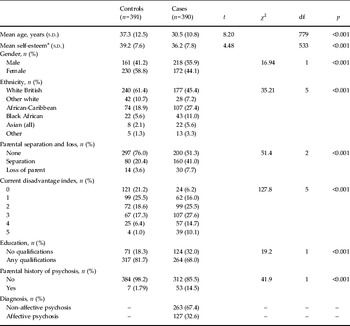
A total of 390 cases and 391 controls were assessed in the south-east London and Nottingham sites of the AESOP study over a 3-year period. Basic sociodemographic characteristics and the main social exposures and mediators by case-control status, and the distribution of diagnoses among cases, are shown in Table 1.
Basic sociodemographic and diagnostic characteristics by case-control status

df, Degrees of freedom; s.d., standard deviation.
a Sample size: n = 535 (240 cases, 295 controls).
Previous findings
In our previous analyses, we demonstrated strong and independent associations between psychosis and both (a) separation from a parent [adjusted OR (aOR) 2.45] and death of a parent (aOR 3.06) and (b) all current and long-term indicators of social disadvantage (aORs ranged from 2.11 to 7.50) (Morgan et al. Reference Morgan, Kirkbride, Leff, Craig, Hutchinson, McKenzie, Morgan, Dazzan, Doody, Jones, Murray and Fearon2007, Reference Morgan, Kirkbride, Hutchinson, Craig, Morgan, Dazzan, Boydell, Doody, Jones, Murray, Leff and Fearon2008). When indicators of social disadvantage were combined to form indices, there was clear evidence of linear relationships, such that as the number of indicators present (current and long term) increased the odds of psychosis increased (Morgan et al. Reference Morgan, Kirkbride, Hutchinson, Craig, Morgan, Dazzan, Boydell, Doody, Jones, Murray, Leff and Fearon2008). In addition, compared with controls, cases were almost three times more likely to have no formal qualifications (aOR 2.92, 95% CI 1.98–4.30).
Mediation (1): parental separation, education and adult disadvantage
To assess pathways from childhood adversity to psychosis via education and adult disadvantage, estimates of the total effects of parental separation and of parental death on odds of psychosis were parsed into direct (i.e. unmediated) and indirect (total and specific) effects using multiple mediation analyses, as detailed above.
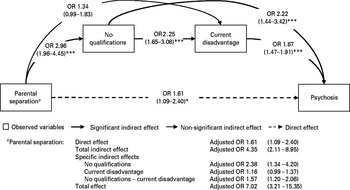
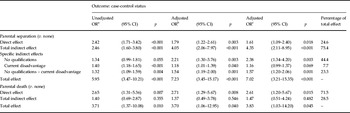
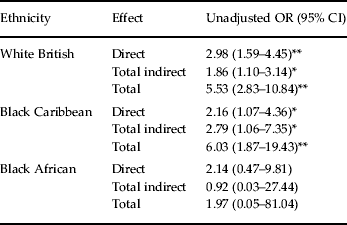
Beginning with separation, both unadjusted direct (OR 2.42, 95% CI 1.71–3.42) and total indirect (OR 2.46, 95% CI 1.60–3.80) effects of separation on case-control status were statistically significant at conventional 5% levels, indicating strong evidence for partial mediation via education and current disadvantage. These findings remained when adjusted for age, gender, ethnicity, study centre and parental history of psychosis (direct effect: aOR 1.61, 95% CI 1.09–2.40; total indirect effect: aOR 4.35, 95% CI 2.11–8.95) (Table 2 and Fig. 2; see Supplementary Table S1 for probit estimates). The total indirect effect of separation, after adjustment, accounted for around 75% of the total effect of separation from a parent on case-control status. In other words, a substantial proportion of the impact of separation on psychosis was via pathways through poor educational attainment (no qualifications) and adult disadvantage. Second, when specific indirect effects were scrutinized there was evidence for pathways from separation to psychosis via no qualifications alone (aOR 2.38, 95% CI 1.34–4.20), via adult disadvantage alone (aOR 1.16, 95% CI 0.99–1.37), and via no qualifications and adult disadvantage (aOR 1.57, 95% CI 1.20–2.06). When stratified by ethnic group, the effects were very similar for the white British and black Caribbean groups; for the black African group the indirect effects did not hold, but CIs were wide, which suggests this may reflect loss of power (see Table 3). Further, when we repeated the above analyses using (a) our index of long-term disadvantage (online Supplementary Tables S2a, S2b) and (b) a sample of cases restricted to those with a very-short duration of untreated psychosis (DUP) (1 month or less) (online Supplementary Tables S3a, S3b), very similar findings emerged, i.e. strong evidence for partial mediation via poor education and adult disadvantage.
Path diagram of odds ratios (ORs) and 95% confidence intervals of parental separation, educational level and current social disadvantage on case-control status adjusted for age, gender, ethnicity, study centre and parental history of psychosis (n = 781, 65 free parameters). Compared with controls, cases were 2.38 times more likely to have been separated from a parent and go on to have no qualifications. Further, cases were 1.16 times more likely to have been separated from a parent and, in turn, experience social disadvantage. Cases were 1.57 times more likely to have been separated from a parent, followed by no qualifications and, then, social disadvantage. Overall, compared with controls, cases were 4.35 times more likely to experience one of these three pathways. * p < 0.05, *** p < 0.001.

Total, direct, total indirect and specific indirect effects (ORs) of parental separation, educational level and current social disadvantage on case-control status (n = 781)

OR, Odds ratio; CI, confidence interval.
a See Table 3 for estimates stratified by ethnicity.
b Adjusted for age, gender, ethnicity and study centre.
c Adjusted for age, gender, ethnicity, study centre and parental history of psychosis.
Separation of ORs by ethnicity (white British, black Caribbean and black African) a

OR, Odds ratio; CI, confidence interval.
a Likelihood ratio test: χ 2 = 4.99, p = 0.661.
*p < 0.05, ** p < 0.01.
Mediation (2): self-esteem
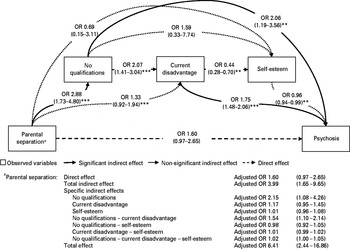
Further elaborating the model, in a subsample of 240 cases and 295 controls on whom data were available on current self-esteem, we examined whether the effects of separation and adult disadvantage were mediated via self-esteem at entry into the study. First, in this subsample the patterns of association and mediation described above broadly held. Second, there was weak evidence (unadjusted OR 1.02, 95% CI 1.00–1.05, p = 0.096) for a pathway from separation to psychosis via education, disadvantage and low self-esteem (Fig. 3 and Supplementary Tables S4a, S4b).
Path diagram of odds ratios (ORs) and 95% confidence intervals of parental separation, educational level, current social disadvantage and self-esteem on case-control status adjusted for age, gender, ethnicity, study centre and parental history of psychosis (n = 781, 65 free parameters). Compared with controls, cases were 2.15 times more likely to have been separated from a parent and go on to have no qualifications. Further, cases were 1.54 times more likely to have been separated from a parent, followed by no qualifications and, in turn, experience social disadvantage. A trend (p = 0.096) was observed for the indirect effects of parental separation to poor education to current disadvantage to self-esteem to psychosis. ** p < 0.01, *** p < 0.001.

Mediation (3): accounting for pre-morbid IQ
To assess whether our findings in relation to mediation via education and disadvantage could be accounted for by pre-morbid cognitive deficits, we repeated the relevant analyses above in a restricted sample with data on estimated pre-morbid IQ (n = 457) (Supplementary Tables S5a, S5b). To begin with, in this restricted sample, the strength of unadjusted and adjusted direct and indirect effects of parental separation were similar to those shown in Table 2. When these effects were further adjusted for pre-morbid IQ both direct and total indirect effects were attenuated but remained significant at conventional levels. All specific indirect effects were attenuated and only a pathway through poor education and current disadvantage (p = 0.071) was close to the standard 5% level of statistical significance.
Mediation (4): parental death
With regard to parental death, the proportion in the sample reporting loss of a parent during childhood was too small to allow for stable estimates of specific indirect effects. Unadjusted findings for direct and total indirect effects were broadly similar in magnitude to those for separation, but only reached conventional levels of statistical significance for direct effects (see Table 2). The direct effect for parental death remained robust to adjustment for age, gender, ethnicity, study centre and parental history of psychosis (Table 2), and pre-morbid IQ (Supplementary Table S4).
Synergistic effects
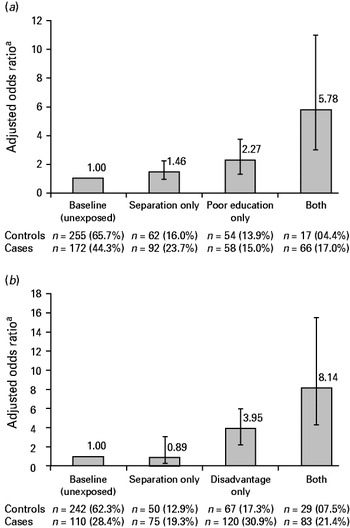
Following on from our analyses of mediation, we next examined evidence for synergistic effects of parental separation and both poor education (i.e. no qualifications) and adult disadvantage on risk of psychosis. For these analyses, our index of disadvantage was dichotomized into those exposed to no markers and those exposed to one or more. Beginning with separation and poor education, there was only suggestive evidence of departure from additivity. The aOR for those exposed to separation only was 1.46 (95% CI 0.95–2.25), for those exposed to poor education only it was 2.27 (95% CI 1.39–3.71), and for those exposed to both it was 5.78 (95% CI 3.04–10.98) (ICR 3.05, 95% CI –0.62 to 6.72, p = 0.103; see Fig. 4 a). Turning to separation and disadvantage, there was strong evidence of departure from additivity. The aOR for those exposed to separation only was 0.89 (95% CI 0.27–2.95), for those exposed to markers of disadvantage only it was 3.95 (95% CI 2.24–6.97), and for those exposed to both it was 8.14 (95% CI 4.26–15.55) (ICR 4.30, 95% CI 0.66–7.94, p = 0.021; see Fig. 4 b). These effects were broadly similar across the three main ethnic groups (data not shown; available on request).
Additive interactions between separation from a parent and poor education and adult disadvantage. Values are adjusted odds ratios, with 95% confidence intervals (CIs) represented by vertical bars. (a) Separation and education. Interaction contrast ratio: 3.05 (95% CI –0.62 to 6.72) (p = 0.103). (b) Separation and disadvantage. Interaction contrast ratio: 4.30 (95% CI 0.66–7.94) (p = 0.021). a Odds ratios adjusted for age, gender, ethnicity, study centre and parental history of psychosis.

When we repeated these analyses restricted to the sample with data on pre-morbid IQ and further adjusted analyses for pre-morbid IQ, the interaction between separation and disadvantage was attenuated (ICR 2.83, 95% CI –0.79 to 6.45, p = 0.126). This may, however, largely reflect a loss of power, as the estimated ICR remain notably above zero and CIs are wide.
There was no evidence for additive interaction between parental death and either education or disadvantage (data not shown; available on request).
Discussion
Building on previous analyses of the AESOP sample, we sought to move beyond identification of single environmental risk factors to examine whether markers of childhood adversity combine with other socio-environmental factors to increase risk of psychosis by testing path (mediation) models and synergistic effects. Three primary findings emerged: (1) there was strong evidence that the effect of separation from (but not death of) a parent on risk of psychosis was partially mediated through subsequent poor educational attainment and social disadvantage and, more tentatively, low self-esteem; (2) there was strong evidence that separation (but not death) interacted synergistically, on an additive scale, with disadvantage to increase risk; and (3) there was no evidence that the mediation or interaction effects varied by ethnicity. The evidence for both mediated and synergistic effects is suggestive of mediated synergy (i.e. of separation from a parent both increasing likelihood of, and interacting with, subsequent social disadvantage). It is notable, moreover, that similar effects were not observed for the loss of a parent during childhood. This, of course, may be due to a lack of power given that parental loss is relatively rare and therefore needs to be interpreted cautiously. This noted, it raises the possibility that specific factors may have specific effects and operate through different paths and mechanisms, and this merits further consideration in future research.
Methodological limitations
Data for this study were collected retrospectively at a single time point, which inevitably limits the inferences that can be drawn regarding causal pathways. We did, however, select variables that are temporally sequential such that it is reasonable to assume in most cases that parental separation prior to the age of 16 years preceded educational level (i.e. no qualifications on leaving school at 16 years or subsequently), which in turn preceded disadvantage and self-esteem (determined at the point of assessment, i.e. after age 16 years). Perhaps more problematically, as disadvantage and self-esteem were assessed after onset of disorder, we cannot determine the direction of causation between these and psychosis. However, we have shown in previous analyses that associations between case-control status and markers of disadvantage held when the sample was restricted to those with a very short DUP (< 1 month) and when long-term indicators of social disadvantage were considered, which suggests that high levels of disadvantage in the case sample are not simply a consequence of disorder (Morgan et al. Reference Morgan, Kirkbride, Hutchinson, Craig, Morgan, Dazzan, Boydell, Doody, Jones, Murray, Leff and Fearon2008). In a more recent study, we replicated these findings and further showed that markers of disadvantage were present 5 years prior to onset (Stilo et al. Reference Stilo, Di Forti, Mondelli, Falcone, Russo, O Connor, Palmer, Paparelli, Kolliakou, Sirianni, Taylor, Handley, Dazzan, Pariante, Marques, Zoccali, David, Murray and Morgan2012). Similarly, in the analyses presented in this paper, when we both restricted the sample to those with a short DUP and repeated analyses using the long-term index of social disadvantage the findings were the same.
We were able to adjust for a parental history of psychosis and, in a subsample, for estimated pre-morbid IQ, and the findings remained largely robust. Parental history, however, is a limited proxy for genetic risk and we cannot entirely rule out the possibility that some of the observed effects are a consequence of underlying genetic susceptibility. Polygenic risk scores may provide more useful summaries of total genetic risk that can be employed in future studies (Purcell et al. Reference Purcell, Wray, Stone, Visscher, O'Donovan, Sullivan and Sklar2009). In addition, we cannot rule out confounding by unmeasured factors such as substance use. What this indicates is that the models we have tested are inevitably partial.
Our finding of evidence for synergistic effects on an additive scale should be interpreted with caution. As has been discussed in relation to gene–environment interactions, models are scale dependent (Zammit et al. Reference Zammit, Lewis, Dalman and Allebeck2010a ). Recent critiques of interaction analyses, particularly of additive models, emphasize the need to determine analyses and scale for interaction a priori, especially given the high probability of type I error (Zammit et al. Reference Zammit, Lewis, Dalman and Allebeck2010a ). Our decision to model interactions on an additive scale was made because, within a minimum sufficient causes framework, additive models provide the best representation of synergy (Rothman et al. Reference Rothman, Greenland and Walker1980; Schwartz, Reference Schwartz, Hernandez and Blazer2006). In addition, as others have noted, multiplicative models are more complex and prone to error and, from a public health perspective, they are not as informative as additive models, which provide more readily interpretable information on the combined impact of two risk factors over and above what would be expected from each one alone (Kendler & Gardner, Reference Kendler and Gardner2010).
It further bears noting that our key exposure variables are perhaps most usefully considered risk indicators that probably index exposure, in some but not all, to risk factors that are more common among those who are separated and who are unemployed, living alone and so on. That there are multiple effects of separation on risk further hints at this. The meaning and impact of separation, for example, is probably diffuse; indeed, our findings suggest that separation indicates exposure to processes that make an impact on the risk of psychosis both directly (e.g. disrupted attachments, intra-familial conflict and neglect), which in turn may combine synergistically with subsequent exposures, and indirectly via other variables, e.g. education and subsequent disadvantage. What is more, this may explain why the same exposures are often associated with a heterogeneous range of outcomes; that is, specificity may lie in the particular paths that follow initial exposures, and this points strongly to a need for more detailed and robust measures of social exposures.
Interplay between social factors
The above limitations noted, the analyses reported here both illustrate how multiple (social) risk factors can be simultaneously modelled to provide clues on how they combine in developmental trajectories to psychosis and provide initial evidence in relation to childhood adversity, subsequent disadvantage and (tentatively) self-esteem.
Our analyses tie in with a developing literature considering how social and non-social environmental factors combine and interact over time to increase risk of psychosis. There is, for example, increasing evidence for cross-level social environment–environment interactions, such that the effects of individual-level exposures (e.g. being single) often depend on area-level exposures (e.g. living in an area with few single people) (van Os et al. 2000). In relation to non-social environmental factors, Clarke et al. (Reference Clarke, Tanskanen, Huttunen, Leon, Murray, Jones and Cannon2011) found evidence for interaction between obstetric complications and delayed developmental milestones in risk for schizophrenia using data from population records in Helsinki, Finland. With regard to causal paths, Bebbington et al. (Reference Bebbington, Jonas, Kuipers, King, Cooper, Brugha, Meltzer, McManus and Jenkins2011) found evidence consistent with a pathway from childhood sexual abuse to psychosis via anxiety and depression in their analyses of data from the 2007 Adult Psychiatric Morbidity Survey in England (n in analysis = 7353). More recently, Fisher et al. (Reference Fisher, Schreier, Zammit, Maughan, Munafò, Lewis and Wolke2012), in analyses of data from the UK Avon Longitudinal Study of Parents and Children birth cohort (n in analyses = 6692), found that the effects of harsh parenting and bullying prior to the age of 8.5 years on risk of psychotic experiences at the age of 13 years were fully or partially mediated by anxiety, depressive symptoms, external locus of control and low self-esteem. Our findings are consistent with and add to this developing literature and further extend it by modelling paths and interactions within the same analyses. There is, however, some way to go before our models capture the complexity that undoubtedly underlies developmental trajectories to psychosis. In this respect, models of the environmental antecedents of psychosis are currently less well developed and empirically supported than those for other disorders (e.g. depression; Brown et al. Reference Brown, Craig, Harris, Handley, Harvey and Serido2007); this wider literature points a way forward for studies of psychosis.
In relation to socio-environmental factors, it is important to note that there is now evidence for plausible mechanisms that may account for how external social experiences impact on individuals in such a way as to increase risk of psychosis [e.g. via effects of stress on dopamine (Howes & Kapur, Reference Howes and Kapur2009), the hypothalamic–pituitary–adrenal axis (Mondelli et al. Reference Mondelli, Dazzan, Hepgul, Di Forti, Aas, D'Albenzio, Di Nicola, Fisher, Handley, Marques, Morgan, Navari, Taylor, Papadopoulos, Aitchison, Murray and Pariante2010), neural function (Lederbogen et al. Reference Lederbogen, Kirsch, Haddad, Streit, Tost, Schuch, Wust, Pruessner, Rietschel, Deuschle and Meyer-Lindenberg2011) and cognition and affect (Fowler et al. Reference Fowler, Hodgekins, Garety, Freeman, Kuipers, Dunn, Smith and Bebbington2012)]. These findings, in turn, validate the importance of environmental factors and provide further impetus to research on how such factors combine and interact with each other to increase risk of disorder.
A sociodevelopmental pathway?
Social disadvantage, broadly defined, frequently persists over time and is often associated with poor outcomes in a number of domains (e.g. education, health, housing, etc.); these poor outcomes in turn further entrench and amplify disadvantage, creating for many a vicious downward cycle of poverty and exclusion (Pantazis et al. Reference Pantazis, Gordon and Levitas2006). Given this, it is plausible that one pathway from adversity in childhood to psychosis is via persistent exposure to disadvantage in adulthood and consequent low self-esteem. With this in mind, we have previously proposed a predominantly sociodevelopmental pathway to psychosis, in which, for some, adverse social experiences in childhood link to psychosis via and in interaction with further cumulative stressors in adulthood (and indeed other factors, e.g. substance use) (Morgan et al. Reference Morgan, Charalambides, Hutchinson and Murray2010). The analyses presented here are, put cautiously, consistent with this. Further, this model was proposed primarily to explain the high rates of psychosis observed in some minority ethnic populations, particularly the black Caribbean in the UK, in which there are very high levels of social disadvantage across the life course. The data are, again put cautiously, consistent with this (i.e. similar effect sizes among populations, higher prevalence of exposure in one population).
Unravelling these complex connections is of potential public health importance. Put simply, if initial disadvantage in childhood is not followed by later disadvantage, the overall effect of, say, separation from a parent on risk may be reduced, a possibility with tangible public health implications. Related to this, there is emerging interest in the role of protective factors and resilience in mitigating the effect of social adversities on risk of psychosis (Gayer-Anderson & Morgan, Reference Gayer-Anderson and Morgan2012). It may be, then, that by identifying how social (and other) factors that may be amenable to change connect over time in complex causal webs, we can gain further traction on when and how to intervene to reduce risk.
Supplementary material
For supplementary material accompanying this paper visit http://dx.doi.org/10.1017/S0033291713000767.
Acknowledgements
This work was supported by the UK Medical Research Council and the Stanley Medical Research Institute and the Department of Health via the National Institute for Health Research (NIHR) Specialist Biomedical Research Centre for Mental Health award to South London and Maudsley NHS Foundation Trust (SLaM) and the Institute of Psychiatry at King's College London. C.M. and R.M.M. are supported by funding from the Medical Research Council (no. G0500817), Wellcome Trust (grant no. WT087417) and European Union [European Community's Seventh Framework Programme (grant agreement no. HEALTH-F2-2009-241909) (Project EU-GEI)], P.D. is supported by funding from the Medical Research Council (no. G0500817) and Wellcome Trust (grant no. WT087417). R.M. received and honoraria from Janssen, Astra-Zeneca, Lilly, BMS and Roche.
Declaration of Interest
R.M.M. is an editor of Psychological Medicine.