Parents often find the hyperactive and impulsive behavior of children with attention-deficit/hyperactivity disorder (ADHD) extremely challenging and stressful (Podoski & Nigg, Reference Podolski and Nigg2001; Shelton et al., Reference Shelton, Barkley, Crosswait, Moorehouse, Fletcher and Barrett1998). It is no surprise, therefore, that their behavior toward their children with ADHD is likely to be characterized by high levels of coerciveness and negativity (Campbell, Breaux, Ewing, Szumowski, & Pierce, Reference Campbell, Breaux, Ewing, Szumowski and Pierce1986; DuPaul, McGoey, Eckert, & Vanbrakle, Reference DuPaul, McGoey, Eckert and Vanbrakle2001). Parents of children with ADHD, when compared to those of controls, are more directive and negative, less socially engaged (Campbell et al., Reference Campbell, Breaux, Ewing, Szumowski and Pierce1986; DuPaul et al., Reference DuPaul, McGoey, Eckert and Vanbrakle2001; Johnston & Mash, Reference Johnston and Mash2001), and have harsher and more demanding interactions with their children (Buhrmester, Comparo, Christensen, Gonzalez, & Hinshaw, Reference Buhrmester, Comparo, Christensen, Gonzalez and Hinshaw1992). Furthermore, their expressed emotion (EE) is higher, especially the criticism component (Peris & Hinshaw, Reference Peris and Hinshaw2003; Schwartz, Dorer, Beardslee, & Lavori, Reference Schwartz, Dorer, Beardslee and Lavori1990; Taylor, Chadwick, Heptinstall, & Danchaerts, 1996).
The potential significance of negative parenting in the development of children with ADHD is highlighted by studies demonstrating its place in the coercive reciprocal cycles of parent–child interaction that can compound the developmental risk associated with the original disorder. This can increase the likelihood of the development of oppositionality and noncompliance in the child (Anderson, Hinshaw, & Simmel, Reference Anderson, Hinshaw and Simmel1994; Berg-Nielsen & Vikan, Reference Berg-Nielsen and Vikan2002; Cunningham & Boyle, Reference Cunningham and Boyle2002; Johnston & Mash, Reference Johnston and Mash2001; Maccoby, Reference Maccoby2000; Woodward, Taylor, & Dowdney, Reference Woodward, Taylor and Dowdney1998), an effect that appears to be distinct from the factors determining persistence of ADHD symptoms themselves (Campbell, Reference Campbell2002).
Children's impulsive and hyperactive behaviors may produce a negative reaction from parents that can create a context for further parental coerciveness and negative parent–child encounters. Implicit in this model is the idea that child behaviors “initiate” the parental responses, which in turn, contributes to a chain of negative interactions between parent and child. “Child effects” have been demonstrated in showing that methylphenidate reduces negativity in parent–child interactions involving children with ADHD (Barkley, Reference Barkley1989; Barkley, Karlsson, Pollard, & Murphy, Reference Barkley, Karlsson, Pollard and Murphy1985). At the same time, negative interactions are likely to be promoted by the negative reinforcement generated when initial episodes of child noncompliance to parental demand are rewarded by submission to the child's wishes (Patterson, Reference Patterson1982). On the other hand, constructive, noncoercive parental responses to challenging behavior have the potential to disrupt risk pathways and improve prognosis (Taylor, Reference Taylor1999). For instance, positive and proactive parenting has been identified as reducing the risk of conduct problems (Gardner, Sonuga-Barke, & Sayal, Reference Gardner, Sonuga-Barke and Sayal1999; Pettit, Bates, & Dodge, Reference Pettit, Bates and Dodge1997).
Given the putative role of negative parenting in creating negative developmental trajectories in high-risk samples and the potential of positive parenting to interrupt such trajectories, it is clearly important to find out more about the characteristics that determine the nature of parental responses to children's ADHD behaviors. A factor of potential importance in this regard, which has, perhaps surprisingly, largely escaped scrutiny, is parental ADHD. This factor may be especially significant for the parenting of children with ADHD because of the familial basis of ADHD: children with the condition are more likely to have an ADHD parent than are other children (Smalley et al., Reference Smalley, McGough, Del'Homme, Newdelman, Gordon and Kim2000). Family studies of children with ADHD have found that 15–20% of mothers and 20–30% of fathers have ADHD (Biederman et al., Reference Biederman, Faraone, Keenan, Benjamin, Krifcher and Moore1992). Although ADHD has for a long time been considered primarily a disorder of childhood, growing evidence points to the significance of ADHD symptoms in adult life (Kessler et al., Reference Kessler, Adler, Barkley, Biederman, Conners and Demler2006; Wilens, Faraone, & Biederman, Reference Wilens, Faraone and Biederman2004). ADHD in adulthood is associated with social, intellectual, and neuropsychological deficits and an increased risk for marital dissolution and criminality (Biederman et al., Reference Biederman, Faraone, Spencer, Wilens, Norman and Lapey1993; Downey, Stelson, Pomerleau, & Giordani, Reference Downey, Stelson, Pomerleau and Giordani1997; Murphy, Barkley, & Bush, Reference Murphy, Barkley and Bush2002; Rassmussen & Gillberg, Reference Podolski and Nigg2000; Seidman, Biederman, Weber, Hatch, & Faraone, Reference Seidman, Biederman, Weber, Hatch and Faraone1998; Secnik, Swenson, & Lane, Reference Secnik, Swenson and Lange2005).
Although currently underresearched, parenting is an area of functioning that is likely to be particularly affected by ADHD in adulthood. Studies to date suggest that parental ADHD is likely to reduce the quality of parenting and increase the risk of negative and chaotic parenting. Arnold, O'Leary, and Edwards (Reference Arnold, O'Leary and Edwards1997) demonstrated that ADHD leads to a parenting style characterized by inconsistency, reactivity, and a lack of self-reflectiveness. Evans, Vallano, and Pelham (Reference Evans, Vallano and Pelham1994) found that ADHD prevented effective parental monitoring and consistent implementation of constructive management techniques. Harvey, Danforth, McKee, Ulaszek, and Friedman (Reference Harvey, Danforth, McKee, Ulaszek and Friedman2003) found that parental ADHD symptoms were associated with lax discipline. High levels of parental ADHD also appear to reduce the benefits of parent training for mothers of children with ADHD (Sonuga-Barke, Daley, & Thompson, Reference Sonuga-Barke, Daley and Thompson2002).
The two studies reported in the present paper assess the impact of maternal ADHD symptoms on mother's parenting practices, interactional style, and expressed emotion. On the basis of what is known already, we predicted that child and parental ADHD symptoms would both be independently associated with more negative parenting behaviors, emotions, and attitudes. More difficult to predict are the effects of child and parent ADHD symptoms in combination. It is certainly possible that parent and child ADHD symptoms would simply act additively to increase the risk of negative parenting. However, the situation may be more complicated. For instance, the idea of “goodness of fit” between the mother and the child introduced by Thomas and Chess (Reference Thomas and Chess1977) highlights the importance of taking into account the interaction between the child's characteristics and the characteristics of the social environment (in this case, the ADHD symptoms of the parents) when trying to determine their developmental effects (Lerner, Reference Lerner1984; Thomas & Chess, Reference Thomas and Chess1977). Therefore, in attempting to understand the impact of child ADHD symptoms on parenting one has to consider the sort of parent involved, and more importantly the “fit” between the parent and child (O'Connor & Dvorak, Reference O'Connor and Dvorak2001).
Although promoting the study of the mutual influence of parent on child and child on parent, the concept of “fit” as it applies to specific situations remains underdetermined. “Fit” is not necessarily equivalent to the similarity of child and parent characteristics. Indeed, it is possible that similar behavioral styles may compound the problems associated with each set of behaviors separately: a good “fit” may require a parent with a different behavioral style to the child. Alternatively, a similar behavioral style may provide a good “fit” by creating a shared tempo of activity between parent and child or increasing the sense of understanding or empathy of the child by the parent. This is similar to the attraction hypothesis of Byrne, Clore, and Smeaton (Reference Byrne, Clore and Smeaton1986), in which mother and child similarity is said to create an affinity between the mother and their child, leading to increased identification and empathy or sympathy because of shared experiences of living with a particular temperamental style or type of psychopathology. In this case we might expect behavioral similarity of parent and child to ameliorate the difficulties displayed by each separately.
In this paper these two notions of “fit” are tested in relation to the question of parent and child ADHD symptoms and their effects on the quality of parenting. Two opposing hypotheses are tested against each other. The first hypothesis, in keeping with a model of pathological parenting in ADHD, is that the negative effects of child ADHD symptoms on parenting will be exacerbated by a general parenting incompetence displayed by adults who also have high levels of ADHD symptoms. This similarity-misfit hypothesis was based on the assumption that the additional challenges associated with managing a child with ADHD would add significantly to the parenting burden and overwhelm the already limited organizational and regulatory resources of mothers with ADHD symptoms (Weinstein, Apfel, & Weinstein, Reference Weinstein, Apfel and Weinstein1998). This hypothesis predicts an interaction between child and parent ADHD symptoms such that the impact of child ADHD symptoms would be greater on the parents (a steeper negative slope of association) with high levels of ADHD themselves relative to those with low ADHD symptoms.
The alternative hypothesis (the similarity-fit hypothesis) makes a radically different prediction—that parent ADHD symptoms ameliorate the negative effects of child ADHD symptoms on parenting because parent and child share a similar behavioral style. This could be the case for a number of reasons. Children with ADHD may share a similar motivational and cognitive tempo with their ADHD parents and thus enter into conflict less often than when a similarity does not exist. Alternatively, parents with high levels of ADHD symptoms may be more tolerant of their children's challenging behavior because of a raised level of empathy for their child, which results from them having shared similar challenges and experiences in their own childhood (Weiss, Reference Weiss2000).
In the current paper these hypotheses were tested against each other in two separate studies. Study 1 was relatively small scale, and focused only on the self-reported child-specific attitudes of parents and should be considered as a prelude to Study 2. In Study 2, parental ratings were replaced by more objective observational data of mother–child interactions. These were deemed likely to provide access to the real behaviors of interest defined by the researcher and not by the parent, and also to avoid the influence of systematic rating biases because of factors such as expectations and attributions about child difficult behavior, or other factors such as parental depression (Eddy, Dishion, & Stoolmiller, Reference Eddy, Dishion and Stoolmiller1998; Fergusson, Lynskey, & Horwood, Reference Fergusson, Lynskey and Horwood1993). Observations were supplemented with a measure of EE. By putting the emphasis on the person who expresses the emotion and on the child who is the target of these expressions, EE has the potential to assess the impact of “nonshared” factors within family environments, whereas other indicators of psychosocial adversity such as those related to divorce might affect all children in the family (Hirshfield, Biederman, Brody, Faraone, & Rosenbaum, Reference Hirshfield, Biederman, Brody, Faraone and Rosenbaum1997). In this sense it complements the observational data gathered by providing a second level of analysis of relationship quality.
Studies in community and clinical samples reveal associations between parental EE and the presence, course, and outcome of mental health problems in children and adolescents. Peris and Baker (Reference Peris and Baker2000) found that EE in preschool was predictive of ADHD symptoms and a diagnosis of ADHD at third grade, and this relationship remained as the children entered elementary school. Taylor et al. (Reference Taylor, Chadwick, Heptinstall and Danckaerts1996) found that low levels of affection/warmth and high levels of hostile/critical EE when the child was 7 years old significantly predicted the course of ADHD and also the extent to which children with ADHD developed conduct disorder. Finally, studies report significant correlations between EE and observational data. Daley, Sonuga-Barke, and Thompson (Reference Daley, Sonuga-Barke and Thompson2003) demonstrated significant correlations between EE and mother–child interaction in a sample of mothers of preschool children with ADHD. Although no study so far has investigated EE as a function of parental ADHD, parental psychopathology more generally is a significant predictor of high parental EE toward children (Hibbs et al., Reference Hibbs, Hamburger, Lenane, Rapoport, Kruesi and Keysor1991). Mothers with elevated psychological symptoms have been found to be critical toward their children, and their children have more behavioral problems (McCarty & Weisz, Reference McCarty and Weisz2002).
For the purposes of the current study ADHD was conceptualized and measured as a quantitative trait rather than as a discrete disorder (Haslam et al., Reference Haslam, Williams, Prior, Haslam, Graetz and Sawyer2006). Current genetic and neuropsychological research suggests that such a conceptualization reflects the underlying structure of the condition (Levy, Hay, McStephen, Wood, & Waldman, Reference Levy, Hay, McStephen, Wood and Waldman1997). This approach seems especially appropriate in studies with age groups (preschoolers and adults) for which current evidence of the validity of diagnostic thresholds is limited (Byrne, DeWolfe, & Bawden, Reference Byrne, DeWolfe and Bawden1998; Faraone, Reference Faraone2000; Faraone, Biederman, Feighner, & Monuteaux, Reference Faraone, Biederman, Feighner and Monuteaux2000).
ADHD symptoms often coexist with other characteristics that have been shown to predict parenting behavior. Child ADHD symptoms are highly correlated with child oppositional/defiant behaviors (Kadesjo & Gillberg, Reference Kadesjo and Gillberg2001), and it has been suggested that parent–child difficulties and family hostility are determined by these associated characteristics rather than ADHD itself (Schachar & Wachsmuth, Reference Schachar and Wachsmuth1991; Shaw, Owens, Giovannelli, & Winslow, Reference Shaw, Owens, Giovannelli and Winslow2001). Low mood appears to correlate with ADHD symptoms in adults (McGough et al., Reference McGough, Smalley, McCracken, Yang, Del'Homme and Lynn2005) and is associated with higher levels of negative, hostile, and disengaged behavior and lower levels of positive interaction (Jouriles, Murphy, & O'Leary, Reference Jouriles, Murphy and O'Leary1989; Lovejoy, Graczyk, O'Hare, & Neuman, 2000). In the light of these findings the influence of child oppositionality and adult depressed mood were taken into account in both studies.
Study 1
Method
Sample
A convenience sample of 95 mothers of school-aged children (31 boys, 64 girls; mean age = 7.61, SD = 2.58) took part in the study. They were recruited from two primary schools in Hampshire, England. The response rate was 47.7 of the parents solicited. The sample was 97% White British, of mixed social class, and largely representative of the general population. Twenty percent of mothers were employed in professional occupations, 19% were in managerial and technical occupations, 11% were in skilled occupations nonmanual, 9% were in skilled occupations manual, and the remaining 5% were in partly skilled occupations. Thirty-six percent of mothers were not currently employed. Seventy-six percent of mothers were married, 10% divorced, 6% were cohabitating, 7% were single, and 1% were widows. Where parents had more than one child they completed questionnaires for the eldest child only.
Measures
Child ADHD and conduct problem symptoms
Child's ADHD symptoms and conduct problems were measured with the Strengths and Difficulties Questionnaire (SDQ; Goodman, Reference Goodman1997). The SDQ is a well-validated 25-item questionnaire with five subscales: hyperactivity, conduct problems, emotional symptoms, peer problems, and prosocial behavior. Cutoffs are standardized to identify the top 10% of children within the United Kingdom (Goodman, Reference Goodman1997).
Maternal ADHD symptoms
Maternal ADHD symptoms were measured with the Adult ADHD Rating Scale (AARS; Barkley & Murphy, Reference Barkley and Murphy1998). This is an 18-item self-report scale based on the DSM-IV definition of symptoms of ADHD rated over the past 6 months on a 4-point scale. It has good psychometric properties and has been shown to be correlated with spousal, parental, and cohabiting partner ratings of symptoms (Murphy & Barkley, Reference Murphy and Barkley1996). Scores of nine symptoms are used as the standard cutoff to identify adults at risk for clinical problems (Barkley & Murphy, Reference Barkley and Murphy1998).
Maternal depression symptoms
Maternal depressive symptoms were measured with the General Health Questionnaire, 12-item version (GHQ; Goldberg, Reference Goldberg1978, Reference Goldberg1982). The GHQ is a widely used, reliable, and well-validated questionnaire. Scores from the 12 items are added to produce an overall rating. A score of 3 or more indicates elevated levels of depressive symptoms (Goldberg, Reference Goldberg1982).
Parenting practices
Parenting was measured with the Alabama Parenting Questionnaire (APQ; Shelton, Frick, & Wootton, Reference Shelton, Frick and Wootton1996). This is a 42-item measure of parenting practices using a 5-point scale. It has six subscales: involvement, positive parenting, poor monitoring and supervision, inconsistent discipline, physical punishment, and other discipline practices. This last scale was excluded from the current study because it had low internal consistency (α = .46). The APQ differentiates between families of children with disruptive behavior problems and those with normal control children (Shelton et al., Reference Shelton, Frick and Wootton1996). Thus, the measure has adequate discriminant validity and is sensitive enough to detect differences in parenting practices between families.
Procedure
Ethical approval was obtained from the school of Psychology at Southampton University. The head teachers of two primary schools were provided with information about the study and gave their consent. Packs of questionnaires together with an information sheet were then administered to each parent in the school. Parents gave their written consent and returned the completed questionnaire in a free-post envelope.
Results
Descriptive statistics and associations between child and maternal symptoms of psychopathology
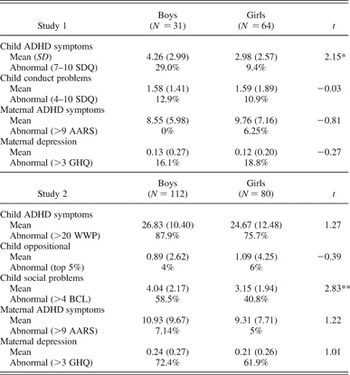
Table 1 displays levels of maternal and child symptoms within the sample. Boys had more ADHD symptoms than girls. Levels of maternal depressive symptoms (low mood) were high but in line with other studies using nonclinical samples (Kringlen, Torgersen, & Cramer, Reference Kringlen, Torgesen and Cramer2001). Also, maternal ADHD symptoms were high and reflecting the fact that part of the sample was selected to include mothers with high ADHD symptoms. Maternal ADHD symptoms were correlated with child ADHD (r = .33, p < .01) and maternal depressive symptoms (r = .34, p < .01). Child ADHD symptoms were correlated with child emotional (r = .27, p < .01) and conduct problems (r = .55, p < .01).
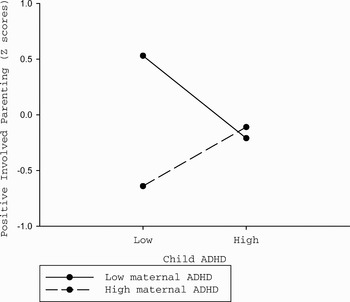
The interaction of the effects of child and maternal attention-deficit/hyperactivity disorder (ADHD) symptoms on the Positive Involved Parenting factor (Study 1). This figure was plotted using the regression techniques described by Aiken and West (Reference Aiken and West1991). High and low scores for ADHD represent centered scores 1 SD above and below the mean, respectively.

Scores and proportion of participants meeting standard cutoffs for the presence of adjustment problems broken down by child gender

Note: ADHD, attention-deficit/hyperactivity disorder; SDQ, Strengths and Difficulties Questionnaire; AARS, Adult ADHD Rating Scale; GHQ, General Health Questionnaire; WWP, Werry–Weiss–Peters Hyperactivity Scale; BCL, Behavior Checklist. Values are means (standard deviations).*p < .05. **p < .01.
Associations among parenting practices
In general, intercorrelations between APQ elements were small. Positive parenting correlated with involvement (r = .47, p < .01) and poor monitoring correlated with inconsistent discipline (r = .27, p < .01) and physical punishment (r = .23, p < .01).
To simplify the presentation of the analysis of the associations between ADHD symptoms and parenting the APQ scale scores were submitted to principal components analysis (PCA) with factors rotated to a varimax solution (i.e., orthogonal factors). Two factors with eigenvalues >1 were extracted and together accounted for 60% of the variance. We created orthogonal weighted factor scores using weights derived from the item loadings from PCA. Positive parenting (item loading = .86) and involvement (.85) loaded on the first factor (Positive Involved Parenting [PIP]). Poor monitoring (.74), physical punishment (.66), and inconsistent discipline (.68) loaded on the second factor (Negative Parenting [NP]). There were significant correlations between NP and child symptoms. NP correlated with child ADHD symptoms (r = .34, p < .01), child conduct problems (r = .55, p < .01), and child emotional symptoms (r = .33, p < .01). There was also a significant correlation between maternal ADHD symptoms and NP (r = .27, p < .05). No other correlations reached significance.
The contribution of child and maternal ADHD symptoms in predicting parenting
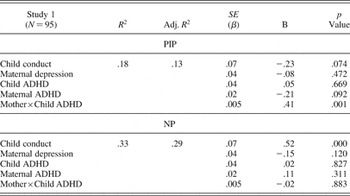
Hierarchical multiple regressions were used to examine the independent contribution of maternal and child ADHD symptoms, and their interaction, on PIP and NP. The interaction term was the product of the multiplication of the centered values for maternal and child ADHD symptoms. To control for potential confounding factors, child conduct problems (Step 1) and maternal depressive symptoms (Step 2) were also entered into the model. Child and maternal ADHD symptoms were entered in Step 3 and the interaction term in Step 4.
For PIP, the adjusted R 2 values at each step were Step 1, .008, F (1, 90) = 1.73, ns; Step 2, .03, F (2, 89) = 2.44, ns; and Step 3, .01, F (4, 87) = 1.26, ns. In Step 4, the adjusted R 2 was .13 and the overall model was significant, F (5, 86) = 3.73, p < .005. The final model (Step 4) revealed a significant interaction between child and maternal ADHD symptoms and PIP (Table 2). The interaction between child and maternal ADHD symptoms was probed using the procedures proposed by Aiken and West (Reference Aiken and West1991). Figure 1 plots this interaction using the regression procedures of Aiken and West (Reference Aiken and West1991, pp. 12–14) with values for high and low ADHD that are 1 SD above and below the means, respectively. The figure shows that when maternal ADHD was high elevated child ADHD symptoms were associated with higher levels of PIP, but when it was low, levels of PIP were lower. A simple slope analysis demonstrated that the positive slope for the regression of PIP onto child ADHD symptoms was significantly different from 0 when maternal ADHD symptoms were high (β = .28, p < .05) but not when it was low (β = −.16, ns).
Hierarchical multiple regression analyses of Study 1

Note: ADHD, attention-deficit/hyperactivity disorder; PIP, positive involved parenting; NP, negative parenting. The analyses show the independent association of maternal and child ADHD (and the interaction) on PIP and NP after controlling for comorbid problems.
For NP, the adjusted R 2 values at each step were Step 1, .30, F (1, 90) = 39.13, p < .001; Step 2, .30, F (2, 89) = 20.64, p < .001; Step 3, .30, F (4, 87) = 10.55, p < .001. In Step 4, the adjusted R 2 was .29 and the overall model was significant F (5, 86) = 8.35, p < .001. The final model (Step 4) revealed a significant and positive association between child conduct problems and NP (Table 2). No other associations were significant.
Discussion
The results of Study 1 supported the similarity-fit hypothesis over the similarity-misfit hypothesis. The interaction between child and parent ADHD symptoms on levels of PIP suggested that parental ADHD symptom status altered the association between child ADHD symptoms and PIP. However, there was no evidence that mother's ADHD symptoms exacerbated the risk of negative parenting usually associated with child ADHD symptoms. Indeed, child ADHD symptoms had a negative effect on levels of PIP in the low ADHD mothers (as would be expected). However, high maternal ADHD symptoms appeared to ameliorate the effects of high levels of child ADHD symptoms on parenting. In particular, high ADHD mothers with high ADHD children average Z scores on PIP were 0 (i.e., average), meaning that the maternal–child similarity attenuated the deleterious impact of offspring ADHD but only up to a point. However, the specificity of this interaction was not hypothesized and the study provided no support for significant interactions between child and maternal ADHD symptoms in predicting negative parenting.
Study 2
In response to the positive findings from Study 1, Study 2 extended the test of the similarity-fit hypothesis in relation to parent and child ADHD symptoms into the realms of direct observation of mother–child interaction and EE. More specifically we predicted, based on the findings of Study 1, that the association between child ADHD symptoms and less positive parenting would be ameliorated when mothers also had high levels of ADHD symptoms: high levels of child ADHD symptoms would be associated with less positive parenting when mothers had low levels of ADHD symptoms but with more positive parenting when mothers had high levels of ADHD symptoms.
The sample for this study was a relatively large group of preschool children with a broad range of ADHD symptoms. There is growing evidence that ADHD in preschool is comparable to that displayed during the school period. Studies (Fantuzzo et al., Reference Fantuzzo, Grim, Mordell, McDermott, Miller and Coolahan2001; Sonuga-Barke, Thompson, Stevenson, & Viney, Reference Sonuga-Barke, Thompson, Stevenson and Viney1997) using large community samples found that symptoms of inattentiveness, hyperactivity, and impulsivity cluster in preschool age children in the same way as is found in school children. Wilens et al. (Reference Wilens, Biederman, Brown, Tanguay, Monuteaux and Blake2002) found that preschool children had similar rates of comorbid psychopathology compared to school-age youths with ADHD, and both groups had substantial impairment in school, social, and overall functioning.
Method
Participants
In total, 192 mother–child dyads (112 males, 80 females) were included in the study. These were drawn from two sources. Group 1 consisted of 157 children who met criteria for high levels of ADHD as rated by their mothers and who entered one of two trials of parent training (Sonuga-Barke, Daley, Thompson, Laver-Bradbury, & Weeks, Reference Sonuga-Barke, Daley, Thompson, Laver-Bradbury and Weeks2001; Sonuga-Barke, Thompson, Daley, & Laver-Bradbury, Reference Sonuga-Barke, Thompson, Daley and Laver-Bradbury2004). There was a three stage screening process. Children entered the trial if they scored (a) 20 or more (above the 84th percentile) on the Werry–Weiss–Peters Hyperactivity Scale (WWP; Routh, Reference Routh1978) or (b) 18 or more (above the 96th percentile) on a preschool version of the Parental Account of Childhood Symptoms (PACS; Taylor, Sandberg, Thorley, & Giles, Reference Taylor, Sandberg, Thorley and Giles1991). The PACS is a structured clinical interview in which parents describe their children's ADHD symptoms and oppositional/defiance displayed over the previous 6 months across a range of situations (home, shops, play group, etc.); and (c) their parents reported significant impairment. Seven children from the trial were excluded from the current analysis because of missing data on the parenting measures.
The second group was newly recruited for the study and included 42 3-year-old child–mother dyads. Children were attending local preschool facilities and were only selected if they scored below the WWP cutoff. This was a convenience sample that was added to the clinical sample to increase the range of ADHD symptom scores within the study and increase the power of the analysis. The sample was 98% British White. For the first group, 22% was employed in managerial or professional occupations, 37% in manual occupations, and 41% in semiskilled and skilled occupations. For the second group, 38% was employed in professional or managerial occupations, 33% in manual occupations, and 29% was unemployed.
Measures
Symptoms of maternal ADHD and depression were measured as in Study 1.
Child ADHD symptoms
Child's ADHD symptoms were measured with the WWP (Routh, Reference Routh1978). The WWP is a 27-item parent rated scale that provides a single overall rating of hyperactivity symptoms displayed by hyperactive children in multiple settings such as at home or while shopping. Scores from the 27 items are combined to produce an overall rating.
Child oppositional symptoms
The measure of child oppositional behavior was recorded during an episode of mother–child interaction (Daley et al., Reference Daley, Sonuga-Barke and Thompson2003). Mothers were asked to play with their child for 10 min with a toy (The “Fun Park”), which included different activity zones (i.e., roller coaster, Ferries wheel, etc.). The code for oppositional behavior included any challenging behavior exhibited by the child that occurred during this interaction. This included both physical and verbal forms of defiance, noncompliance, aggression, taunting, and screaming. It could be independent or in response to an action by the mother.
In addition, the child's social problems were measured with the Behavior Checklist (Richman, Stevenson, & Graham, Reference Richman, Stevenson and Graham1982; Sonuga-Barke et al., Reference Sonuga-Barke, Thompson, Stevenson and Viney1997). The Behavior Checklist contains 19 items measuring social, sleep and feeding problems, emotional symptoms, overactive/inattentive behavior, and soiling/wetting. It has satisfactory reliability and predictive validity (Sonuga-Barke et al., Reference Sonuga-Barke, Thompson, Stevenson and Viney1997). Cutoff scores of 4 identify children with social problems (i.e., over 1 SD above the mean in a normal population sample; Sonuga-Barke et al., Reference Sonuga-Barke, Thompson, Stevenson and Viney1997).
Quality of mother's interaction with child
The quality of mother's interaction with their child was derived from the direct observation of mother–child interaction described above (Daley et al., Reference Daley, Sonuga-Barke and Thompson2003). The observational coding scheme was drawn from Daley et al. (Reference Daley, Sonuga-Barke and Thompson2003) with behavioral categories selected because previous studies suggest that parents of children with ADHD use more control, more negative statements, less praise, and play with their child for less time than parents of control children (Mash & Johnston, Reference Mash and Johnston1983). There were five categories.
1 Overcontrol: any command given to the child in a negative tone of voice. The mother attempts to inappropriately control the direction of play or the actions of the child.
2 Criticism: a comment that is critical of the child or something the child had done.
3 Expansion: a question or comment that expands on play. The mother introduces something new that is not present in the play. This does not include switching to a part of toy that has not been used before.
4 Affection: episodes of physical affection such as cuddles, play fighting, tactile displays of affection, or verbal episodes such as joint laughter. Tone of voice is very important and it must be positive.
5 Separate play: mother and child play simultaneously but separately. For example, mother and child play with different parts of the toy. This includes coding any maternal switch that is not followed by the child.
The frequency of expansion, affection, praise, and overcontrol and the duration of separate play were observed during the 10 min of continuous recording of free play with a standard toy (Fisher Price Fun Park). These observations were coded using Observer event recording software (Noldus Information Technology, 1996). The coding scheme has good discriminant validity differentiating dyads with an ADHD from those with a non-ADHD child (Daley et al., Reference Daley, Sonuga-Barke and Thompson2003) and satisfactory interobserver reliability. We tested the interobserver reliability on 16% of the dyads (average reliability r = .92). For each behavioral category the interobserver reliability was high: overcontrol (r = .98), criticism (r = .86), expansion (r = .90), affection (r = .91), separate play (r = .92), and child oppositional behavior (r = .92).
Maternal EE
The Preschool Five Minute Speech Sample (Daley et al., Reference Daley, Sonuga-Barke and Thompson2003) is a measure of EE for preschool children. It generates three global scores: initial statement, relationship, and warmth (each scored high, neutral, or negative and high scores are more negative). It also has frequency counts of positive and negative comments. A set of standardized instructions ask parents to speak for 5 min about their child, giving the experimenter details about the child's characteristics and their relationship with the child. We examined the interrater reliability for EE using 16% of the data. Overall, the reliability was satisfactory (i.e., average r > .83). For each component, the interrater reliability was high: initial statement (r = .86), relationship (r = .82), warmth (r = .79), negative comments (r = .77) and positive comments (r = .81). It also has good validity and discriminates between parents talking about their ADHD and non-ADHD children (Daley et al., Reference Daley, Sonuga-Barke and Thompson2003).
Procedure
Data was collected during home visits. For the group of children and mothers participating in the parenting trial this visit constituted the baseline pretreatment assessment. Packs of questionnaires were posted to the parents prior to, and collected at the time of, the visit. Mother–child pairs were observed at home usually in the morning or afternoon when older siblings were at school. Mothers were asked to play with their child for 10 min, as they would normally, using the toy. The interaction was videotaped for later coding.
Results
Descriptive statistics and associations between child and maternal symptoms of psychopathology
The proportion of children and mothers displaying problems in Study 2 was significantly higher than in Study 1 across all domains including child and maternal ADHD (Table 1). ADHD scores for boys were not significantly greater than girls. Maternal ADHD and depressive symptoms were correlated (r = .53, p < .01). Maternal depressive symptoms correlated with child ADHD symptoms (r = .25, p < .01) and child oppositional behavior (r = .19, p < .01).
Associations among components of parenting
For EE, initial statement, warmth, and relationship were correlated (r > .33, p < .01), negative comments were correlated with relationship (r = .28, p < .01) and positive comments were negatively correlated with warmth, relationship, and negative comments (r > −.26, p < .01). For mother–child interaction only expansion was positively correlated with affection (r = .33, p < .01). Finally, there were significant correlations between observed affection and EE negative relationship (r = −.24, p < .01), observed criticism and EE negative comments (r = .15, p < .05), and between observed affection and EE positive comments (r = .22, p < .01).
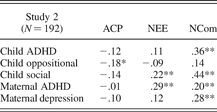
Parenting and EE measures were submitted to PCA using the same procedures as in Study 1. Three factors with eigenvalues >1 were extracted accounting for 50% of the variance. Initial statement (.74), warmth (.78), and relationship (.68) loaded on the first factor (Negative EE [NEE]). This factor was termed NEE because higher scores represent negative initial statement, negative relationship, and low warmth. Negative comments (.84) and lack of positive comments (−.74) loaded on the second factor (Negative Comments [NCom]). Expansion (.81), lack of criticism (−.39), affection (.70), and lack of separate play (−.33) loaded on the third factor (Affectionate and Constructive Parenting [ACP]). No other item to factor loading exceeded .3. Weighted factor scores were created on the basis of the factor loadings. Both parent and child ADHD symptoms were correlated with negative aspects of parenting (Table 3). Child ADHD symptoms were associated with more NCom and child oppositional behavior with less ACP. Maternal ADHD symptoms were associated with more NEE and more NCom and maternal depressive symptoms with more NCom. No other correlations were significant.
Correlations between factors and child and mother symptoms
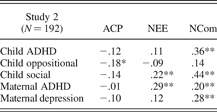
Note: ADHD, attention-deficit/hyperactivity disorder; ACP, affectionate and constructive parenting; NEE, negative expressed emotion; NCom, negative comments.
* p < .05.
** p < .01.
The contribution of child and maternal ADHD symptoms in predicting parenting
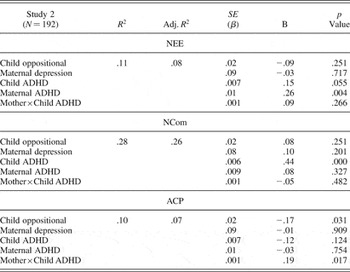
Hierarchical multiple regressions were again used to examine the independent contribution of child and maternal ADHD symptoms, and their interactive effects on ACP, NEE, and NCom (Table 4). The same stepwise regression model was employed but with child's oppositional behavior from the observed mother–child interaction used as the measure of conduct problems (Step 1).
Hierarchical multiple regression analyses of Study 2

Note: NEE, negative expressed emotion; NCom, negative comments; ACP, affectionate and constructive parenting. The analyses show the independent association of maternal and child ADHD (and the interaction) on NEE, NCom, and ACP after controlling for comorbid problems.
For NEE, the adjusted R 2 values at each step were Step 1, .003, F (1, 173) = 1.50, ns; Step 2, .02, F (2, 172) = 2.54, ns; and Step 3, .08, F (4, 170) = 4.70, p < .001. In the final Step the value was .08, F (5, 169) = 4.018, p < .01. There was a significant positive association between maternal ADHD symptoms and NEE and a marginally significant association between this factor and child ADHD symptoms (Table 4).
For NCom, the adjusted R 2 values at each step were Step 1, .01, F (1, 173) = 2.99, ns; Step 2, .06, F (2, 172) = 6.90, p < .01; and Step 3, .26, F (4, 170) = 16.05, p < .001. In the final step, the value was significant at .26, F (5, 169) = 12.91, p < .001. The only significant and positive association was between child ADHD symptoms and NCom.
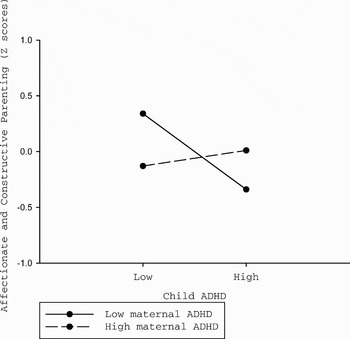
For ACP, the adjusted R 2 values at each step were Step 1, .03, F (1, 173) = 5.83, p < .05; Step 2, .02, F (2, 172) = 3.11, p < .05; and Step 3, .04, F (4, 170) = 2.93, p < .05. In the final step, the value was significant at .07, F (5, 169) = 3.43, p < .01. There was a significant interaction between the effects of child and maternal ADHD symptoms on ACP (Table 4). The interaction pattern was replicated when the score from the child social problem scale of the BCL was entered as a covariate, β = .16; F (5, 159) = 2.70, p < .05.
The interaction between child and maternal ADHD symptoms was probed using the procedures proposed by Aiken and West (Reference Aiken and West1991). The interaction is plotted in Figure 2 using the same procedures as in Study 1. A simple slope analysis demonstrated that the negative slope for the regression of ACP onto child ADHD symptoms was significantly different from 0 when maternal ADHD was low (β = −.35, p < .01) but not when it was high (β = .08, ns).
The interaction of the effects of child and maternal attention-deficit/hyperactivity disorder (ADHD) symptoms on the Affectionate and Constructive Parenting factor (Study 2). This figure was plotted using the regression techniques described by Aiken and West (Reference Aiken and West1991). High and low scores for ADHD represent centered scores 1 SD above and below the mean, respectively.

Discussion
The primary aim of the studies reported was to examine the way that parent and child ADHD symptoms interacted in their effects on parenting. Two hypotheses were set against one another. The similarity-misfit hypothesis, that parental ADHD symptoms would exacerbate the negative effects of child ADHD symptoms by increasing parenting burden (Weinstein et al., Reference Weinstein, Apfel and Weinstein1998); and the similarity-fit hypothesis, that parental ADHD symptoms would ameliorate these effects because the parent and child share a similar behavioral style and tempo. Main effects of child and mother psychopathology were also investigated.
Independent main effects of maternal and child symptoms were found. Child conduct problems were related to negative parenting behaviors, negative parenting (Study 1), and lower levels of constructive parenting (Study 2). Child ADHD symptoms were associated only with more negative comments (Study 2) a finding in line with previous research linking ADHD and criticism (Baker, Heller, & Henker, Reference Baker, Heller and Henker2000; Peris & Hinshaw, Reference Peris and Hinshaw2003). Consistent with recent reports (Evans et al., Reference Evans, Vallano and Pelham1994; Harvey et al., Reference Harvey, Danforth, McKee, Ulaszek and Friedman2003; Murray & Johnston, Reference Murray and Johnston2006), parental ADHD symptoms was related to lower levels of positive parenting (Study 1) and more negative EE (Study 2). The unexpected lack of an effect of maternal low mood (Lovejoy et al., Reference Lovejoy, Graczyk, O'Hare and Neuman2000) may be related to the study sample (although levels of low mood were rather high in both samples) or the fact that in the current analyses, the effects of child characteristics were controlled for, whereas in previous studies, this was not always the case.
There was no evidence that maternal ADHD symptoms exacerbated the effects of child ADHD symptoms on negative parenting; the similarity-misfit hypothesis was not supported by the current data. In contrast, support was found for the similarity-fit hypothesis in both studies. The negative effect of child ADHD symptoms on parenting was significantly lower when mothers had high levels of ADHD symptoms. These effects related specifically to higher levels of positive parenting rather than lower levels of negative parenting.
This finding is consistent with the findings of a study by Biederman, Faraone, and Monuteaux (Reference Biederman, Faraone and Monuteaux2002), demonstrating that parental ADHD did not constitute an additional risk to the child with ADHD, but it had a detrimental impact on non-ADHD siblings. Persistent parental ADHD was associated with improvements for the ADHD child and worsening of behavior for the non-ADHD child in terms of a range of functional outcomes.
At present, one can only speculate about the mechanisms underpinning the similarity-fit phenomenon. First, children with ADHD might not provoke parents with high levels of ADHD symptoms to the same extent as they do low ADHD parents. When mother and child share a similar motivational and cognitive tempo they may enter into conflict less often. Second, parents with high levels of ADHD symptoms may be more tolerant of their children's challenging behavior. This could be because of an increased level of empathy for their child, which results from them having experienced similar challenges in their own childhood. If this were the case, they may find it easier to take their child's perspective and to understand how the child feels. Weiss (Reference Weiss2000) has observed that parents with ADHD are often unusually tolerant of ADHD symptoms in their children, and have a special understanding of what the child experiences. Third, there is a possibility that the results are an artifact of rating bias and that mothers with high levels of ADHD symptoms are simply less aware of the behavior of their children. This cannot be ruled out on the basis of the present results. Future research is needed to address these hypotheses directly. However, in the present study the effects were limited to positive aspects of parenting, and this may provide some initial support for the hypothesis that parent's show more empathy and understanding of their children, but that this does not necessarily lead to lower levels of conflict.
What is the impact of the similarity-fit phenomenon on the adjustment of children with ADHD symptoms in the longer term? A large body of evidence confirms that positive and constructive parenting can reduce the likelihood of the onset (Gardner et al., Reference Gardner, Sonuga-Barke and Sayal1999; Holden & Hawk, Reference Holden, Hawk and Kuczynski2002) and persistence of behavioral problems in at risk samples (Denham et al., Reference Denham, Workman, Cole, Weissbrod, Kendziora and Zahn-Waxler2000). Positive and proactive parenting is associated with better social skills and peer relationships (Davidov & Grusec, Reference Davidov and Grusec2006; Zhou et al., Reference Zhou, Eisenberg, Losoya, Fabes, Reiser and Guthrie2002), and lowered conduct problems, aggression, and delinquency (Galambos, Barker, & Almeida, Reference Galambos, Barker and Almeida2003; Gardner, Ward, Burton, & Wilson, Reference Gardner, Ward, Burton and Wilson2003; Pettit, Laird, Dodge, Bates, & Criss, Reference Pettit, Laird, Dodge, Bates and Criss2001; Stormshak, Bierman, Mahonand, & Lengua, Reference Stormshak, Bierman, Mahonand and Lengua2000). If these findings can be extended to the domain of children with ADHD then there is every reason to expect that the positive parenting by high ADHD mothers could have a positive developmental impact on their children with ADHD.
Conversely, parent training appears to be far less effective when mothers themselves had high levels of ADHD symptoms (Sonuga-Barke et al., Reference Sonuga-Barke, Daley and Thompson2002). It appeared that parents with ADHD symptoms had difficulty implementing the sort of structured and organized approach to parenting required for the management of ADHD. At first sight the current results seem to stand in contrast to this finding. However, these two sets of findings can be reconciled if it is recognized that the affectionate and positive parenting displayed by high-scoring ADHD mothers toward their children with high ADHD symptoms is independent of the other qualities required for the effective management of challenging children. Indeed, it is possible that an overly affectionate empathic approach to the child with ADHD displayed by their mother may represent a barrier to effective and consistent discipline and the imposition of clear boundaries.
The present study had a number of limitations. First, although evidence of interactions between parental and child ADHD symptoms was found in both studies in relation to positive parenting, other areas of parenting did not show such effects, and the specificity of the effect was not predicted. Second, lack of a genetic design meant that gene–environment correlations between parenting and child behavior could not be examined. This leaves open the possibility that the effects shown were because of genes shared in common by the mother and child but expressed in different forms. Third, reports of ADHD symptoms (child and mother) were all based on maternal self-reports. Fourth, neither sample included parents with a clinical diagnosis of ADHD, so that the range of severity of symptoms was narrower for mothers than for children. Given the possibility that the interaction between parental and child ADHD may differ as a function of symptom severity, it will be important for future studies to include a higher proportion of more severe cases of maternal ADHD. Fifth, the parenting of fathers was not examined despite evidence suggesting an association between paternal factors and child and adolescent adjustment (Connell & Goodman, Reference Connell and Goodman2002; Phares & Compas, Reference Phares and Compas1992).
Conclusion
In summary, despite these limitations, the current studies provide replicated evidence of a new phenomenon, similarity-fit, whereby parent and child characteristics, in this case, ADHD symptoms, act together to create a more positive parenting context than would not be expected on the basis of the characteristics of either the parent or child alone. Given their novelty and somewhat unexpected nature, these findings need to be replicated and the potential mechanisms responsible explored.