Introduction
Rapid population ageing is resulting in a growing need to assist individuals to enjoy a healthy old age that is characterised by high levels of physical health and functionality, positive mental health and the ability to contribute to society (World Health Organization (WHO), 2015). Part of this process is the identification and promotion of protective healthy lifestyle behaviours that reduce the risk of disease and enhance quality of life. Particularly important lifestyle behaviours are those that involve physical exertion, mental activity and social interaction due to the role of such activities in sustaining and improving health and wellbeing (Holt-Lunstad et al., Reference Holt-Lunstad, Smith and Layton2010; Hupin et al., Reference Hupin, Roche, Gremeaux, Chatard, Oriol, Gaspoz, Barthélémy and Edouard2015; Bouaziz et al., Reference Bouaziz, Vogel, Schmitt, Kaltenbach, Geny and Lang2017; Lee et al., Reference Lee, Chi and Palinkas2018).
Several specific categories of activities are recognised as being especially relevant for healthy ageing interventions due to their compatibility with older people's interests and abilities. These include walking, gardening and volunteering (Jenkinson et al., Reference Jenkinson, Dickens, Jones, Thompson-Coon, Taylor, Rogers, Bambra, Lang and Richards2013; Hanson and Jones, Reference Hanson and Jones2015; Husk et al., Reference Husk, Lovell and Garside2018). In terms of walking, even small increases among sedentary older adults can have meaningful health benefits (Diehr and Hirsch, Reference Diehr and Hirsch2010), resulting in many later-life physical activity interventions aiming to increase walking levels (Zubala et al., Reference Zubala, MacGillivray, Frost, Kroll, Skelton, Gavine, Gray, Toma and Morris2017). Gardening represents a form of physical activity that is typically low to moderate in intensity (Nicklett et al., Reference Nicklett, Anderson and Yen2016), but with demonstrated benefits across both physical and mental health domains (Soga et al., Reference Soga, Gaston and Yamaura2017). Encouraging gardening has been identified as an effective intervention approach for addressing and accommodating various age-related problems including decreased mobility, social isolation and cognitive decline (Wang and McMillan, Reference Wang and MacMillan2013; Robson and Troutman-Jordan, Reference Robson and Troutman-Jordan2015; Scott et al., Reference Scott, Masser and Pachana2015). Volunteering among older people has been associated with a wide range of physical, psychological and social benefits (Kahana et al., Reference Kahana, Bhatta, Lovegreen, Kahana and Midlarsky2013; Anderson et al., Reference Anderson, Damianakis, Kröger, Wagner, Dawson, Binns, Bernstein, Caspi and Cook2014; Kim and Konrath, Reference Kim and Konrath2016), and additionally constitutes a contribution to economic activity that has important benefits for society as a whole (WHO, 2015).
To a lesser extent, moderate-to-vigorous forms of physical activity are also recognised as being beneficial (Kim et al., Reference Kim, Park, Kim and Fontes-Comber2020), with a dose–response relationship appearing to exist between exercise intensity and health benefits for older people (McPhee et al., Reference McPhee, French, Jackson, Nazroo, Pendleton and Degens2016). In addition to enhancing physical health, replacing sedentary time with moderate to vigorous physical activity has been found to produce improvements in older people's cognitive performance (Fanning et al., Reference Fanning, Porter, Awick, Ehlers, Roberts, Cooke, Burzynska, Voss, Kramer and McAuley2017). However, developing interventions to encourage greater physical activity is complicated by the need to consider a potential increased risk of falls and other injuries resulting from individuals being ill-prepared for this level of exertion due to prior sedentary lifestyles (Bauman et al., Reference Bauman, Merom, Bull, Buchner and Fiatarone Singh2016; McPhee et al., Reference McPhee, French, Jackson, Nazroo, Pendleton and Degens2016).
The WHO (2017) notes the need for research that focuses on older people's current situations and preferences to inform future methods of facilitating healthy ageing. Previous research examining older people's participation in activities such as walking, sport and gardening has found male gender, younger age and higher levels of functional health to be associated with greater participation (Lim and Taylor, Reference Lim and Taylor2005; Haley and Andel, Reference Haley and Andel2010; Avital, Reference Avital2017). By comparison, volunteering prevalence among older people is typically higher among females, younger seniors, and those with higher levels of income and education (Choi et al., Reference Choi, Burr, Mutchler and Caro2007; Principi et al., Reference Principi, Chiatti, Lamura and Frerichs2012). The identification of the characteristics of those older people who are most likely to engage in these activities is useful to assist in prioritising sub-populations of seniors who could benefit from interventions designed to encourage greater participation, however, this approach is limited by a reliance on prevalence data from individual lifestyle behaviours. An alternative approach is to delineate clusters of older people according to their patterns of participation across these behaviours to identify groups that could benefit most from initiatives to enhance participation due to current low enactment levels across a range of potentially beneficial activities.
The aim of the present study was to undertake a segmentation analysis using a latent profile approach that enabled relevant clusters to emerge based on participation in key activity-based healthy lifestyle behaviours. The results provide insight into the likely socio-demographic and modifiable factors influencing participation and suggest potential areas of leverage to increase overall activity levels among those who could benefit most.
Methods
Study participants
This study was part of a larger research project on the topic of healthy ageing (Jongenelis et al., Reference Jongenelis, Dana, Warburton, Newton, Talati and Pettigrew2020; Pettigrew et al., Reference Pettigrew, Jongenelis, Newton, Warburton and Jackson2015, Reference Pettigrew, Jongenelis, Jackson, Warburton and Newton2020). Various strategies were used to recruit a diverse sample of Western Australian seniors, including placing notices in community newspapers, seniors’ publications, and the offices of relevant government and non-government institutions; distributing flyers at seniors’ events and retirement villages; and announcements on a community radio station. The resulting sample comprised 746 retired Australians aged between 60 and 95 years. The average age was 71.66 years (national average 71.31 years) and 61 per cent of the sample were female (national figure 53%; Australian Bureau of Statistics, 2019).
Survey instrument
Respondents could choose whether to access the survey online or via paper copies posted out in the mail. The survey instrument incorporated items related to socio-demographic, psycho-social, physical activity and volunteering variables. The measures used to assess these variables are outlined below.
Socio-demographic variables
The assessed socio-demographic variables were age, gender (1 = male, 2 = female), living arrangements (1 = live alone, 2 = live with spouse/partner, 3 = live with other family, 4 = other) and education level (1 = no formal school/primary school to 5 = postgraduate qualifications). For analysis purposes, living arrangements and education were dummy coded to lives alone/does not live alone and no tertiary education/tertiary qualifications, respectively.
Psycho-social variables
Quality of life was assessed using a single item asking respondents to rate their overall quality of life (Hyland and Sodergren, Reference Hyland and Sodergren1996). The Personal Growth and Purpose in Life subscales of Ryff's (Reference Ryff1989) Psychological Well-being Scale (14 items each) were used to measure personal growth and purpose in life, respectively. Depression was measured using the 20-item Center for Epidemiology Studies Depression Scale (Radloff, Reference Radloff1977). Psychological wellbeing was assessed on the 14-item Warwick-Edinburgh Mental Well-being Scale (Tennant et al., Reference Tennant, Hiller, Fishwick, Platt, Joseph, Weich, Parkinson, Secker and Stewart-Brown2007). The ten-item Generalized Self-efficacy Scale (Schwarzer and Jerusalem, Reference Schwarzer and Jerusalem1995) and the ten-item Rosenberg Self-esteem Scale (Rosenberg, Reference Rosenberg1989) were used to measure self-efficacy and self-esteem, respectively. The 24-item Social Provision Scale was used to assess social support (Cutrona and Russell, Reference Cutrona and Russell1987).
Physical health
A single item – ‘How would you describe your physical health’ – was used to assess self-rated health on a scale ranging from 1 (very good) to 5 (very bad) (Idler and Benyamini, Reference Idler and Benyamini1997). Responses were reverse coded for analysis purposes.
Physical activity
Respondents were asked ‘Over the past month, how often did you…’, with listed activities including ‘Take walks’, ‘Engage in active sports or exercise’ and ‘Work in your garden or yard’. An additional ‘Other’ option was also provided. Each activity was assessed on a scale of 1 (never) to 8 (more than once a day) (adapted from items used in the American Changing Lives Study; House, Reference House2018).
Volunteering
Respondents reported whether they had engaged in formal volunteer work in the 12 months prior to data collection (1 = yes, 2 = no). Formal volunteering was defined in the survey as ‘work activities that are unpaid, non-compulsory, and unrelated to family obligations’ (as per Cnaan et al., Reference Cnaan, Handy and Wadsworth1996). Those who volunteered were further asked how often they engaged in volunteering, with response options ranging from 1 (daily) to 6 (less than once a month) (reverse coded for analysis purposes). These two items were then combined to form a frequency of volunteering variable, with responses ranging from 1 (never) to 7 (daily). Information about attitude to volunteering was obtained using a ten-item volunteering attitudes scale (Jongenelis et al., Reference Jongenelis, Dana, Warburton, Newton, Talati and Pettigrew2020).
Data analysis
Latent profile analysis was performed using four continuous indicator variables assessing the frequency of engagement in the activities of walking, gardening, active sports/exercise and formal volunteering. This analysis method can accommodate varying scale lengths and types (Hagenaars and McCutcheon, Reference Hagenaars and McCutcheon2002; Magidson and Vermunt, Reference Magidson and Vermunt2002), and it was therefore not necessary to standardise participation frequencies across the indicator variables. Two- to seven-class models were computed, with the best fitting model selected based on Akaike Information Criteria (AIC), Bayesian Information Criteria (BIC), Sample-size Adjusted BIC (SABIC) and entropy values. The most appropriate solution for the data is one with the lowest AIC, BIC and SABIC values, and a higher entropy value (Akaike, Reference Akaike1974; Nylund et al., Reference Nylund, Asparouhov and Muthén2007). Individuals were assigned to a latent class based on the highest posterior probabilities.
Following identification of the most appropriate solution, one-way analysis of variance (for continuous predictor variables) or chi-square tests (for categorical predictor variables) were conducted to examine differences between the identified latent classes. The variables that emerged as significantly predicting class membership were used to describe the characteristics of each class. All analyses were performed using Stata version 15.1 (StataCorp, College Station, TX).
Results
Descriptive results
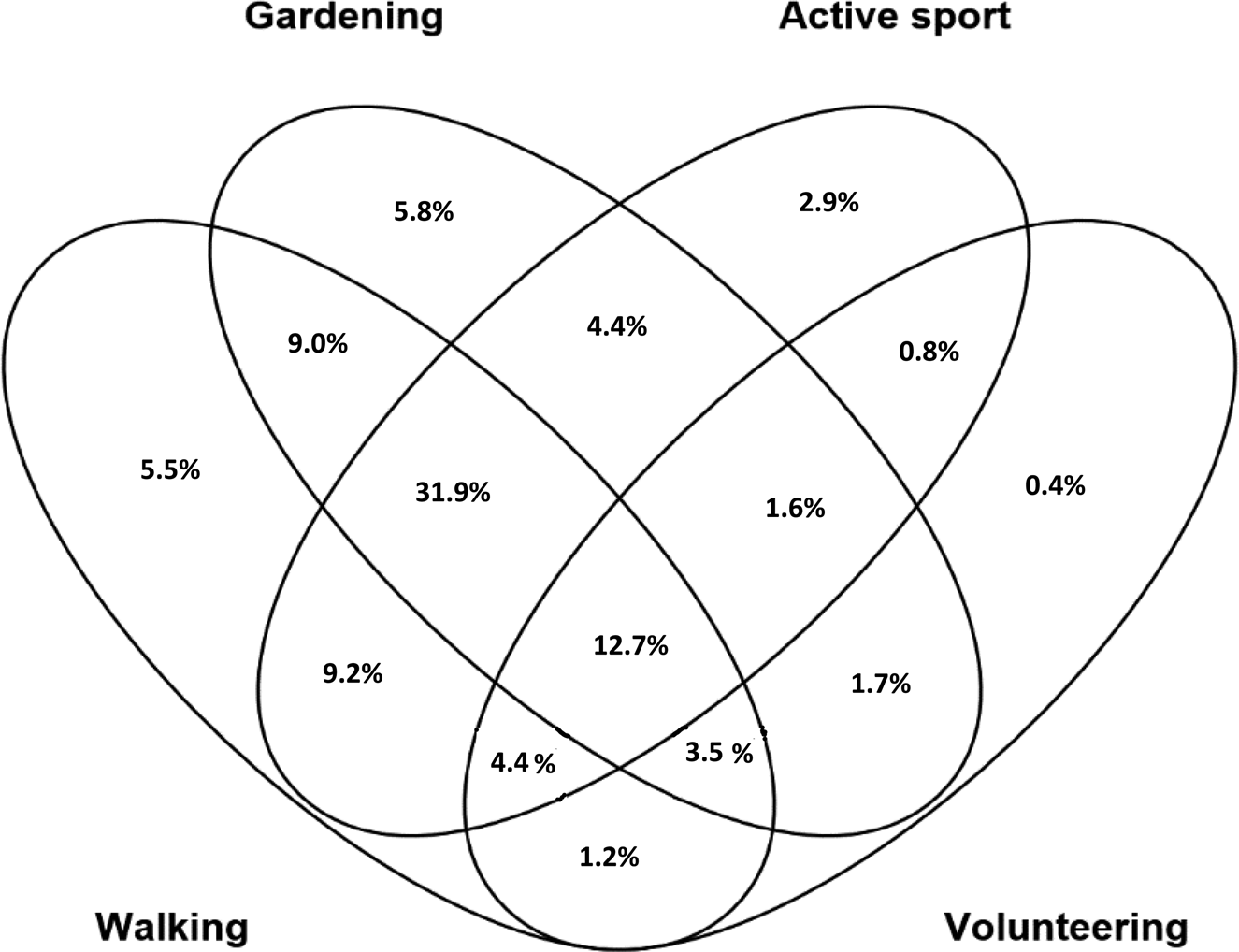
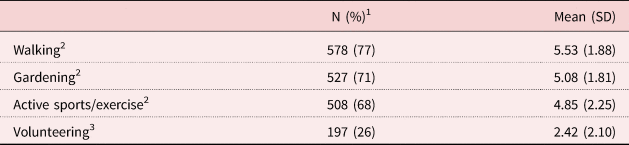
Of the activities assessed, walking was the most frequently enacted across the sample, with around three-quarters (77%) of respondents reporting engaging in walking as a form of physical activity at least once per week (see Table 1). Gardening was the second most popular pastime (71% at least once per week), followed by active sports/exercise (68%). The least frequently reported activity was volunteering; around one-quarter (26%) of respondents reported that they engaged in this activity at least once a week. The extent of overlap in activity participation is depicted in Figure 1.
Distribution of activity participation.
Note: Percentages do not add to 100 because 4.6 per cent of participants (N = 36) did not do any of the four activities.

Descriptive statistics for the indicator variables

Notes: N = 749. SD: standard deviation. 1. Proportion of respondents who reported engaging in the activity at least once per week. 2. Assessed on an eight-point scale of 1 (never) to 8 (more than once a day). 3. Assessed on a seven-point scale of 1 (never) to 7 (daily).
Statistical indices
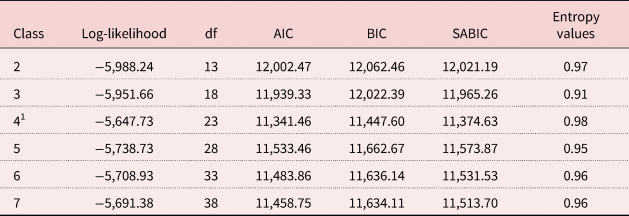
The best fitting model was the four-class model. This model had the lowest AIC, BIC and SABIC values, and the highest entropy value (see Table 2). In addition to superior statistical fit, the four-class model was deemed most appropriate due to the following outcomes: (a) a different pattern of means of the indicator variables emerged compared to models with fewer classes; (b) the five-class model was not substantively different other than splitting one of the classes into two groups; and (c) ease of interpretation and parsimony were greater for the four-class model relative to models with a larger number of classes. The highest entropy value of 0.98 for the four-class model indicates that 98 per cent of respondents were correctly allocated to an appropriate class. This entropy value exceeds 0.80, suggesting the presence of high between-class variation (Clark and Muthen, Reference Clark and Muthen2009; Kamata et al., Reference Kamata, Kara, Patarapichayatham and Lan2018). The average posterior probabilities of the latent classes in this model ranged from 0.90 to 1.00, indicating very good classification precision and well-separated classes (as per the >0.70 rule-of-thumb; Nagin, Reference Nagin2005).
Statistical indices of the two- to seven-class models

Notes: 1. Best fitting model. df: degree of freedom. AIC: Akaike Information Criteria. BIC: Bayesian Information Criteria. SABIC: Sample-size Adjusted Bayesian Information Criteria.
Latent profile results
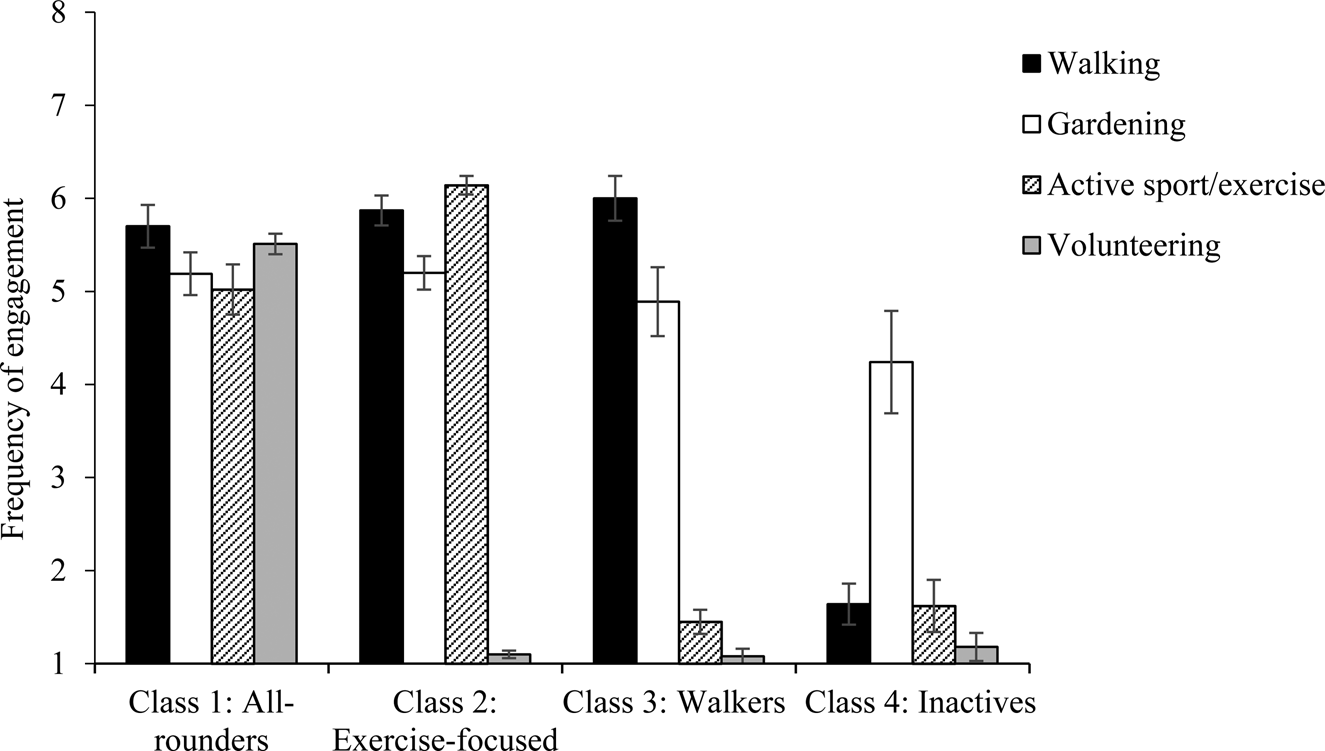
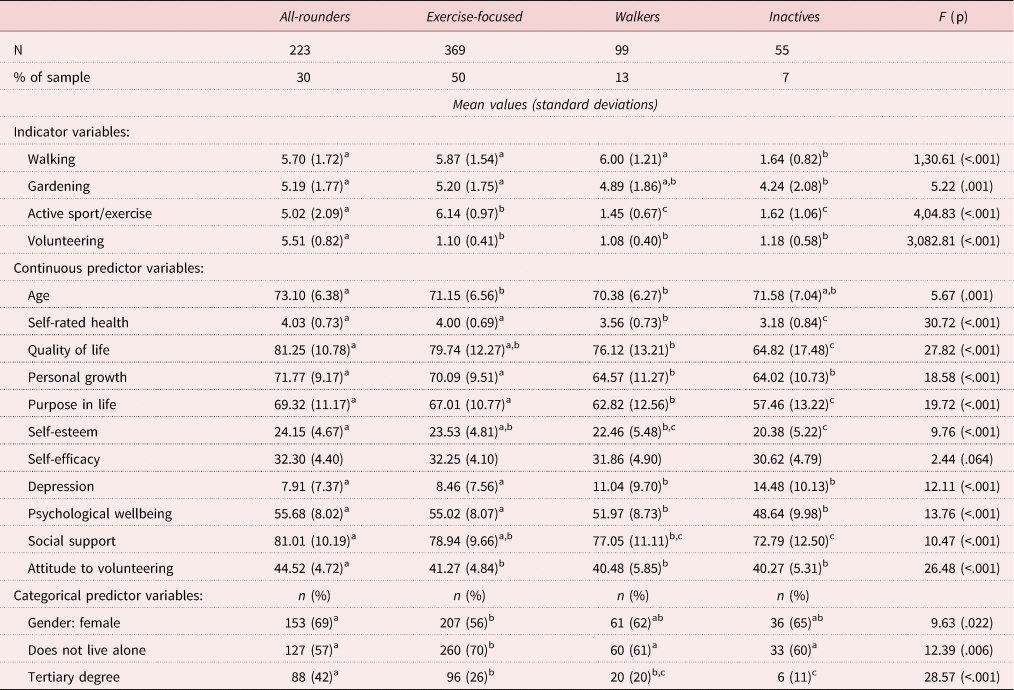
Clear classes based on activity patterns emerged from the data. One group was active across all four behavioural domains and one across three domains, with the other two classes exhibiting more varied outcomes. The differences between the groups are detailed in Table 3 and the corresponding profile plot is illustrated in Figure 2.
Activity distribution patterns for the four-class model with 95 per cent confidence intervals.

Indicator and predictor variable results for the four-class model

Notes: N = 749. 1. χ2 for categorical predictor variables.
Significance levels: Superscript letters denote significant differences between classes at p < 0.05: values sharing superscript letters are not significantly different from each other, while values with different superscript letters are significantly different from each other.
Class 1 accounted for 30 per cent of the sample and was characterised by individuals who demonstrated at least moderate levels of engagement in all four forms of activity assessed in the study. The particular point of difference relative to all other classes was volunteering, with Class 1 being the only group to feature high average levels of participation. Average participation rates were ‘2–3 times per week’ for walking, ‘more than once per week’ for volunteering, and ‘weekly’ for gardening and active sport/exercise. Reflecting this overall pattern of participation, this class was titled the all-rounders.
Class 2 was the largest group, accounting for 50 per cent of the sample. Compared to the other three groups, this class was distinguished by significantly higher reported levels of active sport/exercise (‘2–3 times per week’). Levels of walking (‘2–3 times per week’) and gardening (‘weekly’) were also high relative to most other groups, resulting in the group being titled exercise-focused.
Class 3 represented 13 per cent of the sample and constituted a group with regular walking (‘2–3 times per week’) and semi-regular gardening (‘weekly’) behaviours, but very low levels of active sport/exercise and volunteering (both ‘never’). This class was titled the walkers.
Class 4 was the smallest group, comprising just 7 per cent of the sample. Members of this group reported significantly lower levels of walking (‘less than monthly’) compared to those allocated to the other three groups, and also tended to have low levels of gardening (‘2–3 times a month’), active sport/exercise (‘less than monthly’) and volunteering (‘never’). This group was titled the inactives.
Group member characteristics
The bivariate analyses assessed the distinguishing features of each class to identify factors associated with the varying patterns of activity (see Table 3). Members of the all-rounders group were differentially characterised by holding a more positive attitude to volunteering and reporting higher levels of education. They were also more likely to be older than respondents allocated to most other classes. Across all the health and wellbeing variables included in the analysis, the all-rounders exhibited the most favourable outcomes, especially in comparison to the walkers and inactives groups.
The class profile for the exercise-focused group was very similar to that of the all-rounders, with notable exceptions being a less-favourable attitude to volunteering and a greater likelihood of being younger, male and without a tertiary qualification. Members of this class were significantly less likely to live alone than all three other classes. There were no characteristics that differentially predicted allocation to the walkers group, and members of this group provided mid-range scores for most health and wellbeing outcomes. The inactives group was demographically similar to the other groups, but had the poorest health and wellbeing outcomes, especially for self-rated health, quality of life and purpose in life.
Discussion
The results of the present study provide insights into the ways in which various activities that are important for the health and wellbeing of older people cluster within and between different sub-groups of seniors. Of note is that on average those in the group with the highest levels of overall activity (the all-rounders) tended to be older than many other sample members, which may indicate that advancing age per se may not be a primary determinant of low levels of participation. Importantly, the profile of the least active group (the inactives) did not differ significantly from the more active groups on the socio-demographic variables of age, gender and living status. Instead, self-rated health and various psychological wellbeing indicators appear to represent factors that may be contributing to and/or resulting from overall low levels of participation among members of this group. These attributes may therefore constitute important indicators of those who could benefit most from interventions designed to reduce barriers and increase motivation to participate in activities that can provide a wide range of health and wellbeing outcomes.
Self-rated health is not always a good indicator of objective health, especially among older people (Leinonen et al., Reference Leinonen, Heikkinen and Jylhä2001). As such, while poor health is likely to account for a substantial proportion of inactivity, there is likely to be the potential to improve participation in health-promoting activities by enhancing individuals’ perceptions of their health status (Ruuskanen and Ruoppila, Reference Ruuskanen and Ruoppila1995; Bunda and Busseri, Reference Bunda and Busseri2019). This can be potentially achieved by increasing ‘health optimism’, which is in turn reliant on psychological wellbeing and quality of life (Rai et al., Reference Rai, Jongenelis, Pettigrew, Jackson and Newton2019). However, the inactives group exhibited low scores across these variables, highlighting the challenges associated with encouraging higher participation levels among members of this group.
While a relatively small segment (7% of the total sample), when extrapolated to the broader population of seniors the inactives group represents a substantial number of people who are likely to require personalised assistance to achieve higher levels of activity. Such assistance may need to be provided by health professionals capable of (a) assessing both physical and mental health status and (b) providing guidance on suitable activities and appropriate ways of commencing participation to avoid injury. This approach would ensure that individuals with physical health problems that limit their ability to participate in many mainstream physical activity options receive the assistance they need to identify and utilise available alternatives (e.g. via accessing exercise physiologists).
The higher participation in gardening among members of the inactives group relative to the other assessed behaviours indicates that this may constitute an entry point for encouraging other forms of activity. Gardening is associated with positive physical and mental health outcomes (Lee et al., Reference Lee, Lan and Lee2012; Park et al., Reference Park, Lee, Son, Lee and Kim2016; Soga et al., Reference Soga, Gaston and Yamaura2017), but is also often motivated by an intrinsic desire for contact with nature (Wang and Glicksman, Reference Wang and Glicksman2013; Scott et al., Reference Scott, Masser and Pachana2015). There may be the potential to leverage this desire by facilitating access to walking groups and volunteering positions that have a nature focus to encourage higher levels of physical activity among those who would otherwise be sedentary and to provide pathways to greater social interaction and enhanced purpose in life. However, an important consideration is that absolute levels of gardening were still quite low among members of this group (‘2–3 times per month’), indicating substantial opportunity to increase participation to enable inactive older people to access greater health and wellbeing benefits. Relevant strategies are likely to include providing individuals with information about benefits associated with gardening and ensuring that housing and neighbourhood design are conducive to participation (Burton et al., Reference Burton, Mitchell and Stride2015).
Given the potential for volunteering to provide physical, psychological and social stimulation and to provide economic benefits to society as a whole (Anderson et al., Reference Anderson, Damianakis, Kröger, Wagner, Dawson, Binns, Bernstein, Caspi and Cook2014; Pettigrew et al., Reference Pettigrew, Jongenelis, Newton, Warburton and Jackson2015), the low overall levels of participation in this activity, both in this sample and among Australian seniors in general (Australian Institute of Health and Welfare, 2018), highlight the particular importance of introducing initiatives designed to promote this pastime. Consistent with behavioural theories (e.g. Theory of Planned Behavior; Ajzen, Reference Ajzen1991), the results of the present study indicate that enhancing seniors’ attitudes to volunteering is likely to be critical in achieving this objective. However, information about the most effective methods of conveying this information is lacking, and research is needed to identify appropriate approaches (e.g. mass media versus personalised communications), spokespersons (e.g. medical practitioners versus celebrities) and message content (e.g. informative versus emotional appeals) (Pettigrew et al., Reference Pettigrew, Jongenelis, Jackson, Warburton and Newton2020). The results of the present study suggest that such research may be most needed among those in the inactives group due to their apparent reluctance or inability to engage in activities requiring physical exertion and their greater potential to achieve benefits from volunteering given their low baseline levels across physical and psychological health variables.
The primary limitations of this study were the non-random sample resulting from the recruitment methods used and the cross-sectional design that limits the generalisability of the findings and prevents determination of causation. The identified associations between variables within groups are likely to reflect a reciprocal relationship between health and activity levels (Steinmo et al., Reference Steinmo, Hagger-Johnson and Shahab2014), and different methodological approaches are required to enable determination of directionality. For example, a longitudinal approach would be necessary to assess whether lower quality of life among the inactives is a cause or consequence of their low levels of activity. In addition, testing the identified relationships in multivariate models would constitute a useful extension of this work. A further limitation relates to the potential for some level of bias to have been introduced through the dissemination of the survey instrument via different mechanisms (i.e. online versus hard copy). Finally, the present study focused on four major forms of activity, potentially omitting other important pastime categories (e.g. social activities) and preventing identification of the relative contributions of specific forms of physical activity (e.g. swimming versus dancing). The lack of more detailed data relating to participation (e.g. intensity and whether the activity was undertaken alone or with others) represents a further limitation related to understanding the variation in activity within the sample.
Study strengths included the simultaneous examination of multiple health-promoting behaviours, the inclusion of predictor variables for which there is longitudinal evidence of causal relationships with the behaviours of interest, and the use of an advanced data analysis method (probabilistic model-based clustering) that outperforms traditional cluster analysis methods (Hagenaars and McCutcheon, Reference Hagenaars and McCutcheon2002; Magidson and Vermunt, Reference Magidson and Vermunt2002). Further work is needed to assess the robustness of the identified segments elsewhere in Australia and other cultural contexts, and to explicate the implications for interventions designed to increase the quantity and diversity of activity among low-participation segments. In addition, the inclusion of measures of objective health would be useful to understand further the issues relating to very low levels of participation.
In conclusion, the results of the present study indicate that there are likely to exist highly divergent segments within the older population in terms of participation across various combinations of health-promoting activities. Segment membership appeared to be more closely associated with physical and psychological factors than socio-demographic characteristics. This outcome may reflect the examination of participation in terms of clusters of activities rather than the more common approach of identifying characteristics associated with individual activities or an aggregated measure of activity (e.g. daily step count). The most inactive group exhibited poor scores across most wellbeing indicators, highlighting the importance of focusing on this segment in future initiatives to improve the health and wellbeing of older people.
Conflict of interest
The authors declare no conflicts of interest.
Ethical standards
Ethics approval for the study was obtained from the Curtin University Human Research Ethics Committee.