INTRODUCTION
Alteration of savanna community structure as a result of plant utilization by increasing African elephant (Loxodonta africana Blumenbach) populations is well documented throughout Africa (Barnes Reference BARNES1983, Ben-Shahar Reference BEN-SHAHAR1993, Beuchner & Dawkins Reference BEUCHNER and DAWKINS1961). An understanding of the mechanisms responsible for the loss of large trees due to elephant utilization is important, given the observation that large trees are in decline in some parts of Africa (Barnes Reference BARNES1983, Eckhardt et al. Reference ECKHARDT, VAN WILGEN and BIGGS2000). Elephants utilize trees in a variety of ways: they may remove foliage when foraging, break canopy branches, uproot entire trees, break stems or remove bark. Whilst it is clear how uprooting and stem breakage can result in the loss of large trees and the alteration of habitat structure, the largest trees in the landscape ought to be impervious to these types of utilization. Alternative mechanisms need to be explored in order to explain the elephant-induced loss of the largest trees from a landscape. One form of elephant utilization that is concentrated on the largest trees is bark removal (Gadd Reference GADD2002, MacGregor & O'Connor Reference MACGREGOR and O'CONNOR2004).
Fire is known to be an important factor causing stem mortality (top-kill) in savanna trees (Bond & van Wilgen Reference BOND and VAN WILGEN1996, Gignoux et al. Reference GIGNOUX, CLOBERT and MENAUT1997, Hoffmann & Solbrig Reference HOFFMANN and SOLBRIG2003, Trollope Reference TROLLOPE, Booysen and Tainton1984). Various authors have suggested that fire and elephants interact, exacerbating the effects of one another on vegetation (Dublin et al. Reference DUBLIN, SINCLAIR and MCGLADE1990, Holdo Reference HOLDO2005, Shannon et al. Reference SHANNON, DRUCE, PAGE, ECKHARDT, GRANT and SLOTOW2008). However, none have explicitly considered the synergistic effect of elephants and fire on an individual tree.
While plant height is often thought of as critical in determining post-fire survival of savanna trees (Bond & van Wilgen Reference BOND and VAN WILGEN1996, Higgins et al. Reference HIGGINS, BOND and TROLLOPE2000, Trollope Reference TROLLOPE, Booysen and Tainton1984), the death of large trees cannot be explained by this hypothesis. This is because the canopies of large trees are well beyond flame height, the only structure being exposed to fire is the stem. Large trees may still be killed by fire, if their bark is not thick enough to insulate vulnerable stem tissues from heat (Gill & Ashton Reference GILL and ASHTON1968, Hare Reference HARE1965a, Hoffmann & Solbrig Reference HOFFMANN and SOLBRIG2003, Vines Reference VINES1968). The matter of which tissues are important (xylem, phloem or cambium) and how much heat need be applied has received little attention until recently (Balfour & Midgley Reference BALFOUR and MIDGLEY2006, Bova & Dickinson Reference BOVA and DICKINSON2005, Jones et al. Reference JONES, WEBB, BUTLER, DICKINSON, JIMENEZ, REARDON and BOVA2006).
The mode through which fire-induced stem damage is mediated has implications for understanding and predicting elephant effects on large trees. The removal of bark from the stem reduces the amount of cambium around the circumference of the stem. This, in isolation, does not appear to be the cause of the death of large trees. MacGregor & O'Connor (Reference MACGREGOR and O'CONNOR2004) and Gadd (Reference GADD2002) showed that for bark removal to cause stem death, trees had to be almost entirely ring-barked. Bark removal may however increase the vulnerability of undamaged cambium to heat. Alternatively, heating of exposed xylem may result in increased post-fire stress, ultimately increasing the probability of stem death (Balfour & Midgley Reference BALFOUR and MIDGLEY2006, Rundel Reference RUNDEL1973). Also, several fires may weaken stem heartwood sufficiently to cause mechanical failure (Yeaton Reference YEATON1988). The invasion of exposed wood by wood-boring beetles has also been postulated as expediting stem death, as they create burrows and fissures in wood, perhaps ventilating fires and augmenting damage (Guy Reference GUY1989). We hypothesize that bark removal by elephants will increase post-fire stem mortality, and that this increase in mortality is due to fire damage to exposed xylem rather than stem cambium.
We experimentally manipulated small Acacia nigrescens Oliv. stems in order to determine how tissue damage influences the vulnerability of stems to fire-induced mortality. We also investigated the influence of bark removal on fire damage to remaining cambium. Mechanistic insights gained from experimental manipulation of small stems were used to interpret mortality patterns observed in large trees. We surveyed burned A. nigrescens populations within the Kruger National Park to determine the extent of bark removal and the influence of bark removal on post-fire mortality.
METHODS
Study area
All experiments and fieldwork were conducted in and around the Kruger National Park, South Africa. The 1 898 458-ha park is located in the north-eastern corner of South Africa, bordering Mozambique and Zimbabwe. The mean annual rainfall for the entire park is roughly 500 mm, but considerable spatial variability exists, with a general pattern of increasing variability from south to north. Experiments and field surveys were done in and around the Skukuza and Tshokwane districts. The mean annual rainfall for Skukuza is 550 mm. In Tshokwane the mean annual rainfall is 562 mm. The landscape type in both study areas is marula (Sclerocarya birrea)-knobthorn (Acacia nigrescens) savanna (Gertenbach Reference GERTENBACH1983).
Fire simulations
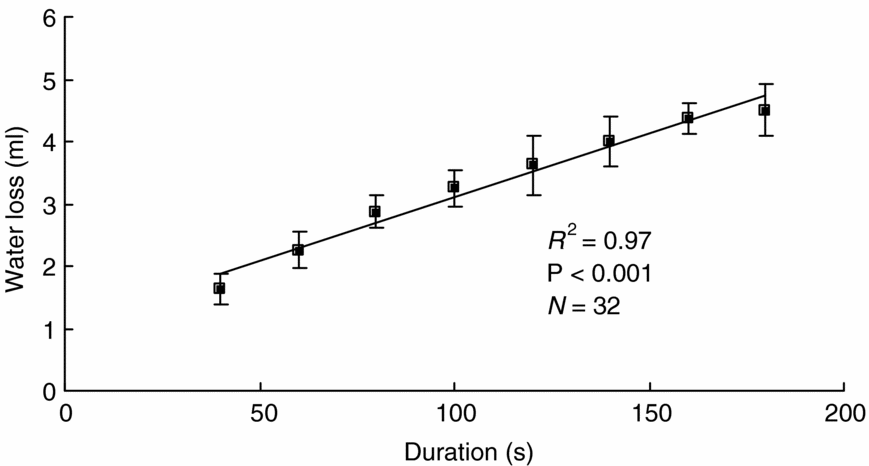
In order to control for fire intensity in all experiments and to produce a controlled, localized fire, a modified wick technique was used to burn stems (Hare Reference HARE1965b, Uhl & Kauffman Reference UHL and KAUFFMAN1990). This method involves wrapping a paraffin-soaked wick around the stem of a tree and allowing the wick to burn for a fixed period of time. Wicks were wrapped twice around the circumference of each burnt stem. The intensity of wick fire was calibrated relative to high-intensity fires burnt in the Pretoriuskop region of the Kruger National Park on 12 June 2007. Our intention in the calibration of wick fires was not to quantitatively replicate natural fires. Rather, we aimed to produce a fire that would expose stems to fire intensities within a realistic range. Open-calorimeters were used to measure intensities of both natural and wick fires (Pérez & Moreno Reference PÉREZ and MORENO1998). This was done by filling aluminium cans with 20 ml of water and measuring the volume of water evaporated by fires. Each of three calorimeters was fitted with four cans at ground level, grass canopy height and 1 m above the ground. Water loss caused by wick fires burnt for a duration between 40 s and 3 min was measured using four cans for each time interval. Wicks were wrapped twice around the base of the cans, as was done for experimental stems. This allowed us to generate a standard curve to calibrate the duration of a wick burn with natural fire's intensity (Figure 1). The duration most accurately replicating natural fire intensities was 2 min 20 s. This was decided on the basis of water loss measured for both back and forward burns, at all height levels.
The intensity of fires burnt for different durations using the wick technique on aluminium cans filled with 20 ml of water. A duration of 140 s was chosen as most accurately simulating savanna surface fires.

Fire resistance and bark removal
Experimental treatments involving bark removal and burning of stems using wicks were set up between 14 and 16 June 2007. Plants were chosen in a disused rhino enclosure situated near Skukuza and in a communal area near Justicia, abutting Kruger National Park. Neither site had been burnt within the last 2 y prior to the start of the experiment.
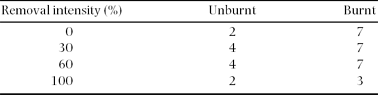
Given the limitations of working in conservation areas and the need to limit mortality we used as few stems as possible and did not experimentally manipulate large trees. Rather, we assume that mechanisms responsible for mortality in small trees also operate on large trees. Sample sizes for each treatment are given in Table 1. Stems ranging between 30 and 68 mm diameter at the height of bark removal were used. The effect of bark removal on stem mortality was determined by three bark removal intensities: 30%, 60% and 100% of the circumference stripped of bark. Bark removal comprised cutting roughly 5 cm length of bark. Half of the treated stems were burnt and the other half remained unburnt. Four months after treatment, survivorship of stems was determined by testing for living stem tissues above the burnt stem section. A 0.8% m/v solution of 2, 3, 5-triphenyl-tetrazolium chloride (TTC) in 0.05 mol l−1 potassium phosphate buffer was used as an indicator of respiration activity in tissues. TTC is reduced to insoluble pink formazan by living tissue but remains colourless in dead tissue. TTC has been used in numerous studies to examine heat impacts on stem tissues (Bova & Dickinson Reference BOVA and DICKINSON2005, Jones et al. Reference JONES, WEBB, BUTLER, DICKINSON, JIMENEZ, REARDON and BOVA2006). Three bark samples were taken from around the circumference of each stem 10 cm above the burn scar and immersed in a dark chamber overnight in the TTC solution. Only if all three bark samples gave a negative result was it concluded that a stem had been killed. This is because it takes complete ring-barking to kill A. nigrescens stems in the absence of fire (G. Moncrieff unpubl. data). Stem survival was compared to bark removal intensity and fire treatment using the logistic regression equation with the form

with P being the probability of mortality, X 2 − X n being independent variables and β 1 − β n coefficients estimated from mortality data. Analysis was done in R v 2.5.1 (R Foundation for Statistical Computing, Vienna, Austria) using the glm function with logit link. Model goodness of fit was assessed using Akaike's Information Criterion and deviance residuals. All possible combinations and interaction effects of the continuous variables bark removal and stem diameter and the categorical variable burn treatment were tested.
Numbers of Acacia nigrescens stems burnt using the wick technique.

Mechanisms of fire-induced stem death
Twelve untreated stems and eleven stems with 50% of their bark removed around their circumference were burnt using the wick technique. The following day stem sections roughly 5 cm in length were cut from 2 cm above the wick burn scar and immersed in TTC overnight. The proportion of the remaining cambium (i.e. 50% in treated and 100% in untreated stems) around the stem circumference that had not been killed by the fire was measured the following day. The influence of bark removal on the relationship between stem diameter and cambium survival was analysed using ANCOVA implemented in R using the lm function after arcsine transformation of cambium survival proportions. No evidence was found to suggest an interaction between the effect of stem diameter and bark removal and therefore we assume homogeneity of slopes.
Elephant utilization and top-kill following natural fires
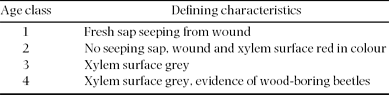
Field surveys of recently burnt (< 6 mo) A. nigrescens stems were conducted in the Skukuza and Tshokwane districts of the Kruger National Park on 2–7 October 2007. Patterns of utilization and mortality in large A. nigrescens trees were investigated for all stems encountered in transects with a dbh greater than 15 cm. For each large tree encountered the following was noted: stem diameter at breast height, height, presence or absence of bark removal, the agent of bark removal (porcupine or elephant), maximum percentage of bark removed around the circumference, total percentage of bark removed up to 3 m, the height of the lowest point of removal, the age of bark removal (as defined in Table 2), presence or absence of heartwood charring, presence or absence of boring beetles in the heartwood and the post-fire fate (alive/dead) of the tree in question. Bark removal was visually assessed and attributed to porcupines if gnawing at the bark between 0 and 60 cm was observed. A stem was determined to be dead if no new growth or leaves were obser–ved in the canopy.
Classification and characteristics of bark removal age.

Mortality patterns observed in field surveys were analysed using logistic regressions as described for the analysis of mortality in experimentally treated stems. Only stem diameter, maximum percentage of bark removed around the circumference and the total percentage of bark removed up to 3 m were informative variables and thus all other measurements were excluded. We did not include interaction effects as these proved insignificant in preliminary analyses.
RESULTS
Experimental results
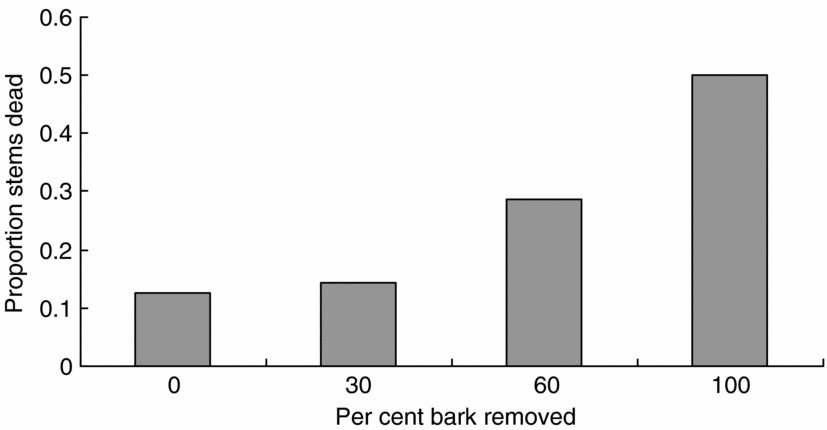
Regardless of the intensity of bark removal, none of the unburnt stems had died 4 mo after treatment, even those that were subjected to ring-barking. While it is almost certain that these stems and perhaps others treated to less intense bark removal will suffer mortality in the long term, here we only consider the effects of treatment after 4 mo of exposure. In contrast, burnt stems did die, and the proportion of stems killed in each bark removal intensity class increased with increasing removal intensity (Figure 2). Despite this trend no combination of variables produced a significant regression because of low sample sizes.
The proportion of Acacia nigrescens stems killed after 4 mo by wick fires under different bark removal intensities (n = 24).

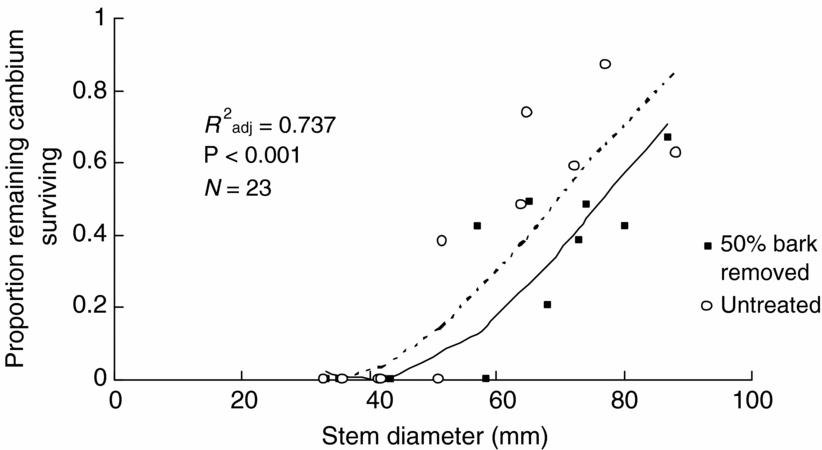
All stems with diameters less than 5 cm had no surviving cambium following experimental fires (Figure 3). As stem diameter increased, the proportion of remaining cambium surviving increased for both treated and untreated stems (estimate ± 1 SE = 0.0214 ± −0.0027; F = 31.8; df = 2, 20; P < 0.001). However, the proportion of remaining cambium surviving is not significantly different between treatments (50% removal = 0.422±0.112, untreated = 0.497 ± 0.149; F = 31.8; df = 2, 20; P = 0.139).
The proportion of cambium around the stem circumference of Acacia nigrescens surviving wick burns plotted against stem diameter for both untreated and 50% bark-removed stems. The solid line represents the regression for 50% bark-removed stems while the dashed line represents the regression for untreated stems after back-transformation of fitted regressions. The reported R2 value refers to whole-model fit.

Natural patterns of utilization and mortality
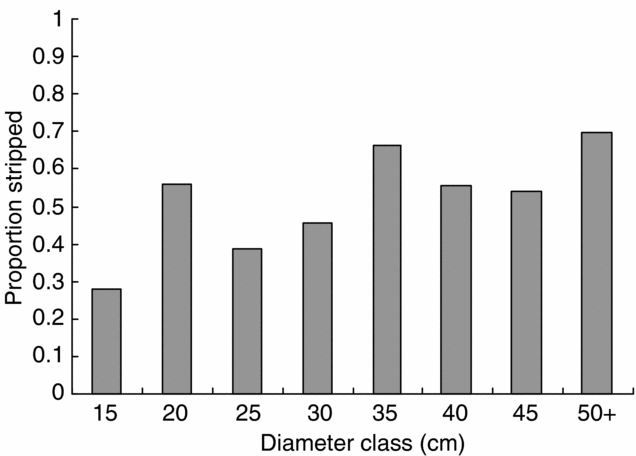
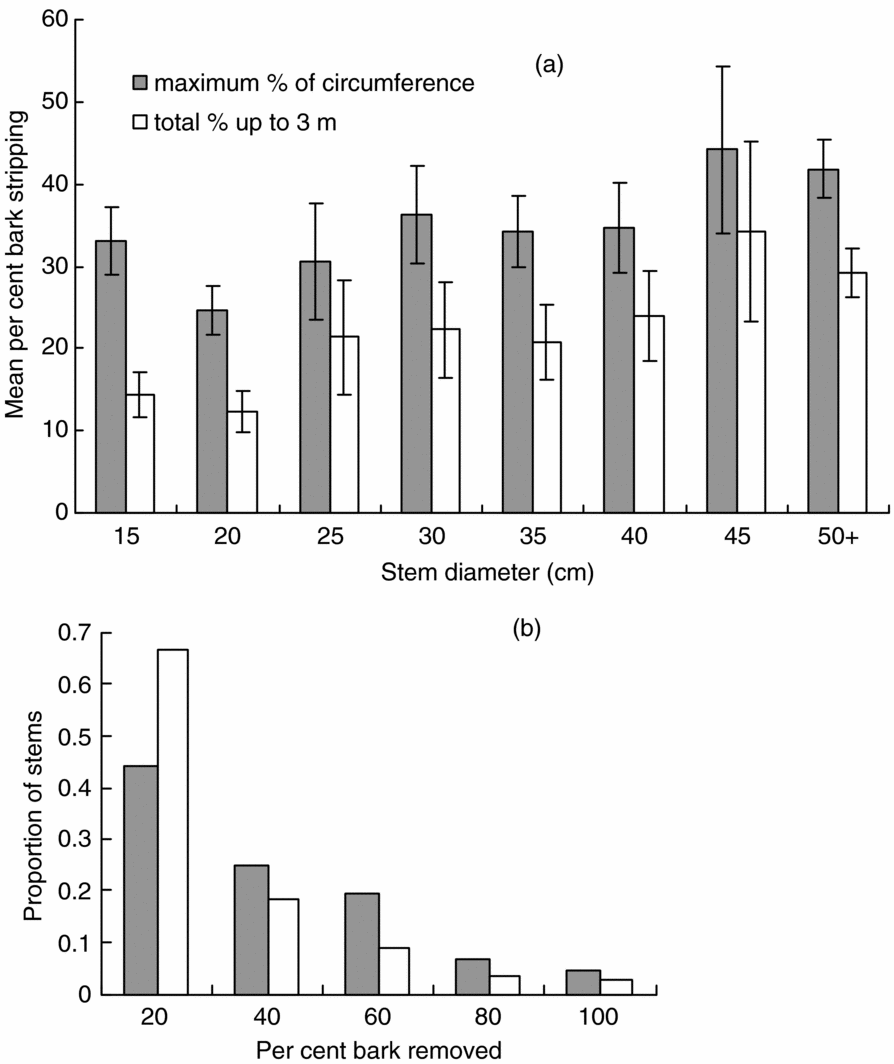
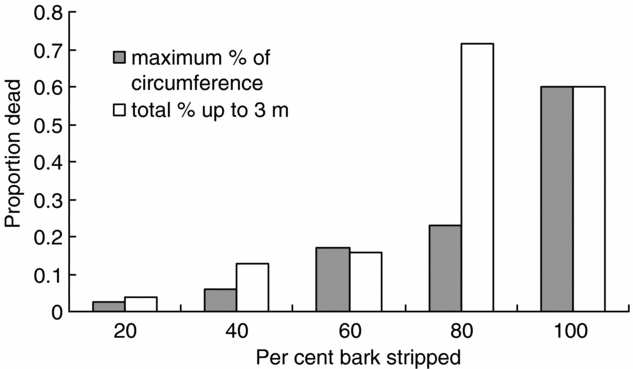
In total 437 large trees were surveyed ranging from 15–85 cm in diameter. Of the surveyed trees, 22 (5%) were found to have been killed by the fire, while 415 survived (95%). All dead trees, save one, had bark removed either by elephants or porcupines. In total 196 (44%) trees were found to have had bark removed by elephants, whereas 14 (3%) were judged to have had bark removed by porcupines. The mean maximum percentage of bark removed around the circumference was 66.2% for dead trees and 30.1% for surviving trees. The mean total percentage of bark removed up to 3 m was 51.4% for dead trees and 17.3% for surviving trees. The size-class distribution of bark removal on stems shows a linear trend of an increasing proportion of stems with bark removed as size increases (Figure 4). The overall pattern was of a very high proportion of stems having had bark removed, with 69% of all trees larger than 50-cm stem diameter experiencing some degree of bark removal. The mean per cent of bark removed per size class increases as the size of stems increases for both the maximum percentage of bark removed around the circumference and the total percentage of bark removed up to 3 m (Figure 5a). High-intensity removal was less frequent than low-intensity for both measures of removal (Figure 5b). The results of the logistic regressions on large tree mortality data are presented in Table 3. All models including either the maximum percentage of bark removed around the circumference or the total percentage of bark removed up to 3 m proved significant. Mortality rates increased with increasing bark removal (Figure 6). Of the significant models, those that included both stem diameter and a measure of bark removal had the lowest AIC and residual deviance. Alternating between the total per cent of bark removed up to 3 m and the maximum per cent of bark removed around the circumference as the measure of bark removal intensity produced a negligible difference in model performance when stem diameters were incorporated into the model.
The size distribution of elephant bark stripping on Acacia nigrescens stems with a stem dbh greater than 15 cm (n = 423).

The mean per cent of bark removed (a) and the distribution of bark removal intensity (b) for all Acacia nigrescens stems with dbh greater than 15 cm that had bark removed by elephants (n = 196).

Performance of different combinations of predictor variables used in logistic regressions analysing the effect of bark removal on mortality of large stems in Acacia nigrescens. For all models null deviance = 133.48 on 195 degrees of freedom. For models with one predictor variable df = 194, for models with two predictor variables df = 193. Circ.Strip = maximum per cent of bark removed around the circumference; Tot.Strip = total per cent of bark removed up to 3 m. Significance codes: ***P < 0.001, **P < 0.01, *P < 0.05. Model equation: 

Mortality of Acacia nigrescens stems larger than 15 cm dbh plotted against elephant bark removal intensity (n = 22).

DISCUSSION
The experimental results are not unequivocal – because of low sample sizes we cannot eliminate the possibility of either type of tissue damage being responsible for the mortality patterns observed. However, when bark was removed (resulting in cambium death as would occur in fires) no trees died, even after 4 mo exposure and with complete ring-barking. Only when trees had bark removed and were subsequently burnt did top-kill occur. The only additive effect that burning can have in this case is to damage the xylem, as all the phloem and cambium have been removed (at least in the 100% removal treatment). Thus the mortality patterns observed in the field studies would not be manifest as rapidly as observed if only cambium and/or phloem damage was important in determining mortality. Balfour & Midgley (Reference BALFOUR and MIDGLEY2006) showed that fire-induced xylem damage resulted in rapid leaf loss and wilting after fire in Acacia karroo. The results presented here suggest that fire-induced xylem damage affects stem mortality. It is likely that heating and vaporization of the water travelling in xylem vessels causes damage to lignified vessels, resulting in the reduction of water-conducting capacity. This could hasten mortality as the stem would be under increased transpirational and nutritional stress if its conduits were damaged (Tyree & Sperry Reference TYREE and SPERRY1988).
Damage to cambium is unlikely to be the mechanism responsible for the increased vulnerability of stems with bark removed and the resulting death of large trees. This is because no significant differences in fire damage to remaining cambium were detected between stems with bark removed and those with their bark intact. Moreover, cambium damage in large stems was low for both treatments. Fire damage to cambium in stems of the size sampled in our field survey would therefore be low in all instances of bark removal, regardless of intensity. However, bark removal will clearly increase the amount of damage caused to xylem through the removal of insulation. As was shown in the experimental treatments, xylem damage does play a role in post-fire stem mortality. It also appears that as more xylem is exposed through increasing intensities of bark removal so the probability of mortality increases, although our analysis is hindered by low sample sizes.
The removal of A. nigrescens bark by elephants is a prominent occurrence in the Kruger National Park, far more frequent than bark removal by porcupines. However, most instances of bark removal are of a low intensity. As was found for Acacia tortillis and Acacia nilotica by MacGregor & O'Connor (Reference MACGREGOR and O'CONNOR2004) and for Sclerocarya birrea by Gadd (Reference GADD2002), bark damage is accumulated by the largest stems. Therefore the largest trees are particularly vulnerable to the synergistic effects of bark removal and fire. Our results confirm that bark removal strongly influences post-fire survival of large stems, as all trees killed by fire had had bark removed, with a significantly greater proportion removed than those that survived fires. Bark regrowth does not appear to be fast enough to compensate for elephant utilization, as large trees accumulate damage, rather than recover from it.
The exposure of heartwood to burning by porcupine (Hystrix africaeaustralis Peters) utilization and the subsequent mechanical failure of stem support as a result of successive burning, proposed by Yeaton (Reference YEATON1988) as a mechanism resulting in the death of large stems, does not appear to be important in the mortality of large A. nigrescens stems in Kruger National Park. Firstly, the scarcity of porcupine damage implies that this mechanism of mortality is not ubiquitous. Secondly, no trees felled by fire were recorded in our survey. Rather, the frequency of bark removal by elephants and its importance in determining post-fire survival suggest that it plays an important role in the mortality of large trees in Kruger National Park.
Large trees have an important role to play in savanna ecosystems. They act as nutrient and water pumps, enhancing productivity below their canopy (Belsky Reference BELSKY1994, Ludwig et al. Reference LUDWIG, DE KROON, BERENDSE and PRINS2004). They also provide shade and roosts for various bird and mammal species, further enhancing the nutrient status of the surrounding soils as a result (Dean et al. Reference DEAN, MILTON and JELTSCH1998). Their persistence in the landscape is therefore desirable. Demographic studies are needed in order to determine if replacement rates are high enough to compensate for the mortality rates of stems after fire (c. 5%) as a result of elephant utilization observed in this study.
ACKNOWLEDGEMENTS
Our research would not have been possible without the assistance provided to us by the Organization for Tropical Studies. Navashni Govender and Dr Winston Trollope allowed us to collect data during their experiments and provided insightful comments and discussions. Funding assistance was provided by the National Research Foundation and the University of Cape Town.