Borderline personality disorder (BPD) is characterized by affective instability, impulsivity, impaired social functioning, and identity disturbance (American Psychiatric Association, 2013). BPD is related to a number of negative outcomes including interpersonal and occupational impairment and suicide (Skodol et al., Reference Skodol, Gunderson, McGlashan, Dyck, Stout, Bender and Sanislow2002). Particularly concerning are the high rates of comorbidity between BPD and other psychiatric disorders, including major depressive disorder (MDD), alcohol use disorder (AUD), and illicit drug use disorders (DUD; McGlashan et al., Reference McGlashan, Grilo, Skodol, Gunderson, Shea, Morey and Stout2000; Zanarini et al., Reference Zanarini, Frankenburg, Hennen, Reich and Silk2004; Zimmerman & Mattia, Reference Zimmerman and Mattia1999). For those who meet diagnostic criteria for BPD, lifetime comorbidity rates with MDD and AUD or DUD have been reported as high as 32.1% and 30.9%, respectively (Grant et al., Reference Grant, Chou, Goldstein, Huang, Stinson, Saha and Ruan2008). Moreover, the association between BPD and several areas of functional impairment can be attributed to a general impairment shared between BPD and MDD, AUD, and DUDs (Lenzenweger, Lane, Loranger, & Kessler, Reference Lenzenweger, Lane, Loranger and Kessler2007), although there is evidence that BPD predicts functional impairment over and above comorbid psychopathology (Skodol et al., Reference Skodol, Gunderson, McGlashan, Dyck, Stout, Bender and Sanislow2002). In order to better inform treatment frameworks for BPD, it is especially important to investigate the developmental origins and etiological influences that contribute to this comorbidity.
Normative Developmental Change
In epidemiological samples, BPD prevalence and trait levels decline from middle adolescence into young adulthood (Bernstein et al., Reference Bernstein, Cohen, Velez, Schwabstone, Siever and Shinsato1993; Bornovalova, Hicks, Iacono, & McGue, Reference Bornovalova, Hicks, Iacono and McGue2009; Cohen, Crawford, Johnson, & Kasen, Reference Cohen, Crawford, Johnson and Kasen2005; Johnson et al., Reference Johnson, Cohen, Kasen, Skodol, Hamagami and Brook2000; Lenzenweger, Reference Lenzenweger1999). There is also evidence for similar declines in adolescents and adults with clinically elevated levels of BPD symptoms (Cohen et al., Reference Cohen, Crawford, Johnson and Kasen2005; Grilo et al., Reference Grilo, Sanislow, Gunderson, Pagano, Yen, Zanarini and McGlashan2004; Johnson et al., Reference Johnson, Cohen, Kasen, Skodol, Hamagami and Brook2000; Lenzenweger, Reference Lenzenweger1999; Meijer, Goedhart, & Treffers, Reference Meijer, Goedhart and Treffers1998; Paris, Brown, & Nowlis, Reference Paris, Brown and Nowlis1987; Shea et al., Reference Shea, Stout, Gunderson, Morey, Grilo, McGlashan and Keller2002; Zanarini, Frankenburg, Hennen, & Silk, Reference Zanarini, Frankenburg, Hennen and Silk2003). The normative decline in BPD levels is likely due to developmental changes associated with personality maturation. Declines in the normal range personality traits of negative emotionality and behavioral disinhibition, traits that are core to the definition of BPD, show most pronounced changes from late adolescence to young adulthood (Durbin et al., Reference Durbin, Hicks, Blonigen, Johnson, Iacono and McGue2016; Johnson, Hicks, McGue, & Iacono, Reference Johnson, Hicks, McGue and Iacono2007; Roberts, Caspi, & Moffitt, Reference Roberts, Caspi and Moffitt2001). In contrast, MDD prevalence rates spike in middle adolescence and increase into young adulthood, after which they remain relatively stable. Risk for AUD and DUD increases in late adolescence, peaks in young adulthood, and then shows a substantial decline by age 30 (Chassin, Flora, & King, Reference Chassin, Flora and King2004; Compton, Thomas, Stinson, & Grant, Reference Compton, Thomas, Stinson and Grant2007; Costello, Mustillo, Erkanli, Keeler, & Angold, Reference Costello, Mustillo, Erkanli, Keeler and Angold2003; Merikangas et al., Reference Merikangas, He, Burstein, Swanson, Avenevoli, Cui and Swendsen2010; Wittchen, Nelson, & Lachner, Reference Wittchen, Nelson and Lachner1998). The rise and subsequent decline in AUD and DUD symptoms likely represents extreme versions of maturational changes in behavioral disinhibition. Likewise, the rise in MDD symptoms during adolescence likely represents maladaptive variation in neuroticism and social problem solving (Keller & Nesse, Reference Keller and Nesse2005; Moffitt, Reference Moffitt1993; Nettle, Reference Nettle2006; Watson & Andrews, Reference Watson and Andrews2002).
Evidence for Common Cause, Predisposition, and Pathoplasty Models
Several models have been proposed to account for personality–psychopathology associations, including the predisposition, pathoplasty, and common cause models (Durbin & Hicks, Reference Durbin and Hicks2014). The predisposition model posits that BPD traits increase risk for the onset of a new disorder. The pathoplasty model predicts that BPD traits affect the course of disorders, such that higher BPD traits contribute to greater severity and/or chronicity of a disorder. The common cause model posits that some third variable, such as emotion dysregulation or disinhibition, accounts for the comorbidity between BPD traits and other disorders. While each of these models could independently account for BPD–psychopathology associations, it is important to note that they can operate simultaneously. In addition, these models ignore normative developmental shifts in the mean levels of traits and the prevalence of disorders, and thus do not account for how these age-related changes might contribute to the comorbidity between BPD traits and other disorders.
The common cause model has received the majority of empirical attention and suggests that BPD traits and symptoms of comorbid disorders are derived partly from shared neurobiological influences. Seminal theories posit that BPD traits result partly from the interplay between the same environmental risk (e.g., traumatic life events) and preexisting, biologically influenced tendencies that exacerbate comorbid disorders, such as negative emotionality, sensitivity to emotional cues, and behavioral disinhibition (Linehan, Reference Linehan1993). Given that impulsivity is related to BPD traits, AUD, and DUD symptoms throughout development, it has received special attention in efforts to identify a common diathesis (Berlin, Rolls, & Iversen, Reference Berlin, Rolls and Iversen2005; Brodsky et al., Reference Brodsky, Oquendo, Ellis, Haas, Malone and Mann2001; De Wit, Reference De Wit2009; Dick et al., Reference Dick, Smith, Olausson, Mitchell, Leeman, O'Malley and Sher2010). Recent models of BPD further emphasize developmental processes that contribute to heterotypic continuity (Kaufman, Crowell, & Stepp, Reference Kaufman, Crowell, Stepp, Beauchaine and Hinshaw2015) and include evidence from behavior genetic methodology and neuroimaging to support the notion that impulsivity is a common feature of BPD traits and AUD and DUD symptoms (Beauchaine, Klein, Crowell, Derbidge, & Gatzke-Kopp, Reference Beauchaine, Klein, Crowell, Derbidge and Gatzke-Kopp2009; Crowell, Beauchaine, & Linehan, Reference Crowell, Beauchaine and Linehan2009). These models posit that the expression of an underlying biological system for a phenotype, such as trait impulsivity (Coccaro et al., Reference Coccaro, Siever, Klar, Maurer, Cochrane, Cooper and Davis1989; Friedel, Reference Friedel2004), gives rise to multiple maladaptive phenotypic outcomes in the context of other biological and environmental influences (Beauchaine et al., Reference Beauchaine, Klein, Crowell, Derbidge and Gatzke-Kopp2009). Similarly, neuroticism has been considered as one possible source in BPD-MDD comorbidity (Clarkin, Hull, Cantor, & Sanderson, Reference Clarkin, Hull, Cantor and Sanderson1993; Distel, Trull, et al., Reference Distel, Trull, Willemsen, Vink, Derom, Lynskey and Boomsma2009; Hettema, Neale, Myers, Prescott, & Kendler, Reference Hettema, Neale, Myers, Prescott and Kendler2006; Soldz, Budman, Demby, & Merry, Reference Soldz, Budman, Demby and Merry1993; Trull, Reference Trull1992).
Building on well-established evidence that differences in neural responses to rewarding stimuli covary with impulsivity (Martin & Potts, Reference Martin and Potts2004; Wilbertz et al., Reference Wilbertz, van Elst, Delgado, Maier, Feige, Philipsen and Blechert2012), recent neuroimaging evidence suggests that reduced activation in neural regions that process rewards are associated with higher levels of BPD traits, such as self-injurious behavior (Sauder, Derbidge, & Beauchaine, Reference Sauder, Derbidge and Beauchaine2016). Similar findings have been observed in participants with MDD symptoms and elevated alcohol or substance use (Beck et al., Reference Beck, Schlagenhauf, Wüstenberg, Hein, Kienast, Kahnt and Heinz2009; Jentsch & Taylor, Reference Jentsch and Taylor1999; Must et al., Reference Must, Szabó, Bódi, Szász, Janka and Kéri2006). Further evidence suggests that BPD patients and participants with lesions in brain regions associated with reward processing, such as the orbitofrontal cortex, exhibit elevated impulsivity, inappropriate behavior, and other common BPD characteristics compared with a control group (Berlin et al., Reference Berlin, Rolls and Iversen2005; Forbes et al., Reference Forbes, Brown, Kimak, Ferrell, Manuck and Hariri2009). With respect to the BPD-MDD comorbidity, recent neuroimaging work suggests that variability in structure and function of the prefrontal cortex, anterior cingulate, hippocampus, and amygdala may represent a neurobehavioral risk factor for development of neuroticism that has downstream effects on BPD and MDD comorbidity (Cremers et al., Reference Cremers, Demenescu, Aleman, Renken, van Tol, van der Wee and Roelofs2010; Davidson, Pizzagalli, Nitschke, & Putnam, Reference Davidson, Pizzagalli, Nitschke and Putnam2002; DeYoung et al., Reference DeYoung, Hirsh, Shane, Papademetris, Rajeevan and Gray2010; Driessen et al., Reference Driessen, Herrmann, Stahl, Zwaan, Meier, Hill and Petersen2000; Haas, Omura, Constable, & Canli, Reference Haas, Omura, Constable and Canli2007; Hazlett et al., Reference Hazlett, New, Newmark, Haznedar, Lo, Speiser and Buchsbaum2005; Soloff et al., Reference Soloff, Meltzer, Becker, Greer, Kelly and Constantine2003; Tzschoppe et al., Reference Tzschoppe, Nees, Banaschewski, Barker, Buchel and Conrod2014). These data emphasize the importance of neurodevelopmental influences on BPD and commonly comorbid psychopathology, and provide suggestive evidence that the common cause model may partially explain codevelopment and change in BPD traits and symptoms of comorbid psychopathology. However, a longitudinal test of the common cause model is needed.
In a prior study with a subset of the present sample, we provided a test of the predisposition model for BPD traits and a composite of substance use (tobacco, alcohol, and marijuana quantity and frequency) in 14- and 18-year-old female twins (Bornovalova, Hicks, Iacono, & McGue, Reference Bornovalova, Hicks, Iacono and McGue2013). BPD traits and substance use were correlated at each age, but BPD traits at age 14 did not predict substance use at age 18 after accounting for the stability of BPD traits and substance use (and vice versa). These results were consistent with a common cause but not a predisposition model; however, they failed to rule out the pathoplasty model. In addition, while this study focused on quantity and frequency of substance use, it did not examine the association with substance use disorder symptoms.
Finally, there is accumulating evidence for the pathoplasty model. For example, recurrent or chronic MDD is associated with a failure to exhibit normative declines in the personality trait of stress reaction, while persistent AUD is associated with a lack of normative decline in aggression and behavioral disinhibition (Durbin & Hicks, Reference Durbin and Hicks2014). Given the strong connection between BPD traits and these normal-range personality traits, it is also likely that BPD traits will fail to decline when accompanied by chronic MDD and substance use disorder symptoms; conversely, the remission of comorbid disorders may facilitate a reduction in BPD traits. For instance, a large community sample of adolescent females reported that increasing BPD symptoms were associated with worsening social and mental health outcomes (Wright, Zalewski, Hallquist, Hipwell, & Stepp, Reference Wright, Zalewski, Hallquist, Hipwell and Stepp2015). Likewise, adult clinical samples report that the rate of decline in BPD traits is associated with the rate of decline for the personality trait of neuroticism (Wright, Hopwood, & Zanarini, Reference Wright, Hopwood and Zanarini2015), as well as decline in co-occurring MDD, AUD, and DUD symptoms (De Panfilis et al., Reference De Panfilis, Politi, Fortunati, Cazzolla, Scaramuzzino, Marchesi and Maggini2011; Gunderson et al., Reference Gunderson, Stout, Sanislow, Shea, McGlashan, Zanarini and Skodol2008; Zanarini Frankenburg, Hennen, Reich, & Silk, Reference Zanarini, Frankenburg, Hennen, Reich and Silk2004; Zanarini et al., Reference Zanarini, Frankenburg, Weingeroff, Reich, Fitzmaurice and Weiss2011). Data from the Collaborative Longitudinal Personality Disorder Study, for instance, indicated that patients with BPD and MDD negatively impacted each other's time to remission and accelerated time to relapse (Grilo et al., Reference Grilo, Sanislow, Shea, Skodol, Stout, Gunderson and McGlashan2005; Gunderson et al., Reference Gunderson, Stout, Shea, Grilo, Markowitz, Morey and McGlashan2014); similar results have been reported for substance use disorders (Walter et al., Reference Walter, Gunderson, Zanarini, Sanislow, Grilo, McGlashan and Skodol2009). Likewise, results from the McLean Study of Adult Development have repeatedly documented that initial levels and remission status in BPD predict change in major depressive, drug, and alcohol use disorders (and vice versa; Frankenburg, Fitzmaurice, & Zanarini, Reference Frankenburg, Fitzmaurice and Zanarini2014; Zanarini, Frankenburg, Hennen, Reich, & Silk, Reference Zanarini, Frankenburg, Hennen, Reich and Silk2005; Zanarini, Frankenbug, Vujanovic, et al., Reference Zanarini, Frankenburg, Vujanovic, Hennen, Reich and Silk2004; Zanarini et al., Reference Zanarini, Frankenburg, Weingeroff, Reich, Fitzmaurice and Weiss2011).
Current Study
We sought to advance our understanding of the association between BPD traits and symptoms of comorbid disorders in a number of ways. First, we focused on examining both the pathoplasty and common cause models of BPD traits and AUD, DUD, and MDD symptoms (because of the lack of support in our prior research with this sample, we did not examine the predisposition model). By including symptoms of multiple disorders, we were able to examine convergent and discriminant processes contributing to BPD trait levels and symptoms of commonly co-occurring disorders. Second, we extended the developmental period of interest from age 14 to 24, a period when there are declines in BPD traits and large increases in MDD, AUD, and DUD symptoms. Most studies that have examined the comorbidity between BPD traits and other disorders have used adult samples (Gunderson et al., Reference Gunderson, Stout, Sanislow, Shea, McGlashan, Zanarini and Skodol2008; Zanarini, Frankenburg, Hennen, et al., Reference Zanarini, Frankenburg, Hennen, Reich and Silk2004) with fewer developmental change in these traits and disorders. Third, we used our twin sample to estimate genetic and environmental contributions to BPD traits and their overlap with symptoms of the disorders. Several large cross-sectional studies have investigated both the heritability of BPD traits (Distel et al., Reference Distel, Trull, Derom, Thiery, Grimmer, Martin and Boomsma2008, Reference Distel, Middeldorp, Trul, Derom, Willemsen and Boomsma2011; Distel, Rebollo-Mesa, et al., Reference Distel, Rebollo-Mesa, Willemsen, Derom, Trull, Martin and Boomsma2009; Kendler et al., Reference Kendler, Aggen, Czajkowski, Roysamb, Tambs, Torgersen and Reichborn-Kjennerud2008, Reference Kendler, Aggen, Knudsen, Røysamb, Neale and Reichborn-Kjennerud2011; Reichborn-Kjennerud et al., Reference Reichborn-Kjennerud, Czajkowski, Røysamb, Ørstavik, Neale, Torgersen and Kendler2010, Reference Reichborn-Kjennerud, Czajkowski, Ystrom, Orstavik, Aggen, Tambs and Kendler2015; Torgersen et al., Reference Torgersen, Lygren, Oien, Skre, Onstad, Edvardsen and Kringlen2000, Reference Torgersen, Czajkowski, Jacobson, Reichborn-Kjennerud, Roysamb, Neale and Kendler2008) and the genetic and environmental overlap between BPD traits and MDD, AUD, and DUD symptoms in adults (Distel et al., Reference Distel, Trull, de Moor, Vink, Geels, van Beek and Boomsma2012; Kendler et al., Reference Kendler, Aggen, Knudsen, Røysamb, Neale and Reichborn-Kjennerud2011). The current study extends this work to modeling the etiological influences on longitudinal relationships as well. Fourth, we modeled the cross-sectional and longitudinal relationships between BPD features and MDD, AUD, and DUD symptoms simultaneously. This allowed us to test the common cause and pathoplasty models for multiple disorders, thereby connecting the current study to the broader developmental psychopathology literature.
A small but growing literature indicates that BPD tendencies are influenced roughly equally by additive and nonadditive genetic (35%–50%) and nonshared environmental (50%–60%) sources (Distel, Rebollo-Mesa, et al., Reference Distel, Rebollo-Mesa, Willemsen, Derom, Trull, Martin and Boomsma2009; Distel et al., Reference Distel, Trull, Derom, Thiery, Grimmer, Martin and Boomsma2008; Kendler et al., Reference Kendler, Aggen, Czajkowski, Roysamb, Tambs, Torgersen and Reichborn-Kjennerud2008, Reference Kendler, Aggen, Knudsen, Røysamb, Neale and Reichborn-Kjennerud2011). Genetic factors account for much of the association between BPD traits with AUD and DUD symptoms in adults (Bornovalova, Hicks, et al., Reference Bornovalova, Huibregtse, Hicks, Keyes, McGue and Iacono2013; Distel et al., Reference Distel, Trull, de Moor, Vink, Geels, van Beek and Boomsma2012; Kendler et al., Reference Kendler, Aggen, Knudsen, Røysamb, Neale and Reichborn-Kjennerud2011), whereas the association with MDD symptoms is largely accounted by environmental factors (Kendler et al., Reference Kendler, Aggen, Knudsen, Røysamb, Neale and Reichborn-Kjennerud2011). These previous studies have been almost exclusively cross-sectional and focused on adults. We hoped to extend this work to the codevelopment between BPD traits and symptoms of multiple disorders from middle adolescence through young adulthood.
We also capitalized on the longitudinal nature of the data to fit biometric latent growth models to better understand the codevelopment between BPD traits and symptoms of MDD, AUD, and DUD (as well as the interrelationships within MDD, AUD, and DUD symptoms). Evidence consistent with the common cause model exists if there are significant correlations between the intercepts (average levels) and slopes (linear rate of change) for BPD traits and symptoms of MDD, AUD, and DUD. Common cause would also be inferred if common genetic or environmental influences accounted for any of the cross-sectional or longitudinal relationships between BPD traits and MDD, AUD, and DUD symptoms. Evidence consistent with the pathoplasty model exists if the intercept for BPD traits are correlated with the slopes of MDD, AUD, and DUD symptoms (and vice versa), that is, if average levels of BPD traits predicted a more severe course (i.e., greater increase) in symptoms of the disorder. Likewise, pathoplasty would be inferred if high average levels of MDD, AUD, and DUD symptoms are associated with a lack of normative declines in BPD trait levels (i.e., shallower slopes).
Method
Sample
Participants were adolescent female twins taking part in the Minnesota Twin Family Study (MTFS), an ongoing population-based, longitudinal study of twins and their families (Iacono, Carlson, Taylor, Elkins, & McGue, Reference Iacono, Carlson, Taylor, Elkins and McGue1999; Keyes et al., Reference Keyes, Malone, Elkins, Legrand, McGue and Iacono2009). Birth records and public databases were used to locate more than 90% of families that included a twin birth in the state of Minnesota from 1975 to 1984 and 1988 to 1994. Eligible twins and their families were (a) living within a 1-day drive of Minneapolis with at least one biological parent, and (b) had no mental or physical handicap precluding participation. All protocols were approved by the Institutional Review Board. Parents and children gave informed consent or assent as appropriate.
The MTFS intake sample includes an 11-year-old and a 17-year-old cohort consisting of same-sex male and female monozygotic (MZ) and dizygotic (DZ) twins. The current study focused on the female twins, as the male twins only had BPD data at two assessment time points. Intake and follow-up assessments are scheduled to coincide with major transitions in the lives of adolescents and young adults. BPD traits were first assessed at age 14 for the younger cohort, and at age 17 for the older cohort. Follow-up assessments of BPD traits were conducted at age 17 and 24 in the younger cohort and at ages 20 and 24 in the older cohort. In the current study, the cohorts were combined and matched by age of assessment. The actual ages at each assessment (corrected for in all analyses) were 14.88 (SD = 0.57), 17.89 (SD = 0.69), 20.83 (SD = 0.61), and 25.09 (SD = 0.73). AUD, DUD, and MDD symptoms were assessed using the same time points and procedures, then combined and corrected for age variability in the same manner as BPD traits. Retention rates were excellent, with approximately 90% participation at each wave.
The final sample included 1,121 MZ (or identical) twins and 642 DZ (or fraternal) twins. The sample sizes for each assessment time point were as follows: age 14 (N = 1,080; 674 twins from MZ pairs, 406 twins from DZ pairs); age 17 (N = 1,602; 1,026 twins from MZ pairs, 576 twins from DZ pairs); age 20 (N = 1,389; 879 twins from MZ pairs, 510 twins from DZ pairs); and age 24 (N = 1,260; 797 twins from MZ pairs, 463 twins from DZ pairs). Zygosity was determined by agreement among three estimates: MTFS staff evaluations of the twins’ physical similarity, parents’ completion of a standard zygosity questionnaire, and twin similarity on an algorithm of ponderal and cephalic indices and fingerprint ridge count. A serological analysis was performed if the three estimates did not agree. Consistent with the racial/ethnic makeup of the recruitment area, 95.3% of the sample was White. In addition, the mean maternal and paternal years of education among the families of origin were 13.57 (2.09) and 13.67 (2.61), respectively.
Measures
BPD traits
The Minnesota Borderline Personality Disorder Scale (MBPD; Bornovalova, Hicks, Patrick, Iacono, & McGue, Reference Bornovalova, Hicks, Patrick, Iacono and McGue2011) is a self-report inventory of BPD traits that provides a dimensional measure of BPD trait severity. The MBPD was developed using items from the Multidimensional Personality Questionnaire (MPQ; Patrick, Curtin, & Tellegen, Reference Patrick, Curtin and Tellegen2002; Tellegen, Reference Tellegen1982) and asks participants to respond to 19 items on a 4-point scale (agree, somewhat agree, somewhat disagree, or disagree). Items for the MBPD were selected due to overlap with BPD symptomatology and were drawn from the following MPQ scales: stress reaction (e.g., “Mood often fluctuates”), alienation (e.g., “Often betrayed by friends”), control (e.g., “Often act impulsively”), aggression (e.g., “Sometimes enjoy saying mean things”), well-being (e.g., “Rarely feel happy”), and absorption (e.g., “Sometimes feel presence of people not actually there”). While the MPQ was designed to measure normal personality functioning, the MBPD scale is correlated with established self-report measures of BPD traits (rs = .80–.89) and BPD diagnosis and symptom counts (rs = .60–.66) from structured interviews in community and clinical samples (Bornovalova et al., Reference Bornovalova, Hicks, Patrick, Iacono and McGue2011; Rojas et al., Reference Rojas, Cummings, Bornovalova, Hopwood, Racine, Keel and Klump2014; Rojas, Hicks, Stark, Hopwood, & Bornovalova, Reference Rojas, Hicks, Stark, Hopwood and Bornovalova2015). MBPD scores also show high reliability and temporal stability (Rojas et al., Reference Rojas, Hicks, Stark, Hopwood and Bornovalova2015) as well as theoretically expected associations with criterion variables in the BPD trait nomological network, such as impulsivity, antisocial behaviors, interpersonal problems, MDD symptoms, and alcohol and drug use (Bornovalova, Hicks, et al., Reference Bornovalova, Hicks, Patrick, Iacono and McGue2011, Reference Bornovalova, Huibregtse, Hicks, Keyes, McGue and Iacono2013; Rojas et al., Reference Rojas, Cummings, Bornovalova, Hopwood, Racine, Keel and Klump2014, Reference Rojas, Hicks, Stark, Hopwood and Bornovalova2015). In this sample, internal consistency reliability was >0.80 for all follow-ups, and the score distributions exhibited minimal skew and kurtosis (<1 for all time points). Therefore, MBPD scores can be used to make reasonable inferences about BPD traits. To adjust for any variability in age at each assessment, the BPD trait data were conditioned on target age (ages 14, 17, 20, or 24 depending on the assessment wave, that is, age variability around each assessment point regressed out; Bornovalova et al., Reference Bornovalova, Hicks, Iacono and McGue2009; Johnson et al., Reference Johnson, Hicks, McGue and Iacono2007). Raw scores are plotted for descriptive purposes in Figure 1. To aid with model fitting in all nondescriptive analyses, MBPD scores were recoded to range between 1 (maximum possible score) and 0 (minimum possible score) using the following equation: (MBPD individual score-min)/(max-min) = ([MBPD individual score – 19]/57). This rescaling minimized the differences in variance between the variables in the models while maintaining all the original properties of the MBPD scores.
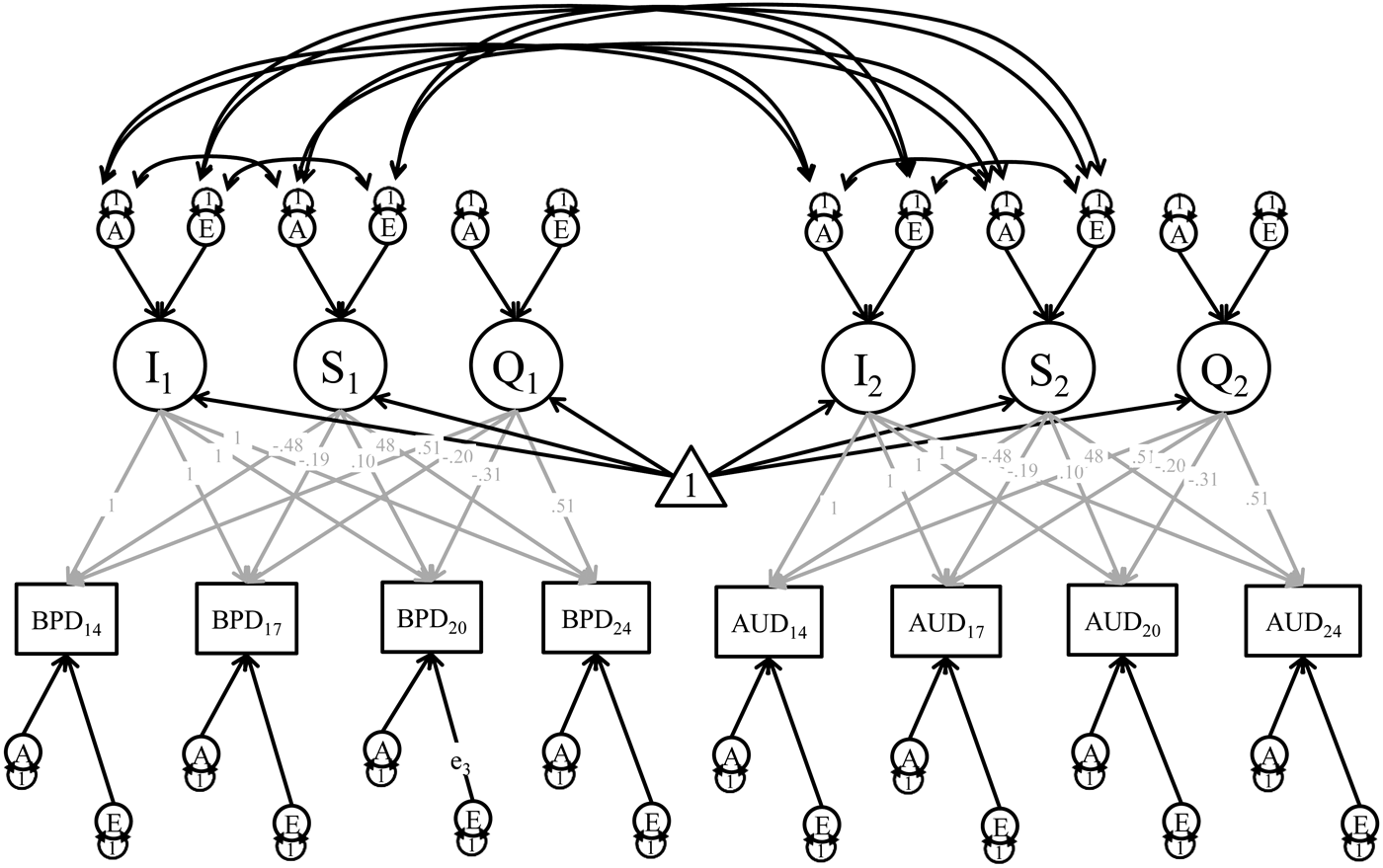
Bivariate growth model for one twin. BPD, Borderline personality disorder traits; AUD, alcohol use disorder symptoms. In the full model, BPD traits, AUD, major depressive disorder, and drug use disorder were included. An abbreviated figure is presented to increase clarity. Each assessment point is assumed to reflect an effect of general level of the phenotype/intercept (I), linear slope (S), and quadratic slope (Q), and assessment-specific additive genetic (A), shared environmental (C), and nonshared environmental effects (E). The intercept and slope effects are also decomposed into correlated additive genetic, shared environmental, and nonshared environmental effects. Subscripted numbers refer to the age of measurement, and numbers above the gray paths coefficients indicate fixed factor loadings for the growth parameters. Common environmental effects were estimated in the fully saturated model, but they were subsequently removed, as they did not improve the fit of the model.

MDD, AUD, and DUD symptoms
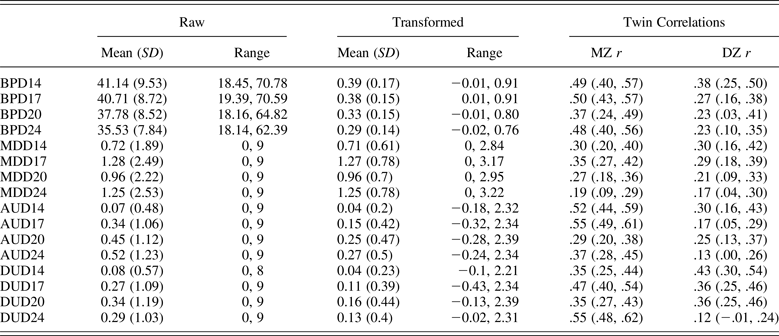
Symptoms of MDD, AUD, and DUD were assessed using the Diagnostic Interview for Children and Adolescents—Revised (Reich & Welner, Reference Reich and Welner1988), the Structured Clinical Interview for DSM-III-R (Spitzer, Williams, Gibbon, & First, Reference Spitzer, Williams, Gibbon and First1987), and the Substance Abuse Module of the Composite International Diagnostic Interview (Robbins, Cottler, & Babor, Reference Robbins, Cottler and Babor1990). Clinical interviews were conducted by trained staff members at the University of Minnesota. Maternal reports of these symptoms were also collected at ages 14 and 17. Consistent with evidence that each informant provides unique information in the assessment of psychopathology, we utilized a best estimate approach and considered a symptom present if reported by either the twin or parent (Burt, Krueger, McGue, & Iacono, Reference Burt, Krueger, McGue and Iacono2001, Reference Burt, Krueger, McGue and Iacono2003). An established diagnostic consensus procedure was used to maximize accuracy of symptom assignment. For each participant, a clinical case conference consisting of at least two advanced clinical psychology graduate students was conducted in which all interview data was reviewed, referring to audiotapes when necessary. The two diagnosticians were required to reach consensus regarding symptom presence prior to assigning any symptoms. Once consensus was reached regarding the presence/absence of symptoms, a computer algorithm was used to determine diagnosis. The consensus process yielded diagnostic κ reliabilities that ranged from 0.71 to 0.92. All symptom counts were log transformed to reduce skew and kurtosis (see Table 1 for means and standard deviations, as well as the range of the raw and log-transformed scales). As with MBPD scores, the MDD, AUD, and DUD data were conditioned on target age to account for any variability in age at each assessment.
Descriptive statistics and twin correlations and 95% confidence intervals for BPD traits, MDD symptoms, AUD symptoms, and DUD symptoms across ages 14 to 24
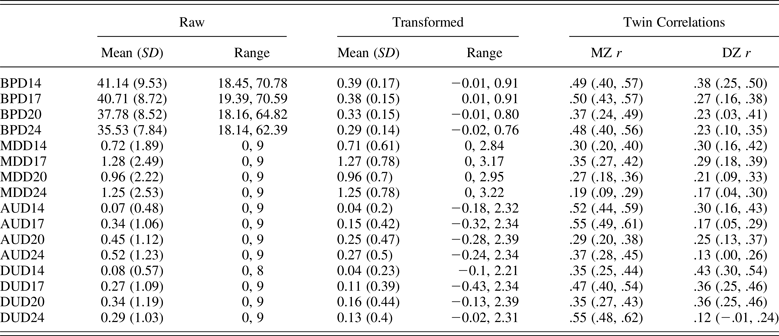
Note: BPD, borderline personality disorder traits; MDD, major depressive disorder symptoms; AUD, alcohol use disorder symptom; DUD, drug use disorder; MZ, monozygotic; DZ, dizygotic. MDD, AUD, and DUD symptom variables underwent a log + 1 transformation for all analyses, after which they were corrected for age variability around each age of assessment (accounting for negative values under transformed range). MZ and DZ correlations are presented for the log-transformed values.
Analytic approach
We fit a multivariate biometric latent growth model to BPD traits and MDD, AUD, and DUD symptoms between the ages of 14 and 24. This model allows us to simultaneously model the developmental trajectories of each phenotype using a set of latent factors that estimate the average level (intercept) and rate of change (both linear and quadratic) in each phenotype, as well as the covariance between the latent growth parameters (Molenaar & Rovine, Reference Molenaar and Rovine1998; Neale & McArdle, Reference Neale and McArdle2000; Singer & Willett, Reference Singer and Willett2003).Footnote 1 Multivariate growth models allowed us to examine the covariance between the latent growth parameters across phenotypes, such as (a) the correlation between the intercept of BPD traits and the intercept of the other phenotypes (e.g., do people with higher levels of BPD traits have more symptoms of other psychopathology?), (b) the correlation between the linear slope of BPD traits and the linear slope of the other phenotypes (e.g., do people who decrease in BPD traits more slowly also have a faster rate of increase in other symptoms of psychopathology?), (c) the correlation between the intercept of BPD traits and the linear slope of the other phenotypes (e.g., do people with higher BPD traits increase faster in AUD symptoms?), and (d) the correlation between the linear slope of BPD traits and the intercept of the other phenotype (e.g., do BPD traits decrease more slowly among people with higher average levels of AUD symptoms?). Both (a) and (b) provide evidence for common cause, whereas both (c) and (d) provide evidence of pathoplasty.
We used the twin data to decompose the variance of the latent growth parameters into additive genetic (the additive effect of individual genes summed over loci on trait variance), shared environmental (the environmental influences that increase similarity between members of a twin pair), and unshared environmental (the environmental factors that contribute to differences between members of a twin pair, including measurement error) variance components. This allowed us to examine genetic and environmental influences on the codevelopment between BPD traits and MDD, AUD, and DUD symptoms. To determine the best fitting model for each phenotype, we progressively dropped parameters for the variance components and time-specific residuals and compared model fit of nested models to identify a parsimonious model that was consistent across all four phenotypes. Because the common environmental factors did not significantly improve the fit of any models, we present the results with these parameters fixed at zero. Finally, we estimated the genetic and environmental contributions to covariance between growth parameters for BPD traits and the other phenotypes. A path depiction of the bivariate growth model for one twin (which generalizes to the multivariate case) is presented in Figure 1. All models were fit with full information maximum likelihood (which is robust to most forms of missingness) in OpenMx 2.0 (Little & Rubin, Reference Little and Rubin1983; Neale et al., Reference Neale, Hunter, Pritikin, Zahery, Brick, Kirkpatrick and Boker2016).
Results
Within-trait biometric latent growth parameters
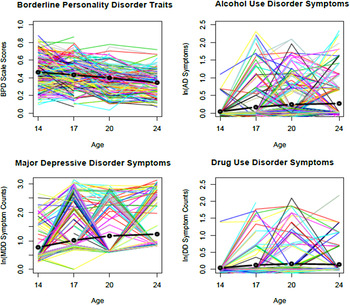
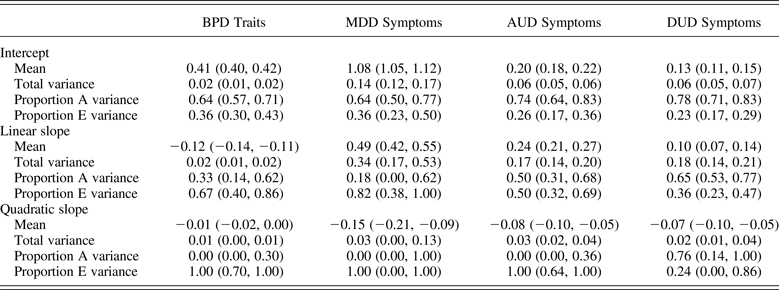
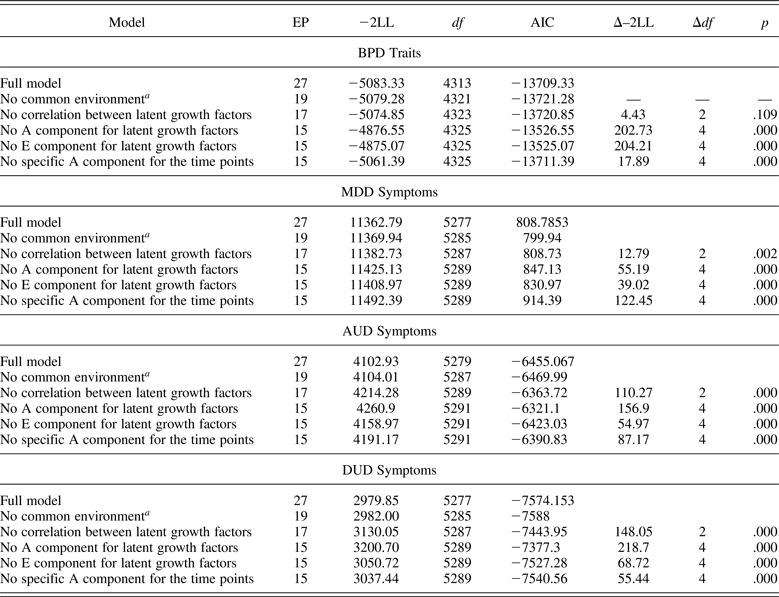
Descriptive statistics for all of the variables, such as means, standard deviations, and twin correlations by zygosity for all phenotypes and ages are reported in Table 1. We present the means, variances, and proportion of additive genetic and unique environmental variance of the latent growth factors for each phenotype in Table 2, and a spaghetti plot of the trajectories of each phenotype in Figure 2. Consistent with our previous report, the negative slope for BPD traits indicated that trait BPD significantly decreased from ages 14 to 24 (Bornovalova et al., Reference Bornovalova, Hicks, Iacono and McGue2009). In contrast, MDD, AUD, and DUD symptoms all had positive linear slopes, indicating that on average there was an increase in symptoms for each disorder from ages 14 to 24. Biometric model fitting (Table 3) indicated that the best fitting biometric models included only genetic and nonshared environmental components for the latent growth factors and residual variances of each phenotype at each assessment. The results from the biometric variance decompositions (Table 4) revealed that the intercept of each phenotype was highly heritable (0.64 to 0.78) with small to medium nonshared environmental influences (0.36 to 0.22). The linear slope for BPD traits and AUD and DUD symptoms exhibited significant genetic influences (0.33 to 0.65), while the linear slope for MDD symptoms was mostly determined by nonshared environment influences (0.82). Finally, although the quadratic variance component did not have sufficient variation to reliably decompose into genetic and environmental influences, it improved model fit and was subsequently retained in all models.Footnote 2
(Color online) Predicted growth trajectories for borderline personality disorder traits, major depressive disorder symptoms, alcohol use disorder symptoms, and drug use disorder symptoms. Each point in the graphs represent expected means for the respective phenotype, while the black lines depict mean trajectories. The surrounding lines are 250 randomly sampled individuals from the data set that illustrate variability around the mean trajectory. Major depressive disorder, alcohol use disorder, and drug use disorder symptom variables underwent a log + 1 transformation for all analyses, and log-transformed data are plotted above. The Minnesota Borderline Personality Disorder Scale (MBPD) was recoded to range between 1 (maximum possible score) and 0 (minimum possible score): (MBPD individual score-min) (max-min) = ([MBPD individual score – 19]/57).

Model predicted means and total variances and standardized genetic and unique environmental variance components of BPD traits, MDD symptoms, AUD symptoms, and DUD symptoms for the univariate phenotypes
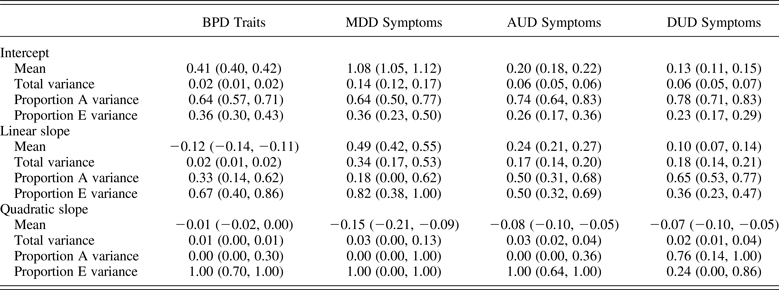
Note: BPD, borderline personality disorder traits; MDD, major depressive disorder symptoms; AUD, alcohol use disorder symptom; DUD, drug use disorder. All symptom counts were subjected to a log transformation [log(x + 1)] to reduce skew and kurtosis. To aid with model fitting, The Minnesota Borderline Personality Disorder Scale (MBPD) was recoded to range between 1 (maximum possible score) and 0 (minimum possible score) [(MBPD individual score-min) (max-min) = (MBPD individual score – 19)/57). Accordingly, the intercept can be interpreted as the level (form 0 to 1), and the slope can be interpreted as the percentage change over the 10-year interval.
Biometric model fitting results for the univariate latent growth models for BPD traits, MDD symptoms, AUD symptoms, and DUD symptoms
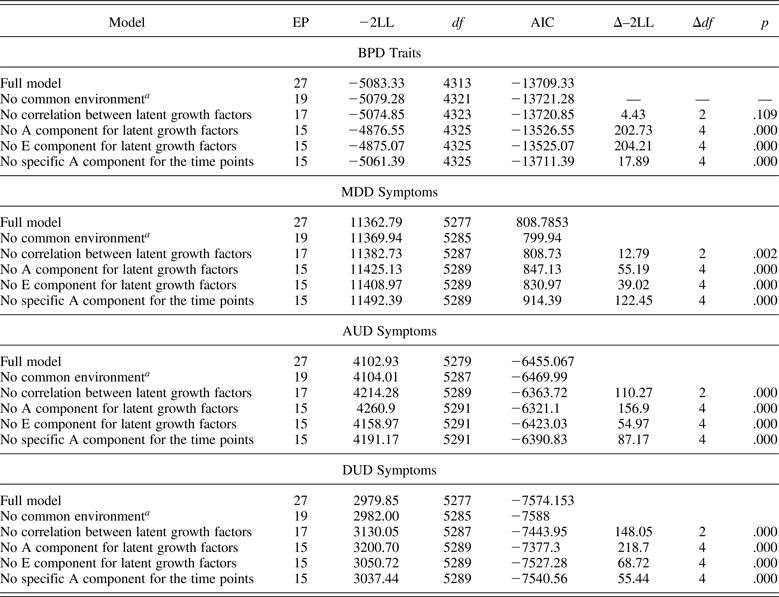
Note: BPD, borderline personality disorder traits; MDD, major depressive disorder symptoms; AUD, alcohol use disorder symptom; DUD, drug use disorder; EP, estimated parameters; –2LL, –2 log likelihood; AIC, Akaike information criterion.
a Because the common environment did not significantly contribute to variation in any of the phenotypes, it was dropped from the analysis. Accordingly, the no common environment model is the model against which subsequent reduced models were tested, and it was always the best fitting model.
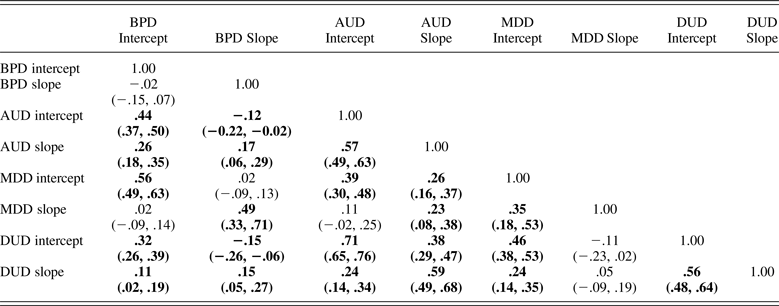
Total correlations between the latent growth parameters for BPD traits, MDD symptoms, AUD symptoms, and DUD symptoms
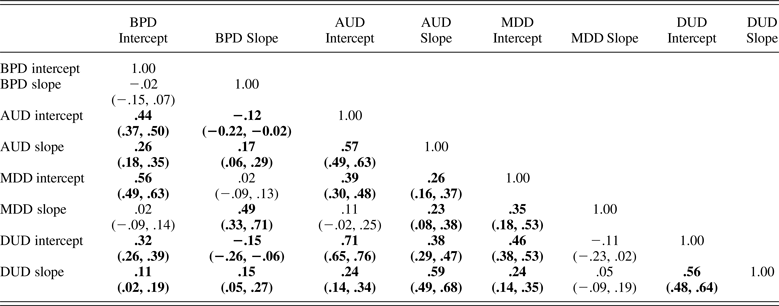
Note: BPD, borderline personality disorder traits; MDD, major depressive disorder symptoms; AUD, alcohol use disorder symptom; DUD, drug use disorder. Key relationships of interest between BPD intercept and slope and the intercept and slope of MDD, AUD, and DUD are in the second and third columns. All significant relationships are in bold.
Cross-phenotype biometric latent growth parameters
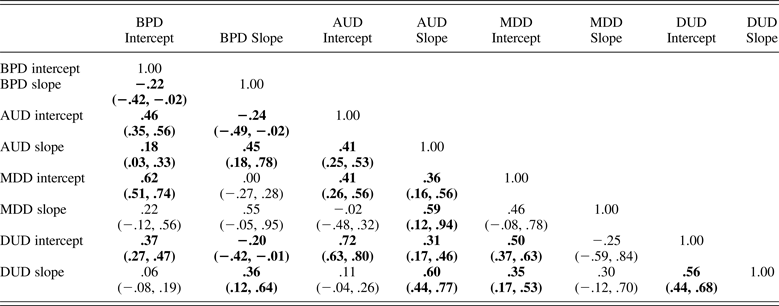
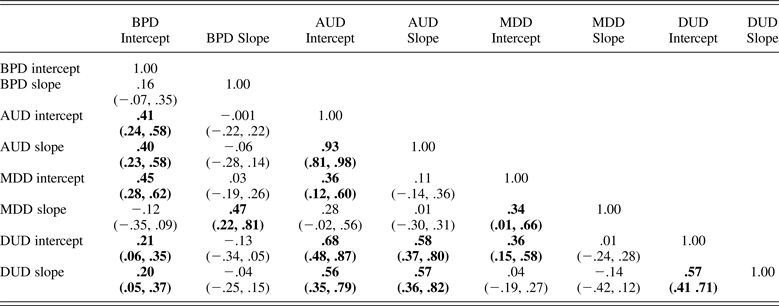
Table 5 presents the phenotypic correlations, Table 6 presents the additive genetic correlations, and Table 7 presents the unique environmental correlations for the growth parameters across the four phenotypes. Because we focused on the relationship between BPD traits and the three other phenotypes, the first two columns of Tables 5–7 are of primary interest. The other columns speak to broader codevelopment of MDD, AUD, and DUD symptoms.
Genetic correlations between the latent growth parameters for BPD traits, MDD symptoms, AUD symptoms, and DUD symptoms
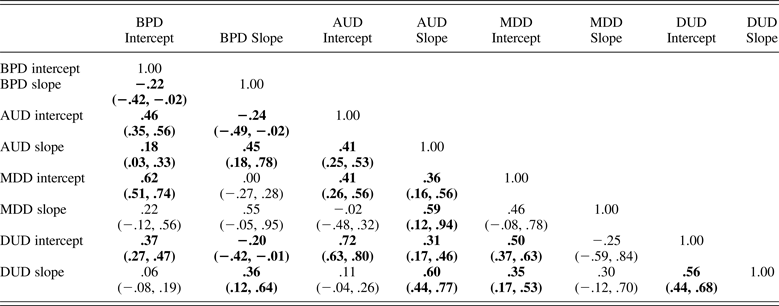
Note: BPD, borderline personality disorder traits; MDD, major depressive disorder symptoms; AUD, alcohol use disorder symptom; DUD, drug use disorder. Key relationships of interest between BPD intercept and slope and the intercept and slope of MDD, AUD, and DUD are in the second and third columns. All significant relationships are in bold.
Nonshared environmental correlations between the latent growth parameters for BPD traits, MDD symptoms, AUD symptoms, and DUD symptoms
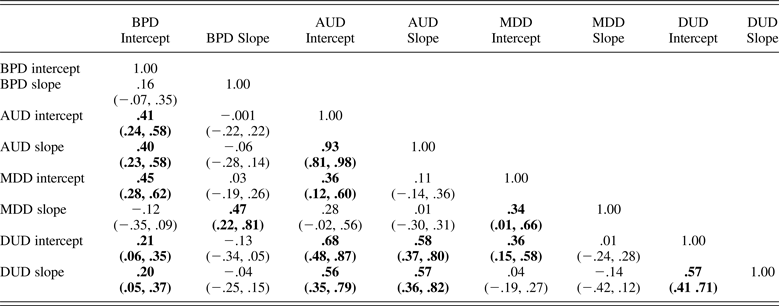
Note: BPD, borderline personality disorder traits; MDD, major depressive disorder symptoms; AUD, alcohol use disorder symptom; DUD, drug use disorder. Key relationships of interest between BPD intercept and slope and the intercept and slope of MDD, AUD, and DUD are in the second and third columns. All significant relationships are in bold.
Evidence for common cause
Consistent with the common cause model, the BPD trait intercept was significantly correlated with the intercepts for MDD, AUD, and DUD symptoms, indicating that those with higher BPD trait levels tended to experience more symptoms of MDD, AUD, and DUD. The intercept for BPD traits showed significant genetic and moderate nonshared environmental correlations with the intercepts of MDD, AUD, and DUD symptoms (Tables 5 and 6), indicating greater genetic relative to environmental overlap between BPD traits and the other phenotypes. A similar pattern was evident for MDD, AUD, and DUD symptoms: the intercepts were significantly correlated with each other, and evidenced similar pattern of genetic and environmental covariation.
Next, the linear slope for BPD traits was correlated with the linear slopes for MDD, AUD, and DUD symptoms. This indicates that after accounting for the average level, greater increases in symptoms of MDD, AUD, and DUD were associated with a slower decline in BPD traits. Alternatively, this could be stated as the smaller the increase in symptoms of MDD, AUD, and DUD, the greater the decline in BPD traits. The genetic correlation between the slopes was significant and of moderate effect, while the nonshared environmental correlations were not significant, with one notable exception. The nonshared environmental correlation between BPD trait slope and MDD symptom slope was moderate (0.47) and significant. No other nonshared environmental correlations approached significance. Therefore, genetic influences primarily accounted for the associations between the linear slopes of BPD traits and AUD and DUD symptoms. In contrast, nonshared environmental influences primarily accounted for the association between the linear slopes of BPD traits and MDD symptoms. With respect to other phenotypes, MDD symptom slope predicted AUD but not DUD symptom slope. This relationship was accounted for by overlapping genetic factors, with no significant evidence for nonshared environmental overlap. AUD and DUD symptom slopes were significantly correlated, showing strong and roughly equal influences of common genetic and nonshared environmental factors.
Evidence for pathoplasty
The intercept for BPD traits was correlated with the linear slope of AUD and DUD symptoms, but not MDD symptoms. Consistent with the pathoplasty hypothesis, individuals who had higher levels of BPD traits increased in AUD and DUD symptoms more rapidly. Furthermore, the nonshared environmental correlations between BPD trait intercept and the linear slopes of AUD and DUD symptoms were significant and contributed more to the covariance than genetic factors. The linear slope for BPD traits was negatively correlated with the intercepts of AUD and DUD symptoms, and unrelated to the MDD symptoms intercept. This indicates that individuals with more AUD and DUD symptoms were associated with a slower rate of decline in BPD traits, even after adjusting for the average trait level. The associations between the linear slope of BPD traits and the intercepts of AUD and DUD symptoms were almost entirely due to genetic influences. As for the other phenotypes, the MDD symptom intercept was positively correlated with AUD and DUD symptom slope (but not vice versa), with this relationship accounted for solely by genetic overlap. AUD symptom intercept was correlated with DUD symptom slope (and vice versa), with somewhat more robust nonshared environmental than genetic overlap. Taken together, the slope–intercept correlations across all four phenotypes suggest that an individual's comorbid psychopathology is associated with the trajectory of other maladaptive traits.
Discussion
Using a large, longitudinal twin sample, we conducted the first study to investigate the genetic and environmental influences on the codevelopment between BPD traits and MDD, AUD, and DUD symptoms from middle adolescence to young adulthood. Previous studies have reported that BPD traits tend to decline over time, and that declines in BPD traits are associated with declines in the symptoms of comorbid disorders (Bornovalova et al., Reference Bornovalova, Hicks, Iacono and McGue2009; Gunderson et al., Reference Gunderson, Stout, Sanislow, Shea, McGlashan, Zanarini and Skodol2008; Lenzenweger, Reference Lenzenweger1999). Few studies, however, have considered the developmental context of the associations between BPD traits and symptoms of other disorders, specifically during a period when there are dramatic changes in the mean levels of BPD traits, MDD, AUD, and DUD symptoms, allowing for hypotheses about developmental processes that might contribute to these associations. Next, no study has examined the genetic and environmental influences on the codevelopment between BPD traits and symptoms of other disorders. Finally, the current paper simultaneously modeled the total, genetic, and nonshared environmental correlations between BPD traits, MDD, AUD, and DUD symptoms. The results from this model align the current paper with the broader models within developmental psychopathology that suggest that disorders rarely develop discretely and independently. Rather, there is an interdependence and interaction among multiple forms of psychopathology that necessitate a whole-organism approach.
In terms of developmental change, we replicated previous epidemiological findings that BPD traits decreased, while symptoms of MDD, AUD, and DUD increased from ages 14 to 24 (Chen & Jacobson, Reference Chen and Jacobson2012; Dussault, Brendgen, Vitaro, Wanner, & Tremblay, Reference Dussault, Brendgen, Vitaro, Wanner and Tremblay2011). The decline in BPD traits was consistent with longitudinal research on normal personality development that finds large declines in negative emotionality and behavioral disinhibition during the transition from adolescence into young adulthood (Johnson et al., Reference Johnson, Cohen, Kasen, Skodol, Hamagami and Brook2000; Roberts, Walton, & Viechtbauer, Reference Roberts, Walton and Viechtbauer2006). Our findings suggest similar maturational processes may contribute to age-related declines in BPD traits.
The current results support two models of comorbidity: the common cause model and the pathoplasty models. For common cause, we detected medium to large associations between (a) the average level of BPD traits and the average levels of the other disorders and (b) changes in BPD traits and changes in other disorders associations. Consistent with previous work (Distel et al., Reference Distel, Trull, de Moor, Vink, Geels, van Beek and Boomsma2012; James & Taylor, Reference James and Taylor2008; Kendler et al., Reference Kendler, Aggen, Knudsen, Røysamb, Neale and Reichborn-Kjennerud2011), these associations were primarily due to genetic influences. Beyond BPD, there were large genetic correlations between MDD, AUD, and DUD as well. The data suggest that there are transdiagnostic, heritable influences (e.g., temperament traits) that contribute to the average level as well as the covariation in change of BPD traits, MDD, AUD, and DUD symptoms from ages 14 to 24.
It is important to note that correlated rates of change provide especially strong evidence of a common cause model, suggesting that a similar process is affecting fluctuations in both BPD traits and symptoms of other psychopathology. There was substantial genetic and environmental overlap between the intercepts and slopes among BPD traits, AUD, DUD, and MDD symptoms, which is also consistent with a common cause model. It was interesting that genetic influences primarily accounted for the correlated changes between BPD traits and AUD and DUD symptoms, while environmental influences primarily accounted for the correlated changes between BPD traits and MDD symptoms. In addition, the correlations between the slope for BPD traits and the changes in AUD and DUD symptoms were small, while the correlation between the slope of BPD traits and MDD symptoms was large. Consistent with previous cross-sectional reports (Kendler et al., Reference Kendler, Aggen, Knudsen, Røysamb, Neale and Reichborn-Kjennerud2011), common nonshared environmental factors also accounted for the correlated slopes between BPD traits and MDD symptoms. The large, nonshared environmental correlation stands in contrast to the moderate to large genetic correlations between the growth parameters for BPD traits and AUD and DUD symptoms, and suggests that a markedly different process is driving the correlated rates of change between BPD traits and MDD symptoms. While complex processes involving both genetic and environmental factors likely contribute to the codevelopment of BPD traits and symptoms of commonly comorbid psychopathology, it is possible that environmental experiences (e.g., stressful life events or changes in relationships) have more pronounced effects on correlated changes in both BPD traits and MDD symptoms, with more gradual maturational changes in heritable characteristics (e.g., behavioral disinhibition) accounting for the majority of correlated changes between BPD traits and AUD and DUD symptoms.
On a broader level, the genetic correlations among the multiple forms of psychopathology are consistent with recent findings from molecular genetic research (Lichtenstein, Carlstrom, Rastam, Gillberg, & Anckarsater, Reference Lichtenstein, Carlstrom, Rastam, Gillberg and Anckarsater2010; Maier et al., Reference Maier, Moser, Chen, Ripke, Coryell and Potash2015). The cross-disorder group from the Psychiatric Genetics Consortium, for instance, reported that some genetic risk factors seem to be shared across multiple disorders (attention-deficit/hyperactivity disorder, autism spectrum disorder, bipolar disorder, MDD, and schizophrenia; Smoller et al., Reference Smoller, Craddock, Kendler, Lee, Neale and Nurnberger2013). Like previous work, our results provide support for the common cause and pathoplasty models across multiple forms of psychopathology. However, unlike existing molecular genetic work, we were able to model longitudinal relationships. This allowed us to begin disentangling common cause and pathoplasty at a finer level.
Given our results, an obvious question concerns identification of the common causes underlying the codevelopment between BPD traits and symptoms of other disorders. One possibility is common genetic variants influence both disorders, a possibility that should be explored in the cross-disorder group of the Psychiatric Genetics Consortium. As briefly alluded to above, a likely answer is that broad neurobehavioral processes such as negative emotionality, rejection sensitivity, emotional dysregulation, or behavioral disinhibition have nonspecific effects and contribute to a diverse set of phenotypes including internalizing and externalizing disorders (Beauchaine, Gatzke-Kopp, & Mead, Reference Beauchaine, Gatzke-Kopp and Mead2007; Iacono et al., Reference Iacono, Carlson, Taylor, Elkins and McGue1999; Lenzenweger, Reference Lenzenweger2010; Lilienfeld, Reference Lilienfeld2003; Silk, Steinberg, & Morris, Reference Silk, Steinberg and Morris2003; Young et al., Reference Young, Friedman, Miyake, Willcutt, Corley, Haberstick and Hewitt2009). With regard to behavioral disinhibition, the literature clearly documents elevated impulsivity in patients with BPD, AUD, and DUDs (Lee, Bagge, Schumacher, & Coffey, Reference Lee, Bagge, Schumacher and Coffey2010; Links, Heslegrave, Mitton, Vanreekum, & Patrick, Reference Links, Heslegrave, Mitton, Vanreekum and Patrick1995; Wilson, Fertuck, Kwitel, Stanley, & Stanley, Reference Wilson, Fertuck, Kwitel, Stanley and Stanley2006), suggesting that the latter serves as a process common to the two disorders (Bornovalova, Lejuez, Daughters, Rosenthal, & Lynch, Reference Bornovalova, Lejuez, Daughters, Rosenthal and Lynch2005; Trull, Sher, Minks-Brown, Durbin, & Burr, Reference Trull, Sher, Minks-Brown, Durbin and Burr2000).
Common neurobiological changes throughout development may account for the correlated slopes between BPD traits and AUD and DUD symptoms. Developmental imaging studies suggest that the brain systems governing the socioemotional, cognitive, and decision-making processes that contribute to disinhibited behavior exhibit dramatic remodeling during middle and late adolescence (Spear, Reference Spear2010; Wahlstrom, White, & Luciana, Reference Wahlstrom, White and Luciana2010). Distinct changes in adolescent neural processing of social and emotional information are thought to impact the functioning of the prefrontal cortex and subsequent self-regulation of motivational states and impulsive behavior (Ernst & Fudge, Reference Ernst and Fudge2009; Spear, Reference Spear2010; Steinberg, Reference Steinberg2007). Of note, development of these networks involves changes in the amygdala, nucleus accumbens, orbitofrontal cortex, medial prefrontal cortex, and superior temporal sulcus (Nelson, Leibenluft, McClure, & Pine, Reference Nelson, Leibenluft, McClure and Pine2005) that occur at the same time as a dramatic remodeling of the dopaminergic neural reward system (Spear, Reference Spear2000; Wahlstrom et al., Reference Wahlstrom, White and Luciana2010). The reward system also shows enhanced responsivity to anticipating and receiving rewards of disinhibited behavior in adolescence relative to adulthood (Bjork et al., Reference Bjork, Knutson, Fong, Caggiano, Bennett and Hommer2004; Ernst & Fudge, Reference Ernst and Fudge2009; Geier, Terwilliger, Teslovich, Velanova, & Luna, Reference Geier, Terwilliger, Teslovich, Velanova and Luna2010; Joseph, Liu, Jiang, Lynam, & Kelly, Reference Joseph, Liu, Jiang, Lynam and Kelly2009). Structural and functional variability in these systems has been documented cross-sectionally in BPD, AUDs, and DUDs (Bowirrat & Oscar-Berman, Reference Bowirrat and Oscar-Berman2005; Everitt & Robbins, Reference Everitt and Robbins2005; Friedel, Reference Friedel2004; Hyman, Malenka, & Nestler, Reference Hyman, Malenka and Nestler2006; Kelley & Berridge, Reference Kelley and Berridge2002; Koob, Reference Koob1992; Makris et al., Reference Makris, Oscar-Berman, Jaffin, Hodge, Kennedy, Caviness and Harris2008; Wrase et al., Reference Wrase, Schlagenhauf, Kienast, Wustenberg, Bermpohl, Kahnt and Heinz2007). Competition between the socioemotional and cognitive control systems (Drevets & Raichle, Reference Drevets and Raichle1998), altered timing in the maturation of these systems (Steinberg, Reference Steinberg2007), or incomplete functional integration of neural signals implicated in the socioemotional and cognitive control systems (Stevens, Reference Stevens2009) may be driving the correlated changes in BPD, AUD, and DUD. While the latter notion is speculative, data from large, epidemiological projects that include imaging (e.g., Adolescent Brain and Cognitive Development and the National Consortium on Alcohol and Neurodevelopment in Adolescence) will be able to test it empirically.
Several findings were also consistent with the pathoplasty model. Average levels of BPD traits were associated with greater increases in AUD and DUD symptoms, suggesting that BPD traits increase the likelihood of a transition from use to problem use and the escalation of AUD and DUD symptoms. Likewise, AUD and DUD symptoms were associated with a slower decline in BPD traits, suggesting substance use disorder symptoms disrupt maturational processes and contribute to the persistence of BPD traits. This result is consistent with other studies of BPD comorbidity in adolescence and adulthood (Burke & Stepp, Reference Burke and Stepp2012; Rohde, Lewinsohn, Kahler, Seeley, & Brown, Reference Rohde, Lewinsohn, Kahler, Seeley and Brown2001; Zanarini, Frankenburg, Hennen, et al., Reference Zanarini, Frankenburg, Hennen, Reich and Silk2004). For instance, Zanarini, Frankenburg, Hennen, et al. (Reference Zanarini, Frankenburg, Hennen, Reich and Silk2004) reported that the absence of substance use disorders at a 6-year follow-up was the strongest predictor of the remission of BPD in patients diagnosed with BPD.
In addition, pathoplasty was evident for symptoms of MDD on AUD and DUD symptoms. That is, higher mean levels of MDD symptoms were associated with greater increases in symptoms of AUD and DUD. This association was not reversed; that is, greater mean levels of AUD and DUD symptoms were not associated with changes in MDD symptoms. Prior work has provided mixed evidence on the temporal ordering of MDD and substance use problems, with some studies reporting that drug and alcohol use predicts MDD levels (Bovasso, Reference Bovasso2001; Rohde et al., Reference Rohde, Lewinsohn, Kahler, Seeley and Brown2001; Stice, Burton, & Shaw, Reference Stice, Burton and Shaw2004), others that MDD symptoms predict substance use symptoms (Abraham & Fava, Reference Abraham and Fava1999), and still others reporting reciprocal relationships (Hettema, Prescott, & Kendler, Reference Hettema, Prescott and Kendler2003). Differences in sample composition and measurement approaches may account for many of the disparities. Our results suggest that unipolar mood symptoms are indicative of a more severe and persistent course of AUDs and DUDs.
When examining the evidence for the common cause and the pathoplasty hypotheses, two important observations should be underscored. First, it appears that the evidence for pathoplasty is more associated with unique environmental factors, while the evidence for common cause is more associated with common/shared genetic factors, with the notable exception of the MDD intercept correlations with AUD and DUD linear slopes. Second, the magnitudes of the relationships that support the common cause hypothesis are slightly stronger than those that support the pathoplasty hypothesis.
Although unique, these findings are qualified by several limitations. First, nearly all participants were females of European American ancestry, limiting generalizability. BPD has traditionally been investigated in samples of middle to upper class, educated Caucasian females in psychiatric inpatient facilities (Silk, Lee, Hill, & Lohr, Reference Silk, Lee, Hill and Lohr1995; Zanarini, Frankenburg, Khera, & Bleichmar, Reference Zanarini, Frankenburg, Khera and Bleichmar2001; Zanarini et al., Reference Zanarini, Yong, Frankenburg, Hennen, Reich, Marino and Vujanovic2002). However, it is possible that BPD–psychopathology relationships may differ across gender and ethnic groups, particularly considering evidence that rates of psychopathology, including personality disorders, differ across racial/ethnic groups (McGilloway, Hall, Lee, & Bhui, Reference McGilloway, Hall, Lee and Bhui2010; Turner & Gil, Reference Turner and Gil2002). Second, the rate of BPD diagnosis is unknown in the current sample. Nevertheless, rates of similar disorders (e.g., antisocial personality disorder) are consistent with large, representative samples (Hamdi & Iacono, Reference Hamdi and Iacono2014). Third, the MBPD scale is a self-report questionnaire (albeit, well validated) that provides a dimensional/trait rather than symptom measure of BPD. In contrast, MDD, AUD, and DUD symptoms were clinician-determined symptom counts. The differences in measurement introduce the potential concern of method effect that is not accounted for in the data, and likely reduces the effect sizes between BPD traits and the disorders given the different method of measurement. While interviews are often assumed to be superior to questionnaire measures, there is limited evidence for the incremental validity of one method over the other, though each approach has particular strengths and weaknesses (Hopwood et al., Reference Hopwood, Morey, Edelen, Shea, Grilo, Sanislow and Skodol2008). The current study should be replicated using a multimethod (i.e., trait- and interview-based measures) approach. Finally, the current study was not set up to arbitrate between common cause and pathoplasty hypotheses (although the two may operate simultaneously).
Together, our results are indicative of meaningful codevelopmental processes between BPD traits and MDD, AUD, and DUD symptoms. Moreover, our results further highlight the construct validity of the MBPD. The availability of a quantitative and dimensional measure of BPD traits that can be applied in a general population sample will further bridge the gap between psychopathology and normal behavior, a perspective consistent with the National Institute of Mental Health's Research Domain Criteria framework (Insel et al., Reference Insel, Cuthbert, Garvey, Heinssen, Pine, Quinn and Wang2010). Our results set the stage for several future studies. The most apparent follow-up study would investigate temperamental and environmental processes that account for the genetic and environmental correlations between BPD traits and MDD, AUD, and DUD symptoms. One approach is to test if there is a corresponding reduction in the genetic correlation between BPD traits and AUD symptoms after accounting for a preexisting vulnerability (e.g., behavioral disinhibition). Next, this work should be replicated in another sample, preferably using a multimethod approach to the measurement of psychopathology. Likewise, this study should be replicated using males and more diverse samples. Finally, there is a clear need to extend these models of comorbidity into middle and late adulthood, as there is a clear drop-off in our understanding of BPD comorbidity past middle adulthood. Exploration of these questions will provide further insight into etiological influences on BPD and its comorbidity with other psychopathology throughout the life span.